
Think of Salesforce Marketing Cloud as the central nervous system for your customer engagement. Instead of juggling a dozen different tools for email, social media, advertising, and mobile messaging, this platform brings everything under one roof. The core business goal is to help you truly understand each customer and then deliver the right message at the right time, on whatever channel they happen to be using, creating a seamless customer experience.
Understanding the Core Purpose of Marketing Cloud
At its heart, Salesforce Marketing Cloud is designed to solve one of the biggest challenges in modern business: scattered and disconnected customer data. For most companies, the business challenge is that customer information lives in silos. Purchase history is in one system, service tickets are in another, and website activity is somewhere else entirely. This data fragmentation makes it almost impossible to deliver a consistent or personal brand experience.
The Salesforce solution is a platform built to tear down those walls. It creates a single, unified view of every customer by pulling scattered data into one central hub. Suddenly, you have a complete picture of every interaction. This is the key to moving beyond generic, "one-size-fits-all" campaigns and starting to create cohesive customer journeys that feel genuinely personal and solve real-world business problems.
As a trusted Salesforce partner, we've seen firsthand how this platform helps businesses switch from disjointed marketing efforts to highly coordinated, personalised experiences that build real loyalty and drive measurable growth.
To give you a clearer picture, here’s a quick breakdown of how its core capabilities address common business challenges.
Salesforce Marketing Clouds at a Glance
| Core Capability | Primary Business Goal | Example Use Case |
|---|---|---|
| Email Studio & Journey Builder | Nurture leads and customers with automated, personalised email campaigns. | A retail brand sends an automated "welcome" series to new subscribers, followed by targeted promotions based on their browsing history. |
| Social Studio | Monitor and engage with customers across major social media platforms. | A travel company tracks brand mentions on Twitter and can respond instantly to customer queries or feedback. |
| Advertising Studio | Create targeted digital advertising campaigns using your CRM data. | A B2B firm uses its customer data to run highly specific lookalike ad campaigns on LinkedIn to find new leads. |
| Mobile Studio | Communicate with customers via SMS, push notifications, and group messaging. | An airline sends real-time flight delay notifications and gate changes directly to passengers' phones via SMS. |
| Interaction Studio | Deliver real-time, one-to-one personalisation on your website and app. | An e-commerce site shows product recommendations that change instantly as a visitor clicks on different items. |
Ultimately, this unified approach allows for smarter, more effective marketing that drives digital transformation and improves the customer experience.
From Disparate Channels to Unified Journeys
The platform makes this happen through powerful automation. To really get your head around these features, it helps to understand the big idea behind marketing clouds, which is explained perfectly in this guide on What Is Marketing Automation? A Simple Explainer. By setting up automated workflows, you can ensure the right message gets to the right person at the right time, triggered by their specific actions.
This proactive, data-driven approach is solving real-world business problems for companies across Australia. The key benefits and results we see in our projects are:
- Consistent Brand Messaging: Ensures every communication, from an email to a social media post, feels like it’s coming from your brand.
- Data-Driven Decision Making: Delivers clear analytics, so you can measure what’s working and fine-tune your strategy.
- Enhanced Customer Loyalty: Builds stronger relationships by showing customers you understand their individual needs.
- Increased Operational Efficiency: Automates repetitive marketing tasks, freeing up your team to focus on strategy and creativity.
It's no surprise that its popularity is growing. In Australia alone, over 315 companies are actively using Salesforce Marketing Cloud across a huge range of industries, from tech and finance to retail and beyond.
Inside the Marketing Cloud Toolkit: Key Salesforce Features
Salesforce Marketing Cloud isn't just one product; it’s a powerful suite of specialised tools, each built to handle a different piece of the customer communication puzzle. Instead of getting bogged down in technical names, it’s far more useful to think about what each component actually does for your business.
The whole idea is to move beyond disconnected campaigns and start building intelligent, automated customer experiences. This infographic captures the main goals: unifying your data, personalising interactions, and automating engagement across the board.
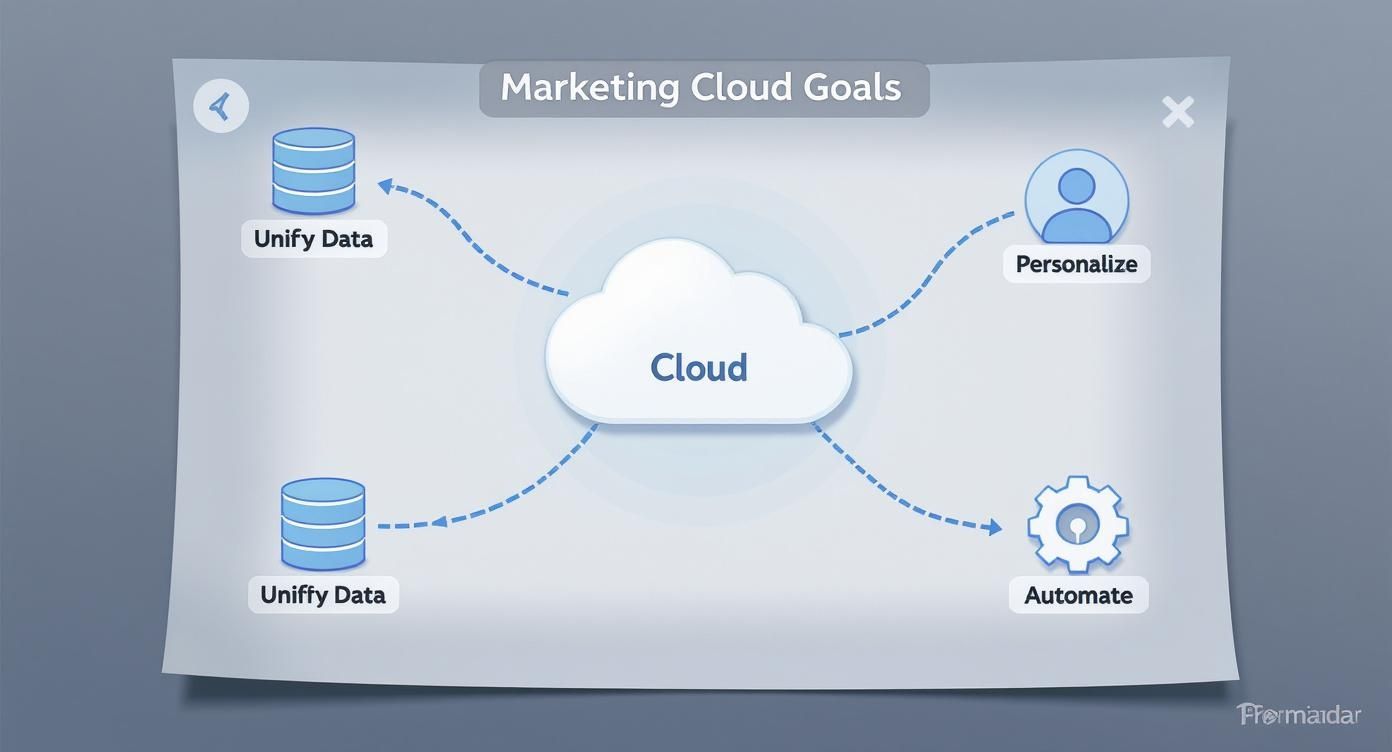
As you can see, every function within the platform serves these three foundational pillars to create a marketing strategy that delivers results.
The Storyteller: Journey Builder
Right at the heart of the toolkit is Journey Builder. Think of it as the architect of your customer's experience. This is where you map out every step a customer takes with your brand, from the second they sign up for a newsletter to a post-purchase follow-up and long-term loyalty campaigns.
For instance, a new subscriber could get a welcome email on day one, a special offer on day three if they haven't bought anything, and an invite to follow you on social media on day seven. Journey Builder automates this entire sequence based on what the customer does (or doesn't do), ensuring no one falls through the cracks. It’s a proactive way to guide customers and build real relationships over time.
The Direct Communicator: Email Studio
Working hand-in-hand with Journey Builder is Email Studio. This is your direct communication engine, letting you design, build, and send highly personalised emails at scale. Forget generic email blasts; this tool taps into your rich CRM data to slot in dynamic content, like a customer's name, their last purchase, or recommendations based on their browsing history.
That level of personalisation makes your messages far more relevant and seriously boosts engagement. While Journey Builder maps the path, Email Studio is what delivers the specific, tailored messages along the way. For businesses focused on lead nurturing, getting these distinctions right is crucial. You can dive deeper into this with the insights in our guide on Account Engagement best practices.
Reaching Customers Everywhere Else
Of course, marketing isn't just about email. The toolkit includes other essential pieces for reaching customers on the channels they actually use.
- Mobile Studio lets you connect with people on the go through SMS and push notifications. It's perfect for time-sensitive updates, like appointment reminders or flash sale alerts.
- Advertising Studio closes the loop between your marketing and advertising. It lets you use your valuable first-party CRM data to find new audiences on platforms like Google, Facebook, and LinkedIn. You can create super-targeted ad campaigns that reach people who look just like your best customers.
When you put them all together, these tools form an interconnected system. A customer's journey might kick off with an ad, lead to an email sign-up, continue with a welcome series, and even include a follow-up SMS. This integrated approach is what makes Salesforce Marketing Cloud the central hub for modern customer engagement.
How Businesses Drive Real Results with Salesforce Marketing Clouds
Understanding the tools inside Salesforce Marketing Cloud is one thing, but seeing them deliver real-world results is where the value becomes clear. This is where theory is put to the test, and businesses across industries use the platform to tackle their biggest customer engagement challenges.
These aren't just fuzzy benefits; we're talking about tangible returns that directly impact the bottom line. As a Salesforce partner, we've had a front-row seat, helping organisations shift from guesswork to data-backed strategies, turning their marketing spend from a cost centre into a predictable source of revenue.
Case Study Example: From Abandoned Carts to Completed Sales
For any e-commerce business, the abandoned cart is a classic business challenge. A customer is close to buying—they’ve added items and shown clear intent—but then they vanish. This is the perfect moment for Journey Builder to step in and recover that potential lost revenue.
Here's how we implement a Salesforce solution for this problem:
- Within an hour of cart abandonment, an initial reminder email lands in their inbox, showing the exact items they left behind.
- If 24 hours pass with no action, a second email could offer a small incentive, like free shipping.
- For a high-value cart, the journey could even trigger a final SMS to grab their attention.
The result is a straightforward, automated flow that can significantly boost conversion rates, turning a common frustration into a reliable revenue stream. This is a textbook example of how Salesforce Marketing Cloud directly translates into more sales.
Case Study Example: Creating Seamless Onboarding Experiences
The first few interactions after a customer signs up are crucial, especially in industries like financial services or SaaS. A clunky, impersonal onboarding process can create doubt, but a smooth, guided one builds confidence and sets the stage for a long-term relationship.
Here's a Salesforce solution for a financial services firm: as soon as a client signs up, they’re automatically placed into a journey that:
- Sends a personalised welcome email from their dedicated advisor.
- Drips out educational content over the next few weeks, explaining how to use their online portal.
- Schedules automated check-in messages to ensure they feel supported.
This kind of structured, personal communication makes new clients feel valued from day one, which is huge for customer satisfaction and long-term retention. It’s a lesson learned from many projects: build loyalty right from the very start.
This focus on sophisticated customer relationship management is a key reason for the platform's incredible growth in Australia. The region's leadership in the global market for Salesforce services shows a real appetite for these powerful solutions. In fact, research points to Australia and New Zealand being on track for a 19.1% compound annual growth rate in this space through 2035, highlighting just how much value businesses see in these platforms. You can read the full research on Salesforce services adoption to learn more.
These are just a couple of examples of what's possible. To see more real-world applications, take a look at our in-depth Salesforce case studies. Each one tells a story of how the right strategy, powered by the right technology, leads to measurable business success.
Connecting Marketing with Sales Cloud and Service Cloud
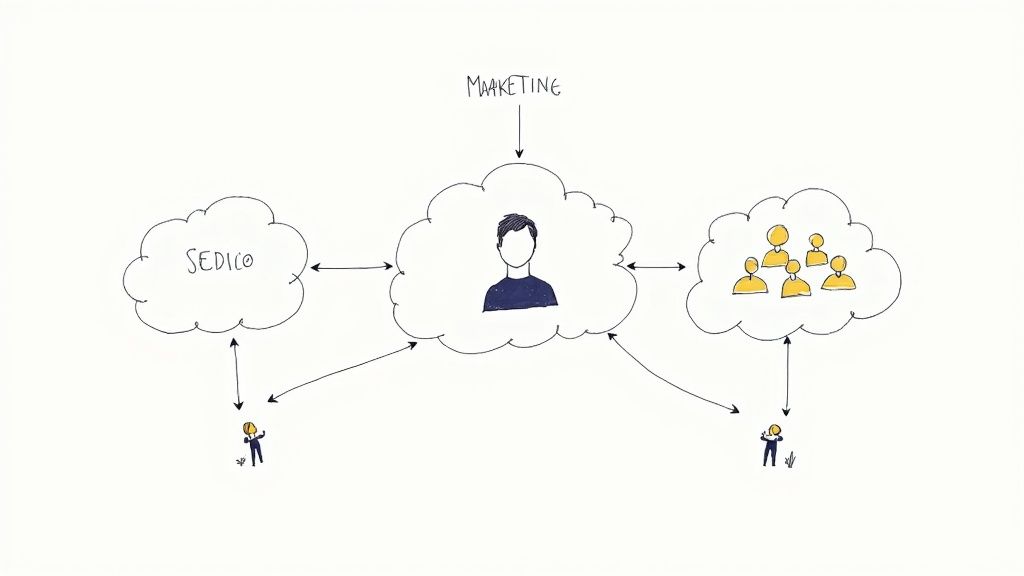
Salesforce Marketing Cloud is a powerful platform on its own, but its true potential is unlocked when you connect it to the rest of your Salesforce ecosystem. When it shares data seamlessly with Sales Cloud and Service Cloud, its value multiplies. This integration is how you break down the traditional walls between your marketing, sales, and customer service departments.
Instead of operating in isolated bubbles, your teams start working from a single, unified view of every customer. This shared intelligence creates a level of consistency and personalisation that simply isn't possible with disconnected systems. It’s the difference between a fragmented conversation and a truly seamless customer experience.
Empowering Sales with Marketing Insights
Imagine your salesperson is about to call a new lead. Without an integrated system, they're often going in blind. But by connecting Marketing Cloud to Sales Cloud, that same salesperson can see the lead’s complete marketing engagement history right on their screen.
This includes every email they’ve opened, every link they’ve clicked, and every webpage they’ve visited. This context is a game-changer. The conversation immediately shifts from a cold call to a highly relevant discussion.
- Smarter Conversations: Your salesperson can reference the whitepaper the lead just downloaded, tailoring their pitch to what the lead actually cares about.
- Prioritised Leads: Sales teams can focus their energy on the most engaged leads—the people actively interacting with your marketing—which massively improves efficiency and conversion rates.
This connection turns your sales team into trusted advisors who understand a prospect's journey before the first "hello."
Creating Proactive Service Experiences
This integration also transforms your customer service operations. When a customer contacts your support team through Service Cloud, that interaction can automatically trigger a personalised follow-up journey in Marketing Cloud. You’re no longer just reactively solving problems; you're proactively building relationships.
One of our key lessons learned is that connecting these platforms creates a feedback loop where every customer interaction—no matter the department—enriches the overall customer profile. This shared data empowers every team to deliver a smarter, more cohesive experience.
For example, after a support case is successfully resolved, an automated journey could:
- Send a follow-up email asking for feedback on their service experience.
- Share a helpful article related to their initial problem, helping prevent future issues.
- Add them to a special list for a loyalty offer a few weeks later.
This simple workflow shows customers you’re paying attention long after the immediate problem is solved. As a Salesforce partner, we specialise in building these vital connections, making sure every part of your organisation works together to create exceptional customer journeys.
Measuring Marketing ROI with Salesforce Marketing Clouds
How do you prove your marketing is worth the investment? This is the critical question for every decision-maker, and Salesforce Marketing Cloud is built to provide a confident answer. Forget vague benefits—this is about tracking concrete business outcomes and drawing a straight line from every campaign right back to the bottom line.
This means you can finally attribute revenue to the new personalised journey you launched, or calculate the efficiency gains from automating tasks. It’s about demonstrating the strategic value of your marketing in the language the C-suite understands: clear, quantifiable results.
Key Performance Indicators That Matter for Your CRM
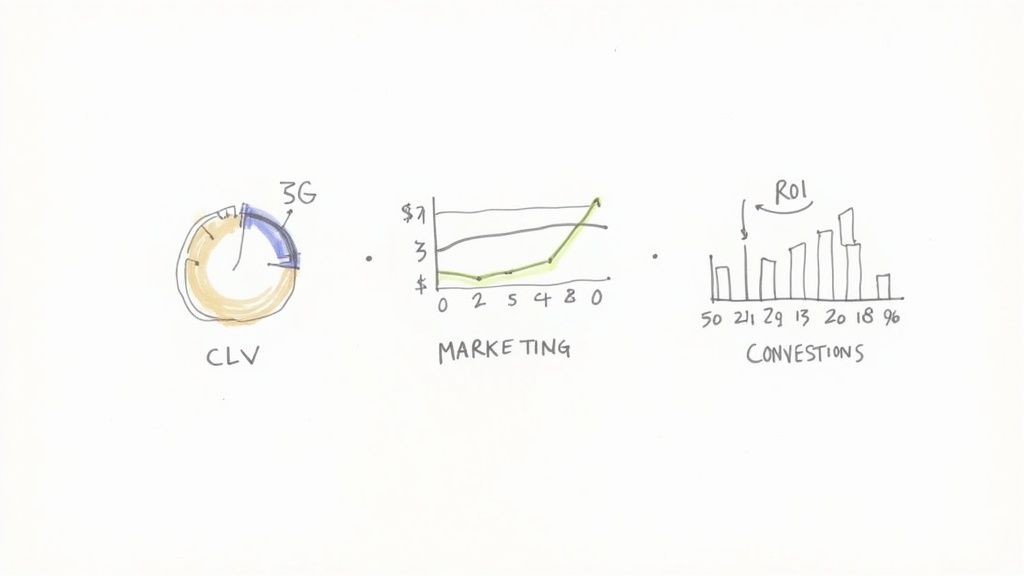
To measure success properly, you need to focus on the key performance indicators (KPIs) that reflect business health. Salesforce Marketing Cloud makes it easier to track these critical numbers, giving you a clear framework for calculating your return on investment (ROI).
Here are the core KPIs that should be on your radar:
- Marketing-Attributed Revenue: The gold standard. It lets you directly connect sales revenue back to specific marketing activities, whether it was an email nurture series or a paid ad.
- Customer Lifetime Value (CLV): By tracking how customers engage and buy over time, you can measure how your marketing efforts are increasing the total value of each customer.
- Conversion Rates: From email opens to landing page submissions, tracking conversions at every stage of the funnel shows you exactly where your strategy is working and where it needs tuning.
These metrics provide the hard data needed to justify your marketing spend and secure the budget for future growth.
Linking Platform Features to Financial Success
The platform's powerful ROI measurement capabilities are a huge reason for its market dominance. In the first half of 2022 alone, Salesforce Marketing Cloud captured a 14.7% share of the global market. We’re seeing this trend in Australia too, where businesses focused on tangible results value its robust tools and integration power.
To truly understand the value, you need to connect the dots between the features you use and the financial outcomes they produce. The table below breaks down how specific platform tools directly impact the KPIs that matter most.
Mapping Marketing Cloud Features to Business ROI
| Marketing Cloud Feature | Primary Business Benefit | Key KPI to Measure |
|---|---|---|
| Journey Builder | Automates personalised customer paths to increase engagement and sales. | Marketing-Attributed Revenue, Conversion Rate |
| Email Studio | Delivers targeted email campaigns to nurture leads and retain customers. | Open Rate, Click-Through Rate, CLV |
| Advertising Studio | Creates synchronised ad campaigns across digital channels. | Cost Per Acquisition (CPA), Ad Spend ROI |
| Datorama Reports | Provides a unified view of all marketing data for better decision-making. | Overall Marketing ROI, Campaign Performance |
| Interaction Studio | Delivers real-time personalisation on web and mobile channels. | On-site Conversion Rate, Average Order Value |
By mapping features to outcomes like this, you build a powerful business case for your investment. It stops being about "sending emails" and starts being about generating measurable revenue and long-term customer value.
As a Salesforce partner, our best practice is to help businesses establish these measurement frameworks from day one. Our goal is to ensure your implementation isn't just technically sound, but strategically aligned to deliver the clear, quantifiable results your organisation needs. For a deeper dive, it's worth understanding how to measure marketing ROI using Salesforce.
Finding the Right Salesforce Partner for Implementation
Getting a Salesforce Marketing Cloud rollout right is about more than just technology. It’s about finding a strategic partner who is invested in your business goals. When choosing who to work with, look beyond basic setup skills. What you need is a team with deep, real-world industry experience and a history of success stories you can see.
A great partner acts as your guide. They'll start by digging deep to understand your unique business challenges, help you create a solid data strategy, and ensure your team gets the training they need to succeed. Their job isn't just to get you live; it's to make sure you're getting maximum value from your investment for years to come through ongoing optimisation.
Why Your Salesforce Partner Matters
A certified partner brings much more than just technical know-how. They bring a collaborative spirit, working side-by-side with your team to ensure the solution is a perfect fit for your specific marketing needs. This partnership is critical for navigating the platform's complexities and unlocking its true potential.
An experienced Salesforce consulting team doesn't just install software; they build a foundation for your business to grow on. We specialise in aligning Salesforce Marketing Cloud with core business objectives, helping organisations like yours turn powerful features into measurable results and a clear return on investment. Let us help you get it right from the start.
Salesforce Marketing Cloud FAQs
When exploring Salesforce Marketing Cloud, it's normal for a few key questions to arise. Getting clear answers is the best way to determine if this powerful platform is the right move for your business. Here are answers to some of the most common questions we hear from decision-makers.
For a wider range of answers, you can also check out our main Salesforce FAQ page.
What is the difference between Marketing Cloud and Account Engagement?
This is a frequent question. The simplest way to frame it is B2C versus B2B.
- Marketing Cloud is primarily designed for B2C engagement. It excels at managing individual customer journeys across a mix of channels—email, mobile, social media, and digital ads. Its strength is handling massive-scale, one-to-one conversations with consumers.
- Account Engagement (formerly Pardot), on the other hand, is built for B2B marketing. It focuses on nurturing leads, scoring their interest, and tightly aligning marketing with sales to manage longer, more complex sales cycles.
How does Marketing Cloud use AI?
Artificial intelligence isn't just a buzzword in Salesforce Marketing Cloud; it's a core component. The platform’s built-in AI, known as Einstein, works behind the scenes to make marketers smarter and more efficient.
Einstein analyzes customer data to predict future actions, like who is most likely to unsubscribe or make a purchase. It also helps optimise your timing by finding the perfect moment to send a message to each individual for the best engagement, and it personalises content on the fly.
What is the learning curve for Marketing Cloud?
Is Marketing Cloud hard to learn? The honest answer is that it's a sophisticated platform with a learning curve. While the interface is user-friendly, unlocking its full power requires a mix of strategic thinking and some technical know-how.
This is exactly where a strategic Salesforce partner makes all the difference. One of our key lessons learned is that proper implementation, tailored team training, and ongoing support are what ensure your people feel confident and can get the most out of the platform from day one.
As a leading Salesforce partner in Australia, Adaptal specialises in helping businesses implement and master Salesforce Marketing Cloud. If you're ready to build exceptional customer journeys and drive measurable results, let's talk about how we can help. Contact Us for a Consultation