

Improving customer satisfaction isn’t about a single action. It's a strategic commitment to understanding and meeting your customer's expectations, powered by a unified CRM. The process starts by connecting your customer data to create the seamless, personalised experiences people now demand. You then use that insight to resolve issues quickly, efficiently, and with the full context of their journey.
Ultimately, exceptional service delivered through a platform like Salesforce is the foundation of loyalty and business growth.
Why Customer Satisfaction Is Your Most Critical CRM Metric
Customer satisfaction is far more than just a performance metric; it's the core engine that drives retention, loyalty, and sustainable growth. In today's competitive landscape, delivering a superior experience through your CRM is non-negotiable.
The cost of a single poor interaction is higher than ever. Customer expectations have shifted towards immediate, personalised, and effortless service. If you fail to deliver, your customers will find a competitor who can.

Here in Australia, we've seen a massive shift in how critical experience has become to retaining loyalty. Recent data reveals that only 6% of Australian consumers continued purchasing after a negative experience in 2024. That’s a sharp decline from 16% in 2019, which tells us customers have become far less tolerant of poor service over the last five years.
The Business Challenge: The Real Cost of Disconnected Experiences
Think about a common challenge we solve for our clients. A national retail business was grappling with disconnected customer data. Their sales, service, and marketing teams operated in silos, each holding a different fragment of the customer story. This created frustrating, repetitive experiences for customers who had to explain their history with every single interaction.
This fragmentation led directly to:
- Increased customer frustration from having to repeat the same information.
- Longer resolution times as agents struggled to track down the right details.
- Missed opportunities for sales and marketing to offer relevant products.
- Declining satisfaction scores and a noticeable drop in customer retention.
A business can't build loyalty on a foundation of disjointed interactions. The first step in knowing how to improve customer satisfaction is admitting you don't have the full picture and committing to building one with a unified CRM.
This is precisely the challenge a platform like Salesforce is designed to solve. By centralising all customer data, you empower every team member with the context needed to deliver seamless, intelligent, and positive experiences. To see the direct impact of satisfied customers and understand their experiences, it’s always powerful to review real-world examples like customer testimonials.
We've seen firsthand how this transformation unfolds. Explore our collection of Salesforce case studies to see how we’ve helped businesses turn fragmented data into exceptional customer journeys.
Building a 360-Degree View of Your Customer in Salesforce
You can't improve satisfaction for a customer you don't really know. It all starts with consolidating every email, phone call, purchase, and support ticket into one actionable profile inside Salesforce. This is the heart of what we, as Salesforce partners, call a 360-degree customer view.
Many businesses operate in silos. Sales knows one part of the story, service knows another, and marketing has its own data. This fragmentation is exactly why customers get frustrated—being asked for the same information repeatedly. Real improvement begins when you start breaking down those internal walls with a shared CRM platform.
By pulling together data from different Salesforce clouds, you create a single source of truth.
- Sales Cloud: Provides the full history of a customer's purchasing journey, including past deals, key contacts, and communication logs.
- Service Cloud: Tracks every support interaction, from open cases and their resolution to direct customer feedback.
- Marketing Cloud / Account Engagement: Shows exactly how customers engage with your campaigns, what content they find valuable, and their overall journey.
This image from Salesforce perfectly illustrates how Customer 360 brings this data together, putting the customer at the centre of the business.

As you can see, a central customer profile connects sales, service, marketing, and commerce—the key to a seamless and intelligent experience.
The Salesforce Solution: A Financial Services Case Study
We recently worked with a financial services client struggling with this exact problem. Their wealth management advisors (sales) and their client support team (service) were using separate systems. When a client called support with a portfolio question, the agent had zero visibility into recent conversations with their advisor.
This disconnect meant agents were constantly putting clients on hold while they scrambled for information. They asked repetitive questions that eroded trust and caused frustration. Unsurprisingly, their customer satisfaction scores were in steady decline.
The solution wasn't just about new technology; it was about fostering a shared understanding of the customer's complete journey. By implementing a unified view in Salesforce, we gave every team member the full context they needed before they even picked up the phone.
Our approach involved integrating their systems and customising the Salesforce contact record layout. We ensured the most critical information—like recent advisor meetings, open support tickets, and portfolio highlights—was immediately visible. Agents could finally greet clients with full awareness of their situation, transforming a disjointed process into a smooth, professional interaction.
Salesforce Best Practice: Customise Your View for Maximum Impact
Once your data is unified, the next step is making it easy to digest. A cluttered screen is as useless as no information at all.
Actionable Tip: Customise your Salesforce page layouts to surface the most relevant information for different roles. A service agent needs to see open cases and recent interactions first. A salesperson will want to see recent purchases and open opportunities. Use the Lightning App Builder to create dynamic, component-based pages that put critical data at your team's fingertips, cutting down on clicks and search time. This seemingly small tweak has a massive impact on team efficiency and, ultimately, customer satisfaction.
Streamlining Support with Service Cloud to Resolve Issues Faster
Nothing sinks customer satisfaction faster than slow, frustrating support. When a customer reaches out, they expect a fast and effective resolution. Waiting around or getting stuck in a convoluted process is a guaranteed way to lose their trust.
This is where focusing on efficiency through a platform like Salesforce Service Cloud can be a total game-changer.
In Australia, the challenge of resolving issues quickly is significant. Recent data shows that customers wait an average of 5.2 days to get a service issue sorted out. What's staggering is that agents estimate they only need about 30 minutes per issue. This massive gap points to a serious process breakdown, contributing to Aussies collectively spending around 123 million hours a year waiting for help.
The Salesforce Solution: Automating the Path to Resolution
We saw this exact problem with a B2B technology company. Their support team was drowning in long ticket queues, leading to agent burnout and nosediving customer satisfaction scores. Simple questions took days to answer, and complex problems got lost in the noise.
The bottleneck was their completely manual triage process. Every ticket landed in one general queue, waiting for a manager to assign it. This created a huge delay before an agent even saw the case.
Our approach was to implement smart automation using their Salesforce Service Cloud instance. Here's what we did:
- Intelligent Case Assignment Rules: We built rules that automatically analysed incoming cases based on keywords, product type, and customer priority level. This instantly routed every ticket to the agent with the right skills, eliminating manual triage.
- Macros for Common Requests: The team was wasting hours typing the same answers. We created a set of macros for common requests—like password resets or order status updates—allowing agents to resolve them with a single click. This freed them up to focus on more complex issues.
- Automated Status Alerts: We set up workflows that automatically emailed customers at key points in the resolution journey. This proactive communication kept everyone in the loop and slashed the number of "just checking in" calls flooding the queue.
This flow chart gives you a sense of how a structured, automated approach can guide a customer smoothly from their first point of contact right through to a satisfying resolution.
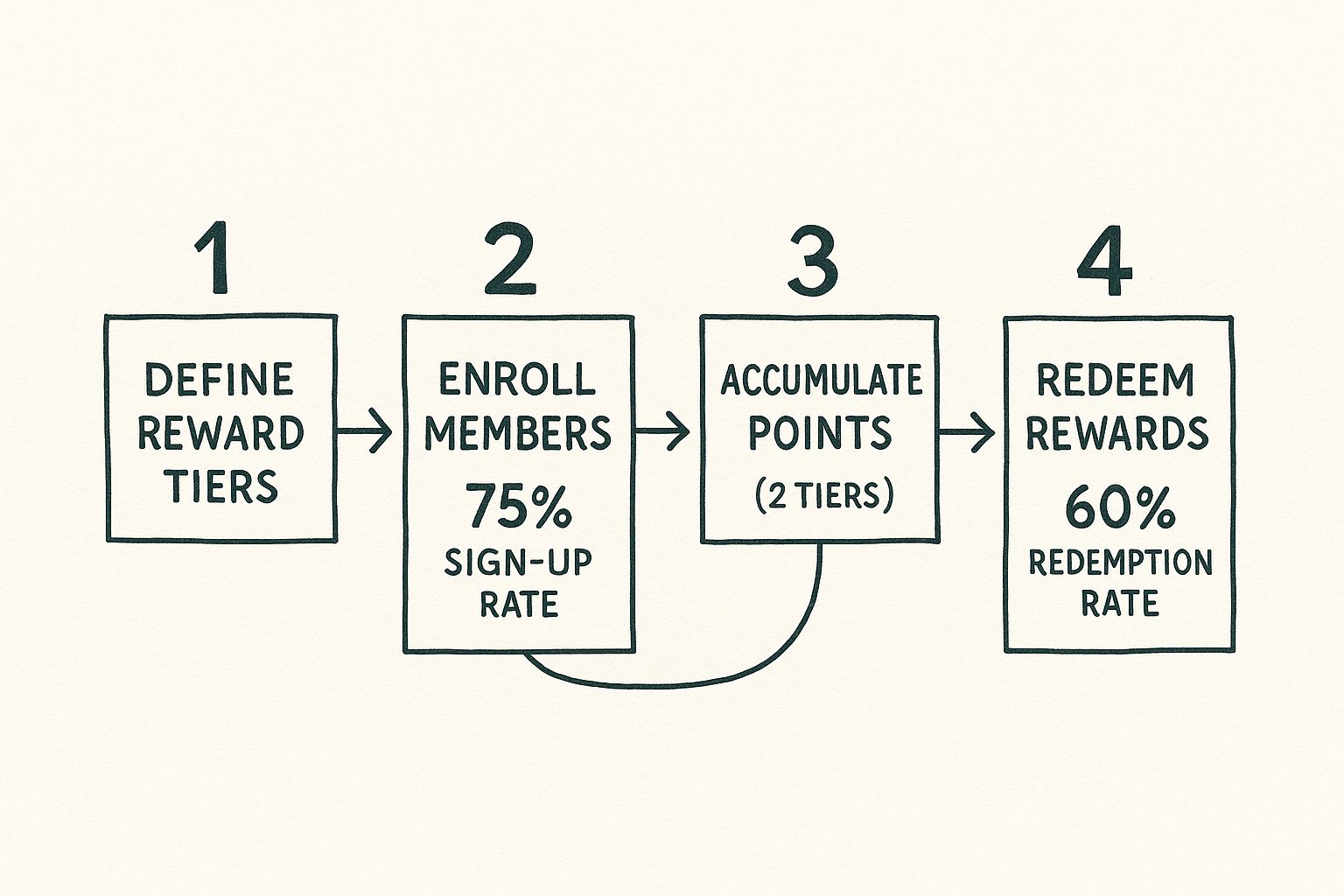
The real takeaway here is that a well-defined process, backed by the right automation, is a direct path to better customer engagement and higher satisfaction.
By automating the routine, we empowered their support team to focus on what humans do best: solving complex problems and building relationships. They weren't just closing tickets faster; they were delivering a higher quality of service.
The results and benefits were undeniable. Within the first quarter, the company achieved a 40% reduction in average resolution time and saw a major lift in their CSAT scores.
Of course, other factors play a role. For insights on how foundational elements like seamless connectivity can contribute to overall efficiency, it's worth reading up on how to improve customer experience through smart guest WiFi solutions. And for those tricky field service issues, tools like a Visual Remote Assistant can accelerate diagnostics and resolutions, trimming down resolution times even further.
Empowering Your Team with the Right Salesforce Tools
Technology should be an enabler for your team, never a barrier between them and your customers. The best tools work seamlessly in the background, making every human interaction more meaningful and effective. At its core, this is how you improve customer satisfaction—by genuinely supporting the people at the heart of your service with the right cloud solutions.
Human connection remains the bedrock of great service, especially when things get complicated. A recent Australian report found that 9 in 10 customers still want to talk to a person for service matters, and two-thirds strongly favour that personal interaction over automated systems.
Even as digital channels grow, 66% of people pick up the phone when an issue is important. This underscores the lasting need for skilled, well-equipped agents. You can discover more about these customer service expectations in the full 2025 report.
This is where a smart Salesforce implementation makes all the difference. It’s not about replacing your agents; it’s about arming them with the information they need to be brilliant.
Case Study: A Salesforce Solution for Confidence and First-Call Resolution
We recently worked with a healthcare provider whose support team was struggling. They had no central place to find approved procedures or patient information, which meant putting frustrated callers on hold while they scrambled through outdated documents. This bred uncertainty for the agents and created long, painful calls for patients.
Our solution was to roll out Salesforce Knowledge. We helped them build a dynamic, searchable knowledge base right inside their Service Cloud console, giving their team instant access to accurate, up-to-the-minute information when they needed it most.
The impact was immediate and profound.
- Agent confidence soared because they finally had a single source of truth to rely on.
- First-call resolution rates jumped by over 35% in the first quarter alone.
- Onboarding time for new staff was cut in half; the knowledge base became their go-to training tool.
The goal was never to automate the conversation. It was to remove the friction that stopped agents from having a helpful, empathetic conversation. Technology should clear the path for human connection, not block it.
Finding the Right Balance with Automation
Striking the right balance between automation and authentic human interaction is everything. Automation is perfect for handling simple, repetitive tasks—think order status updates or password resets. This frees up your skilled agents to focus their energy on the complex, high-value interactions that demand empathy and critical thinking.
By equipping your team with the right Salesforce tools, you empower them to be more efficient, confident, and effective problem-solvers. It's a direct investment in their success and a crucial step in delivering service that builds lasting customer loyalty. For organisations looking to get this balance right, our Salesforce consulting services focus on building solutions that support your people and processes.
Turning Salesforce Data into Actionable Insights
Improving customer satisfaction isn't a one-off project; it’s a constant journey of improvement. You can’t fix what you don’t measure, which is why turning your raw customer data into clear, actionable insights is absolutely critical. This is where Salesforce reports and dashboards become your mission control, helping you monitor progress and make smarter decisions based on facts, not feelings.

Without consistent tracking, any effort to boost satisfaction is just a shot in the dark. Salesforce allows you to move beyond guesswork and pinpoint exactly what’s working and what isn’t.
Creating Salesforce Dashboards That Drive Improvement
The key is to focus on metrics that directly reflect the customer experience. We always advise our clients to build a central Service Cloud dashboard that visualises a handful of essential Key Performance Indicators (KPIs).
Here are the reports we recommend starting with:
- Case Resolution Time: This tracks the average time your team takes to close a case from the moment it’s opened. It's a direct measure of your efficiency.
- First Contact Resolution (FCR) Rate: This metric reveals the percentage of cases resolved in the very first interaction. A high FCR is a powerful indicator of agent knowledge and happy customers.
- CSAT Scores by Agent or Team: By tying survey results back to specific agents or teams, you can spot top performers (who can mentor others) and identify areas that might need more training.
Data tells a story. When you see a sudden drop in FCR for a particular team, it’s not a failure—it’s an opportunity. The data is simply flagging a specific process or knowledge gap that you can now address with targeted action.
From Insight to Action: A Logistics Case Study
We once worked with a logistics client grappling with inconsistent service quality. While their overall CSAT scores were decent, they noticed a worrying trend of negative reviews piling up around one specific service line. They couldn't figure out the root cause.
By building the exact Salesforce dashboards mentioned above, the problem became crystal clear. The data showed that the team handling freight forwarding inquiries had a 30% longer average Case Resolution Time and a much lower FCR rate compared to every other team.
This single insight allowed them to stop guessing and take decisive action. They organised a focused retraining program for that team, updated their Salesforce Knowledge articles with clearer freight procedures, and monitored the dashboard daily.
Within a single quarter, that team’s resolution time fell in line with the company average, and their CSAT scores saw a tangible lift. It’s a perfect example of using data not to assign blame, but to diagnose and empower your people to succeed.
Building a strong data feedback loop is also crucial for your marketing. For more on this, check out our guide on Account Engagement best practice to see how data can inform more effective customer journeys.
Salesforce & Customer Satisfaction: Your Questions Answered
When business leaders and admins explore how to lift customer satisfaction scores using Salesforce, a few common questions arise. Here are the answers we provide, based on our experience as a Salesforce partner.
What's the first step to improve customer satisfaction with Salesforce?
Before anything else, consolidate your customer data into a single, unified view. You simply can't improve service, reduce friction, or personalise an interaction until you have a complete picture of who your customer is and their entire history with your business.
We always tell our clients to focus on creating a 360-degree view of the customer. This means pulling in data from every touchpoint, including:
- Sales Cloud: Purchase history, past conversations, and deal stages.
- Service Cloud: Support tickets, issue resolutions, and agent notes.
- Marketing Cloud or Account Engagement: Campaign interactions, email opens, and website activity.
When your team has the full story right in front of them, they can stop asking repetitive questions and get straight to solving problems. This one change is often the most powerful move you can make.
How can I measure the ROI of investing in Salesforce for customer satisfaction?
Measuring the return on your investment comes down to tracking key business metrics before and after you've implemented or optimised Salesforce. It's about connecting service improvements to real, tangible financial outcomes.
Focus on a few core metrics that directly show the value of happy, loyal customers. With simple Salesforce reports and dashboards, you can keep an eye on:
- Customer Lifetime Value (CLV): Satisfied customers stick around longer and spend more. Track the average CLV of customers who have positive service interactions versus those who don't.
- Customer Retention Rates: The whole point of better service is to reduce churn. Monitor your retention rate each quarter to see how your efforts are paying off.
- Reduced Cost-to-Serve: As you streamline processes with automation and give agents better tools, the cost of handling each ticket should drop.
By directly linking improvements in service metrics (like First Contact Resolution) with these financial outcomes, your Salesforce dashboards can paint a crystal-clear picture of your ROI. The data will prove that great service isn't a cost centre—it's a profit driver.
Can small businesses use Salesforce to improve customer satisfaction?
Absolutely. The idea that Salesforce is only for massive enterprises is a common myth. Salesforce has solutions built specifically for small and growing businesses, giving you the core CRM and service tools needed to deliver a professional, consistent customer experience.
For a small business, a platform like Salesforce levels the playing field. It lets you implement foundational practices that have a huge impact on customer satisfaction, including:
- Centralised Case Management: A single place to track every query, so nothing falls through the cracks.
- A Unified Customer View: Giving your small team the same deep customer context that big businesses have.
- Simple Automation: Using macros and email templates to respond faster and with more consistency.
These features allow a small business to deliver the kind of reliable, high-quality service that builds trust and loyalty, helping you compete with companies many times your size.
Ready to transform your customer experience and see a measurable lift in your satisfaction scores? As a dedicated Salesforce partner, Adaptal specialises in designing and implementing Salesforce solutions that deliver real results. Contact us today for a consultation and let's build a strategy that puts your customers at the centre of everything you do.