
For any FMCG company in Australia, winning comes down to mastering a unique landscape. The challenge isn't just selling products; it's navigating powerful retail duopolies, sprawling supply chains, and shifting consumer tastes. The real struggle we see with clients is tying everything together—from the sales rep visiting stores to the marketing team building brand loyalty, all while managing complex data. Too often, this data is fragmented across disconnected systems.
This guide outlines a proven solution based on our project experience. We'll explore the common business challenges faced by Australian FMCG leaders and demonstrate how a well-implemented Salesforce platform becomes the central command centre for your entire operation, driving digital transformation and delivering measurable results.
The Business Challenge: Navigating the Complex Australian FMCG Market
The fast-moving consumer goods sector is a high-stakes game where efficiency, speed, and accuracy are critical. The core business challenge is often fragmented information. Sales figures live in one system, inventory in another, and trade promotion plans are buried in spreadsheets. This disconnect creates operational drag, costing time, money, and growth opportunities.
This guide shares best practices for leveraging Salesforce CRM to connect every part of your business. Think of it as a roadmap for turning scattered data into a strategic advantage, leading to stronger retailer partnerships, optimised operations, and profitable direct-to-consumer relationships.
The Salesforce Opportunity in a Growing Market
The Australian FMCG market is on an impressive growth trajectory. Valued at USD 69.32 billion in 2024, it’s projected to more than double to USD 149.57 billion by 2033—a compound annual growth rate (CAGR) of 8.98%. The food and beverage segment is the powerhouse behind this expansion. You can explore these market trends at Deep Market Insights.
But this growth presents real operational headaches familiar to every FMCG company in Australia:
- The Business Challenge: Managing relationships with major retailers who dominate the market, making shelf space and compliance critical.
- The Logistical Challenge: Efficiently distributing products across a vast geography, demanding airtight inventory control and optimised supply chains.
- The Consumer Challenge: Meeting the demands of modern shoppers who value sustainability, health, and seamless digital experiences.
The Salesforce Solution: A Unified CRM Platform for Growth
Salesforce is more than a CRM; it's an operational backbone that unites your teams, data, and processes. The solution is to create a single, shared view of every customer, partner, and process.
Lesson Learned: By pulling data from sales, service, and marketing into one platform, we help FMCG companies shift from reactive problem-solving to proactive, data-driven decision-making. In a market where every efficiency gain is a competitive edge, that's a game-changer.
In this guide, we’ll break down how specific Salesforce products solve these challenges. We’ll look at case-study style examples, from optimising retail execution with Sales Cloud to building brand loyalty with Marketing Cloud and streamlining partner management with Experience Cloud. This is a clear path to not just compete but thrive.
The Salesforce Solution for Field Sales and Retail Execution

The Business Challenge: Field sales teams often operate inefficiently, using manual methods for store audits, visit reports, and stock checks. This leads to missed sales, poor promotion execution, and a lack of visibility into on-the-shelf performance.
The solution is to empower your team with a mobile-first tool that provides a complete view of every retail partner. Salesforce Sales Cloud transforms your team from reactive problem-solvers to proactive, data-informed advisors, boosting profitability with every store visit.
Arming Your Team with Actionable CRM Data
Winning in the Australian FMCG market means winning in the aisles. With Woolworths and Coles commanding a combined 68% market share, every store visit must be perfectly executed. Salesforce transforms these visits into strategic, data-driven actions. On their mobile device, reps get a 360-degree view of each account, including:
- Past Orders and Sales History: To spot trends and suggest reorders on the spot.
- Active Promotions: To ensure compliance and measure performance at the store level.
- Key Contact Information: To facilitate productive conversations with store managers.
- Store-Specific Notes: To track unique details like delivery times or merchandising preferences.
The Result: From Manual Tasks to Automated Success
The key benefit is automating low-value administrative tasks, freeing up reps to focus on what they do best: building relationships and selling. Instead of being buried in paperwork, they can execute high-impact activities driven by real-time CRM data.
Lesson Learned: A field rep using Salesforce can walk into a store knowing which products are underperforming, what promotions need a compliance check, and what the next order should look like. This turns every conversation with a store manager into a valuable, strategic interaction.
For any FMCG company in Australia, this digital transformation is essential. The platform provides tools built specifically to solve the daily challenges your field teams face.
Key Salesforce Features for Retail Execution
A modern CRM solution like Salesforce equips your team with capabilities that solve common field sales headaches, all within a single mobile app.
1. Intelligent Route Planning
Salesforce can automatically map out the most efficient daily routes for reps based on store location, visit priority, and schedules. This automation reduces travel time and maximises productive store visits.
2. Guided Visit Checklists
Create standardised, step-by-step digital checklists. Reps can easily conduct audits, check planogram compliance, capture photos of displays, and verify promotional pricing, ensuring consistent execution.
3. Instant Order Capture
Reps build and submit orders directly from their mobile device in-store. This eliminates manual data entry, reduces errors, and dramatically accelerates the order-to-fulfilment cycle.
4. Real-Time Performance Dashboards
Reps and managers get instant access to KPIs. Track sales volume, visit completion rates, and promotional uplift in real-time to make smarter decisions. See how this works by exploring our insights on Salesforce Sales Cloud implementation. By centralising these functions, you create a connected and highly effective field sales operation.
The Salesforce Solution for Direct-To-Consumer (D2C) Brand Loyalty
The Business Challenge: In a market where shelf space is fiercely competitive, building a direct connection with consumers is a powerful differentiator. Many FMCG companies struggle to deliver personalised interactions and consistent support across multiple channels, hindering brand loyalty.
The solution is to leverage Salesforce Marketing Cloud and Service Cloud to build a cohesive brand experience that turns one-time buyers into lifelong advocates. This moves your strategy beyond generic campaigns to creating thoughtful, automated customer journeys.
Crafting Personalised Consumer Journeys with Marketing Cloud Automation
Imagine launching a new product. Instead of a one-size-fits-all campaign, Marketing Cloud enables a multi-channel journey. It might start with targeted social ads, followed by an automated email sequence offering an introductory discount.
As consumers interact, the platform tracks their behaviour, helping you serve relevant content. For example, a customer who buys an organic snack could receive a follow-up email with recipe ideas or content about your brand's sustainability commitment. This personal touch transforms a simple purchase into a memorable interaction. You can learn more about creating these experiences with our guide to Salesforce Marketing Clouds.
Lesson Learned: The goal is to make every touchpoint feel intentional and valuable. Whether it's automating loyalty rewards, sending birthday offers, or re-engaging customers with tailored content, you're building a relationship that lasts long after the first sale.
Unifying Customer Service for a Seamless Experience
The Business Challenge: Customers interact with brands across many channels—website, social media, phone. Without a unified view, service agents lack context, leading to frustrating, repetitive experiences for the customer.
The Salesforce solution is Service Cloud, which brings all conversations into a single customer profile. When a service agent receives an enquiry, they see the customer's entire history—past purchases, marketing interactions, and previous support tickets. This context enables faster, more empathetic problem-solving.
The key benefits delivered are:
- Consistent Messaging: Every agent has the same information, ensuring a consistent customer experience.
- Proactive Support: Identify common issues to create knowledge bases or trigger proactive service alerts.
- Valuable Data Capture: Every interaction provides feedback that can inform product development and marketing.
To succeed in D2C, you need the right strategy. Explore a complete guide to D2C for a deeper understanding. By integrating personalised marketing with responsive, unified service, you build a loyal community around your brand.
The Salesforce Solution for Streamlining B2B Partner Relationships
The Business Challenge: For any FMCG company in Australia, managing distributors, wholesalers, and retail buyers with emails, calls, and spreadsheets is a manual grind. This creates administrative bottlenecks, slows down the supply chain, and forces teams into a reactive loop of chasing information.
The solution is to migrate from this fragmented model to a unified, self-service digital hub using Salesforce Experience Cloud. This secure, branded partner portal becomes a single source of truth, available 24/7.
The Result: Empowering Partners with On-Demand Access
Imagine a world where partners no longer call your team for everyday requests. With a Salesforce partner portal, they can log in anytime to get what they need, empowering them to manage their accounts efficiently.
This self-service automation slashes the administrative burden on your internal teams, freeing them to focus on high-value activities like joint business planning and growth strategy. The result is a fundamental shift from a transactional relationship to a truly collaborative one.
Lesson Learned: By giving partners direct access to the tools and information they need, you're not just making their lives easier—you're making your business easier to work with. This reduction in operational friction is a powerful competitive advantage that fosters loyalty.
This digital-first model allows your partners to take control of key processes, improving both their experience and their effectiveness.
From Manual Processes to Automated Efficiency
A well-designed Experience Cloud portal automates the most common B2B interactions, which is a game-changer for improving supply chain velocity and accuracy.
Let's compare the old way with the Salesforce solution.
B2B Partner Portal vs Traditional Methods
| Business Process | Traditional Challenge (Email/Phone) | Salesforce Experience Cloud Solution |
|---|---|---|
| Order Placement | Partners email/call orders. Prone to manual entry errors and delays. | Partners place orders 24/7 via an online catalogue with real-time stock levels. |
| Order Status | "Where's my order?" calls require staff to look up information manually. | Partners track shipment status in real-time with a single click inside the portal. |
| Marketing Materials | Sales reps email outdated PDFs. Inconsistent branding and materials. | Centralised, on-demand access to the latest product images, sell sheets, and promo calendars. |
| Partner Support | Untracked phone calls and emails lead to slow response times. | Partners log and track support cases or find answers instantly in a shared knowledge base. |
| Onboarding | A slow, manual process involving multiple emails and forms. | A guided, self-service onboarding journey with all necessary resources in one place. |
This table shows a clear shift from reactive, time-intensive work to a proactive, efficient system.
By moving these workflows into a self-service portal, you build a more efficient and connected ecosystem.
- 24/7 Order Placement: Partners browse catalogues, check live stock levels, and place orders directly, accelerating the order-to-cash cycle.
- Real-Time Shipment Tracking: Partners get total visibility into delivery timelines without calling for updates.
- Marketing & Sales Collateral: Instant access to the latest materials ensures brand consistency across all channels.
- Case Management & Support: Partners can log tickets, find answers in a knowledge base, and track issue resolution independently.
The result is a more efficient, profitable, and collaborative distribution network. Your partners feel more supported, while your internal teams can focus on strategic growth.
Integrating Your Systems for Total Visibility and a Single Source of Truth
The Business Challenge: For any FMCG company in Australia, running separate systems for ERP, supply chain management (SCM), and point-of-sale (POS) creates data silos. This fragmentation hides crucial insights and slows down decision-making.
The Salesforce solution is to act as the central hub, integrating these disparate systems. By connecting all your data streams into a single, reliable source of truth, you create a powerful engine for digital transformation that everyone in the organisation can trust.
Why a Unified Tech Stack is the Solution
A fully integrated Salesforce platform tears down departmental walls, creating a level of operational clarity impossible with disconnected software. This is a strategic necessity in a sector that is a cornerstone of the Australian economy, employing around 530,000 people and supporting a retail sector with over 155,000 businesses. With food retailing alone generating $168 billion in 2023, the efficiency gained from integration has a massive impact on the bottom line. Find more insights at the IMARC Group.
Lesson Learned: The goal of integration is to get data flowing effortlessly from where it’s captured to where it can drive strategic decisions. It transforms your tech stack from a collection of tools into a unified asset that drives growth and profitability.
Getting this connectivity right is the difference between guessing your inventory levels and knowing them with certainty. The diagram below shows this evolution, moving from messy, manual communication to a clean, integrated digital portal.
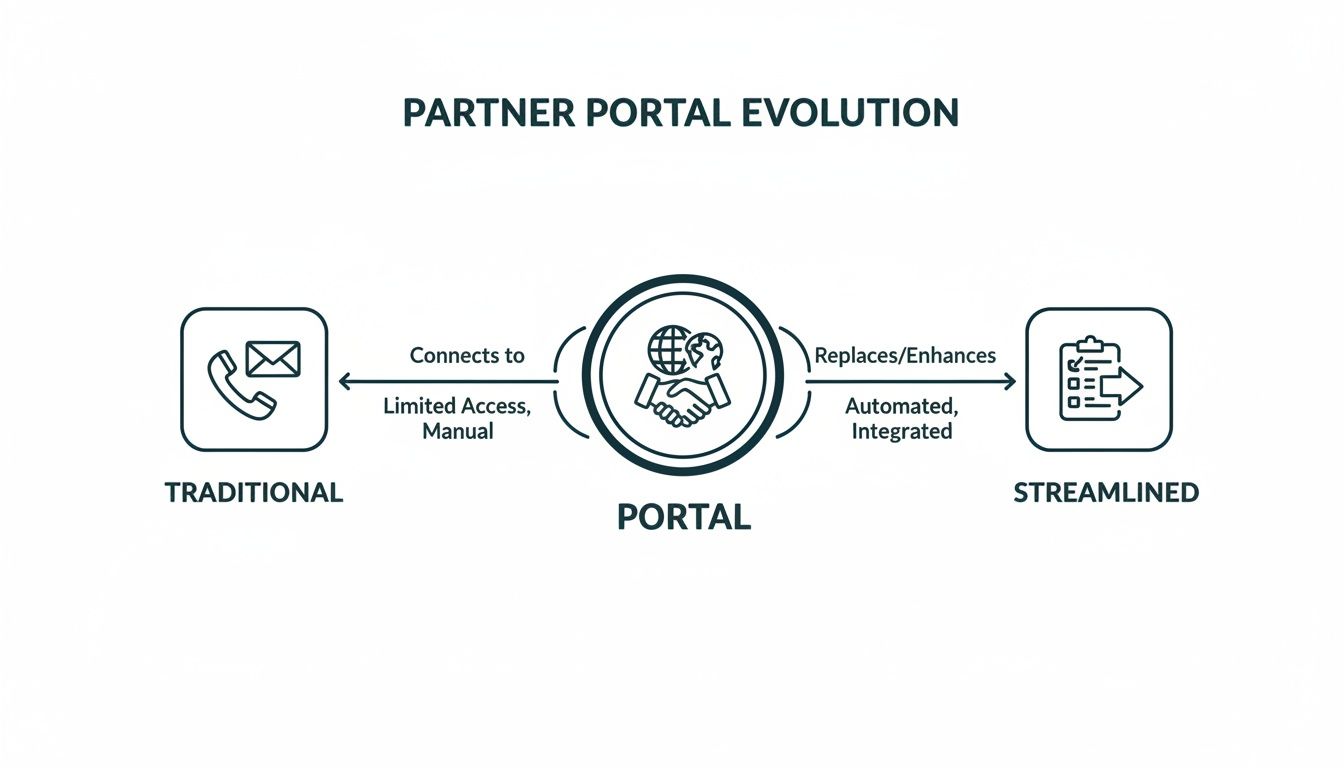
This shift replaces inefficient, manual processes with automated, on-demand access that boosts speed and accuracy across the board.
The Business Results of System Integration
When Salesforce is properly integrated with your core operational systems, the benefits are felt throughout the business. Here are a few real-world examples from our projects:
- Real-Time Stock Visibility: A field rep in a store can check live inventory levels on their tablet, preventing stockouts and making promises they know the warehouse can keep.
- Automated Order-to-Cash Cycle: An order placed in Salesforce automatically triggers the entire process in your ERP—from invoicing to fulfilment. This slashes manual data entry, reduces errors, and improves cash flow.
- Hyper-Accurate Demand Forecasting: Live sales data from POS systems feeds directly into Salesforce, allowing demand planners to make highly accurate forecasts instead of relying on outdated reports.
Building this unified technology requires a Salesforce partner with deep expertise in the data flows of an FMCG company in Australia. To learn more about this foundational work, see our guide on what is system integration.
Selecting the Right Salesforce Partner for Your FMCG Business
Implementing Salesforce is more than a technology project—it's a business transformation initiative. To succeed in the competitive Australian FMCG landscape, you need a Salesforce partner who understands your unique challenges, from managing retail duopolies to optimising complex supply chains.
Choosing the right partner is the most critical decision you'll make. A generic IT provider won't suffice. You need a team that can translate your business goals—like improving trade promotion ROI or boosting field sales efficiency—into a Salesforce solution that delivers tangible results.
Look for a Partner with Proven Industry Experience, Not Just Technical Skills
The ideal partner for an FMCG company in Australia brings deep, proven industry experience. They understand the difference between a planogram and a promotion and know the real-world pressures your teams face.
Look for a partner with a track record of success in:
- Trade Promotion Management: They should have case studies demonstrating how they've configured Salesforce to plan, execute, and analyse trade spend effectiveness.
- Field Sales Automation: Ask for examples of how they’ve empowered field teams with mobile CRM tools for visit planning, order taking, and retail execution.
- Complex ERP and SCM Integrations: They must have the expertise to connect Salesforce with your core systems (e.g., SAP, Oracle, NetSuite) to create a single source of truth.
Our Approach: A true Salesforce partner doesn't just build what you ask. They challenge your thinking, bring best practices to the table, and guide you toward a solution that delivers measurable business outcomes. They act as a strategic advisor, not just a vendor.
Questions to Ask a Potential Salesforce Partner
Vetting potential partners is the best way to de-risk your investment. Before signing a contract, get clear, confident answers to these key questions to find a team equipped to help you grow.
- Can you share case studies of other FMCG companies you've worked with in Australia?
- What is your approach to user adoption and change management for our field and office-based teams?
- How do you manage complex integrations between Salesforce and our existing ERP and supply chain systems?
- How will you help us define and track the key performance indicators (KPIs) that matter to our business?
Finding the right team is crucial for success. For more guidance, explore our overview of what to look for in Salesforce implementation partners. Understanding the pivotal Role of CRM in E-commerce can also provide context. A partner with relevant experience has already navigated these challenges and can steer you toward sustainable growth.
Frequently Asked Questions (FAQ) about Salesforce for FMCG
How can Salesforce CRM improve our trade promotion ROI?
The business challenge is that trade promotion spend is a massive part of your budget, yet proving its worth is difficult with disconnected spreadsheets. The Salesforce solution is a single command centre to plan, execute, and measure every promotion against live sales data. You can see which campaigns are driving uplift by store or region, allowing you to double down on what works and stop investing in promotions that don't deliver. The result is a shift from blind spending to strategic investment backed by real-time data.
Is Salesforce suitable for a mobile field sales team?
Yes. The Salesforce mobile app is designed for field reps on the go. Its offline capabilities ensure that reps can log visits, check stock, and capture orders even with poor reception. We configure the app as a complete retail execution toolkit with guided visit checklists, smart route planning, and on-the-spot order capture. For any FMCG company in Australia with a field team, this automation drives productivity and consistency.
Can Salesforce integrate with our existing ERP system?
Yes, this integration is critical. Salesforce is designed to be the heart of your operations, not another data silo. Using robust integration tools like MuleSoft, it connects seamlessly with major ERPs like SAP, Oracle, or NetSuite. This creates a two-way flow of essential data (orders, inventory, customer updates) between your sales and back-office teams. The result is a single source of truth for the entire business, which is foundational for digital transformation.
Ready to see how Salesforce could be shaped to fit your business? The team at Adaptal has deep experience helping Australian FMCG companies build powerful, integrated CRM solutions that drive growth. Contact us today for a personalised consultation.