

Salesforce Financial Services Cloud is a CRM platform built specifically to handle the complex relationships and strict regulatory demands of the financial world. It goes far beyond a standard CRM by providing a unified, 360-degree view of clients and their households, linking family members, financial accounts, and life goals all in one place.
Think of it as the difference between a generic sedan and an armoured vehicle—both provide transport, but one is purpose-built for a high-stakes environment. This is the core challenge Financial Services Cloud was designed to solve.
What is Financial Services Cloud?

Standard CRMs like Salesforce Sales Cloud are excellent at tracking individual contacts and sales pipelines. However, the world of finance operates on a much deeper level of relationships. A client isn’t just a name in a database; they are part of a household, with family members, trusts, business partnerships, and intricate financial webs that a generic CRM tool simply can’t map effectively.
Financial Services Cloud (FSC) was engineered to solve this very problem. It’s built on the powerful Salesforce platform but is specially tailored with pre-built data models and features for banking, wealth management, and insurance. From our project experience, this industry-specific design is what allows institutions to shift from a transactional focus to a proactive, relationship-driven approach, unlocking significant value.
From Siloed Data to a 360-Degree Client View
The primary business challenge that FSC solves is the elimination of internal data silos. Information about a client’s mortgage, investments, and insurance policies often lives in separate, disconnected systems. This fragmentation creates a disjointed customer experience and prevents advisors from seeing the complete financial picture.
FSC unifies this data, creating a single source of truth that empowers financial professionals. By understanding the entire client relationship, an advisor can deliver timely, relevant advice that builds trust and loyalty—a critical factor for success in today’s competitive financial industry.
The platform is designed to solve key business problems by:
- Visualising Households: Mapping out complex family trees and financial relationships to understand a client’s full financial world.
- Tracking Life Goals: Linking financial products and advice directly to a client’s objectives, like saving for retirement or funding a child’s education.
- Automating Key Processes: Streamlining client onboarding, managing referrals, and ensuring compliance with automated workflows.
- Surfacing Actionable Insights: Using AI to spot new opportunities and potential risks within a client portfolio.
Driving Digital Transformation in Finance
Adopting specialised cloud solutions like FSC is a key part of the digital transformation sweeping through the finance sector. This trend is reflected in significant market growth; the Australian cloud computing market was valued at USD 12.7 billion in 2024 and is projected to hit USD 30.3 billion by 2033. This growth is fuelled by the need for secure, scalable platforms that can support modern digital initiatives.
Of course, implementing such a specialised system requires careful planning and expertise. As an experienced Salesforce partner, we know a successful rollout depends on a deep understanding of both the technology and your specific business challenges. To learn more, explore our approach to delivering expert Salesforce consulting services. For an in-depth look at how specialised fintech solutions like Financial Services Cloud operate, you can read everything you need to know about SCF platforms.
Core Features of Financial Services Cloud
To truly understand what makes Financial Services Cloud unique, we need to look at the purpose-built tools designed for the financial industry. These aren’t just add-on features; they are core components designed to give advisors, bankers, and insurers a real-world advantage. They work in concert to transform scattered data points into strong client relationships and actionable business insights.
The infographic below shows how these features translate into concrete benefits for financial organisations.
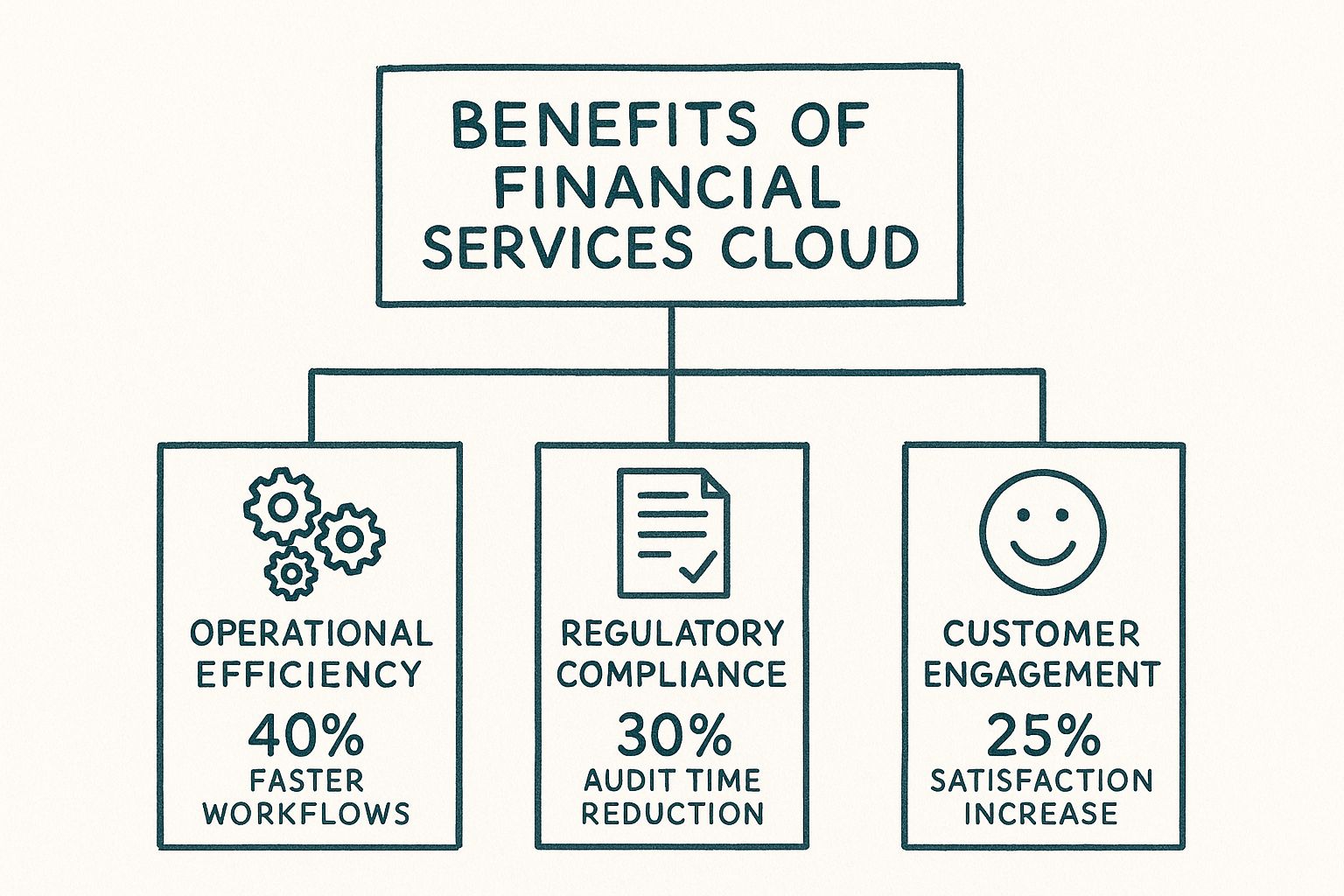
As you can see, the data points to a powerful combination of improvements. The platform drives faster workflows, simplifies compliance, and delivers better customer outcomes—all at the same time.
The Client and Household Data Model
The bedrock of Financial Services Cloud is its unique data model. Unlike a standard CRM that tracks individual contacts, FSC is built around the concept of the client and the household. This structure allows you to map complex relationships that go far beyond a simple family tree.
You can visually link individuals to the trusts, businesses, and legal entities they’re connected with. At a glance, an advisor can see that their main client is also the director of a company, a trustee for their parents’ estate, and part of a joint investment account with their spouse. This 360-degree view is the key to providing advice that is contextually relevant to a person’s life and uncovering opportunities that would otherwise remain hidden.
Actionable Relationship Intelligence
Building on that data model, FSC provides tools to turn this information into action. Relationship Maps create a visual web of a client’s connections, both personal and professional. An advisor can instantly see who their client knows, who their accountant is, or which lawyer they use. This is much more than a static chart; it’s a dynamic way to spot warm leads and referral opportunities.
By understanding the entire network surrounding a client, an advisor can move from being a service provider to becoming a central, trusted connector in their client’s financial life. This deepens the relationship and creates immense value.
For instance, a lesson learned from our projects is that noticing two clients use the same solicitor can be the perfect opportunity to introduce them for a potential business partnership, making the advisor invaluable to both.
Connecting FSC Features to Business Outcomes
| FSC Feature | Description | Primary Business Impact |
|---|---|---|
| Client & Household Data Model | Maps complex relationships beyond individuals, including trusts and businesses. | Provides a 360-degree client view, enabling holistic advice and cross-selling opportunities. |
| Relationship Intelligence | Visually displays a client’s personal and professional network connections. | Uncovers warm referral pathways and strengthens the advisor’s role as a key connector. |
| Integrated Financial Planning | Allows advisors and clients to collaboratively set and track life goals within the CRM. | Turns financial planning into an engaging, ongoing process, increasing client retention. |
| Compliance & Security Tools | Includes audit trails, data encryption, and secure portals for sharing information. | Reduces compliance risk and automates audit preparations, saving time and resources. |
Each feature is designed not just to manage data, but to drive a specific, positive change in how you do business—whether that’s finding new clients or increasing lifetime value.
Integrated Financial Planning Tools
Financial Services Cloud brings financial planning directly into the daily CRM workflow. This allows advisors and clients to collaboratively set and track life goals within the platform. A goal like “Save for University Tuition” isn’t just a note; it becomes a tangible object in Salesforce.
Advisors can then link specific financial accounts, insurance policies, and investment products directly to that goal. This gives the client a clear view of how their portfolio is working towards their real-world objectives. It also provides a framework for proactive check-ins, turning financial planning into an ongoing conversation instead of a once-a-year meeting. The platform’s ability to adapt is a key benefit, and you can learn more about its continuous improvement in our overview of the Salesforce Winter ’25 release highlights.
Robust Compliance and Security Features
Working in finance means navigating a minefield of regulations. FSC was designed with compliance at its core, offering features that help firms meet these demands without the typical administrative burden.
Key compliance capabilities include:
- Audit Trails: Detailed logs track every change made to a client’s record, providing a complete history for any compliance check.
- Data Encryption: Salesforce Shield offers an extra layer of security, allowing firms to encrypt sensitive data at rest and in transit.
- Secure Collaboration: Information can be shared with clients and external partners through secure portals, so sensitive documents never need to be sent over unsecure channels like email.
These tools help automate compliance monitoring and significantly reduce the time and effort required for audits. While Financial Services Cloud is a powerful, broad solution, its focus on security and tailored experiences is a common theme in the industry; exploring CRM platforms specialized for private equity, for example, shows how other platforms also adapt to meet very specific needs. Ultimately, this focus on security gives both firms and their clients peace of mind.
Case Study: How FSC Transforms Wealth Management

To illustrate how Salesforce Financial Services Cloud solves real-world business problems, let’s look at a mid-sized wealth advisory firm we recently partnered with.
The Challenge: Before implementing Salesforce, their operations were hampered by disconnected spreadsheets, siloed client notes, and manual follow-up reminders. Advisors were working with a fractured, incomplete picture of their clients. This data fragmentation led to missed opportunities. An advisor might discuss investment strategies, completely unaware that the same client was seeking a business loan from another department, or that their adult children were prime candidates for new wealth-building services. This inefficiency was preventing them from building the deep, holistic relationships that drive client loyalty.
The Solution: From Disconnected Data to a Unified Household View
The Salesforce Solution: The implementation of Financial Services Cloud was a turning point. The chaotic web of spreadsheets vanished, replaced by a single, dynamic dashboard. For the first time, advisors could see a client’s entire household, not just a standalone portfolio.
This wasn’t a minor tweak—it completely changed how they worked. An advisor could now instantly visualise:
- Family Connections: The client, their spouse, their children, and even their parents’ trust, all mapped out clearly.
- The Full Financial Picture: Every asset and liability in one place—investments, mortgages, insurance policies, and business holdings.
- Their Professional Network: The client’s accountant, solicitor, and other key contacts, creating a ready-made map of referral opportunities.
Armed with this complete picture, advisors shifted from reacting to client calls to proactively offering strategic advice. They could finally connect the dots, delivering solutions that were comprehensive and genuinely valuable.
The Result: Automating Workflows to Focus on High-Value Advice
One of the biggest drains on the firm’s time was administration. Client onboarding and quarterly reviews were manual, paper-heavy processes. With Financial Services Cloud, we helped them build automated workflows for these critical tasks. The new client onboarding process, which once took weeks, became a streamlined digital journey. Automated reminders for client reviews ensured no one slipped through the cracks.
This shift did more than just boost efficiency. By automating mundane tasks, the firm freed up its highly skilled advisors to do what they do best: build relationships and provide strategic, high-value advice. Productivity was redirected toward activities that generate revenue.
The firm saw a significant boost in advisor productivity, which led directly to more meaningful client conversations. This fostered deeper, more loyal relationships, which in turn drove a measurable increase in AUM. And with all their tracking and reporting now automated, their compliance posture became stronger than ever.
Case Study: Modernising Banking With a Unified Platform
Many banks still grapple with a major internal disconnect between personal and commercial banking. This creates a clunky, disjointed experience for clients who need both, leading to countless missed opportunities.
The Challenge: We saw this firsthand with a mid-sized bank we partnered with. A small business owner would apply for a commercial loan, and the personal banker—who knew their family’s financial situation—would have no visibility into the process. This lack of a single customer view was a significant barrier to growth.
The Salesforce Solution: The solution was to break down these internal walls using Salesforce Financial Services Cloud. By bringing retail and commercial banking data onto one platform, we created a single source of truth that every team member could access. A personal banker could see a pending commercial loan application on a client’s profile and offer support, while a loan officer could see the business owner’s personal wealth portfolio and identify a referral opportunity for financial planning.
This cross-departmental insight transforms the client relationship, shifting the bank from a collection of separate services to one unified team.
The Result: Gamifying Collaboration With Referral Tracking
To formalise this collaboration, we implemented one of the standout features of Financial Services Cloud: Referral Tracking. This tool created a transparent and engaging system for passing leads between departments.
The system included:
- Performance Dashboards: Public leaderboards showed who was generating the most successful referrals, sparking friendly competition.
- Automated Notifications: Everyone was kept in the loop, ensuring referrals were followed up on quickly.
- Clear Attribution: It was easy to see which referrals led to new business, simplifying recognition and incentives.
This digital shift in banking is happening across the industry. In Australia, cloud adoption is advancing rapidly, mirroring global trends where a massive 91% of financial institutions are already using cloud services. Many are leaning on hybrid cloud strategies to manage costs and stay compliant. Projections show that by 2024, 55% of banks will have moved at least 30% of their critical workloads to the cloud. You can dive deeper into the numbers in this report on cloud computing statistics in financial services.
By giving employees the right tools and a clear incentive structure, the bank fostered a culture where collaboration wasn’t just encouraged—it was a core part of their daily operations.
The results were clear and measurable. The bank saw a dramatic jump in successful cross-department referrals, which led directly to new revenue streams. Loan processing times improved because all necessary client information was finally in one place. Most importantly, by offering more holistic financial solutions, they saw a substantial lift in overall customer lifetime value.
A Practical Guide to FSC Implementation

Implementing a platform as powerful as Financial Services Cloud isn’t just a technical project; it’s a fundamental business transformation. Based on our experience across over 110 Salesforce projects, success depends on a clear strategy that addresses data, people, and technology from the start.
This isn’t about flipping a switch. It’s a methodical process of re-engineering how your team interacts with client information to build stronger relationships and drive growth. A well-planned rollout ensures you maximise your return on investment and avoid common pitfalls.
Best Practice 1: Master Your Data Migration Strategy
Your FSC instance will only ever be as good as the data you put into it. A robust data migration strategy is non-negotiable. This involves more than just copying records; it requires a deep clean and careful mapping process.
Legacy data is often messy—full of duplicates, outdated information, and inconsistencies. Before migrating, you must dedicate time to cleaning and standardising it. Most importantly, you need to map your old data to FSC’s unique householding model. This step is critical to ensure that when you go live, your advisors see a clear picture of client relationships, not a jumbled mess of disconnected contacts.
Best Practice 2: Drive Adoption Through Change Management
The most sophisticated platform is useless if your team doesn’t use it. Effective change management is essential for getting buy-in from advisors and bankers.
To ensure user adoption, we focus on a few key lessons learned:
- Involve End-Users Early: Bring key advisors into the design process. When they feel they’ve helped build the system, they become its biggest champions.
- Focus on the “What’s In It for Me?”: Show them exactly how FSC will make their job easier, help them meet their targets, and better serve clients.
- Provide Role-Specific Training: A personal banker works differently from a wealth manager. Training must be tailored to the specific daily workflows of each user group.
Best Practice 3: Prioritise Configuration Over Customisation
One of the first questions we always get is when to customise versus configure. Our advice is simple: always start with configuration. Financial Services Cloud comes packed with industry-specific features out of the box. Your first goal should be to adapt your processes to these standard features where possible.
Custom development should be reserved for unique business needs that provide a true competitive advantage. Over-customising leads to a system that is complex, expensive to maintain, and difficult to upgrade. For a deeper dive into structuring your rollout, check out our complete Salesforce implementation guide for Australian businesses.
Best Practice 4: Integrate for a Seamless Ecosystem
Finally, FSC doesn’t exist in a vacuum. To create a truly powerful platform, it must connect seamlessly with your other core systems, such as core banking platforms, portfolio management tools, and other FinTech applications.
A well-designed integration strategy ensures data flows automatically between systems. This eliminates manual data entry and provides your team with a true, real-time 360-degree view of the client. This level of connectivity is becoming the standard, with public cloud spending in Australia expected to hit A$26.6 billion in 2025. A recent survey found 83% of CIOs in Australia and New Zealand ranked cloud platforms among their top tech investments, proving how critical this connected infrastructure is.
The Future of Finance: AI and Automation in FSC
While Financial Services Cloud is already an impressive tool, its future power lies in its integration of artificial intelligence and automation. The platform is shifting from a system of record to a proactive engine for growth, driven primarily by Salesforce Einstein.
This represents a fundamental change in how financial firms operate. It’s the difference between reacting to client needs and anticipating them. Instead of waiting for a client to inquire about a new investment product, AI-powered insights can alert an advisor the moment a client’s profile matches a new offering. This is hyper-personalisation at scale.
Predictive Insights and Intelligent Automation
Imagine your CRM actively working for you, uncovering opportunities in the background. That’s what Salesforce Einstein does. It analyses client data to spot trends and patterns a human might miss. It can pinpoint clients showing early signs of attrition risk, giving advisors a chance to intervene with proactive support. This data-first approach turns relationship management from an art into a repeatable science.
Beyond insights, intelligent automation takes over routine, time-consuming tasks. These automated workflows can handle processes from start to finish:
- Client Onboarding: Automatically chasing, collecting, and verifying documents.
- Compliance Reporting: Generating standard reports and flagging anomalies for review.
- Routine Communications: Sending personalised market updates or birthday messages.
By taking these repetitive jobs off your plate, automation frees up your professionals for the high-value, complex advisory work that actually builds trust and loyalty. It lets your best people focus on what they do best: strategy, empathy, and relationship building—things AI simply can’t replace.
A Future-Proof Platform for Growth
These technologies are the engine behind the two biggest trends shaping finance: seamless digital experiences and data-backed decision-making. Financial Services Cloud isn’t just a tool to manage your business today; it’s the foundation for staying ahead in an increasingly competitive and automated future. The firms that embrace these capabilities will be the ones that deliver the personalised, efficient service modern clients expect.
As a Salesforce partner, we’ve seen how powerful automation can be when configured correctly. For example, you can design sophisticated processes to manage document handling and approvals. We explore this in our guide on how to expose a file via Salesforce Flow. By properly implementing AI and automation within Financial Services Cloud, you’re positioning your firm not just to keep pace with change, but to lead it.
FAQs on Salesforce Financial Services Cloud
As a Salesforce partner, we get many questions from business leaders evaluating whether Financial Services Cloud is the right move. Here are our straight-to-the-point answers to the most common queries.
How Is FSC Different From Sales Cloud?
While both are built on the Salesforce platform, they serve different purposes. Sales Cloud is an excellent generalist CRM for managing sales pipelines across many industries. Financial Services Cloud is a specialist, built from the ground up for the unique complexities of finance. The key differentiator is its unique data model, which is built around households, not just individual contacts. This allows you to map the entire web of relationships—family connections, trusts, business partnerships, etc. FSC also includes out-of-the-box features for wealth management, banking, and insurance, such as compliance tracking and financial goal setting, which would require extensive customisation in Sales Cloud.
What Are the Biggest Challenges in an FSC Implementation?
From our experience, the most significant challenges are not technical but revolve around data and people.
- Data Quality and Mapping: Legacy data from old systems is often inconsistent. Cleaning this data and correctly mapping it to FSC’s household-centric model is a critical and often underestimated task.
- User Adoption: Your advisors and bankers are accustomed to their existing processes. Without a robust change management plan that clearly demonstrates the value of the new system to them, you risk low adoption.
- System Integration: FSC must connect with your core banking systems, portfolio management tools, and other platforms. A well-planned integration strategy is essential for a seamless flow of data across your entire tech stack.
How Does FSC Help With Regulatory Compliance?
Financial Services Cloud was designed with financial regulations in mind. It provides a complete, auditable trail of every client interaction and data change, which simplifies responses to regulatory audits.
By creating a single source of truth for all client information, Financial Services Cloud drastically reduces the risk of compliance breaches caused by siloed or out-of-date data. Every interaction is tracked, and every relationship is clearly defined.
Furthermore, the platform’s security features, like data encryption and secure client portals, are designed to protect sensitive information and align communications with industry standards. This built-in framework helps automate many compliance tasks, saving time and reducing human error.
Ready to see how a CRM built for finance can transform your business? The team at Adaptal is a trusted Salesforce partner delivering implementations with measurable results. Let us help you unlock the full potential of Financial Services Cloud.