

Think of your Salesforce platform as a high-performance race car—it's incredibly powerful and packed with potential. You might have the best car on the track, but without a skilled and dedicated pit crew handling the tuning, upgrades, and maintenance, you're never going to win the race.
This is exactly the role that CRM managed solutions fill for your business. It’s a complete shift away from the old reactive, break-fix IT support model. Instead, it’s a proactive, strategic partnership focused squarely on maximising the return on your Salesforce investment and driving growth.
The Strategic Value of Salesforce Managed Solutions
With a managed solution, your Salesforce instance stops being a passive database and becomes the active engine driving your business forward. Rather than just waiting for something to go wrong—a broken automation in Sales Cloud, a data sync error with a third-party app, or frustrated users who can't find what they need—a managed solutions partner works to prevent these issues from ever happening.
This partnership is all about turning your Salesforce platform into a tool that doesn't just store information but actively helps you achieve your business goals.
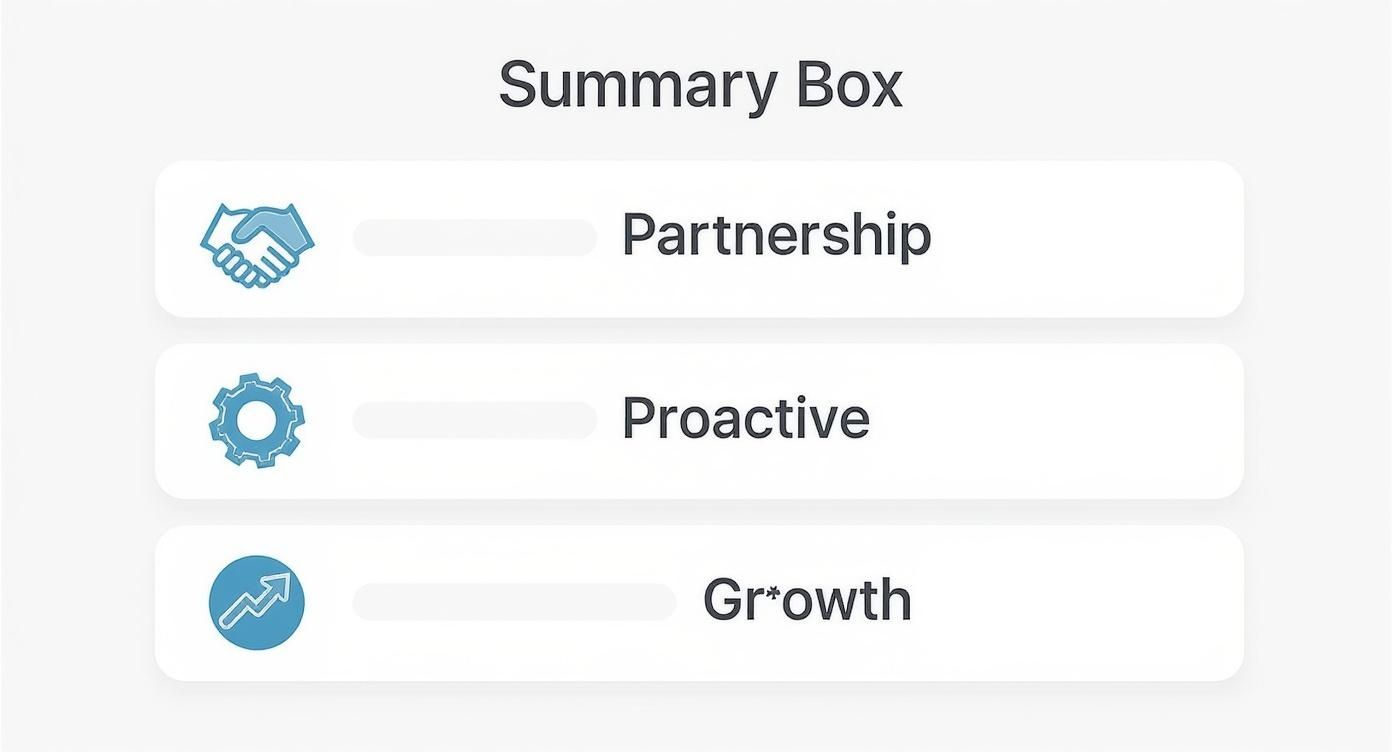
As you can see, the focus is on a true partnership that delivers proactive maintenance to fuel sustainable business growth. It's about looking ahead, not just fixing what's broken today.
Moving Beyond Basic Break-Fix Support for Salesforce
The difference between basic support and a managed service is night and day. Basic support is reactive; you call when something is broken. A Salesforce managed service, on the other hand, is proactive and holistic, covering:
- Continuous Improvement: Regularly identifying opportunities to improve workflows in Sales Cloud, automate tedious tasks with Flow, and roll out new Salesforce features that will actually benefit your team.
- Strategic Guidance: Aligning your Salesforce roadmap with your long-term business objectives. This ensures your technology investment delivers real, measurable returns.
- User Enablement: Providing ongoing training and support to boost user adoption and make sure your team is getting the most out of Sales Cloud, Service Cloud, or any other part of the platform.
This model is gaining serious momentum for a reason. The Australian managed services market is projected to grow from USD 2.46 billion in 2024 to an estimated USD 4.34 billion by 2032, a surge driven by the need for greater organisational efficiency.
Why A Salesforce Partnership Approach Matters
A true managed solution is built on a deep understanding of your unique business challenges. It’s not just about technical Salesforce skill; it’s about applying that expertise to your specific industry, sales processes, and customer service goals.
A managed service isn't an expense; it's an investment in maximising the return on your existing Salesforce licence fees. It ensures the platform you've already paid for is fully utilised, adopted, and optimised for success.
For organisations just starting out, a clear implementation plan is the first step toward this level of optimisation. If you're in that planning phase, you might find our Salesforce implementation guide for Australian businesses helpful for building a strong foundation.
By partnering with a dedicated Salesforce team, you gain instant access to a wealth of experience and best practices, helping you avoid common pitfalls and fast-track your journey to a powerful, growth-driving CRM.
The Core Services That Drive Salesforce Success
So, what does a partnership built around CRM managed solutions actually look like day-to-day? It’s far more than a simple support contract; think of it as a proactive engagement structured around four key pillars. These services work in tandem to ensure your Salesforce platform isn't just kept running, but is constantly being optimised for business growth.
It helps to think of it like the dedicated crew behind a high-performance race car. One person monitors engine health, another tunes the suspension for the specific track conditions, a third coaches the driver on technique, and a fourth plans the overarching race strategy. Each role is distinct but interconnected, all driving towards the same goal: winning the race.
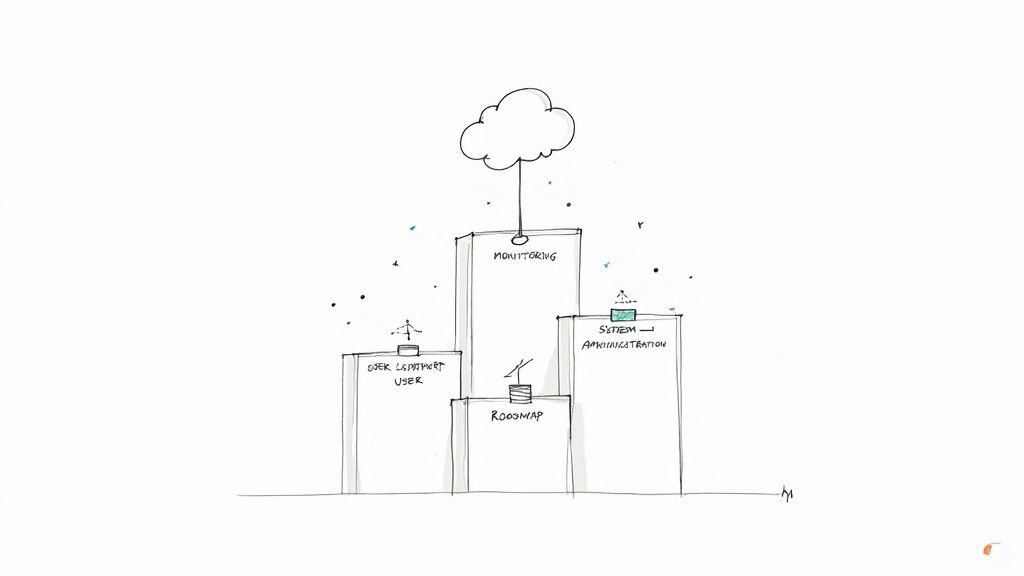
Let’s pop the hood and look at these four pillars of a comprehensive managed service for Salesforce.
Proactive Salesforce Health Monitoring
This is the bedrock of a reliable CRM. Instead of waiting for a frantic call from a user that a critical integration has failed, proactive monitoring spots and fixes issues before they can ever affect your business operations. A managed solutions partner is your system’s first line of defence.
Imagine your sales team in the middle of a crucial end-of-quarter push. Suddenly, a data sync error between Salesforce and your accounting system stops new deals from being processed. With proactive monitoring, alerts would have flagged the underlying API issue hours earlier, giving the managed services team time to resolve it before anyone in sales was even aware there was a problem.
Strategic Salesforce Administration
This pillar moves far beyond the basic admin tasks like adding new users or resetting passwords. Strategic administration is all about continuously refining and customising your Salesforce environment so it aligns perfectly with how your business actually works. It’s about turning your platform into a perfectly fitted tool for your team.
This could mean things like:
- Workflow Automation: Building custom flows in Sales Cloud to automate a complex, multi-stage quoting process, saving each sales rep hours every week.
- Data Integrity: Putting validation rules and duplicate management protocols in place to ensure the data your team relies on for decisions is clean and accurate.
- Security Enhancements: Regularly reviewing and updating user profiles, permission sets, and sharing rules to keep sensitive customer information locked down.
By entrusting administration to experts, you ensure system changes are implemented following Salesforce best practices. This is crucial for preventing the build-up of "technical debt" that can bog down performance and make future enhancements a nightmare.
This level of deep customisation and ongoing improvement is a core part of effective Salesforce management. Our expert team specialises in this area; you can explore our full range of Salesforce consulting services to see how we help businesses get the most out of their platforms.
Dedicated User Support and Enablement
A powerful CRM is only effective if your team knows how to use it. User adoption remains one of the biggest hurdles to getting a positive return on your Salesforce investment. Dedicated support gives your team a reliable expert to turn to for questions, training, and troubleshooting.
But this isn't just a helpdesk. It's an enablement service that helps your team get comfortable with new features and find more efficient ways to work. For example, when a new feature is rolled out in Service Cloud, the managed partner can provide targeted training sessions and quick-reference guides. This ensures a smooth transition and immediate productivity gains, transforming user frustration into confidence.
Strategic Roadmapping and Advisory
Finally, the most forward-looking pillar is strategic roadmapping. A true partner doesn’t just maintain the system you have today; they help you plan for its future. They sit down with your leadership to understand your long-term business goals and translate them into an actionable Salesforce roadmap.
This involves regular strategic reviews to discuss upcoming business initiatives, industry trends, and new Salesforce releases. For instance, if your company plans to expand into a new market segment next year, your managed partner will help you map out the necessary Salesforce enhancements to support that growth. This could mean customising lead routing in Sales Cloud, integrating a new marketing tool like Account Engagement, or building out new reporting dashboards. It’s about making sure your technology investment continues to drive your business strategy forward, not hold it back.
Real-World Benefits of a Managed CRM for Salesforce
Let's move past the technical jargon and talk about what really matters to business leaders: tangible results. The true value of a CRM managed solution is measured by the impact it has on your bottom line. A managed approach isn’t just about using Salesforce; it's about making sure it’s fully optimised to drive a serious return on your investment.
The Australian CRM market is booming, currently valued at around USD 1.73 billion. This isn't just a fleeting trend. It shows that Aussie organisations are actively seeking integrated solutions that deliver real, measurable results across their sales, marketing, and service departments.

Boosting Salesforce ROI and User Adoption
One of the quickest wins you'll see is getting the maximum value out of your Salesforce licence fees. It's a common story: companies pay for all this incredible functionality, but a huge chunk of it goes unused simply because the in-house team doesn't have the time or deep expertise to implement it. This is precisely the gap a managed partner fills.
They focus relentlessly on driving user adoption. This isn't just about a one-off training session; it's about continuous coaching and tweaking the system to make it more intuitive for your specific workflows. When your team sees that Sales Cloud genuinely makes their day-to-day job easier, adoption rates skyrocket. And that directly translates to a much higher ROI.
Enhancing Operational Efficiency
Imagine freeing up your internal team from the constant, reactive grind of Salesforce administration. When you offload the day-to-day management, your people can finally focus on what they do best. Instead of your IT crew or a designated "Salesforce admin" being bogged down with minor fixes and user requests, they can get back to strategic initiatives that actually push the business forward.
Ultimately, a massive benefit of a managed CRM is its power to help you streamline business processes. This shift from reactive firefighting to proactive optimisation allows your entire organisation to run like a well-oiled machine.
Case Study: A Service Cloud Transformation
The Challenge: A mid-sized professional services firm was struggling with customer support. Their team was using a basic Salesforce Service Cloud setup, but case resolution times were painfully high, and customer satisfaction scores were in a nosedive. They were drowning in manual tasks and had zero visibility into key performance metrics.
The Solution: A managed solutions partner was brought in to optimise their Service Cloud instance. The partner immediately got to work, rolling out several key optimisations:
- Automated Case Routing: They set up Omni-Channel to automatically assign incoming cases to the right support agent based on their skills and current workload. No more manual triage.
- Knowledge Base Integration: They implemented a Salesforce Knowledge base, giving agents instant access to solutions for common problems right within the console.
- Custom Dashboards: They built new, real-time dashboards for support managers to track case volume, resolution times, and agent performance at a glance.
The Results:
Within just three months, the firm saw a 40% reduction in average case resolution time. This didn't just make customers happier; it also boosted the support team's capacity without needing to hire more people.
This is a perfect, real-world example of how managed services deliver concrete business value. The investment paid for itself through better efficiency and customer retention. You can dive into similar success stories in our Salesforce case studies, which show how we've helped other businesses achieve incredible results.
A managed CRM partnership is about turning your Salesforce platform from a cost centre into a strategic asset—one that actively fuels your company's growth and success.
Future-Proofing Your Business with Salesforce Einstein AI
Artificial intelligence isn't some far-off concept anymore; it's a real competitive edge just waiting to be switched on inside your Salesforce platform. But for many organisations, the sheer complexity of AI can feel like a mountain too high to climb. This is exactly where a CRM managed solutions partner steps in, acting as your expert guide to turn complex AI capabilities into tangible business results.
Think of Salesforce Einstein as an incredibly smart co-pilot for your business. It has the power to sift through enormous amounts of data to predict outcomes, suggest the next best action, and even automate decisions. But like any sophisticated tool, it needs to be set up, trained, and fine-tuned to understand the unique context of your business. A managed partner is the one who handles all that heavy lifting for you.

Putting Salesforce AI into Action
A good managed solutions partner doesn't just talk theory; they roll up their sleeves and implement AI to solve your actual business challenges. They’ll work alongside you to pinpoint the opportunities where AI can make the biggest impact on your efficiency and growth.
This hands-on approach is what ensures your investment in technology translates into real gains, keeping your organisation a step ahead of the competition. It's about making AI work for you, not the other way around.
The real value of a managed partner in the AI space is their knack for connecting powerful tech to your business goals. They make sure Einstein AI isn't just another feature you’ve ticked a box for, but a strategic asset that’s actively boosting your performance.
The fusion of AI and predictive analytics within Salesforce is a major trend, allowing Australian companies to automate tedious tasks, get a better read on customer behaviour, and forecast what's coming next. Features like intelligent lead scoring and chatbots are becoming the new standard, leading to more personalised customer interactions and improved satisfaction.
Practical AI Use Cases Driven by a Partner
So, what does this actually look like day-to-day? A managed services team can configure and tweak Salesforce Einstein to get you solid results across sales, service, and marketing.
For Your Sales Team (Sales Cloud):
- Predictive Lead Scoring: Instead of your team treating every lead the same, Einstein can analyse past data to score new leads on their likelihood to convert. A partner sets this up so your sales reps can focus their energy on the hottest prospects, which can seriously boost conversion rates.
- Opportunity Insights: The system can act as a proactive coach for every sales rep, flagging deals that are at risk, highlighting key moments in the sales cycle, and even suggesting the next move to keep the momentum going.
For Your Service Department (Service Cloud):
- Automated Case Classification & Routing: Einstein can read an incoming support ticket, understand its intent, and automatically route it to the agent with the right skills. This speeds up resolution times and makes for a much smoother customer experience.
- Recommended Solutions: When an agent opens a case, AI can instantly pull up relevant articles from your Salesforce Knowledge base. This cuts down on research time and helps ensure customers get consistent answers.
For Your Marketing Efforts (Marketing Cloud/Account Engagement):
- Personalised Customer Journeys: In Marketing Cloud, a partner can use AI to build dynamic customer journeys that adapt in real-time. Based on what a customer does, the system delivers the right message at the perfect moment.
Keeping up with these powerful features is vital. As Salesforce continues to evolve, a partner makes sure you’re ready for whatever comes next. To get a feel for the latest advancements, you can read our summary of the highlights of the Salesforce Winter '25 Release. By teaming up with experts, you’re not just keeping pace with technology—you’re using it to build a genuine, lasting competitive advantage.
How to Choose the Right Salesforce Managed Solutions Partner
Picking a partner for your CRM managed solutions is a critical decision for the long-term success of your Salesforce platform.
Get it right, and your partner becomes a true extension of your team, bringing strategic insights and deep expertise to the table. Get it wrong, and you could be looking at stalled projects, mounting technical debt, and a whole lot of user frustration.
You need to dig deeper than a quick glance at a website and ask the tough questions that reveal a provider's real capabilities and how they actually work with their clients.
Assess Their Technical Expertise and Certifications
First things first: check their Salesforce credentials. Any partner worth their salt will be completely transparent about their team's qualifications and proud to show them off. Don't just settle for a generic "Salesforce Certified" badge on their website—dig in.
Ask them specifically about their team's certifications across different Salesforce products. Do they have certified pros in Sales Cloud, Service Cloud, or Marketing Cloud Account Engagement? If you’ve got specific needs like CPQ or Field Service, make sure they have people with proven expertise in those niche areas.
A partner with a broad range of certifications shows a real commitment to the Salesforce ecosystem. It tells you they have a deep bench of talent ready to tackle complex challenges, not just the basic admin stuff.
Evaluate Their Industry and Project Experience
Technical chops are crucial, but that's only half the equation. The best partners don't just know how Salesforce works; they know how it works for a business like yours. Look for a provider with a solid track record of successful projects in your specific industry.
Read their case studies and testimonials with a critical eye. Do the challenges they describe sound familiar? Do the results they're celebrating match up with what you want to achieve? This is the best proof you'll get that they can turn technical features into tangible business value.
For anyone new to the platform, getting a handle on the basics is a huge help. For example, a good step-by-step guide to Salesforce setup can give you a solid foundation before you even start talking to potential partners.
Analyse Their Engagement Model and Communication Style
At the end of the day, a successful partnership comes down to clear communication and a flexible way of working together. You need to know exactly how they’ll integrate with your team. Is their style collaborative, or do they prefer to work in a silo?
During your chats, pay close attention to how they communicate. Are they responsive and easy to talk to? Do they actually listen to your needs, or do they jump straight to pitching a pre-packaged solution? A real partner takes the time to understand your unique business before they start making recommendations.
Checklist for Evaluating a CRM Solutions Partner
This hands-on checklist is designed to guide your assessment and comparison of potential Salesforce managed services providers. Use it to structure your conversations and make sure you're covering all the important bases.
| Evaluation Criteria | Key Questions to Ask | What to Look for in a Response |
|---|---|---|
| Technical & Certification | Can you walk me through your team's Salesforce certifications? Do you have specialists in [Your Specific Cloud, e.g., Sales Cloud, CPQ]? | A confident, detailed list of certifications. They should be able to point to specific team members with relevant expertise. |
| Industry Experience | What experience do you have in the [Your Industry] sector? Can you share a case study of a similar project? | Specific examples and results from your industry. They should talk about industry-specific challenges and how they solved them. |
| Project Methodology | How do you manage projects? What's your process for gathering requirements and providing updates? | A clear, structured methodology (e.g., Agile, Scrum). Look for transparency and a process that includes regular client feedback. |
| Communication & Cadence | What does your standard communication look like? Who will be our main point of contact? | A defined schedule (e.g., weekly check-ins, monthly strategy meetings) and a clear point of contact. Avoid vague answers. |
| Support & Escalation | How do you handle urgent requests or after-hours emergencies? What's your escalation process? | A well-defined process for urgent issues. You want to know there's a plan in place before you need it. |
| Cultural Fit & Partnership | How do you see your role as our partner? How do you measure success for your clients? | Answers that focus on collaboration, strategic guidance, and achieving your business goals—not just closing tickets. |
The answers to these questions will reveal a lot about what it’s really like to work with them day-to-day. You’re looking for a proactive, transparent team that is genuinely invested in your success.
Your Next Steps Toward Salesforce Excellence
It’s easy to look at CRM managed solutions and see an operational cost. That’s a common mistake, but it misses the entire point. A better way to think about this is as a strategic investment—an investment in continuous improvement, innovation, and genuine business growth. The right Salesforce partner takes your platform from being a powerful but mostly static tool and turns it into a living, breathing driver of your commercial strategy.
This whole journey is about unlocking the potential that’s already sitting there inside your Salesforce investment. It’s a shift in mindset from simply maintaining the system to constantly optimising it.
Embracing a Strategic Salesforce Partnership
The benefits we’ve talked about aren't just hypotheticals; they are real, tangible results that businesses see when they commit to a proactive management approach. A dedicated expert partner brings the focus, experience, and forward-thinking vision you need to make it happen.
Think about the key advantages of this model:
- Maximised ROI: You’ll finally get your money’s worth from every dollar spent on Salesforce licences by making sure features are actually being used and your team is fully on board.
- Strategic Agility: As your business goals change, your Salesforce instance changes with them. This allows you to pivot quickly and confidently when new market demands pop up.
- Future-Ready Operations: You'll be ahead of the curve, proactively integrating new advancements like AI and automation, which helps secure your competitive edge for years.
A managed solution transforms your CRM from a reactive administrative burden into a proactive engine for growth. It’s the difference between merely running your business and actively building its future.
Now is the time to take a hard look at your current approach. Are you getting the absolute most out of your Salesforce platform, or is there a mountain of untapped potential just waiting to be unlocked? If you’re serious about hitting your most ambitious business goals, the next logical step is to explore what a dedicated expert partnership could do for you.
At Adaptal, we are the partner ready to help you realise the full value of your investment. To see how we can design a managed solution for your specific needs, we invite you to contact our team of Salesforce experts for a consultation.
FAQ: Common Questions About Salesforce Managed Solutions
Diving into the world of CRM managed solutions always brings a few questions to the surface for business leaders. Getting your head around the answers is key to seeing the real strategic value this kind of partnership can offer, especially when you're running on Salesforce. Let's clear up some of the usual queries.
How is a managed service different from basic Salesforce support?
This is the most important distinction. Basic tech support is purely reactive—it’s a break-fix service. An automation fails, you log a ticket, and they fix that specific problem. It's essential, but it’s limited.
A managed solution, on the other hand, is proactive and strategic. It’s not about waiting for things to go wrong; it’s about continuous improvement, mapping out a strategic plan for your future growth, and making sure your whole team is empowered to get the most out of your Salesforce investment.
The core difference is the mindset: tech support fixes today's problems, while a managed solution builds tomorrow's success.
Are Salesforce managed solutions only for large enterprises?
Not at all. This is a common myth that unfortunately holds a lot of smaller businesses back. The truth is, a scalable managed service model is often even more valuable for small and mid-sized businesses (SMBs).
Hiring a full-time, senior Salesforce administrator or developer is a massive expense. A managed solutions partner gives you access to that same top-tier, enterprise-level expertise but at a fraction of the cost. You get an entire team of specialists—admins, developers, strategists—all for a predictable monthly fee. It completely levels the playing field.
How do you measure the ROI on these services?
The return on investment for a CRM managed solution is tracked through clear, tangible business metrics that directly impact your bottom line. We skip the jargon and focus on the performance indicators that actually matter.
We track success through things like:
- Improved User Adoption Rates: Ensuring your team is actively and effectively using the platform, so you're not wasting a cent of your licence fees.
- Faster Sales Cycles in Sales Cloud: By automating workflows and providing better data, we help shorten the time from lead to closed deal.
- Reduced Administrative Overhead: We take the tedious CRM tasks off your team's plate, freeing them up to focus on big-picture initiatives.
- Increased Customer Retention: Optimising your Service Cloud and customer interaction workflows means you end up with happier, more loyal customers.
Ultimately, every action we take as your managed partner is tied directly back to driving efficiency, boosting revenue, and improving your overall business performance.
At Adaptal, we don't just offer a service; we build strategic partnerships designed to unlock the full potential of your Salesforce investment. Ready to see what a proactive, expert-led approach can do for your business? Explore our Salesforce Managed Services and book a consultation today.