

Let’s cut through the buzzwords. A customer single view (SCV) is the complete story of every customer. From our project experience, it’s about taking all the scattered pieces of their journey—a website visit, a sales call in Sales Cloud, a support ticket in Service Cloud, or a marketing email click in Marketing Cloud—and unifying them into one coherent, actionable profile inside Salesforce.
This isn’t just a data project; it’s the foundation of a modern, effective customer relationship strategy and a core part of any successful digital transformation.
What a Customer Single View Really Means for Your Business
Imagine trying to solve a puzzle with pieces scattered across different rooms. That’s a common challenge we see businesses face with their customer data. Marketing has its pieces, sales has another pile, and the service team holds a few more. This separation creates a fractured, disjointed experience for the very people you’re trying to serve.
A customer single view isn’t just another technical term; it’s a strategic necessity. It solves the incredibly common—and costly—problem of data silos, where each department only sees a fraction of the customer’s story. Without that unified profile, your teams are essentially working in the dark, and your Salesforce investment isn’t delivering its full potential.
The Real-World Cost of Disconnected Data
When customer data is fragmented, the consequences ripple across the entire business and are felt directly by your customers. The disconnect leads to significant inefficiencies and missed opportunities.
Here’s a classic challenge we’ve helped clients solve: a sales rep calls a high-value client to upsell a new service, completely unaware that the client has an unresolved, high-priority support ticket open in Service Cloud. The sale is now in jeopardy, and the entire customer relationship is damaged. This kind of misstep happens all the time without a unified view.
In Australia, fragmented data is a major roadblock to a good customer experience. Research shows that while customers interact across up to seven different channels, it can take an average of 5.2 days to resolve their issues because of these disjointed systems. Over the last year, this inefficiency led to Australians spending a staggering 123 million hours just waiting for resolutions. (Learn more about Australian customer experience trends)
To put it into perspective, here are the common before-and-after scenarios businesses experience when implementing a single customer view in Salesforce.
The Business Impact Before and After a Customer Single View
| Business Challenge (Without SCV) | Salesforce Solution (With SCV) |
|---|---|
| Teams have a fragmented view, leading to inconsistent customer interactions and missed opportunities. | Everyone gets a complete, 360-degree view of the customer, enabling consistent, personalised experiences. |
| Marketing sends generic campaigns that don’t resonate because they lack full context on customer behaviour. | Campaigns are highly targeted and relevant, based on a customer’s entire history and real-time behaviour. |
| Sales reps waste time piecing together information and risk contacting customers at the wrong moment. | Sales conversations are smarter and more effective, armed with full knowledge of past purchases and service issues. |
| Customer service agents have to ask customers to repeat their issues, causing frustration and delays. | Support agents can see the entire customer history at a glance, resolving issues faster and even anticipating future needs. |
| It’s nearly impossible to measure the true lifetime value or overall satisfaction of a customer. | Accurate reporting and analytics provide deep insights into customer value, loyalty, and business performance. |
The contrast is stark. Moving to a unified view doesn’t just fix problems; it unlocks entirely new ways of operating and drives growth.
Why a Unified View Is the Foundation for Growth
A true customer single view, powered by a platform like Salesforce Data Cloud, shifts your operations from reactive to proactive. Your teams can finally deliver the exceptional experiences customers expect because they have the complete context of every interaction. You can learn more about how to bring your data together effectively with our guide to Salesforce Data Cloud.
This unified approach brings clear advantages:
- Personalised Marketing: Campaigns become relevant and timely because they’re based on a customer’s complete history, not just one isolated action.
- Smarter Sales Conversations: Your sales team can engage with prospects and customers with full awareness of their previous purchases, service issues, and marketing engagement.
- Anticipatory Service: Support agents can see a customer’s entire history at a glance, letting them solve problems faster and anticipate future needs without making the customer repeat themselves.
Ultimately, achieving a customer single view is about building stronger, more profitable relationships. It’s the engine that drives loyalty by ensuring every interaction is consistent, informed, and genuinely valuable.
The Blueprint for a Salesforce Customer Single View
Building a reliable single customer view isn’t magic; it’s the result of smart architecture and a clear technical strategy. To create that complete picture within the Salesforce ecosystem, you need a solid blueprint that maps how data flows from all your different systems into one unified profile. From our experience as a Salesforce partner, this blueprint is the technical foundation for turning raw data into your most valuable business asset.
Think of it like building a house. You’d never start construction without architectural plans. Your blueprint must account for every source of customer information, from your website and marketing tools right through to your internal ERP systems.
This diagram shows how different data sources flow into a central, unified customer profile, forming the core of the single customer view.
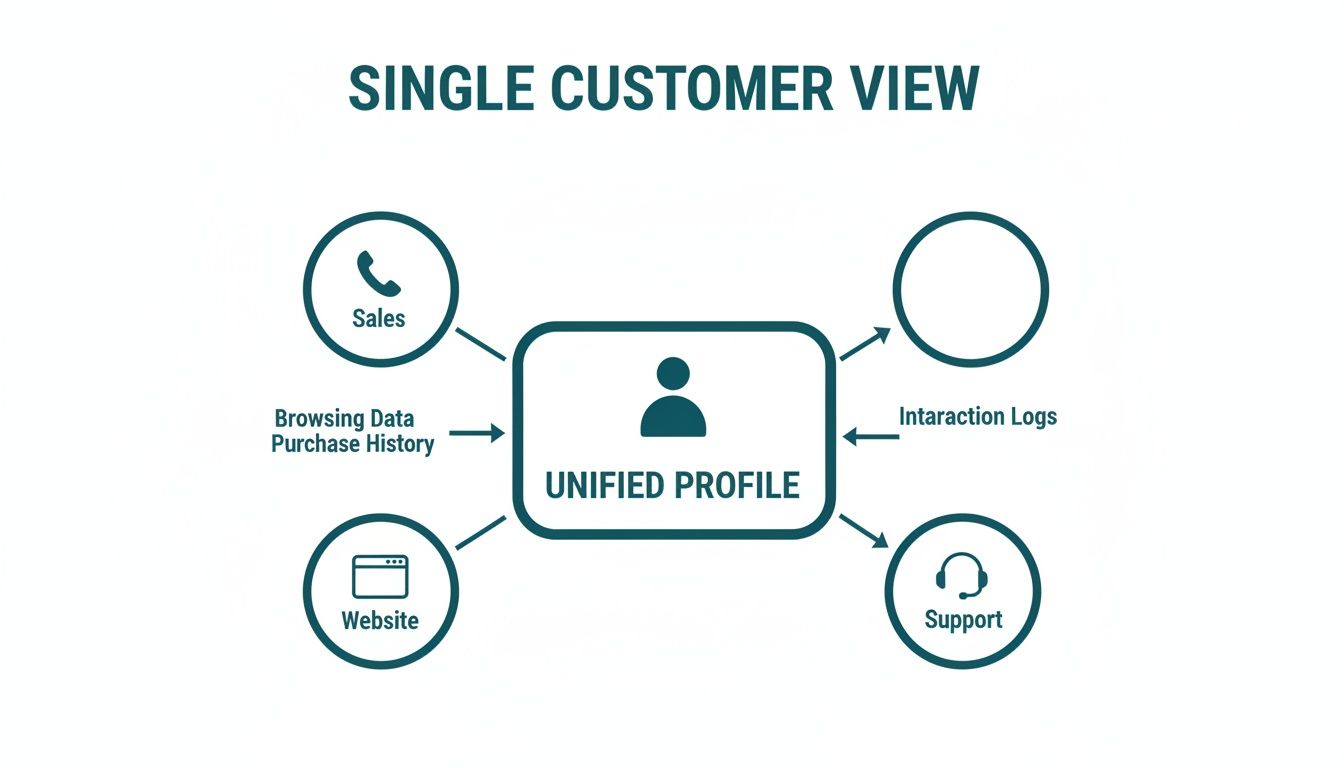
As you can see, the goal is to bring all those disparate interaction points together into a single, trustworthy record that your entire organisation can use to drive automation and insights.
Key Ingredients of the SCV Blueprint
A successful blueprint boils down to three core components: defining your data sources, choosing the right integration methods, and establishing a robust data model. Getting these elements right from the start is non-negotiable for success.
1. Identifying Your Data Sources
First, you need to map out every place a customer interacts with your business. These sources are the raw ingredients for your SCV and typically include:
- CRM Data: Information from Salesforce Sales Cloud and Service Cloud, like contact details, support tickets, and sales activities.
- Marketing Platforms: Engagement data from tools like Marketing Cloud or Account Engagement (Pardot), including email opens, clicks, and campaign responses.
- E-commerce and Websites: Transaction histories, browsing behaviour, and abandoned carts.
- Backend Systems: Data from your ERP or accounting software that provides a view of invoicing and payment history.
2. Choosing Integration Methods
Once you know where your data lives, you need to connect these systems to Salesforce. Effective system integration is the plumbing that allows information to flow freely, and it’s a critical piece of any successful digital transformation. You can find out more by exploring the fundamentals of what is system integration.
Your options usually fall into two camps:
- APIs (Application Programming Interfaces): These are perfect for real-time data exchange, making sure information is always up to date.
- ETL (Extract, Transform, Load): These tools are fantastic for migrating large volumes of data from legacy systems in scheduled batches.
The Central Role of Salesforce Data Cloud and Identity Resolution
At the heart of a modern SCV blueprint is a powerful processing engine like Salesforce Data Cloud. It acts as the central hub where all this incoming data is ingested, cleansed, harmonised, and ultimately unified into that single, reliable profile for each customer.
The core process that makes the SCV possible is identity resolution. This is the intelligent mechanism that connects all the different “bread crumbs” a customer leaves behind and understands they all belong to the same person.
For example, identity resolution figures out that jane.doe@email.com from a marketing campaign and a phone number from a sales call both belong to Jane Doe. It uses a combination of deterministic matching (using unique identifiers like an email) and probabilistic matching (using related data points like a name and city) to build an accurate identity graph. When crafting this blueprint, leveraging expert CRM software development services can help tailor these identity resolution rules to your specific business logic.
A well-designed blueprint isn’t just a technical document. It’s a business strategy that ensures the insights your teams rely on are built on a foundation of clean, connected, and trustworthy data—which translates directly into better decisions and superior customer experiences.
Unifying Sales, Service, and Marketing Cloud Data
Theory is one thing, but seeing a customer single view in action within Salesforce is where its value truly clicks. Here, we move from the blueprint to reality, connecting the core Salesforce Clouds—Sales, Service, and Marketing—to create a seamless flow of information that empowers every team. This is the practical application that turns siloed data into coordinated, intelligent customer engagement.
We’ve seen the alternative in many projects. The business challenge is a familiar one: a company with disconnected teams. Marketing sends a generic promotional campaign. At the same time, the sales team has no idea one of its key accounts has two unresolved, high-priority support tickets. To make matters worse, the service team is blind to the fact that this frustrated customer just made a significant purchase last week.
Each team is operating with only a fraction of the story. This disconnect isn’t just inefficient; it actively damages the customer relationship. This is the exact problem a unified customer single view built on Salesforce is designed to solve.
A Story of Transformation with Salesforce
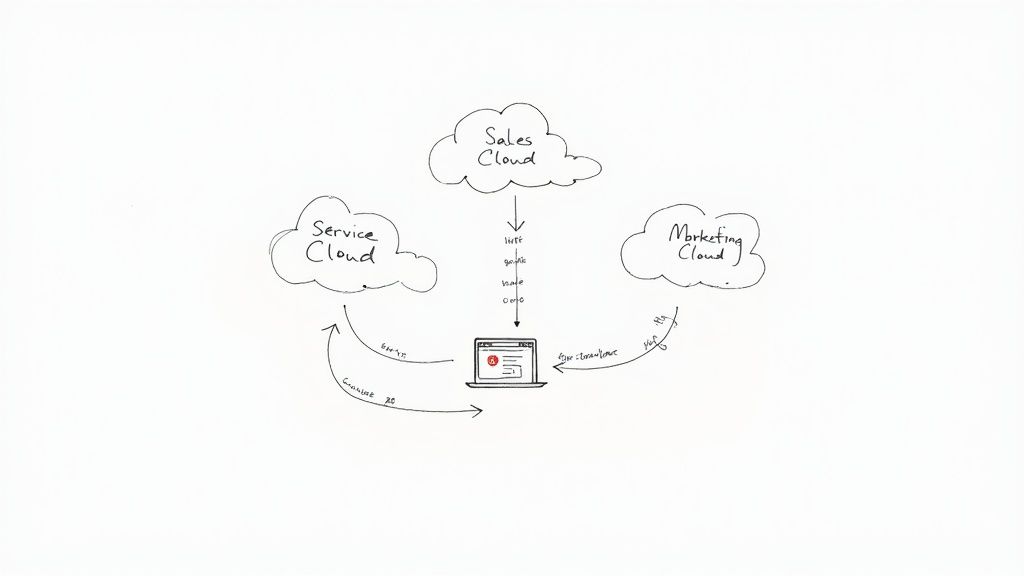
Now, let’s look at the Salesforce solution. With an integrated platform connecting Sales Cloud, Service Cloud, and Marketing Cloud, we create a central nervous system for all customer data. A deep understanding of effective approaches to data integration is essential, as it forms the technical backbone of the entire solution.
Here’s how the situation unfolds with the Salesforce solution implemented:
- A Service Case is Created: The high-value customer logs a support ticket in Service Cloud. Instantly, an automated workflow triggers two critical actions.
- Sales Cloud is Alerted: The account owner in Sales Cloud receives an immediate notification about the high-priority case. Their dashboard now flags the account as “At Risk,” stopping them from making an ill-timed sales call.
- Marketing Cloud Pauses Communication: Simultaneously, the customer is automatically pulled from the generic promotional journey in Marketing Cloud. Instead of an irrelevant offer, they might receive a simple, empathetic message acknowledging their issue is being handled.
The results and benefits are immediate. The sales team is armed with full context, the service team sees the customer’s purchase history, and marketing avoids alienating a crucial client. This coordinated response is only possible when data flows freely between clouds.
The goal is to move from departmental monologues to a single, unified company conversation with the customer. Every interaction should build upon the last, regardless of which department is leading it.
How Each Cloud Contributes to the Unified View
Connecting these platforms is the key to delivering the consistent, context-aware experiences that define a true customer single view. Each cloud plays a specific role but contributes to the greater whole, creating a powerful synergy. The right strategy for connecting your https://adaptal.com.au/salesforce-marketing-clouds/ ensures your campaigns are always informed by the latest sales and service insights.
Here’s a breakdown of how each Salesforce Cloud feeds into the unified view and the specific benefits your teams will see.
Data Flow and Team Benefits Across Salesforce Clouds
| Salesforce Cloud | Data Contribution to SCV | Resulting Business Benefit |
|---|---|---|
| Sales Cloud | Contact details, opportunity history, lead sources, and all sales activities and interactions. | Provides marketing and service teams with a clear view of a customer’s commercial relationship and value. |
| Service Cloud | All support cases, resolution times, customer feedback, and communication history. | Informs sales and marketing of customer satisfaction levels, preventing poorly timed outreach. |
| Marketing Cloud | Campaign engagement, email opens/clicks, website behaviour, and communication preferences. | Gives sales and service teams insight into what topics and products a customer is interested in right now. |
This seamless information exchange proves that the whole is far greater than the sum of its parts. By unifying your core Salesforce platforms, you don’t just organise data—you create an intelligent, responsive organisation that places the customer at the absolute centre of every decision.
How Australian Industries Win with a Unified Customer View
A Single Customer View comes to life when it solves real-world business problems. Its true value isn’t in the technology itself, but in how it’s applied to fix unique operational headaches and open up new doors for growth.
Let’s look at how a unified view of the customer, powered by Salesforce, delivers tangible results for different Australian businesses. These project examples show how connecting the dots in your data can give you a massive competitive edge.
Professional Services: A New Angle on Client Relationships
In professional services, the client relationship is everything. The problem is, that relationship is often fractured across different parts of the business. Tax, audit, and advisory teams might all work with the same client, but their insights are trapped in separate silos.
The Business Challenge
A national accounting firm was struggling to cross-sell its services. An advisory partner had no visibility that another team was already solving a client’s tax compliance issues. This blind spot meant they were missing chances to offer holistic advice.
The Salesforce Solution
By building a Single Customer View, the firm pulled data from every practice area into a single, unified Account record in Salesforce Sales Cloud. Now, before a meeting, any partner can see a complete history of every engagement, open opportunity, and past conversation from across the entire firm.
The Results and Benefits
The result was a 15% jump in cross-practice referrals in the first year alone, driven by better data visibility. This complete picture transforms a client meeting into a strategic conversation. Instead of discussing one service line, partners can proactively suggest solutions, reinforcing their role as a trusted advisor.
Construction: Connecting the Site to the Sales Office
The construction industry juggles complex relationships with clients, subcontractors, and suppliers, often spread across multiple job sites. Information lives in different places—site progress in one system, client financials in another.
The Business Challenge
For one commercial construction company, their project managers and sales teams were completely out of sync. A salesperson might discuss a new project timeline with a client, unaware that on-site delays logged in Salesforce Field Service were about to impact that schedule. This disconnect was eroding client trust.
The Salesforce Solution
We integrated their Field Service data directly into the client’s Account and Opportunity records in Sales Cloud, creating a live Single Customer View. Now, the sales team sees real-time updates from the field—including work orders and service reports—right alongside the client’s commercial history.
The Results and Benefits
This simple connection allows for proactive communication. If there’s a delay on-site, the sales team gets an automatic heads-up and can manage client expectations immediately. It builds credibility and turns potential problems into moments to demonstrate excellent service.
Healthcare: Creating a Better Patient Journey
In healthcare, the patient experience is paramount, but data privacy and compliance add layers of complexity. Clinics often struggle to bring appointment data, communication preferences, and billing history together into a single, compliant record.
The Business Challenge
A multi-location healthcare clinic was dealing with frustrated patients due to fragmented information. A patient would update their contact details at one clinic, only to have appointment reminders from another location sent to their old address, causing confusion and administrative work.
The Salesforce Solution
Using Salesforce Health Cloud, the clinic built a secure Single Customer View for each patient. This unified profile brings everything together—appointment history, communication preferences, billing status—all while adhering to strict privacy rules. An update made at any location is now instantly reflected across the entire system.
The Results and Benefits
This transformed the patient journey. Patients receive consistent, accurate information, and the admin team can solve queries in moments. This unified view is the bedrock for delivering the seamless, trustworthy care that modern patients expect.
Your Implementation Roadmap to a Customer Single View
Embarking on a customer single view project is a significant initiative, but it doesn’t have to be overwhelming. From our project experience, the secret to a successful, low-risk implementation is a structured, phased approach. Instead of a risky ‘big bang’ launch, we guide our clients through a proven method that builds momentum and sets them up for long-term success with Salesforce.
Think of it as building a house: you lay a solid foundation first. This roadmap breaks the process down into four manageable stages.
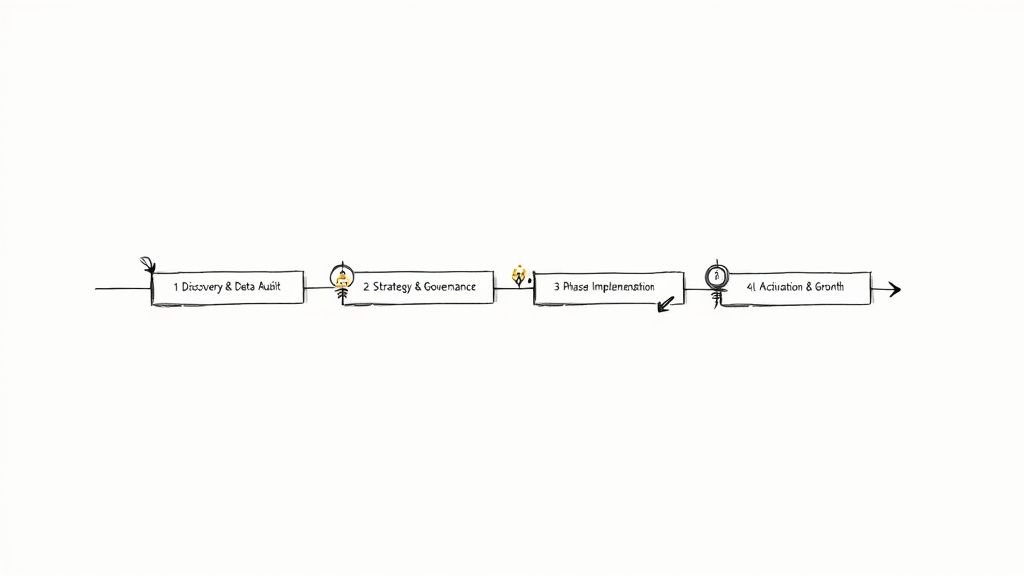
Stage 1: Discovery and Data Audit
Before unifying your data, you need to know what you have and where it lives. This first phase is about investigation. We work with your teams to identify every system holding a piece of the customer puzzle—from your core Salesforce Clouds to third-party marketing tools, ERPs, and spreadsheets.
The goal is a complete data inventory. This audit highlights data quality, consistency, and completeness, uncovering duplicates, conflicting information, or gaps. This clarity is the first step toward building an SCV you can trust.
Stage 2: Strategy and Governance
With a clear map of your data landscape, it’s time to define the rules. This is where we build your data governance framework—a set of standards for how customer data is collected, stored, managed, and unified. Skipping this step is a common pitfall that often leads to a “garbage in, garbage out” situation.
In this stage, we help you answer critical questions:
- What defines a “golden record”? We’ll establish rules for identity resolution, deciding how to merge profiles and which data source is the source of truth.
- Who owns the data? We assign clear ownership and stewardship roles within your organisation to maintain data quality.
- How will we keep it clean? We define processes for ongoing data cleansing and enrichment, so your SCV stays accurate.
A strong governance strategy is the backbone of a successful customer single view. It ensures that the data you unify is not just connected, but also clean, consistent, and trusted by every team in your business.
Stage 3: Phased Implementation
Now the technical build begins, but strategically. A phased implementation delivers early wins by starting with the most critical integrations first. This approach allows your organisation to see the value of a customer single view in action, building momentum and internal support.
For instance, a typical first phase might include:
- Unifying Core Salesforce Clouds: We connect Sales Cloud and Service Cloud data, giving your sales and support teams immediate visibility into each other’s activities.
- Integrating a Key Marketing Platform: We then pull in marketing engagement data, giving sales crucial context on what a customer is currently interested in.
This iterative process reduces risk and allows for adjustments. As a dedicated Salesforce implementation consultant, we specialise in designing these phased rollouts to ensure a smooth project from start to finish.
Stage 4: Activation and Growth
The final stage is about empowering your teams and measuring what matters. A perfectly built SCV is useless if your people don’t know how to use it. This involves hands-on training to ensure everyone understands the new unified profiles and how to apply them in their day-to-day work.
Alongside training, we help you set up key performance indicators (KPIs) to track the project’s real-world impact. These metrics might include a lift in customer satisfaction scores, a drop in service resolution times, or a boost in cross-sell revenue. This data-driven approach proves the ROI of your investment and helps you spot new opportunities for growth.
Partnering for Success to Maximise Your Salesforce Investment
Achieving a true single customer view is a strategic business initiative, not just an IT project. As we’ve outlined, it requires a deep understanding of the Salesforce platform and your business processes. A unified view of your customer is the key that unlocks better personalisation, smoother operations, and the kind of deep loyalty that builds lasting growth.
The most crucial step? Choosing the right Salesforce partner.
The gap between a successful SCV and a frustrating, costly data project often boils down to the experience of the implementation team. A great Salesforce partner doesn’t just configure software. They bring strategic insight to the table, helping you avoid common traps and maximise the return on your CRM investment.
Why an Experienced Salesforce Partner Is Essential
Building a reliable single source of truth takes more than technical skill. It’s about managing stakeholders, guiding your team through change, and having a battle-tested process for turning complex business needs into a clean, scalable solution inside Salesforce.
An experienced partner adds value in key ways:
- Strategic Guidance: We help you map out clear goals and build the robust data governance framework needed to ensure your SCV is built on a foundation of trust.
- Technical Expertise: With over 110 successful Salesforce implementations, we have the hands-on experience to tackle complex integrations and design a data architecture that works for your business.
- Risk Mitigation: We use a phased approach that delivers early wins, reduces the risks of large digital transformation projects, and ensures you see value quickly.
- Ongoing Support: We’re not the type to build and run. Our Salesforce managed services provide the ongoing support and optimisation you need to ensure your platform evolves with your business.
Choosing a partner is about finding a team that’s genuinely invested in your success. They should feel like an extension of your own team, guiding you from discovery all the way through to long-term growth.
Let’s Start the Conversation
You’ve seen the power a single customer view can bring to your organisation. Now, it’s time to make it a reality.
If you’re wrestling with siloed data, inconsistent customer experiences, or just can’t get clear answers from your Salesforce platform, we can help. As an experienced Salesforce partner, we can help you build a powerful single customer view that drives real business results.
We invite you to contact us for a consultation. Let’s discuss your data challenges and design a solution that unlocks the full potential of your Salesforce investment.
Frequently Asked Questions
Here are a few of the most common questions we hear from business and IT leaders when they’re mapping out a customer single view project in Salesforce.
What Is the Difference Between a Customer Single View and a Standard CRM?
Think of a standard CRM like Salesforce Sales Cloud as a silo of excellence. It’s fantastic at managing specific departmental data, like sales activities or customer service interactions. A true customer single view is bigger. It doesn’t just hold your core CRM data; it pulls in information from all the other places your customers interact with you—your marketing platform, your e-commerce store, your ERP. The aim is to build one master customer record that tells their entire story with your brand.
How Long Does It Take to Implement a Customer Single View in Salesforce?
This depends on the complexity of your data and how many systems you need to connect. For a foundational project—like linking Sales Cloud and Service Cloud—you could be up and running in a few months. If you’re building a more ambitious SCV involving multiple legacy systems and Salesforce Data Cloud, it will take longer. As your Salesforce partner, we recommend a phased approach. This delivers tangible results quickly, ensuring you see a return on your investment sooner.
What Is the Biggest Challenge When Building an SCV?
From our project experience, the biggest hurdle isn’t the technology—it’s establishing data governance. Most organisations have duplicate, incomplete, or conflicting customer data scattered everywhere. The most critical first step is establishing clear rules for data quality and defining a master data source. Without strong governance, you risk unifying ‘dirty’ data, which undermines trust in the system. A good Salesforce partner will help you nail these foundational principles from day one to ensure the long-term reliability of your customer single view.
Ready to build a unified view of your customers and unlock the full power of your Salesforce investment? The team at Adaptal has the experience to guide you through every stage of the process, from strategy to implementation and beyond.