

Here’s a common scenario: your best technician is stuck in traffic, a high-priority job is hanging in the balance, and the customer’s patience is wearing thin. Your dispatch team has limited visibility, juggling phone calls and messy spreadsheets to manage a mobile workforce. For many service-based businesses, this operational chaos is just a normal Tuesday.
From Business Challenge to Salesforce Solution
That messy scenario isn't just a minor headache; it's a direct blow to your bottom line, customer satisfaction, and team morale. When your field operations run on guesswork, you're bleeding time, wasting fuel, and putting valuable client relationships at risk. The core business challenge is the lack of a central nervous system connecting your office to the field—from the moment a service request comes in to the final customer sign-off. Without it, you're stuck in a reactive loop, constantly putting out fires instead of proactively managing your service delivery.
This is where Salesforce Field Service provides the solution. Think of it less as just another piece of software and more as the command centre for your entire field operation. It’s designed to transform disorganised processes into a well-oiled machine, driving efficiency and customer delight. To get this digital transformation right, it helps to understand the latest 7 Field Service Management Best Practices, which set the foundation for a successful implementation.
The Result: Intelligent, Data-Driven Operations
Now, imagine the results of this Salesforce solution. Instead of frantic phone calls, you have a dynamic map showing every technician's real-time location and job status. Scheduling is no longer a manual puzzle; it’s an automated, intelligent process that sends the right person with the right skills and the right parts to the right job, every time.
This shift delivers tangible business benefits:
- Intelligent Scheduling: The platform automatically calculates the best routes and assignments, slashing travel time and fitting more completed jobs into each day.
- Real-Time Visibility: Dispatchers get a complete, live view of the field, empowering them to make smarter, faster decisions when the unexpected happens.
- Empowered Technicians: Your mobile team gets a powerful app with all the job details, customer history, and offline access they need to deliver top-notch service anywhere.
As a trusted Salesforce partner, our Salesforce consulting services guide businesses through this exact journey. We help you move from reactive fire-fighting to a proactive model of controlled, efficient, and customer-focused service delivery that enables sustainable growth.
How Salesforce Field Service Solves Operational Challenges
To understand how Salesforce Field Service works, picture an air traffic control system for your entire mobile workforce. Instead of juggling planes, you’re coordinating technicians, jobs, and equipment with precision. The platform is built from the ground up to bring order to the chaos of field operations.
At its core, the system takes every service request and turns it into a clear, actionable workflow within your CRM. It creates a direct line between the back office and your team on the ground, establishing a single source of truth that cuts out guesswork and costly miscommunications. It's not just about scheduling a job; it's about orchestrating a perfect sequence of events, from the moment a customer calls to the final invoice.
This infographic breaks down how it all comes together, showing a central intelligence guiding the key pillars of your operation: scheduling, visibility, and your technicians.
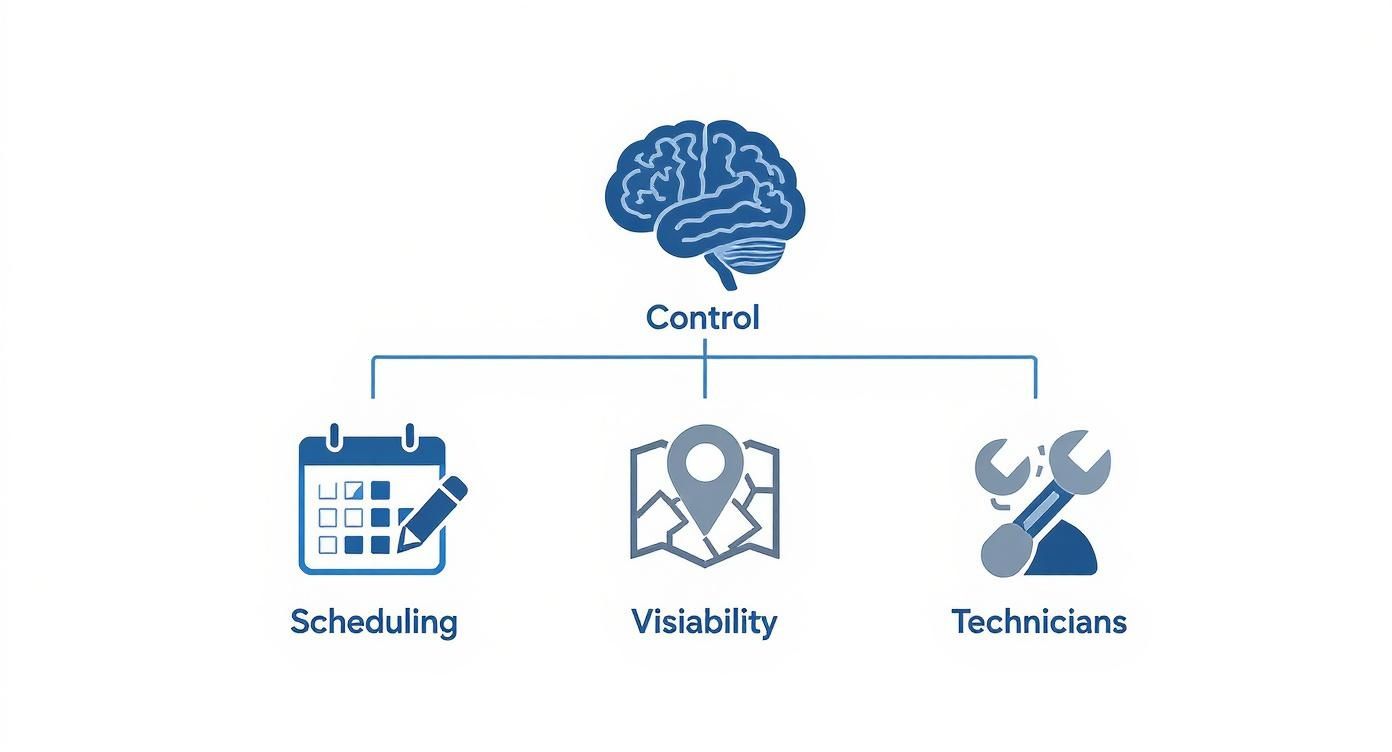
As you can see, genuine operational control is only possible when scheduling, visibility, and technician management are working in perfect harmony, all governed by one intelligent CRM system.
The Core Components of Salesforce Field Service
The whole operation is built on a handful of key 'objects' within Salesforce, each with a specific job. Think of them as the fundamental building blocks of your entire service delivery process. Here's a breakdown of how these essential pieces fit together.
Salesforce Field Service Core Components Explained
| Component | Primary Function | Business Impact |
|---|---|---|
| Work Orders | The master record for a job. It captures all essential details: what needs doing, for whom, where, and what parts or skills are needed. | Acts as the single source of truth for each job, preventing miscommunication and ensuring all requirements are met from the start. |
| Service Appointments | The specific, scheduled visit to a customer site. It locks in the exact date, time, and assigned technician for a Work Order. | Creates a concrete, actionable schedule, improving on-time arrivals and allowing for efficient route planning and resource allocation. |
| Service Resources | The profile for each technician. This record holds vital data like skill sets, certifications, and their designated service territory. | Enables intelligent, skills-based dispatching, dramatically increasing the chances of a first-time fix and improving customer satisfaction. |
These components work together to create a seamless flow of information. It starts when a customer issue creates a Work Order, which then generates a Service Appointment that gets assigned to the best-suited Service Resource. This simple, logical workflow is incredibly effective.
Key Roles and Their Salesforce Tools
Salesforce Field Service gives each person in the service chain a specialised interface, ensuring everyone has what they need to excel.
The Dispatcher (The Air Traffic Controller)
The dispatcher lives in the Dispatcher Console, a dynamic, map-based command centre that provides a complete, real-time view of the entire field operation. They can see where every technician is, track job progress live, and instantly handle exceptions like traffic jams or emergency call-outs. This powerful tool transforms dispatching from a reactive guessing game into a proactive, strategic function.
The Mobile Technician (The On-Site Expert)
Technicians rely on the Salesforce Field Service mobile app, their all-in-one toolkit for success in the field. It gives them their daily schedule, turn-by-turn navigation, and full access to Work Order details, customer history, and technical manuals—even when they're offline.
This level of empowerment is critical for efficiency and can be enhanced with modern tools like the Visual Remote Assistant, which allows technicians to solve complex issues faster with live expert help.
Lesson Learned: By equipping technicians with comprehensive mobile tools, businesses report an average productivity increase of 24% in the first year. This is a direct result of less time wasted travelling and more jobs fixed on the first visit.
The Service Manager (The Operations Director)
For managers, Salesforce dashboards and reports provide the high-level view. They can track key performance indicators (KPIs) like team utilisation, first-time fix rates, and travel time. This data-driven insight allows them to spot trends, pinpoint inefficiencies, and make informed decisions to continuously improve service delivery and profitability. This complete system ensures every role is aligned and working from the same CRM playbook.
Key Salesforce Features That Drive Operational Excellence
Understanding the architecture is one thing, but seeing how specific features solve your biggest operational headaches is where the real value becomes clear. A powerful field service management Salesforce solution isn't just a collection of tools; it's a set of precisely engineered features designed to drive efficiency, empower your team, and improve your bottom line.
These are the features that move beyond theory and deliver practical, day-to-day value for your dispatchers, technicians, and managers. They are the engine that turns a chaotic schedule into a predictable, optimised workflow.
Let's dive into the core capabilities that consistently deliver the biggest impact for Australian businesses.
Intelligent Scheduling and Optimisation
At the heart of Salesforce Field Service is its intelligent scheduling engine. This is more than a digital calendar; it's an AI-powered brain that solves complex field service logistics in seconds. Research shows that scheduling conflicts are a major headache, with nearly half (47%) of all appointments not going as planned.
The engine automatically analyses dozens of variables to make the perfect match:
- Skills-Based Routing: It ensures the technician with the right certifications and expertise is assigned to the job, dramatically increasing first-time fix rates.
- Location and Travel Time: By factoring in real-time traffic and geography, it creates the most efficient routes, minimising travel time and maximising productive hours on site.
- Parts Availability: The system checks inventory to make sure the assigned technician has the necessary parts on their vehicle before they leave, preventing frustrating and costly return trips.
This level of automation frees your dispatchers to manage exceptions and deliver a better customer experience. The result is a direct reduction in operational costs and a significant boost in technician productivity.
The Powerful Mobile App for Field Technicians
Your field technicians are the face of your company. The Salesforce Field Service mobile app is their all-in-one command centre, built to work flawlessly even in remote environments.
For many Australian businesses, the app's robust offline capability is a non-negotiable feature. Technicians working in areas with patchy or non-existent mobile reception can continue working without interruption.
Best Practice: Technicians can access job details, update work orders, log parts used, and capture customer signatures entirely offline. As soon as they reconnect to a network, the app automatically syncs all the data. Nothing gets lost, and the back office has a complete, accurate record of the day's work.
This seamless offline-to-online transition is essential for maintaining operational continuity and data integrity, especially across Australia's vast service territories.
Proactive Asset Management with Salesforce
If your business services and maintains customer equipment, Asset Management is a game-changer. It allows you to shift from a reactive, break-fix model to a far more valuable proactive and predictive service model.
The platform maintains a complete service history for every asset you manage, including installation dates, past repairs, and upcoming maintenance schedules. Having this data centralised offers several massive advantages:
- Informed Technicians: Before arriving on-site, a technician can review the asset's entire history, leading to faster diagnostics and repairs.
- Predictive Maintenance: By analysing an asset's service history, you can anticipate when maintenance is needed before a failure occurs, minimising costly downtime for your customers.
- Higher First-Time Fix Rates: With a clear understanding of the asset, technicians are more likely to arrive with the correct parts and knowledge to resolve the issue on the first visit—a key driver of customer satisfaction.
Each of these features is designed to deliver measurable business outcomes. By automating scheduling, empowering mobile workers, and enabling proactive service, Field Service Management Salesforce provides the tools you need to achieve operational excellence.
Real-World Applications: Salesforce Field Service Case Studies
Salesforce Field Service isn't an abstract concept; its power shines when solving real, industry-specific problems. Across Australia, businesses are using it to untangle complex operational knots—from managing heavy machinery on Perth construction sites to coordinating specialist healthcare providers in Sydney.
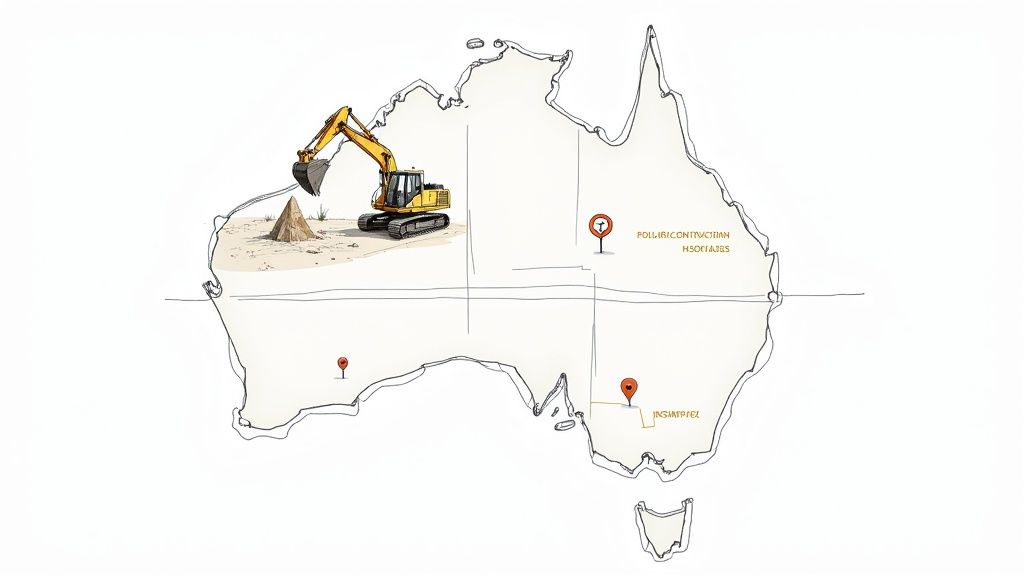
The field service management (FSM) market in Australia is booming as local companies race to meet customer expectations and navigate tighter compliance rules. The payoff is real, with businesses reporting up to a 24% jump in productivity within the first year and a 17% drop in travel time. It’s a clear sign that smart field service technology is no longer a "nice-to-have."
Case Study: Construction and Asset Management in Perth
Imagine a major construction firm juggling multiple projects across Western Australia. Their biggest headache? Tracking high-value machinery, scheduling subcontractors, and staying on top of preventative maintenance to avoid crippling downtime.
-
The Business Challenge: They were stuck in a chaotic loop of disconnected spreadsheets and endless phone calls to manage equipment locations and service schedules. This led to double-bookings, missed maintenance, and project delays whenever a critical machine broke down.
-
The Salesforce Solution: We implemented Salesforce Field Service with a laser focus on its Asset Management features. Every piece of equipment, from excavators to cranes, was logged as a trackable asset in their CRM. We then built proactive maintenance plans tied to operating hours, which automatically triggered Work Orders when a service was due.
The Result: We also set up their subcontractors as Service Resources in the system. The dispatcher gained a single, unified view of everyone and could instantly schedule the right internal technician or external contractor based on skills, certifications, and real-time location. This shifted their site management from reactive firefighting to proactive control.
Case Study: Healthcare and Compliance in Sydney
For an in-home healthcare provider, the margin for error is zero. They needed a system that could enforce strict regulatory compliance, manage clinician qualifications, and maintain ironclad patient service histories.
-
The Business Challenge: Their old system couldn't handle skills-based scheduling, sometimes dispatching a general nurse to an appointment that required a specialist. Documenting patient visits was also a messy, inconsistent process, creating a mountain of administrative work and a huge compliance blind spot.
-
The Salesforce Solution: Our implementation was built around skills-based routing and customised Work Orders. We configured each clinician (Service Resource) with their specific medical certifications. The scheduling engine was then programmed to only assign clinicians with the exact skills required for each appointment, guaranteeing compliance and quality of care.
The Result: We also customised the mobile app to include secure, guided service reports. Clinicians were required to complete step-by-step checklists on-site, capturing all data needed for regulatory audits. This automatically updated the patient's central record, creating a complete, tamper-proof trail of every interaction and slashing both admin time and risk. The results mirror the efficiency gains we helped deliver for Vending First, as detailed in our Salesforce Field Service case study.
Your Salesforce Field Service Implementation Roadmap
A successful Salesforce Field Service implementation is a strategic project that needs a clear plan and a strong partnership. Launching this powerful platform isn't like flipping a switch; it's a carefully planned journey with distinct phases, each one critical for achieving your long-term goals. A structured path helps you avoid common pitfalls and ensures the final solution is something your whole team will embrace.
Phase 1: Discovery and Scoping
This foundational phase is about deep listening and alignment. Before any configuration begins, we need to understand the nuts and bolts of your field operations. What are the biggest daily frustrations for your dispatchers? What information do your technicians wish they had on their device? We work closely with your key stakeholders—from service managers to your most experienced technicians—to map current processes and pinpoint the biggest opportunities for improvement.
Best Practice: Rushing this phase is a classic misstep. A clear scope, well-defined business goals, and agreed-upon success metrics are the bedrock of a successful implementation.
Phase 2: Configuration and Data Migration
With a solid blueprint, we begin the build. This is where we configure core components like work orders, service territories, and technician skill sets within Salesforce, translating your business requirements into a functional system. At the same time, we tackle data migration. Clean, accurate data is the fuel for the entire system, and we guide you through preparing your existing customer, asset, and service history data for import.
Phase 3: Testing and User Adoption
Once configured, the system undergoes rigorous testing. We engage a select group of users to run through real-world scenarios in User Acceptance Testing (UAT), which is critical for polishing the solution before it goes live. After successful testing, the focus shifts to training and change management. This is where user adoption is won or lost. We develop customised training materials and run sessions tailored to each role—dispatcher, technician, and manager. For a deeper look into structuring your project, check out our complete Salesforce Implementation Guide for Australian businesses.
The integration of advanced tech like AI and the Internet of Things (IoT) is changing how Australian businesses operate. Machine learning algorithms are now optimising job assignments by analysing technician skills and real-time traffic, leading to a 27% increase in first-time fix rates. You can discover more insights about these field service management statistics to understand the latest trends.
Ultimately, a strong implementation roadmap, guided by an experienced Salesforce partner, ensures your investment in field service management Salesforce technology translates into tangible, game-changing business results.
Salesforce Field Service FAQs
What's the difference between Service Cloud and Field Service?
Think of Service Cloud as your central command centre. It’s where customer issues land, cases are created, and your office-based team manages the entire customer relationship. It's the brain of the operation. Salesforce Field Service is the boots on the ground. It’s your mobile operations unit that takes the mission from Service Cloud and dispatches a technician to the customer's site. The two are designed to work in perfect sync, creating one seamless, end-to-end service experience.
How does the mobile app handle poor connectivity in remote areas?
The Salesforce Field Service mobile app was built with Australia's vast landscape in mind, offering robust offline capabilities. Before a technician heads out, their device syncs everything they need: job details, customer history, and technical manuals. In the field, they can update work orders, get a customer signature, and log parts used—all without a signal. As soon as they reconnect, the app automatically syncs all data back to the main platform. No information is lost.
Is Salesforce Field Service right for a small business?
Absolutely. Salesforce Field Service is incredibly scalable. A small business can start with core features like scheduling and work order management. As your business expands, you can enable advanced capabilities like AI-powered schedule optimisation or predictive maintenance. A good Salesforce partner will help you map out a phased implementation that aligns with your budget and growth plans, so you’re only ever paying for what you use.
What kind of ROI can we realistically expect from Salesforce Field Service?
The return on investment from Salesforce Field Service comes from significant, measurable gains in efficiency. Most of our clients see the biggest wins in a few key areas:
- Higher First-Time Fix Rates: Sending the right technician with the right skills and parts gets the job done on the first visit.
- Reduced Travel Time: Smart, optimised routing slashes "windscreen time," allowing technicians to complete more jobs each day.
- Increased Technician Productivity: With all information on their mobile device and less admin work, technicians can focus on what they do best.
This all flows directly to your bottom line through lower operating costs, increased revenue, and happier customers. Most businesses we work with see a full return on their investment well inside 18 months of a successful rollout.
Ready to bring order to the chaos of your field operations? As a trusted Salesforce partner, the expert team at Adaptal has helped over 110 Australian businesses implement Salesforce solutions that deliver real, measurable results. Let's discuss how we can tailor Salesforce Field Service to solve your unique challenges. Contact us for a no-obligation consultation today.