

Managed services is a strategic partnership where a provider proactively manages your technology for a predictable fee, shifting your business from reactive problem-solving to continuous optimisation. In the world of Salesforce, this means having a dedicated team ensuring your CRM platform isn't just running, but evolving to meet your business goals.
Think of it this way: you can call a mechanic after your car breaks down, or you can have a dedicated pit crew constantly tuning the engine for peak performance. A Salesforce managed services partner is your CRM pit crew.
Beyond Break-Fix: The Strategic Shift for Your Salesforce CRM
Let's imagine your Salesforce platform is a high-performance vehicle that your business absolutely depends on. The old 'break-fix' model is like only calling the mechanic when you’re stranded on the side of the road with smoke pouring from the engine. It’s stressful, disruptive, and the emergency repair bills are often a nasty surprise.
While you're waiting for a fix, your sales team can't log calls, your service team can't manage cases, and your marketing team can't run campaigns. This reactive approach is inefficient. It treats your technology like a collection of parts that only get attention when they fail, trapping your team in a constant cycle of firefighting. In this scenario, your powerful Salesforce platform might be running, but it’s definitely not being optimised, secured, or aligned with your changing business goals.
The Proactive Partnership Model
Salesforce managed services flips that script. It’s a strategic move away from putting out fires and towards proactive system optimisation. You've got that dedicated pit crew on retainer, and they aren't just waiting for something to go wrong. They're constantly monitoring performance, applying security updates, fine-tuning configurations, and ensuring your Salesforce instance is ready for the road ahead.
A Salesforce managed services partner assumes responsibility for delivering specific outcomes for your CRM. This involves proactive management, user support, and strategic optimisation, enabling your team to focus on core business activities like sales, service, and marketing.
This model makes sure your Salesforce platform doesn't just run—it gets better over time. The real goal is to prevent issues before they ever happen, so your business can accelerate towards its goals with confidence. This proactive mindset is key to modern IT strategy and shares its principles with other outsourced frameworks. For a great explanation of a similar model, check out this guide on the DevOps as a Service (DaaS) delivery model.
Below, we've broken down the core differences between these two approaches when applied to your CRM.
Managed Services vs Traditional IT Support for Salesforce
| Aspect | Managed Services (Proactive) | Traditional Break-Fix (Reactive) |
|---|---|---|
| Approach | Continuous monitoring of your Salesforce org, proactive maintenance, and strategic optimisation. | Waits for a Salesforce user to report a problem before taking action. |
| Goal | Maximise user adoption, platform performance, and ROI from your Salesforce investment. | Restore service after a failure has already impacted sales or service teams. |
| Cost Structure | Predictable, fixed monthly fee for all-inclusive Salesforce support and administration. | Unpredictable, hourly rates and charges per incident. |
| Business Focus | Strategic partnership focused on long-term business outcomes and CRM growth. | Transactional relationship focused on fixing immediate technical issues. |
| Incentive | Provider is incentivised to keep your Salesforce org running smoothly to minimise their own workload. | Provider profits from your Salesforce problems and system failures. |
As the table shows, the value of managed services goes far beyond simply fixing things. It’s about building a stable, reliable, and high-performing Salesforce foundation that actively supports your business.
By partnering with a specialist for your CRM, you move beyond simple fixes and gain a team that's genuinely invested in your success. They provide the continuous support and strategic guidance needed to get the most out of your platform. You can explore our full range of CRM managed solutions to see how a proactive partnership can drive real, measurable results for your business.
The Building Blocks of a Salesforce Managed Services Plan
So, what exactly do you get when you partner with a Salesforce managed services provider? It’s a common question, and the answer goes far beyond just having someone to call when things break. Think of it as a structured, strategic partnership designed to keep your Salesforce platform healthy, secure, and perfectly aligned with where your business is headed.
A solid plan is built from several core components, each delivering real, tangible value. They work together like the essential systems in a high-performance car—each part has a specific job, but they all need to function in sync for a smooth, powerful, and reliable ride. A great managed services partner bundles these elements into one cohesive strategy that keeps you moving forward.
Proactive System Health Monitoring
First up is proactive system health monitoring. This isn't about sitting around waiting for a Salesforce error message to pop up. It’s about having an early warning system that constantly scans your Salesforce environment, hunting for potential issues before they can cause any real trouble.
This is like a continuous health check-up for your CRM. For example, a managed services partner monitors API limits, data storage, and Apex job failures. Imagine a silent failure in a third-party app integration—it could create massive data gaps between Salesforce and your ERP without anyone knowing. Proactive monitoring spots this hiccup immediately, allowing for a swift fix before your sales team even notices a problem. To get a better handle on how these connections work, you can check out our guide on what is system integration.
This visual neatly compares the proactive approach of managed services against the reactive nature of old-school, break-fix support.
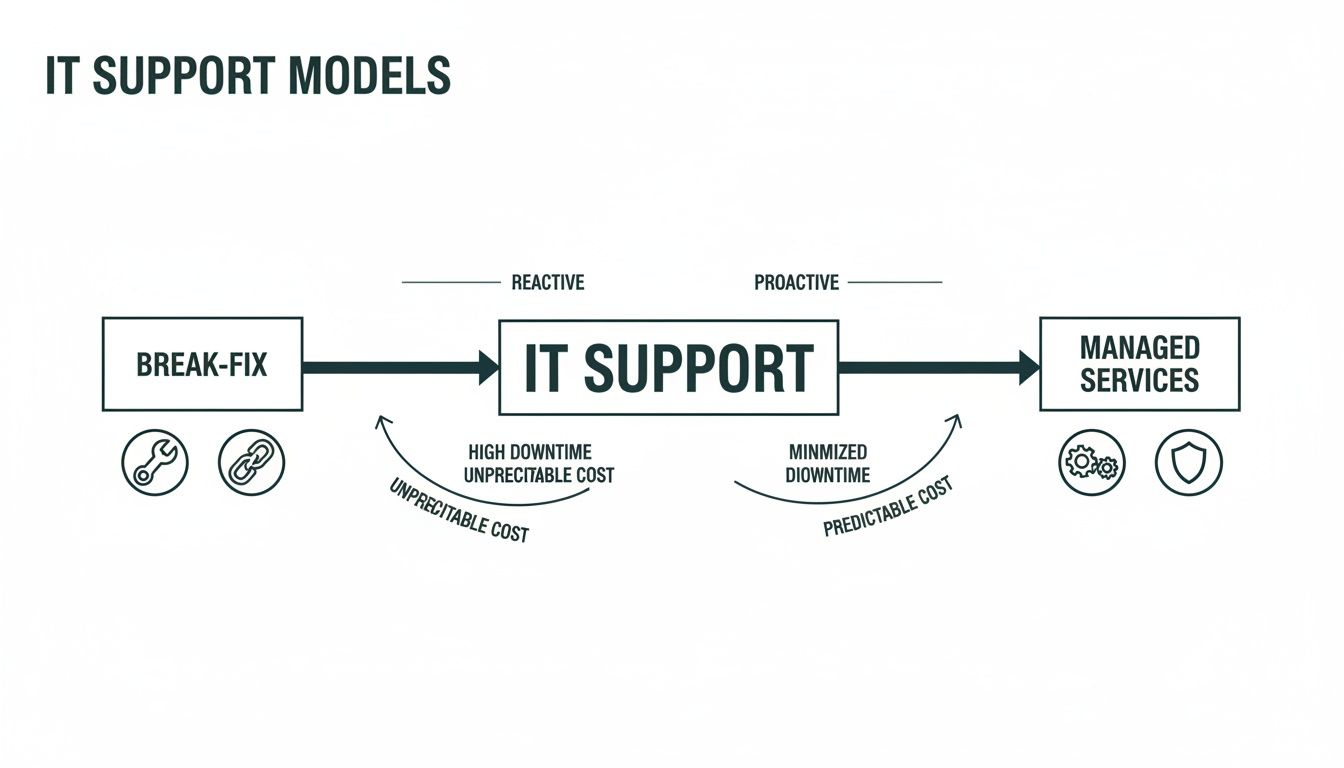
As you can see, managed services minimise downtime and give you predictable costs by focusing on prevention. It's a world away from the high, unpredictable bills that come from just waiting for things to break.
Dedicated User Support and Helpdesk
Next, you get dedicated user support and helpdesk services. This is your team's direct line to Salesforce experts who can provide quick, reliable answers to their everyday questions and challenges.
Instead of your internal IT team getting bogged down with complex Salesforce queries, your staff gets immediate access to certified professionals. This could be anything from a Sales Cloud user who can’t create a report to a Service Cloud agent needing help with a case escalation rule. That kind of rapid support cuts down on lost productivity and empowers your team to actually use the platform to its full potential.
A strong managed services plan ensures that your team isn't just using Salesforce; they're using it correctly and confidently. It removes technical roadblocks, fostering better user adoption and maximising your ROI.
Ongoing System Administration and Optimisation
Another critical piece of the puzzle is ongoing system administration. This covers all the essential backend tasks that keep your Salesforce instance clean, secure, and running efficiently.
Some of the key activities here include:
- User Management: Securely adding or removing users, managing permission sets, and ensuring profiles are correctly configured as your team grows and changes.
- Data Hygiene: Implementing de-duplication rules, creating validation rules, and maintaining the high-quality data your team needs to trust.
- Security Audits: Regularly reviewing security settings, field-level security, and access levels to protect your sensitive customer data.
Strategic Release Management and Advisory
Finally, a truly valuable managed services plan always includes strategic release management and advisory services. Salesforce doesn't stand still—it pushes out three major updates every year, packed with new features and functionality for Sales Cloud, Service Cloud, and more.
Your partner will analyse these updates through the lens of your business, flagging new tools that could give you a competitive edge. They then handle all the testing and rollout in a sandbox environment to ensure a smooth, disruption-free transition. This strategic guidance turns your Salesforce platform from a static tool into an evolving asset that continuously delivers more value.
Driving Real Business Value with Managed Services
Let's move past the idea of just keeping the lights on. A proper managed services partnership should deliver a tangible return on investment that actually means something to business leaders. The value isn't just about fixing tech problems; it’s about finding new efficiencies, building a stronger security posture, and giving your team back their most valuable asset: time.
One of the first things our clients notice is the shift to cost predictability. The old break-fix model is a financial rollercoaster, leaving you wide open to sudden, expensive IT emergencies. Managed services flips that script, trading uncertainty for a stable, predictable operational expense. Budgeting for your Salesforce investment becomes simpler and a whole lot more accurate.

This steady cost structure becomes even more powerful when you think about the expertise it unlocks.
Access to a Deep Bench of Certified Specialists
Hiring a full-time team of certified Salesforce specialists—we're talking architects, developers, and senior administrators—is a massive financial commitment. For many organisations, especially in the small to medium-sized space, it’s just not on the cards.
A managed services plan gives you immediate access to this deep bench of talent for a fraction of what it would cost to hire them yourself. Instead of relying on a single internal admin who's probably stretched thin, you get a dedicated team with a diverse range of skills, ready to jump on anything from a complex Flow automation to strategic roadmap planning.
The real value isn't just having experts on call; it's having the right expert for the right task at the right time, without the overhead of full-time salaries.
This model is gaining serious traction here in Australia. Sectors like IT & Telecom, BFSI, and government are the main drivers behind the country's managed services demand. In a market currently valued at USD 2,456.71 million and projected to reach USD 4,342.52 million by 2032, the need for specialised support is undeniable. Take the BFSI sector, where regulatory heat from APRA has pushed banks to adopt managed compliance services, helping them drastically cut down the risk of breaches.
Enhanced Security and Proactive Compliance
With the constant rise of cyber threats and tough data privacy laws, security is no longer just an IT problem—it’s a fundamental business function. When you're managing sensitive customer data in Salesforce, you need constant vigilance and a deep understanding of the platform's security architecture.
A managed services provider brings a dedicated, proactive focus to security and compliance. They're the ones running regular health checks, meticulously managing user permissions, and making sure your Salesforce org is configured to best practices. This forward-thinking approach significantly lowers the risk of data breaches and helps you stay compliant with standards like the Australian Privacy Principles. Modern providers also go beyond the basics, using advanced tools like Intelligent Process Automation (IPA) to truly overhaul business operations.
Reclaiming Focus for Strategic Growth
This might just be the biggest benefit of all: the strategic advantage. When your internal teams are stuck in the daily grind of Salesforce admin—dealing with user issues, fixing data errors, prepping for system updates—there’s no headspace left for innovation. Their focus is completely swallowed by maintenance, not growth.
By outsourcing the day-to-day running of your Salesforce platform, you empower your key people to focus on what they were hired to do: drive the business forward. This shift is a huge part of successful digital adoption. If you want to dive deeper into how to guide your team through this kind of operational change, our change management consultants have some valuable insights to share.
Consider a professional services firm we worked with. Their operations manager was spending nearly half her week on Salesforce admin tasks and user support tickets. After moving to our managed services plan, her time was freed up. She refocused her energy on optimising their client onboarding process in Salesforce and developing new service offerings—initiatives that directly grew revenue.
That’s the end game here: turning your technology platform from an administrative headache into a powerful engine for growth.
Decoding Managed Services Pricing Models for Salesforce
When you're figuring out what managed services are all about, you've got to get your head around the money side of things. It's not just about the tech benefits; picking the right pricing model is make-or-break for ensuring the partnership actually works with your budget and business goals.
Let's pull back the curtain on the common pricing structures you’ll come across. Each one strikes a different balance between cost predictability, flexibility, and the scope of work, so it's vital to find the one that fits your organisation perfectly.
The Per-User Per-Month Model
The per-user per-month model is probably the most straightforward and popular option out there, especially for businesses that are growing. Simple stuff: you pay a flat fee every month for each Salesforce user your managed services provider is supporting.
This model gives you fantastic predictability, making it a breeze to budget for your Salesforce support. As your team grows or shrinks, your costs scale right alongside your headcount. For a company constantly adding new sales reps to their Sales Cloud instance, this structure is dead simple to manage and forecast.
The only thing to keep in mind is that its main focus is on user support. It might not be the best fit if your needs are more about big, backend development projects that have little to do with how many people are logging in.
The Block-of-Hours Retainer
With a block-of-hours retainer, you're essentially pre-paying for a set number of support hours each month for a fixed price. This model is all about flexibility, letting you use those hours for a massive range of tasks.
One month, you might burn through your block on user training and building out new dashboards in Sales Cloud. The next, you could pivot and have the team focus on a major data cleansing project or automating a few workflows in Service Cloud. This adaptability is perfect for businesses with needs that change from month to month.
The real beauty of a block-of-hours retainer is control. You get to point your managed services partner at your biggest Salesforce priorities each month, making sure their effort is always locked onto what your business needs right now.
The main catch here is that unused hours might not roll over to the next month—that all depends on your agreement. You'll also want to keep a close eye on your usage so you don't get caught out with no support time left just when you need it most.
The Tiered Service Model
The tiered model bundles services into different packages, usually with names like Essentials, Pro, and Premier. Each tier adds more services and a deeper level of engagement for a corresponding price, letting you pick the exact package that fits your needs and budget.
This structure makes it really clear what you're paying for and helps you line up your investment with the value you're getting. In a Salesforce world, it might look something like this:
- Essentials Tier: This is your foundation. It typically covers the core helpdesk support, basic user admin tasks, and system health checks. It’s a great starting point for organisations that just need reliable, day-to-day support to keep the lights on.
- Pro Tier: Building on the essentials, this middle tier might add in proactive release management, advanced reporting, and minor configuration changes.
- Premier Tier: This is the top-shelf option for businesses looking for a genuine strategic partner. It often includes everything from the other tiers plus dedicated advisory sessions, strategic roadmap planning, architectural reviews, and ongoing optimisation projects.
The tiered approach is great because it stops you from paying for services you don’t actually need, while giving you a clear path to upgrade your support as your business grows more dependent on Salesforce.
How to Choose the Right Salesforce Managed Services Partner
Picking a Salesforce managed services provider is a big deal, and it goes way beyond just comparing quotes. You’re not just hiring a supplier; you’re bringing on a strategic partner who will be deeply involved in your day-to-day operations and future growth. Get it right, and you'll accelerate your business. Get it wrong, and you're in for a world of frustration, wasted money, and missed opportunities.
So, where do you start? The absolute basics: verify their credentials. You need a partner with a proven track record, specifically in the Salesforce ecosystem. Look for their official Salesforce partnership status and check the certifications of their team members. This first step is just a sanity check to make sure you're dealing with a provider that meets Salesforce's own standards.

Look Beyond the Sales Pitch
Once you’ve confirmed they’re qualified, it’s time to dig into their real-world experience. Don't let them get away with generic promises of "optimisation" and "support." Ask for case studies and references from businesses that look like yours—similar industry, size, and Salesforce products used.
A provider that has already solved challenges for another professional services firm or a multi-location franchise will just get it. They’ll understand your unique pain points and speak your language from day one. This industry-specific knowledge is invaluable and drastically shortens the learning curve. This is a massive differentiator when you're evaluating potential Salesforce partners in Australia.
Scrutinise the Service Level Agreement
The Service Level Agreement (SLA) is the rulebook for your relationship. It needs to be a crystal-clear document that sets firm, unambiguous expectations. You absolutely have to get into the details here.
A solid SLA will clearly define things like:
- Response Times: How quickly will they acknowledge your support ticket?
- Resolution Times: What are the target timelines for fixing issues based on their severity (e.g., critical, high, medium, low)?
- Business Hours: What are the standard hours of support? What happens if there's an emergency after hours?
- Communication Channels: How do you log a ticket, and how will they keep you in the loop on progress?
A vague SLA is a huge red flag. This document should give you total confidence that your most critical business system has your back.
Assess Proactive Strategy Over Reactive Fixes
Here’s the single most important difference between an average provider and a true strategic partner. An average provider just closes tickets. A great partner, on the other hand, looks past the immediate fire to find the root cause and stop it from happening again. They’re proactive, not just reactive.
The ultimate goal of a managed services partnership is not just to maintain your system, but to continuously enhance its value to your business. This requires a provider focused on proactive strategy and long-term optimisation.
To figure this out, you need to ask some probing questions during the evaluation. Their answers will tell you everything you need to know about their philosophy.
The Australian managed services market has ballooned to USD 6,092.00 million, and it's no surprise. There's a huge national push for digital transformation, and businesses need IT support they can count on. Small and medium enterprises are a massive part of this, with adoption rates jumping by 15% annually as they look for smart ways to slash IT overheads by up to 30%. You can find more insights on this growing market trend on imarcgroup.com.
Critical Questions to Ask Potential Salesforce Partners
Go into your meetings armed with a checklist of questions designed to reveal their actual expertise and strategic thinking:
- Salesforce Release Preparedness: "How do you help clients prepare for Salesforce’s three annual releases to leverage new features?"
- Proactive Optimisation: "Can you give me an example of a time you proactively improved a client's Salesforce org, instead of just responding to a ticket?"
- Team Structure: "Who will be my main point of contact, and what does the wider team supporting my account look like?"
- Cultural Fit: "Describe your communication style. How do you handle disagreements or changes in scope?"
Finding a provider with the right technical chops is table stakes. Finding one that aligns with your company culture and feels like a genuine extension of your team—that’s what creates a successful, long-term partnership.
Unlocking Your Salesforce Potential with Adaptal
Plenty of businesses invest a small fortune in Salesforce but never quite see the full return. It's a common story: limited in-house expertise, a dozen competing priorities, and a reactive, "if it ain't broke" approach to maintenance. The result? A powerhouse platform that's barely ticking over.
This is where having a dedicated partner changes everything. It’s about moving you from just having Salesforce to truly profiting from it.
At Adaptal, we directly connect the idea of managed services to your real-world business outcomes. We don't just sit around waiting to fix problems. We build proactive, strategic partnerships designed to hit your specific goals. Our team of certified, Australian-based consultants takes the time to understand your vision first, then we align your Salesforce platform to help you get there.
From Data Chaos to Marketing Clarity: A Case Study
We recently helped a national franchise that was struggling with poor data quality in their Sales Cloud instance. Their customer information was a mess of inconsistencies and duplicates, making any effective marketing campaign with Account Engagement (Pardot) a non-starter. Their team was spending more time cleaning up spreadsheets than actually talking to potential customers.
Our managed services team didn't just patch up the immediate data problems. We went deeper, implementing automated validation rules, creating a solid data governance framework, and delivering targeted training for their staff. This proactive strategy was a complete game-changer.
The results speak for themselves:
- Data accuracy shot up by over 85% within the first three months.
- Their marketing team could finally build highly targeted campaigns, which led to a 40% uplift in lead conversion rates.
- Freed from the grind of manual data entry, their sales team could focus on what they do best—building relationships and closing deals.
A proactive managed services partnership is about turning your CRM from a simple database into a strategic asset that fuels growth, efficiency, and better decision-making across the entire organisation.
This is the Adaptal difference. We go beyond the typical break-fix cycle to become a genuine extension of your team, dedicated to unlocking every bit of potential from your Salesforce investment.
The demand for this level of expertise is surging. Across Australia, the cloud managed services market is projected to hit USD 10,313.9 million by 2030, driven by businesses wanting enterprise-grade tech without the massive overheads. For SMEs, which make up 97% of all Australian businesses, these services can mean cutting costs by 25-40% while gaining the power to scale on demand. You can dig deeper into Australia's cloud managed services market on grandviewresearch.com.
If you’re ready to stop firefighting and start getting the most out of your Salesforce investment, our team is here to help. Contact Adaptal today for a consultation and discover what a true strategic partnership can do for your business.
Salesforce Managed Services FAQ
When business leaders start digging into what managed services can really do for their Salesforce platform, a few questions always come up. Here are some straight, practical answers to the most common ones.
Aren't Managed Services Just for Big Companies?
Not at all. Actually, managed services are a game-changer for small and medium-sized businesses (SMBs). Most SMBs can't justify the cost of hiring a full-time, in-house team of certified Salesforce architects, developers, and administrators.
A managed services plan gives you direct access to that same top-tier expertise for a predictable monthly fee. This levels the playing field, allowing smaller organisations to tap into enterprise-grade support and strategic guidance, fuelling their growth without the massive overhead of a digital transformation.
How is this different from a Salesforce implementation project?
The main difference comes down to purpose and timeframe. A Salesforce implementation project has a clear start, a defined finish, and a very specific scope—like setting up Sales Cloud for the first time or a major system integration. Once that goal is hit, the engagement is over.
A project solves a single, point-in-time business problem. Managed services is an ongoing partnership focused on continuous improvement, maintenance, and the strategic evolution of your Salesforce platform.
Managed services, on the other hand, is a long-term relationship. It’s all about making sure your Salesforce org not only runs smoothly day-to-day but also adapts and improves as your business needs change. It’s about squeezing every drop of value out of your initial investment for years to come.
How quickly do you actually fix Salesforce issues?
This is where your Service Level Agreement (SLA) comes in. It’s the part of your contract that formally lays out resolution times, and a good one isn't a one-size-fits-all answer. Instead, it provides clear, tiered timelines based on an issue's direct impact on your business.
Here’s how it usually breaks down:
- Critical Priority: A system-wide outage stopping your entire team from working triggers an immediate response, often within the hour.
- High Priority: A key feature like lead assignment rules malfunctioning for the sales team would have a very urgent resolution target.
- Standard Priority: A request for a new report or a minor user question will have a standard, non-urgent turnaround time.
A quality Salesforce partner will sit down with you to define these terms clearly upfront, so you have complete transparency and confidence in the support you’ll get.
Ready to move beyond reactive fixes and unlock the full potential of your Salesforce platform? The team at Adaptal is here to build a proactive partnership focused on your business outcomes. Contact us today for a consultation.
Pingback: A Guide To Salesforce Field Management And Governance