

Managed IT services, in a nutshell, is about outsourcing your company's technology management to a third-party expert. For businesses leveraging Salesforce, this move fundamentally shifts your IT approach from a reactive, break-fix model to a proactive ongoing partnership that’s all about prevention and optimisation of your most critical platform.
Understanding the Core Shift to Managed IT
Think of it like hiring a property manager for your entire technology setup, with a special focus on your Salesforce ecosystem. Instead of calling a plumber only when a pipe bursts, this manager is on the ground, proactively maintaining everything to stop problems from happening in the first place. That’s exactly what a Managed Service Provider (MSP) does for your tech. They take complete ownership of your environment—from servers and networks to cybersecurity and your core CRM.
For Australian small and medium businesses (SMEs), this is a game-changer. The old way meant waiting for a server to crash, a Salesforce integration to fail, or a security breach to hit before calling in an expensive expert for an emergency fix. That approach is unpredictable, often surprisingly costly, and always leads to disruptive downtime that can halt your sales or service operations.
From Reactive Repairs to Proactive Strategy
Managed services completely flip that model on its head. An MSP’s job isn't to react to problems; it's to prevent them from ever happening. This proactive stance is the crucial difference, turning IT from a source of unexpected costs into a predictable, value-driving part of your business.
A proactive approach delivers some pretty immediate wins:
- Predictable Costs: You move from volatile, one-off capital expenses to a stable operational budget with a fixed monthly fee. No more surprise bills.
- Access to Specialised Skills: You get the collective brainpower of an entire IT department—cybersecurity pros, cloud specialists, and certified Salesforce consultants—for less than the cost of hiring one senior person in-house.
- Increased Focus: Your team can finally stop wrestling with CRM headaches and get back to what they do best: driving sales, serving customers, and growing the business.
This visual perfectly contrasts the old reactive model with the forward-thinking approach of managed services.
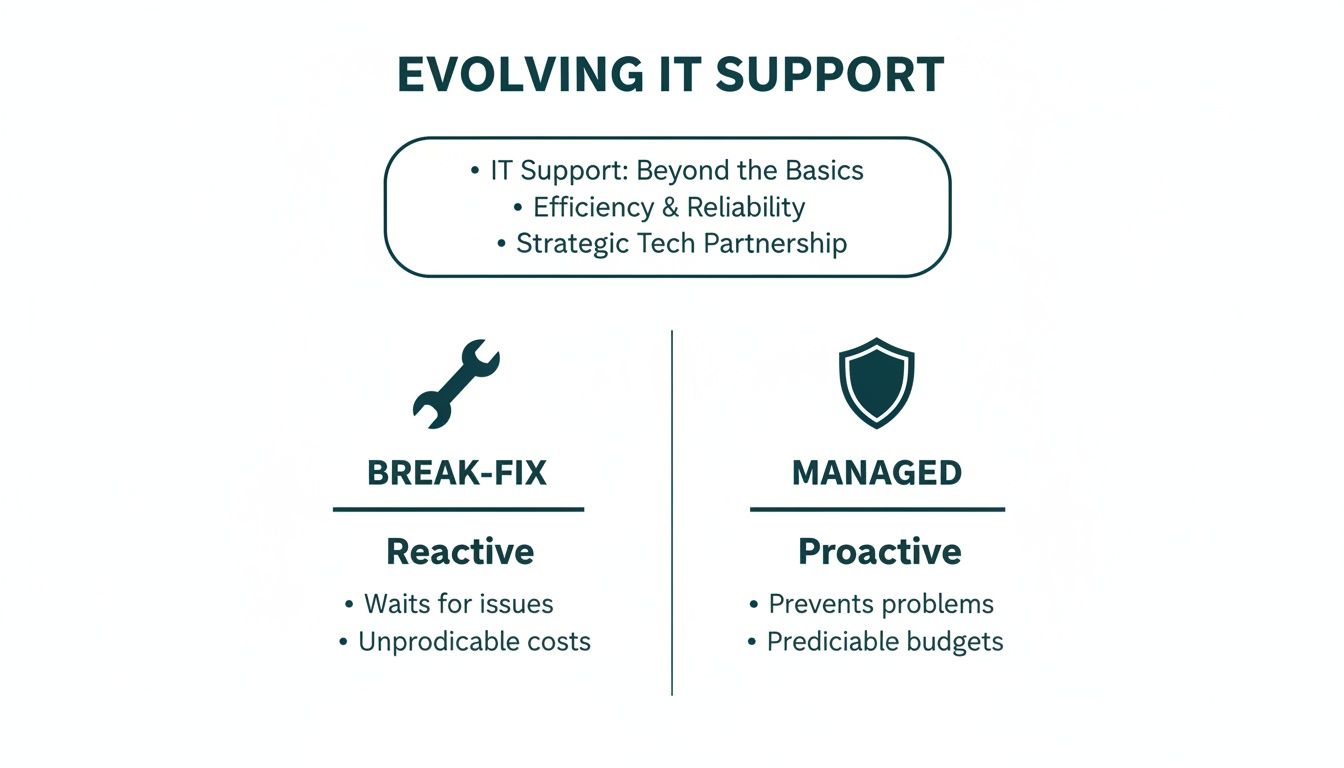
As the infographic shows, it’s about moving from a state of unplanned emergencies to one of stability and strategic foresight. To really hammer home the difference, let's look at a side-by-side comparison.
Traditional IT Support vs Managed IT Services at a Glance
| Attribute | Traditional IT Support (Break-Fix) | Managed IT Services (Proactive) |
|---|---|---|
| Business Model | Reactive—service is provided only when something breaks. | Proactive—focuses on prevention and continuous maintenance. |
| Cost Structure | Unpredictable, hourly rates or per-incident charges. | Predictable, fixed monthly fee for a defined set of services. |
| Goal Alignment | Provider profits from your downtime and problems. | Provider profits when your systems run smoothly and efficiently. |
| Downtime | Frequent and disruptive, as problems must occur before they are fixed. | Minimised, as issues are often identified and resolved before they impact users. |
| Budgeting | Difficult to budget for IT, as costs are variable and unexpected. | Simple and stable budgeting with a recurring operational expense. |
| Strategic Input | Little to no strategic guidance; focused only on immediate fixes. | Ongoing strategic advice, technology roadmaps, and long-term planning. |
This table makes it clear: the two models are built on fundamentally different philosophies. One thrives on chaos, the other on stability.
In Australia, managed IT services have grown from simple break-fix support into a central pillar of digital strategy for SMEs. While reactive support used to be the norm, proactive services are now the fastest-growing approach. Businesses are wisely shifting to ongoing, subscription-based management for everything from infrastructure and cloud platforms to crucial business applications like Salesforce. This model is especially powerful when applied to critical systems, ensuring your investments deliver continuous value.
For a deeper dive, you can read our detailed breakdown of what is managed services or explore related topics like What Is Managed Network Services for a more complete picture.
What a Managed Services Agreement Actually Delivers
So, you're thinking about signing on with a Managed Service Provider (MSP). What do you actually get? It’s much more than just an IT support subscription. Think of it as a detailed blueprint for the proactive care, security, and strategic oversight of your entire technology environment. It’s the tangible promise of stability and performance.
At its heart, the agreement maps out a suite of services designed to stop problems before they ever disrupt your business. This proactive foundation is built on several key deliverables that work in tandem to keep your operations running smoothly and securely. The goal? Let your team focus on their actual jobs instead of constantly fighting tech fires.

Core Components of a Managed Services Partnership
A quality agreement will always mix foundational support with platform-specific expertise. While the exact services can be customised to your needs, there are a few non-negotiables you should expect to see:
- Proactive 24/7 System Monitoring: Your MSP acts as a constant watchdog. They use advanced tools to monitor the health and performance of your servers, networks, and critical applications around the clock. This means a potential issue, like a server running out of disk space or a failing hard drive, gets flagged and fixed long before it can cause any costly downtime.
- Robust Cybersecurity Defence: This is way more than basic antivirus software. We're talking about a multi-layered security strategy. This includes managing firewalls, detecting threats, filtering malicious emails, and rolling out regular security patches to shield your business from malware, phishing, and ransomware.
- Reliable Data Backup and Recovery: Your data is arguably your most valuable asset. A good MSP implements and manages automated backup solutions for all your critical information, whether it’s stored on-site or in the cloud. Just as importantly, they test these backups regularly to make sure that if a disaster ever strikes, your business can be restored quickly.
Connecting Managed Services to Your Salesforce Ecosystem
For businesses running on Salesforce, these services become even more crucial. A specialised Salesforce partner takes this proactive model and applies it directly to your CRM, ensuring your most important business platform is always optimised and secure.
Case Study Example: We worked with a fast-growing financial services firm that was struggling with data integrity. Their Salesforce instance had critical integrations with their accounting software that would frequently fail, causing reporting nightmares. Our managed services team implemented proactive monitoring on these integration points. We now catch and resolve sync errors before the finance team even notices, ensuring their data is always reliable for month-end reporting.
This involves specific, high-value activities that have a direct impact on your operations. For instance, a Salesforce MSP will actively monitor the health of your integrations with other key platforms like Xero or NetSuite, preventing data sync errors that could throw your financial reporting into chaos.
They also handle user permissions, apply crucial security updates, and provide expert support to your team. This transforms your Salesforce instance from a complex administrative burden into a consistently reliable engine for growth. A key piece of any managed services agreement is the clear definition of a Service Level Agreement (SLA), which sets measurable expectations for response times and service quality.
The Strategic Benefits of Adopting Managed IT Services
Moving past the basic "what" of managed IT services gets you to the much more powerful "why". For Australian companies, the decision is rarely just about outsourcing IT tasks; it's a strategic move designed to unlock some serious business advantages. These benefits create a solid foundation for stable, secure, and scalable growth, letting you focus on your actual business instead of wrestling with technology.
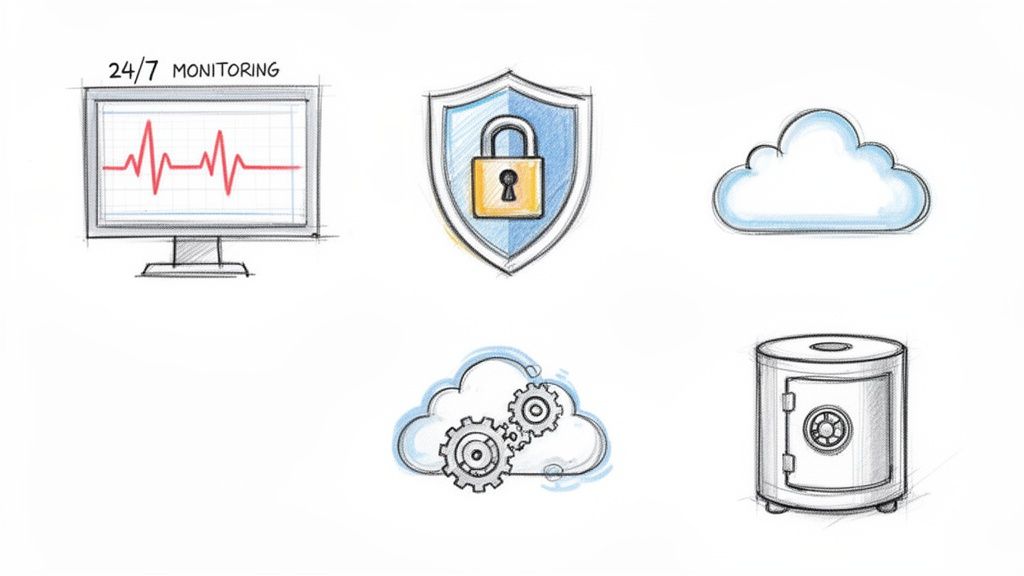
This strategic shift really comes down to three core pillars of value. Each one directly tackles the most common headaches that growing businesses face, offering a clear return by changing how you think about and use technology.
Achieve Predictable Costs and Financial Stability
One of the first things you'll notice is the shift from unpredictable capital expenses (CapEx) to a stable, predictable operational expense (OpEx). The old break-fix model was a budgeting nightmare, leaving you vulnerable to huge, unexpected bills for emergency repairs or hardware replacements.
With a managed services agreement, you're looking at a fixed monthly fee that covers a whole suite of services. This predictability makes financial planning so much easier and wipes out the risk of surprise IT costs blowing up your budget. Industry analysis actually shows that managed services can reduce IT costs by 25–45% while simultaneously improving operational efficiency by 45–65%.
For Australian businesses on Salesforce, we often see these gains in areas like ongoing system configuration, integrations, and user support. If you're curious about how local businesses are benefiting, you can check out these managed services insights on Statista.
Enhance Security and Ensure Compliance
Cybersecurity isn't just a big corporate problem anymore; it's a critical issue for businesses of every size. A Managed Services Provider (MSP) gives you access to enterprise-grade security tools and the expertise to run them—things that would be way too expensive to build from scratch in-house. This includes proactive threat monitoring, firewall management, and making sure every system is patched and updated against the latest threats.
Case Study Example: We partner with a healthcare provider that uses Salesforce Health Cloud to manage patient interactions. Their challenge wasn't just platform uptime; it was ensuring constant compliance with Australia's strict data privacy laws. Our team manages their security posture, from user permissions to data encryption, providing them with peace of mind and auditable proof of compliance.
This constant oversight is a game-changer for businesses in regulated industries. An MSP helps you stay compliant with standards like GDPR or Australian privacy laws, dramatically reducing the risk of costly fines and the reputational damage that comes with a data breach.
Gain Access to a Deep Bench of Expert Talent
Trying to hire, train, and keep a diverse team of IT specialists—from network engineers to Salesforce developers—is a huge and expensive challenge. Managed services instantly give you access to a deep pool of expert talent without all the overheads of recruitment and salaries.
This means you have the right specialist for every single job, right when you need them. A construction firm, for example, can lean on its MSP to secure project data across multiple remote job sites and ensure their Salesforce integrations with project management software are working perfectly.
This level of expert support, covering a wide range of technology and services, allows your own team to perform at a higher level, confident that the technology underpinning everything they do is being managed by experts.
How Managed Services Maximise Your Salesforce Investment
Your Salesforce platform is a powerful engine for business growth. But just like any high-performance engine, it needs regular maintenance and expert tuning to keep delivering peak results. This is where managed services come in, shifting the relationship from a one-off implementation project to a continuous partnership. It’s all about making sure your initial investment doesn't just sit there, but actively evolves with your business.
Without this proactive management, even the best Salesforce setup can slowly lose its edge. Business processes change, new sales territories open up, customer service expectations shift, and integrations can become outdated. This gradual drift leads to frustrated users, messy data, and a return on investment that never quite lives up to its promise.
A Salesforce platform isn't a "set and forget" tool. It's a living asset that needs consistent care to grow alongside your organisation. Managed services provide the technical stewardship to ensure it remains a source of competitive advantage, not a source of frustration.
Keeping Your Salesforce Engine Finely Tuned
A specialised Salesforce managed services partner understands that your business doesn't stand still. They don't just wait for things to break; they work to anticipate your needs, constantly refining the platform to meet new challenges and grab new opportunities.
This proactive approach covers several critical areas:
- Workflow and Process Optimisation: As your sales process matures, your Sales Cloud workflows have to keep up. A managed services partner will continuously tweak automations, update page layouts, and adjust approval processes to match how your team actually works, keeping them efficient.
- Integration Health Monitoring: Your Salesforce instance probably talks to other key systems like Xero, MYOB, or NetSuite. Managed services include keeping a close eye on these connections to ensure data flows flawlessly, preventing the sync errors that cause major headaches for your accounting and operations teams.
- User Support and Training: When your team has a question or needs a new report built, they get expert help, fast. This keeps user adoption high and stops small issues from turning into major roadblocks to productivity.
From Static Tool to Strategic Asset
The real magic of this partnership is turning Salesforce from a static database into a genuine driver for growth. Imagine your customer service team wants to lift its satisfaction scores. A managed services partner can jump in to optimise Service Cloud case routing, set up new knowledge articles, and build dashboards that give real-time insights into team performance.
Or maybe your sales team is expanding into a new region. Your partner can configure the new territories, adjust lead assignment rules, and make sure all the reporting accurately reflects the new structure. This kind of ongoing evolution is what keeps Salesforce perfectly aligned with your business goals, ensuring every feature is working to support your objectives. Our dedicated CRM managed solutions are specifically designed to deliver exactly this level of continuous improvement.
Ultimately, a managed services partnership ensures your Salesforce investment pays dividends for years to come. By maintaining, evolving, and scaling your platform, it becomes a lasting asset that helps your business grow smarter and faster.
Choosing the Right Managed Services Partner in Australia
Getting your head around managed services is the first step, but finding the right partner is what really makes or breaks your success. For Australian businesses in Sydney, Melbourne, Brisbane, and beyond, picking a Managed Service Provider (MSP) is a huge decision that’s much bigger than a simple vendor contract. You’re not just hiring a supplier; you're bringing on a strategic partner who will be woven into your daily operations and long-term plans.
The selection process means taking a good, hard look at a provider’s technical chops, their feel for your industry, and whether they’re a good cultural fit. A generic, one-size-fits-all sales pitch should be a massive red flag. The right partner will feel like an extension of your own team—genuinely invested in helping you hit your specific business goals.

Key Evaluation Criteria for Your Next MSP
To cut through all the marketing fluff and find a genuinely capable partner, you need to zero in on a few core areas. Asking the right questions will help you sort the simple service providers from the true strategic allies.
First up, check out their industry-specific knowledge. A partner who gets the unique grind of your sector—whether that’s franchising, professional services, or construction—can offer solutions that actually work. They'll already understand your operational workflows, compliance headaches, and the specific tech that can give you a real competitive edge.
Next, you have to go deep on their platform expertise, especially if your business runs on Salesforce.
A provider's ability to show proven, hands-on experience with the Salesforce ecosystem isn't just nice to have; it's non-negotiable. Ask to see case studies, certifications, and real examples of how they've managed complex setups involving Sales Cloud, Service Cloud, or specific integrations like NetSuite or Xero.
Just as critical are their security credentials and the frameworks they use to deliver their service. Robust security isn't just another line item; it's the absolute foundation of a reliable partnership. Don’t be shy about asking direct questions about their cybersecurity protocols, data protection policies, and how they stay compliant with Australian privacy laws. This conversation should naturally flow into a discussion about their Service Level Agreement (SLA).
A transparent, comprehensive SLA is your best friend. It should spell out, in no uncertain terms:
- Response Times: How quickly will they jump on issues of varying priority?
- Resolution Targets: What are the agreed-upon timeframes for actually fixing the problems?
- System Uptime Guarantees: What level of availability do they promise for your most critical systems?
- Reporting and Communication: How will they keep you in the loop about system health and the work they're doing?
In Australia, the demand for managed IT services is sharpest in the major business hubs like Sydney, Melbourne, and Brisbane, where the competition is fierce and cybersecurity risks are at their peak. This makes sense when you see the forecasts for significant growth in public cloud spending, which in turn fuels the need for MSPs skilled in managing complex SaaS platforms like Salesforce. For businesses in these cities, finding a partner with specialised Salesforce capabilities is quickly becoming essential.
Ultimately, choosing the right provider is about finding a team that gets your vision and aligns with your strategic goals. Our guide to managed services in Australia offers more detail on how to pick a partner who can genuinely support your growth.
FAQ: Salesforce Managed IT Services
To wrap things up, let's tackle some of the most common questions business leaders have when they're first looking into managed services for their Salesforce platform.
What Is the Typical Cost Structure for Salesforce Managed IT Services?
Most Salesforce managed IT services work on a predictable, subscription-based monthly fee. This is a huge shift from the old "break-fix" support model, which was billed hourly and could throw your budget into chaos.
Your monthly fee is typically structured as a block of hours for support, development, and administration. This lets you treat your CRM optimisation spend as a stable operational expense (OpEx) while giving you access to certified experts for a fraction of the cost of a full-time hire. This model provides budget predictability for ongoing improvements to your Sales Cloud, Service Cloud, or other Salesforce products.
Is My Business Too Small for Salesforce Managed Services?
Absolutely not. In fact, it's often the small and medium-sized enterprises (SMEs) that see the biggest wins from partnering with a Salesforce Managed Service Provider (MSP).
Without the budget for a full-time Salesforce Administrator or Developer, SMEs can struggle with platform optimisation, user adoption, and keeping up with the three major Salesforce releases each year.
An MSP gives you access to an entire team of certified Salesforce professionals—from architects to developers—for less than the cost of a single full-time employee. It levels the playing field, ensuring your CRM evolves with your business and continues to deliver a strong ROI.
How Does an MSP Handle Our Specific Salesforce Customisations?
A good Salesforce MSP becomes a true extension of your team. The partnership always starts with a deep dive to understand your unique business processes and how they’re reflected in your current Salesforce configuration, including any custom objects, automation, or integrations.
From there, we manage everything needed to keep the platform perfectly aligned with where your business is heading.
- System Enhancements: This could be anything from creating new fields and building complex automations with Flow, to refining page layouts so your sales or service teams can work more efficiently.
- Integration Management: We keep a close eye on the critical integrations with your accounting or ERP systems, ensuring data flows correctly between platforms like Xero or MYOB.
- Ongoing Administration: We’ll handle the day-to-day tasks like user permissions, security settings, and regular health checks to keep the system clean, effective, and secure.
The main goal is simple: make sure your Salesforce platform evolves as your business does.
What Is the Difference Between Co-Managed and Fully Managed IT for Salesforce?
Figuring out the right delivery model is key to finding the best fit for your business.
Fully managed IT for Salesforce is where the MSP takes complete responsibility for your platform. This model is perfect for businesses that have no dedicated internal Salesforce admin and want a team of experts to handle everything from user support to strategic enhancements.
Co-managed IT is a partnership model where we work alongside your existing Salesforce administrator or IT team. Your internal admin might handle daily user requests and basic reports, while our team provides specialised expertise for complex projects like major integrations, implementing Service Cloud, or developing custom solutions. This lets you fill critical skills gaps and empowers your internal team to focus on high-value, strategic work.
Ready to stop reacting to IT problems and start proactively driving your business forward? The team at Adaptal is a trusted Salesforce partner specialising in managed services that align your CRM with your strategic goals. Contact us today for a consultation to discover how a true partnership can maximise your Salesforce investment.