

A customer journey map is a visual story of how a customer interacts with your business, from their first awareness of your brand to becoming a loyal advocate. It's a strategic tool designed to help you see your business through your customers' eyes, charting out what they're thinking, feeling, and doing at every single step. For any organisation using Salesforce, it's the foundational blueprint for a truly customer-centric strategy.
What a Customer Journey Map Actually Reveals
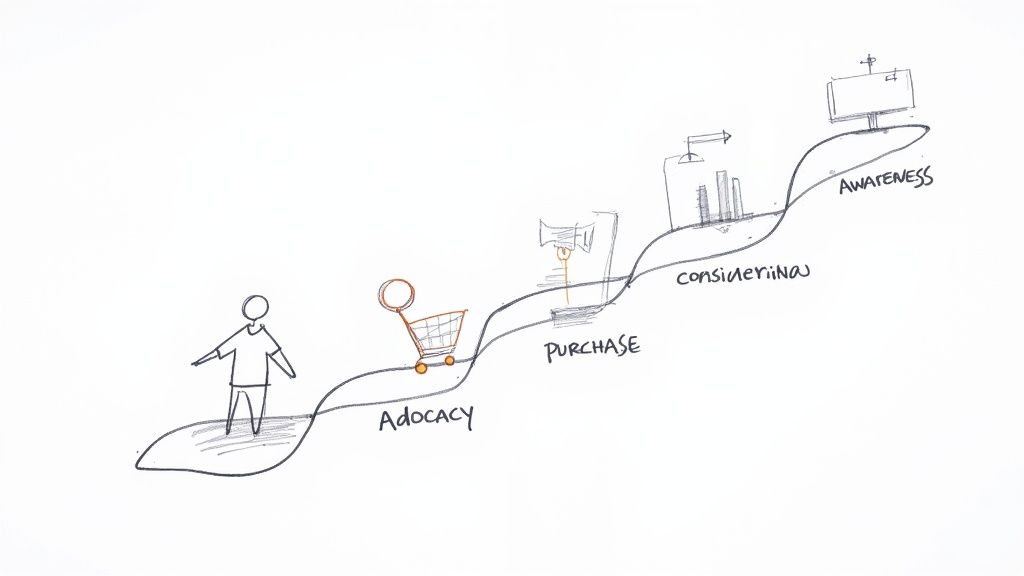
Think of it as a detailed itinerary for your customers. It doesn't just point to the final destination—like a purchase or a subscription renewal. Instead, it maps the entire route, including every stop, potential detour, and the emotional highs and lows they experience.
This isn't just a diagram for a presentation; it's a powerful diagnostic tool that lays the groundwork for a customer-focused strategy. When you connect this map to a robust CRM like Salesforce, it transforms from a static document into a dynamic, actionable blueprint for growth and digital transformation.
The Real Business Value of Mapping the Journey
For any business, especially those deep in the Salesforce ecosystem, understanding what is customer journey mapping is the first step toward uncovering powerful insights. The process forces your teams—sales, marketing, service—to break out of their internal silos and view the company from the outside in.
This is a widely adopted best practice for a reason. In Australia, government and business sectors use journey mapping to improve service delivery. This visual approach highlights customer experiences, emotions, and pain points at every interaction. A great example can be seen in the Queensland Government's service design playbook.
A journey map stops you from guessing what customers want and starts showing you exactly where your processes are letting them down. It’s the difference between assuming your website is easy to use and knowing a confusing checkout page logged in Salesforce is actively costing you sales.
By meticulously charting this path, you can pinpoint the exact moments that cause friction and the ones that create delight. This clarity is invaluable when deciding where to invest your resources for maximum impact.
For example, a journey map might reveal that new leads get bombarded with marketing emails but receive no personal guidance from the sales team. This insight tells you to refine your engagement strategy, perhaps using a tool like Salesforce Marketing Cloud Account Engagement to deliver a more personalised, timely message. As a trusted Salesforce partner, we've seen this simple shift solve major pipeline challenges for our clients.
Ultimately, a well-crafted journey map helps you:
- Identify friction points: Find out precisely where customers get stuck, frustrated, or confused in their interactions with your sales, service, or marketing teams.
- Uncover opportunities: Spot the perfect moments to create a positive, memorable experience that sets you apart from the competition.
- Align internal teams: Get sales, marketing, and service on the same page with a shared, data-backed understanding of the customer's reality.
- Drive measurable improvements: Directly connect your actions within Salesforce to tangible results, like better conversion rates, shorter sales cycles, or higher customer satisfaction scores.
The Building Blocks of an Effective Journey Map
A great customer journey map is more than a simple flowchart; it's a strategic document built from specific, human-centred components. To truly understand what customer journey mapping is, you need to examine its core elements. Each piece adds a layer of insight, and together, they paint a complete picture of your customer's experience.
Think of it like building a detailed profile for a case study. You need to know who the customer is, what they do, where they interact with you, and—most importantly—how they feel along the way. Without these details, the story is incomplete and lacks actionable insights.
Understanding the Core Components
A powerful journey map isn’t just about process; it's about people. It breaks down every interaction into five essential building blocks that tell the complete customer story.
This infographic breaks down the five foundational elements you'll find in any effective customer journey map.
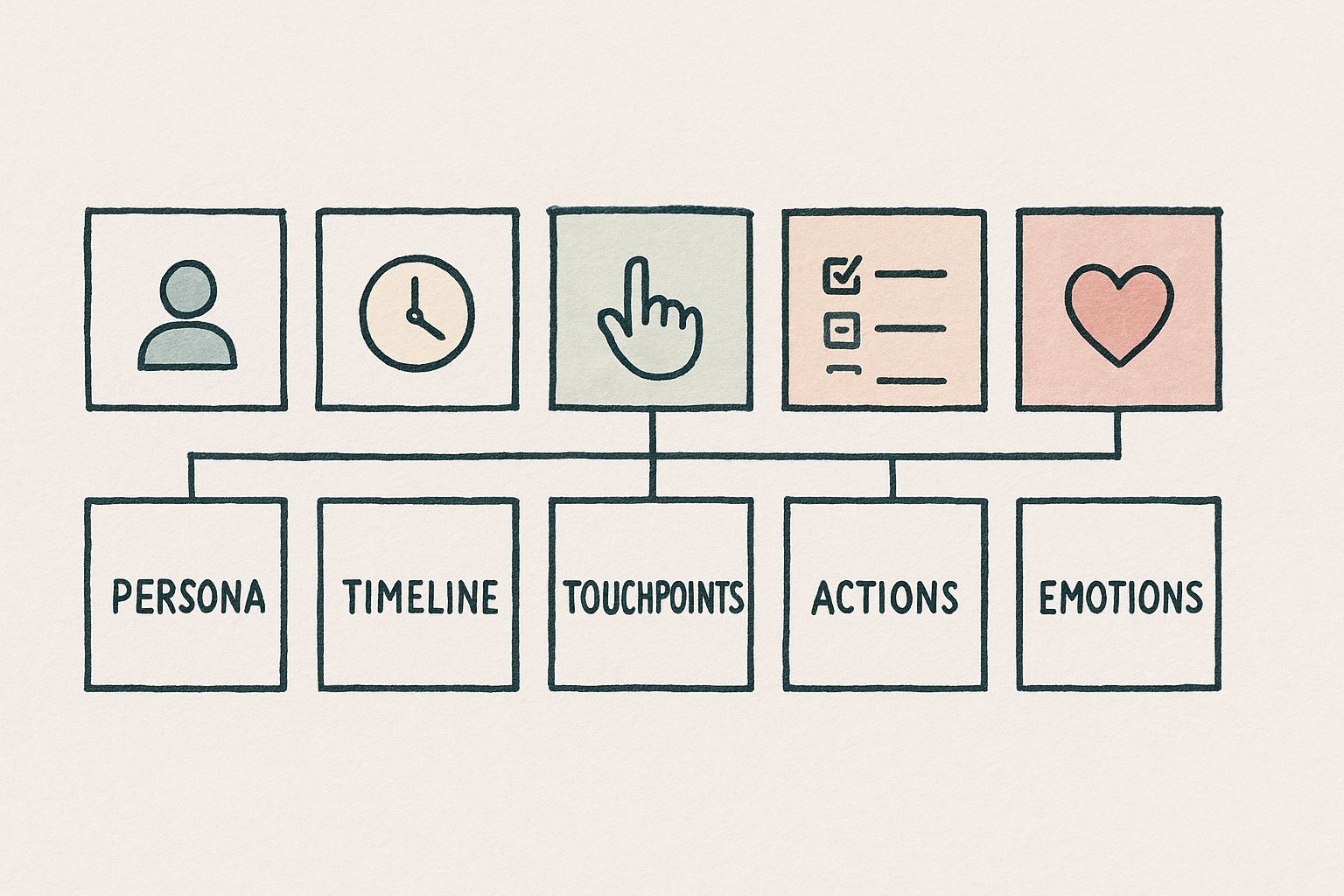
Seeing these components visually helps clarify how each part contributes to a holistic view of the customer's path, from their initial identity right through to their emotional state.
These building blocks are:
-
Personas: This is the "who." A persona is a semi-fictional character based on real data about your target customer. For instance, a B2B software buyer persona might be "IT Manager Alex," who is frustrated with an outdated system and is looking for a reliable, scalable cloud solution. Data from your Salesforce CRM is invaluable for creating these accurate profiles.
-
Timeline: This represents the "when." It breaks the journey into distinct phases, like Awareness, Consideration, Purchase, and Loyalty. These stages are rarely linear; a customer might circle back to the consideration phase multiple times before making a decision.
-
Touchpoints: These are the "where." Touchpoints are all the places your customers interact with your business. This could be anything from a social media ad or a website visit, to a product demo or a support call logged in Salesforce Service Cloud.
-
Actions: This is the "what." It details the specific actions the customer takes at each touchpoint. Think "downloads a whitepaper," "requests a quote," or "submits a support ticket." These are measurable events you can track within your CRM.
-
Emotions: This crucial element captures the "how they feel." Mapping emotions—like frustration with a clunky process, cautious optimism during a demo, or relief after a seamless implementation—reveals the true quality of the customer experience. This is where the most valuable insights live.
By weaving these five components together, you create more than a map. You build an empathy tool that allows your entire organisation to see the business from the customer's perspective, pinpointing moments of friction and opportunities for delight.
Bringing Your Journey Map to Life with Salesforce
A customer journey map on a whiteboard is a brilliant start, but one powered by Salesforce is a complete game-changer. This is where strategic theory transforms into automated action, turning a static visual into a dynamic engine that drives real-time customer engagement and business automation.
This is the control room where your map becomes operational. Each touchpoint becomes an opportunity for automated, highly personalised communication, managed within the Salesforce platform.
The real magic happens when you take the insights from your map and build them directly into tools like Salesforce Marketing Cloud Journey Builder. This is how you stop just understanding the journey and start actively shaping it for the better.
From Static Map to Dynamic Action
Business Challenge: Imagine a retail company reviews its journey map and uncovers a major drop-off point. Customers are adding items to their cart but consistently abandoning them before checkout. With a static map, this is just an interesting observation.
The Salesforce Solution: With Salesforce, this insight becomes an instant action plan. Using Journey Builder, the company can set up an automated workflow. The moment a customer in a specific segment hesitates at checkout, the system can trigger a personalised email with a helpful sizing guide, customer reviews, or a time-sensitive discount to provide a final nudge.
Results and Benefits: By connecting your map to Salesforce, you create a system that doesn't just identify problems—it actively works to solve them in real-time, often without manual intervention. This proactive approach separates decent customer service from a memorable customer experience.
Creating a Self-Improving Engagement Loop
The data fuelling this automation is pulled directly from other parts of the Salesforce ecosystem, creating a powerful, self-improving loop for customer engagement.
- Sales Cloud Data: Information about a lead's status, opportunity stage, and past sales interactions provides crucial context to build relevant marketing journeys.
- Service Cloud Data: Insights from support cases, customer feedback, and common issues highlight pain points that can be addressed proactively through automated communication.
This constant flow of real-world data ensures your journey maps never become stale. They evolve with your customers, allowing you to fine-tune automated responses based on actual behaviour. To truly bring your journey map to life, especially when using platforms like Salesforce, having solid data integration is non-negotiable. See how expert data integration services can help you pull together data from all your different sources, including your CRM.
In Australia, over 81% of CX practitioners say customer journey mapping effectively educates stakeholders about consumer behaviour. This education drives smarter business decisions, especially when backed by a powerful platform like Salesforce.
By blending a deep understanding of your customer's path with the automation power of Salesforce, you build a smarter, more responsive business. If you're ready to connect your journey map to a powerful CRM, our Salesforce consulting services can provide the expert guidance needed to turn your insights into results.
How to Create Your First Journey Map with Salesforce Data
https://www.youtube.com/embed/mSxpVRo3BLg
Creating your first customer journey map can feel like a massive undertaking, but breaking it down into a clear, actionable process makes it far more manageable. The goal isn't to create a perfect, all-encompassing masterpiece on day one. It's about building a practical tool grounded in real data—much of which is already in your Salesforce CRM—that gives you insights you can use immediately.
Start with a Clear Business Objective
Before drawing a single box, you need to know what you're trying to achieve. A journey map without a specific goal is just a diagram.
Are you trying to smooth out the onboarding experience for new clients? Do you want to understand why qualified leads are stalling in the sales cycle?
Setting a clear objective focuses your efforts. For example, your goal might be: “To identify and reduce friction points in the first 30 days for new customers using our professional services, tracked through Salesforce Service Cloud.” This gives your map a purpose and a solid benchmark for success.
A well-defined goal ensures your customer journey mapping exercise produces actionable insights, not just observations. It transforms the map from a passive document into an active tool for strategic change.
Once your goal is locked in, it’s time to get to know the person whose journey you're mapping.
Build Your Customer Personas with Real Salesforce Data
Every map needs a protagonist: your customer persona. This isn't a character you invent in a boardroom; it’s a profile built from real, hard data.
Your Salesforce CRM is a goldmine for this. Analyse your most successful customers. What are their common job titles? What industries and company sizes do they represent? Dig into sales notes in Sales Cloud and support cases in Service Cloud to find their documented goals and pain points.
Then, combine that CRM data with other sources:
- Google Analytics: Analyse demographic and behavioural data to see how different customer segments interact with your website.
- Customer Feedback: Pull insights from surveys, reviews, and support ticket logs to capture their experiences in their own words.
- Sales Team Interviews: Talk to your front-line team. They speak to customers daily and have invaluable, real-world knowledge of their challenges.
This data-driven approach, rooted in your CRM, ensures your map reflects your actual customer base, leading to more impactful insights.
Map Touchpoints, Actions, and Emotions
With your persona and goals defined, it’s time to map the journey. List every touchpoint where a customer interacts with your business, from seeing a social media ad to receiving their final invoice.
For each touchpoint, document three key things:
- Actions: What is the customer actually doing? (e.g., Clicks on an ad, fills out a form, attends a demo).
- Thoughts: What questions are on their mind? (e.g., "Is this solution affordable? Does it integrate with my other tools?").
- Emotions: How are they feeling? (e.g., Curious, confused, excited, frustrated).
The final step is to analyse the completed map to pinpoint pain points and uncover opportunities. Look for stages with negative emotions or where customers drop off. These are your opportunities to make meaningful improvements, like refining your lead nurturing with Salesforce Account Engagement. For a deeper dive, check out our guide on Account Engagement best practice. Exploring different business process mapping techniques can also offer great ideas for structuring your map.
How Journey Mapping Drives Real Business Results
Understanding the theory of customer journey mapping is one thing, but seeing it in action reveals its true value. A well-designed map is a strategic blueprint that delivers tangible, measurable improvements. It provides the clarity to make smarter investments in your people, processes, and technology.
When you connect your map to your Salesforce platform, you can shift from reactive problem-solving to proactive experience design, deploying targeted fixes that genuinely drive growth. The following case study style scenarios show how businesses have used this process to turn customer insights into significant commercial wins.
Shortening the B2B Sales Cycle with Sales Cloud
The Business Challenge: A B2B professional services firm was wrestling with a long, unpredictable sales cycle. Their sales team felt they were losing momentum at the proposal stage but couldn't identify why. Deals would stall for weeks, disrupting their forecasting.
The Salesforce Solution: As their Salesforce partner, we helped them map the prospect's journey from initial enquiry to a signed contract. By interviewing clients and digging into data within Salesforce Sales Cloud, we uncovered a critical friction point: prospects were getting bogged down by overly complex proposals and struggled to share key details with other decision-makers.
Armed with this insight, the firm redesigned its proposal process. They started using Salesforce to generate clearer proposals and created simple, shareable one-page summaries that internal champions could easily circulate.
The Results and Benefits: This journey-led approach fixed a problem they didn't know they had. Within six months, the firm slashed its average sales cycle by 20%. This improved cash flow and freed up the sales team to focus on closing more deals, demonstrating a clear ROI on their Salesforce investment.
Boosting Repeat Purchases for a B2C Brand with Marketing Cloud
The Business Challenge: A growing B2C e-commerce brand noticed a worrying trend: a low repeat purchase rate despite strong first-time sales. Customer feedback suggested the post-purchase experience felt impersonal and disconnected.
The Salesforce Solution: The team mapped the entire post-purchase journey, from order confirmation to delivery and beyond. It quickly became clear they were missing opportunities to build a lasting relationship. Using Service Cloud and Marketing Cloud, they designed a new, proactive post-purchase experience.
This new automated journey included:
- Personalised order confirmation emails reinforcing the brand's value.
- Automated shipping updates, triggered at key milestones, so customers were never left guessing.
- A post-delivery follow-up email asking for feedback and offering a curated selection of related products.
The Results and Benefits: By focusing on the moments after the initial sale, the brand transformed a transactional process into a relationship-building one. This strategic shift led to a 35% increase in repeat purchases from customers who went through the new journey, significantly boosting their customer lifetime value.
Journey Mapping Impact: Before vs. After Salesforce
| Business Metric | Before Journey Mapping | After Journey Mapping with Salesforce |
|---|---|---|
| Customer Insight | Relied on anecdotal feedback and gut feelings. | Data-driven insights from every touchpoint in the CRM. |
| Sales Cycle Length | Inconsistent and often stalled at key stages. | Reduced by 20% with targeted process improvements. |
| Repeat Purchase Rate | Low and stagnant due to impersonal follow-up. | Increased by 35% through automated, personalised journeys. |
| Problem Solving | Reactive; fixing issues only after they occurred. | Proactive; identifying and eliminating friction points. |
| Forecasting | Unreliable due to unpredictable deal progression. | More accurate with clear visibility into pipeline health. |
As these examples show, connecting a clear customer map to a powerful platform like Salesforce creates a direct, measurable impact on the bottom line. You can explore more stories of how businesses have driven growth in our collection of Salesforce case studies.
Mapping the Modern Digital Experience with Salesforce
In today's market, your digital touchpoints often define your business in the eyes of your customers. Mapping the modern digital experience isn't about drawing a straight line from A to B; it's about charting the complex path a prospect takes from a social media post to a webinar sign-up, and what happens after they download a whitepaper.
This is no longer a simple, linear funnel. A solid journey map acts as the strategic blueprint for designing a seamless digital experience, helping you build trust and avoid the disjointed interactions that cause potential customers to click away.
Connecting Digital Footprints to Salesforce CRM
The real magic happens when you connect all that online behaviour to your CRM. This is where Salesforce tools become essential, turning a theoretical map into measurable action and personalised engagement.
For B2B organisations, Salesforce Account Engagement (formerly Pardot) is the engine that tracks these digital footprints. It scores leads based on interactions—like email opens, page views, and form submissions—giving your sales team a clear picture of who is genuinely engaged. This allows for timely, relevant follow-ups that feel helpful, not intrusive.
In the B2C space, Salesforce Marketing Cloud excels at creating personalised, multi-channel experiences at scale. By mapping the B2C digital journey, you can automate interactions across email, SMS, social media, and your mobile app, ensuring a consistent brand story no matter how a customer chooses to engage.
A digital journey map shows you not just what customers do online, but why they do it. It reveals moments of hesitation before a purchase and pinpoints the content that sparks interest, allowing you to fine-tune your digital strategy with precision.
Here in Australia, getting these digital interactions right is a major focus. This approach helps companies customise messaging for different segments by using detailed analytics to create smooth online experiences.
Mapping the digital journey ensures every click, scroll, and form submission leads to a more cohesive and satisfying experience. The latest platform updates, like those in the highlights of the Salesforce Winter '25 release, often introduce new tools to refine these digital interactions even further.
FAQs on Customer Journey Mapping with Salesforce
Here are answers to common Salesforce-related questions we hear from clients and decision-makers when they begin their journey mapping projects.
How Is a Journey Map Different from a Sales Funnel in Salesforce?
A sales funnel, often visualized in Salesforce Sales Cloud, represents your internal process. It tracks leads as they move through stages like "Prospecting," "Qualification," and "Closed Won." It's business-centric.
A customer journey map is customer-centric. It captures the customer's entire experience from their perspective—what they're doing, thinking, and feeling, often across marketing, sales, and service touchpoints. It provides the "why" behind the data you see in your sales funnel.
How Often Should We Update Our Journey Maps?
Your journey maps should be living documents, not static files. We recommend reviewing them quarterly, but a mandatory update is needed whenever something significant changes in your business—a new product launch, a market shift, or a change in your customer base. As your customers' expectations evolve, your journey maps must evolve with them, informed by fresh data from your Salesforce CRM.
Can We Use One Journey Map for Different Customer Personas?
We strongly advise against it. Different customer personas have unique needs, pain points, and decision-making processes. For example, the journey a technical evaluator takes will look vastly different from that of an executive decision-maker. Creating separate maps for each key persona is the only way to gain specific, actionable insights that allow you to tailor your sales and marketing efforts for maximum impact.
Ready to stop guessing and start seeing your business through your customers' eyes? As an expert Salesforce partner, Adaptal helps you turn journey mapping insights into real, measurable results. Contact us today for a consultation and let’s build a customer-centric strategy that drives growth.