
The ground is shifting under Australia's utility sector. For years, the model was simple: generate power, get it to people's homes, and send the bill. That world is gone. Today, trends like decarbonisation and the explosion of distributed energy sources—think rooftop solar—are rewriting the rules. For traditional energy providers, this isn't just a minor update; it's a business challenge that demands a radical rethink of their entire operation, powered by a robust CRM like Salesforce.
The Business Challenge: Why Legacy Systems Are Failing Australian Utility Companies
The predictable, one-way flow of energy has been disrupted by powerful market forces and, just as importantly, by a new breed of customer. We've seen firsthand how the old, siloed legacy systems that many utilities rely on simply can't keep up anymore. This creates significant business challenges in customer service, operational efficiency, and data management.
Customers now expect the same slick, digital experience from their energy provider that they get from their bank. They want to manage their accounts online, get real-time updates on outages, and feel like the company actually knows who they are.
At the same time, the operational side of the business has become massively complex. Juggling a grid with fluctuating renewable energy and managing two-way power flows from 'prosumers'—customers who both use and generate electricity—is an incredible technical challenge that legacy systems were never designed to handle.
A New Operational Mandate Driven by Digital Transformation
This new reality creates a crystal-clear mandate: digital transformation is no longer optional. To succeed, utilities must move beyond disconnected spreadsheets and clunky, decade-old software. The business challenge is to implement a single, agile platform that connects everything from customer service and billing to field operations and asset management.
The core challenge is no longer just about keeping the lights on. It’s about creating a responsive, customer-centric organisation that can adapt to rapid market changes and leverage data for smarter decision-making. This is a classic CRM and data management problem.
This is exactly where a powerful CRM platform like Salesforce comes in. It provides the technological backbone to finally break down those internal walls and put the customer right at the centre of the business. As a Salesforce partner, we've guided companies through this shift. By creating a single source of truth for all customer and operational data, utilities can turn market pressures into opportunities. Exploring strategies for reducing costs and boosting productivity with CRM and ERP systems is the first step.
The Salesforce Solution: Turning Challenges into Opportunities
This shift is more than just a tech upgrade; it's a strategic necessity. The Salesforce solution allows utilities to:
- Improve Customer Experience: Offer personalised service with Service Cloud, communicate proactively, and ultimately reduce customer churn.
- Boost Operational Efficiency: Automate manual tasks, optimise field service with Salesforce Field Service, and improve asset management.
- Drive Innovation: Use data analytics to spot usage patterns, create new energy products, and help manage grid stability.
This guide will walk you through how utilities can make this critical shift. As an experienced Salesforce partner, we've been in the trenches, helping Australian utility companies navigate these exact challenges and build a rock-solid foundation for the future.
The Problem in Detail: Legacy Systems vs. the Modern Utility
For many utilities companies in Australia, daily operations feel like a battle against their own technology. They're often wrestling with outdated, disconnected systems that create friction, impacting everything from customer happiness to the bottom line. These legacy platforms were built for a simpler world and are failing to solve the complex problems of today's energy market.
Consider this common business challenge: a customer service agent tries to solve a tricky billing question. They see the customer's name in one system but must open another clunky program to find their billing history. Meanwhile, the smart meter data—the key to the puzzle—is locked in a separate database, invisible to the agent. A simple query becomes a long, frustrating call, a poor customer experience, and a waste of company resources. This is a clear case where a Salesforce CRM implementation is needed.

The Challenge of Unpredictable Demand
One of the biggest cracks in old systems is their inability to handle the swings of modern energy demand. Extreme weather, the explosion of electric vehicles, and population growth create massive year-on-year changes.
AEMO's recent reports show that underlying demand in New South Wales shot up by 376 MW (+4.3%) in a single quarter, while Victoria’s jumped by 316 MW (+5.4%). You can dig into the full details in the Quarterly Energy Dynamics report from AEMO. Legacy forecasting tools, lacking CRM integration and modern analytics, simply can't keep up. This forecasting failure causes real operational headaches, throwing a wrench in grid maintenance planning and putting network stability at risk. Without a modern, data-first platform, utilities are stuck reacting instead of proactively managing their networks.
Data Silos and the 'Prosumer' Problem
The rise of the 'prosumer'—customers with rooftop solar who both use and generate electricity—has shattered traditional service models. Legacy systems struggle to cope, leading to common pain points:
- Inaccurate Billing: Calculating solar feed-in tariffs alongside consumption on an outdated platform is a recipe for errors, causing disputes and eroding trust.
- Poor Customer Insights: Scattered data prevents a clear picture of a prosumer's energy habits, leading to missed opportunities for new products or services.
- Inefficient Field Service: Sending a technician to fix a solar inverter issue without access to the customer's generation history makes diagnostics a guessing game.
These operational struggles spill over into higher customer churn, bloated service costs, and a tarnished brand. The root cause is always the same: no single, unified view of the customer and their assets—a problem Salesforce is designed to solve.
Moving away from these siloed databases is a major undertaking. A successful transition demands a carefully planned strategy to bring scattered information together. Our guide on what is data migration is a great place to start. In this new reality, a modern CRM like Salesforce isn't just a tool—it's critical infrastructure for survival and growth.
The Salesforce Solution: Your Operational Hub for CRM and Service
After seeing the cracks that legacy systems create, it’s obvious that a new approach is needed. Patching old software won't solve the core business challenge. What's required is a central nervous system for your operation—a single platform connecting every department. This is exactly the role Salesforce is built to play for modern utilities companies in Australia.
Picture Salesforce as your company’s operational hub, where customer service, field operations, and self-service channels share information and work in sync. This digital transformation takes a utility from chaotic, siloed functions to intelligent, coordinated efficiency.
The financial stakes are massive. The Australian electricity retailing market is valued at around AUD 50.4 billion, with giants like Origin Energy and AGL Energy pulling in multi-billion dollar revenues. In this intensely competitive environment, operational excellence driven by a powerful CRM is how you survive and thrive. You can dig deeper into the numbers on Australia's electricity retailing market size and structure.
Case Study Insight: Creating the 360-Degree Customer View with Service Cloud
One of the first results we deliver for clients is a genuine 360-degree view of the customer. This isn’t a trendy phrase; it’s a practical reality that changes the game.
With Salesforce Service Cloud, a customer service agent no longer toggles between applications. When a customer calls, their entire history appears on a single screen:
- Contact and account details
- Complete billing history and payment status
- Recent smart meter usage data
- Past service requests and technician visit notes
This unified view empowers agents to solve issues on the first call. They can explain a high bill by pointing to specific usage data, schedule a technician with full knowledge of the property’s service history, and give proactive updates on an outage—all without putting the customer on hold.
Case Study Insight: Streamlining Field Service Operations with Salesforce
For a utility, field service is where the rubber meets the road. A disorganised dispatch system is a logistical and financial nightmare. Salesforce Field Service transforms this chaos into a well-oiled machine.
The platform uses AI to automatically schedule and dispatch the right technician for the right job, based on skills, location, and availability. Technicians receive all job details on their mobile device, including customer history and asset information, so they arrive prepared to get the job done right the first time.
The business challenge before implementing Salesforce Field Service is a manual, reactive puzzle. The solution delivers a proactive, automated process that boosts technician productivity and dramatically improves customer experience.
Case Study Insight: Empowering Customers with Experience Cloud
Today's customers expect control. With Salesforce Experience Cloud, you can provide a secure, branded online portal where customers can manage their own accounts, 24/7. This self-service capability reduces call centre load and meets modern consumer expectations.
Through their portal, customers can:
- Pay bills and set up direct debits
- Track their energy usage
- Report an outage and see restoration updates
- Update their contact information
By empowering customers, you free up service agents to handle more complex, high-value interactions. This is a key benefit of digital transformation.
Mapping Utility Challenges to Salesforce Solutions
| Common Utility Challenge | Salesforce Solution | Key Benefit |
|---|---|---|
| Disconnected Customer Data | Salesforce Service Cloud | Creates a single, unified view of the customer, enabling first-call resolution and personalised service. |
| Inefficient Field Operations | Salesforce Field Service | Automates scheduling and dispatching with AI, increasing technician productivity and reducing operational costs. |
| High Call Centre Volume | Salesforce Experience Cloud | Provides a 24/7 self-service portal, empowering customers and deflecting routine support queries. |
| Reactive Outage Management | Salesforce Service Cloud & Marketing Cloud | Enables proactive communication with affected customers via SMS or email, improving satisfaction during disruptions. |
| Complex Billing Enquiries | Integrated CRM & Billing Data | Gives agents access to real-time usage and billing history, allowing them to resolve complex queries quickly. |
Ultimately, this mapping shows that Salesforce is a purpose-built platform designed to tackle the specific, high-stakes challenges that define the Australian utilities industry.
Salesforce Integration Best Practices for Core Utility Systems
Let's be blunt: a powerful CRM like Salesforce isn't much use if it’s cut off from the rest of your business. For utilities companies in Australia, a CRM that can't see what's happening in your core operational systems—billing, metering, and your Enterprise Resource Planning (ERP)—is only doing half its job. The real breakthrough happens when you knock down those data silos through smart system integration.
This is all about connecting the front office (your customer service team using Sales Cloud or Service Cloud) with the back office (operations and finance) to create a single source of truth. Picture this: when billing data from your ERP flows directly into Service Cloud, an agent can instantly see a customer’s entire payment history. No more switching screens. Just faster, more accurate resolutions.
This diagram shows how Salesforce can become the central hub of your operations, tying service, field operations, and customer engagement into one seamless system.
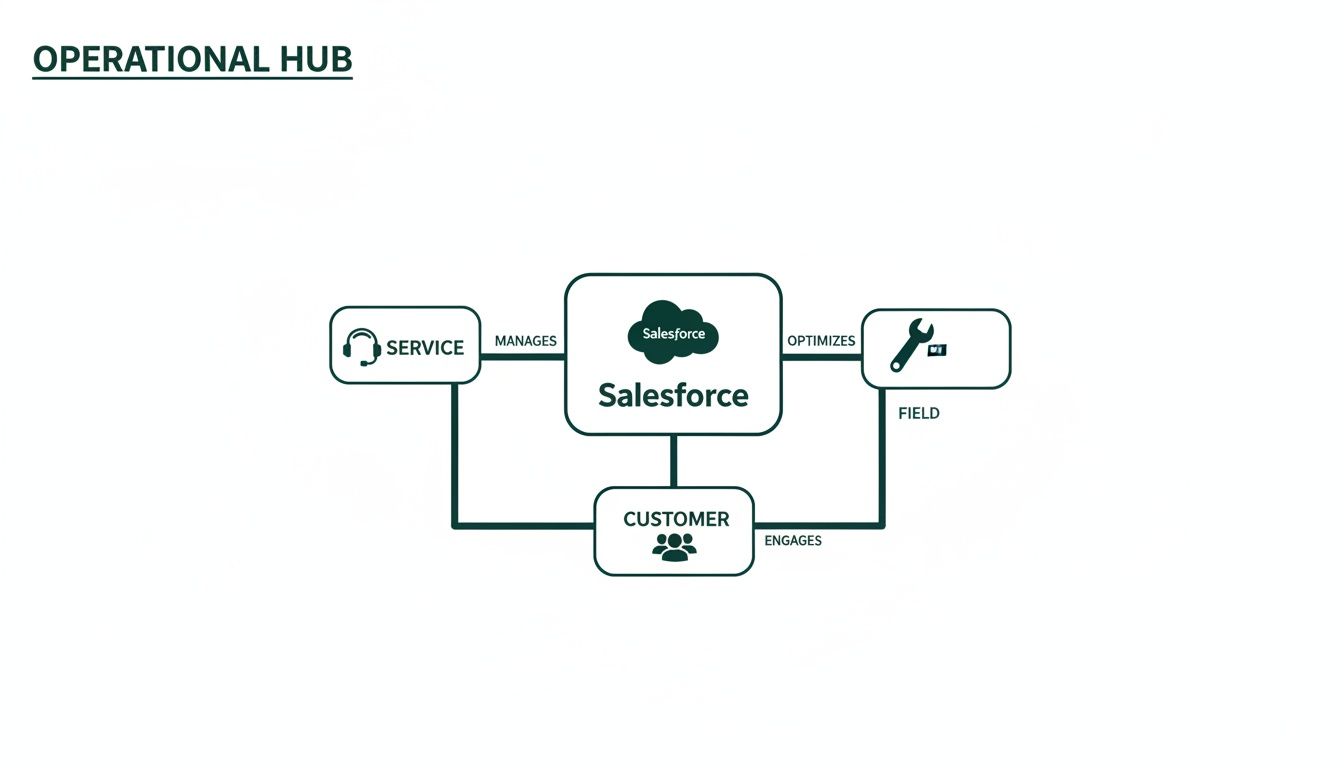
By putting Salesforce at the core, data moves freely between functions that were once disconnected. The result? A much more responsive and efficient organisation.
Connecting Your Technology Stack
Most utilities run on a handful of key platforms. The goal of a Salesforce integration project is to make them talk to each other.
- ERP Systems (NetSuite, SAP): Integrating your ERP means financial data, like invoices and payment statuses, is visible right inside Salesforce. This gives service agents the confidence to handle any billing query.
- Metering and Asset Management: Hooking up your metering infrastructure allows real-time consumption data to feed directly into customer records. This is huge for providing proactive service and ensuring accurate billing, especially for customers with solar.
- Customer Information Systems (CIS): The CIS is often the master record for customer accounts. A two-way sync with Salesforce keeps the data consistent across both platforms, stopping frustrating errors.
A successful integration isn’t just about plugging two systems together. It's about architecting a scalable and secure data flow that supports your business now and five years from now. This is where having an expert Salesforce partner really pays off.
The Role of a Salesforce Partner in Integration
Trying to design and build these complex integrations yourself is a minefield of potential pitfalls. An experienced Salesforce partner brings a proven methodology to the table.
They'll help you map out your business processes, choose the right integration tools (like MuleSoft or custom APIs), and construct a solid architecture that guarantees data integrity. This expert guidance helps you sidestep costly mistakes and ensures your integrated platform is reliable.
If you want to get your head around the fundamentals, check out our guide on what is system integration and how it drives business efficiency. A well-planned integration is what unlocks the true power of your Salesforce investment.
Case Study: Transforming Field Service and Customer Support with Salesforce
Theory is great, but a real-world transformation reveals the true impact of a unified platform. Let’s walk through a project we delivered for an Australian energy retailer—a narrative that highlights the journey from operational friction to streamlined excellence. Their business challenge was familiar to many utilities companies in Australia, rooted in the disconnect between their customer service centre and their field technicians.
The old way was a constant struggle. A customer would report a fault, and a call centre agent would log a basic work order. This ticket was then manually assigned by a dispatcher with little visibility into technician skills or locations. The result? A frustrating cycle of repeat visits, delayed fixes, and unhappy customers.

The Salesforce Solution: A Unified Operation
The path forward required tackling both sides of the problem. First, we implemented Salesforce Service Cloud for the customer support team. This immediately gave agents a single screen where they could see a customer's entire history, from billing to past service requests.
Second, we deployed Salesforce Field Service. This connected the back-office dispatchers and the mobile workforce directly into the same data hub. The system began to automatically schedule the best technician for each job based on skills, location, and the specific equipment at the customer's property.
This shift created a closed-loop system. The field technician could see the agent’s notes on their mobile device, and the agent could see the technician’s real-time status back in the office. Communication gaps simply vanished.
The Results: Measurable Business Benefits
This project wasn't just about better technology; it was about tangible outcomes that boosted the business's health and customer loyalty. The results were clear:
- A 30% reduction in repeat technician visits because technicians arrived with the right information and parts the first time.
- A 25% increase in first-call resolution rates, as service agents had the data needed to solve more issues over the phone.
- A measurable lift in their Net Promoter Score (NPS), reflecting a dramatic improvement in customer satisfaction.
These metrics make a powerful business case for a connected platform. To learn more, explore our guide on field service management software in Australia.
Lessons Learned: Adapting to a Changing Energy Landscape
This operational agility is even more critical as the grid itself changes. Australia’s electricity generation mix has shifted profoundly, with renewables now providing about 40.0% of total electricity. At peak times, renewables have even supplied over 77% of the National Electricity Market's power.
This variability means maintenance and rapid response are more important than ever. Modern utilities are using approaches like drone power line inspection for utility maintenance to proactively identify issues. A platform like Salesforce Field Service is essential for managing these advanced maintenance schedules and dispatching specialised teams efficiently, ensuring network reliability in a renewable-heavy grid.
This retailer's success story proves that connecting your teams isn't just an improvement—it's a foundational requirement for any future-ready utility.
Building Your Salesforce Roadmap for Digital Transformation
Thinking about the shift from clunky systems to a modern, customer-centric platform can feel overwhelming. The good news? The path to becoming a future-ready utility doesn't have to be a disruptive, all-at-once overhaul. It’s a strategic journey, and it all starts with a clear, practical roadmap.
For utilities companies in Australia, this means treating digital transformation with Salesforce not as a far-off goal, but as an essential tool for survival. The core message is simple: a unified platform is non-negotiable, and the journey begins with a focused, phased approach that delivers value every step of the way.
Charting Your Course: Best Practices for Salesforce Implementation
A successful rollout isn't just about the tech; it's about solving your biggest business headaches first. When you start small and build momentum, you can demonstrate value quickly, making it much easier to get organisational buy-in.
Your roadmap should follow three key steps:
- Identify Your Biggest Pain Points: Is it the chaotic field service scheduling pushing up costs? Or high call volumes due to a lack of self-service options? Pinpoint the one or two areas causing the most friction and make them your initial target.
- Build a Solid Business Case: Connect the Salesforce solution to real business outcomes. For instance, show how Salesforce Field Service will lead to a measurable drop in repeat truck rolls, or how Service Cloud can boost first-call resolution by a specific percentage.
- Choose the Right Implementation Partner: You need a strategic ally. A Salesforce partner with deep industry experience will help you sidestep common pitfalls, design a system built to scale, and ensure your investment pays off for years to come.
The goal is to create a clear path forward that turns a complex project into a series of manageable, high-impact wins. This builds confidence and drives adoption, paving the way for a more agile organisation.
Ready to take that first step? Our team specialises in digital transformation management consulting and can help you build the perfect roadmap. Let's talk about how Salesforce can solve your unique challenges.
Salesforce for Utilities FAQ
Making a big technology change always brings up important questions. Here are some of the most common queries we hear from leaders at Australian utilities companies when considering a Salesforce CRM implementation.
How does Salesforce handle the complex billing of the Australian energy market?
While Salesforce isn't a billing engine itself, its real power lies in its seamless integration with specialised utility billing systems. As your Salesforce partner, we connect these systems to create a 'single source of truth' for your customer service team. This integration allows an agent on a call to see and clearly explain complex tariffs, demand-based pricing, and solar feed-in credits directly from the customer's record in Service Cloud. The result is a massive improvement in first-call resolution and a better customer experience.
Can Salesforce help us manage regulatory compliance?
Absolutely. Staying on top of regulatory demands is non-negotiable, and Salesforce provides the tools to make it happen. We help clients build automated workflows to ensure consistent adherence to guidelines from bodies like the AEMC and AER. This means you can automatically track complaint resolution times, manage guaranteed service level (GSL) payment processes, and keep detailed, tamper-proof audit trails of every customer interaction. This automation reduces both administrative work and compliance risk.
Is Salesforce a good fit for smaller Australian energy retailers?
Yes, it’s not just for industry giants. The platform is incredibly scalable, which is perfect for smaller, growing retailers. You can start with the core editions of Sales Cloud and Service Cloud to get that unified customer view and streamline operations without a huge upfront cost. The beauty of Salesforce is its flexibility. You can start with the essentials and then add more advanced tools like Field Service or Marketing Cloud (Account Engagement) as your business grows. It’s a solution that grows with you.
Ready to map out a more agile, customer-first future for your utility? The team at Adaptal has helped over 110 Australian businesses get it right with Salesforce. Get in touch for a consultation and let's talk about how we can solve your unique challenges.