

When business leaders discuss growth, the term technology and services often surfaces. But what does it mean in a practical sense? It’s the strategic marriage of a powerful software platform with the expert human touch required to implement, customise, and support it. For a growing Australian organisation, this means selecting a robust platform like Salesforce and engaging a trusted partner to configure it, integrate it with other critical tools, and ensure it delivers real-world results. This is how you transform a software subscription into a core business asset that drives growth.
What Salesforce Technology and Services Mean for Your Business
Think of your business as a high-performance motorcycle. The technology—a powerful CRM like Salesforce—is the engine. It has incredible potential, but on its own, it’s just a piece of machinery sitting on a workbench.

To win the race, you need a skilled crew of mechanics and an expert rider. This is where the services component comes in. A Salesforce partner provides the strategic planning, custom configuration, user training, and ongoing optimisation. It's the human expertise that tunes the engine, navigates the track, and ensures every component works together flawlessly to achieve your business objectives.
From our project experience, this partnership solves the real-world challenges that hinder growth for many Australian businesses.
- The Challenge: Customer data is scattered across disconnected spreadsheets, leading to errors and a fragmented view of your client relationships.
- The Salesforce Solution: A single, reliable source of truth within Salesforce CRM that provides a 360-degree view of every customer.
- The Result: Teams can trust the data, sales cycles are streamlined with automated workflows that replace manual follow-ups, and leads no longer fall through the cracks. Your sales, service, and marketing departments can finally collaborate on one unified platform, breaking down internal silos.
From Software Purchase to Strategic Asset
Without expert services, even the best technology can quickly become an expensive, underutilised tool. A Salesforce partner is the crucial bridge between the platform’s potential and your unique business goals. They don't just install the software; they embed it deeply into your daily operations. This is what transforms it from a simple software subscription into the central nervous system of your company.
In today's digital-first landscape, this is non-negotiable. With Australia's internet penetration rate hitting 97.1% in early 2025, customers expect seamless digital experiences. This makes a well-optimised CRM more critical than ever to remain competitive. You can dig deeper into Australia's digital environment in this DataReportal analysis. In this environment, combining technology with expert services isn't just a good idea; it's essential for survival and growth.
A successful digital transformation isn't about buying the best software; it's about building the best system. It requires combining powerful technology with the strategic insight and technical skill to make it work for your specific business context.
This synergy between a platform like Salesforce and a dedicated partner ensures you get a clear return on your investment. It’s not just about patching up inefficiencies. It's about building a scalable foundation for sustainable, long-term success.
Building Your Growth Engine with Salesforce Clouds
Salesforce isn't just a single piece of software; it's a powerful suite of interconnected tools—or "Clouds"—designed to be the growth engine for your entire business. Each Cloud is built to solve specific operational challenges. When implemented correctly by a Salesforce partner, these components work together to create a unified platform that drives efficiency and revenue.

Too many businesses view their CRM as a simple digital address book. This is a mistake. The right technology and services transform it into a strategic command centre. Let's break down how the core Salesforce Clouds solve real-world problems based on what we've seen in our projects.
Automate Your Sales Pipeline with Sales Cloud
- The Challenge: The sales process is a chaotic mix of manual follow-ups, messy spreadsheets, and guesswork, leading to missed opportunities and an unreliable forecast.
- The Salesforce Solution: Sales Cloud brings structure and intelligence to your pipeline, providing a clear, real-time view of every lead, opportunity, and deal.
- The Result: Your sales team knows exactly who to call next, armed with the complete history of that relationship. Forecasting tools allow you to predict revenue with confidence, shifting your sales operation from reactive to proactive.
Create Loyal Customers with Service Cloud
- The Challenge: Support teams are overwhelmed juggling emails, phone calls, and social media messages, resulting in slow response times and frustrated customers.
- The Salesforce Solution: Service Cloud consolidates all customer service channels into a single, organised console, giving agents a complete view of every interaction.
- The Result: Faster case resolutions, happier customers, and increased loyalty. By solving problems efficiently, you turn your support team from a cost centre into a powerful retention engine. This is a critical part of any successful digital transformation. Our Salesforce implementation guide for Australian businesses offers deeper insights into planning this journey.
Personalise Customer Journeys with Marketing Cloud Account Engagement
- The Challenge: Generic marketing blasts are ignored, and the marketing team struggles to deliver qualified, sales-ready leads.
- The Salesforce Solution: Marketing Cloud Account Engagement (formerly Pardot) enables the creation of intelligent, automated customer journeys that nurture leads from initial interest to final sale.
- The Result: You can deliver the right message to the right person at the right time—automatically. By tracking engagement and scoring leads, marketing can hand over only the hottest prospects, creating powerful alignment between your sales and marketing teams.
Empower Partners and Clients with Experience Cloud
- The Challenge: Customers and partners lack a centralised, self-service channel for information, leading to high administrative overhead for your internal teams.
- The Salesforce Solution: Experience Cloud (formerly Community Cloud) allows you to build secure, branded online portals for customers, partners, or employees to find answers, track orders, or collaborate.
- The Result: You reduce the administrative load on your team while building stronger business relationships by empowering your external stakeholders. Each of these Salesforce components works together, fuelled by expert technology and services, to create a cohesive system that drives your business forward.
Creating a Single Source of Truth with Salesforce Integration
As a business grows, its data becomes scattered across different systems that don't communicate. Sales information is in your CRM, accounting figures are in another system, and service history is somewhere else entirely. These digital silos are a major source of inefficiency and prevent you from seeing the complete picture of your business.
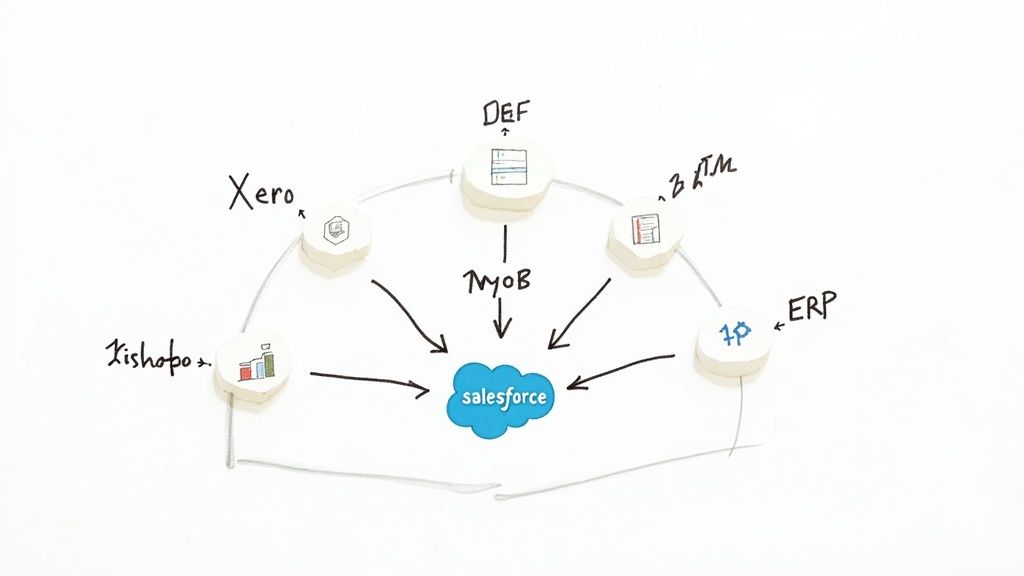
The solution is to create a single source of truth by integrating Salesforce with your other essential business platforms, like Xero, MYOB, or your Enterprise Resource Planning (ERP) software. This integration strategy is a cornerstone of effective technology and services, turning your standalone tools into a unified, intelligent system.
The Business Challenge of Disconnected Data
Imagine a salesperson closes a major deal. Without integration, they must manually re-enter all client and order details into the accounting system. This double-handling is time-consuming and a recipe for human error. One incorrect invoice number or mistyped address can lead to payment delays, shipping mistakes, and a frustrated customer. When your teams are forced to jump between applications, productivity plummets.
This is a significant challenge for growing Australian businesses. The local IT services sector is expanding as companies seek to resolve these exact issues. In fact, IT spending in Australia is projected to hit AU$147 billion in 2025, driven by a push for digital transformation and modernisation. You can read more about Australia's IT market trends on teksystems.com.
The Salesforce Solution: A Unified View
A Salesforce partner architects the integrations that create a seamless flow of information. When your Salesforce platform is connected to your other systems, the benefits are immediate.
- The Solution: When a deal is marked "Closed-Won" in Salesforce, an invoice is instantly and automatically generated in Xero or MYOB.
- The Result: Manual data entry is eliminated, drastically reducing costly errors and ensuring data accuracy across all systems. Your sales team can see a customer's payment history within Salesforce, and your finance team can view the live sales pipeline without leaving their accounting software.
A well-integrated system provides tangible benefits that drive efficiency and collaboration across the entire organisation.
Salesforce Integration Benefits Across Departments
| Department | Business System Integrated | Key Benefit Achieved |
|---|---|---|
| Sales | Accounting (Xero, MYOB) | Can see a customer's payment status and order history directly in Salesforce, leading to more informed conversations. |
| Finance | CRM (Salesforce) | Automates invoice creation from closed deals, reducing manual entry and speeding up the accounts receivable cycle. |
| Customer Service | ERP (NetSuite, SAP) | Gains real-time visibility into inventory levels and shipping status, allowing for faster and more accurate query resolution. |
| Marketing | Sales & Service Cloud | Accesses a complete customer profile, enabling highly targeted campaigns based on purchase history and service interactions. |
| Leadership | All Integrated Systems | Obtains a live, 360-degree dashboard of business health for quicker, data-driven strategic decisions. |
By creating a single, reliable source of business intelligence, you give your leadership team a live, 360-degree dashboard of your company’s health. This empowers faster, smarter, and more confident decision-making.
This unified approach also enhances data management and security. With information flowing through a central hub, it becomes simpler to manage access, maintain data integrity, and meet compliance standards. For a deeper dive, check out our guide on secure data storage and file deletion strategies.
Integrating your key business applications isn’t just a tech project—it's a core business strategy. It breaks down silos, boosts operational efficiency, and delivers the clear visibility needed to steer your company toward sustainable growth.
Measuring the ROI of Your Salesforce Investment
While the features of technology and services are impressive, what truly matters to decision-makers is the tangible impact on the bottom line. A strategic Salesforce investment isn’t just another expense; it's a direct driver of profitability and operational efficiency. The goal is to link every platform function to a measurable return on investment (ROI).
When implemented correctly by a trusted partner, Salesforce becomes an engine for efficiency, enabling your teams to achieve more with less effort. This results-driven focus is what separates a simple software purchase from a true business advantage.
From Operational Improvements to Financial Gains
The connection between a well-configured CRM and your financial statements is direct and measurable. It begins with streamlining daily tasks, which creates a positive ripple effect across the organisation. The key is to track the right metrics and understand how they contribute to overall business health.
- The Challenge: A professional services firm struggles with case resolution times, leading to high service costs and dissatisfied clients.
- The Salesforce Solution: By using Service Cloud to automate case routing and provide agents with a complete client history, the firm can resolve inquiries 25% faster.
- The Result: This not only improves client satisfaction but also directly cuts the cost of each interaction and frees up valuable team time.
A well-implemented Salesforce solution provides clarity and control. It moves your business from making decisions based on guesswork to making strategic moves based on real-time, accurate data.
- The Challenge: A construction company faces project delays and high operational costs due to inefficient scheduling of its site crews.
- The Salesforce Solution: By using Salesforce Field Service to optimise scheduling and dispatching, the company achieves a 15% reduction in project delays and a noticeable drop in fuel and maintenance costs.
- The Result: These are hard numbers that translate directly to increased profit margins. You can explore more of these success stories in our detailed Salesforce case studies.
Quantifying Your Return on Investment
Calculating the ROI from your Salesforce implementation involves analysing both cost savings and revenue growth to build a compelling business case.
Key metrics to track include:
- Increased Sales Productivity: Measure the reduction in time spent on administrative tasks. A 10% productivity boost for a team of five reps can add significant new revenue.
- Lower Customer Service Costs: Monitor metrics like average handling time and first-contact resolution. Improvements here directly reduce the operational cost of your support team.
- Improved Client Retention: Delivering superior service builds loyalty. A 5% increase in customer retention can increase profitability by 25% to 95%.
- More Effective Marketing Spend: With Marketing Cloud Account Engagement, you can track campaign performance from first click to final sale, ensuring your marketing budget is invested effectively.
This data-first approach is amplified by advancements in artificial intelligence. AI adoption in Australian businesses is projected to add up to $112 billion to the nation's GDP annually by 2030. Crucially for SMEs, this technology is expected to boost their productivity growth 22% faster than larger firms. You can explore these forecasts in the World Bank's report on AI adoption.
When assessing the impact of your technology stack, don't forget the ROI of cybersecurity investments—protecting your digital assets is fundamental to sustainable operations. Every dollar invested in your Salesforce ecosystem should be traceable to a clear, positive impact on your company's financial health.
Choosing The Right Salesforce Partner For Your Journey
Implementing Salesforce is a significant step for any business. From our experience across countless projects, we've learned that the success of the technology often depends more on the implementation team than on the software itself. A great Salesforce implementation is not a one-off project; it’s an ongoing journey of adaptation and improvement as your business evolves. This is where a strategic Salesforce partner becomes your most valuable asset.
Choosing a partner is about more than technical certifications. You need a guide who understands your business, speaks your industry's language, and is invested in your long-term success. The right partner acts as a translator, turning your commercial goals into practical, technical solutions that deliver real value.
Beyond Technical Skills: What to Look For in a Salesforce Partner
When vetting potential Salesforce partners, it’s easy to focus solely on technical capabilities. While expertise is essential, the true indicators of a great partner are their strategic approach and deep understanding of your commercial reality. You are looking for a team that feels like an extension of your own.
Ask questions that go beyond a standard capabilities pitch to determine if they are focused on a true partnership, not just another project.
The best Salesforce partner doesn't just configure software; they align technology with your business strategy. They should challenge your assumptions, offer new perspectives, and guide you toward solutions that drive growth, not just complete tasks.
This approach ensures your investment in technology and services is directly tied to business outcomes, as illustrated below.
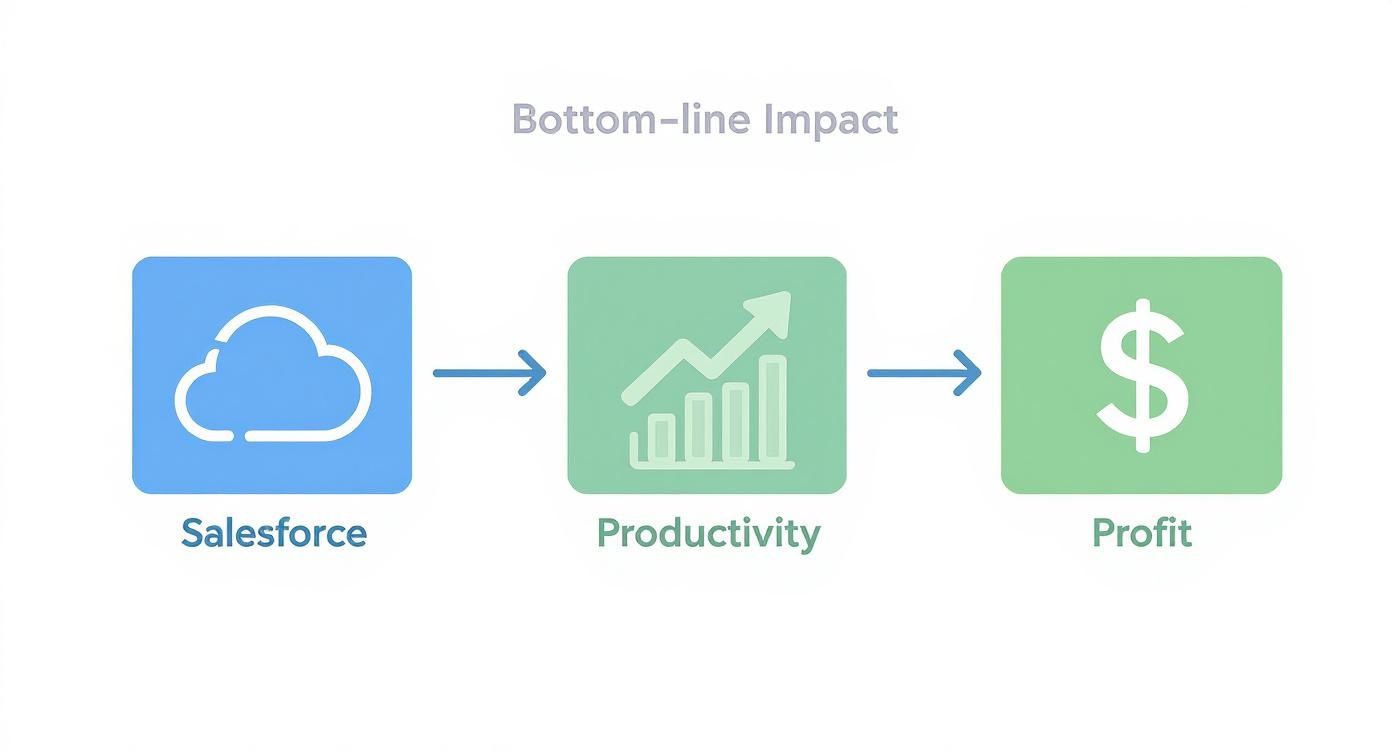
This visual roadmap shows how expert services unlock the platform's potential, creating tangible operational gains that directly boost your profitability.
A Practical Checklist For Evaluating Partners
To help you make a confident decision, use this checklist of questions when evaluating a potential Salesforce partner. These questions are designed to reveal their industry knowledge, collaborative approach, and commitment to your results.
Industry and Business Acumen:
- Can you share case studies from businesses in our industry?
- How will you learn about our unique operational challenges and business goals?
- Based on what you know, what initial opportunities do you see for us to improve efficiency with Salesforce?
Collaborative Approach and Process:
- What is your project methodology, from discovery and planning to training and ongoing optimisation?
- How will our team be involved throughout the implementation process?
- How do you manage scope changes or unexpected roadblocks during a project?
Long-Term Vision and Support:
- What do your ongoing support and managed services include after the initial project is complete?
- How do you help clients stay current with new Salesforce features and updates to ensure they continue to derive value from the platform?
As you evaluate potential solutions, understanding the wider CRM landscape can be beneficial. Resources like FranFunnel’s guide on Choosing the Best Franchise CRM for Growth can provide valuable industry-specific insights.
Ultimately, finding the right partner comes down to trust and a shared vision. You need a team that will not only meet your immediate needs but will also serve as a strategic advisor on your digital transformation journey. To see what this partnership looks like in action, learn more about our Salesforce consulting team.
How Salesforce Solves Industry-Specific Challenges
One-size-fits-all solutions rarely deliver optimal results. The true power of strategic technology and services is realised when a platform is tailored to the unique challenges of a specific industry. A construction company's daily operations are vastly different from those of a healthcare clinic, and their technology should reflect that.
Based on our project experience, here is how tailored Salesforce solutions solve the most significant challenges for key Australian sectors. These are proven, practical applications that help businesses improve efficiency, deliver better client outcomes, and drive growth.
Construction: Project and Team Management
In the construction industry, success depends on managing complex projects, coordinating on-site teams, and keeping everything on schedule and within budget. Communication breakdowns between the site and the office lead to costly delays, rework, and budget overruns.
Salesforce Field Service provides a single source of truth to manage scheduling, dispatch crews, and track progress in real-time.
- The Challenge: A project manager lacks timely updates from site supervisors, resulting in inaccurate progress reports and inefficient resource allocation.
- The Salesforce Solution: Field teams use the Salesforce mobile app to log job progress, upload site photos, and complete tasks on-site. This information is instantly visible to the office team.
- The Result: Project managers gain a live, accurate view of every project. They can address issues proactively, reallocate resources effectively, and ensure deadlines are met, leading to a significant reduction in administrative overhead and a direct boost to project profitability.
Healthcare: Patient Relationship Management
Healthcare providers must deliver exceptional patient care while navigating strict privacy regulations like the Australian Privacy Principles. Managing patient communications, appointments, and follow-ups with disparate systems is inefficient and risky.
Salesforce Health Cloud provides a secure, compliant platform for a complete view of the patient journey, improving engagement and operational efficiency while safeguarding sensitive data.
This specialised solution enables clinics and hospitals to move away from fragmented records and adopt a holistic approach to patient management.
Salesforce Solutions for Key Industry Challenges
The table below provides a snapshot of how the versatile Salesforce platform can be tailored to address the distinct pain points of different sectors.
| Industry Vertical | Common Business Challenge | Recommended Salesforce Solution |
|---|---|---|
| Franchise | Maintaining brand consistency and operational standards across all locations. | Experience Cloud for a central franchisee portal and Salesforce Maps to manage territories. |
| Construction | Poor communication between field teams and the main office, leading to project delays. | Salesforce Field Service for real-time job tracking and mobile updates from the site. |
| Healthcare | Managing patient data securely while ensuring compliance with privacy laws. | Salesforce Health Cloud for a compliant, 360-degree view of the patient journey. |
| Professional Services | Inefficiently tracking billable hours and managing the entire client lifecycle from lead to invoice. | Sales Cloud & Service Cloud combined, integrated with accounting software like Xero or MYOB. |
Professional Services: Client Lifecycle Management
Professional services firms manage a long and intricate client journey. Tracking billable hours, meeting project milestones, and nurturing relationships across multiple projects can become chaotic when relying on spreadsheets and disconnected applications.
A customised Salesforce solution, combining the strengths of Sales Cloud and Service Cloud, brings order to this process.
- The Challenge: A consulting firm loses revenue due to unrecorded non-billable client interactions. Project managers spend days each month manually compiling data for invoicing.
- The Salesforce Solution: The platform is configured to capture every client touchpoint, automate milestone reminders, and integrate directly with accounting software like Xero or MYOB. Invoicing becomes a one-click process.
- The Result: The firm gains a complete, 360-degree view of every client relationship. The billing cycle is reduced from days to minutes, freeing up senior staff to focus on delivering exceptional client work rather than administrative tasks.
Frequently Asked Questions about Salesforce Services
Investing in new technology naturally raises questions. To provide clarity, here are straightforward answers to the queries we most frequently hear from business leaders considering a Salesforce implementation.
How Long Does a Typical Salesforce Implementation Take?
There is no one-size-fits-all answer, as every project is tailored to a business's unique needs. A straightforward implementation for a small team using core Sales Cloud features might take 4 to 8 weeks.
A more complex project involving multiple clouds (e.g., Sales and Service), data migration from legacy systems, and integration with accounting software like Xero or MYOB is more likely to take 3 to 6 months. A detailed discovery and planning phase is key to establishing a realistic timeline from the outset.
What’s the Difference Between Salesforce Configuration and Customisation?
Understanding this distinction is crucial for managing your budget and expectations.
-
Configuration involves using Salesforce’s powerful, built-in, point-and-click tools to adapt the platform to your business processes. This includes creating new fields, building reports and dashboards, and setting up automation rules. It is always the preferred approach.
-
Customisation involves writing custom code (like Apex or Lightning Web Components) to build functionality that does not exist out-of-the-box. This is reserved for highly specific or complex requirements, as it is more time-consuming and costly to develop and maintain.
A trusted Salesforce partner will always leverage configuration to its fullest extent first, as it keeps your system scalable, flexible, and easier to maintain.
How Is Pricing and Cost Structured for a Salesforce Project?
Salesforce project costs are typically divided into two main categories. First are the Salesforce licence fees, which are paid directly to Salesforce on a per-user, per-month basis. The cost varies depending on the product (e.g., Sales Cloud) and edition (e.g., Professional or Enterprise) you choose.
Second are the implementation service fees paid to your Salesforce partner. This covers the hands-on work, including discovery, design, setup, data migration, training, and project management. After a thorough discovery process, we provide a fixed-price quote to ensure you have complete budget clarity from the start.
What Happens After We Go Live?
Your Salesforce journey does not end at go-live. To ensure you continue to maximise your return on investment, ongoing support and optimisation are vital.
Think of your Salesforce platform as a living part of your business. As your company grows and your processes evolve, your CRM must adapt alongside it. This is where a long-term partnership delivers immense value.
This is often managed through a managed services agreement, which provides user support, a plan for continuous improvement, and assistance with rolling out the new features Salesforce releases three times a year.
Ready to see how a strategically planned Salesforce solution can drive your business forward? The team at Adaptal is here to guide you through every step, from initial concept to long-term success.
Contact us today for a consultation and let's build your growth engine together.