
A single view of the customer is more than just a buzzword; it’s the practice of bringing together every piece of customer data from every interaction into one clear, consistent profile. Think of it as the difference between seeing a customer as a series of random, disconnected snapshots and understanding their entire journey with your business, from start to finish. For businesses running on Salesforce, achieving this unified view is the key to unlocking true customer-centricity.
The High Cost of Disconnected Customer Data
Let’s be honest about a hard truth many Australian businesses are grappling with. While almost every leader knows a single customer view is vital, most are still stuck wrestling with disconnected data silos. This creates a jarring and impersonal experience for your customers—like trying to have a real conversation with someone who forgets who you are the second you part ways.

This data disconnect isn't just a tech headache; it hits your bottom line. It results in frustrated customers, missed opportunities for growth, and teams who spend more time hunting for information than actually using it to create value.
The Problem of Data Silos
Data silos are what happen when information is trapped in separate, unlinked systems across your organisation. Your marketing team has its campaign data in Marketing Cloud, sales has its deal history in Sales Cloud, and the service team has support tickets tucked away in Service Cloud. Critically, these systems aren't always configured to talk to each other seamlessly.
This fragmentation creates a huge gap between what customers expect and what you deliver. For instance, in Australia, a massive 97% of marketers see a centralised view of the customer as absolutely crucial, yet 81% are still stuck using siloed measurements.
The fallout from this is very real. While 76% of customers expect consistency across departments, 54% say it feels like sales, service, and marketing teams don’t share information. You can dig into the full findings on why Australian customers feel this disconnect on the official Salesforce research page.
This leads to some all-too-common (and damaging) scenarios we've helped clients overcome:
- Irrelevant Marketing: A loyal, high-value client gets a generic introductory offer because the marketing system has no idea they've been a customer for five years.
- Clumsy Sales Handovers: A sales rep calls a prospect, completely unaware they just had a frustrating support experience an hour ago logged in Service Cloud. Ouch.
- Repetitive Service Interactions: A customer is forced to repeat their entire story and account history every single time they speak to a different support agent.
"Without a unified view, you're not just missing data; you're missing the context of your customer relationship. It’s the context that transforms a simple transaction into genuine loyalty."
The table below breaks down just how stark the difference is between operating with siloed data versus a unified customer view powered by Salesforce.
Impact of Siloed vs Unified Customer Data in Salesforce
| Business Area | Impact of Data Silos (The Problem) | Benefit of Single Customer View (The Salesforce Solution) |
|---|---|---|
| Marketing | Generic, untargeted campaigns that annoy customers and waste budget. Inability to measure true ROI. | Highly personalised campaigns in Marketing Cloud that resonate with customers based on their history and preferences. Clearer ROI. |
| Sales | Reps flying blind without a full picture of past interactions, leading to missed cross-sell/upsell opportunities. | Empowered sales teams using Sales Cloud who can have contextual, value-driven conversations and identify opportunities proactively. |
| Customer Service | High customer frustration due to repetitive questions and long resolution times. Agents lack context to solve issues effectively. | Faster, more empathetic support in Service Cloud where agents have all the information they need at their fingertips to solve problems on the first call. |
| Operations | Inefficient processes and wasted time as staff manually search for information across multiple systems. | Streamlined workflows and increased productivity, as all teams work from Salesforce as a single, reliable source of truth. |
| Strategy | Business decisions based on incomplete or inaccurate data, leading to flawed strategies and missed market shifts. | Data-driven insights from Salesforce reports and dashboards that fuel accurate forecasting, better strategic planning, and a deeper understanding of the customer base. |
As you can see, the shift isn't just about organising data—it’s about fundamentally changing how every part of your business operates for the better.
Turning Data into Your Strongest Asset
The first step is to stop thinking of the single view of the customer as a technical project and start seeing it as a core business strategy. It’s about building a solid foundation to create lasting loyalty and drive sustainable growth.
The ultimate goal is to bridge these internal gaps so you can present one cohesive, intelligent, and empathetic face to your customer at every single touchpoint. This is exactly what a powerful CRM platform like Salesforce is built to do. By connecting all your disparate data sources, Salesforce gives you a clear roadmap for turning fragmented information into your most valuable asset.
What a Single Customer View Looks Like in Salesforce
So, what does a single view of the customer actually feel like in practice? Imagine having a complete, living profile for every single person who interacts with your business, all neatly organised right inside Salesforce. This is worlds away from a static contact record; it's a unified story that evolves with every touchpoint.
Think of it as an intelligent ‘Customer Dossier’. This dossier doesn’t just store information—it intelligently stitches together and contextualises every interaction to build a rich, multi-dimensional picture of a real person.
From Scattered Data to a Unified Story
Without a unified view, your customer data is like a jigsaw puzzle with the pieces scattered across different boxes. You might have one piece in Marketing Cloud, another on your e-commerce platform, and a third in Service Cloud. Each piece on its own tells you very little.
The whole point of a single customer view in Salesforce is to find all those pieces, bring them into one place, and assemble the complete puzzle. Only then does the full picture of the customer's relationship with your brand emerge.
For example, a unified Salesforce profile would show you the entire sequence of events:
- Marketing Engagement: A customer clicks on a Marketing Cloud email promoting a new service.
- Website Behaviour: They then spend ten minutes on your website, browsing the features and pricing pages.
- Service History: A week later, they log a query with your service team via Experience Cloud to ask about implementation.
- Sales Activity: Following a positive support experience, a sales rep follows up via Sales Cloud, and the customer makes a purchase.
This isn't just about collecting data; it's about seeing the narrative behind the numbers. It transforms your perspective from tracking isolated events to truly understanding a coherent customer journey. Mapping these interactions is a critical step, and you can explore this further in our detailed guide on what is customer journey mapping.
The Role of Salesforce Data Cloud
The central hub making all of this possible is Salesforce Data Cloud. It acts as the engine that pulls in, cleans up, and harmonises all those scattered data points from your different systems. Data Cloud connects information from Sales Cloud, Service Cloud, Marketing Cloud, and even external sources like your website or accounting software.
By bringing all this data together, Salesforce Data Cloud creates a single, reliable source of truth for every customer. This isn't a one-time snapshot; it's a dynamic profile that updates in real-time as new interactions happen.
Enabling Smarter, Proactive Engagement
Ultimately, the goal isn't just to hoard data but to genuinely understand the person behind it. When your teams have this complete dossier at their fingertips, their entire approach to engagement can change.
- Sales reps can have far more meaningful conversations, armed with the full context of a customer’s history and interests.
- Service agents can resolve issues faster and more empathetically, without ever having to ask a customer to repeat their story.
- Marketers can deliver truly personalised campaigns that resonate because they’re based on actual behaviour, not guesswork.
This shift moves your business from being reactive to proactive. You can start to anticipate customer needs, spot opportunities before your competitors do, and deliver the kind of seamless, personalised experience that builds lasting loyalty and drives real business growth.
Unifying Your Data Sources Within Salesforce
This is where the rubber meets the road—turning your single customer view strategy into a reality. The whole point is to pull together crucial bits of data from every corner of your business to build a complete, genuinely useful picture of your customer. We're moving way beyond just names and email addresses here; we're creating a rich profile built on actual, real-world interactions.
Think about it. Your sales history is tucked away in Sales Cloud, support tickets are piling up in Service Cloud, and all that juicy campaign engagement data is sitting in Account Engagement (Pardot). Each system tells a part of the story, but the real magic happens when we, as your Salesforce partner, help you weave them all together.
And let's be honest, with third-party cookies on their way out, your own first-party data has become gold. This is the information you gather directly from your audience—what they do on your website, what they buy, and how they ask for help. It’s the most valuable and accurate data you’ll ever have for building a true single customer view.
This diagram shows how a 'Customer Dossier' becomes the central hub, pulling in key data from website behaviour, sales activities, and service chats.
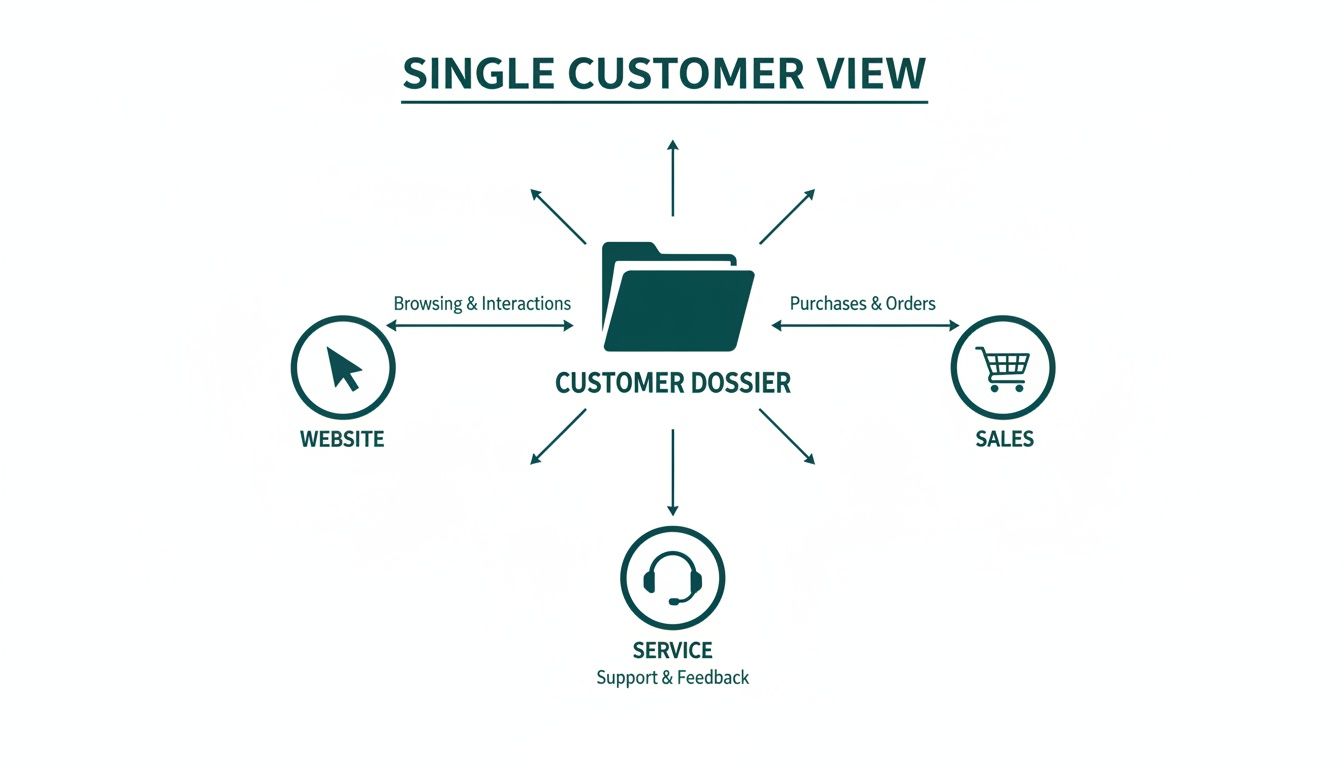
When you see it laid out like this, it just clicks. You can see how all those previously disconnected touchpoints come together to form one smart, cohesive customer profile inside Salesforce.
The Salesforce Architecture for Data Unification
Salesforce isn't just a place to dump your data; it offers a powerful toolkit designed specifically to pull in, clean up, and connect all those different streams of information. It’s not about storage—it’s about intelligent harmonisation that creates a single source of truth everyone in your organisation can rely on.
Two key players make this happen: Salesforce Data Cloud and MuleSoft.
- Salesforce Data Cloud is the central nervous system of this operation. It's built to ingest huge volumes of data from all over the place—your CRM, marketing platforms, e-commerce site, you name it—and unify it all around a single customer identity.
- MuleSoft acts as the ultimate connector. It provides the APIs and pre-built connectors you need to link Salesforce with pretty much any other system, whether it’s a modern cloud app or some ancient on-premise software. This ensures no data source gets left behind.
If you want to get into the nuts and bolts of how connecting your tech stack directly creates this unified view, this guide on platform integration for a single customer view is a fantastic resource. That integration is the technical bedrock your entire strategy is built on.
The real trick isn't just grabbing data from different places. It's the platform's ability to resolve identities and stitch together a customer’s entire journey across every channel into one, easy-to-read timeline.
Starting with High-Impact Data
A classic mistake we see is clients trying to boil the ocean by connecting everything at once. That approach is a recipe for overwhelm and usually just delays getting any real value. A much smarter play is to start with the data sources that will make the biggest, fastest impact on your business goals.
For most businesses, these high-impact sources are:
- Sales & CRM Data: What have they bought? What deals are in the pipeline? Information from Sales Cloud gives you the commercial side of the story.
- Customer Service Data: Support tickets, resolution times, and satisfaction scores from Service Cloud tell you where the customer is feeling pain and what makes them happy.
- Marketing Engagement Data: Clicks, opens, and form fills from Marketing Cloud Account Engagement (Pardot) show you exactly what content and offers are hitting the mark.
- Website & E-commerce Data: Page views, time on site, and abandoned carts are massive behavioural clues about what a customer is interested in right now.
By nailing these core areas first, we can build a solid foundation and show a quick win. From there, you can start layering in other sources like financial data from your ERP or feedback from social media.
This phased approach also helps you establish clear data governance rules from day one. Strong governance keeps your data clean, accurate, and trustworthy as you scale, avoiding the dreaded "garbage in, garbage out" problem that sinks so many data projects. Getting this foundation right is the key to unlocking long-term success.
Why Do So Many Companies Struggle with a Unified View?
If creating a single view of the customer is such a game-changer, why is it still the exception rather than the rule? The simple truth is, that building this unified perspective is tough. It's a complex puzzle, and that’s why it remains an elusive goal for so many organisations.
The numbers don't lie. Research shows that a tiny 5% of Australian marketers have actually managed to achieve a true single view of their customer. This leaves a huge majority frustrated with their cross-channel marketing and unable to deliver the seamless experiences modern buyers expect. You can dig deeper into these findings on the challenges facing Australian marketers on Data.com.au.
Without this 360-degree perspective, businesses are flying blind. They can't effectively track customer journeys, which leads to customers repeating themselves, getting poorly personalised offers, and ultimately, a lot of missed opportunities. Let’s break down the most common roadblocks we see in our Salesforce projects and how a smart approach clears the path forward.
The Challenge of Legacy Systems
One of the biggest hurdles we see is companies wrestling with outdated, clunky legacy systems. Many businesses have been running for years on a patchwork of different technologies for sales, marketing, and operations—most of which were never designed to talk to each other.
These old systems often lack modern APIs, making it difficult, expensive, and painfully slow to get data out. Trying to connect them can feel like trying to fit a square peg in a round hole.
The Salesforce Solution: This is where an integration platform like MuleSoft becomes your secret weapon. MuleSoft acts as a universal translator, creating a seamless bridge between your legacy systems and the modern Salesforce cloud. It lets you unlock all that valuable data trapped in older platforms without having to rip and replace everything at once.
Poor Data Quality and Governance
Another all-too-common problem is just plain bad data. Incomplete records, duplicate contacts, and inconsistent formatting can sabotage your efforts before you even start. If you try to unify messy data, all you’re going to get is a bigger, more organised mess.
This "garbage in, garbage out" issue usually comes from a lack of clear data governance—the rules of the road for keeping your data accurate and consistent. Without a solid governance strategy, your unified view will be built on a shaky foundation, leading to flawed insights and a lack of trust from your teams.
The Salesforce Solution: Salesforce Data Cloud has powerful, built-in tools for data cleansing, de-duplication, and identity resolution. It helps you standardise and enrich your data as it’s brought into the system, ensuring the information you’re unifying is accurate and reliable right from the get-go.
A single view of the customer isn't just a data project; it's a commitment to data quality. Salesforce provides the tools, but a strong governance strategy is what makes it sustainable.
Navigating Departmental Silos
Technology is only one piece of the puzzle. Often, the biggest barriers are cultural. Departments can become fiercely protective of "their" data, creating organisational silos that are just as damaging as any technical ones.
Marketing might be reluctant to share campaign performance data, while sales guards their customer contact lists. This resistance to collaboration stops a truly unified view dead in its tracks because no single team ever has the complete picture.
The Salesforce Solution: Salesforce, by its very nature, is a shared platform. When implemented the right way, it becomes the single source of truth that every team works from. This immediately starts breaking down walls by giving every department a shared interest in maintaining a clean, complete, and accurate view of the entire customer relationship.
Australian Privacy and Compliance Complexities
Finally, Australian businesses have to navigate the complexities of the Australian Privacy Act. Collecting and unifying customer data comes with serious responsibilities to protect personal information and respect consumer rights.
Making sure you're compliant isn't just a legal box to tick; it’s fundamental to building customer trust. A data breach or misuse of information can cause irreparable damage to your brand's reputation.
The Salesforce Solution: The Salesforce platform is built from the ground up with security and compliance at its core. It provides robust tools for managing data access, consent, and privacy preferences, helping you build a single customer view that is not only powerful but also fully compliant with local regulations. With the right Salesforce partner, you can configure these controls to align perfectly with your governance policies and give you peace of mind.
Your Salesforce Blueprint for a Unified Customer View
Theory is one thing, but a practical, actionable plan is what truly drives results. Building a single view of the customer isn’t some monolithic, boil-the-ocean project; it's a strategic journey you take one step at a time. To make this tangible, let's walk through a proven, five-step blueprint for getting it done on the Salesforce platform, using the story of a professional services firm we recently partnered with.
The Challenge: This firm, like many, had client data scattered everywhere. Project details were locked in one system, billing history in another, and crucial client communications were buried deep in individual email inboxes. This fragmentation meant missed opportunities and clunky, inefficient client management. They needed a clear path forward to unify their data and start creating a seamless client experience.
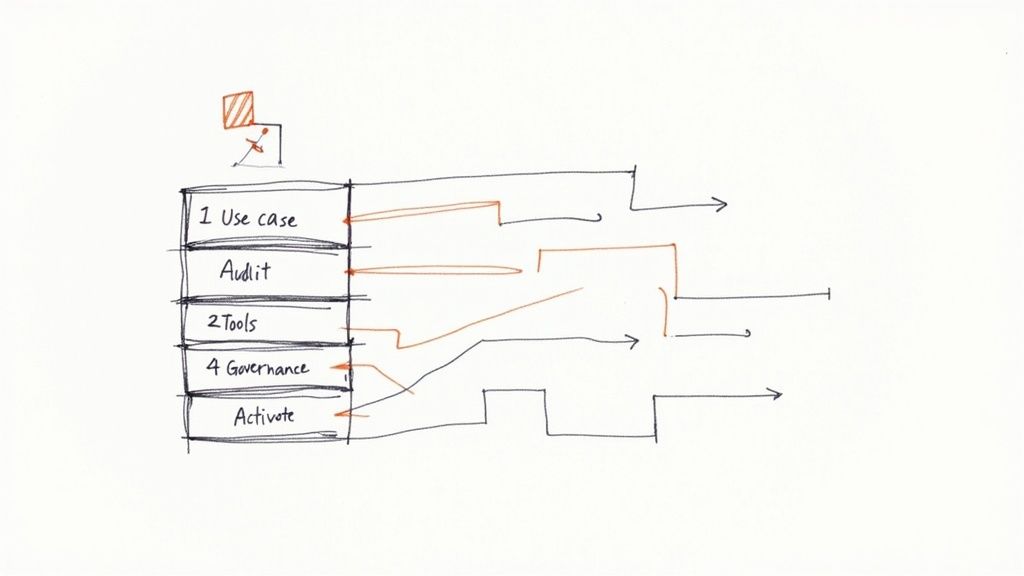
This is the exact blueprint they followed—a process we guide our own clients through to turn scattered information into a powerful, unified asset.
Step 1: Pinpoint a High-Impact Use Case
The biggest mistake you can make is trying to solve every problem at once. It’s a recipe for disaster. We worked with the firm to identify their most pressing challenge: client retention. With that in focus, they decided to build a unified view specifically to identify at-risk clients and proactively improve their experience.
The Salesforce Solution: This focused approach gave them a clear, measurable goal, which made it easy to secure executive buy-in and ensured they could deliver real value, fast. Instead of a vague objective like "unify all data," they aimed to reduce client churn by 15% in the first year by leveraging insights from their new unified view in Salesforce.
Step 2: Conduct a Thorough Data Audit
With a laser-focused goal in mind, the next step was to map out every single place client data lived. Think of this audit as a critical discovery phase where you identify all your data sources, no matter how small or seemingly insignificant.
For our client, the audit uncovered these key data pockets:
- Sales Cloud held all initial contact info and opportunity management data.
- Xero contained the invoicing and payment history.
- A separate project management tool was tracking all their deliverables and milestones.
- Outlook was a treasure trove of client email correspondence.
The Salesforce Solution: This process created a comprehensive map of their data landscape, showing them exactly what needed to be connected to hit their retention goal.
Step 3: Select the Right Salesforce Tools
Salesforce offers a powerful suite of tools designed for this exact purpose. The key is choosing the right combination for your specific needs. The firm’s strategy relied on two core components for system integration, a process that’s absolutely essential for connecting disparate platforms.
The Salesforce Solution:
- Salesforce Data Cloud would serve as the central hub. Its job was to ingest data from all sources and use its identity resolution capabilities to create a single, unified profile for each and every client.
- MuleSoft would act as the connective tissue. It uses robust APIs to pull data from their project management tool and Xero, ensuring a seamless flow of information straight into Data Cloud.
This combination provided the technical foundation needed to bring their entire client story into one place. For a deeper dive into how this all connects, check out our guide on what system integration is and why it matters.
Step 4: Establish Robust Data Governance
Before a single piece of data was activated, the firm established clear rules for data quality and management. This is a non-negotiable step. Without it, your unified view will be untrustworthy and inaccurate. They defined clear ownership for each data source, created standards for data entry, and set up automated cleansing rules within Salesforce to handle duplicates and inconsistencies.
The Salesforce Solution: This proactive governance prevents the classic "garbage in, garbage out" problem that can completely undermine the entire initiative. A clean, reliable dataset is the absolute bedrock of a successful single customer view. Investing in this foundation is critical, as a staggering 95% of consumers have dropped a company after a poor experience, often caused by disconnected data.
Step 5: Build and Activate the Unified Profile
With a solid foundation in place, the final step was to build and activate the unified client profiles across their key Salesforce Clouds.
This is where the strategy comes to life. The unified data isn't just stored; it's put to work to drive smarter actions and better experiences across the entire business.
The Salesforce Solution: They configured dashboards in Sales Cloud for their account managers, showing a complete client history that included recent project milestones and any open service tickets. Over in Service Cloud, agents could immediately see billing status and project scope when a client called for support. Finally, they used Marketing Cloud Account Engagement to send highly personalised communications based on a client's specific service history and engagement level, transforming their retention strategy from reactive to truly proactive.
Achieving Your Unified View with the Right Salesforce Partner
Building a single view of the customer isn’t just another IT project; it's a complete shift in how your business thinks and operates. Getting from scattered data silos to a single, unified source of truth takes commitment, but the competitive edge it creates is massive.
This change delivers real, measurable value right across your organisation. You'll see stronger customer loyalty, find more avenues for revenue, and empower your teams to stop wasting time hunting for information and start creating incredible experiences.
While the path involves sorting out technical integrations and setting up solid data governance, you don’t have to figure it all out on your own. The complexities are exactly why bringing in a specialist Salesforce partner makes all the difference.
Why a Salesforce Partner is Your Greatest Asset
A seasoned Salesforce partner brings more to the table than just software configuration. We offer a strategic viewpoint forged from countless real-world projects, helping you sidestep common mistakes and get value from your investment much faster. A great partner helps you lay out a practical roadmap that delivers quick wins along the way.
Choosing the right partner gives you access to expertise that ensures your setup isn't just technically sound, but is also laser-focused on your business goals. We become your guide, helping you:
- Map out a clear strategy that starts by tackling your biggest business headaches first.
- Navigate the technical maze of data integration and identity resolution.
- Establish robust data governance from day one to guarantee long-term success.
- Drive user adoption by getting powerful, easy-to-use insights into the hands of your teams.
A successful single customer view isn’t really about the technology itself. It’s about pairing a powerful platform like Salesforce with the strategic guidance of a partner who knows the ropes and has a track record of delivering results.
Let's Build Your Roadmap to Success
The value of seeing your customer clearly can't be overstated. It's the bedrock for building the kind of lasting relationships that fuel sustainable growth, no matter what the market is doing. Don't let the challenges of data integration and governance stop you from gaining this powerful advantage.
Our team has walked countless Australian businesses through this exact journey. As an experienced Salesforce implementation consultant, we have the know-how to help you build a single source of truth that energises your entire organisation.
Ready to transform your scattered customer data into your most valuable asset? Let’s connect for a no-obligation chat to talk about your specific challenges and build a clear, actionable roadmap for your success.
Salesforce Single View of the Customer: FAQ
When you start exploring a single view of the customer, a few key questions always come up. It's a journey that touches both business strategy and technical execution, so it's natural for leaders and their teams to have these queries. Here are some straightforward answers to the questions we hear most often from our clients.
What Is the Difference Between a CRM and a Single Customer View?
This is a fantastic question because it gets right to the heart of the strategy.
Think of your CRM, like Salesforce Sales Cloud, as a critical chapter in your customer's story. It’s where you keep all that vital information about sales activities, contact details, and current opportunities. It's a rich and essential part of the narrative.
A true single customer view, however, is the entire book. It pulls together the data from all your systems—your CRM, marketing platform, service desk, e-commerce site, you name it. It creates one complete, unified profile that tells the whole story. Tools like Salesforce Data Cloud are the engine that makes this possible, stitching together all those separate chapters into a single, cohesive narrative.
How Long Does This Salesforce Implementation Take?
The good news is that achieving a single customer view isn't some massive, multi-year project that brings your business to a standstill. It’s an iterative journey. The smartest way to approach it is to start small, prove the value quickly, and then build on that success.
We guide our clients to pinpoint a high-impact, specific use case to tackle first. Maybe it's personalising a marketing campaign or improving a service interaction. By zeroing in on a clear goal, we can deliver real, tangible results in a matter of months, not years. This approach builds momentum, clearly demonstrates the ROI, and gets your team genuinely excited about what’s next.
How Do We Ensure Data Privacy and Compliance in Salesforce?
Data privacy isn’t just a box to tick at the end; it's a core part of the foundation from day one. This is especially true here in Australia with regulations like the Privacy Act. The Salesforce platform itself is incredibly secure and built with compliance in mind, offering robust features for managing consent and controlling data access.
From the very beginning of any project, we work with you to bake in a strong data governance strategy. This makes sure every single piece of data is handled correctly. The end result is a single customer view that’s not just powerful but also fully compliant, building trust with your customers and giving your internal teams complete confidence.
Ready to turn your scattered customer data into your most powerful asset? The team at Adaptal has guided countless Australian businesses through this exact journey. Let’s connect for a no-obligation chat to build a clear, actionable roadmap for your success.