

Is your sales operation running on disconnected tools? For many growing businesses, every lead, customer interaction, and pipeline stage is scattered across different spreadsheets and systems. This creates data silos and hinders growth. SFDC Sales Cloud acts as the central nervous system for your sales team, unifying every process into one intelligent, cohesive platform. It’s designed to move Australian businesses from messy data management to a streamlined, strategic sales engine.
Unifying Your Sales Process with SFDC Sales Cloud
Many organisations begin by juggling sales with a mix of spreadsheets, shared inboxes, and separate calendars. While this works initially, it quickly becomes a bottleneck. Information gets lost, collaboration suffers, and gaining a clear view of the sales pipeline feels like guesswork. SFDC Sales Cloud, a cornerstone of the Salesforce ecosystem, was purpose-built to solve this exact challenge.
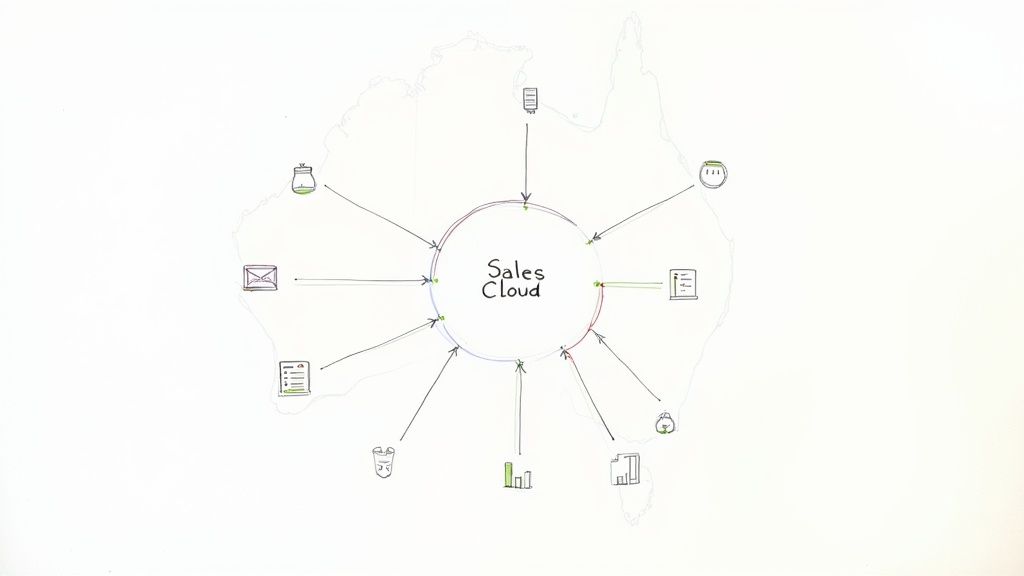
Think of it as the mission control for your sales department. Instead of data being scattered, Sales Cloud centralises it.
- Lead Management: It captures and tracks every potential customer from their first interaction, ensuring no opportunity is missed.
- Opportunity Tracking: It provides a clear, real-time view of every deal, its stage, and the next steps required to close.
- Contact and Account History: Every email, call, and meeting note is logged against the customer record, accessible to the entire team.
- Accurate Forecasting: It leverages real-time data, enabling sales leaders to predict future revenue with greater confidence.
This unified approach gives your team a 360-degree view of the customer. Your CRM evolves from a simple database into a powerful strategic asset that drives smarter business decisions.
Why Automation Is the Secret Ingredient
At its heart, Sales Cloud is a powerful automation engine. Understanding what is sales automation reveals how it fundamentally changes the sales game. Automation handles the repetitive, administrative tasks that consume a sales representative's day, freeing them to focus on what they do best: building relationships and selling.
From our experience: By automating routine jobs like follow-up reminders, task assignments, and activity logging, sales teams can dedicate more time to high-value conversations. This directly impacts productivity, pipeline velocity, and ultimately, win rates.
For instance, when a new lead from your website enters the system, a business challenge is immediately solved. Sales Cloud can instantly assign it to the right team member, create a follow-up task, and send a personalised welcome email. This simple, automated workflow ensures every potential customer receives a prompt response and no opportunity falls through the cracks.
Driving Growth in the Australian Market
Across Australia, businesses in finance, healthcare, and retail are leveraging Salesforce Sales Cloud to refine their strategies. As more companies embrace cloud solutions to scale and support remote teams, Salesforce provides robust features that also address local regulations like the Consumer Data Right (CDR) and the Privacy Act.
By creating a single source of truth for sales data, SFDC Sales Cloud empowers Australian organisations to improve team collaboration, make data-driven decisions, and achieve sustainable growth in a competitive market.
Core SFDC Sales Cloud Features That Drive Performance
To understand what makes SFDC Sales Cloud so effective, it's essential to look beyond a simple feature list. Instead, let's explore how its tools combine to create a powerful, data-driven sales engine for a growing Australian business, using a case study-style approach.
Opportunity Management: From Lead to Closed-Won
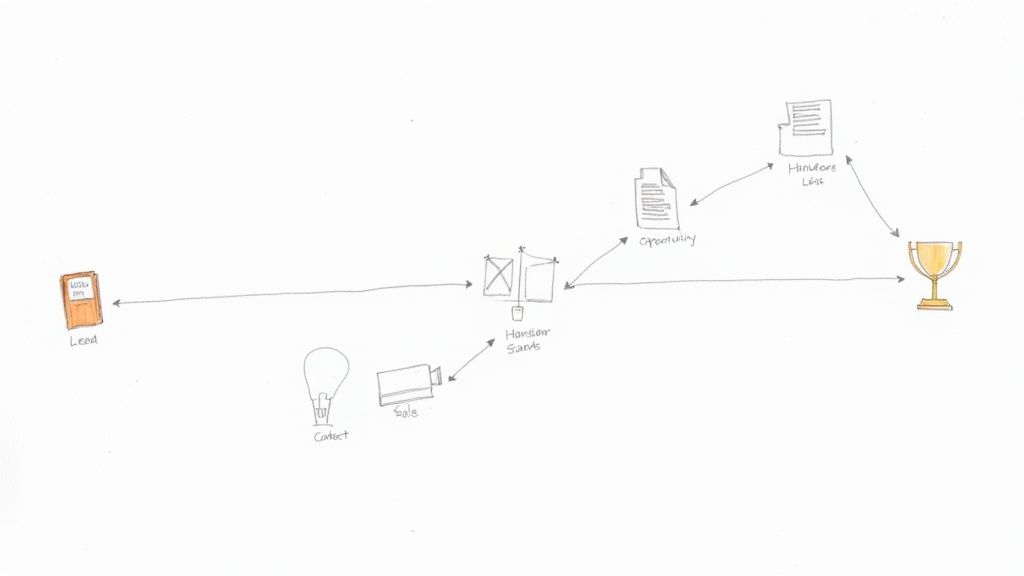
The Business Challenge: A promising new lead arrives, but tracking its journey is manual and prone to error. Without a central view, it's hard to know the deal's status, and key details can get lost in email threads.
The Salesforce Solution: In Sales Cloud, this lead becomes the start of a managed relationship. Opportunity Management provides a clear view of every deal at every stage. A sales rep creates an opportunity record, which becomes the single source of truth, tracking every email, call, and key stakeholder.
The Result: As the deal progresses from qualification to negotiation, the entire team sees its health in real-time. This visibility means nothing is missed, and managers know precisely when to offer support, leading to faster deal cycles and higher close rates.
Process Automation: Freeing Reps to Focus on Selling
The Business Challenge: Your best salespeople are buried in administrative tasks—logging calls, sending follow-ups, and updating records—which limits their time for actual selling.
The Salesforce Solution: Process Automation becomes a secret weapon. For example:
- Automated Follow-Ups: After a proposal is sent, an automation rule triggers a follow-up email three days later if no response is received.
- Smart Task Assignments: When a deal reaches the "Negotiation" stage, a task is automatically assigned to the sales manager for review.
- Effortless Data Logging: Calls and emails can be logged against the correct contact or opportunity without manual data entry.
The Result: By handling these routine tasks, SFDC Sales Cloud allows reps to focus on building relationships and closing deals. The impact on productivity and team morale is immediate and measurable.
Lead and Contact Management: Building a Solid Foundation
The Business Challenge: Customer data is disorganised, making it difficult to prioritise leads and personalise communication.
The Salesforce Solution: Lead and Contact Management forms the bedrock of Sales Cloud, ensuring all customer information is clean, accessible, and actionable. New leads can be automatically scored based on your ideal customer profile, helping reps focus their energy effectively. When qualified, a lead is converted into a contact, account, and opportunity with a single click, preserving its entire history.
Best Practice Tip: A well-organised CRM is more than a digital address book. It's a strategic asset providing the deep customer insights needed to personalise communication and build lasting relationships, turning one-time sales into loyal customers.
SFDC Sales Cloud Feature Breakdown and Business Impact
| Feature | Core Functionality | Primary Business Benefit |
|---|---|---|
| Opportunity Management | Tracks deal stages, values, key players, and activities from start to finish. | Provides accurate sales forecasting and ensures no deals fall through the cracks. |
| Process Automation | Automates repetitive tasks like follow-up emails, task creation, and record updates. | Frees up salesperson time to focus on high-value selling activities, boosting productivity. |
| Lead & Contact Management | Captures, scores, routes, and converts leads into contacts, accounts, and opportunities. | Ensures reps prioritise the best leads and maintains a clean, organised customer database. |
| Mobile CRM | Provides full CRM access on any mobile device for on-the-go updates and data access. | Increases team responsiveness and ensures data is always current, regardless of location. |
Mobile CRM: Selling from Anywhere
Modern sales teams are constantly on the move. The Salesforce Mobile App puts the full power of Sales Cloud in their hands, whether they're meeting a client on-site or travelling between appointments. Reps can update opportunities, log calls, and collaborate with their team directly from their phone. For a sales team covering the vast territories of Australia, this is essential for staying efficient and responsive. The platform is also constantly improving; stay ahead by reading about the highlights of the Salesforce Winter '25 Release.
Tailoring Sales Cloud for Australian Industries
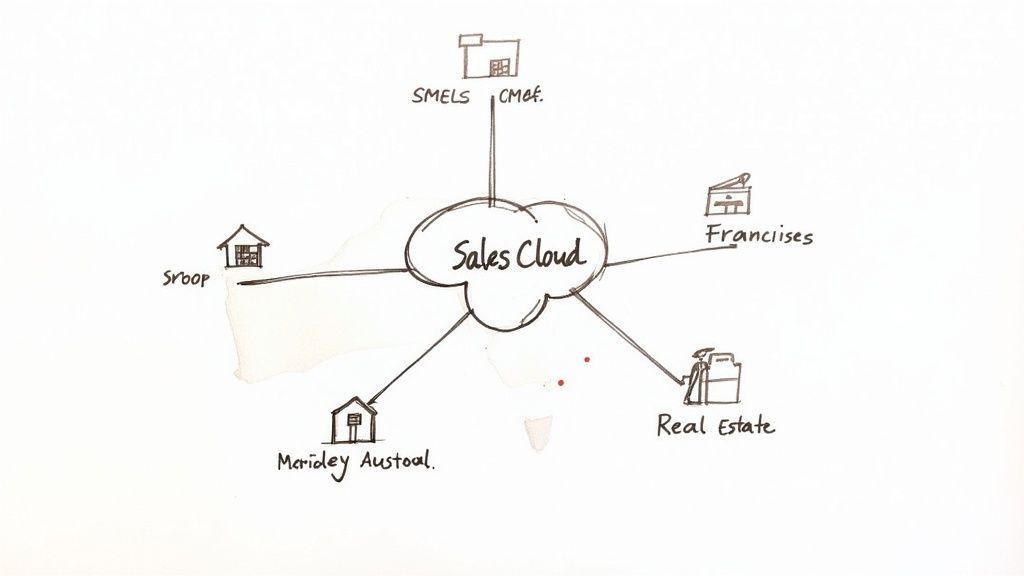
Sales Cloud isn't a rigid, one-size-fits-all platform. Its real value is realised when customised to the unique workflows of a specific industry. For Australian businesses, this adaptability is key to solving distinct challenges and unlocking growth.
Think of it as a high-end multi-tool. Its flexibility allows it to become a specialised instrument, whether you're managing complex construction projects or standardising operations across a national franchise network. When a Salesforce partner configures Sales Cloud to mirror your industry-specific processes, it transforms a powerful CRM into a purpose-built engine for your needs.
Let's look at how this plays out in key Australian sectors.
Small and Medium-Sized Enterprises (SMEs)
The Challenge: Many Australian SMEs need to scale without a massive upfront investment.
The Solution: SFDC Sales Cloud offers a scalable foundation that grows with the business. An SME can start with core features like lead and opportunity management. As the business expands, they can add automation, advanced reporting, and analytics.
The Result: A local manufacturing company, for example, might start by using Sales Cloud to track leads and manage its pipeline. Later, they can integrate it with their inventory system and automate quote generation. This delivers a controlled, affordable path to digital transformation.
Franchise Networks
The Challenge: Maintaining consistency and visibility across a national franchise network while empowering local operators.
The Solution: Sales Cloud acts as a central command centre. A national fast-food chain can use it to standardise new franchise applications. Simultaneously, each franchisee can manage local marketing and B2B opportunities within their own secure environment.
The Result: Head office gains a clear, high-level view of network performance, while franchisees have the autonomy to drive local growth.
Construction and Real Estate
The Challenge: Managing long sales cycles, complex projects, and numerous stakeholders.
The Solution: A commercial construction firm can configure SFDC Sales Cloud to manage the entire project lifecycle, from tender to final handover.
Lesson Learned: In this industry, an "opportunity" is a complex project with multiple milestones and communication threads. Sales Cloud can track every interaction, document, and deadline, ensuring nothing is missed.
The Result: For real estate agencies, the platform becomes essential for nurturing long-term client relationships. An agent can track a client's journey from their first rental to buying their dream home, providing personalised service that builds loyalty. See how we solve these puzzles in our Salesforce case studies.
Professional Services Firms
The Challenge: Firms in accounting, legal, and consulting need to manage client engagements, track billable hours, and forecast resource allocation.
The Solution: Sales Cloud can be customised to link a sales opportunity directly to project management. When a new project is won, Sales Cloud can automatically create the project record and assign the right consultants.
The Result: This seamless handover from the sales team to the delivery team is crucial for client satisfaction and project profitability.
How Salesforce Einstein AI Transforms Your Sales Process
Artificial intelligence is no longer a future concept; it's a practical tool integrated directly into SFDC Sales Cloud. Salesforce Einstein acts as an expert analyst working alongside every sales rep, uncovering insights and automating decisions that once required hours of manual effort. This isn't about replacing salespeople; it’s about equipping them with data-driven intelligence to work smarter.
From Guesswork to Guided Selling
In traditional sales environments, reps often rely on instinct to prioritise leads. Einstein replaces this guesswork with data science, making sales efforts more focused and effective.
Key AI-driven features include:
- Predictive Lead Scoring: Einstein analyses past successful deals to identify the characteristics of a high-quality lead. It then automatically scores new leads, enabling your team to focus on opportunities most likely to convert.
- Opportunity Insights: The system monitors your sales pipeline, flagging at-risk deals. It might detect that a key stakeholder has gone quiet or that a competitor was mentioned in a recent email, prompting immediate action.
- Einstein Automated Contacts: Einstein reduces tedious data entry by automatically identifying new contacts in emails and calendar events, prompting reps to add them to Salesforce with a single click.
From our experience: Salesforce Einstein transforms your CRM data into your most valuable asset. It shifts your team from reacting to sales events to proactively shaping them, guided by smart recommendations that lead to higher win rates and improved forecasting.
The Tangible Impact on Australian Businesses
The adoption of AI within Australian sales teams is delivering measurable results. Recent findings from Salesforce's Agentic Enterprise Index show that among early adopters, agent creation increased by 119% in the first half of 2025. Furthermore, Australian consumers who interact with AI agents report 64% higher satisfaction, highlighting how AI enhances the customer experience. You can discover more insights on Salesforce's Agentic Enterprise Index.
By integrating AI, your organisation can achieve more accurate forecasts, boost team productivity, and secure a significant competitive advantage. To understand the critical role of AI in sales, it's worth reading why every sales team needs an AI sales assistant.
A Proven Roadmap for SFDC Sales Cloud Implementation
A successful implementation is the bridge between business strategy and technology. Simply installing SFDC Sales Cloud is not enough; true value comes from a thoughtful rollout designed around your specific goals. Our proven methodology avoids common pitfalls like messy data and low user adoption, ensuring a strong return on investment.
Discovery and Strategic Design
This first phase is critical. Before any configuration, we dive deep into your existing sales processes, pain points, and objectives. This strategic conversation maps out how Sales Cloud will help you achieve your goals.
We ask key questions:
- What are the biggest bottlenecks slowing down your sales team?
- What does your ideal customer journey look like?
- Which key performance indicators (KPIs) matter most to your leadership?
The answers form the blueprint for the entire project, ensuring the final solution is tailored to your business.
Data Migration and System Integration
Your customer data is a valuable asset. We plan a clean data migration to maintain its integrity, addressing issues like duplicates and incomplete information to establish a reliable single source of truth.
Equally important is integrating Sales Cloud with other business tools. For many Australian organisations, this means creating a seamless ecosystem with accounting software like Xero or MYOB.
Project Insight: Integration transforms Sales Cloud from a standalone tool into your operational hub. When a deal is marked "Closed-Won," an invoice can be automatically generated in your accounting system, eliminating manual entry and providing a complete view of the customer's financial journey.
This process visualises how AI, a core part of a modern Sales Cloud setup, transforms raw data into actionable sales intelligence.
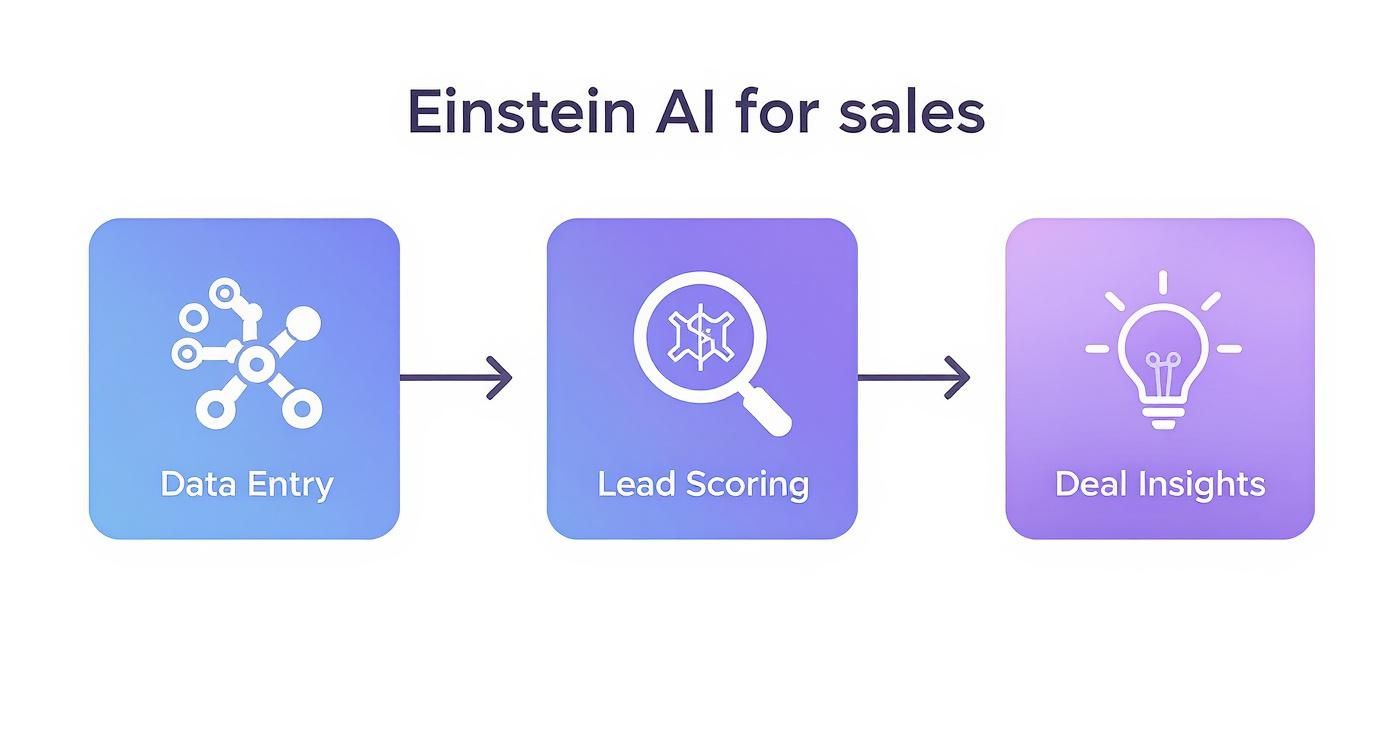
By automating data entry and applying intelligent analysis, your team can focus on high-value activities like nurturing leads and closing deals.
User Training and Adoption
Technology is only effective if people use it. Our training goes beyond feature demonstrations to show your team exactly how Sales Cloud will make their jobs easier. This hands-on training is tailored to different roles, ensuring everyone from reps to managers feels confident. By focusing on the "what's in it for me," we drive high user adoption—the ultimate measure of a successful implementation. Get more insights from our Salesforce implementation guide for Australia.
The Salesforce ecosystem in Australia is growing significantly. IDC projects it will create over 245,000 jobs and more than $46 billion in business revenues by 2028. You can learn more about Salesforce's investment in Australia.
Maximising Your ROI with a Strategic Salesforce Partner
Implementing SFDC Sales Cloud is a powerful first step, but the journey doesn't end there. True value emerges from continuous improvement and expert guidance. This is where the right Salesforce partner becomes an extension of your team. A standard setup only scratches the surface. To unlock its full potential, you need deep expertise to refine workflows, build powerful automations, and integrate it with other critical business systems.
Beyond Implementation to True Partnership
An experienced Salesforce partner ensures your investment delivers a measurable return. Our focus is on turning your platform into a dynamic asset that actively drives business growth.
Our ongoing collaboration includes:
- Managed Services: We provide continuous monitoring, user support, and system health checks to ensure your SFDC Sales Cloud instance runs smoothly.
- Strategic Optimisation: We work with you to regularly review processes and identify new opportunities for automation and efficiency, ensuring the platform evolves with your business.
- Growth-Focused Roadmapping: We help you plan for the future, whether it’s advising on new features or scaling your sales operations.
Our Approach: A strategic partner doesn't just ask, "What do you want to build?" We ask, "What business problem are you trying to solve?" This ensures every customisation is directly tied to achieving tangible outcomes.
An Extension of Your Team
Our goal is to be your dedicated Salesforce expert, freeing you to focus on your business. We handle the technical complexities so you can reap the strategic rewards. By ensuring your platform evolves and aligns with your long-term vision, we help you maximise the value of your investment.
If you’re ready to unlock the full power of SFDC Sales Cloud, it's time for a conversation. Explore our Salesforce consulting services to see how we help Australian businesses like yours achieve their growth objectives.
Frequently Asked Questions About SFDC Sales Cloud
Here are answers to common questions from Australian businesses considering or using Sales Cloud.
What's a realistic implementation timeline for an SME?
For most Australian SMEs, a standard SFDC Sales Cloud implementation takes 4 to 12 weeks. A basic 'quick start' project is on the faster end. However, complex data migration, custom automation, or integration with systems like Xero or MYOB will require more time. A thorough discovery phase with your Salesforce partner is key to setting an accurate timeline.
How does Sales Cloud help with Australian privacy law compliance?
SFDC Sales Cloud provides a robust framework to help you meet your obligations under laws like the Privacy Act. You can configure detailed data access controls, manage customer consent, and maintain a clear audit trail of data access. A knowledgeable Salesforce partner can ensure your setup aligns with local compliance duties, which is fundamental to building customer trust.
Best Practice Tip: A key strength of the platform is its ability to be shaped around specific regulatory requirements. This isn't just about ticking a compliance box; it's about demonstrating responsible data management to your customers.
Can Sales Cloud integrate with our Xero or MYOB system?
Absolutely. Integrating SFDC Sales Cloud with accounting software like Xero and MYOB is one of its most powerful capabilities. It creates a seamless bridge between your sales and finance teams. For example, when a deal is marked 'Closed-Won' in Sales Cloud, an invoice can be automatically generated in Xero. This eliminates double data entry and provides a complete view of the customer journey from prospect to paid invoice.
Ready to see how Adaptal can tailor SFDC Sales Cloud to meet your unique business challenges and drive measurable growth? Contact us today for a consultation with our Salesforce experts.