

Investing in Salesforce is a significant step, but the platform's true power is only unlocked with an expert guide. Your choice of a Salesforce implementation partner is one of the most critical factors for success, influencing everything from team adoption to your long-term return on investment.
Why Your Salesforce Partner is a Critical Decision

Choosing a Salesforce implementation partner is about more than just technical configuration. You're forging a strategic relationship with a team that will shape your customer relationships, operational efficiency, and ultimately, your growth. The right partner acts as a guide on your digital transformation journey, translating your business vision into a functional, high-performing CRM solution that actually works for your people.
A skilled partner doesn't just install software; they dive deep into your unique business processes, pinpoint operational bottlenecks, and design a Salesforce solution that solves real-world problems.
More Than a Vendor—A Strategic Guide
Think of your partner as an extension of your own team. They're there to:
- Align Technology with Business Goals: Ensure your Salesforce solution directly supports commercial objectives, whether that's increasing sales pipeline velocity with Sales Cloud or reducing customer service response times with Service Cloud.
- Drive User Adoption: Guide your employees through the transition, a crucial step for ensuring your team embraces the new system and you get real value from the platform.
- Future-Proof Your Investment: Build a scalable solution that can adapt as your business evolves, helping you avoid costly rework down the track.
The selection process itself is a valuable exercise. Many of the same critical considerations apply when navigating partner choices for other enterprise software, such as when reviewing a Dynamics 365 Partner selection guide. The core principles of vetting technical skill, industry knowledge, and cultural fit remain constant across platforms.
The difference between a successful Salesforce launch and a frustrating, costly failure often comes down to the quality of the implementation partner. They are the bridge between the platform's potential and your business's reality.
Before diving into the specifics, it's helpful to have a high-level framework for what makes a great partner. The table below summarises the key pillars we'll be exploring in this guide.
Key Pillars for Evaluating a Salesforce Partner
| Evaluation Pillar | What to Look For |
|---|---|
| Technical Expertise | Certified consultants with deep knowledge of Salesforce clouds (Sales, Service, Marketing Cloud, etc.) and proven experience with complex customisations. |
| Industry Knowledge | Verifiable experience in your specific sector (e.g., Construction, Healthcare, Professional Services). |
| Integration Skills | Expertise in connecting Salesforce with key Australian systems like Xero, MYOB, NetSuite, and SAP. |
| Methodology & Process | A clear, agile approach to project management, discovery, development, and user training. |
| Cultural Fit & Team | A collaborative, communicative team that feels like an extension of your own. Check their local presence and support. |
| Post-Launch Support | Defined plans for ongoing support, managed services, and continuous improvement after the initial project is complete. |
This guide moves past generic advice. We're offering practical insights drawn from our experience delivering successful Salesforce projects for Australian businesses. We'll unpack what you really need to look for to find a partner that drives genuine results.
Defining Your Project Scope and Business Goals

Before you talk to a Salesforce implementation partner, the most important work happens inside your own business. A successful project is built on a deep, shared understanding of what you need to achieve and why. Without this groundwork, even the best partner will struggle to deliver a solution that moves the needle.
This phase is about turning vague frustrations—like "our reporting is a mess" or "the sales process is clunky"—into an actionable plan. The goal is to create a well-defined brief that prevents scope creep and sets clear expectations.
From Business Challenges to Measurable Objectives
Start by mapping your current workflows to pinpoint the exact operational bottlenecks holding you back. This isn't just an IT task; you need buy-in from every department that will touch the new system—sales, service, marketing, and operations.
Case Study Example: A construction client we worked with faced a common challenge: their project managers were losing hours each week manually piecing together reports from different spreadsheets. The data was unreliable and slow to compile.
- The Business Challenge: Wasted time and untrustworthy project data.
- The Salesforce Solution: We implemented a custom solution on the Salesforce platform to centralise project data.
- The Result: The client set a measurable objective: "Reduce project reporting time by 30% within six months of go-live." This gave our team a clear target to aim for, ensuring the project delivered tangible business value.
A well-defined scope is your project's North Star. It guides every decision, from initial design workshops to user training, ensuring the final Salesforce solution is precisely tuned to your most critical business outcomes.
To start, gather your team and work through these key discovery questions.
Key Questions to Define Your Project Scope
- Process Mapping: Can we map our current lead-to-cash process? Where are the handoffs, and where do things consistently fall apart?
- Data Challenges: What critical business information is stuck in spreadsheets, inaccessible to the teams who need it most?
- Customer Experience: What is the number one complaint we receive from customers about our service or sales process?
- Reporting Needs: What are the top three reports our leadership team needs but can't easily get today?
- Success Metrics: If this project is a success one year from now, what specific numbers will have changed? (e.g., lead conversion rate increased by 15%, customer churn is down by 10%).
Answering these questions builds a rock-solid foundation for your project. For a deeper dive into this phase, our guide on streamlining business processes offers practical tips on mapping workflows for real-world efficiency. This detailed brief will be the most powerful tool you have when evaluating potential partners.
Vetting Technical Expertise and Industry Experience
Once you have a clear vision, it's time to find a Salesforce implementation partner with the skills to make it happen. You need to look past slick marketing and dig into what makes a partner a genuine expert.
Certifications are a good starting point, but the real proof is in their project track record. You need a partner who deeply understands the specific Salesforce products you'll be using, whether that’s Sales Cloud for your reps, Service Cloud for your support team, or Experience Cloud for your customer portals.
Beyond Certifications: Assessing Real-World Product Knowledge
A partner’s website might list a dozen Salesforce clouds, but you need to push for specifics. Ask for real-world examples of how they’ve used these tools to solve business problems like yours.
For example, if you’re looking to automate your sales pipeline, ask direct questions:
- "Can you show us a custom lead routing model you built in Sales Cloud for another professional services firm?"
- "What was your approach to setting up case management in Service Cloud for a business with complex support tiers?"
- "Walk me through a project where you used Experience Cloud to build a secure portal for partners to access operational data."
These questions force a potential partner to discuss specifics, not just theory. Experience with other enterprise platforms like Microsoft Dynamics 365 consulting can also indicate a high level of technical skill applicable to large, complex CRM projects.
Why Industry Knowledge is Non-Negotiable
This may be the most crucial factor. A partner who understands the unique language, processes, and compliance rules of your industry will build a solution that clicks. They’ve seen the common pitfalls and already know the best-practice configurations that make a difference in your sector.
A generic implementation for a construction company juggling subcontractor compliance is worlds away from one for a healthcare provider managing sensitive patient data. A specialised partner brings pre-built knowledge to the table, accelerating the project and delivering a superior outcome.
A partner with deep industry experience doesn't just configure Salesforce; they configure it for your business context. This specialised insight is the difference between a CRM that works and a CRM that transforms your operations.
Use these essential questions during your evaluation to cut through the noise and reveal a partner's true capabilities.
Essential Questions for Your Potential Salesforce Partner
| Category | Question to Ask |
|---|---|
| Technical Expertise | Can you provide examples of complex customisations or integrations you’ve built? |
| Product Knowledge | Which Salesforce Clouds (e.g., Sales, Service, Marketing) do you have the most hands-on project experience with? |
| Industry Experience | What percentage of your clients are in our industry? Can you provide relevant case studies? |
| Project Management | What is your methodology for managing projects, and how do you handle scope changes? |
| Integration Skills | Describe a challenging integration you’ve managed with a system like NetSuite, SAP, Xero, or MYOB. |
| Team Structure | Who will be on our project team, and what are their specific qualifications? |
| Post-Launch Support | What does your support and training model look like after we go live? |
The Critical Role of System Integration
Your Salesforce instance rarely works in isolation. Its true value is unlocked when it communicates seamlessly with the other software that runs your business. This is where a partner's integration skills become absolutely critical.
Connecting Salesforce to local accounting systems like Xero and MYOB, or larger ERPs like NetSuite and SAP, is a common but technically demanding task. It requires a partner who understands the APIs of both platforms and can build a reliable data bridge. A poor integration results in data silos, manual double-entry, and a frustrated team.
A partner who acts as a true https://adaptal.com.au/business-transformation-consultant/ will have a portfolio of these complex integrations to showcase their expertise.
Understanding Costs, Timelines, and Engagement Models
Establishing a realistic budget and timeline for your Salesforce project is a critical conversation. The true cost isn't just the number on your Salesforce implementation partner's quote.
To get the full picture, you must also factor in Salesforce's licensing fees, data migration costs, and—most importantly—a budget for ongoing support and enhancements after go-live. Overlooking these can lead to surprise costs and a system that never reaches its full potential.
Realistic Project Timelines
Timelines vary based on project complexity. A good partner will provide a phased plan to avoid surprises.
- Rapid Deployment (4–8 weeks): Ideal for a small business implementing a single, standard Salesforce product like Sales Cloud with minimal customisation.
- Standard Implementation (3–6 months): This is common for SMBs and typically involves some custom features, data migration from a legacy CRM, and integration with local systems like Xero or MYOB.
- Complex Rollout (6–12+ months): Larger enterprises implementing multiple clouds (e.g., Sales, Service, and Experience Cloud) with significant custom code and deep ERP integrations (NetSuite or SAP) require a longer timeline.
A reputable partner will assess your needs across key areas to determine where your project falls.
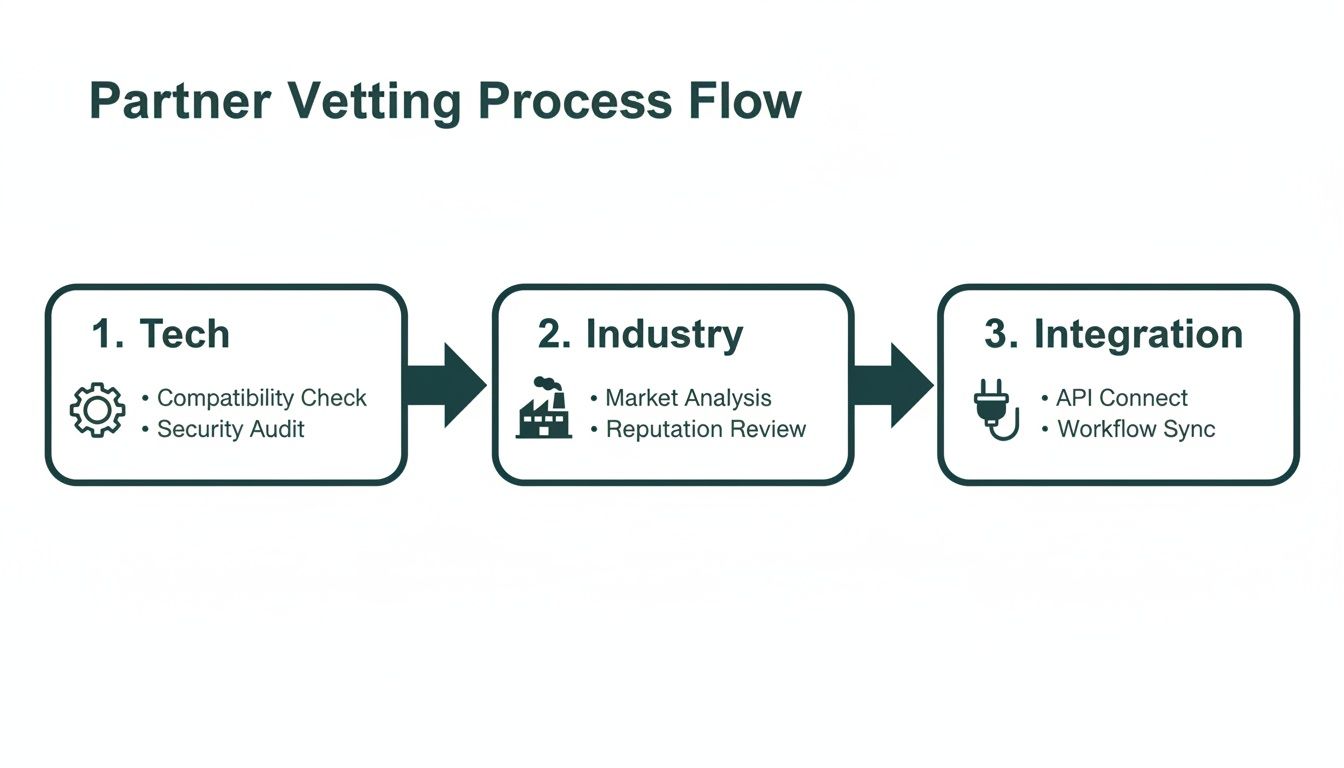
This vetting process is how a partner properly scopes the work, which directly influences your timeline and budget.
Choosing the Right Engagement Model
How you work with your partner is as important as who you work with.
Fixed-Price Projects
A set cost for a clearly defined project. This model provides budget certainty and is ideal when requirements are unlikely to change.
Time and Materials (T&M)
You pay for the actual hours the team works. This offers maximum flexibility, making it perfect for complex, evolving projects where an agile approach is needed.
Managed Services
This model focuses on what happens after implementation. You pay a recurring fee for ongoing support, strategic advice, and system enhancements. It's the best way to ensure your Salesforce investment continues to deliver value long after launch. You can learn more about what managed services involve and see why it’s critical for long-term success.
Your Salesforce "go-live" is the starting line, not the finish. The most successful businesses view their CRM as an evolving asset and budget for ongoing optimisation from day one to maximise their return on investment.
Common Implementation Pitfalls and How to Avoid Them
Knowing where Salesforce projects typically go wrong is the first step to ensuring yours doesn't. From our experience, the biggest project killers aren't technical bugs; they're human and strategic oversights. A great Salesforce implementation partner anticipates these challenges.
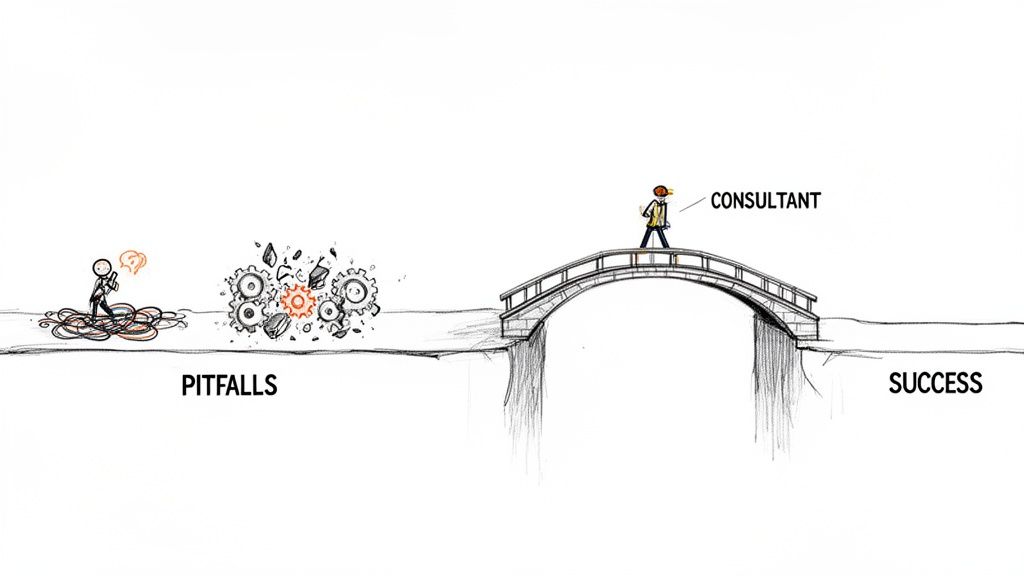
The Challenge: Low User Adoption
You can build the most powerful Salesforce solution, but if your team doesn't use it, it’s a failed investment. User adoption is the true measure of success.
The Solution: A Proactive Change Management Strategy. A good partner addresses this from day one.
- Identify Champions: We find influential team members who can advocate for the new system internally.
- Role-Based Training: We tailor training to specific roles, focusing on the "what's in it for me" for each user group.
- Post-Launch Support: We provide a 'hypercare' period immediately after go-live to offer on-the-ground help, build confidence, and ensure new habits stick.
The Challenge: Scope Creep and Misaligned Expectations
This often starts with a vague project brief, where stakeholders continuously add "just one more feature." This leads to blown budgets and missed deadlines.
The Solution: Agile Project Management. Instead of a rigid plan, we break the project into manageable "sprints." This creates regular checkpoints for feedback, keeping the project on track while focusing on delivering the most valuable features first.
The real goal of a Salesforce implementation isn't just to launch software; it's to solve specific business problems. A partner's job is to tie every single feature back to those core objectives, protecting the project from expensive distractions.
The Challenge: The Data Migration Nightmare
A messy data migration—where duplicate records and outdated information are dumped into your new Salesforce org—destroys user trust from day one.
The Solution: A Meticulous Data Cleansing Plan. We execute a rigorous data strategy before any records are moved.
- Data Audit: We analyze existing data sources to identify inconsistencies and duplicates.
- Cleansing Strategy: We work with you to create clear rules for cleaning and standardising the data.
- Test Migrations: We perform multiple trial runs in a Salesforce sandbox to resolve issues before the final cutover.
By proactively addressing these common pitfalls, a strategic Salesforce partner delivers a solution that gets adopted, is trusted, and genuinely drives business growth.
FAQs on Choosing a Salesforce Implementation Partner
Here are straight answers to the most common questions we hear from Australian businesses evaluating a Salesforce implementation partner.
How much does a Salesforce implementation cost in Australia?
There's no single price tag. Costs depend on complexity and business outcomes.
- Small Business Starter Project: For a basic setup of a single cloud (e.g., Sales Cloud) with minimal customisation, expect a range of $20,000 – $40,000.
- Mid-Sized Business Implementation: For projects involving custom features, data migration, and integration with systems like Xero or MYOB, budgets typically fall between $60,000 and $150,000+.
- Large-Scale Enterprise Projects: Complex, multi-cloud rollouts with deep customisation and ERP integrations (e.g., NetSuite) represent a more significant investment.
Remember to budget separately for Salesforce licenses and ongoing support.
How long does a typical Salesforce implementation take?
Timelines are tied to project complexity.
- A 'quick start' package can be live in 4-8 weeks.
- A standard implementation for an SMB typically takes 3-6 months.
- Larger, comprehensive projects can range from 6 to 12 months or more.
Should I choose a local Australian partner or a global firm?
For most Australian businesses, a local partner offers significant advantages. They understand the local market, compliance obligations like the Privacy Act, and have proven experience integrating with Australian software.
Choosing a local Salesforce implementation partner means you get support in your timezone from a team that understands your cultural and business context. While global firms offer scale, a local partner delivers a level of personalised service that's tough to beat.
What happens after the implementation is complete?
Go-live is the beginning. The real value comes from continuous improvement. A strong partnership continues with a 'hypercare' period to resolve immediate issues, followed by a managed services agreement. This provides ongoing admin support, strategic advice, and system enhancements, ensuring your Salesforce platform evolves with your business.
Ready to unlock the full potential of your Salesforce investment with a partner that understands the Australian market? Adaptal has delivered over 110 successful Salesforce projects, helping businesses just like yours achieve real, measurable results. Contact us today for a no-obligation consultation.