

Salesforce Field Service Management is more than a scheduling tool; it’s a powerful platform designed to connect your mobile workforce, office staff, and customers to deliver intelligent, proactive on-site service. It shifts your operations beyond simple dispatching, using automation and data to get the right technician to the right job at the right time, fully equipped to succeed on the first visit.
From Dispatch Chaos to a Coordinated Operation

Consider a common business challenge: your most experienced technician is stuck in traffic, running late for their next appointment. At the same time, a high-priority customer with a critical equipment failure is minutes away from a less-experienced but currently available agent. This is the daily operational friction many service-based businesses face.
This kind of inefficiency leads to frustrating and costly outcomes. Missed appointments erode customer trust, while low first-time fix rates mean expensive repeat visits and wasted resources. It's a constant struggle to balance efficiency with exceptional service when your team relies on spreadsheets, phone calls, and manual guesswork.
The Shift to Proactive Service Delivery
Salesforce Field Service Management is built to solve this exact challenge. Think of it less as a piece of software and more as an operational command centre. It delivers a unified, real-time view of your entire field operation, connecting your dispatchers, mobile workers, and customers on one intelligent platform powered by your CRM data.
This visibility is the foundation for a much more strategic approach to service. Instead of reactively assigning jobs as they come in, you can proactively manage your resources. The platform considers countless factors to ensure scheduling and job execution are truly optimised.
By transforming how you manage on-site service, Salesforce FSM turns a traditional cost centre into a powerful engine for customer satisfaction and business growth.
Turning Operational Headaches into a Competitive Edge
For an equipment maintenance firm, the difference is significant. Before implementing a Salesforce solution, they battled disorganised schedules and technicians showing up unprepared. After implementing Salesforce Field Service Management, they gained the tools to finally get ahead. The platform allows for streamlining business processes that were previously manual and prone to errors.
This digital transformation provides the automation and insight needed to turn those operational headaches into a serious competitive advantage. It empowers businesses to:
- Improve First-Time Fix Rates: Technicians arrive on-site with the correct parts, full customer history from your CRM, and knowledge articles needed to resolve issues on the first attempt.
- Boost Technician Productivity: Intelligent scheduling minimises travel time and downtime between jobs, allowing technicians to complete more work each day.
- Enhance Customer Experience: Customers get automated updates, accurate ETAs, and consistently excellent service, which builds lasting loyalty and trust.
This guide will explore how this powerful Salesforce product provides the tools to move beyond operational chaos and build a coordinated, efficient, and customer-focused field service operation.
The Core Tools That Power Your Mobile Workforce

The mobile interface is where the platform's power becomes clear, giving a technician a complete overview of the job at their fingertips—customer details, required parts, even the ETA. This single screen acts as a command centre for your team in the field, turning a mountain of CRM data into clear, actionable steps.
To understand how Salesforce Field Service Management overhauls your operations, we need to examine the core components that drive its effectiveness. This is a comprehensive toolkit designed to empower every person in your service chain, from the dispatcher in the office to the technician meeting the customer.
The entire system is designed to make every site visit as efficient and effective as possible. These components work in harmony, creating a seamless flow of information between the back office and the field, eliminating data silos and costly delays.
Intelligent Scheduling and Dispatch
At the heart of the platform is intelligent scheduling. This goes far beyond simply mapping the shortest route. Using AI, the system evaluates multiple factors in real-time to identify the ideal technician for every job.
This automated intelligence considers:
- Technician Skills: Does this job require a certified specialist or a junior technician? The system knows the difference and assigns the right person.
- Parts Availability: It checks inventory in the vehicle and the warehouse, ensuring the technician has the right parts before they leave.
- Customer SLAs: High-priority contracts are automatically prioritised, helping you meet service-level agreements and avoid penalties.
- Location and Travel Time: Routes are optimised to reduce travel time and maximise time spent with customers.
This automated process frees your dispatchers from the complex puzzle of manual scheduling, allowing them to focus on managing exceptions and delivering premium service.
Mobile Workforce Empowerment
True empowerment comes from having the right information at the right time. The Salesforce Field Service mobile app transforms a technician's phone or tablet into their all-in-one service hub. By the time they arrive on-site, they are fully briefed and ready to begin.
This mobile-first design means they have instant access to a customer's entire service history, asset details, and digital work orders within the CRM. They can access knowledge articles or technical schematics to troubleshoot complex problems and even use AI-powered image analysis to identify faulty parts. Understanding the benefits of robust fleet management software is also a crucial piece of this puzzle for many organisations.
The platform turns your technicians into expert problem-solvers. When you give them the tools and context they need, the probability of a first-time fix increases dramatically.
Work Order and Asset Management
Digital work order management tracks the entire service lifecycle, from job creation and assignment through to the final debrief and customer sign-off, replacing messy paperwork. This creates a single, reliable record for every job.
This digital trail is invaluable. It provides clean data for invoicing, keeps track of parts used, and captures technician notes—all in one place. In Australia, this level of control has proven incredibly effective. For instance, some Australian utilities saw a 25% improvement in technician utilisation after implementing Salesforce FSM, while first-time fix rates soared to an impressive 92%.
Where the platform truly excels is connecting work orders to asset management within the Salesforce CRM. Every service visit is logged against a specific customer asset, building a rich maintenance history over time. This data is the key to predictive maintenance, allowing you to service equipment before it fails. This is a game-changer for any business that sells "uptime" as a service. Furthermore, understanding what is API integration is essential for connecting these tools with your other enterprise systems for a truly unified view of your operations.
Translating Field Efficiency Into Business Growth
For any decision-maker, the conversation always returns to the bottom line. It's one thing to hear about optimised routes or more effective technicians, but how does that translate into tangible, measurable growth? Improving day-to-day operations is valuable, but that efficiency must be reflected in revenue and profitability.
This is where the true power of Salesforce Field Service Management becomes evident. It’s not just about operational tweaks; it’s a strategic tool that directly connects on-site performance with boardroom objectives. The business case is built on three solid pillars.
Slashing Operational Costs
One of the first and most noticeable benefits of implementing a Salesforce FSM solution is a sharp reduction in operational spending. Smarter scheduling and route optimisation directly target your biggest cost centres. Fuel consumption plummets when technicians spend less time in traffic and more time on the job.
The real game-changer, however, is improving first-time fix rates. Every return visit drains resources—you pay for wages, fuel, and parts all over again, while also managing a customer who’s losing patience. By ensuring your team arrives with the right information and parts the first time, FSM drastically reduces these expensive repeat visits and cuts down on unnecessary overtime.
FSM systematically targets operational waste, turning inefficiencies previously accepted as the "cost of doing business" into significant, predictable savings.
Boosting Field Productivity
Beyond saving money, Salesforce FSM actively helps you generate more revenue. Consider the impact on quarterly revenue if every technician could complete just one extra job per day. This isn't about pushing them to work harder; it's about providing the tools to work smarter.
The platform achieves this by eliminating the small pockets of wasted time that accumulate throughout the day:
- Less Idle Time: Technicians are not left waiting for their next assignment or for critical information from the back office.
- Quicker Job Completion: With instant access to customer history, asset data, and knowledge articles on their device, troubleshooting becomes faster and more precise.
- Minimal Admin: Digital work orders and automated reports mean less time filling out paperwork and more time focused on billable work.
This is especially critical in high-pressure industries like telecommunications. In Australia's telco sector, where rapid response is essential, major providers have seen 20-30% gains in first-time fix rates after rolling out FSM. Some are seeing technicians process up to 10 more work orders weekly. An efficiency boost of that magnitude directly contributes to revenue growth. You can find more insights on the Australian FSM market from Grand View Research.
Elevating the Customer Experience for Sustainable Growth
Perhaps the most crucial pillar for long-term success is the complete transformation of the customer experience. In today's competitive landscape, reliable on-site service isn't just a bonus—it's an expectation. A single positive field service interaction can be one of the most powerful loyalty builders you have.
Salesforce FSM delivers the consistent, professional experience that builds real trust. Customers receive accurate arrival windows, proactive updates on their technician's ETA, and service from a professional who is fully informed and prepared to solve their problem. This reliability turns your field team from a reactive cost centre into a proactive, brand-building asset.
When customers are satisfied, they don't just stay with you; they become advocates who drive repeat business and referrals. This is how operational excellence fuels sustainable, long-term growth. By mastering that final mile of customer interaction, you create a powerful market differentiator that is difficult for competitors to match.
Key Benefits of Salesforce FSM Implementation
This table summarises the primary business outcomes and the metrics used to measure the impact of adopting Salesforce Field Service Management.
| Benefit Area | Description | Key Performance Indicators (KPIs) |
|---|---|---|
| Operational Cost Reduction | Minimises expenses through smarter resource allocation, reduced travel, and fewer repeat visits. | Fuel costs per vehicle, average travel time, first-time fix rate, overtime hours. |
| Increased Productivity | Empowers technicians to complete more jobs per day by eliminating administrative tasks and downtime. | Jobs completed per technician per day, mean time to repair (MTTR), technician utilisation rate. |
| Enhanced Customer Satisfaction | Builds loyalty and trust by delivering consistent, timely, and professional on-site service. | Customer Satisfaction (CSAT) scores, Net Promoter Score (NPS), customer retention rate. |
| Revenue Growth | Drives new business opportunities through improved service quality and the ability to handle more work orders. | Service revenue growth, contract renewal rates, cross-sell/upsell opportunities identified in the field. |
| Improved Compliance & Safety | Ensures adherence to safety protocols and service level agreements (SLAs) with standardised digital checklists and reporting. | SLA compliance rate, safety incidents reported, audit pass rates. |
Ultimately, adopting Salesforce FSM isn't just about making your field operations run smoother. It's about fundamentally strengthening your business from the ground up, creating a more resilient, profitable, and customer-focused organisation.
How Australian Industries Win with Salesforce FSM
While understanding the features of Salesforce Field Service Management is one thing, seeing it in action reveals its true value. For Australian businesses grappling with unique geographical hurdles and operational demands, the platform is more than an efficiency tool—it’s a powerful engine for solving industry-specific problems. Let's look at how key sectors are using FSM to gain a competitive advantage.
Each industry uses the platform to solve different challenges, transforming complex field operations into a source of customer satisfaction and business growth. These case studies illustrate the features we've discussed in a practical, real-world context.
Utilities: From Reactive Repairs to Predictive Resilience
The Challenge: An Australian energy provider faced a classic issue: managing a vast, remote network of assets constantly impacted by harsh weather. Their old model was entirely reactive. An outage would occur, a call would come in, and a team would be dispatched, often with little information about the fault's exact location or cause.
The Salesforce Solution: By implementing FSM and connecting it to IoT sensors on their grid infrastructure, they shifted to a predictive maintenance model. Now, the Salesforce system monitors asset health in real-time and automatically creates a work order the moment a component shows signs of potential failure.
The Results: Instead of waiting for a blackout, technicians are now dispatched proactively to perform preventive maintenance. This has led to a significant reduction in unplanned outages, improved public safety, and dramatically lower operational costs from emergency repairs. For a deeper look at tailored solutions, explore our guide on field service management software in Australia.
Manufacturing: Selling Uptime, Not Just Machines
The Challenge: A manufacturer of complex industrial machinery wanted to move beyond just selling products. Their goal was to transition to a "servitisation" model, where they sell guaranteed uptime and performance through long-term service contracts. This required a complete overhaul of their field service operations.
The Salesforce Solution: FSM became the backbone of their new service-focused business. It allowed them to manage complex service level agreements (SLAs), track the entire lifecycle of every machine they sold, and schedule regular maintenance with pinpoint accuracy, all within the Salesforce CRM.
The Results: This strategic shift created a predictable, recurring revenue stream that was far more profitable than one-off equipment sales. Customer loyalty increased because clients weren't just buying a machine; they were buying the assurance that it would always work. Amid Australia's push for digital efficiency, local data shows a 14.1% CAGR for services, with firms using IoT for predictive maintenance cutting unplanned downtime by 28%. You can find out more about the trends in the field service management market.
By embracing a servitisation model powered by FSM, manufacturers can transform their customer relationships from transactional to true partnership, locking in long-term value.
Telecommunications: Powering the 5G Rollout
The Challenge: For a major Australian telco, the nationwide 5G network rollout presented a massive logistical challenge. The project involved coordinating thousands of technicians for new installations, equipment upgrades, and repairs across both metropolitan and regional areas. The sheer scale demanded flawless execution.
The Salesforce Solution: They used Salesforce FSM to orchestrate the entire operation. The platform’s smart scheduling was critical, optimising complex, multi-day jobs that required technicians with specific certifications and specialised equipment. The mobile app ensured every field worker had the right plans and safety checklists on their device at all times.
The Results: The provider managed the immense workload with incredible efficiency. They met ambitious rollout targets, kept service disruptions to a minimum for existing customers, and maintained high safety standards. The system provided the real-time visibility needed to reassign resources on the fly, allowing them to respond instantly to unexpected delays or urgent repair calls.
Your Blueprint for a Successful FSM Implementation
Bringing a powerful tool like Salesforce Field Service Management into your business requires more than just technical know-how; it demands a smart, strategic plan. As a dedicated Salesforce partner, we've guided countless businesses through this process, and we've developed a practical roadmap for success. This isn't just a checklist—it's about the strategic thinking that separates a smooth rollout from a costly misstep.
Think of it like building a house. You wouldn't start laying bricks without a solid foundation and detailed architectural plans. In the same way, your FSM project needs a clear structure to ensure it supports your business goals from day one.
Define Clear Business Goals First
Before you configure any software, you must answer one crucial question: "What problem are we actually trying to solve?" Many projects get sidetracked by focusing on features instead of outcomes. Is your main goal to boost the first-time fix rate by 20%? Or is it to slash technician travel time and reduce fuel costs?
Defining these specific, measurable goals at the start is essential. They become your north star, guiding every decision throughout the implementation, from configuring workflows to designing training sessions for your team.
A successful Salesforce FSM implementation isn't about adopting new tech for its own sake. It’s about re-engineering your service process to deliver real, tangible business results.
This flow chart gives a great visual of how different industries get value from a well-planned Salesforce Field Service Management process.
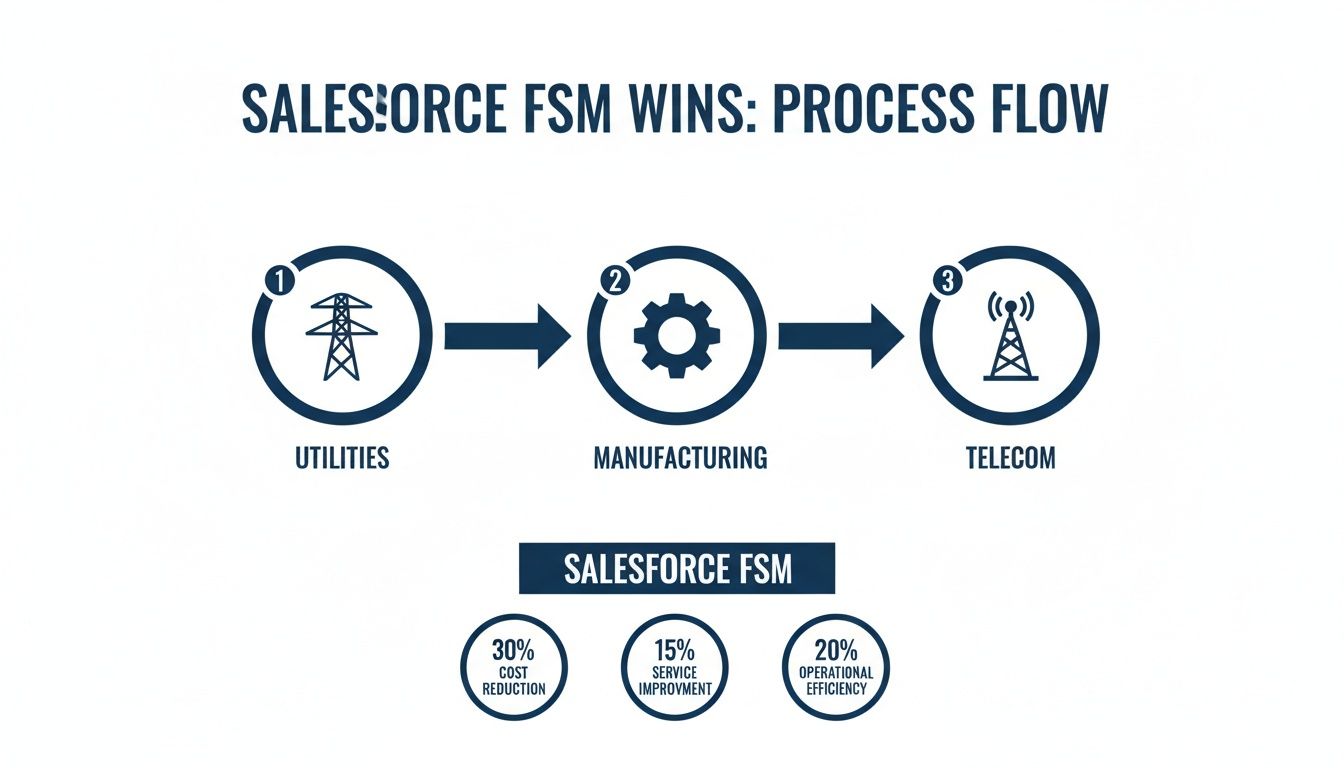
You can see how sectors like utilities, manufacturing, and telecommunications each achieve distinct operational wins by using the platform effectively.
Secure Buy-In from the Ground Up
Your technicians and dispatchers will use this system every day. If they don't see its value, your project is unlikely to succeed. Gaining their buy-in from the very beginning is non-negotiable.
Involve them in planning meetings. Listen to their frustrations with current processes. Most importantly, show them exactly how FSM will make their jobs easier. Frame it in terms of benefits they'll feel directly: less paperwork, smarter schedules, and fewer frustrating return trips. When your team sees the platform as a tool that helps them, not just another mandate, adoption rates increase significantly.
Avoid Common Implementation Pitfalls
Drawing from our project experience, we've seen a few common traps that can derail an otherwise solid implementation. Knowing them is the first step to avoiding them.
- Automating a Broken Process: Simply digitising an inefficient workflow only helps you do the wrong thing faster. Use this opportunity to analyse and improve your core service processes before you automate them.
- Neglecting Data Migration: Your existing customer info, asset histories, and service records are invaluable. A poor data migration strategy can lead to a chaotic launch. Plan it meticulously to ensure your CRM data is clean, accurate, and mapped correctly into the new system.
- Overlooking Technician Training: Don't just show them which buttons to push. Proper training needs to focus on the "why" behind the new process. Help your technicians understand how using the mobile app correctly leads to better outcomes—for them, the business, and the customer.
By approaching your Salesforce field service management project with this strategic blueprint, you can steer clear of expensive mistakes and set your organisation up for long-term success. It’s about building a system that not only works but drives meaningful, lasting improvements to your operations.
Why a Strategic Partner Is Your Greatest Asset
You've seen the powerful potential of Salesforce Field Service Management to streamline operations and create outstanding customer experiences. But turning that potential into a solution that fits your business perfectly is a different challenge. This is precisely where a strategic Salesforce partner becomes your most valuable asset.
An expert partner does more than just install software. They act as your strategic guide, helping translate big-picture business goals into a practical, hard-working system. This digital transformation journey is unique for every organisation.
From Implementation to Ongoing Success
A certified partner brings a wealth of project experience, ensuring your implementation is built on a solid foundation from day one. This involves tailoring the platform to your specific workflows, integrating it seamlessly with your existing systems, and—critically—providing the training your team needs to feel confident and drive adoption.
A partner’s job isn’t just to get you live; it’s to ensure you achieve and exceed your desired business outcomes, delivering a strong return on your investment for years to come.
As your business evolves, your needs will too. Ongoing support and managed services ensure your Salesforce FSM instance evolves with you, ready to tackle new challenges and seize new opportunities. This proactive approach helps you sidestep common pitfalls and keep optimising performance long after the initial launch.
This partnership model delivers tangible benefits:
- Faster Time-to-Value: Expert guidance cuts through complexity, accelerating the implementation process and helping you achieve your goals sooner.
- Maximised ROI: A system properly configured for your business needs ensures you get the most out of every feature.
- Reduced Risk: Leaning on proven project experience helps you avoid costly mistakes and ensures a smooth, predictable rollout.
By collaborating with a team that understands both the technology and the unique Australian business landscape, you can approach your Salesforce field service management project with complete confidence. For more insights on picking the right team, learn about the key qualities of Salesforce partners in Australia.
Common Questions About Salesforce FSM
When organisations consider a new platform, a few key questions always arise. Drawing from our experience helping Australian businesses implement Salesforce Field Service Management, we've compiled straightforward answers to the most common queries from decision-makers.
Understanding these points is the first step to seeing how FSM can fit into your wider operational strategy and drive real change. Businesses typically want to know how it integrates with existing systems, how it relates to other Salesforce products, and whether it's suitable for their business size.
How Is Field Service Different from Service Cloud?
This is the most frequent question we encounter. The simplest way to think about it is that they are two sides of the same customer service coin, designed to work together seamlessly. Salesforce Service Cloud is your contact centre's command centre for managing customer issues via phone, email, and chat.
Salesforce Field Service Management takes over when that service needs to happen on-site. If a problem cannot be resolved remotely, FSM manages the entire physical visit. It handles everything from scheduling and dispatching the right technician to managing their workflow on a mobile device. They are two distinct Salesforce products, but they share the same customer data on the CRM platform, ensuring the handover from a service agent to a field technician is completely seamless.
Does It Integrate with Other Business Systems?
Absolutely. In fact, integration is one of its biggest strengths. An effective field service solution cannot exist in a silo; it must connect with the other core systems that run your business to create a single source of truth for your entire operation.
Salesforce FSM is built for integration. As a Salesforce partner, we regularly connect it with key platforms like:
- ERP Systems: For a smooth flow of information covering inventory management, parts ordering, and financial tracking.
- Asset Management Tools: To pull in detailed histories for every asset and trigger predictive maintenance work orders.
- Accounting Software: To generate an invoice the moment a job is completed and signed off by the customer.
This connectivity allows data to move freely across your organisation, breaking down frustrating silos and giving you a complete picture of service delivery, from the first customer call to the final invoice.
Is FSM Only for Large Enterprises?
Not at all. While large corporations with massive mobile workforces certainly benefit, the scalable, cloud-based design of Salesforce Field Service Management makes it an incredibly powerful tool for growing businesses as well. The licensing is flexible, allowing you to start with what you need now and add more users as your team expands.
The core business challenges FSM solves—inefficient scheduling, poor first-time fix rates, and a disconnected customer experience—are universal. SMEs often feel these pains more acutely, which makes an optimised system a critical tool for growth and competing with larger players.
Ultimately, the platform levels the playing field. It gives small and medium-sized businesses the same powerful automation and data-driven tools that were once exclusive to large enterprises. This allows them to deliver a consistently professional service experience that builds customer loyalty and fuels sustainable growth.
Ready to turn your field operations into a strategic asset? The team at Adaptal specialises in tailoring Salesforce Field Service Management to the unique needs of Australian businesses. Contact us today for a consultation and let’s build your blueprint for success.