

Selecting the right Salesforce partner is a strategic business decision, not just a technical one. The best Salesforce consulting firms become genuine allies, translating your business challenges into CRM solutions that spark growth. They ensure high user adoption, deliver clear ROI, and turn Salesforce from a mere platform into a core business asset that drives digital transformation.
Why Your Choice Of Salesforce Partner Is So Critical
This decision will shape how your organisation operates day to day. A competent partner goes beyond clicks and configurations—they immerse themselves in your workflows to tackle real pain points, ensuring your CRM investment pays off.

Business Challenge: Imagine a real estate agency stuck with a fractured sales cycle. Leads are manually assigned, follow-ups are inconsistent, and management has zero visibility into the sales pipeline until the end of the month. A basic implementation might just digitise existing broken steps, perpetuating the confusion.
The Salesforce Solution: A strategic Salesforce partner would analyse the entire process and implement a solution like this:
- Redesign lead routing within Sales Cloud to automate assignments based on agent territories.
- Implement activity tracking to ensure every lead receives timely follow-up.
- Build dynamic dashboards giving sales managers real-time visibility into agent performance and pipeline health.
- Integrate seamlessly with property listing portals to capture leads directly in the CRM.
That’s where the real value kicks in. The focus shifts from simply "installing software" to solving core business problems with cloud solutions.
The Impact Of A Strategic Partnership
A partnership grounded in outcomes focuses on more than a “go live” date. You’ll see tangible improvements such as:
- Higher User Adoption: Solutions that are intuitive and solve daily frustrations get used—and embraced—by your team.
- Clearer Data Insights: Clean, actionable reports empower executives to steer the business with confidence.
- Improved Customer Experience: Streamlined service and marketing processes make every interaction count, building loyalty.
By 2026, the Salesforce partner network will be nearly six times the size of Salesforce itself, with partners worldwide earning an estimated $6.19 for every $1 Salesforce makes. To explore this expanding ecosystem, discover more insights about the Salesforce economy.
A skilled consultant translates your goals into a technical roadmap, steering clear of common pitfalls like over-customisation or botched data migrations. This expertise is what ensures a successful digital transformation.
Expertise in key integrations can take your implementation further. A closer look at specific Salesforce integrations shows how connected systems multiply efficiency.
To see these principles in action, explore our portfolio of Salesforce implementation case studies.
Defining What Success Looks Like for Your Business
Before you start evaluating Salesforce consulting firms, the most critical work happens internally. Jumping into calls with vendors without a clear vision is like starting a road trip with no destination. You first need to map out exactly what you want to achieve with your CRM.

This groundwork is non-negotiable. When you have a well-defined scope, you can measure potential partners against tangible requirements, ensuring you find a firm that’s aligned with your goals from day one. Without this clarity, you risk a project that drifts off-course, exceeds its budget, and ultimately fails to deliver the expected ROI.
Pinpoint Your Specific Business Pains
Start by documenting the real challenges you need Salesforce to solve. Vague goals like "improve sales" are not actionable. You need to get specific and turn those day-to-day frustrations into problems that can be solved with technology.
For instance, instead of saying "our reporting is messy," a much better pain point would be, "our sales manager spends 10 hours a week manually merging spreadsheets from three different systems just to create the weekly forecast." That level of detail immediately highlights the need for centralised data and automated dashboards in Sales Cloud.
Consider common pain points across your teams:
- Sales Teams: Are leads slipping through the cracks because there's no organised follow-up process in your CRM?
- Service Departments: Do agents lack a 360-degree view of a customer's history in Service Cloud, causing longer call times and frustrating, repetitive questions?
- Marketing Teams: Can you actually measure the ROI of your campaigns in Pardot, or is your marketing and sales data completely disconnected?
A deep, detailed understanding of your pain points is the bedrock of a successful Salesforce project. It shifts the conversation with potential partners from a generic software pitch into a focused strategy session about solving your real-world business problems.
Set Measurable and Achievable Goals
Once you've identified the pain points, the next step is to define what success will look like with quantifiable goals. This gives you a clear benchmark to measure the project's impact and hold your chosen partner accountable.
Your goals should always be SMART: Specific, Measurable, Achievable, Relevant, and Time-bound. This framework transforms vague ambitions into a proper project charter.
Here’s how you could frame some of your objectives:
- Goal: Reduce first-call resolution time in the service centre by 15% within six months of implementing Service Cloud.
- Goal: Increase the sales team's quote generation efficiency by 25% by automating the process with Salesforce CPQ.
- Goal: Boost user adoption to 90% across the sales department within the first three months after launch.
Documenting these goals gives any Salesforce consulting firm a crystal-clear brief. It also helps you appreciate the role of Salesforce development consultants in digital transformation, as they’ll be the ones responsible for turning these goals into technical realities. This prep work ensures every decision made during the project is tied directly to a measurable business outcome.
How to Evaluate Salesforce Consulting Firms
You've mapped out your business needs and now it's time for the real test: vetting potential Salesforce consulting firms. This isn't just about a quick scan of their website. It's a deep dive into what they can actually deliver. A structured evaluation helps you cut through the marketing noise and zero in on the partners who have the genuine expertise to make your project a success.
The aim here is to get past the slick sales pitch and scrutinise the hard evidence of their work. A firm with proven experience in your sector, whether that's manufacturing or financial services, will already understand your unique challenges and speak your language from day one.
This is a good illustration of a typical project flow a consulting partner might follow, from discovery and data migration through to user training and go-live.
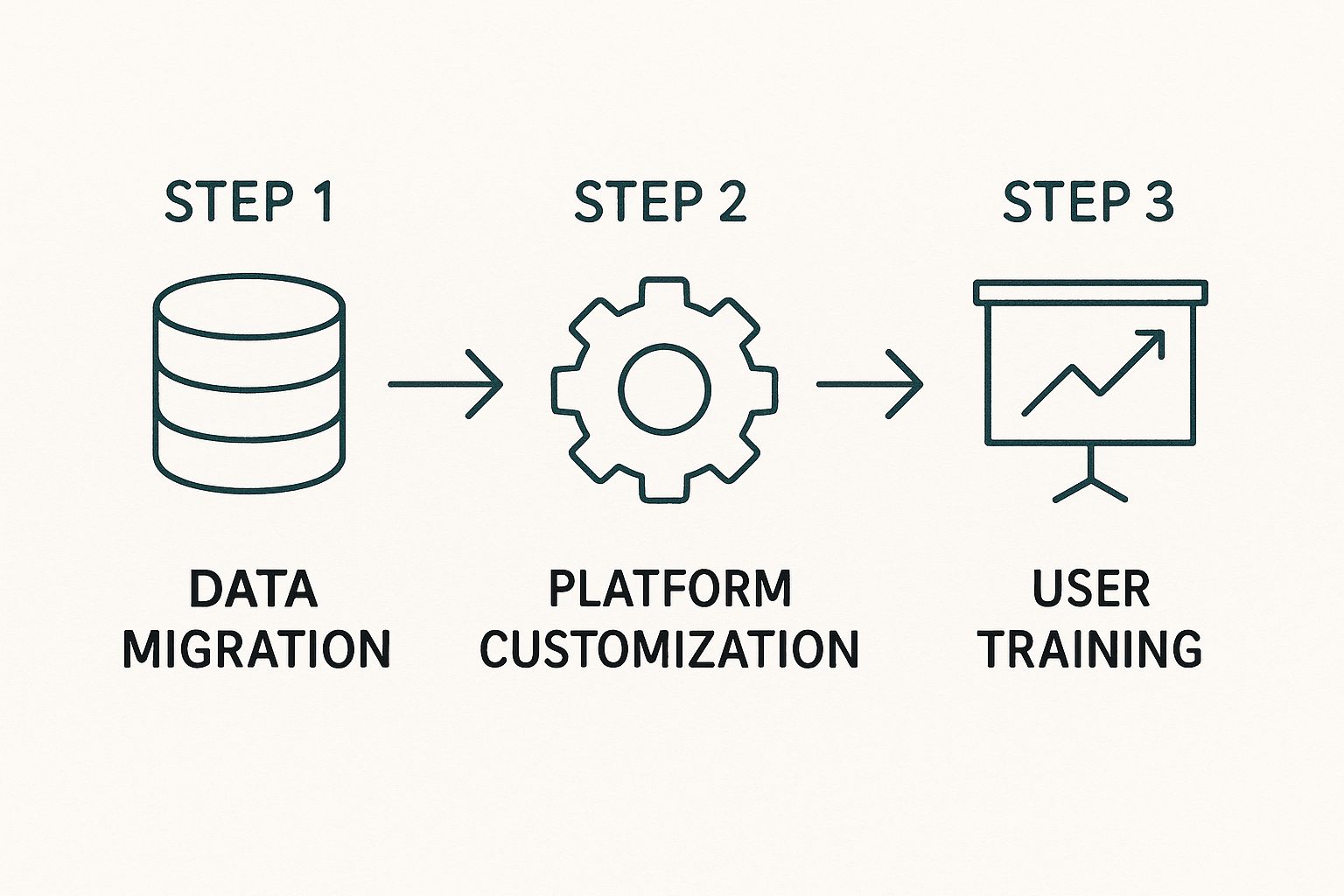
As you can see, the journey kicks off with secure data migration, moves into the core customisation of the platform, and wraps up with solid user training to make sure people actually use the new system.
Look Beyond the Logo Wall at Real Case Studies
Every firm loves to show off their client logos, but you need to dig deeper. Get into their case studies and testimonials. Don't just read the headlines; analyse the story behind them. A compelling case study should lay it all out:
- The Business Challenge: What specific problem was the client struggling with before the project kicked off?
- The Salesforce Solution: Which Salesforce products (e.g., Sales Cloud, Experience Cloud) were implemented, and how were they configured to solve that problem?
- The Measurable Results: What were the quantifiable outcomes? Look for metrics like a 20% increase in lead conversion, or a 30% reduction in case resolution time.
If a case study is vague on the results, that’s a red flag. Real success is always backed by real numbers.
A great Salesforce partner will also think beyond the technical setup. When you're evaluating them, see if they can help you develop broader business strategies, like creating effective sales playbook examples that will integrate seamlessly with your new CRM processes. It shows they're focused on your business outcomes, not just ticking off tasks.
Verify Salesforce Certifications and Specialisations
Salesforce certifications are non-negotiable. They are a critical, verifiable indicator of a firm's technical depth and a consultant's knowledge across different Salesforce Clouds. A team with a broad range of certifications has proven expertise across the entire platform.
A partner’s project methodology is another key differentiator. Do they follow an Agile approach with iterative sprints, which allows for flexibility and regular feedback? Or do they use a more traditional Waterfall model where everything is planned upfront?
Understanding their process gives you a clear picture of how they'll manage your project, communicate progress, and handle any curveballs along the way. Getting this right from the start ensures a much smoother collaboration and a more predictable outcome.
Key Criteria for Evaluating Salesforce Consulting Firms
| Evaluation Criterion | What to Look For | Why It Matters |
|---|---|---|
| Industry Experience | Case studies, client testimonials, and team member bios specific to your industry (e.g., finance, healthcare, manufacturing). | They'll understand your unique business processes, terminology, and regulatory challenges without a steep learning curve. |
| Technical Certifications | A high number of current Salesforce certifications across relevant Clouds (Sales, Service, Marketing, etc.). Ask for specific numbers. | Certifications are proof of verified expertise. A well-certified team is less likely to make costly mistakes. |
| Project Methodology | A clearly defined process (Agile, Waterfall, or a hybrid). Ask how they manage scope, communication, and changes. | The right methodology ensures transparency, aligns expectations, and keeps the project on track and on budget. |
| Client References | Willingness to connect you with 2-3 past clients who had similar projects. | Speaking directly with past clients provides unfiltered insight into their communication style, problem-solving skills, and reliability. |
| Cultural Fit | How well their team communicates and collaborates with yours. Do they feel like true partners or just vendors? | A strong cultural fit fosters a better working relationship, leading to more open communication and a smoother project experience. |
Using a structured approach like this ensures you're not just swayed by a good sales pitch. It forces you to look at the tangible evidence that points to a partner who can truly deliver.
Don't just ask if they are a "Salesforce Partner." Get specific: "How many certified Service Cloud consultants do you have on your team?" or "Can you share your team's experience with Salesforce CPQ for businesses like ours?"
Questions That Reveal a Partner's True Capabilities
The first meeting is your chance to get past the polished sales pitch and see how a potential Salesforce consulting firm really operates. Asking the right questions is the key to uncovering their strategic thinking, technical depth, and cultural fit. This is where you separate the order-takers from the genuine partners who can drive real digital transformation.
Don't just ask if they can do something. Ask how they do it. Their answers open a window into their real-world problem-solving abilities and project management discipline.
Probing Their Project Management Process
A successful project is always built on a solid process. If you get vague answers about "staying in touch," that’s a massive red flag. You need to pin down their exact methodology for keeping your project on track, on time, and on budget.
Here are a few specifics to dig into:
- "How do you handle scope changes or unexpected requests mid-project?" A good partner will have a formal change request process, not just a casual "we'll figure it out" attitude. This protects both of you from scope creep and budget blowouts.
- "What communication cadence can we expect? And who will be our main point of contact?" You're looking for clear, confident answers about regular check-ins (like weekly status calls), defined communication channels, and, most importantly, a dedicated project manager.
- "Can you walk me through your user acceptance testing (UAT) process?" This question reveals just how rigorously they test their work before handing it over. A detailed UAT plan is a great sign of their commitment to quality.
Gauging Their Strategic and Technical Depth
Technical skill is non-negotiable, but it’s their strategic thinking that delivers real, long-term value. You want a firm that doesn’t just understand Salesforce; they need to understand your business, too.
One of the most telling questions you can ask is this: "Tell me about a project that hit a major roadblock. What was the issue, and how did your team navigate it?" Their response tells you more about their resilience and problem-solving skills than any capabilities deck ever could.
This question forces them to go off-script and talk about actual challenges. It shows you how they handle pressure and whether they take ownership when things don't go to plan. It's also vital they stay current. You can get a feel for the platform's direction yourself by reading the highlights of the Salesforce Winter '25 Release.
Understanding Post-Launch Support and Training
The project isn't over when the system goes live—that’s just the beginning. A partner’s commitment to user adoption and your long-term success is a key differentiator.
- "What does your user training strategy look like?" Do they offer customised training sessions for your team, create user guides, or provide train-the-trainer programs? One size rarely fits all.
- "What are our options for ongoing support after the 'hypercare' period ends?" Get clarity on their managed services, expected response times for support tickets, and exactly what's included in their support plans.
Asking these questions helps you find a firm that builds lasting solutions, not just one-off implementations.
Making the Final Decision and Crafting a Solid Contract
You’ve done the research, asked the tough questions, and seen the demos. Now you have a shortlist of potential Salesforce consulting firms, and it's time to make the final call. This decision isn't just about technical chops; it's about the human element, the rapport you've built, and the communication style you've seen in action.

While certifications and case studies are non-negotiable, don't underestimate cultural fit. When challenges pop up—and they always do—a team that communicates transparently and feels like a true extension of your own will be infinitely more effective. Trust your gut, but make sure it’s backed up by the data you’ve gathered.
The Anatomy of a Strong Statement of Work
Once you've picked your partner, the next critical step is getting the Statement of Work (SOW) right. Think of this document as the bedrock of your partnership. There can be no room for ambiguity here. A vague SOW is a recipe for disaster: scope creep, blown budgets, and unmet expectations.
Your contract needs to spell out every component of the project in plain English. A well-written SOW is your best insurance policy, ensuring everyone is on the same page about what success looks like.
A transparent and comprehensive contract isn't just a formality; it's the foundation of a successful partnership. It protects both you and your chosen firm, creating a clear roadmap for the entire project.
Key Elements to Include in Your Contract
Your SOW needs to be specific and detailed. Before you sign, insist on having these elements locked down:
- Clear Deliverables: Itemise everything you expect to receive. This means every custom object, automated workflow, training manual, and final data migration report.
- Detailed Timelines: Don't accept a vague end date. You need a phase-by-phase project plan with key milestones and firm deadlines. This is how you hold both sides accountable.
- Payment Schedules: Always link payments to the completion of specific milestones. This way, you’re paying for tangible progress, not just for hours clocked.
- Support Agreements: What happens after go-live? Define the scope of post-launch support. Get specifics on what’s covered, the length of the "hypercare" period, and the process for flagging and fixing issues.
Great Salesforce projects deliver real, measurable results, like a 50% increase in first-time fix rates for a service team using Service Cloud or a 35% boost in lead conversion for a sales team using Sales Cloud. These are the kinds of tangible outcomes your contract should be aiming for.
With these final checks in place, you can sign with confidence. A solid contract, combined with a partner you genuinely trust, is what sets the stage for a project that delivers real business value.
When you're ready to see what a dedicated partnership can achieve, take a look at our complete Salesforce consulting services.
FAQ: Common Questions About Salesforce Consulting Firms
Navigating the world of Salesforce partners often brings up a few common questions. Here are straightforward answers to the queries we hear most often from business leaders and IT managers.
How much do Salesforce consulting firms cost?
Most Salesforce consulting firms work on one of two primary models, depending on the project's scope and complexity.
- Time & Materials (T&M): You pay an agreed-upon hourly or daily rate. This model is ideal for projects where the scope may evolve, offering maximum flexibility.
- Fixed Price: You agree on a single, upfront cost for a very clearly defined scope of work. This is best for projects with well-documented requirements and a need for predictable budgeting.
Some firms, like us, also offer ongoing managed services or retainers for support and continuous improvement after the initial implementation. No matter which model you choose, the Statement of Work (SOW) should clearly detail all costs and payment schedules.
How long does a typical Salesforce implementation take?
The timeline can vary significantly based on your project's complexity. A simple "quick start" implementation for a small team using a core product like Sales Cloud could be completed in 4 to 8 weeks. However, a more complex project involving multiple clouds (e.g., Sales and Service Cloud), significant data migration, and custom integrations could take 3 to 9 months or longer.
A reputable Salesforce partner will never provide a firm timeline without first conducting a thorough discovery phase. This initial deep dive is essential for creating a realistic project plan with achievable milestones.
Should I choose a large global firm or a smaller boutique agency?
There are compelling advantages to both, and the best choice depends on your specific needs and company culture. Large global firms often have a vast pool of resources and experience with massive, complex enterprise-level projects across many industries.
Conversely, smaller boutique agencies can offer a more personalised, high-touch experience. You often get direct access to senior consultants and deep, specialised expertise in a particular industry (like financial services or manufacturing) or Salesforce product (like CPQ or Field Service). If you value a close, collaborative partnership, a boutique firm could be the perfect fit. Our advice is to evaluate both and focus on the specific team you'll be working with.
What happens after we 'go live'?
A top-tier Salesforce partner understands that the launch is just the beginning. Post-launch support is critical for driving user adoption and ensuring you achieve long-term ROI. Typically, this includes a "hypercare" period to resolve any immediate issues, followed by structured user training. Many firms also offer ongoing managed services to help with system administration, continuous improvements, and future enhancements. Before signing a contract, ensure you have a clear understanding of their post-launch support plan, including service-level agreements (SLAs) and associated costs.
Ready to work with a Salesforce consulting firm that’s focused on your business goals? The team at Adaptal is here to help you unlock the full potential of your Salesforce platform. Contact us today for a consultation.