

What is Salesforce Sales Cloud? At its core, it's the world's leading Customer Relationship Management (CRM) platform, engineered to manage, automate, and accelerate your entire sales journey. From our experience as a Salesforce partner, think of it as the central nervous system for your sales operation—a single source of truth that drives predictable growth.
What Problem Does Salesforce Sales Cloud Solve for Businesses?
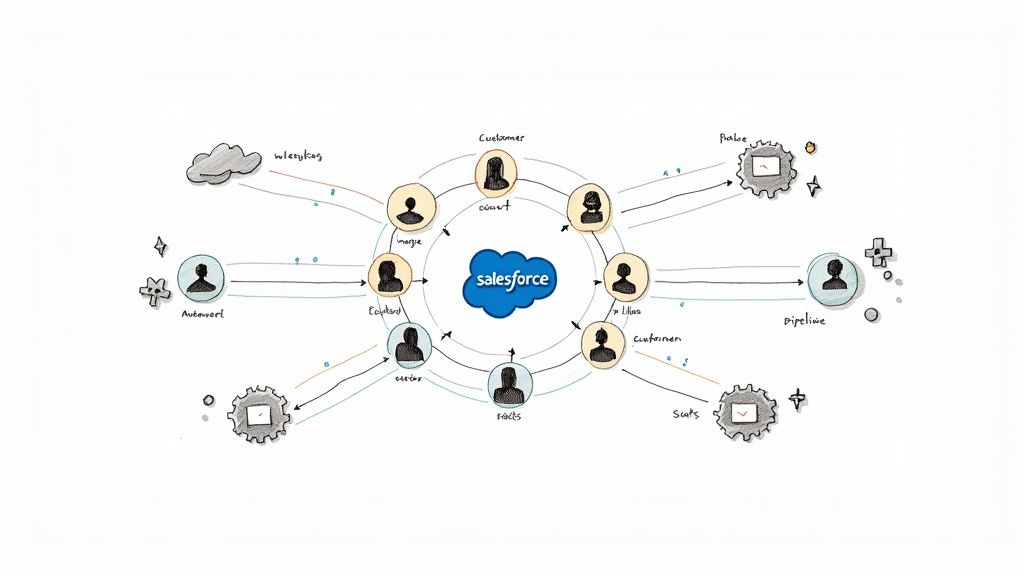
Here’s a business challenge we see constantly: a sales team trying to manage customer data scattered across spreadsheets, lost in email threads, and jotted on sticky notes. For many Australian businesses, this data fragmentation leads to missed opportunities, inaccurate forecasting, and a blurry view of the sales pipeline.
The Salesforce solution is to cut through that chaos. Salesforce Sales Cloud acts as a single, intelligent command centre for your entire sales force, unifying every piece of customer data and every interaction. By automating the tedious manual tasks that drain your team's time, it replaces confusion with crystal-clear visibility and empowers your team to focus on what they do best: selling.
Moving Beyond a Simple Database
It's easy to mistake Sales Cloud for just a fancy digital address book, but that’s barely scratching the surface. While it’s brilliant at contact management, its real power is in connecting data points to reveal actionable insights. The platform isn’t just about storing information; it’s about using it to sell smarter and faster.
With Sales Cloud, a sales manager can instantly identify at-risk deals, forecast revenue with greater accuracy, and see which marketing campaigns are generating the highest-quality leads. This level of visibility is the difference between good business decisions and great ones.
A well-implemented CRM like Salesforce Sales Cloud isn’t an expense; it’s an investment in predictable revenue growth. By organising data and processes, you empower your team to focus on what they do best: building relationships and closing deals.
A Unified Platform for Sales Success
At its heart, the platform is designed to support every stage of the sales journey. It provides the tools your team needs to manage leads, track opportunities from qualification to close, and collaborate seamlessly. This integrated approach ensures nothing falls through the cracks.
Key functions include:
- Centralised Data Management: All leads, contacts, accounts, and opportunity details live in one accessible, shared location.
- Process Automation: Say goodbye to manual follow-ups, approvals, and admin work. Workflow automation handles repetitive tasks, freeing up reps to focus on selling.
- Pipeline Visibility: Real-time dashboards and reports provide a clear, up-to-the-minute view of your entire sales pipeline.
- Improved Collaboration: Information flows seamlessly between team members, managers, and even other departments involved in the customer lifecycle.
As a dedicated Salesforce partner, we've seen firsthand how this structured approach gives businesses a serious competitive edge. It builds the foundation for scalable growth by creating a sales process that is both repeatable and measurable.
Exploring the Core Features That Drive Revenue
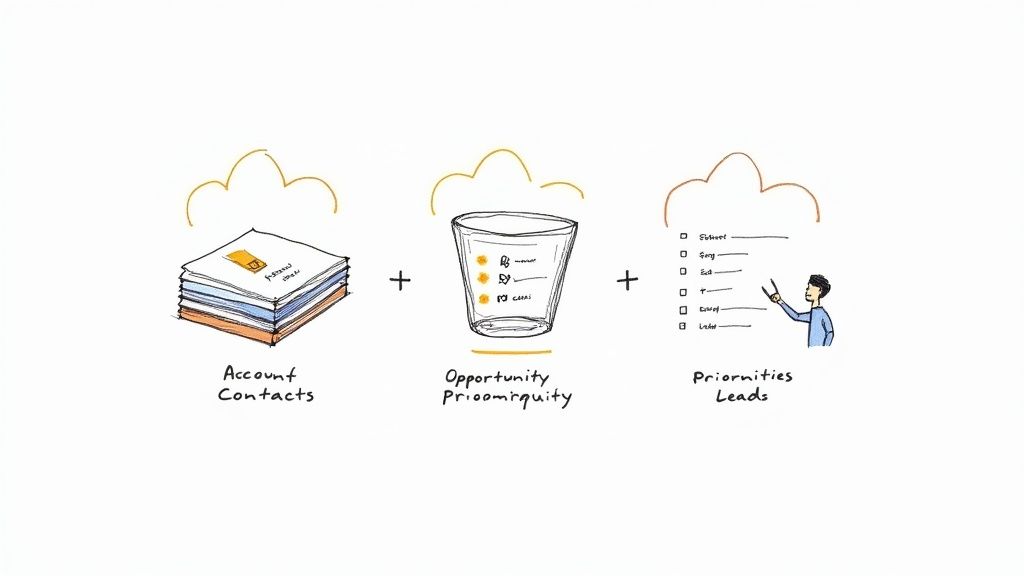
It’s one thing to understand the concept of Salesforce Sales Cloud, but it’s another to see how its features translate into real-world results. Let’s move beyond a technical list and dive into the powerhouse tools that solve everyday business challenges and drive tangible outcomes.
These aren't just software functions; they are solutions. From wrangling customer data to tracking complex deals, each feature is built to bring order, efficiency, and insight to your sales process. This is where Sales Cloud evolves from a simple database into a strategic asset for growth.
Mastering Customer Data with Account and Contact Management
The business challenge is clear: disjointed customer information leads to a poor customer experience. The solution within Sales Cloud is Account and Contact Management, which provides a complete, 360-degree view of every customer. Think of it as your single source of truth for every client interaction.
This unified view pulls together contact details, communication history, past deals, and current activities. For a professional services firm we worked with, this meant any team member could engage in a client conversation with full context, instantly. The result? No more embarrassing repeat questions—just a seamless customer experience and stronger relationships.
By centralising this information, Sales Cloud solves the problem of data silos. Information is no longer trapped in one salesperson's inbox; it becomes a shared, collaborative asset that empowers the entire team.
Navigating the Deal Lifecycle with Opportunity Management
The business challenge: lack of visibility into the sales pipeline and inconsistent sales processes. The solution is Opportunity Management, where potential interest is converted into closed revenue. It empowers your team to track every stage of a deal, from initial qualification to final signature, offering unparalleled visibility into your sales pipeline.
For example, a growing retail supplier faced the challenge of inconsistent sales processes across multiple states. By implementing this feature, they standardised their sales stages. Reps knew exactly what actions to take at each step, while management gained a real-time view of pipeline health. The result? They could spot bottlenecks instantly and forecast revenue with far greater confidence.
The real power here is turning your sales process from an art into a science. Opportunity Management provides the data-driven framework you need to make your pipeline predictable, scalable, and manageable.
This is key if you want to build a sales pipeline that converts. By clearly defining each step, you eliminate guesswork and help your team focus on the activities that move deals forward.
Increasing Productivity with Automation and Workflow Rules
The business challenge: sales teams spend too much time on manual admin work instead of selling. Sales Cloud hits this problem head-on with powerful automation tools that handle repetitive tasks.
Workflow Rules can automatically assign new leads to the right salesperson, send follow-up email reminders, create tasks for the next steps in a deal, and update fields when a milestone is hit. This automation brings consistency and speed to your entire sales operation.
We helped a client dramatically reduce their lead response times by automating the initial assignment and follow-up process. The result was a noticeable jump in conversion rates because prospects were engaged while their interest was highest. The latest Salesforce updates continue to add even smarter automation features, as we covered in our overview of the highlights of Salesforce Winter '25 Release.
To put it all together, here’s a simple breakdown of how these features create direct business impact.
Sales Cloud Features and Their Business Impact
This table connects the core tools within Sales Cloud to the real-world benefits they deliver for your sales team.
| Feature | Primary Function | Key Business Benefit |
|---|---|---|
| Account & Contact Management | Centralises all customer data and interaction history. | Creates a unified customer view, improving service and relationships. |
| Opportunity Management | Tracks every deal through a defined sales process. | Provides pipeline visibility, accurate forecasting, and process consistency. |
| Lead Management | Captures, scores, and routes incoming leads efficiently. | Ensures faster follow-up on high-quality leads, boosting conversion rates. |
| Workflow Automation | Automates repetitive tasks like emails, tasks, and field updates. | Increases sales productivity by freeing up rep time for selling activities. |
| Reports & Dashboards | Offers real-time analytics and customisable reports. | Delivers data-driven insights for smarter, more informed business decisions. |
By weaving these powerful tools together, Sales Cloud creates a cohesive system that doesn't just organise data—it actively improves the processes that generate sales and drive revenue.
The Strategic Pay-Offs of Adopting Sales Cloud
Looking past individual features, the real power of Salesforce Sales Cloud lies in the strategic impact it has across your business. A smart implementation isn't just about organising contacts; it’s about building a predictable growth engine, streamlining operations, and making smarter, data-driven decisions. These are the high-level advantages that executives feel on the bottom line.
When a company truly embraces Sales Cloud, it shifts from being reactive to proactive. You stop guessing which leads are hot or wondering why a deal stalled. Instead, you gain a crystal-clear, real-time view of your entire sales operation. This move from guesswork to a data-backed strategy is the foundation for scaling any modern business successfully.
For our clients, these benefits typically fall into three main categories: tangible growth, enhanced efficiency, and game-changing insights.
Pillar 1: Fuelling Sustainable Business Growth
At its core, Sales Cloud is built to help you sell more. It achieves this by creating a structured, repeatable sales process that every person on your team can follow. That consistency is critical for scaling up without things falling apart.
Case Study Example: A manufacturing partner we worked with was challenged by a long, complex quote-to-cash cycle. By implementing Sales Cloud, we helped them automate key stages of that process. The result? They slashed their average sales cycle time by over 20%. This didn’t just bring in revenue faster; it freed up their reps to chase and manage bigger, more complex deals.
This isn't a one-off. By giving sales teams the right tools to manage their pipeline and focus on the best opportunities, the platform directly drives top-line revenue. You can see more real-world examples of Salesforce driving growth in our client success stories.
Pillar 2: Driving Operational Efficiency
For any sales team, time is the most precious resource. Sales Cloud gives that time back by automating the tedious, low-value admin tasks that slow reps down. Think about the hours wasted logging calls, manually sending follow-up emails, and updating spreadsheets—the platform handles a huge chunk of this automatically.
This focus on efficiency means your team can spend more time on what actually matters: building relationships and closing deals. It also leads to a more professional and consistent customer experience, as follow-ups are never missed and crucial information is always accessible.
An efficient sales process isn’t about making people work harder; it’s about removing the friction that slows them down. Sales Cloud is the ultimate friction-remover for sales teams.
The Australian business landscape is incredibly competitive, making this operational efficiency a key advantage. Being smart with technology is non-negotiable. Reports show that reps can spend a staggering 71% of their time on non-selling activities. Sales Cloud directly addresses this challenge.
Pillar 3: Unlocking Actionable Insight
Perhaps the biggest long-term payoff from Sales Cloud is the deep business insight it provides. With all your sales data in one place, you can get clear answers to critical questions:
- Which lead sources are generating the most revenue?
- What is our team's true win rate, and how can we improve it?
- Where are the bottlenecks in our sales process?
- Are our revenue forecasts based on hope or reliable data?
Through customisable dashboards and real-time reports, Sales Cloud transforms raw data into actionable intelligence. Managers can coach their teams with precision, and leadership can make strategic decisions with confidence. This data-driven culture is what separates market leaders from the rest.
Your Roadmap for a Successful Sales Cloud Implementation
A powerful platform like Salesforce Sales Cloud is only as good as its implementation. Buying the software isn't the magic bullet; the real return on investment comes from a structured rollout that ties the technology directly to your unique business goals.
We've seen companies jump in without a clear plan, leading to low user adoption and wasted potential. As a Salesforce partner that has guided numerous businesses through this process, we’ve learned that success hinges on a roadmap—one that considers not just the tech, but also the people and processes it supports. A proper implementation is a journey, not a sprint.
This infographic highlights the key benefits a well-planned implementation delivers, turning your investment into measurable growth and efficiency.
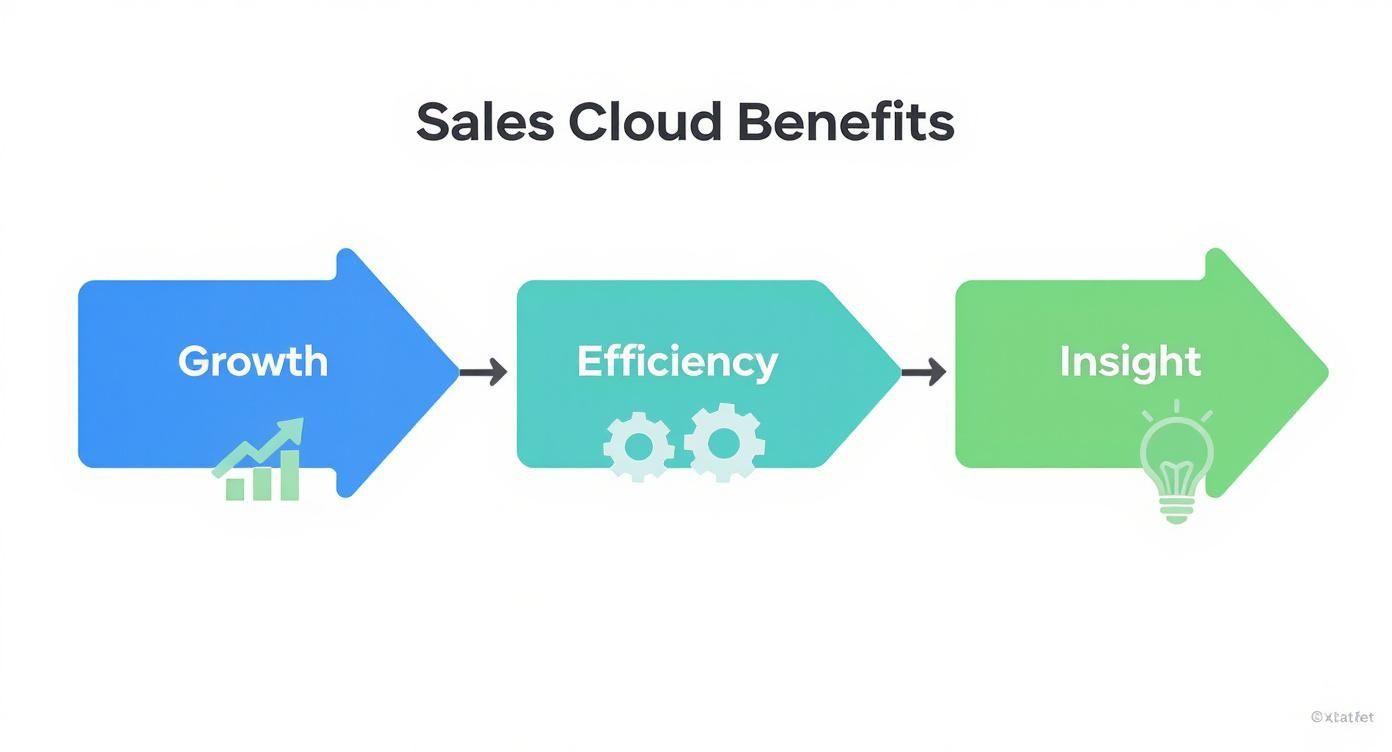
A strategic rollout translates directly into real business outcomes, creating a solid foundation for future growth.
Phase 1: Discovery and Planning
This is the most critical phase. Before configuring a single feature, you must define what success looks like for your organisation. This involves getting stakeholders from sales, marketing, and leadership to map out your current sales processes and pinpoint the biggest challenges.
Get clear on these questions:
- What are our main business objectives for this digital transformation project?
- Which specific sales processes are we trying to fix or improve?
- What data is essential for our team to have at their fingertips?
- How will we measure success in 6-12 months?
Documenting the answers provides a north star for the project, ensuring every decision aligns with your strategic goals. For a deeper dive, check out our complete Salesforce Implementation Guide for Australian businesses.
Phase 2: Configuration and Customisation
Once you have a solid plan, it's time to mould Sales Cloud to fit your specific needs. This involves setting up user profiles, defining your sales stages within the platform, and creating custom fields to capture the data that matters to your business.
The best approach is to start with the essentials. Focus on configuring core features that deliver the most immediate impact, like lead management and opportunity tracking. This agile approach delivers value faster and allows you to gather real user feedback for future enhancements.
Phase 3: Data Migration and Integration
Your CRM is only as valuable as the data inside it. This phase involves carefully moving your existing customer information from old systems—whether spreadsheets or a legacy CRM—into Sales Cloud. Clean, accurate data is non-negotiable for user trust and reliable reporting.
A common pitfall is underestimating the effort required for data cleansing. Treat data migration as a mini-project. Dedicate time to de-duplicating records and standardising formats before importing anything.
This is also when you connect Sales Cloud to other key business systems, like your accounting software or marketing automation platform. A well-integrated system breaks down frustrating data silos and creates a unified view of your customer.
Phase 4: Training and User Adoption
Finally, the most important phase: bringing your team on board. A successful rollout is less about technology and more about people. If your sales reps don't use the system, the project has failed.
Effective training must be role-specific and focus on how Sales Cloud makes their job easier. You have to nail the "what's in it for me" factor, showing them how the platform helps them close more deals and spend less time on admin. Ongoing support and celebrating early wins are crucial for building momentum and ensuring this new way of working sticks.
Integrating Sales Cloud into Your Tech Stack
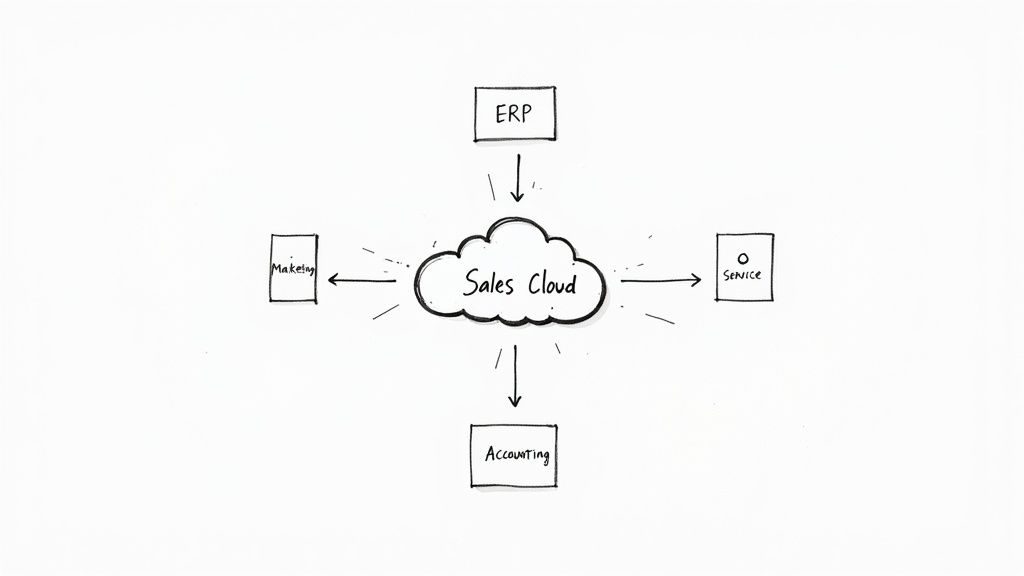
While Salesforce Sales Cloud is powerful on its own, its true value is unlocked when it integrates with the other systems that run your business. Integration transforms your CRM from a sales tool into the beating heart of your entire customer data ecosystem.
This is how you finally tear down the data silos that create friction between departments. When Sales Cloud connects to your other platforms, it creates a single, reliable information highway across the organisation. Suddenly, every team—from marketing to finance to customer service—is working from the same playbook.
Creating a Unified View of the Customer
A common challenge we see is a sales team operating without visibility into a customer's support history or payment status. Integration fixes this.
Imagine a sales rep preparing for a call. With an integrated system, they can see everything they need in one place, right inside Sales Cloud:
- Marketing Engagement: Which email campaigns the contact has opened (from a marketing platform like Account Engagement).
- Service History: Any open support tickets or past issues (from a service tool like Service Cloud).
- Financial Status: Their complete payment history and any outstanding invoices (from an accounting system like Xero or MYOB).
This 360-degree view empowers your team to have smarter, more relevant conversations. This is especially vital in industries like real estate, where multiple systems must work in harmony. You can learn more about how Salesforce serves as the backbone of a modern real estate tech stack in our detailed guide.
Boosting Efficiency with Automated Workflows
Integration isn't just about seeing data; it's about automating the work that happens between departments. When your systems are connected, you can build powerful workflows that save time and reduce human error.
For example, when a sales rep closes a deal in Sales Cloud, a smart integration can automatically:
- Generate an invoice in your accounting software.
- Create a project for the delivery team in their project management tool.
- Add the new customer to an onboarding journey in your marketing platform.
This automation ensures a smooth handover from sales to the rest of the business, creating a seamless experience for your customer from day one.
A well-integrated tech stack means your systems do the heavy lifting, freeing up your people to focus on high-value work instead of tedious data entry across multiple apps.
Extending Functionality with the AppExchange
Beyond direct integrations, the Salesforce AppExchange is a massive advantage. It’s the world's leading enterprise cloud marketplace, packed with thousands of apps that extend what Sales Cloud can do. Think of it as the app store for your business.
Whether you need a niche tool for document signing, advanced analytics, or industry-specific compliance, there’s likely an app for it. As an experienced Salesforce partner, we help clients navigate the AppExchange to find trusted, pre-built solutions that solve unique business challenges without the cost of custom development.
How AI Is Reshaping the Future of Sales with Salesforce
The future of sales is about working smarter, not harder. Today, Artificial Intelligence (AI) is a practical tool built directly into Salesforce Sales Cloud. The engine behind this is Salesforce Einstein, which acts as a brilliant assistant for every person on your sales team.
This AI assistant is designed to take over tedious, time-consuming tasks and, more importantly, serve up data-driven insights that help your team focus on what truly matters—giving them a competitive advantage where speed and intelligence win the deal.
Making AI Practical with Salesforce Einstein
Instead of relying on gut feelings, Einstein provides solid, data-backed predictions. A perfect example is Predictive Lead Scoring, which analyzes historical data to identify which new leads are most likely to convert. This allows your team to stop wasting time on cold trails and focus their energy on the hottest prospects.
Another game-changer is Einstein Activity Capture. This feature automatically syncs customer emails and calendar events to the correct records in Sales Cloud. This simple automation eliminates hours of manual data entry, keeps your CRM up-to-date, and frees up your reps to build relationships.
Think of Einstein as your team's personal data analyst, constantly working in the background to spot patterns, automate admin, and flag the next best action for every opportunity. It turns your CRM from a simple database into a proactive sales machine.
AI's role in refining the sales process is growing daily. For a great real-world example of how this works in practice, check out this successful AI-powered cold email playbook.
The Real-World Impact on Australian Businesses
The commercial benefits of AI within Sales Cloud are massive, especially for Australian small to medium businesses (SMBs). A comprehensive Salesforce survey revealed that 88% of Australian SMBs using AI have seen a direct boost in revenue.
Local companies are using AI-driven tools in Sales Cloud for everything from generating content to automating customer service. A powerful example is Urban Rest. By combining Sales Cloud with AI, they increased their revenue by a staggering 1400% in just three years—a testament to how this combination drives both efficiency and serious growth.
Frequently Asked Questions About Salesforce Sales Cloud
Jumping into a platform like Salesforce Sales Cloud is a big decision, and it’s natural to have questions. Here are our answers to some of the most common queries we hear from Australian business leaders considering this powerful sales CRM. Our goal is to provide the clarity you need to move forward with confidence.
How does Sales Cloud differ from other CRMs?
While many CRMs act as a digital address book, Sales Cloud is an entire revenue platform. Its key differentiators are its ecosystem, deep customisation capabilities, powerful automation, and access to the AppExchange—a marketplace with thousands of pre-built business apps. While other CRMs manage contacts, Sales Cloud is built to manage and automate your entire revenue process, from lead generation to forecasting and performance analytics.
What is a typical implementation timeline?
The timeline varies based on your company's size and complexity. We strongly recommend a phased approach.
- Phase 1 (Foundation): For a small or medium-sized business needing core features like account, contact, and opportunity management, a typical timeline is 4-8 weeks. This delivers quick value.
- Phase 2 (Enhancement): Adding complex automation, custom reports, or integrations can add another 4-12 weeks.
As an experienced Salesforce partner, we help clients build a realistic roadmap, prioritising features that solve the biggest challenges first to deliver immediate wins.
Can Sales Cloud be customised to our unique sales process?
Absolutely. This is one of the biggest strengths of the Salesforce platform. Your business isn’t one-size-fits-all, and your CRM shouldn’t be either. Sales Cloud can be shaped to mirror your specific sales stages, terminology, and data capture needs.
The platform is designed to be moulded to your business, not the other way around. This is crucial for user adoption—when the system speaks your team's language and supports how they already work, they'll actually use it.
This flexibility means we can create custom fields, build unique approval processes, and design dashboards that show the KPIs that matter most to your organisation, ensuring the platform grows alongside your business.
Ready to see how Salesforce Sales Cloud can be adapted to your exact business needs? As a leading Salesforce Consulting Partner in Australia, Adaptal specialises in helping businesses unlock the full potential of their CRM. Contact us for a no-obligation consultation today.