
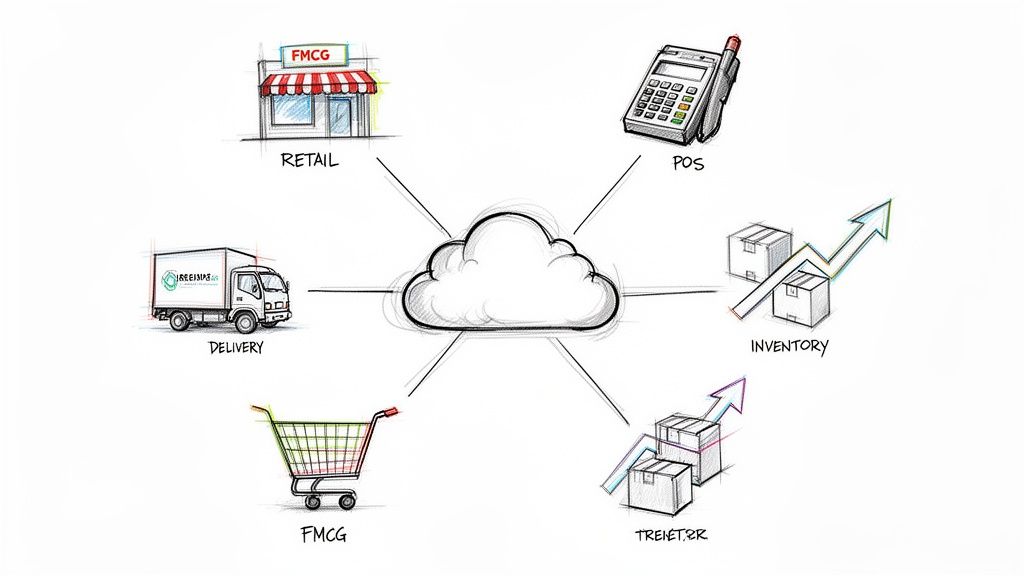
The Australian retail and FMCG landscape is a highly competitive arena defined by tight margins, complex supply chains, and digitally savvy customers. To thrive, businesses need to move beyond disconnected spreadsheets and legacy software. The key is operating from a single command centre that provides clarity and control over every part of the business—from sales and service to marketing and operations.
The Modern Challenge for Australian Retail and FMCG
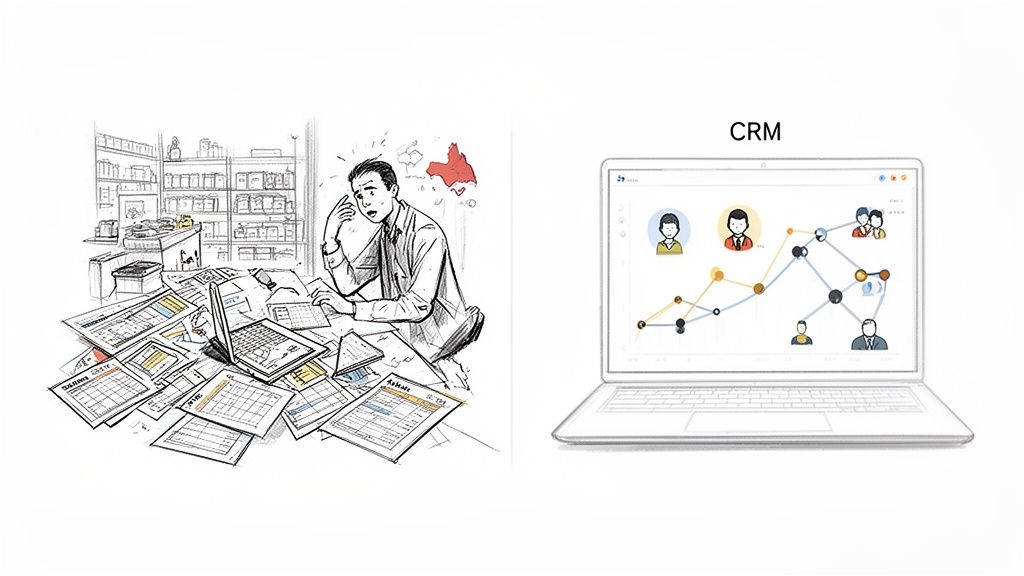
Many Australian retail and fast-moving consumer goods (FMCG) businesses are struggling with a patchwork of systems that don’t talk to each other. This digital fragmentation creates frustrating data silos, making it nearly impossible to get a clear, single view of the customer journey or the overall health of the business.
When your data is scattered, the entire operation feels the strain. Sales teams lack a clear view of their pipeline, marketing campaigns are disconnected and difficult to measure, and customer service agents are left trying to solve problems without the full context of a customer's history. This isn't just inefficient; it undermines the very customer experience that modern shoppers demand.
The High Stakes of a Growing Market
These operational challenges are amplified by the sheer scale of the industry. Australia's FMCG market is projected to hit AU$168 billion by 2025, with grocery retail alone commanding over AU$115 billion. Managing countless distribution channels and product lines in such a massive market is complex, but it also creates a significant opportunity for platforms that can bring order to the chaos through digital transformation.
This is precisely where a powerful CRM like Salesforce steps in. As a central command centre, Salesforce connects every part of your business, giving every team a single, shared view of every customer interaction. From the first marketing touchpoint to the final sale and any follow-up service, the entire journey is visible.
By unifying data and processes, Salesforce allows retail and FMCG companies to move from a reactive position to a proactive one, anticipating customer needs and optimising every stage of the value chain.
This guide, based on our experience as a Salesforce partner, will break down how the platform directly tackles the core pressures facing the retail and fmcg sectors. We'll explore how it builds a single source of truth and solves key challenges across your sales, service, and marketing teams. For a closer look at the market dynamics, check out our guide on navigating the FMCG industry in Australia.
Building a Single Source of Truth with Salesforce CRM
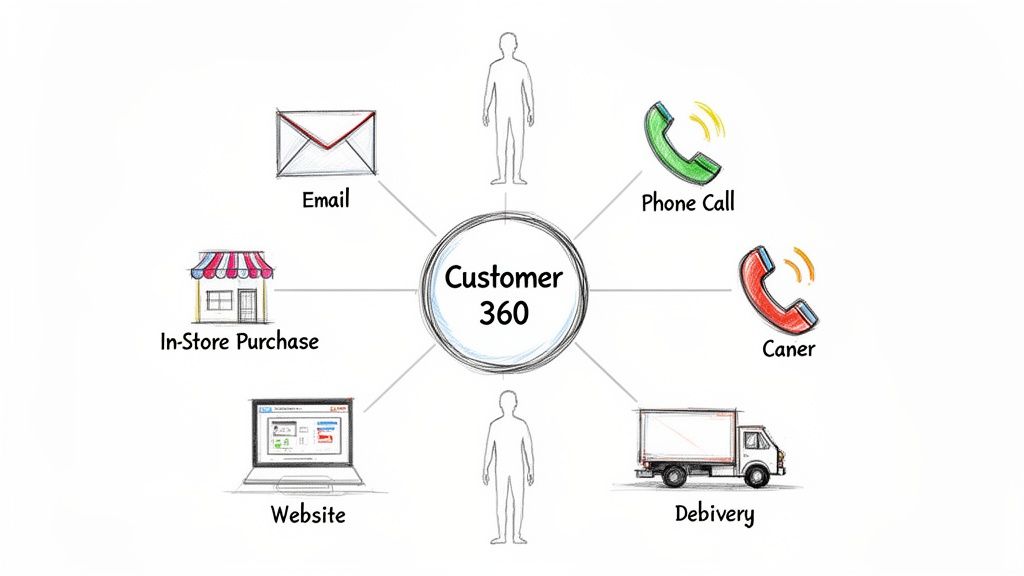
Running a retail and FMCG business with siloed data is like trying to navigate a busy city with a dozen different, outdated maps. It's confusing, inefficient, and leads to missed opportunities. The solution is to create a single source of truth (SSOT)—a central hub where every piece of customer information lives and connects to tell one coherent story.
Salesforce is designed to be this operational nerve centre. It consolidates every customer touchpoint into one cohesive profile, capturing interactions from marketing email clicks and website visits to in-store purchases and support calls. This allows you to move beyond fragmented spreadsheets and gain a complete, 360-degree customer view.
Creating the Complete Customer Profile in Salesforce
This unified view is achieved by integrating different Salesforce products that manage specific parts of the customer journey. These cloud solutions work in tandem, sharing information to build a comprehensive picture of each customer.
Here’s a practical example of the business challenge and the Salesforce solution:
- The Challenge: A potential customer responds to a marketing campaign, speaks with a sales rep, makes a purchase, and later contacts support with a query. In a siloed business, each team only sees their piece of the puzzle.
- The Salesforce Solution: The initial engagement is captured in Marketing Cloud. The sales conversation and opportunity are tracked in Sales Cloud. The subsequent support ticket is managed in Service Cloud. Because it all lives on one platform, the service agent sees the customer's full purchase and marketing history, enabling a faster, more personalised resolution. This is the power of a connected CRM.
A single source of truth eliminates guesswork. It empowers your teams to make smarter, data-driven decisions that directly impact customer satisfaction and your bottom line.
Beyond Customer Data: Integrating Product Information
A true single source of truth must also extend to your products. For retail and FMCG companies managing thousands of SKUs, consistent and accurate product information is non-negotiable.
Integrating dedicated Product Information Management Systems (PIM) with Salesforce is often the backbone of a true SSOT. This ensures that every department—from marketing and sales to logistics and finance—is working from the same accurate product details. This prevents ordering errors, incorrect marketing content, and frustrating customer experiences. When product and customer data are unified, your entire operation becomes more coherent and reliable. We dive deeper into this topic in our detailed guide to achieving a customer single view.
Building a single source of truth with Salesforce replaces fragmentation with clarity, providing the foundation needed for personalised engagement and strategic growth in the competitive Australian retail and FMCG market.
How Salesforce Solves Key Retail and FMCG Challenges
For retail and FMCG companies, daily challenges range from managing field sales teams to delivering personalised customer service. This is where Salesforce transitions from a concept to a practical, results-focused tool for effective CRM Management. Let’s break down common industry challenges and see how different Salesforce products deliver tangible benefits.
Salesforce Solutions for Core Retail and FMCG Challenges
| Business Challenge | Salesforce Solution | Key Features & Benefits |
|---|---|---|
| Inefficient Field Sales & B2B Account Management | Sales Cloud | Provides mobile access to account history, route planning, and real-time order entry. This leads to more productive reps, stronger retailer relationships, and less administrative work. |
| Disconnected & Slow Customer Service | Service Cloud | Unifies all communication channels (phone, email, social) into a single agent view. This gives agents full context for faster resolutions and boosts customer satisfaction (CSAT) scores. |
| Fragmented Customer Journeys & Lost Sales | Marketing Cloud | Automates personalised marketing journeys, like abandoned cart reminders or targeted promotions. This helps recover lost sales and builds a more consistent brand experience. |
| Clunky & Impersonal E-commerce Experience | Commerce Cloud | Delivers fast, mobile-friendly online stores that integrate directly with marketing and service data. This boosts online conversions and provides a seamless shopping experience from ad to purchase. |
This table provides a high-level overview. Now, let's explore these real-world business scenarios in more detail.
Empowering Field Sales and B2B Account Management with Sales Cloud
A significant challenge in the FMCG sector is managing relationships with hundreds of retailers. Field reps need instant access to information to place orders, check stock levels, and plan visits efficiently. Without a central hub, this process is often chaotic.
The Business Challenge: Field sales reps operate with outdated account information, spend hours on manual data entry after visits, and lack a clear view of their sales pipeline.
The Salesforce Solution: Sales Cloud provides the structure and mobility needed. Using the mobile app, a rep can:
- Plan efficient routes based on customer location and priority.
- Access complete account history, including past orders and service issues, before a meeting.
- Log visit notes and place new orders directly on their tablet, eliminating late-night data entry.
- Track performance against targets with real-time dashboards.
The Result: This digital transformation shifts the sales process from reactive to strategic. It leads to more productive reps, stronger retailer relationships, and a significant reduction in administrative overhead.
Transforming Customer Service into a Loyalty Engine with Service Cloud
In modern retail, customer service must be a proactive tool for building loyalty. Customers expect fast, consistent support across all channels—phone, email, social media, and web chat. Disconnected systems make this seamless experience impossible.
Salesforce Service Cloud unifies all customer communication channels into a single console, giving agents a 360-degree view of every interaction to solve problems faster and more effectively.
The Business Challenge: A customer calls support, but the agent has no visibility into their recent purchases or previous interactions, leading to a frustrating experience where the customer has to repeat their story.
The Salesforce Solution: With Service Cloud, when a customer calls, the agent instantly sees their entire purchase history, past support tickets, and recent marketing engagement.
The Result: The agent can move from "Can you give me your order number?" to "I see you recently bought our new product. How can I help?" This contextual service leads directly to higher first-call resolution rates and improved customer satisfaction (CSAT) scores.
Creating Seamless Digital Experiences with Marketing and Commerce Cloud
The modern customer journey spans multiple touchpoints, from social media ads to in-store purchases. To succeed, retail and FMCG brands must connect these dots to create a consistent and personal experience.
The Business Challenge: A customer abandons their online shopping cart, and the opportunity is lost. Marketing efforts are generic and fail to resonate with individual customer behaviour.
The Salesforce Solution: The combined power of Marketing Cloud Account Engagement and Commerce Cloud creates seamless, automated journeys. A customer who abandons their cart can automatically receive a follow-up email reminder. A customer’s browsing habits on a Commerce Cloud site can trigger a tailored journey in Marketing Cloud.
The Result: Targeted automation can recover up to 15% of lost sales. This integration boosts online sales, improves marketing ROI, and builds a brand that customers feel connected to.
Case Study: How an Australian Franchise Unified Its Sales Process with Salesforce
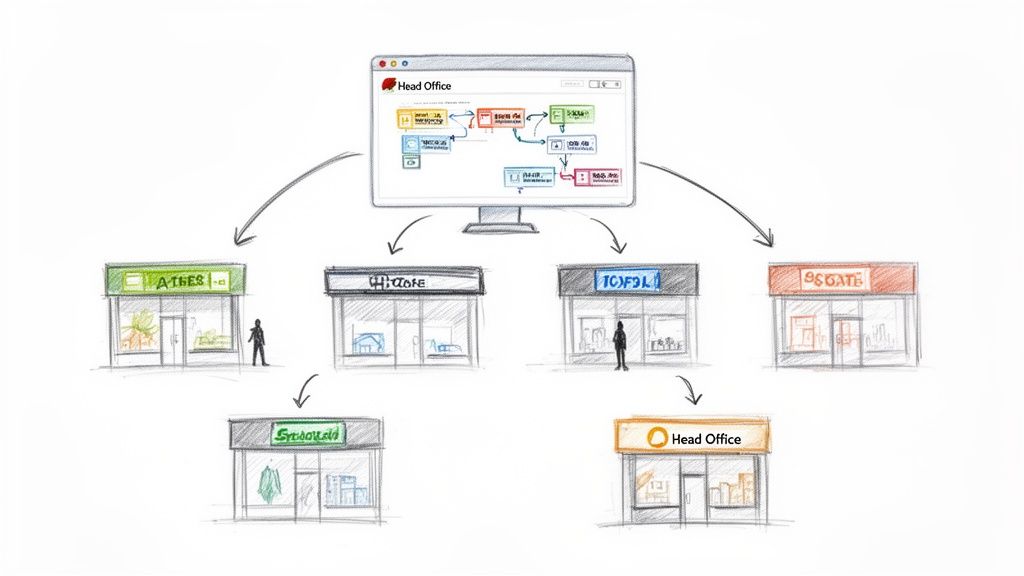
Real-world examples best illustrate the value of a well-implemented CRM. Let's look at a common scenario in the Australian retail and FMCG sector: a mid-sized franchise network struggling with operational complexity.
The Business Challenge
Before partnering with us, each franchise operated in a silo, using a mix of spreadsheets and local systems to track leads and sales. This decentralised approach created significant problems:
- Head office had no real-time visibility into the national sales pipeline.
- Marketing campaigns were inconsistent and nearly impossible to measure across the network.
- Valuable leads were falling through the cracks due to a lack of a unified process.
The Salesforce Solution
The goal was to build a system that empowered individual franchisees while providing head office with essential oversight. As an experienced Salesforce partner, our strategy centred on two pillars:
- Sales Cloud: To create a single, standardised sales process for the entire franchise network.
- Marketing Cloud: To execute coordinated national campaigns that franchisees could localise.
We began by customising Sales Cloud to be the single source of truth for all sales activities. We designed a clear, consistent lead management process that every franchisee could follow, ensuring all leads were captured and tracked uniformly. Next, we implemented Marketing Cloud to centralise national campaigns while allowing franchisees the flexibility to run their own local promotions, with all data feeding back into the central CRM.
By standardising the sales process, we eliminated the guesswork. Franchisees had a clear roadmap for nurturing leads, and leadership could finally see a reliable, network-wide sales forecast.
The Results and Benefits
The transformation from a chaotic, siloed operation to a collaborative, data-driven one delivered tangible results. Within the first year, the franchise network achieved:
- A 30% increase in lead conversion rates due to a structured follow-up process.
- Real-time reporting and dashboards providing leadership with an instant view of sales performance.
- Empowered franchisees with powerful tools to manage their local sales and marketing more effectively.
This case study shows how a strategic Salesforce implementation is more than a software project; it's a business transformation that can turn operational chaos into a competitive advantage in the retail and fmcg space.
Integrating Salesforce into Your Business Ecosystem
A CRM like Salesforce delivers maximum value when it’s integrated with your other core business systems. For retail and FMCG businesses, Salesforce becomes the central hub of operations, connecting sales, service, and marketing data with inventory, finance, and logistics. Without these connections, you operate with blind spots, leading to inefficiency and costly mistakes.
The goal is to create a unified view where information flows automatically between every system, enabling smarter, faster decision-making across the entire organization.
Connecting Your Core Business Systems with Salesforce
Based on our project experience, these are the most critical integration points for retail and FMCG companies:
- ERP Integration (NetSuite, SAP): Connecting Salesforce to your Enterprise Resource Planning system syncs vital data like inventory levels, order information, and shipping updates. This allows a sales rep to check stock levels in real-time before finalising a quote.
- POS System Integration: This integration pulls in-store transaction details into a customer's Salesforce profile, providing a complete picture of their online and offline buying habits for more effective marketing and service.
- Accounting Software Integration (Xero, MYOB): This connection automates the flow of financial data, linking sales orders and invoices between Salesforce and your accounting platform to reduce manual entry and provide a clear, real-time view of your financial health.
Integrating these systems creates a single source of truth that powers smarter decisions. When everyone is working from the same live data, your whole operation becomes more agile.
The Power of API Integration
These connections are made possible by Application Programming Interfaces (APIs), which act as secure messengers allowing different software programs to communicate. A skilled Salesforce partner is essential to design and build these data bridges correctly.
When implemented properly, API integration ensures data flows seamlessly between systems. For example, an order status update in your ERP is automatically reflected in the customer’s Salesforce record. Our guide on what API integration is provides more detail on how these connections form the backbone of a modern, efficient business.
The Australian grocery market is expected to reach AUD 148.33 billion in 2025, driven by consumer demand for locally sourced products and greater traceability. Integrating Salesforce with your supply chain systems helps you manage partners and meet these expectations. You can discover more insights about the Australian grocery market on expertmarketresearch.com.au.
A fully integrated ecosystem transforms Salesforce from a CRM into the command centre for your entire retail and FMCG business, unlocking unparalleled operational clarity.
Your Roadmap to a Successful Salesforce Implementation
Implementing a powerful platform like Salesforce can feel daunting. However, with a clear, structured roadmap and an experienced Salesforce partner, the project becomes a manageable, strategic business transformation. A successful implementation moves through distinct phases designed to deliver value quickly and ensure long-term success.
Discovery and Strategy
Every successful Salesforce project begins with a deep-dive discovery phase. We work with you to map your current processes, identify key pain points, and define clear, measurable business objectives.
We focus on answering critical questions:
- Where are the bottlenecks in your sales cycle?
- What are the biggest challenges for your customer service team?
- What data do you need to make better strategic decisions?
The answers form the blueprint for your Salesforce solution, ensuring it is designed to solve your unique challenges in the retail and FMCG sector.
Customisation and Data Migration
With a solid strategy, our team configures Salesforce to match your blueprint. We customise layouts, build automation to handle repetitive tasks, and set up the reports and dashboards that will provide instant visibility into your operations.
A critical step is migrating your data from legacy systems and spreadsheets. We manage this process carefully to ensure your customer, product, and sales history is clean, organised, and ready to use from day one.
A well-executed implementation positions Salesforce not as a technical project, but as a strategic business asset. The goal is a seamless transition that empowers your team immediately.
This is where Salesforce becomes the central hub for your operation, connecting critical systems like your POS, ERP, and accounting software.
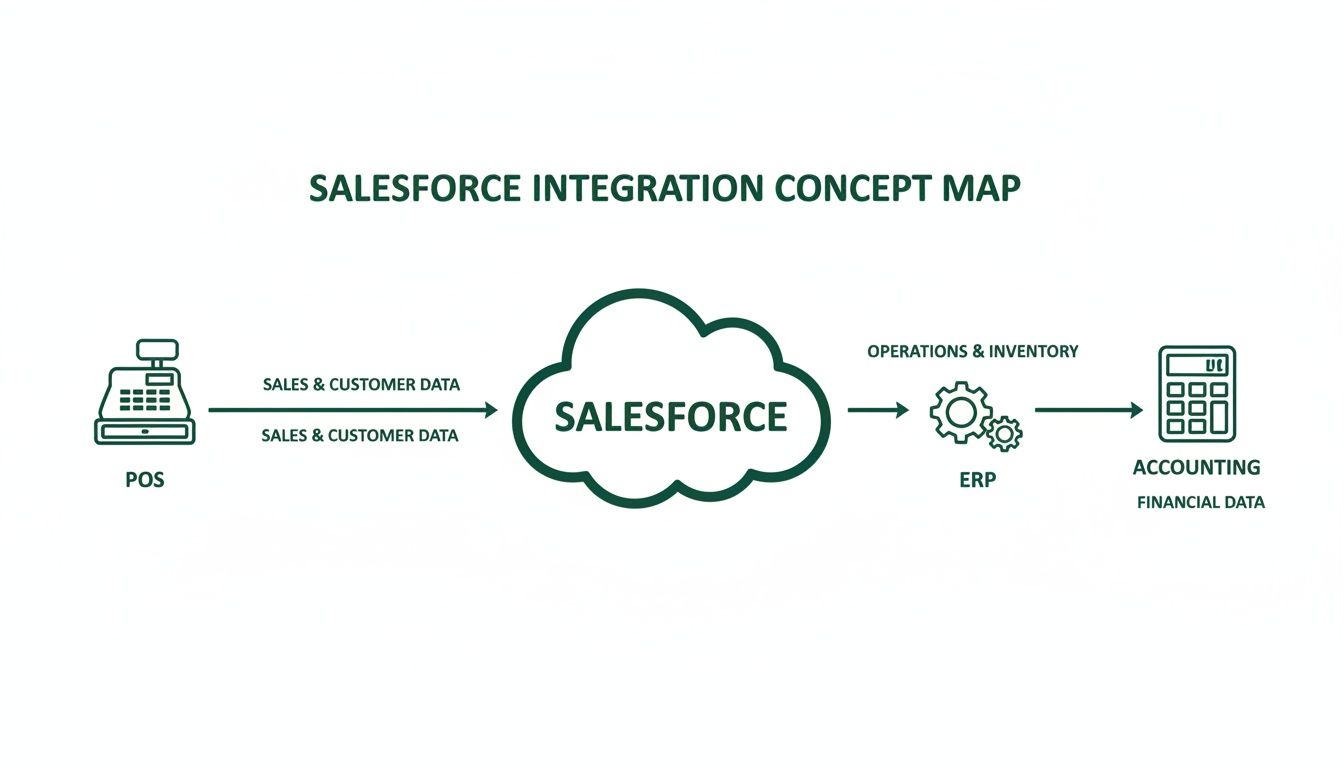
This integrated system breaks down data silos and provides a complete, unified view of your business.
Training and Ongoing Support
Technology is only as effective as the people who use it. We provide hands-on, role-based training to ensure your team feels confident and ready to adopt the new platform. Our partnership extends beyond launch, with ongoing support to help you adapt, grow, and continue to get the most value from your Salesforce investment.
If you're ready to start this journey and build your implementation roadmap, contact us for a consultation.
Salesforce for Retail & FMCG FAQ
Here are answers to common questions we hear from retail and FMCG businesses considering a Salesforce implementation.
Is Salesforce Too Expensive for a Medium-Sized Business?
This is a common misconception. Salesforce offers various editions and pricing models to fit different budgets and is designed to scale with your business. An experienced Salesforce partner ensures you start with the features you need most, focusing on a phased implementation that delivers a strong, immediate return on investment.
How Long Does a Salesforce Implementation Take?
The timeline depends on the complexity of the project. A straightforward Sales Cloud setup for a single team might take a few weeks. A more comprehensive implementation involving multiple clouds, customisations, and integrations with systems like your ERP could take three to six months. We begin every project with a detailed discovery process to create a realistic plan with clear milestones.
Can Salesforce Manage Relationships with Major Retailers?
Absolutely. This is a key strength for the retail and FMCG industry. Salesforce provides a central platform to track key contacts, manage trade promotions, and log every interaction with major accounts like Coles or Woolworths.
Salesforce provides a structured, complete view of each partnership, equipping your account managers with the full history they need to build stronger, more profitable relationships.
Is Salesforce Effective for a Mobile Sales Team?
Yes, it's a game-changer for field sales reps. The Salesforce mobile app allows your team to stay productive on the road. Reps can access customer histories, update opportunities in real-time, log visit notes, and generate quotes from their phone or tablet. This keeps them focused on selling and ensures your CRM data is always accurate, eliminating end-of-day administrative work.
Ready to see how Salesforce can be tailored to the unique demands of your retail or FMCG business? The team at Adaptal is a Salesforce partner specialising in practical, results-driven CRM solutions that power growth. Contact us for a no-obligation chat today.