
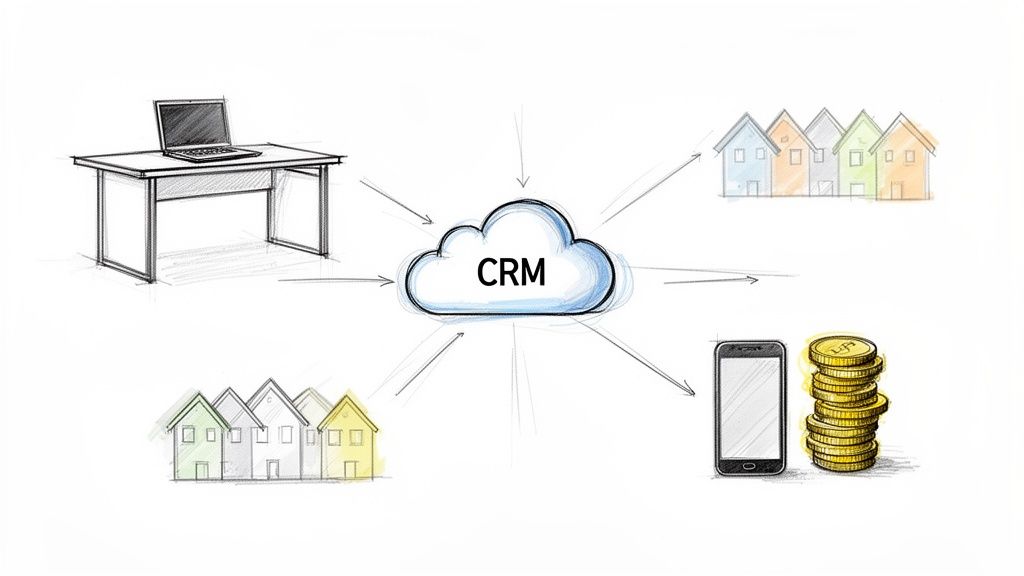
Running a modern real estate agency from a spreadsheet is like navigating Sydney with a paper map—it’s possible, but you’re missing out on a smarter, faster way. Australian agencies today face immense pressure to deliver a seamless, digital-first experience. Clients expect instant responses, personalised property suggestions, and transparent updates—demands that manual processes simply can’t meet.
This guide explores how moving from disjointed tools to a unified platform like Salesforce isn’t just an upgrade; it’s a fundamental business transformation. We’ll share insights from real-world projects, showing how the right real estate client management software solves common industry challenges and drives sustainable growth.
The Business Challenge: Why Disconnected Systems Are Holding Agencies Back

Consider the common scenario for a mid-sized agency: leads from Domain and REA get lost in email inboxes, follow-ups are inconsistent, and there’s no single view of a client’s history. The potential buyer you’re speaking with today might also be a future landlord or seller. Without a connected system, that valuable insight slips through the cracks, leading to missed opportunities and a fragmented client experience. This is a classic data silo problem that directly impacts revenue and reputation.
The Salesforce Solution: A Central Hub for Growth
This is where a powerful CRM like Salesforce becomes the central nervous system for a modern agency. It’s not just another app; it’s the single source of truth connecting every text, email, and inspection back to a client’s profile.
This shift is a key part of the industry’s digital transformation. The Australian real estate software market is projected to hit USD 557.7 million by 2030, with cloud-based CRM solutions leading this growth. Agencies are moving their core operations to the cloud to enhance efficiency and scale effectively.
As a Salesforce partner, we’ve seen how a well-implemented CRM takes an agency from being reactive to proactive. Instead of chasing missed calls and lost notes, agents can anticipate client needs, automate routine tasks, and focus on high-value activities: building relationships and closing deals.
Laying the Foundation for a Scalable Future
Implementing Salesforce is about more than gaining a competitive edge today; it’s about building a robust foundation for future growth. It empowers your agency to:
- Achieve a 360-Degree Client View: Track the entire client journey, from their first online enquiry to becoming a long-term property management client.
- Drive Efficiency with Automation: Systemise lead assignments, follow-up reminders, and marketing communications so no opportunity is missed.
- Deliver Exceptional Customer Experiences: Provide the fast, personalised service that modern clients expect, which is the key to building loyalty and generating referrals.
By centralising your data and processes, you build a resilient business ready for market shifts and evolving client expectations. To learn more, explore our guide on why Salesforce is the backbone of the modern real estate tech stack.
How Core Salesforce Features Solve Real Estate Challenges

Generic software often presents a long list of features, but in real estate, success comes from having the right tools that solve daily challenges. The true power of a platform like Salesforce isn’t just its features, but how it reshapes an agent’s workflow to be more efficient, insightful, and client-focused.
Imagine an agent’s day transformed. Instead of a chaotic inbox and a desk buried in notes, they start with a clean, personalised dashboard. This single screen highlights what matters: new leads from property portals, follow-up reminders for active buyers, and key dates for upcoming settlements. This is about moving from being merely organised to having actionable operational intelligence at a glance.
When a skilled Salesforce partner configures the platform for real estate, it becomes a powerhouse for managing client relationships and driving sales.
Centralised Lead and Contact Management with Salesforce
At the heart of any agency is its network. Salesforce consolidates every interaction with buyers, sellers, tenants, and landlords into one unified contact record. This provides a 360-degree view that is impossible to achieve with spreadsheets or disparate apps.
An agent can instantly access a contact’s complete history: properties they’ve viewed, feedback from inspections, and every email or text message exchanged. This deep context allows for genuinely personal conversations that build trust and demonstrate a true understanding of the client’s needs.
Use Case: A potential buyer attended an open house six months ago. When a similar property is listed, a Salesforce workflow automatically prompts the agent to reconnect, armed with the specific feedback from the previous viewing. This is how Salesforce helps you create opportunities, not just wait for them.
Visualising the Deal Pipeline with Opportunity Management
The journey from enquiry to settlement is complex. Salesforce’s Opportunity Management tools in Sales Cloud turn this process into a clear, visual pipeline. Agents can track every deal stage, from “Initial Contact” to “Property Appraisal,” “Contract Negotiation,” and “Settlement.”
This visual pipeline brings clarity to the entire business. Sales managers can identify bottlenecks, forecast revenue with greater accuracy, and analyse which lead sources deliver the highest value. It replaces guesswork with a data-driven sales strategy. For more on filling that pipeline, explore our strategies for real estate lead generation.
A Day in the Life: The Impact of Salesforce Automation
To see the difference, let’s follow an agent using a Salesforce-powered real estate client management software solution.
- Morning (9:00 AM): The agent logs in to find three new leads from REA.com.au automatically assigned via Salesforce. The system has already sent a branded welcome email and created a task reminding the agent to call them before midday. No lead is left behind.
- Mid-morning (11:00 AM): Immediately after a property viewing, the agent uses the Salesforce mobile app to log attendee details and feedback on the spot. This information can be instantly shared with the property owner through a secure portal built on Experience Cloud.
- Afternoon (2:00 PM): A contract goes unconditional. The agent updates the opportunity stage to “Sold.” This single click triggers an automated workflow: it notifies the finance team to prepare the invoice in their system, schedules a “congratulations” email for the buyer and seller, and updates the agency’s sales reports in real-time.
- End of Day (5:00 PM): The agent reviews their performance dashboard. They can see conversion rates, current pipeline value, and key activities for the week—all without manually creating a single report.
This level of intelligent automation removes administrative drag, freeing up agents to focus on revenue-generating activities. It ensures process consistency, prevents lead leakage, and creates a seamless client experience from end to end.
Salesforce vs. Niche Real Estate CRMs: A Strategic Choice
Choosing your real estate client management software is a critical decision that will shape your agency’s future. It’s a strategic fork in the road.
One path leads to specialised, off-the-shelf real estate CRMs promising a simple, plug-and-play experience. The other leads to a powerhouse platform like Salesforce, offering a foundation you can build your entire business on for years to come.
This isn’t just a feature comparison. It’s a choice between short-term convenience and long-term, scalable power. A niche CRM might seem easier today, but a platform approach prepares your business for where it will be in 5 or 10 years.
Scalability and Future-Proofing Your Growth
Niche CRMs are built for a specific purpose and market segment. They often excel at standard residential sales workflows out of the box.
But what happens when your agency diversifies into property management, commercial real estate, or franchising? That’s when the rigid structure of a niche tool can become a limitation.
Salesforce, however, is designed for infinite scalability. It adapts whether you’re adding 5 agents or 500, opening a new office, or launching a new service line. The platform grows with you, avoiding the disruptive and costly process of re-platforming down the road. For ambitious agencies, this flexibility is invaluable.
Customisation to Match Your Unique Processes
Your agency’s unique processes are your competitive advantage. While niche CRMs offer some configuration, they often force you to adapt your workflows to their software. This creates friction and limits innovation.
With Salesforce, you build a system that mirrors your business model. Every workflow, from lead assignment rules and commission tracking to complex settlement checklists, can be fully customised. The software serves your business, not the other way around.
Lesson Learned: The core difference is like buying a pre-built house versus designing a custom home. One is ready immediately but may not fit your future needs. The other is built precisely for how you operate and grow, becoming a far more valuable long-term asset.
To help you weigh the options, the table below breaks down the key considerations.
Platform Comparison: Salesforce vs. Niche Real Estate CRMs
| Consideration | Salesforce Platform | Niche Real Estate CRMs |
|---|---|---|
| Scalability | Virtually unlimited. Scales from a single agent to a global franchise without re-platforming. | Often limited. Can struggle with diversification (e.g., commercial, property management) or rapid team growth. |
| Customisation | Fully customisable. Workflows, data models, and UI can be tailored to your exact processes. | Limited configuration. You adapt to the software’s pre-defined workflows. |
| Integration | Massive ecosystem (AppExchange). Easily connects to thousands of apps (Xero, NetSuite, marketing tools). | Limited, pre-built integrations. Can create data silos if your other tools aren’t supported. |
| Initial Setup | Higher upfront investment in time and cost for custom configuration. Requires expert implementation. | Lower initial cost and faster setup. Designed for immediate, out-of-the-box use. |
| Long-Term ROI | Higher initial cost but lower total cost of ownership over time. Avoids costly migrations as you grow. | Lower initial cost, but you may face hidden fees for add-ons or a full migration when you outgrow it. |
| User Experience | Can be tailored to be incredibly simple and role-specific for agents, admin, and leadership. | Generally user-friendly for its core purpose, but can feel clunky for tasks outside its scope. |
Ultimately, the right choice depends on your vision. If you need a simple tool for today’s needs, a niche CRM can work. But if you’re building a scalable asset for tomorrow, a platform like Salesforce provides the foundation you won’t outgrow.
The Power of the Salesforce Integration Ecosystem
A modern agency relies on a tech stack—accounting software, marketing automation, property portals, and more. Niche CRMs may offer a few integrations, but they often operate in a closed ecosystem, making it difficult to achieve a truly connected business.
This is where Salesforce excels. Its AppExchange is a massive marketplace of pre-built integrations. Connecting to systems like Xero, MYOB, or NetSuite is a standard procedure. This creates a single source of truth for your entire operation, eliminating data silos and automating cross-departmental workflows. Reviewing guides on the best CRM for real estate teams often highlights Salesforce’s superior integration capabilities.
Long-Term Value and Total Cost of Ownership
While the initial setup for a tailored Salesforce solution may be higher than an off-the-shelf product, the total cost of ownership often tells a different story.
With niche CRMs, you can face additional costs for essential add-ons or, worse, a disruptive and expensive migration project when you inevitably outgrow the system.
Investing in Salesforce is an investment in a long-term business asset. As an expert Salesforce partner, we design solutions that not only solve today’s problems but also provide a solid foundation for sustainable growth. For a deeper dive, explore our overview of CRM software for real estate agents.
Case Study: Creating a 360-Degree View with Salesforce Integration
Your real estate client management software becomes truly transformative when connected to other critical systems. Operational excellence is achieved when information flows seamlessly across your agency—from marketing and sales through to finance and operations.
Disconnected systems create data silos, leading to manual double-entry, delays, and a fragmented business view. When your CRM doesn’t talk to your accounting package, tracking agent commissions becomes a spreadsheet nightmare. When sales data is separate from your ERP system, forecasting is pure guesswork.
As a Salesforce partner, we’ve seen firsthand how breaking down these silos unlocks incredible efficiency. Let’s walk through a common project scenario.
The Business Challenge: From Disconnected Data to a Single Source of Truth
A rapidly growing property development group was using Salesforce Sales Cloud effectively for their sales pipeline, but their finance team operated on NetSuite, a separate ERP system. This disconnect created significant operational friction. When the sales team closed a deal, the finance team had to manually re-enter contract details, payment schedules, and client information into NetSuite to handle invoicing.
This manual process was slow and prone to errors that could delay settlements and impact cash flow. Leadership also lacked a real-time, unified view of business performance, constantly trying to stitch together reports from two different systems.
The Salesforce Solution: A Robust Two-Way Integration
Our solution was to build a robust, two-way integration between Salesforce and NetSuite.
- Automated Data Sync: When a sales opportunity in Salesforce was marked as “Closed Won,” the integration automatically created a corresponding sales order and customer record in NetSuite. All necessary data was transferred without manual intervention.
- Financial Visibility in the CRM: Key financial data from NetSuite, such as invoice statuses and payment receipts, was synchronized back to the client’s account in Salesforce. This gave the sales team a complete view of the deal’s financial status, enabling them to answer client queries without chasing the accounts department.
The Result: This integration created a customer single source of truth. Both sales and finance teams worked from the same accurate information, eliminating errors and providing decision-makers with a complete, real-time picture of the business.
Why Integration is a Core Part of Digital Transformation
This level of system integration is now standard practice. The Australian software development market is projected to hit USD 17.15 billion by 2033, driven largely by the need to connect specialised systems like CRMs with core ERP and accounting platforms. You can explore more about the growth of the Australian software market on IMARC Group.
Common Salesforce Integrations for Real Estate Agencies
Beyond large-scale ERP projects, we frequently help agencies integrate Salesforce with other essential tools:
- Accounting Systems (Xero, MYOB): Automate invoice creation upon settlement and streamline the calculation and payment of agent commissions.
- Marketing Automation (Account Engagement/Pardot): Ensure marketing leads flow directly into Salesforce for immediate follow-up and track the full client journey from first click to final sale.
- Property Portals (Domain, REA): Automatically capture enquiries from property listings as new leads in Salesforce, ensuring no opportunity is missed.
Strategically connecting these systems builds a powerful, automated ecosystem. Learn more in our detailed guide to creating a customer single view. Executing these complex integration projects is a core part of what we do as a Salesforce partner, transforming your CRM into the central engine for your entire business.
Your Salesforce Implementation Roadmap with a Trusted Partner
Successfully implementing a powerful real estate client management software solution is more than just buying a license—it’s a carefully managed digital transformation. A clear, structured process is what separates a smooth launch that delivers immediate value from a frustrating project that creates more problems than it solves.
As a dedicated Salesforce partner, we guide agencies through a proven methodology designed to deliver results and remove guesswork.
Our approach breaks the project down into distinct, logical phases, ensuring your team is supported from the initial concept through to post-launch optimization. This ensures the final solution is a perfect fit for your agency’s unique operations.
This process connects your key business functions, creating a seamless flow from marketing engagement, through client management in the CRM, and into your financial systems.
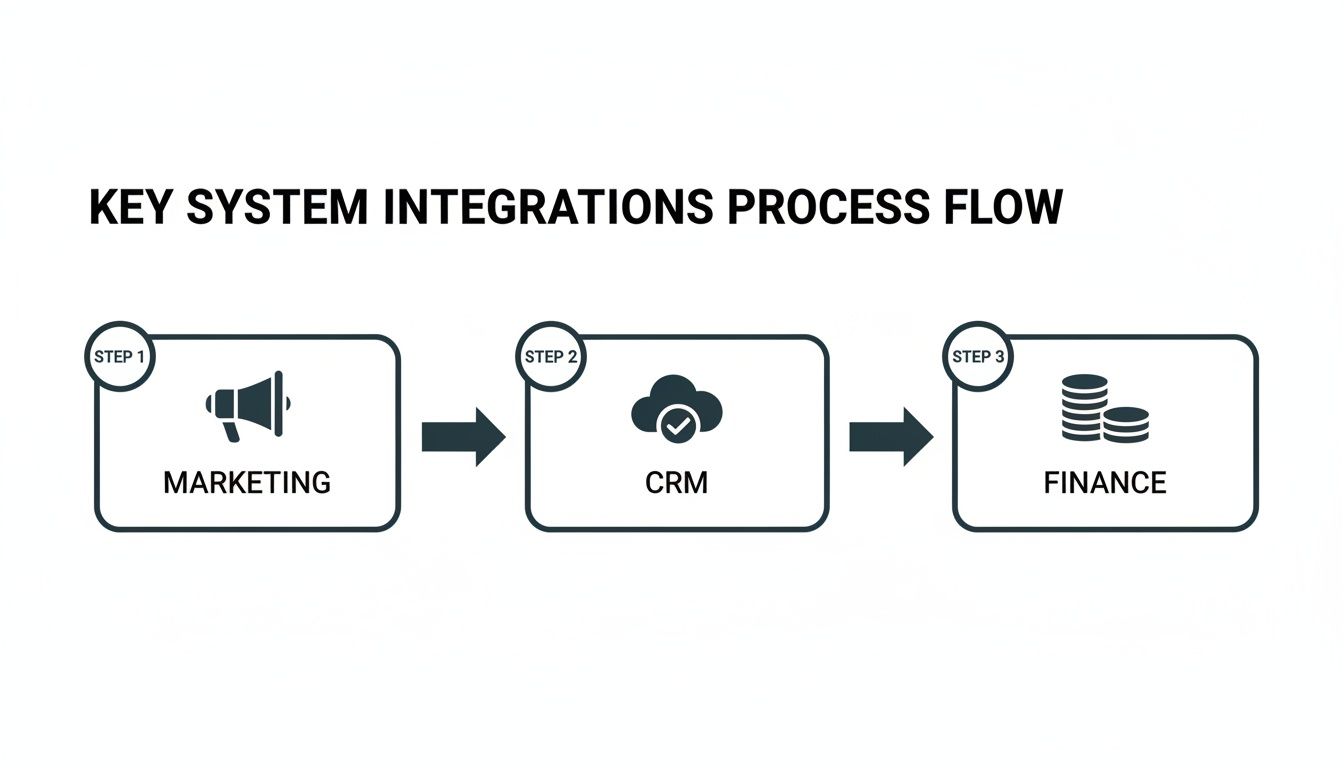
This flow illustrates how an integrated Salesforce setup creates a single, automated pipeline for your client data, breaking down the traditional walls between departments.
Our Proven 5-Step Implementation Process
Our roadmap is designed to ensure nothing is left to chance. We combine deep technical expertise with a genuine understanding of the real estate industry to build a Salesforce solution that works for you from day one.
- Discovery and Requirements Gathering: We start by listening. This crucial phase involves sitting down with your team to understand your current workflows, pain points, and business goals. We map everything from lead handling to commission calculations.
- System Design and Customisation: Armed with these insights, our architects design a bespoke Salesforce solution. This isn’t a one-size-fits-all setup. We customise objects, fields, and workflows to mirror your specific processes, ensuring the platform feels intuitive for your agents.
- Data Migration: Your existing client data is a valuable asset. We manage the complex process of securely extracting, cleaning, and migrating your data from old spreadsheets or legacy CRMs into Salesforce, establishing one clean, accurate source of truth.
- User Training and Onboarding: A new tool is only as good as the team using it. We provide comprehensive, role-specific training to ensure your agents, admins, and leadership are confident and ready to leverage the new platform effectively.
- Go-Live and Ongoing Support: Launch day is just the beginning. We provide dedicated support during the transition to resolve any immediate issues. Afterward, we offer ongoing managed services to help you continuously optimise and maximise your Salesforce investment.
Mini Case Study: Unifying a National Franchise with Salesforce
We recently partnered with a national real estate franchise struggling with inconsistent data across its branches. Each office used its own system, making it impossible for the head office to get a clear view of the sales pipeline or agent performance. Reporting was a manual and time-consuming task.
The Solution & Result: Following our structured roadmap, we implemented a single, unified Salesforce Sales Cloud solution across all locations. We built custom dashboards for franchise-level reporting and automated lead distribution rules to ensure timely and fair follow-up. The result was a genuine 360-degree view of the entire business. Management gained real-time performance data, and agents had a standardised, efficient system for client management, enabling the franchise to scale with confidence.
Calculating the Return on Your Salesforce Investment
Investing in a powerful new CRM is a significant business decision. The primary question is always, “What’s the ROI?” Building the business case for a real estate client management software solution on Salesforce goes beyond the initial cost. It involves understanding the total value—both tangible and intangible—that it brings to your agency.
View it not as an expense, but as an investment in a revenue-generating asset designed to grow with your business.
Measuring the Tangible ROI
These are the direct financial gains and cost savings that appear on a balance sheet. For a real estate firm, these benefits are clear.
- Increased Agent Productivity: By automating repetitive tasks like lead follow-ups, data entry, and reporting, agents regain significant portions of their day. Studies show sales reps can spend up to 66% of their time on non-revenue-generating activities. Salesforce automation gives that time back, allowing them to focus on building relationships and closing deals.
- Improved Lead Conversion Rates: A structured sales process in Salesforce ensures no opportunity falls through the cracks. Automated lead nurturing and systematic follow-ups consistently lead to higher conversion rates. Even a small increase in conversions can significantly boost gross commission income.
- Reduced Administrative Overhead: A single source of truth and automated workflows reduce manual administrative work. This not only cuts down on errors and eliminates duplicate tasks but can also lower the headcount required to manage disparate systems.
For a deeper look at evaluating new technology, this guide on the ROI calculation for software investments offers a valuable framework.
The Impact of Intangible Benefits
While harder to quantify, intangible benefits are crucial for the long-term health and growth of your agency. They often have the most significant impact on your bottom line over time.
Our Insight: The real magic of a platform like Salesforce lies in its ability to transform the client experience. This creates a powerful ripple effect, enhancing your brand’s reputation and fuelling referral business—the most cost-effective form of marketing for any agency.
These critical returns include:
- Enhanced Client Satisfaction: A seamless, professional experience builds trust and loyalty. Satisfied clients provide positive reviews, return for future transactions, and refer friends and family.
- A Stronger Brand Reputation: Consistent and professional client interactions cement your agency’s reputation as a market leader.
- Data-Driven Strategic Decisions: With clean, centralised data, your leadership team gains a clear, real-time view of business performance. This improves forecasting accuracy and helps you make informed decisions about where to allocate marketing budgets and resources for maximum impact.
When you consider the full picture, a well-implemented Salesforce solution ceases to be a cost centre. It becomes the engine that powers scalable, sustainable growth for your agency.
FAQs: Salesforce for Real Estate Client Management
As you consider your options, you likely have questions. Here are our answers to the most common queries we hear from real estate agencies evaluating Salesforce.
Is Salesforce too complex for a small real estate agency?
Not when it’s configured correctly by an experienced Salesforce partner. Salesforce is an incredibly powerful platform, but its strength lies in its flexibility. A good implementation partner will tailor the system to your specific needs, creating a clean, simple interface that hides unnecessary complexity. The goal is to make the system fit your business, not the other way around. For a smaller agency, this typically means focusing on core functionalities—lead tracking, contact management, and pipeline visibility—to deliver immediate value without overwhelming your team.
How long does a typical Salesforce implementation take for a real estate business?
The timeline varies with complexity, but it’s always a structured process. For a small to medium-sized agency implementing core Sales Cloud features, a typical project timeline is between four to eight weeks. More complex projects involving multiple business units (e.g., sales, rentals, commercial) or deep integrations with accounting systems like Xero or NetSuite will extend the timeline. We always provide a clear project roadmap with defined milestones to ensure a smooth and predictable rollout.
Can we migrate our existing client data into Salesforce?
Absolutely—this is a critical and non-negotiable step in any successful CRM implementation. Your client lists, property records, and interaction history are among your most valuable assets. Moving this data from old spreadsheets or a legacy CRM is a core part of the process. Our implementation projects include a dedicated data migration phase where we manage the entire process: extracting data from your current systems, cleaning and de-duplicating it to ensure quality, mapping it to the new fields in Salesforce, and importing it securely. This ensures a seamless transition and provides your team with a single source of truth from day one.
Ready to see how a Salesforce solution, configured by a trusted partner, can transform your agency’s operations? The team at Adaptal specialises in implementing Salesforce for the unique demands of the Australian real estate market. Get in touch for a no-obligation chat and let’s start building the platform for your future growth.