

Are you staring at a jumble of marketing tools and confusing data, wondering how to connect it all? You’re not alone. This is where marketing and technology intersect—not as two separate departments, but as a single, powerful engine for your business growth. It's about strategically fusing smart marketing principles with the right CRM platform to genuinely connect with customers and achieve measurable results.
The New Engine For Business Growth
This guide is designed to demystify 'Martech' for Australian SMBs. We're cutting through the buzzwords to show you how a cohesive strategy, built around Salesforce, can turn chaotic, disconnected efforts into a predictable revenue stream. Think of it like a high-performance race car: every single component, from the engine (your CRM) to the navigation system (your analytics), has to work in perfect sync to win the race.
This is exactly where Salesforce comes in. As your trusted Salesforce partner, we've seen firsthand how it acts as the central chassis of your race car, uniting all your tools and data into one streamlined system. The result? Smarter decisions, enhanced digital transformation, and a winning customer experience that leaves the competition in the dust.

Unifying Your Marketing Efforts with Salesforce CRM
In business, crossing the finish line isn't just about speed. It's about precision, endurance, and flawless coordination. A random collection of marketing tools is like a race car built with mismatched parts—sure, it might move, but it will never perform at its peak. Each tool spits out its own data, creating frustrating information silos that hide the true picture of your customer.
The real challenge for most businesses isn't a lack of data; it's the inability to connect all that data into a single, actionable view of the customer journey. This is the exact problem a unified marketing and technology strategy, powered by Salesforce, solves.
A truly cohesive system ensures insights from your email campaigns directly inform your social media strategy. It means data from customer service interactions helps personalise your sales team's outreach. This level of integration isn't a 'nice-to-have' anymore; it's fundamental. A modern multi-channel marketing strategy is absolutely essential for any business serious about getting the most from its customer engagement.
How Salesforce Provides the Chassis for Success
Salesforce provides the framework—the chassis—that brings all these moving parts together into a high-performance machine. It becomes your single source of truth, giving every department, from sales and marketing to service, access to the same up-to-date customer information.
This unified platform lets you:
- Automate Customer Journeys: Use tools like Marketing Cloud Account Engagement to guide prospects from awareness to loyalty with automated, personalised communications.
- Gain Deeper Insights: Understand what’s working with comprehensive analytics that connect your marketing spend directly to revenue in Sales Cloud.
- Deliver Personalised Experiences: Use rich customer data to tailor every single touchpoint, making your customers feel genuinely understood and valued.
By building your marketing & technology stack on a robust CRM platform like Salesforce, you’re not just buying another piece of software. You’re investing in a cloud solution engineered for growth. To get a closer look at the tools that power this engine, explore our overview of the technology and services we implement for businesses like yours.
Why a Salesforce Martech Strategy is Crucial for SMBs
For many Australian small and medium-sized businesses, marketing can feel like shouting into the void. Your customers are everywhere online, expecting a personal touch, while competitors get smarter with their tech. Trying to keep up with a patchwork of disconnected marketing tools just isn't cutting it anymore.
This is where a cohesive marketing & technology strategy, centered on Salesforce, becomes a genuine game-changer. It’s not just about buying software; it's about making all your tools talk to each other and work as one well-oiled machine. When our clients get this right, they solve some of the most persistent headaches that hold SMBs back.
Breaking Down Business-Critical Data Silos
The biggest hurdle for most growing businesses? Data silos. The challenge is classic: your email platform knows one thing, your accounting software knows another, and your sales team’s spreadsheets are a different world. This makes it impossible to see the full picture of who your customer is.
When you can't get a single source of truth, you're essentially flying blind. You can't track a customer's journey from their first website visit through to their latest support ticket. The result is a clunky customer experience, missed sales opportunities, and the inability to prove which marketing campaigns are actually making you money.
A unified martech strategy, built on a central CRM like Salesforce, is the sledgehammer that demolishes these data silos. It gets every department working from the same playbook, with the same up-to-the-minute customer information.
By connecting your marketing, sales, and service data on the Salesforce platform, you finally get that elusive 360-degree customer view. Your business can shift from being reactive to proactive, and marketing transforms from a cost centre into a predictable and measurable growth engine. Our guide on finding the best CRM for a small business dives deeper into how this foundational tool can make all the difference.
Meeting Customers Where They Are
Let's be real, the Australian market is plugged in. In 2025, over 91% of the population is online, a number that screams just how vital digital channels have become. At the same time, businesses are set to pour a staggering AU$7.5 billion into social media advertising this year alone. They're putting their money where the eyeballs are. You can dig into the numbers yourself with these full marketing statistics for Australia.
This digital-first reality makes a cohesive, Salesforce-powered strategy non-negotiable for a few key reasons:
- Personalisation at Scale: Your customers expect you to remember them. A connected system lets you automate personal touches, so you can scale up without losing that human connection.
- Efficiency and Automation: Think of all the hours wasted exporting and importing lists. A unified stack kills that dead, freeing up your team to focus on strategy and growth.
- Proving Marketing ROI: This is the big one. When your systems are connected, you can finally draw a straight line from a specific marketing campaign to a closed deal in Sales Cloud. That clarity lets you confidently double down on what works, making every dollar work harder.
At the end of the day, a cohesive approach to marketing & technology is how you deliver the seamless, smart, and personal experiences that modern Australian consumers expect. It's the key to building real relationships and driving sustainable growth for your business.
Building Your Martech Stack Around Salesforce
So, you're ready to build a martech stack that actually works together? Let's start with Salesforce as the foundation. Think of it as the central nervous system for your entire business, connecting every part of the customer journey—from the first click to the final sale and beyond. As an experienced Salesforce partner, we know a well-designed stack isn't about having the most tools; it’s about making them work in perfect harmony.
This approach gives you a practical blueprint for creating a seamless flow of information. By organising your marketing & technology efforts around a single, powerful CRM core, you eliminate the guesswork and give your teams the data they need to make smart, confident decisions.
The diagram below highlights the exact challenges that a unified stack is designed to solve.
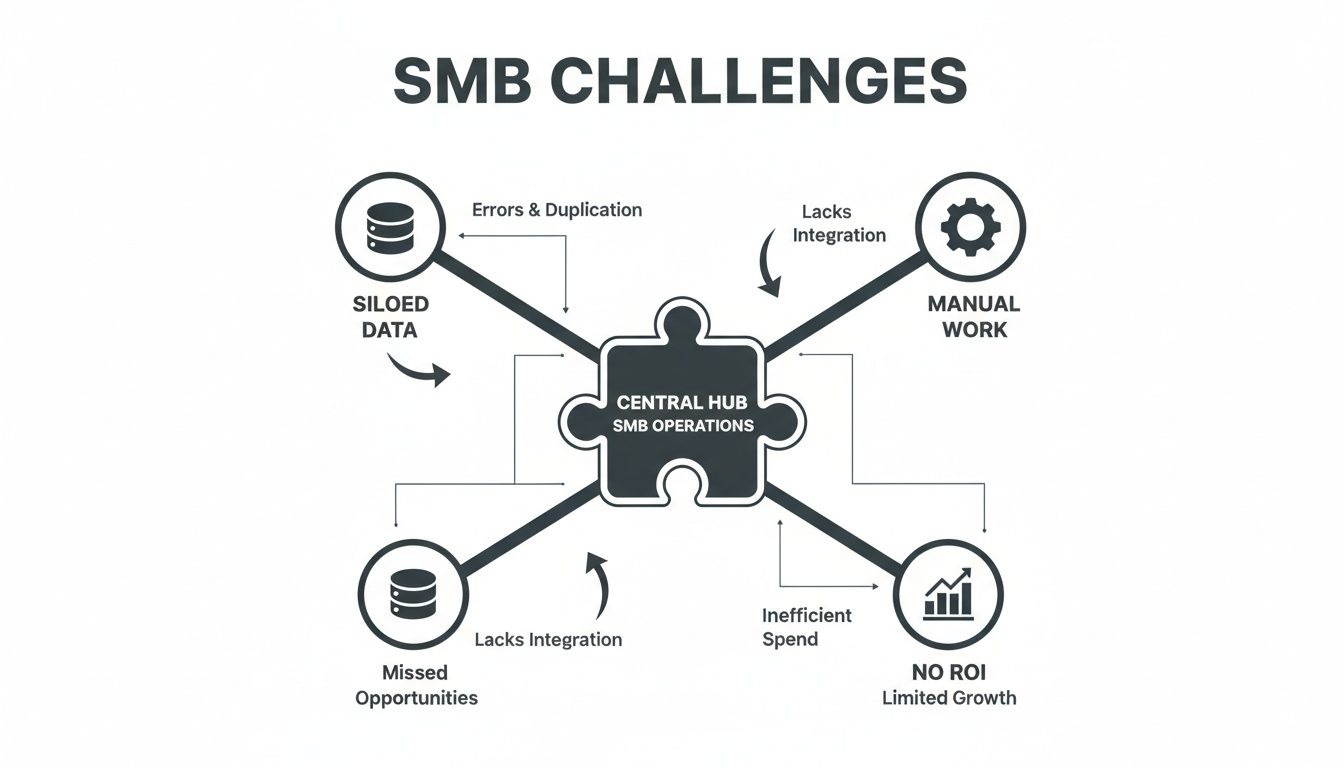
As you can see, siloed data, endless manual work, and a fuzzy sense of ROI are the main roadblocks holding businesses back. A Salesforce-centric stack tackles these issues head-on by creating one single source of truth for everyone.
The Core Salesforce Components for a 360-Degree View
To build that elusive 360-degree customer view, you need to connect your marketing automation with your core customer relationship management (CRM) data. This is where the different Salesforce Clouds come together to form a powerful, integrated system.
The challenge we often solve for clients is capturing valuable customer interaction data and making it available to every team that needs it, right when they need it. This simple shift breaks down the fragmented data points that stop you from seeing the complete customer lifecycle, turning isolated interactions into a coherent story about each customer.
By placing Salesforce at the centre of your marketing and technology ecosystem, you’re not just collecting data—you're creating a shared intelligence that drives better marketing, smarter sales, and more responsive customer service.
This unified approach ensures that insights gathered in one part of the business are immediately used to improve performance in another. It’s the key to turning raw data into real, actionable intelligence.
How Salesforce Products Work Together
Let’s walk through a practical example of how these different components connect to create a seamless customer experience. This isn't just theory; it's a proven model we’ve implemented for businesses across Australia, solving the common disconnect between marketing, sales, and service.
The table below shows how different Salesforce Clouds address specific business challenges that Australian SMBs face every day.
Mapping Business Challenges to Salesforce Solutions
| Business Challenge | Primary Salesforce Solution | Key Benefit |
|---|---|---|
| Inconsistent lead nurturing and follow-up | Marketing Cloud Account Engagement | Automates personalised communication to guide leads through the sales funnel, ensuring no opportunity is missed. |
| Sales team lacks context on lead history | Sales Cloud | Provides a complete view of a lead's interactions (emails opened, pages visited) directly on their record. |
| Disconnected post-sale customer support | Service Cloud | Manages all support interactions in one place, giving agents full context to resolve issues faster. |
| Fragmented customer journey across channels | Experience Cloud | Creates branded portals and communities, offering customers a self-service hub for information and support. |
This mapping isn't just about plugging in technology; it's about building a system where each part supports the others, creating a virtuous cycle of information that benefits every department.
Here’s how that interconnected flow works in practice:
- Marketing Cloud & Account Engagement: These are your lead generation and nurturing engines. They automate email campaigns, track website visitor behaviour, and score leads, ensuring your sales team only gets the most qualified prospects.
- Sales Cloud: This is where the baton is passed from marketing to sales. All the rich data gathered by Marketing Cloud is visible right on their contact record in Sales Cloud, empowering sales reps to have far more relevant conversations.
- Service Cloud: After a deal is closed, the journey continues with Service Cloud. This platform manages all post-sale interactions, from support tickets to feedback. This information is crucial for identifying opportunities for upselling or understanding potential issues.
This interconnected flow ensures every department is on the same page. A service agent can see a customer's entire purchase history, and a marketer can see which products are generating the most support tickets. For a deeper dive into how these tools fit into a broader strategy, discover how we approach Salesforce for marketers.
Ultimately, this integration transforms your business. It breaks down the traditional barriers between departments and fosters a culture of collaboration built around a single, shared view of the customer. The result? A more efficient business and a far superior customer experience.
Supercharging Your Strategy with AI
Artificial Intelligence isn't a far-off concept anymore; it’s a powerful and practical tool that Australian SMBs can leverage right now. AI is the key that unlocks the real value in your marketing & technology investment, turning raw data into sharp predictions and automated actions that grow your business.
In the Salesforce ecosystem, AI is Salesforce Einstein. The best way to picture Einstein is as a dedicated data scientist on your team, always working behind the scenes. It sifts through customer information, spots patterns, and flags opportunities you would otherwise miss. It’s the difference between reacting to what’s already happened and getting ahead of what’s coming next.
This is about more than just working faster; it's about working smarter. Imagine automatically scoring every new lead on how likely they are to convert, so your sales team can zero in on the hottest prospects. That's the power of AI in action.
From Data Overload to Actionable Insights with Salesforce Einstein
One of the biggest headaches for any growing business is making sense of the mountains of data you collect. Without AI, that data is just untapped potential. Salesforce Einstein flips this script by making sophisticated analytics accessible to everyone.
The true value of AI in a martech stack isn't just processing data faster; it's about asking smarter questions. It finds the "why" behind customer behaviour, giving you the clarity to make better strategic decisions.
We saw this firsthand with an Australian services firm we partnered with. The business challenge was a decent flow of leads but battling low conversion rates. Their team was treating every lead the same, burning precious time.
The Salesforce solution we implemented used Einstein to:
- Implement Predictive Lead Scoring: Einstein analysed their historical data to identify the traits of leads that became customers. It then automatically scored every new lead, showing the sales team exactly who to call first.
- Automate Personalised Journeys: The firm used AI insights to build out automated, multi-step campaigns in Marketing Cloud, nurturing leads more effectively over time.
- Optimise Campaign Performance: AI provided recommendations on the best content and channels for different customer segments, improving marketing ROI.
Making AI Practical for Your Business
The results were significant. Within six months, the firm saw a 25% increase in lead conversion rates and a 15% boost in overall operational efficiency. This project is a real-world example of how AI delivers measurable business benefits. If you want to get into the nitty-gritty of putting artificial intelligence to work in your own marketing, check out this practical guide on how to use AI in marketing.
This shift is happening fast. Australian marketing businesses are ahead of the curve, with a massive 91% already using AI. This is backed up by the 87% of marketers who say AI is crucial to their work, cementing its place at the heart of modern business.
Platforms like Salesforce are making this technology easier to adopt than ever. When you connect all your customer data using a tool like the Salesforce Data Cloud, you're creating the perfect foundation for AI to do its best work. It gives Einstein a rich, unified set of data to learn from, leading to more accurate predictions and smarter automation.
Integrating Salesforce with Your Existing Business Tools
A powerful martech stack isn't measured by how many shiny tools you have—it’s about how well they talk to each other. This is where many businesses stumble; they invest in fantastic software, but each piece operates in its own world. The real magic, the secret to a standout customer experience, happens when you get every system speaking the same language through integration.
This means making Salesforce your central hub, the single source of truth connecting everything from your accounting software to your e-commerce platform. Think of it less like a collection of apps and more like a unified data network for your entire business.
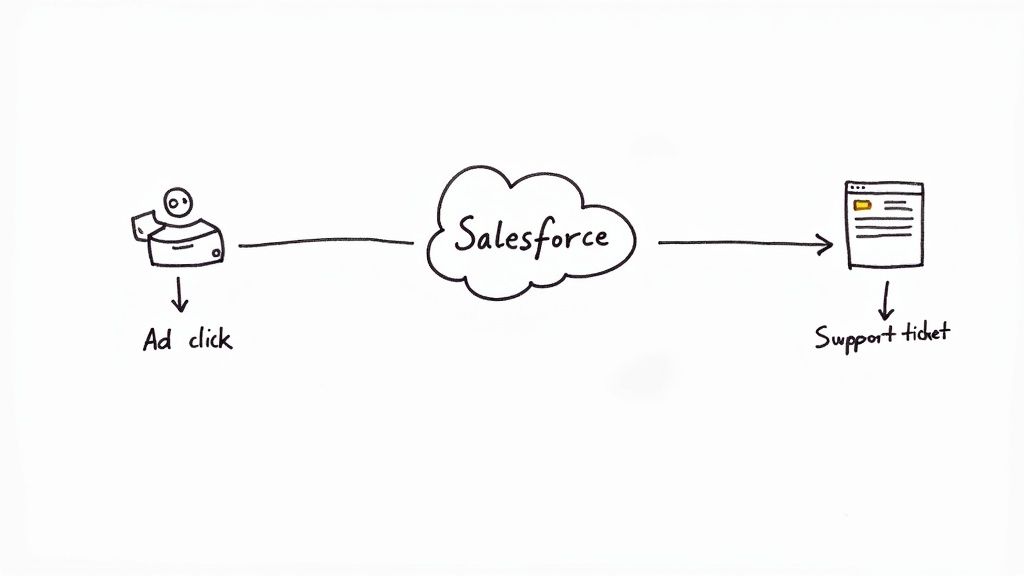
The ultimate goal here is to completely demolish data silos. When information flows freely, you can create a consistent and genuinely personal journey for every single customer, from their first ad click right through to a post-purchase support ticket. This is how you build the kind of trust and loyalty that drives long-term business value.
Why Integration Is Non-Negotiable for Digital Transformation
Let’s be honest: disconnected systems create a clumsy and frustrating experience for customers. When your marketing team is blind to sales data, or your service agents have no clue about a customer's purchase history, everyone is flying half-blind. This gap doesn't just feel unprofessional; it leads to missed opportunities and seriously inefficient workflows.
True integration means every scrap of customer data is available to every team, right when they need it most. It’s about building a business where information isn’t just hoarded—it’s actively shared and used to make smarter decisions.
A fully connected system lets you:
- Trace ROI with pinpoint accuracy: Finally see exactly how a marketing campaign led to a sale recorded in Sales Cloud.
- Personalise at scale: Use a customer's complete history—purchases, support chats, website behaviour—to tailor every future interaction.
- Boost team efficiency: Automate the mundane flow of data between systems, freeing your team from manual data entry.
The Salesforce Integration Ecosystem
Salesforce was built from the ground up to be the heart of your business operations. It provides not just powerful native tools, but also a huge marketplace of apps designed to connect your entire technology stack.
Integrating your tools isn't just a technical box to tick; it's a strategic necessity. It's the groundwork you need to lay to transform a bunch of disconnected activities into a single, cohesive growth engine.
This connectivity is what separates the businesses that are just using digital tools from those that are digitally mature. In Australia, 90% of businesses have dipped their toes in digitalisation, but only 18% have reached full maturity. For those that make the leap, 86% report significant productivity jumps. The most successful companies are the ones that integrate systems seamlessly, a key insight from recent market outlooks. You can find more detail on adtech market trends on grandviewresearch.com.
A Practical Case Study in Connectivity
Let’s walk through a real-world example we implemented for a professional services firm. Their business challenge was classic: website contact forms were dumping leads into one system, billing was handled over in Xero, and client project management was happening somewhere else entirely. It was a recipe for chaos.
The Salesforce solution we designed used the platform as the central connector:
- Lead to Client: We integrated their website forms directly with Salesforce Sales Cloud. Any new enquiry automatically created a lead record and assigned follow-up tasks to the right person. No more leads falling through the cracks.
- Sale to Invoice: The moment a deal was marked 'Won' in Salesforce, our integration with Xero automatically generated a new customer profile and fired off the initial invoice, eliminating manual data entry.
- Client to Project: That same 'Won' deal also triggered the creation of a new project in their management tool, pre-populating it with all relevant client details straight from Salesforce.
The result of this connected workflow wasn't just a smoother journey for their new customer; it saved the firm countless hours of administrative headaches. It’s a perfect example of how a well-integrated approach to marketing & technology delivers real, tangible business results.
Moving From Strategy to Salesforce Implementation
You understand the theory. The real question is: how do you actually make it happen? This is where we lay out a clear path for SMBs ready to build a proper strategy around Salesforce and kickstart their growth. Bringing a powerful platform like Salesforce into your business needs real expertise, and finding the right partner to guide you is everything.
A great implementation is more than just installing new software. Think of it as a strategic project that begins with a deep dive into your unique business challenges. This is how you ensure your investment in technology delivers tangible, measurable results.
Finding the Right Salesforce Implementation Partner
Choosing a Salesforce partner is one of the most important decisions you'll make. You’re not just hiring a technical team. You're bringing on a strategic guide who understands both the technology and your industry. A seasoned partner helps you sidestep common pitfalls and achieve a faster return on investment.
When you're evaluating a potential partner, here's what to look for:
- Proven Project Experience: Have they done this before? They should have a solid portfolio of successful Salesforce implementations for businesses like yours. Ask for case studies and client references.
- A Strategic Approach: The first conversation should be about your business goals, not technical features. A good partner wants to understand your challenges before proposing a solution.
- Local Presence and Support: Working with an Australian-based partner like Adaptal is a huge advantage. You get support from people who understand the local market and work in your time zone.
A Phased Approach to Success
Rolling out your Salesforce strategy needs to be a structured process. A methodical approach ensures the final system is perfectly tuned to your business needs. While no two projects are identical, a proven methodology generally involves auditing your needs, designing the right architecture, and ensuring the investment pays off.
The whole point is to move from a plan on paper to confident, real-world execution. A step-by-step process, guided by an expert partner, takes the guesswork out of it and sets you up for scalable, long-term growth.
This journey completely reshapes how you handle your marketing & technology. It takes you from a messy collection of disconnected tools to a single, unified system built for efficiency and incredible customer engagement. Your path to scalable growth starts right here, and our team is ready to walk it with you.
Frequently Asked Questions About Marketing & Technology
Stepping into the world of marketing technology can feel like a lot, especially when you're busy running your business. It's only natural to have questions. Here are some straightforward answers to the things we hear most often from Australian businesses just like yours.
Where Do I Even Start with Salesforce and Martech?
The absolute first step is to map out your customer's journey and take a hard look at your own internal processes. You need to get crystal clear on where the real operational headaches are, where your data is currently scattered, and what you’re trying to achieve.
This is where a Salesforce partner becomes invaluable. We jump in during this discovery phase to help connect your specific business needs to the right Salesforce products and the right setup. It’s all about making sure the technology serves your strategy, not forcing your strategy to fit the tech.
How Does Salesforce Actually Improve Marketing ROI?
In short, Salesforce boosts your return on investment (ROI) by giving you a single, complete picture of every single customer. This lets you run highly targeted, personalised campaigns that just plain work better because they’re genuinely relevant.
Its powerful analytics and reporting tools mean you can track performance from the first lead right through to the final sale, clearly showing which marketing efforts brought in the cash.
This is a game-changer. You can finally stop guessing where your marketing budget is making a difference. Instead, you can confidently double down on the channels and strategies you know are delivering real, measurable results for your business.
Can Salesforce Connect with the Tools We Already Use?
Absolutely. One of Salesforce’s biggest strengths is that it’s built to be an open and flexible platform. It has a massive marketplace of third-party apps on the AppExchange and powerful APIs that allow for custom connections to pretty much any system you can think of.
A crucial part of any successful implementation is linking Salesforce to your other essential software—whether that’s accounting platforms like Xero or MYOB, your ERP, or other industry-specific tools. This is how you break down the data silos that are holding your business back, creating one source of truth that empowers your whole team.
Ready to build a connected marketing & technology strategy that drives real growth? The team at Adaptal specialises in designing and implementing Salesforce solutions that are built for your specific business needs. Contact us today for a consultation and let's discuss how we can help you get the most out of your technology investment.