

Picture your business as a high-performance race car. Marketing is the fuel, and technology is the engine. When they work in sync, you fly past the competition. When they don’t, you’re left sputtering at the starting line, burning through resources and falling behind.
For many Australian SMEs, implementing the right marketing and technology strategy feels like a constant struggle. This disconnect between marketing efforts and the underlying technology creates frustrating roadblocks to growth, from inconsistent customer data to an inability to prove marketing ROI. The solution isn’t just buying more software; it’s about building an integrated system with a strong, central core—a challenge we, as a Salesforce partner, help businesses solve every day.
Connecting Your Marketing and Technology Engine with Salesforce
For a lot of Australian SMEs, the link between marketing and technology feels broken. You might have powerful tools, but if they operate in isolation, they just create frustrating roadblocks to growth. This disconnect usually shows up as inconsistent customer data, clunky lead generation processes, and a complete inability to prove your marketing return on investment (ROI).
The answer isn’t just to buy more software; it’s about building an integrated system with a strong, central core. This is where MarTech—the essential fusion of marketing and technology—becomes your secret weapon, and where Salesforce often provides the ideal foundation.
The Business Challenge: Overcoming Common Growth Roadblocks
Without a unified strategy, businesses bump into the same old predictable challenges that stunt their growth. From our experience in over 110 Salesforce projects, these aren’t unique issues; they’re symptoms of a disconnected engine. The key problems usually boil down to:
- Disjointed Customer Data: Your sales team has one version of a customer’s history in their CRM, while the marketing team has another in their email platform. This fragmentation makes real personalisation impossible and leads to pretty average customer experiences.
- Inefficient Lead Management: Leads from marketing campaigns get passed manually to sales, causing delays and letting perfectly good opportunities go cold. This is a classic issue that a well-implemented Salesforce CRM solves.
- Lack of Clear ROI: When your systems aren’t connected, you can’t track a customer’s journey from their first ad click to their final purchase. Good luck trying to justify your marketing spend without that visibility.
A truly effective MarTech stack does more than just hold your tools. It transforms fragmented data into a powerful, unified growth engine—an operating system for your entire customer lifecycle, powered by Salesforce.
Making this strategic shift is becoming urgent for businesses right across Australia. In fact, digital transformation is a top priority for 74% of Australian brands heading into 2025, a trend that’s set to fuel major growth in IT services. SMEs are increasingly turning to cloud, AI, and CRM technologies to solve critical problems, especially poor customer experiences—an issue that caused 49% of users to walk away from brands last year.
At Adaptal, our experience with Salesforce implementations has shown us one thing: framing Salesforce as this central operating system is the key. It gives businesses in sectors like construction, healthcare, and professional services a rock-solid foundation for scalable growth. A huge part of integrating your marketing tech is understanding how to make your systems talk to each other, which is where a solid Marketing Automation API Guide becomes invaluable. If you’d like to see how we put this into practice, you can learn more about our approach to marketing and technology strategy.
Building Your Modern MarTech Stack on Salesforce
A powerful MarTech stack isn’t just a random collection of software you’ve picked up over the years. It’s a carefully planned ecosystem built around a strong core, where every single part works together to create a seamless customer journey. For Australian SMEs, getting this foundation right is the difference between simply having tools and having a true growth engine.
Rather than getting lost in a long, technical list of applications, it’s much more effective to think about your stack in terms of its function. You have a few key pillars: your Customer Relationship Management (CRM) system, your marketing automation platform, your analytics and reporting tools, and your content management systems. Each one has a specific, vital role to play.
The most critical decision you’ll make is choosing the hub of this ecosystem. For countless growing businesses, Salesforce is the undeniable centre of gravity.
Why Salesforce is the Ideal Foundation for Growth
Salesforce provides the core parts needed to manage the entire customer lifecycle. It’s not just one product but an integrated platform that brings different business functions together, making sure everyone is working from the same playbook.
Think of it like this:
- Sales Cloud is your central nervous system for sales. It manages leads, opportunities, and every customer interaction, creating a single source of truth for every prospect and client.
- Service Cloud makes sure your customer service is exceptional by tracking cases and support history to build genuine, long-term loyalty.
- Marketing Cloud Account Engagement (you might remember it as Pardot) automates your marketing campaigns, nurturing leads with personalised content until they’re ready for a chat with your sales team.
When these systems are unified on one platform, data flows freely between them. A marketing campaign can automatically create a lead in Sales Cloud, and a Service Cloud case can trigger a follow-up marketing journey. This kind of integration completely eliminates the data silos that cripple so many businesses.
This diagram shows how a well-structured MarTech stack, built on a solid data foundation, combines marketing and technology to fuel real business growth.
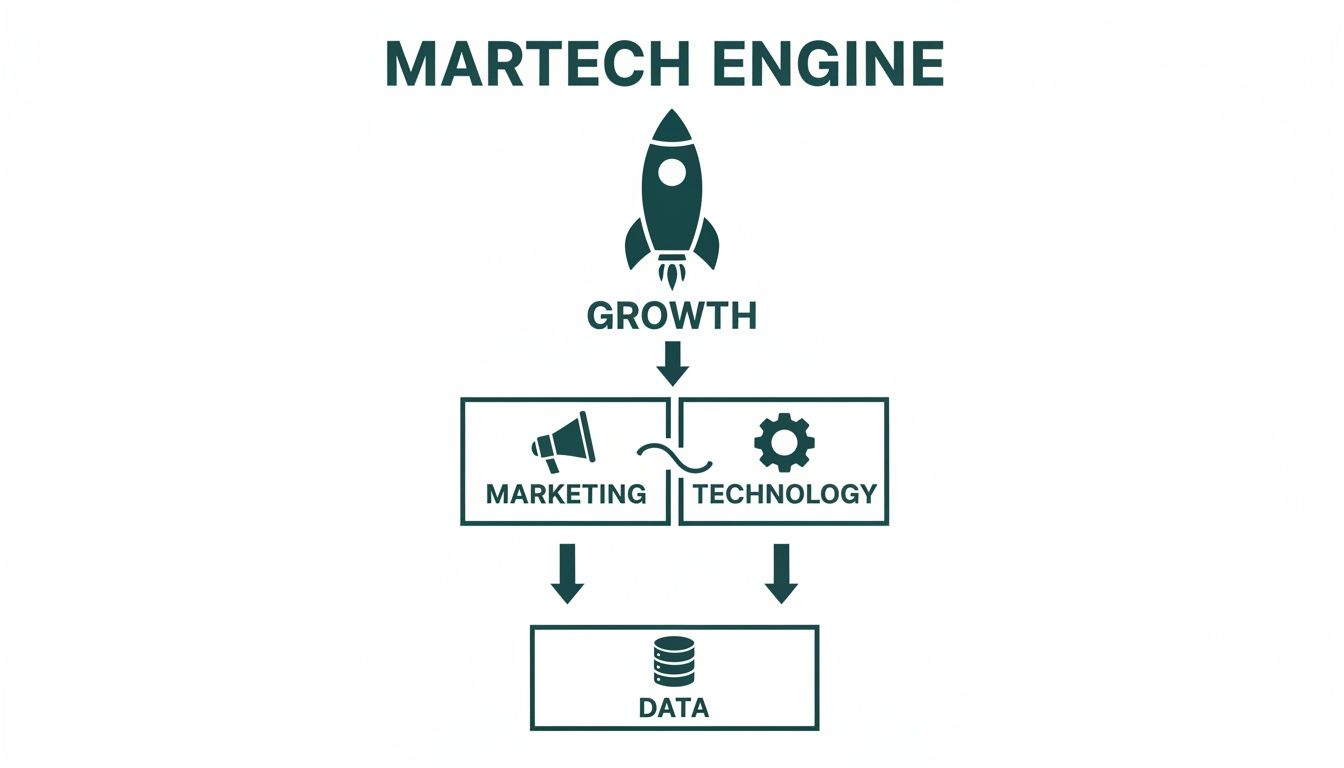
The key insight here is that growth isn’t an accident; it’s the direct result of having clean data powering a connected marketing and technology strategy.
To make this tangible, let’s map out how Salesforce addresses common business challenges across different MarTech functions.
Key MarTech Components and Their Salesforce Solution
This table breaks down the essential marketing technology functions, the typical business problems they solve, and how the Salesforce platform provides a unified solution.
| MarTech Function | Business Challenge | Salesforce Solution | Primary Benefit |
|---|---|---|---|
| CRM & Data Management | Disconnected customer data across sales, marketing, and service teams, leading to inconsistent experiences. | Salesforce Platform (Sales Cloud, Service Cloud) | Creates a 360-degree customer view and a single source of truth for all teams. |
| Marketing Automation | Inefficient lead nurturing and inability to deliver personalised communication at scale. | Marketing Cloud Account Engagement | Automates personalised customer journeys, scores leads, and aligns marketing with sales. |
| Analytics & Reporting | Difficulty measuring marketing ROI and understanding which campaigns are actually driving revenue. | Salesforce Reports & Dashboards | Provides real-time visibility into campaign performance and its direct impact on the sales pipeline. |
| Content & Experience | Creating consistent, branded experiences across a website, customer portal, and email campaigns. | Experience Cloud & Email Studio | Delivers personalised digital experiences, from public websites to secure member portals, all connected to CRM data. |
Understanding this mapping helps clarify that you’re not just buying software; you’re investing in a system designed to solve fundamental business problems in a connected way.
Case Study: How a National Franchise Network Unified Its Marketing with Salesforce
The Business Challenge: A national franchise network with locations across Australia struggled with brand consistency. The head office needed to maintain control, but each local franchisee had to run marketing campaigns that spoke to their specific community. Their disjointed tools created data silos and a fragmented customer experience.
The Salesforce Solution: We implemented a Salesforce-centric solution to create a streamlined operation.
- Centralised Control with Local Flexibility: Corporate marketing creates branded email templates and customer journeys in Marketing Cloud.
- Empowering Franchisees: Franchisees log into a simplified interface within an Experience Cloud portal, access these pre-approved assets, and customise them with local offers.
- Unified Data: All customer data from every franchise rolls up into one Salesforce CRM instance.
The Results and Benefits: The head office gained a complete, real-time picture of national performance, while each franchisee could see their own customer base and campaign results. The real power move came when we integrated their Salesforce hub with their accounting platform, Xero (similar integrations work with ERPs like NetSuite). This created a true 360-degree view of the customer, where a sales transaction in Salesforce automatically triggers an invoice in Xero, and payment history informs future marketing offers.
Building a modern MarTech stack is less about accumulating the most tools and more about achieving total integration. The goal is to create one single source of truth that delivers a connected experience from the first click to the final sale and beyond.
This level of integration is what turns marketing and technology from a cost centre into a predictable revenue driver. To explore how these concepts apply directly to campaign execution, our guide on Salesforce for marketers provides practical insights and strategies. As a Salesforce partner, we specialise in designing and building these connected ecosystems, ensuring they are scalable, efficient, and perfectly aligned with your business goals.
Leveraging AI and Automation in Your Salesforce Marketing Strategy
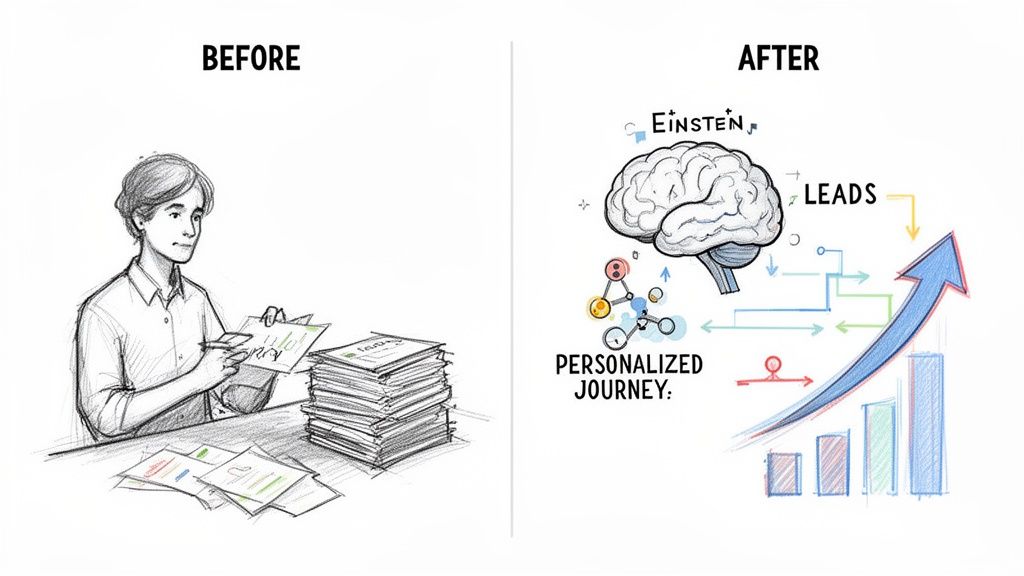
You’ve heard the terms “AI” and “automation” thrown around a lot lately, but for businesses using Salesforce, they are a genuine, tangible competitive edge. This is where marketing and technology really click, shifting your team from reactive tasks to proactive, data-driven strategies.
Australian marketing businesses are already well ahead of the game. In 2025, a massive 91% have already woven AI into their daily work, and another 6% are set to follow within two years. That’s the highest adoption rate of any sector in the country, which tells you everything you need to know about how vital this tech has become. We see it every day with the businesses we partner with—from franchises and healthcare providers to construction firms and professional services. You can get more insights on this from Australian businesses adapting to AI on bizcover.com.au.
From Manual Grind to Intelligent Action: A Real-World Scenario
Let’s look at a common business challenge and see how the Salesforce solution transforms it. Imagine a Sydney-based professional services firm pulling in hundreds of leads every month.
- The Business Challenge: A junior marketer is stuck in a spreadsheet for hours each week, manually qualifying new leads. They’re eyeballing job titles and company sizes, essentially guessing which leads are worth the sales team’s precious time. Hot leads go cold, and the sales team wastes time on prospects who were never the right fit.
- The Salesforce Solution: The firm implements Salesforce Sales Cloud with Einstein AI. Instantly, the system starts analysing every new lead against historical data from all their past successful deals. It looks at dozens of signals—industry, engagement, website behaviour—to generate a predictive lead score.
- The Results and Benefits: The sales team now gets a prioritised list of the hottest leads delivered straight to them in Salesforce. They know exactly who to call first and have AI-powered insights into what that person is interested in. The marketing team is freed from manual data entry to focus on creating better campaigns, and lead conversion rates increase significantly.
How Salesforce Einstein Makes Your Marketing Smarter
Salesforce Einstein isn’t some far-off concept; it’s a set of practical AI tools built right into the platform. It works behind the scenes to make your marketing and technology efforts sharper and more effective.
Here’s a taste of what it can do:
- Predictive Lead Scoring: Just like in our example, Einstein pinpoints the leads most likely to convert, letting your sales team focus their energy where it will have the biggest impact.
- Hyper-Personalised Customer Journeys: By analysing customer behaviour, Einstein helps Marketing Cloud predict the best next step, delivering the right message at the right time to build trust and drive sales.
- Optimised Ad Spend: Einstein AI analyses campaign performance data and recommends which channels and audiences are delivering the best ROI, helping you allocate your budget more effectively.
AI and automation aren’t here to replace marketers. They’re here to give them superpowers, freeing them from repetitive tasks so they can focus on the creative, strategic work that actually grows the business.
At the end of the day, bringing AI into your marketing isn’t just about doing things faster; it’s about understanding your customers on a much deeper level. By sifting through huge amounts of information, these tools spot patterns and insights a human could never find. Unifying all that customer information is the crucial first step, and that’s precisely what the Salesforce Data Cloud is designed to do.
A Practical Roadmap for a Successful Salesforce MarTech Implementation
Kicking off a Salesforce MarTech implementation can feel like a mountain to climb. But when you break it down with a clear roadmap, it becomes a manageable—and even exciting—project. A successful rollout isn’t about just plugging in new software. It’s a strategic process that aligns technology with your business goals right from the start.
This isn’t just another technical checklist. Think of it as a proven guide for navigating the whole process, dodging the common pitfalls, and making sure your investment actually delivers real, measurable results. Let’s walk through the key phases.
Phase 1: Audit and Goal Definition
Before you even think about new tools, you need to look inward. You can’t figure out where you’re going until you know exactly where you are. This means a thorough audit of your current processes and technology.
Start by mapping out your entire customer journey. List every single tool your sales, marketing, and service teams currently touch. The goal here is to pinpoint the exact bottlenecks, data silos, and frustrating inefficiencies that are holding you back.
With this baseline, you can finally set specific, measurable business goals. Don’t start with “we need a new CRM.” Instead, frame it around objectives like, “we need to cut our lead response time by 50%,” or “we need to lift customer retention by 15%.” These goals become your North Star for the Salesforce implementation.
Phase 2: Salesforce Solution Design and Integration Planning
Now that you have clear goals, you can start designing the right Salesforce solution. The trick is to see your MarTech stack as a single, connected ecosystem built around a powerful central hub like Salesforce.
When you’re looking at any new technology, the first question you should ask is: “How well does this integrate with Salesforce?” A seamless link between your marketing automation, your analytics, and your core CRM is completely non-negotiable. This is how you prevent the very data silos you worked so hard to identify in phase one.
This phase is also where you get into detailed integration planning. How will data flow between systems? What are the key data points that need to be shared between marketing, sales, and finance? A well-documented plan is your best insurance policy for a smooth technical implementation.
Phase 3: Data Migration and Change Management
This is the phase everyone underestimates, but it’s absolutely critical for Salesforce success. Getting clean, accurate data into your new system is the foundation of everything. A “garbage in, garbage out” approach will sabotage your entire project. You need to plan for data cleansing, mapping fields from old systems to new ones, and running a test migration.
Just as important is getting your team on board. The best tech in the world is useless if nobody uses it.
One of the biggest lessons learned from our 110+ Salesforce projects is the power of involving teams from day one. When sales, marketing, and service teams are part of the process, they see the tech as a solution to their problems—not just another tool they’re being forced to learn.
To ensure a smooth transition and high user adoption, focus on:
- Early and Frequent Communication: Keep everyone in the loop on the project’s progress, timeline, and the “why” behind it all.
- Comprehensive Training: Run training sessions tailored for different roles. A salesperson needs different skills in Salesforce than a marketing manager.
- Appoint Internal Champions: Identify enthusiastic team members who can act as go-to resources for their colleagues, building momentum and answering questions on the ground.
Following a structured roadmap like this turns a potentially chaotic project into a controlled, strategic move. It ensures your investment in MarTech isn’t just about adding new features, but about building a powerful engine for real, sustainable business growth.
Measuring Success: Salesforce KPIs That Actually Matter
Investing in new marketing technology feels like a step forward, but how do you prove it’s actually working? Success isn’t measured in clicks or likes; it’s measured in tangible business outcomes that directly affect your bottom line. To get there, you need to use Salesforce to track the Key Performance Indicators (KPIs) that truly matter.
This means moving beyond surface-level numbers and tracking the metrics that tell the whole story of your customer’s journey. Without that clarity, you’re flying blind, pouring money into campaigns without knowing what’s delivering real value.
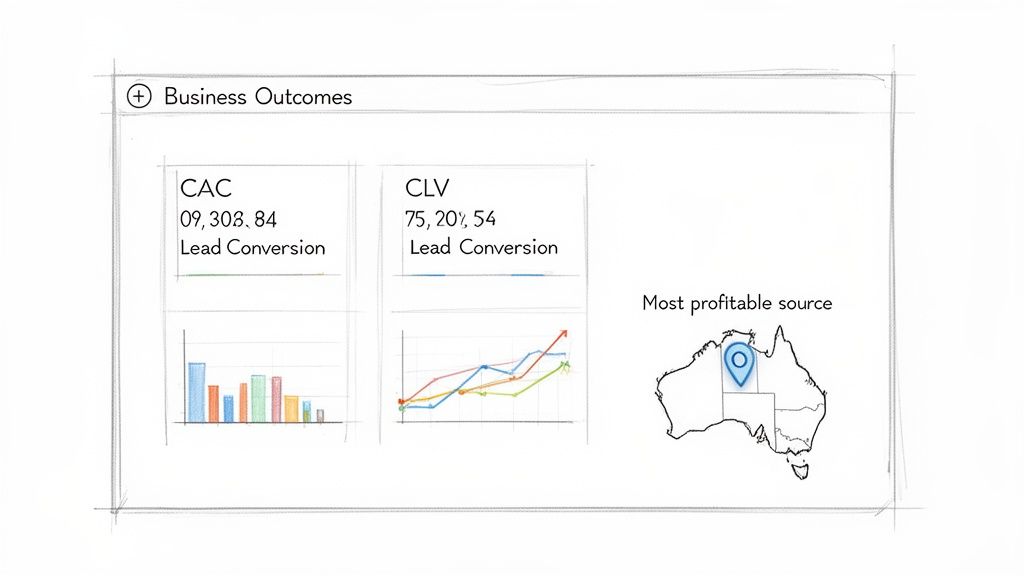
Core Salesforce KPIs for a Modern MarTech Stack
While every business is unique, a few core KPIs are non-negotiable for gauging the health of your marketing and technology engine. These metrics give you a clear, unfiltered picture of profitability, efficiency, and long-term customer value.
Here are the essentials:
- Customer Acquisition Cost (CAC): This is the total cost of your sales and marketing efforts to acquire one new customer. A high CAC can bleed your business dry, making it critical to track and bring down.
- Customer Lifetime Value (CLV): CLV predicts the total revenue your business can expect from a single customer over their entire relationship with you. The goal is a healthy CLV:CAC ratio, making sure you earn far more from customers than you spend to win them.
- Lead-to-Customer Conversion Rate: This metric shows you what percentage of your leads become paying customers. It’s a direct measure of how well your sales and marketing teams are working together.
Trying to track these accurately with disconnected systems is a recipe for frustration. This is where an integrated platform like Salesforce becomes your most important measurement tool. It connects every touchpoint—from the initial ad click to the final sale and repeat business—giving you true end-to-end visibility.
Without a single source of truth, you’re not measuring; you’re guessing. Salesforce provides the clarity needed to see exactly how your investment in marketing and technology translates into revenue.
Mini Case Study: A Construction Company’s Data-Driven Turnaround
The Business Challenge: A mid-sized construction company was spending a significant amount on digital advertising but struggled to pinpoint which channels were delivering genuinely valuable leads. Their data was scattered across different platforms, making it impossible to connect ad spend to closed deals.
The Salesforce Solution: As their Salesforce partner, we implemented Sales Cloud and connected their digital ad platforms directly to their CRM. Using Salesforce Reports & Dashboards, they could finally see the entire journey for every single lead in one place.
The Results and Benefits: The insights were almost immediate. They discovered that while one channel generated a high volume of leads, its conversion rate was painfully low. At the same time, a smaller, more targeted channel was producing leads that converted at three times the rate. By simply reallocating their budget based on this data, they slashed their CAC by over 40% and dramatically improved the quality of opportunities for their sales team.
This success really drives home the importance of precise tracking, especially as the digital ad space gets more competitive. Social media advertising in Australia is set to hit AU$7.5 billion in 2025, and 92% of ad decision-makers now see data usage as critical. To get a better handle on the financial side and the returns on your campaigns, you can learn more about how to calculate marketing ROI. Businesses have to be able to prove their spend is effective, a challenge you can read more about in these Australian marketing statistics from eloquent.com.au.
Why a Salesforce Partner Is Your Secret Weapon for MarTech Success
Investing in powerful technology like Salesforce is a big move, but the software itself is only one part of the puzzle. The real magic happens when you pair that tech with expert strategy and a flawless implementation. Many businesses try to go it alone, but they often hit the same costly roadblocks, turning what should be an exciting investment into a major headache.
This is a common story we hear from new clients. They might see low user adoption because the system feels clunky and disconnected from their team’s day-to-day work. Or perhaps data is still stuck in silos because integrations with other core systems were never properly sorted. Worst of all, they could be missing out on huge automation opportunities, leaving efficiency gains and extra revenue just sitting there, untapped.
Turning a Tool Into a True Business Asset
This is where a specialist Salesforce partner stops being just a technical helping hand and becomes your strategic advantage. Their true value isn’t just in knowing the software inside and out; it’s in their ability to translate your business goals into a rock-solid technical solution. They look past the code to understand what you’re actually trying to achieve—whether that’s shrinking your sales cycle, improving customer retention, or scaling your franchise operations smoothly.
A good partner brings a tonne of practical, hands-on experience to the table, especially with tricky integrations. Getting Salesforce to work seamlessly with essential Australian business systems like MYOB, Xero, or NetSuite isn’t straightforward. It requires specialised knowledge to make sure data flows securely and reliably. An experienced partner has done it all before, so they know exactly how to avoid the common traps.
An expert Salesforce partner doesn’t just install software; they accelerate your growth by turning Salesforce from a tool into a core business asset. They make sure your investment delivers real, measurable returns by aligning the technology directly with your business goals, right from day one.
Ultimately, it’s all about getting the best possible return on your investment. That means more than just the initial setup. It’s about having ongoing support and strategic guidance to ensure the platform grows and adapts right alongside your business. By bridging that critical gap between your vision and the technical nuts and bolts, a partner ensures your entire MarTech stack works together as a powerful engine for growth.
Working with an experienced Salesforce implementation consultant is the surest way to dodge those common implementation headaches and build a platform that delivers value for years to come. They’ll guide you through every single stage—from strategy and data migration to user training and long-term tweaks—making sure you get it right the first time.
Salesforce Marketing & Technology FAQs
When you start blending marketing with technology on the Salesforce platform, a lot of questions come up. Here are some of the most common ones we hear from business leaders, with straightforward answers to give you a clear path forward.
What’s the first step to improve our marketing and technology with Salesforce?
Before you even think about new software, the best place to start is with a solid audit of what you’re doing right now. You need to get a really clear picture of your current customer journey, the actual headaches your teams are dealing with every day, and what “success” truly looks like for your business.
Map out how your sales and marketing teams work together (or don’t). Pinpoint where customer data lives and what’s causing all the bottlenecks. This groundwork is crucial. It lets you build a powerful business case for any tech investment, like Salesforce, and makes sure the solution is set up to solve your real-world problems from day one.
How can Salesforce Marketing Cloud help our franchise business?
Salesforce Marketing Cloud is practically made for the franchise model. It strikes that perfect balance between keeping the brand strong at the corporate level while giving local franchisees the tools they need to market effectively. Your head office can design brand-approved email templates, ad campaigns, and customer journeys.
Then, individual franchisees can take these assets and tweak them for their local area. This keeps the brand consistent everywhere, but still empowers owners to run promotions and events that actually resonate with their community. Plus, features like Journey Builder can automate things like welcoming new customers or running loyalty programs across all locations, ensuring a smooth brand experience whether someone is in Sydney or Perth.
How difficult is it to integrate Salesforce with our other business systems?
Connecting different software is a common challenge, but it’s one of the things the Salesforce platform does best—and it’s a specialty for experienced partners. Using powerful tools like APIs and MuleSoft, we link systems like Xero, MYOB, NetSuite, and SAP directly into Salesforce. The goal is to create one single, reliable source of truth for all your customer data.
While an integration project definitely needs careful planning and expert hands, the result is a total game-changer. You get rid of data silos, automate workflows that cross different departments, and give your teams the complete, real-time information they need to make smarter decisions, faster.
This connected approach is how you unlock the real value of your investment. It turns a messy collection of apps into a smooth, powerful engine for growth. A good partner handles all the technical heavy lifting, so you can stay focused on the business outcomes.
At Adaptal, we specialise in designing and implementing Salesforce solutions that connect your marketing and technology to drive real business growth. As a trusted Salesforce partner, we have the project experience to help you get the most out of your CRM investment. If you’re ready to build a more efficient, data-driven organisation, let’s talk.