
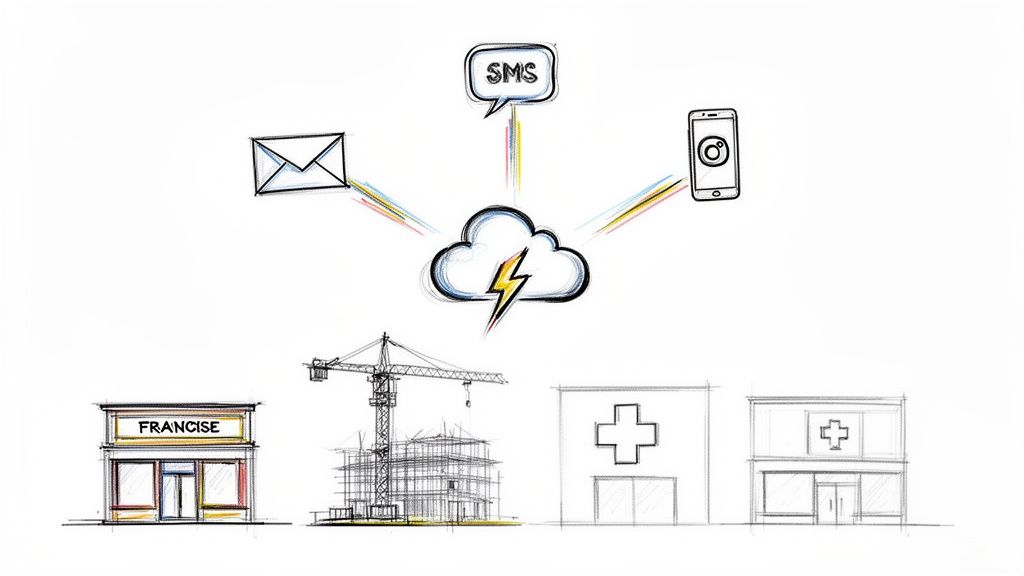
Effective marketing and communications are the twin engines that drive business growth. One works to attract new customers; the other builds a trusted brand. But for many Australian SMEs, these two functions operate in separate silos, creating disjointed customer experiences and inefficient spend.
The challenge is clear: how do you turn marketing spend into measurable revenue? The solution lies in a unified strategy, powered by a central CRM platform like Salesforce. As a Salesforce partner, we’ve guided numerous businesses through this transformation, turning fragmented efforts into a cohesive growth machine.
Why Integrated Marketing and Communications Matter in Salesforce
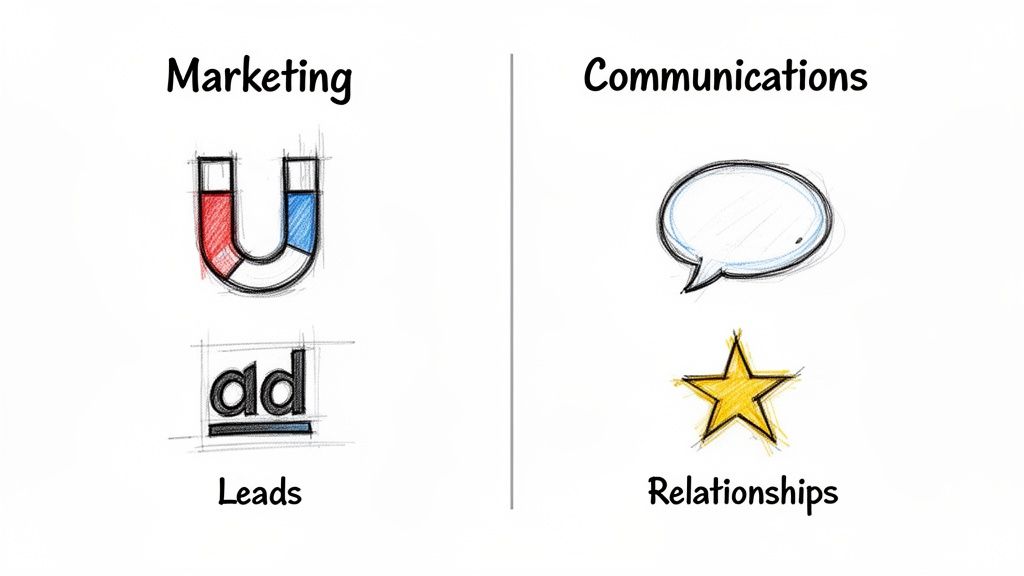
Think of it this way: marketing is the function that sparks interest and generates leads. It’s all about advertising, campaigns, and driving prospects to your door.
Communications, on the other hand, is about building the relationship once they’re engaged. It’s the art of shaping your brand’s reputation, managing public perception, and fostering long-term loyalty.
When these two areas don’t talk to each other, customers feel the disconnect. A prospect might see a brilliant ad (marketing), but then receive a generic, impersonal welcome email (communications). That initial interest vanishes. This fragmentation doesn’t just damage the customer experience; it makes it impossible to measure the true return on your marketing investment (ROMI).
The Power of a Single Customer View in Your CRM
When you integrate marketing and communications within a single CRM, you create a powerful, unified brand voice that resonates with customers at every touchpoint. The key is having a central platform—a single source of truth for every customer interaction. For growing businesses, this is where a platform like Salesforce becomes essential.
By connecting every marketing touchpoint to sales and service data, Salesforce allows you to:
- Create a Seamless Journey: Track a customer from their first ad click, through to purchase, and any subsequent support tickets.
- Deliver Personalised Experiences: Use real data from sales and service teams to shape your marketing messages, ensuring everything is relevant and perfectly timed.
- Measure What Truly Matters: Move beyond simple metrics like clicks and open rates. Understand precisely how your marketing efforts contribute directly to the bottom line.
A unified strategy turns your marketing from a cost centre into a predictable growth engine. By connecting your efforts in a CRM, you ensure that every dollar spent is designed not just to make noise, but to build lasting customer relationships and drive sales.
As a Salesforce partner, we’ve seen firsthand how this cohesive strategy transforms a business. It breaks down frustrating internal silos and focuses the entire organisation on the one thing that matters: the customer. Understanding the full potential of your marketing technology is the first step toward building this powerful alignment.
Defining Marketing and Communications Roles in a Salesforce Ecosystem
Before you can build a unified strategy, you need to be crystal clear on what each team does best. For many business leaders, the lines between marketing and communications can become blurred, but defining their distinct roles is a crucial first step toward successful Salesforce integration.
Here’s a simple way to look at it: marketing’s job is to bring people to your brand, while communications ensures they connect with it. One is transactional, focusing on the sale. The other is relational, focusing on building trust.
Both are critical for growth, but they achieve it in different ways. Marketing is the engine that drives leads and sales, while communications lays the foundation for your reputation and long-term customer relationships. When they work together within a shared CRM, they create a seamless customer journey that feels both compelling and authentic.
Marketing: The Engine of Customer Acquisition
Your marketing team’s primary goal is to drive measurable commercial results. They focus on actions that directly feed the sales pipeline, using data within Salesforce to attract, engage, and convert prospects into customers.
Their work is typically campaign-driven and highly quantifiable. Success is measured in leads generated, conversion rates, and return on ad spend (ROAS). This function is fundamentally about creating demand and making the path to purchase as smooth as possible. For many SMEs, bringing in external expertise can be a smart move. It’s worth understanding the role of a Fractional CMO if you need flexible marketing leadership to define and execute your strategy.
Communications: The Architect of Brand Reputation
In contrast, the communications team is tasked with shaping your organisation’s overall image and story. This is less about the immediate sale and more about building and protecting the brand’s reputation for the long haul.
Their focus is on storytelling, stakeholder engagement, and public perception. This covers everything from public relations and internal comms to corporate social responsibility and crisis management. The goal is to build goodwill, establish credibility, and create a loyal community around your brand. While its impact can be harder to attribute to a direct sale, its value is immense. Strong communications build the trust that makes every marketing dollar work harder.
A brand with a great reputation (thanks to communications) will always find it easier to attract customers (through marketing). One function creates the fertile ground; the other plants the seeds for growth.
To help structure your teams effectively, it helps to see their distinct responsibilities side-by-side. The table below breaks down their different roles, channels, and metrics.
Marketing vs Communications: A Functional Comparison
| Aspect | Marketing | Communications |
|---|---|---|
| Primary Goal | To generate leads, drive sales, and achieve direct revenue targets. It is focused on customer acquisition and conversion. | To build and protect the brand’s reputation, foster positive relationships, and manage public perception. |
| Key Audience | Primarily targets prospective and current customers with the aim of influencing purchasing decisions. | Engages a broader set of stakeholders, including employees, investors, media, and the general public. |
| Core Channels | Digital advertising (Google Ads, social media ads), search engine optimisation (SEO), email marketing campaigns, and content marketing. | Public relations (press releases, media outreach), corporate social media, internal newsletters, and community engagement. |
| Success Metrics | Measured by quantifiable data such as leads generated, cost per acquisition (CPA), conversion rates, and customer lifetime value (CLV). | Evaluated through metrics like brand sentiment, media mentions, employee engagement surveys, and stakeholder feedback. |
Seeing the functions laid out like this makes it clear: they aren’t competing functions, but two sides of the same coin, both essential for building a resilient and profitable business.
Engaging Australian Customers with a Unified Digital Strategy
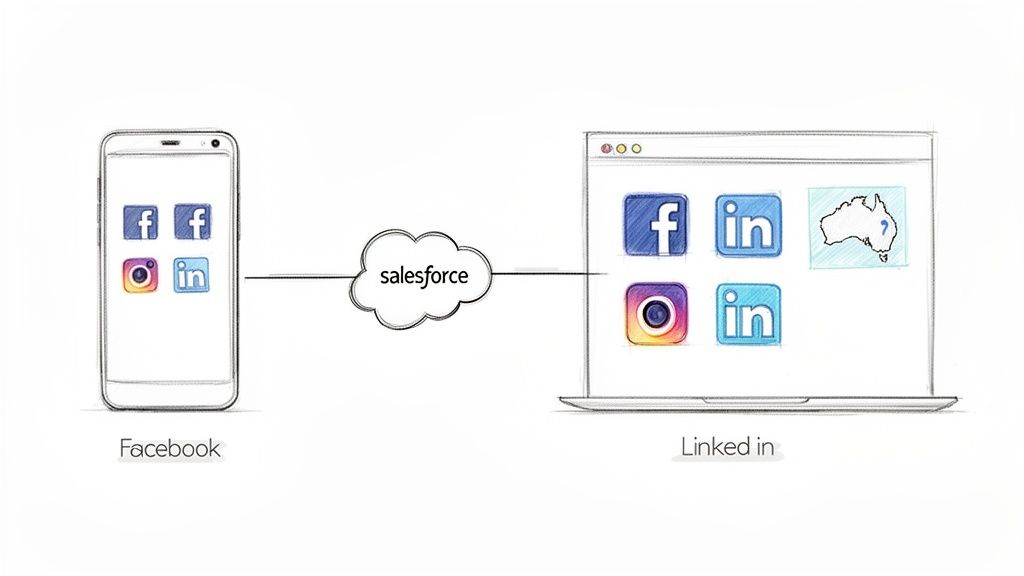
For Australian businesses in construction, healthcare, or professional services, a strong digital presence is the main arena where customer relationships are built. Your audience is already on Facebook, Instagram, and LinkedIn.
To connect with them effectively, you need a consistent message across all channels. The problem is, juggling different platforms often leads to fragmented efforts and a blurry picture of what’s actually working. This is where a unified platform becomes a game-changer for your marketing and communications.
The data speaks for itself. Australia’s total advertising spend recently hit $19.9 billion, with $14.5 billion going to digital ads. With digital now commanding 73.1% of the ad market, it’s clear where Australian SMEs are focused. You can explore the full report on Australian social media statistics on Meltwater to see the full picture.
Unifying Your Channels with Salesforce Marketing Cloud
Managing separate platforms for social media, email, and advertising is a recipe for inefficiency. This is the exact challenge Salesforce is built to solve, acting as your single source of truth for every customer interaction.
Tools like Salesforce Marketing Cloud and Salesforce Experience Cloud let you manage your entire digital presence from one central hub. You can plan, launch, and measure campaigns across email, social media, and more, all within a single system. This integrated view gives you a complete picture of each customer—which ads they clicked, what emails they opened, and how they’ve engaged with your brand.
Case Study: Turning Ad Spend into Measurable Sales
The Business Challenge: A construction company was tracking new leads from LinkedIn ads in a spreadsheet. This manual process meant follow-ups were slow, and they couldn’t tell which campaigns were actually delivering valuable projects.
The Salesforce Solution: We integrated their digital channels with their core CRM. A new lead from a LinkedIn ad was automatically created in Salesforce Sales Cloud.
The Results and Benefits: This automation provided complete visibility.
- Optimised Ad Spend: They could finally see which channels and campaigns were bringing in the best leads, allowing them to reallocate their budget effectively.
- Personalised Content: Customer data from their CRM was used to tailor social media posts and email campaigns, making them far more relevant.
- Improved Customer Experience: Every touchpoint, from the first ad to a follow-up email, was consistent and informed by the customer’s journey.
By connecting every digital channel through Salesforce, you stop guessing and start knowing. Every dollar spent on marketing becomes a measurable investment in growth, backed by hard data on what truly drives results for your business.
This strategic approach ensures your digital marketing is actively building relationships and contributing directly to your bottom line. Working with an expert social media marketing agency can help structure these campaigns to get the most out of the Salesforce ecosystem.
Building a Unified Customer Journey with Salesforce
Defining marketing and communications roles is one thing. Bringing their efforts together to create a single, seamless customer experience is another. A truly unified strategy requires a powerful engine to connect every interaction, and this is where Salesforce becomes the central nervous system for your business.
Instead of seeing customer interactions as isolated events, a unified journey treats every touchpoint as part of one long conversation. This approach solves the common problem where a customer’s experience with a marketing email feels disconnected from their chat with a sales rep.
Salesforce Marketing Cloud as Your Central Hub
At the heart of this unified approach is Salesforce Marketing Cloud. Think of it as the control centre for your customer experience. It’s where you design, automate, and personalise every step of the journey, ensuring your brand’s message is consistent and relevant.
Marketing Cloud lets you visually map out entire customer pathways. This isn’t just about scheduling emails; it’s about creating intelligent journeys that adapt based on customer actions. For example, if someone clicks a link about a specific service, the system can automatically send a follow-up with more detailed information. This automation frees your team to focus on strategy. Understanding what customer journey mapping is is a great starting point for planning these pathways.
A unified journey powered by Salesforce means the end of guesswork. Every marketing action is tracked, every sales interaction is logged, and every service query is recorded in one place. This creates a rich, 360-degree customer profile that informs every communication that follows.
Case Study: A Franchise’s Journey from Ad Click to Qualified Lead
The Business Challenge: An Australian national franchise was running successful social media ad campaigns, but the leads were being dumped into a messy spreadsheet. Salespeople struggled to follow up, and many promising leads went cold. The path from initial interest to a sales conversation was broken.
The Salesforce Solution: As their Salesforce partner, we implemented a connected system using Marketing Cloud and Sales Cloud.
- Automated Lead Capture: When a potential franchisee clicked a Facebook ad and filled out an enquiry form, their details were instantly captured in Marketing Cloud.
- Personalised Nurturing: The system immediately triggered a personalised welcome email series, keeping the lead warm and engaged.
- Seamless Sales Handoff: Once a lead showed high engagement (like downloading a brochure), they were automatically passed to Sales Cloud as a qualified lead.
- Informed Follow-Up: The salesperson could see the lead’s entire history—which ads they’d clicked and what emails they’d opened. This meant their first conversation was highly relevant and personal.
The Results and Benefits: This integration of marketing and sales automation created a smooth pipeline that transformed their lead management. It’s a perfect example of how a properly configured Salesforce environment solves real-world fragmentation and directly drives growth.
Cut Through the Noise With High-Impact SMS in Salesforce
Social media and email are essential, but they’re crowded spaces. To truly connect with customers, smart Australian businesses are turning to a more direct and immediate channel: SMS messaging.
Consider the applications. A healthcare clinic can reduce no-shows with automated appointment reminders. A construction company can keep clients informed with real-time project updates. A retail franchise can drive foot traffic with time-sensitive offers sent straight to their phones. It’s a channel that delivers timely information people actually see.
The Data Behind SMS Marketing Success
The power of SMS is backed by strong data. SMS marketing in Australia boasts a 97% read rate within 15 minutes of being sent. With 96% of Australians using their phones for messaging daily across 34.4 million active connections, the reach is undeniable. You can dive deeper into these SMS marketing statistics at Notifyre.
This makes SMS the perfect tool for any time-sensitive campaign, especially for SMEs, franchises, and healthcare providers.
Integrating SMS into Your Salesforce Ecosystem
The real power is unlocked when SMS is integrated directly into your Salesforce CRM. As a Salesforce partner, we help businesses connect powerful SMS marketing apps into their existing Sales Cloud or Service Cloud. This turns a simple messaging tool into a strategic asset.
Once SMS is connected to Salesforce, every text sent and received becomes valuable data. This allows you to:
- Automate Personalised Campaigns: Trigger an SMS based on a customer action in your CRM, like a completed purchase or a closed support ticket.
- Enable Two-Way Conversations: Let your sales or service teams manage replies directly within Salesforce, turning a one-way blast into a real-time chat.
- Track Performance: Measure delivery, open rates, and conversions to see exactly how your SMS efforts are impacting business goals.
When you integrate SMS with Salesforce, it stops being a simple broadcast channel and becomes a smart, data-driven conversation tool. You meet customers where they are, with messages that feel relevant and perfectly timed.
This thoughtful, multi-channel approach builds stronger customer relationships. To take it a step further, you can even build an SMS chatbot for efficient, automated communication. By folding SMS into your unified strategy, you ensure your most critical messages are seen and acted on, delivering measurable results.
Your Salesforce Implementation Roadmap for Marketing and Communications
Unifying your marketing and communications is a significant project that requires a phased, methodical approach. A structured roadmap ensures your Salesforce implementation delivers real value and sets you up for long-term success.
Our complete Salesforce implementation guide for Australia offers deeper insights, but this game plan breaks the journey down into manageable stages.
Phase 1: Discovery And Strategy
This is the most critical stage. Before configuring any technology, you need to define what success looks like for your business. It’s about mapping current processes, identifying pain points, and setting clear, measurable goals for your marketing and communications.
Key activities include:
- Stakeholder Workshops: Aligning leaders from marketing, sales, service, and IT on project goals.
- Process Mapping: Documenting your current customer journey to identify gaps and opportunities for automation.
- Goal Setting: Defining specific KPIs, such as improving lead conversion rates or customer retention.
Phase 2: Platform Setup And Data Integration
With a solid strategy, it’s time to build the technical foundation. This phase involves configuring your Salesforce environment to match your unique business needs. This is where an experienced Salesforce partner becomes invaluable.
During this phase, we focus on:
- Configuring Salesforce: Customising objects, fields, and workflows across Sales Cloud, Service Cloud, and Marketing Cloud.
- Data Migration: Carefully cleaning and migrating customer data from old systems (like spreadsheets or outdated CRMs) into Salesforce.
- System Integration: Connecting Salesforce with other essential tools, like your accounting software or ERP, to create a single source of truth.
A successful implementation isn’t just about turning on software. It’s about meticulously shaping the platform to support your business processes, ensuring clean data, and creating a system that your team will actually want to use.
Phase 3: Campaign Execution And Measurement
With the platform live, it’s time to put it to work. We recommend starting with a pilot campaign to test the new, integrated workflow. This allows you to gather feedback and make adjustments before a full rollout.
This phase involves:
- Launching a Pilot Journey: Building and launching your first automated customer journey in Marketing Cloud.
- Training Your Team: Providing hands-on training to ensure your marketing and sales teams are confident using the new system.
- Monitoring and Optimising: Using Salesforce dashboards to track campaign performance against the KPIs defined in Phase 1, making data-driven tweaks to improve results.
The infographic below illustrates how a channel like SMS, tracked within your CRM, can evolve from simple delivery to a source of high returns.
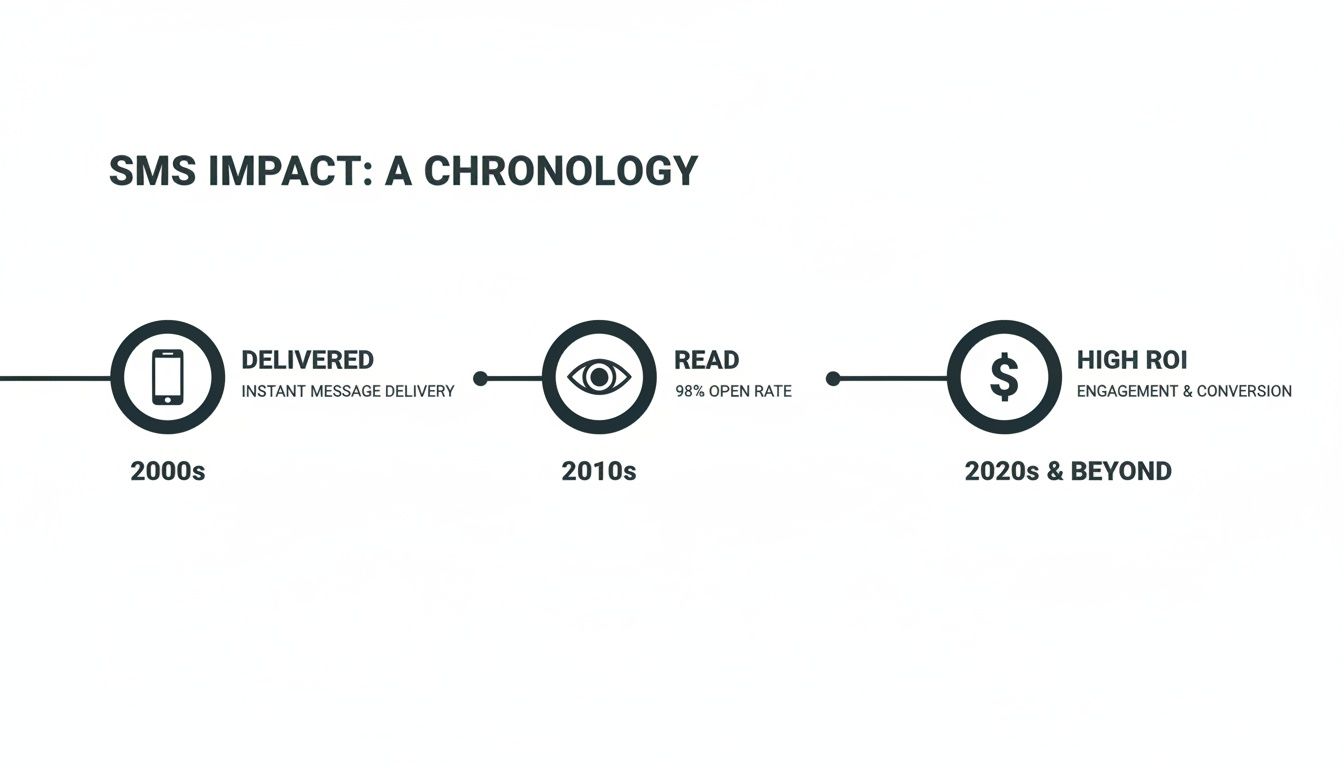
This journey highlights how direct channels, when tracked within Salesforce, deliver measurable results that go far beyond simple delivery and read rates.
Frequently Asked Questions about Salesforce for Marketing & Comms
Here are answers to common questions from businesses looking to unify their marketing and communications with Salesforce.
How does Salesforce help small businesses unify marketing?
Salesforce offers tools designed specifically for smaller businesses, like Marketing Cloud Account Engagement (formerly Pardot). This allows you to start with the essentials: a solid CRM and marketing automation to manage customer relationships and track campaign performance. The platform is scalable, growing with your business so you aren’t constantly switching systems. Working with an experienced partner ensures you get the right setup for your budget and goals from day one.
What is the difference between Marketing Cloud and Sales Cloud?
Think of it this way: Sales Cloud is the CRM for your sales team to manage leads, track opportunities, and handle customer accounts. It’s focused on the sales process.
Marketing Cloud is your platform for engaging customers across email, social media, SMS, and digital ads.
The real magic is connecting the two. When Marketing Cloud and Sales Cloud work together, you get a complete picture of how marketing spend directly translates into sales revenue, eliminating guesswork and departmental silos.
Marketing nurtures leads in Marketing Cloud and then passes them to the sales team in Sales Cloud when they are ready, creating one seamless customer journey.
Can we integrate existing systems like Xero with Salesforce?
Absolutely. A key part of a successful Salesforce implementation is connecting the platform with the tools Australian businesses already use, like accounting software from Xero and MYOB or ERP systems like NetSuite and SAP. Integrating these systems provides a genuine 360-degree view of your customer. When your sales and marketing data connects to your financial data, you unlock deeper insights, build more relevant campaigns, and ensure all your critical systems are finally working together.
Ready to unify your marketing and communications and drive measurable growth? As a leading Australian Salesforce Consulting Partner, Adaptal has the experience to build a tailored roadmap for your business.