
Change management is the single most critical factor in whether your investment in a technology like Salesforce pays off. It's not just a buzzword; it's a structured approach that guides your people, teams, and your entire organisation from how things are now to where you want to be. It ensures powerful tools like Salesforce aren't just installed, but embraced, adopted, and used to drive real business results.
The Real Cost of Ignoring the Human Element in a Salesforce Project
Investing in a powerful platform like Salesforce Sales Cloud or Service Cloud is a significant business decision. You've meticulously planned the technical implementation, configured every custom object, and perfected the workflows. But what happens when, a few weeks after go-live, your team is right back to using their old spreadsheets?
This is a painfully common—and costly—scenario. It’s where the return on investment (ROI) on your Salesforce project flatlines because the human side of digital transformation was overlooked.
The simple truth is that technology is only half the equation. A technically flawless Salesforce implementation can still be a complete failure if your users don’t understand, trust, or see the value in the new system. This gap between technology and adoption is exactly where management consulting for change management proves its worth. It’s not about forcing people to use a new tool; it’s about preparing them for a better, more efficient way of working.
The Human Factor in Your Salesforce ROI
Effective change management gets to the heart of why user adoption often stalls. It moves beyond a few simple training sessions and focuses on the entire user journey. To get a real grip on why your Salesforce ROI hangs in the balance, it helps to understand how to measure the ROI of your corporate training content and ensure your investment delivers tangible results.
A strategic approach, often guided by an experienced Salesforce partner, is about much more than just showing people which buttons to click. It involves:
- Building Awareness: Clearly communicating the why behind the change, not just the how. This means explaining the business challenges Salesforce solves and showing how it will genuinely make each person's job easier and more effective.
- Creating Desire: Actively engaging with your users to build excitement and get buy-in from key influencers within your teams. When employees feel involved and heard, resistance quickly turns into advocacy.
- Developing Knowledge: Providing practical, role-based training grounded in real-world scenarios. Users need to understand exactly how Salesforce fits into their day-to-day tasks and helps them achieve their goals.
Recent studies paint a pretty stark picture: approximately 70% of change initiatives fail to achieve their goals, usually because of a lack of focus on the people involved. Overlooking this human element is a direct threat to your Salesforce investment and the long-term health of your business.
Without a deliberate strategy to guide your team through this transition, you’re risking more than just a failed project. You risk employee frustration, plummeting productivity, and a CRM platform that becomes an expensive, neglected database.
Getting to the Heart of Salesforce Change Management
Let's cut through the jargon. What does change management actually mean when you're rolling out a Salesforce solution?
Imagine your new Salesforce platform—whether it's Sales Cloud, Service Cloud, or a more complex solution like CPQ & Billing—is a high-performance engine. Your business goals are the destination. Think of management consulting for change management as the skilled driver, the GPS, and the fuel that ensures you actually get there without breaking down or getting hopelessly lost.
It’s a classic mistake to view a Salesforce project as a purely technical job. The configuration, data migration, and integrations are crucial, but they’re only half the story. The other, equally vital half is preparing your people for a fundamentally new way of working.
This is where a structured approach to change is non-negotiable. It tackles the human side of the equation that technology alone can't solve, turning potential resistance into genuine buy-in. It ensures your team doesn’t just use the system but becomes its biggest advocates.
This focus on the 'people' part of technology projects is becoming more critical. The Australian management consulting market, valued at around USD 5.25 billion in 2025, is projected to climb to USD 7.37 billion by 2030. This growth is a clear sign of how vital expert guidance has become for major organisational shifts like a Salesforce-led digital transformation.
The Two Streams of a Salesforce Project: People and Technology
A successful Salesforce implementation always runs on two parallel tracks: the technical build and the people-focused change activities. One simply cannot work without the other. Forgetting the 'people' stream is like building that incredible engine but never teaching anyone how to drive.
For example, while a Salesforce developer is deep in Apex code building a custom component, a change management consultant should be working hand-in-glove with the sales team. Their job is to understand exactly how that new tool will fit into daily calls and follow-up routines, ensuring the final product is not just a technical marvel, but something the team will actually find useful.
To really see how this dual approach works, it helps to visualise how these activities run side-by-side.
Technical Implementation vs. People-Focused Change Activities
| Salesforce Implementation Task | Parallel Change Management Activity |
|---|---|
| Configuring Custom Objects & Fields | Conducting Stakeholder Impact Analysis to understand how new data requirements will affect each team's workflow and daily tasks. |
| Building Reports & Dashboards | Defining Success Metrics with Leaders to ensure the new reports align with key business goals and user performance indicators. |
| Automating Workflows with Flow | Developing Role-Based Training Materials that show users exactly how the new automation saves them time and effort on specific tasks. |
| Executing User Acceptance Testing (UAT) | Engaging 'Salesforce Champions' to test the system, gather authentic feedback, and build grassroots support before the official launch. |
| Planning the 'Go-Live' Cutover | Creating and Executing a Communication Plan to build awareness, manage expectations, and provide clear instructions for day one. |
As the table shows, for every technical step forward, there must be a corresponding human-centric action to pave the way for adoption. Without this balanced effort, your technology investment is at risk of stalling before it even gets going.
Key Change Management Principles in a Salesforce Context
Effective change management isn't built on abstract theories; it’s about practical steps that a Salesforce partner takes to guide your team through the transition.
-
Stakeholder Alignment: This is about getting everyone on the same page, from the CEO down to end-users. It involves running workshops and interviews to ensure the Salesforce solution is built to solve the right business problems for the right people.
-
Clear Communication Planning: A steady drumbeat of communication is your best friend. This means sharing project milestones, celebrating small wins, and being upfront about what changes are coming. Keeping everyone in the loop prevents surprises and builds trust.
-
Practical User Enablement: This is more than a single training session. It’s about creating hands-on learning experiences, quick-reference guides, and having solid support channels ready for go-live. This helps people build confidence and skill in the new system. It also means keeping up with platform updates—for instance, you can check out the latest features in our article on the highlights of the Salesforce Winter '25 Release.
How a Consulting Partner Guides Your Salesforce Change Management
Bringing a management consulting partner on board for your Salesforce project goes far beyond a simple tech setup. A true partner acts as your strategic guide, ensuring the technology aligns perfectly with your business goals and—most importantly—with the people who will use it every day. They are the specialists who bridge the gap between what Salesforce can do and what your team will actually do with it.
This specialised guidance is becoming more crucial. The Australian management consulting industry has grown by an average of 4.4% each year between 2019 and 2024, now comprising nearly 98,840 businesses. This boom highlights how much businesses need expert support to navigate complex changes, especially in digital transformation.
At its core, a consulting partner's job is to own the "people" side of the project. They execute the critical change management activities that must happen alongside the technical work. Their expertise is what ensures your investment in platforms like Service Cloud or Marketing Cloud Account Engagement actually delivers ROI.

From Business Analysis to User Advocacy
The journey with a consulting partner starts long before anyone writes code. It begins with a deep dive into your business, understanding your company’s unique culture and its real-world challenges.
Their key functions typically include:
- In-depth Stakeholder Analysis: They identify every group affected by the change, from the C-suite to frontline staff. Through interviews and workshops, they get a handle on current workflows, frustrations, and what each person needs to succeed.
- Strategic Communication Planning: They map out a clear, consistent communication plan that answers the all-important question for every user: "What's in it for me?" This builds trust and transforms uncertainty into excitement.
- User-Centric Training Design: They build training programs that are practical and specific to different roles. Forget generic feature dumps; they focus on how Salesforce will help someone do their actual job better, faster, or easier.
A partner’s real value comes from their objective perspective. They can cut through internal politics, challenge outdated assumptions, and keep everyone focused on the ultimate goal—achieving business outcomes, not just launching new software.
This hands-on, people-first approach elevates a standard CRM rollout into a true business transformation. By focusing on building skills and confidence, a partner ensures the platform isn't just implemented—it's woven into the fabric of your daily operations.
Case Study: Overcoming Field Service Resistance with a People-First Approach
Here’s a real-world example. An industrial services company implemented Salesforce Field Service to streamline scheduling, dispatch, and reporting for its team of experienced technicians. The business challenge was clear: improve operational efficiency and elevate customer satisfaction.
Technically, the project was a success. The system was configured to automate job assignments and provide real-time updates.
The problem? The technicians, many with decades of experience, saw the new mobile app as a threat. They were comfortable with their paper-based system and suspected the platform was a new way for management to micromanage them. The pushback was immediate and strong.
This is where their management consulting partner made all the difference.
- Building Trust: The consultants didn’t just show up with a presentation. They spent days on the road with the technicians, listening to their concerns and observing how they actually worked. They were there to understand the problem from the technicians' point of view.
- Demonstrating Value: Instead of forcing a generic training session, they handpicked a few respected 'champion' technicians. They worked closely with this small group, showing them how the Field Service app eliminated paperwork, provided instant access to job histories, and helped them solve customer problems on the spot.
- Creating Advocates: Once these champions saw the benefits for themselves, they became the project's most powerful allies. They demonstrated the app to their colleagues, answered questions in their own terms, and eased fears because they had lived the positive experience.
The result was a complete turnaround. The technicians went from being the biggest roadblocks to the platform’s biggest fans. They even began suggesting new ways to use the tool, which improved data accuracy and boosted first-time fix rates by 15%. The project was a success not because of the technology alone, but because the consulting partner focused on earning trust and proving value to the end-users.
This story shows how a dedicated Salesforce partner can reshape a project. With the right support, your business can achieve similar results. Explore how our experienced Salesforce consulting team can guide your next digital transformation.
A Practical Framework for Salesforce Change Management
Turning abstract ideas about change into real-world results requires a solid, actionable roadmap. When managing change for a Salesforce project, this isn't just theory—it's a structured process that guides your project from initial concept to long-term success. A proven four-phase framework provides this clarity, ensuring no critical step is missed.
This approach breaks down the monumental task of organisational change into manageable stages. Each phase builds on the one before it, creating momentum and ensuring that both the technical implementation and the human side of your Salesforce rollout remain perfectly aligned.
This visual gives you a high-level look at how a change strategy comes together, from defining the vision to ensuring you have the resources to sustain it.
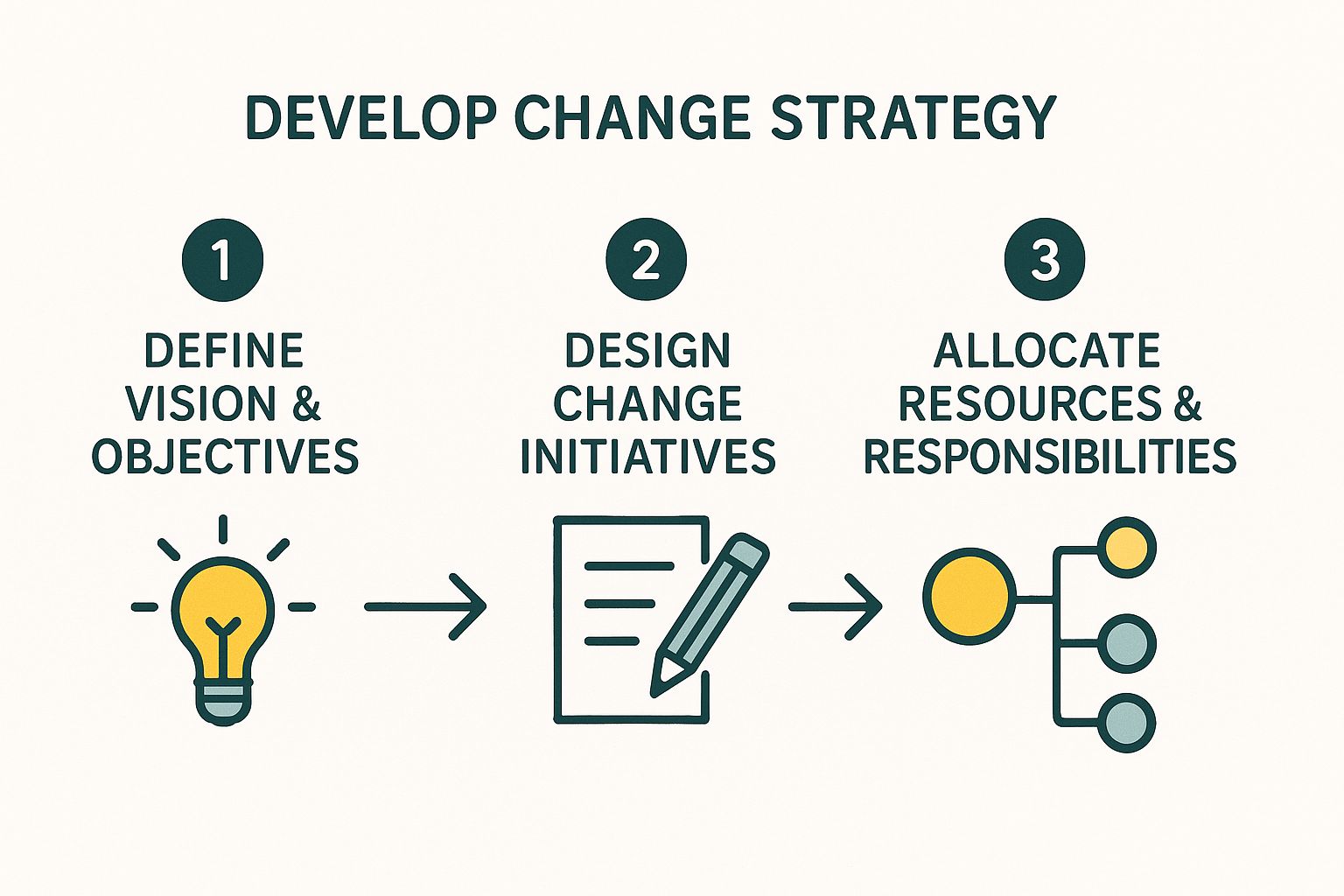
As you can see, it all comes back to having a clear strategy before execution begins. Every action must be tied directly to a specific business goal.
Phase 1: Assess and Align
This foundational stage is all about discovery. Before creating a single custom field in Salesforce, you must get a firm grip on where your business stands now and what "success" will look like post-implementation. This is where you answer the big questions.
A consulting partner facilitates this by meeting with key people across every affected department. They map current processes, pinpoint daily frustrations, and document exactly how switching to Salesforce will change the day-to-day work for every user group.
Salesforce in Action: During this phase, you might analyze sales cycle data from your old systems to set a clear baseline. The goal could be to reduce the average sales cycle by 15% using Sales Cloud automation. This establishes a clear, measurable target for the project.
Phase 2: Plan and Engage
Once you have a crystal-clear picture of your goals and the potential impacts, the next step is to build a strategic plan for communication and training. This is where you proactively answer the question on every employee's mind: "What's in it for me?"
This phase involves creating a detailed communication schedule to keep everyone informed on progress and milestones. It also means designing role-specific training programs—practical, engaging sessions that go beyond a generic, one-size-fits-all approach.
Crucially, this is when you identify and empower your 'Salesforce Champions'. These are influential, respected team members who can build enthusiasm from the ground up and provide invaluable feedback before the official launch. Peer-to-peer support is often more powerful than any top-down directive.
Phase 3: Implement and Support
This is the 'go-live' phase, where all that careful planning comes to life. The technical launch of your Salesforce platform occurs simultaneously with the rollout of your change management support system. It’s not about flicking a switch and walking away; it’s about providing robust, on-the-ground help.
This means having support staff available, a dedicated helpdesk, and easy-to-find quick-reference guides to help users navigate the new system during the crucial first days and weeks. The goal is to build their confidence and make them feel supported, not abandoned.
Key Support Activities:
- Day 1 Readiness: Ensuring every user can log in and has access to the data and tools they need from the moment the system goes live.
- Hypercare Support: Offering an intense period of extra support immediately after launch to quickly resolve issues and answer questions.
- Feedback Channels: Establishing clear ways for users to report problems and suggest improvements, perhaps through a Chatter group or a custom object within Salesforce itself.
Phase 4: Measure and Sustain
The job isn't done just because the system is live. This final, ongoing phase is about tracking adoption, reinforcing new ways of working, and ensuring the benefits of your Salesforce investment are fully realised for years to come.
This involves using Salesforce's own powerful reporting tools to monitor user activity and measure progress against the KPIs defined in Phase 1. When you truly grasp the role of Salesforce development consultants in digital transformation, you’ll see how they can build the very reports and dashboards needed to measure that change effectively.
Salesforce in Action: A consultant can create custom Reports and Dashboards that track key adoption metrics like login rates, new record creation, and data quality scores. If a dashboard shows that the service team is slow to adopt the new case management process in Service Cloud, you can intervene with targeted, follow-up coaching for that group. This ensures no one gets left behind. By celebrating wins and continually refining processes based on real data, you turn a one-off project into a culture of continuous improvement.
Overcoming Common Salesforce Adoption Hurdles
Even the most carefully planned Salesforce project can encounter turbulence. Digital transformation is as much about people as it is about technology. Facing potential adoption hurdles head-on isn’t a sign of a flawed plan; it’s the mark of smart leadership and a core part of effective management consulting change management.
Ignoring common roadblocks like resistance from long-time employees, wavering executive support, or poor data quality can quickly erode user trust and sink the project. The key is to anticipate these challenges and have people-focused solutions ready.
This forward-thinking approach is more critical than ever. The future of the Australian consulting market is projected to grow from USD 5.6 billion in 2024 to USD 10.4 billion by 2033. This boom is fuelled by businesses needing expert help to handle complex changes, proving that managing the human side of technology is a top priority.
Transforming Skeptics into Advocates
One of the biggest hurdles is pushback from experienced team members who are comfortable with their existing processes. A new CRM can feel like a major disruption or, worse, a tool for micromanagement. Simply telling them the new system is “better” is rarely effective.
Instead of a top-down mandate, a better approach is to build support from the ground up. This is where creating a 'Salesforce Champions' program is a game-changer.
How a 'Salesforce Champions' Program Works:
- Identify Influencers: Every team has respected, informal leaders. A good management consulting partner helps you find these individuals—not based on job titles, but on the trust and influence they hold with their colleagues.
- Provide Early Access & Training: These champions get a sneak peek of the Salesforce platform. They receive special, hands-on training and are asked for direct feedback on its configuration. This makes them feel heard and part of the process.
- Empower Them as Leaders: The champions become the go-to experts for their teams. They can answer questions in a way that makes sense to their peers, share real success stories, and ease fears far more effectively than any external trainer or manager.
When you make your most influential users part of the solution, you turn potential resistance into a powerful, grassroots support network. They stop seeing the change as something being done to them and start seeing it as something they are helping to lead.
Tackling Data Distrust and Executive Disengagement
Two other classic project-killers are poor data quality and disengaged leaders. If your team logs into Salesforce on day one and sees incorrect or incomplete customer information, their trust in the system will vanish instantly. Similarly, if executives stop championing the project's importance after launch, employees will assume it’s no longer a priority.
To sidestep resistance and ensure a smooth rollout, it pays to explore proven strategies for introducing change to teams. A skilled partner gets ahead of these issues from the start.
Battle-Tested Solutions for Common Hurdles:
- For Poor Data Quality: A partner will insist on a thorough data cleansing and migration plan before go-live. This ensures that when users log in for the first time, the information they see is reliable, proving the platform's value from the get-go.
- For Inconsistent Sponsorship: A consultant will work with your leadership team to map out a clear sponsorship plan. This includes scheduling regular updates, defining their role in celebrating wins, and coaching them on how to lead by example within Salesforce itself.
Overcoming these hurdles comes down to an honest understanding of human dynamics. It’s about building trust, demonstrating real value, and creating a supportive environment where every user feels confident and equipped to succeed.
Sustaining Long-Term Value from Your Salesforce Investment
Launching your Salesforce platform isn't the finish line; it’s the starting block. The real work of creating lasting value begins the moment you go live. This is where effective management consulting for change management shifts from a project-based mindset to a strategy of continuous improvement, transforming your CRM from a static database into a dynamic asset that evolves with your business.
This ongoing commitment separates a truly successful digital transformation from one that loses steam. It's a common trap: businesses see the 'go-live' date as the final goal, but without a plan to maintain momentum, user adoption can slowly decline, and the platform's full potential is never realised.

Building a Thriving Salesforce Culture
To truly weave Salesforce into your organisation's DNA, you need to cultivate a culture that champions its use daily. This means building systems and feedback loops that encourage people to stay engaged and adapt long after the initial launch excitement has faded.
A powerful tool for this is Salesforce Experience Cloud. You can create dedicated user groups or feedback portals where employees can ask questions, share tips, and suggest improvements. This does more than just solve problems; it builds a genuine community around the platform and provides invaluable, real-time insights into how your team is using the system.
When employees are actively engaged in major change initiatives, their intent to stay with an organisation can increase by as much as 46%. Creating a culture of continuous feedback doesn't just improve your CRM—it strengthens your team.
For larger organisations, establishing a Center of Excellence (CoE) is a game-changer. A CoE acts as the central nervous system for your Salesforce platform, comprising key individuals from IT and various business departments. This group manages future updates, prioritises new feature requests, and ensures every change aligns with the broader business strategy.
Best Practices for Long-Term Salesforce Success
Keeping the momentum going requires a deliberate, ongoing effort. The support you provide at launch must evolve into a sustainable model that builds user confidence and consistently proves the platform's value over time.
Here are a few key practices to lock in:
- Robust Onboarding for New Hires: Don't let new team members figure it out on their own. Integrate Salesforce training directly into your employee onboarding process. This ensures every employee starts with a solid understanding of the platform and your company's best practices from day one.
- Communicate and Celebrate Success: Regularly share success stories that demonstrate how teams are using Salesforce to achieve great results. Use dashboards to showcase tangible wins—like a 15% reduction in sales cycle time or a 20% increase in customer satisfaction scores. This proof makes the tool's value undeniable and inspires others.
- Ongoing Post-Launch Support: Ensure users have clear, easy ways to get help. This could be a helpdesk, a dedicated Chatter group, or regular "office hours" with your Salesforce admin or champions. A responsive support system prevents frustration and is crucial for maintaining engagement.
By focusing on these sustaining activities, you ensure your investment continues to pay dividends for years to come. You can see real-world examples of how businesses have achieved this by exploring our collection of Salesforce case studies.
Frequently Asked Questions About Salesforce Change Management
Embarking on a significant digital transformation with Salesforce naturally brings up questions. Here are answers to some of the most common ones we encounter from business leaders.
What's the first step in a Salesforce change management plan?
The very first step, before any technical configuration begins, is a stakeholder and impact analysis. An experienced Salesforce partner sits down with everyone who will be affected—from sales reps and service agents to executives—to understand their daily work. We map current processes and identify pain points. This foundational work allows us to see exactly how the new Salesforce solution will change their routines, which is critical for gaining buy-in from the start.
How do we measure the success of a change management program?
Success is measured through a combination of quantitative data and qualitative feedback. On the quantitative side, we use Salesforce dashboards to track key metrics like user login rates, new record creation, and data quality scores. We also tie these metrics back to the original business goals, such as reducing the sales cycle or improving first-call resolution rates. Qualitatively, we use user satisfaction surveys, feedback sessions, and direct observation to gauge how people feel about the new system. A truly successful program achieves high user adoption, positive user feedback, and measurable business results.
Can we manage this change internally without a consultant?
While it's possible, partnering with a management consulting firm specializing in Salesforce change management offers significant advantages. We bring an objective, outside perspective and proven frameworks refined over countless projects. This prevents your internal teams from being stretched thin trying to manage a massive change initiative on top of their regular duties. A partner also acts as a neutral facilitator who can navigate internal politics and keep everyone focused on the strategic objectives. This external expertise is often the difference between a Salesforce project that simply gets implemented and one that gets fully adopted and delivers lasting value.
Ready to ensure your Salesforce investment delivers maximum ROI? The team at Adaptal has the management consulting experience to guide your people through a smooth and successful digital transformation.