

Managed IT services offer Australian businesses a strategic way to hand over their technology management, ensuring core systems run smoothly, securely, and efficiently. For companies leveraging Salesforce, this isn't just about fixing broken IT; it’s about building a rock-solid foundation that allows your CRM to deliver maximum value. A managed service provider (MSP) acts as your strategic partner, guaranteeing the stability and security your Salesforce instance needs to thrive.
Why Your Business Needs a Strategic IT Partner for Salesforce Success
Think of your IT infrastructure as the central nervous system of your business. When it’s healthy, every department, from sales to service, operates at its best. Managing this complex system in-house can be a major drain on resources, pulling focus away from strategic goals. Partnering with a Managed Service Provider (MSP) is like gaining an entire team of IT specialists dedicated to keeping this system optimised.
This partnership is a strategic move away from reactive IT firefighting. Instead of scrambling to fix problems after they occur, you get proactive technology management that anticipates issues before they impact your business operations. For Australian organisations using Salesforce, this approach solves several critical challenges.
Overcoming Core Business Hurdles with Managed Services
A skilled MSP helps you navigate the common roadblocks that hinder growth, particularly when it comes to getting the most from your CRM investment.
- Skills Shortages: You gain immediate access to certified experts in cybersecurity, cloud infrastructure, and network management—all essential for a stable Salesforce environment—without the high cost of direct hires.
- Unpredictable Budgeting: Shift from unexpected capital expenses for IT failures to a fixed, predictable monthly operational cost, making financial planning simpler and more accurate.
- Focus on Growth: Your internal teams, including Salesforce administrators, are freed from day-to-day IT maintenance. They can focus on high-value activities like customising Salesforce to improve customer experience and drive business growth.
A stable and secure IT foundation is the launchpad for a high-performance Salesforce platform. Without it, you risk downtime, data integrity issues, and missed opportunities, preventing your CRM from delivering its full potential.
The demand for these partnerships is skyrocketing. The managed services market in Australia hit USD 6,092.00 million in 2024 and is expected to surge to USD 11,437.62 million by 2033. This growth highlights a clear trend: Australian businesses are recognising that robust digital transformation and operational resilience depend on expert IT management.
Core Benefits of Managed IT Services for Australian Businesses
Partnering with an MSP brings strategic advantages that directly impact your operational efficiency and bottom line, especially for businesses reliant on cloud platforms.
| Business Advantage | Direct Impact on Your Operations |
|---|---|
| Predictable Costs | Shift from large, unexpected capital expenses to a fixed monthly operational fee. |
| Access to Expertise | Gain a team of certified specialists in security, cloud, and networking on demand. |
| Proactive Management | Move from reactive problem-fixing to proactive maintenance and monitoring. |
| Enhanced Security | Implement robust cybersecurity measures to protect sensitive customer data in Salesforce. |
| Increased Efficiency | Free up your internal team to focus on core business goals, not IT troubleshooting. |
| Scalability | Easily scale your IT resources up or down to match your business needs. |
This strategic shift transforms IT from a simple cost centre into a powerful asset that fuels growth and innovation.
Ultimately, managed services ensure the technology you rely on—from your CRM to your cloud infrastructure—is not just running, but actively helping you achieve your business goals. For a deeper dive into the foundational importance, explore why managed IT services are crucial for your business. This alignment is what separates a basic IT vendor from a true technology partner.
Choosing Your Managed Services Model for Salesforce
Once you've decided to engage a managed service provider, the next step is choosing the right partnership model. For Australian businesses, this decision depends on your existing in-house resources, your team's expertise, and your strategic objectives. Understanding the two primary models—fully-managed and co-managed—is key to finding the perfect fit for supporting your Salesforce ecosystem.
The model you choose will define the working relationship between your internal team and your new technology partner, directly impacting the performance of your entire IT environment.
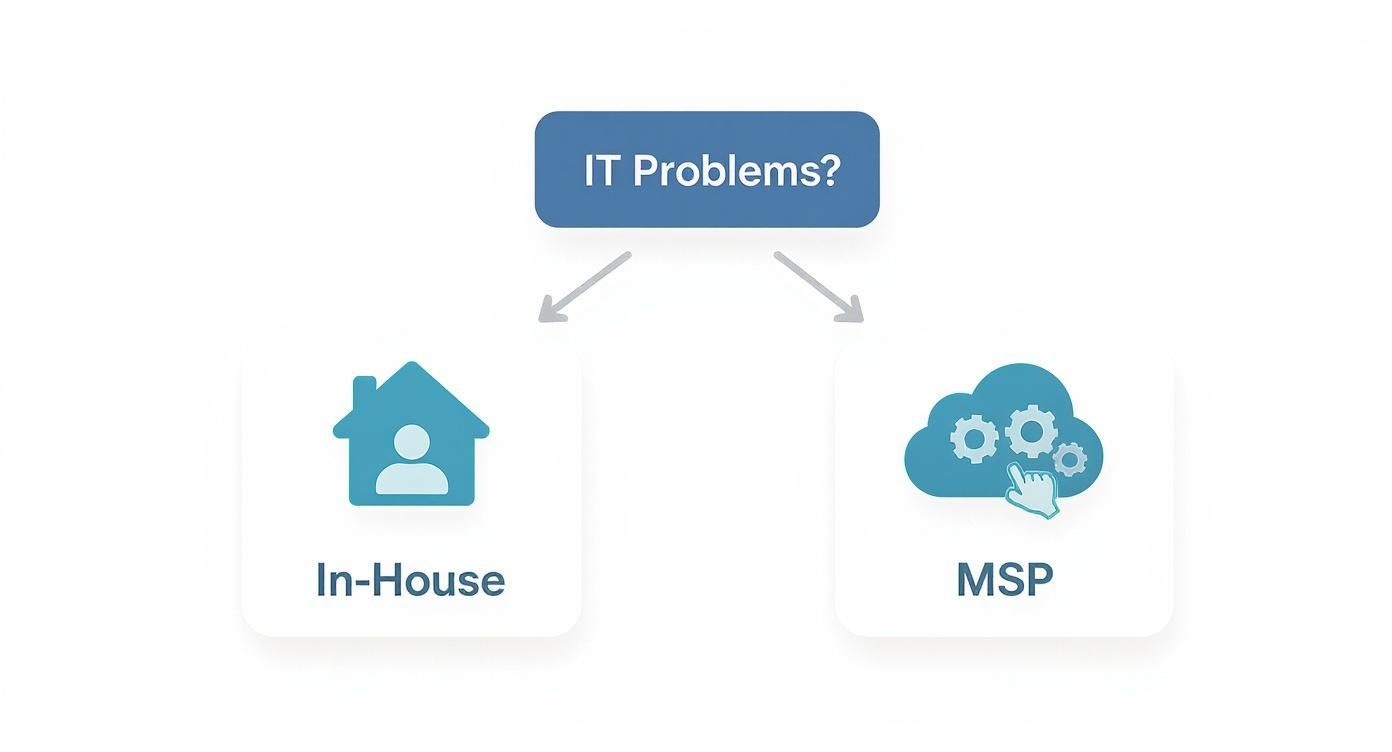
This illustrates the core choice: do you manage IT challenges internally, or do you leverage the specialised expertise of a dedicated partner?
The Fully-Managed Model: Your Outsourced IT Department
The fully-managed model involves handing over your entire IT operation to an MSP. It’s an ideal choice for businesses without an internal IT department or for those who want to reallocate their technical staff to more strategic, revenue-generating projects. Your MSP becomes your dedicated, end-to-end IT team.
In this setup, the provider takes full ownership of everything from daily helpdesk support and network monitoring to long-term technology strategy and cybersecurity. It’s an all-in-one solution designed for complete peace of mind.
- Who it's for: Perfect for small to medium-sized businesses (SMEs), non-profits, or any organisation that wants to focus entirely on its core mission without being distracted by technology issues.
- Salesforce Context: If your business runs on Salesforce, this model is invaluable. It ensures the entire underlying foundation—from network stability to endpoint security—is rock-solid, providing the perfect platform for your CRM to perform optimally.
The fully-managed model is about achieving operational excellence through strategic delegation. You empower specialists to handle the technology, freeing your team to focus on innovation and customer success.
This approach also simplifies accountability. With a single partner responsible for all things IT, you have one point of contact for every issue, from a forgotten password to a major security incident.
The Co-Managed Model: A Collaborative Partnership
The co-managed model, sometimes known as "Co-MITs" (Co-Managed IT Services), is a strategic alliance. It’s not about replacing your IT team but augmenting their capabilities. This approach blends your internal team’s deep business knowledge with an MSP's specialised tools, expertise, and resources.
For instance, your team might excel at daily user support and Salesforce administration but lack the specialised skills for advanced cybersecurity or complex cloud architecture. The MSP steps in to fill these gaps, acting as a powerful extension of your existing team.
- Who it's for: Ideal for businesses with an in-house IT team that is stretched thin, needs specialised skills for complex systems like Salesforce integrations, or requires 24/7 monitoring they cannot provide on their own.
- Salesforce Context: Your Salesforce admins can focus on customising the platform and driving user adoption, while the MSP handles the critical behind-the-scenes security and infrastructure that keeps your customer data safe and your system continuously available.
This hybrid model allows you to retain institutional knowledge and direct control where it matters most while gaining access to enterprise-grade technology and a deep bench of specialists. It's a flexible, powerful way for growing Australian businesses to scale their IT capabilities without the significant overhead of hiring more full-time staff.
Core Managed Services for Australian Businesses
We've covered the different partnership models. Now, let's explore the specific services an Australian provider offers. These aren't just technical terms; they are tangible solutions designed to solve real-world business problems and strengthen your operations.
Think of it as having a dedicated, outsourced IT department with specialised divisions, each handling a critical function. Most of these services fall into three main buckets: security, infrastructure, and communications. Together, they build a rock-solid foundation for business-critical platforms like Salesforce.
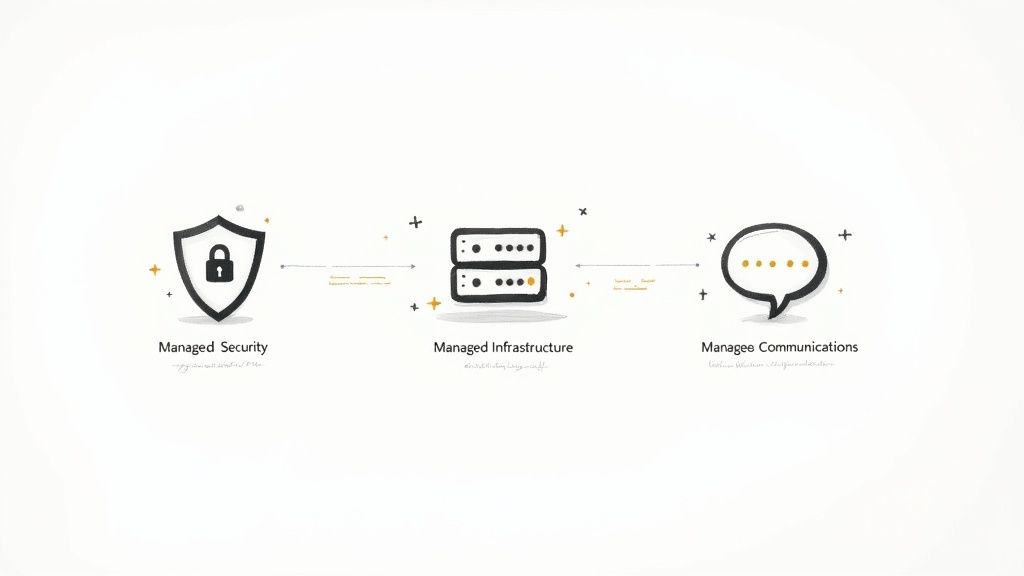
Managed Security: Protecting Your Salesforce Data
In an era of escalating cyber threats, managed security is your most vital line of defence. This service shifts your business from a reactive stance to a proactive one, actively identifying and neutralizing risks before they can cause damage. The primary business challenge it solves is risk mitigation—protecting your valuable customer data and brand reputation.
A comprehensive managed security service delivers 24/7 monitoring, threat detection, and a rapid incident response plan. It ensures your business complies with Australian regulations like the Notifiable Data Breaches scheme and aligns with frameworks like the Essential Eight, protecting the sensitive customer data held within your Salesforce CRM.
Managed security was the largest segment of the Australian managed services market in 2024. As threats grow more sophisticated, businesses are wisely investing in specialist protection to prevent costly data breaches, reputational damage, and operational downtime.
Managed Infrastructure: The Engine Room for Your CRM
If security is your shield, managed infrastructure is the engine that powers your business. This service focuses on the performance, reliability, and health of your core IT components—servers, networks, storage, and data centres, whether on-premises or in the cloud. The goal is to ensure the technology your business and Salesforce depend on is always available and performing at its peak.
Your MSP will proactively monitor systems, apply critical security patches, manage data backups, and plan for future capacity to prevent performance bottlenecks.
Think of it like servicing a high-performance vehicle. You don’t wait for it to break down; you perform regular maintenance to ensure it runs smoothly and reliably. That's what managed infrastructure does for your IT, ensuring Salesforce never falters due to an underlying issue.
This is absolutely crucial for platforms like Salesforce that require constant connectivity and data access to be effective. For example, a property management firm we worked with was experiencing frequent system crashes during peak times. By optimising their cloud infrastructure, we provided the stability their Salesforce instance needed, resulting in a 40% reduction in system downtime and a significant boost in agent productivity.
Managed Communications: Enabling Seamless Collaboration
In today's hybrid work environment, reliable communication is essential for collaboration and customer engagement. Managed communications services ensure your team can connect seamlessly and securely, no matter their location.
This goes beyond traditional phone systems. It encompasses the modern tools that are the lifeblood of daily operations:
- VoIP (Voice over Internet Protocol): Modern, flexible business phone systems that can integrate directly with Salesforce for click-to-dial and automatic call logging.
- Video Conferencing: Ensuring platforms like Zoom and Microsoft Teams are stable, secure, and integrated into your workflows.
- Unified Communications (UC): Weaving voice, video, and messaging into a single, cohesive platform to boost productivity.
A well-managed communications stack prevents the dropped calls and security gaps that kill productivity. For a sales team living in Salesforce, a reliable communication system integrated with their CRM is non-negotiable. It ensures every customer interaction is logged, tracked, and professional, directly fuelling sales and service success.
Using Cloud Managed Services To Fuel Your Growth
The cloud is the engine room for modern Australian businesses. To fully harness its power for agility and innovation, you need Cloud Managed Services. A specialist Managed Services Provider (MSP) acts as your expert guide, helping you master platforms like AWS, Azure, and Google Cloud and turning complex infrastructure into a strategic advantage.
This partnership goes beyond simple maintenance. It includes expert cloud migration, continuous cost optimisation, and proactive performance monitoring to ensure your applications run smoothly. A great cloud MSP ensures your environment is not just working—it's actively fine-tuned to help you achieve your business goals and gain a competitive edge.

Getting Data Sovereignty and Compliance Right
For any business in Australia, using the cloud comes with the critical responsibility of data sovereignty. This principle requires that your sensitive data is stored and managed in accordance with Australian laws, such as the Privacy Act. Partnering with a local Australian provider is non-negotiable for ensuring your data remains onshore and secure.
An expert in managed services Australia understands these local regulations intimately. They design your cloud architecture from the ground up to meet these strict requirements, implementing the necessary security controls and compliance frameworks. This focus provides invaluable peace of mind, knowing your customer, financial, and operational data is properly protected.
The Cloud: Your Foundation for Salesforce Success
Your Salesforce CRM is the heart of your customer relationships, but its performance depends entirely on the health of the infrastructure it runs on. A well-managed cloud environment is essential to unlock the true power of platforms like Salesforce, providing the reliability, scalability, and security your most critical data demands.
Here's how they are directly connected:
- Performance and Reliability: An MSP ensures your cloud infrastructure delivers the high availability and low latency Salesforce needs to operate at full speed. This eliminates frustrating slowdowns for your team and customers.
- Scalability on Demand: As your business grows, your MSP can seamlessly scale your cloud resources. This means Salesforce can handle more data, more users, and more complex processes without missing a beat.
- Integrated Security: The MSP secures the entire cloud environment, hardening the servers and networks that your CRM relies on. This creates a powerful, multi-layered defence against external threats targeting your customer data.
A robust cloud strategy isn’t a separate project from your CRM strategy—it's the foundation. By making sure your cloud operations are expertly managed, you create the perfect conditions for Salesforce to deliver amazing customer experiences and drive real business growth.
Aligning your cloud and CRM strategies is critical. For a deeper dive into building this foundation, explore our complete Salesforce implementation guide for Australian businesses. It provides a roadmap for integrating your platform and infrastructure for maximum impact.
There’s a clear reason why investment in cloud managed services is booming. In Australia, the market generated USD 3,108.6 million in 2024 and is set to grow at a CAGR of 22.3%, reaching USD 10,313.9 million by 2030. A skilled MSP helps you leverage this powerful technology while they handle all the underlying complexity.
How to Select the Right Managed Services Partner
Choosing a managed service provider is one of the most critical technology decisions your business will make. You are not just hiring a vendor to fix IT issues; you are selecting a partner who will be deeply integrated into your daily operations and future growth strategy.
A great MSP partnership ensures your entire tech stack, including core platforms like Salesforce, operates as a cohesive, well-oiled machine. The right choice will accelerate your growth, while the wrong one can lead to constant frustration, security vulnerabilities, and wasted investment. To choose wisely, you must look beyond a simple technical checklist and assess how a potential partner aligns with your business goals.
Look Beyond the Technical Checklist
While technical competence is a baseline requirement, the real value lies in a partner who understands your business context and can tailor their services to help you achieve specific objectives. This is what separates everyday providers from true strategic partners.
As you begin your search, focus on these crucial factors:
- Industry-Specific Experience: Do they understand the unique challenges, terminology, and compliance requirements of your sector? A provider with experience in your industry will anticipate problems and recommend relevant solutions.
- Proven Scalability: Ask for concrete examples and case studies of how they have supported other businesses during periods of growth. You need a partner whose processes and infrastructure can keep pace with your ambitions.
- Security and Compliance Certifications: Look for credentials like ISO 27001, which demonstrates adherence to internationally recognised security standards. This is essential for protecting your data and maintaining customer trust.
Analyse Case Studies and Service Level Agreements
A provider's website will always present them in the best light. To understand their real-world performance, you need to review their case studies and their Service Level Agreement (SLA).
Look for success stories with businesses of a similar size and in the same industry as yours. Pay close attention to their experience managing the infrastructure for complex platforms like Salesforce. A provider who can demonstrate expertise in maintaining the foundation for a high-performing CRM is invaluable. At Adaptal, our Salesforce consulting services are built on the understanding that a stable IT foundation is essential for a successful Salesforce implementation.
The SLA is your contract of accountability. Don’t just skim the response times.
A strong SLA is much more than response times. It must clearly outline guaranteed uptime percentages, resolution times for different issue types, security incident protocols, and a clear escalation path. Think of it as your guarantee of accountability.
As you choose your partner, it's crucial to understand the basics of third-party risk management. Your MSP will have deep access to your systems, so a thorough risk assessment isn’t just good practice; it's essential.
Asking the Right Questions
The best way to find a great partner is to ask great questions. Go beyond "How much does it cost?" and probe into how they work and deliver value day-to-day. You are looking for a team that is genuinely invested in your success. The right questions will reveal their approach to proactive management, strategic advice, and customer support, giving you the confidence to make the right decision.
A structured evaluation process ensures you compare providers fairly and select the one that truly aligns with your long-term goals. Here’s a simple checklist to help you organise your thoughts and compare your options side-by-side.
MSP Evaluation Checklist for Australian Businesses
| Evaluation Criteria | Provider A | Provider B | Provider C |
|---|---|---|---|
| Industry Experience (e.g., Construction, Healthcare) | |||
| Client Case Studies (Relevant to your size/sector) | |||
| Security Certifications (ISO 27001, etc.) | |||
| SLA: Uptime Guarantee (e.g., 99.9%) | |||
| SLA: Response & Resolution Times | |||
| Scalability & Growth Support (Proven examples) | |||
| Local Australian Support Team | |||
| Integration Expertise (Salesforce, NetSuite, etc.) | |||
| Proactive Monitoring & Reporting | |||
| Contract Flexibility & Exit Clauses | |||
| Pricing Model (Clarity & Inclusions) | |||
| Cultural Fit & Communication Style |
By methodically working through these points for each potential provider, you can move past the sales pitch and make a decision based on concrete evidence and genuine alignment with what your business needs to thrive.
Partnering for Strategic Growth, Not Just IT Support
This guide has shown that managed services in Australia are far more than just another IT expense; they are a strategic investment in the future of your business. When you entrust your technology foundation to experts, you free up your team to focus on what truly matters: innovation, customer relationships, and growth.
A reliable IT infrastructure is the bedrock upon which powerful tools like Salesforce thrive. The right managed service provider doesn't just fix problems—they enable opportunities, creating a stable environment where your most critical applications can perform flawlessly. We've seen firsthand in our Salesforce case studies how a solid tech foundation is essential for achieving incredible results.
We understand this connection deeply. The goal is to move beyond reactive fixes and build a holistic technology strategy that proactively drives your business forward. A true partnership is about enabling growth, not just managing helpdesk tickets. We are ready to help you build a comprehensive strategy that turns your technology into a competitive advantage, ensuring your IT investments deliver measurable returns and support your long-term vision.
Your Top Questions About Managed Services Answered
When Australian businesses consider managed services, a few key questions always arise. Getting clear answers is the first step toward making a confident decision. Here are our responses to the most common queries we encounter from organisations using Salesforce.
How Much Do Managed IT Services Cost in Australia?
There is no single price for managed IT services in Australia. Costs are typically structured around models like per-user, per-device, or tiered packages, with the final fee depending on the complexity of your business and the scope of services required.
For example, a small business needing basic helpdesk support will have a different cost structure than a larger enterprise requiring 24/7 cybersecurity, cloud management for Salesforce, and compliance reporting. The key consideration is not the monthly fee but the Return on Investment (ROI).
When evaluating cost, look beyond the invoice. Factor in the financial benefits of reduced downtime, enhanced security that prevents costly data breaches, and increased team productivity. A great MSP delivers value that far exceeds its price.
What Is a Service Level Agreement and Why Does It Matter?
The Service Level Agreement (SLA) is the most important document in your MSP partnership. It is the formal contract that defines the services you will receive, the performance guarantees, and the responsibilities of both parties. It is your primary tool for accountability.
A robust SLA must be crystal clear on several key components to protect your operations.
- Guaranteed Response and Resolution Times: Defines how quickly the MSP must acknowledge and fix different types of issues.
- Uptime Percentages: A firm commitment to keeping your critical systems, including those supporting Salesforce, online (e.g., 99.9% uptime).
- Escalation Procedures: A clear pathway for escalating an issue if it is not resolved within the agreed-upon timeframe.
How Does an MSP Support Our Salesforce CRM?
This is a critical question. While a specialist Salesforce partner like Adaptal focuses on configuring and optimising your CRM, an MSP ensures the entire IT infrastructure underpinning it—the network, security, and user devices—is stable and high-performing. They are two essential partners working together for your success.
A proactive MSP ensures your business-critical applications like Salesforce are always available and performing at their best. They manage the security that protects your customer data, maintain the network that keeps your team connected, and ensure every employee's device is optimised. They collaborate with your other technology partners to create a seamless and secure digital environment.
What Are Typical Managed Services Contract Lengths?
In the Australian market, standard managed services contracts typically range from 12 to 36 months. Longer terms often secure better pricing and allow the MSP to invest more deeply in understanding and optimising your IT environment.
However, flexibility is equally important. When reviewing an agreement, look for clauses that allow for scalability. Your business will evolve, and your agreement must permit you to add or remove services as needed. Understanding termination clauses is also vital to ensure the partnership remains aligned with your long-term strategic goals.
Ready to build a technology strategy that actively drives your business forward? The team at Adaptal has the expertise to ensure your IT foundation perfectly supports your Salesforce platform, enabling growth and innovation. Contact us today for a consultation.