
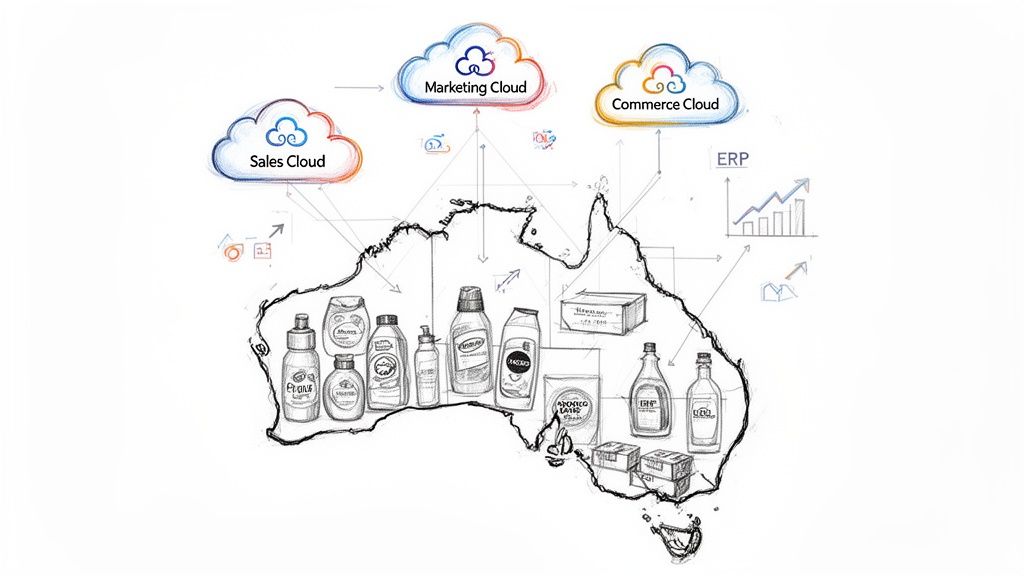
Australia’s Fast-Moving Consumer Goods (FMCG) sector is a high-stakes environment defined by fierce competition and evolving consumer loyalties. The challenge for ambitious FMCG brands in Australia is no longer just about product placement on a physical shelf; it’s about mastering the digital shelf through sophisticated data analytics, seamless customer experiences, and optimised supply chains. For many, logistics is a critical pain point, and finding the best courier services for e-commerce success in Australia is just one piece of a complex puzzle.
The real challenge lies in managing data. Leading brands aren’t just selling products; they’re building data-driven ecosystems to manage complex B2B relationships with retailers and engage directly with consumers. This is where a powerful CRM platform like Salesforce becomes indispensable. In this article, we analyse how prominent players like Woolworths, Coles, and Amazon Business operate, and more importantly, we reveal the Salesforce strategies that enable businesses of any size to compete. From managing trade promotions with Sales Cloud to delivering personalised consumer journeys with Marketing Cloud, we’ll share actionable insights from our real-world Salesforce projects.
1. The Challenge: Managing B2B Procurement at Scale with Woolworths at Work
For businesses procuring supplies, the challenge is maintaining financial control while ensuring operational efficiency. Woolworths at Work, the dedicated B2B platform from Woolworths Group, addresses this by offering a tailored solution for organisations needing food, cleaning supplies, and office essentials at scale. The platform is designed for SMEs, franchises, and healthcare providers that require robust financial and logistical controls.
This platform stands out by integrating powerful business-centric features directly into the procurement process. It’s not just about ordering bulk items; it’s about managing an organisation’s expenditure efficiently, making it a key channel for many FMCG brands in Australia.
The Salesforce Solution: Integrating Procurement Data for a 360-Degree View
For a business using Salesforce, the challenge is connecting procurement data to the rest of the customer and operational picture. The solution is integration. By connecting Woolworths at Work purchasing data with Salesforce Sales Cloud, organisations can solve the problem of inaccurate job costing by tracking supply costs against specific projects or client accounts.
- The Business Challenge: Lack of visibility into operational expenditure per client or project, leading to inaccurate profitability analysis.
- The Salesforce Solution: A custom integration feeds procurement data into a custom Salesforce object linked to Accounts or Opportunities in Sales Cloud. This automates the allocation of supply costs.
- The Results & Benefits: Finance teams gain real-time visibility into project profitability. Account managers can make data-driven decisions on pricing and resource allocation. Marketing Cloud can even leverage procurement trends to inform B2B campaigns, transforming a simple procurement platform into a strategic data source.
Website: https://atwork.woolworths.com.au/
2. The Challenge: Understanding B2C Trends with Woolworths Online
Woolworths Online is the consumer-facing e-commerce platform for one of Australia’s largest supermarket chains. It provides direct access to a vast assortment of groceries and household goods, designed for convenience with multiple fulfilment options. While not a dedicated B2B portal, its scale and accessibility make it a crucial channel for accessing thousands of FMCG brands in Australia.
For FMCG brand managers, the challenge is translating the vast amount of public retail data from platforms like this into actionable business intelligence. How do you know which promotions are working, what regions are showing growth, and where your competitors are gaining an edge?
The Salesforce Solution: Turning Market Data into Actionable Insights
For B2C-focused businesses using Salesforce, the solution is to leverage CRM Analytics (formerly Tableau CRM) to analyse market data. By integrating sales data from retail partners like Woolworths, companies can create powerful dashboards that solve the problem of disconnected, siloed information.
- The Business Challenge: Sales teams and brand managers lack a unified view of product performance across different retail channels and regions.
- The Salesforce Solution: Retail sales data is aggregated and fed into CRM Analytics. Dashboards are created to visualise product performance by region, store type, and promotional period, giving teams in Sales Cloud a clear view of growth opportunities.
- The Results & Benefits: Sales leaders can identify underperforming regions and allocate resources effectively. Marketing teams can use Marketing Cloud to launch campaigns that reflect current consumer preferences, turning broad market activity into a competitive advantage.
Website: https://www.woolworths.com.au/
3. The Challenge: Optimising B2B Supply Chains with Coles Online
Coles Online is the e-commerce platform of Coles Group, another of Australia’s leading supermarket chains. It offers a comprehensive digital channel for consumers and small businesses to purchase groceries and household essentials. For businesses, it serves as an efficient tool for stocking office kitchens or managing supplies for small-scale hospitality venues.
The challenge for B2B suppliers to these major retailers is understanding product performance and demand at a granular level. Without this data, it’s difficult to manage inventory, forecast production, and support retail account managers effectively.
The Salesforce Solution: CRM for Enhanced Supplier Relationship Management
While primarily a B2C platform, the purchasing data from Coles Online is invaluable when integrated with Salesforce. For B2B suppliers, the solution is to use Salesforce as a central hub for retailer relationship management, informed by real-time sales data.
- The Business Challenge: B2B account managers lack the data to have strategic conversations with retailers like Coles about product performance and joint marketing initiatives.
- The Salesforce Solution: An integration feeds FMCG sales data from retail partners into Sales Cloud dashboards. Account managers can now track sales velocity, identify trends, and proactively manage their retail accounts.
- The Results & Benefits: Account managers are empowered with data, leading to stronger retailer partnerships. Marketing Cloud can leverage these insights to create targeted trade marketing campaigns, promoting bulk offers or corporate-specific product bundles. This turns public retail data into a strategic asset for understanding the broader FMCG industry in Australia.
Website: https://www.coles.com.au/
4. The Challenge: Centralising Procurement with Amazon Business Australia
Amazon Business Australia extends the familiar consumer marketplace into a powerful B2B procurement platform. It offers a consolidated purchasing solution for everything from office supplies to a vast range of FMCG products, making it ideal for SMEs and franchises looking to simplify procurement with robust financial oversight.
The platform stands out by embedding business-centric controls and pricing into the Amazon user experience. The challenge for businesses using it is connecting this expenditure to their core financial and project management systems to get a complete view of costs.
The Salesforce Solution: Integrating Salesforce with Procurement Platforms
Integrating Amazon Business purchase data with Salesforce provides a holistic view of client-related and operational costs, solving the problem of manual expense tracking and allocation.
- The Business Challenge: Difficulty attributing procurement costs to specific projects, clients, or internal departments, leading to poor budget tracking and profitability analysis.
- The Salesforce Solution: By connecting purchase history to Salesforce Sales Cloud, businesses can automate the attribution of supply costs. A custom workflow can link an Amazon Business purchase to a specific Opportunity or Account record.
- The Results & Benefits: Businesses gain precise P&L reporting on a per-project basis. This integration elevates a procurement tool into a vital data source, enabling smarter financial management. For brands selling on the platform, effective Amazon PPC and Online Brand Growth Strategies are crucial, and you can explore further insights on top FMCG companies in Australia.
Website: https://business.amazon.com.au/
5. The Challenge: Managing Operational Spend with Chemist Warehouse
Chemist Warehouse is Australia’s largest discount pharmacy retailer. Its aggressive pricing model makes it a major procurement channel for businesses needing toiletries, cleaning supplies, and first-aid essentials. For businesses like healthcare clinics or professional services firms, it provides a cost-effective way to stock facilities.
The challenge is tracking this ancillary, but significant, operational spend across multiple locations or departments without a centralised system.
The Salesforce Solution: Using CRM for Internal Operations Management
Integrating Chemist Warehouse procurement data into Salesforce offers significant advantages for managing staff welfare and operational costs. The solution is to treat internal operations with the same data-driven rigour as customer-facing activities.
- The Business Challenge: A lack of visibility into spending on health and hygiene supplies, making it difficult to manage budgets and forecast operational overheads.
- The Salesforce Solution: Purchasing data is funnelled into a custom object in Salesforce. A dashboard provides a real-time view of expenditure per office location or department.
- The Results & Benefits: The business gains clear visibility into operational costs, enabling better budget management. This data can inform wellness programs managed through Salesforce, helping to build a stronger understanding of what is customer relationship management by treating employees as internal customers. For healthcare providers, this allows for better inventory management of clinical supplies.
Website: https://www.chemistwarehouse.com.au/
6. The Challenge: Optimising Bulk Procurement with Costco Australia
Costco Australia operates as a membership-based warehouse club, providing a powerful procurement channel for businesses that need to purchase in bulk. Its model focuses on offering a curated selection of leading FMCG brands in Australia at highly competitive unit prices, making it ideal for the food service and SME sectors.
The business challenge is managing inventory effectively when purchasing in large, infrequent batches. Without the right system, businesses risk stockouts of high-turnover items or overstocking of slower-moving goods.
The Salesforce Solution: Salesforce Commerce Cloud for Inventory Management
Integrating Costco procurement data into Salesforce can unlock significant operational insights. For businesses in hospitality or retail, the solution is to use Salesforce Commerce Cloud or a custom inventory management app built on the Salesforce Platform.
- The Business Challenge: Manual inventory tracking leads to stockouts, lost sales, and inefficient use of capital.
- The Salesforce Solution: Procurement data from Costco is used to update inventory levels within Salesforce. Automated workflows can trigger re-order alerts when stock for high-turnover FMCG products falls below a set threshold.
- The Results & Benefits: The business reduces the risk of stockouts and optimises cash flow by preventing overstocking. By connecting spending data to Sales Cloud, organisations can accurately track Cost of Goods Sold (COGS), leading to more precise profitability analysis.
Website: https://www.costco.com.au/
7. The Challenge: Streamlining B2B Food Service with Bidfood Australia
Bidfood Australia is a national B2B food service wholesaler supplying over 35,000 products to the hospitality and healthcare sectors. Its online ordering system, myBidfood, is purpose-built for commercial kitchens and multi-site venues that depend on a reliable source for FMCG brands in Australia.
The challenge for a multi-site franchise or healthcare group is managing procurement across all locations, ensuring consistency, controlling costs, and analysing profitability at both a local and national level.
The Salesforce Solution: Centralised Reporting and Analytics in Salesforce
Integrating Bidfood with Salesforce provides a powerful solution for multi-site operators. By connecting myBidfood procurement data to Salesforce Sales Cloud or Service Cloud, an organisation can solve the problem of fragmented purchasing data.
- The Business Challenge: Lack of a centralised view of supply costs and purchasing trends across multiple business locations, making it impossible to negotiate effectively with suppliers or analyse profitability accurately.
- The Salesforce Solution: An integration feeds procurement data into Salesforce, tagged by location. CRM Analytics dashboards provide a consolidated view of spending, highlighting trends and identifying opportunities for cost savings.
- The Results & Benefits: Head office gains the ability to implement national procurement strategies and negotiate better terms with suppliers. For healthcare providers, this integration allows for precise budget management for patient meal services by linking food expenditure to patient management records.
Website: https://www.bidfood.com.au/
How a Salesforce Partner Solves These FMCG Challenges
| Business Challenge | The Salesforce Solution | Key Platform Features | Expected Outcomes | Ideal for… | Why a Partner is Crucial |
|---|---|---|---|---|---|
| Inaccurate job costing & spend visibility | Integrate B2B procurement data into Sales Cloud | Custom Objects, Automated Workflows, CRM Analytics | Accurate project profitability; data-driven financial planning | SMEs, professional services, franchises | To build custom integrations and financial reporting dashboards |
| Lack of insight from retail sales data | Aggregate and visualise sales data in CRM Analytics | Dashboards, Data Connectors, Einstein Discovery | Identify growth opportunities; optimise marketing spend | FMCG brand managers, B2C marketers | To correctly model complex retail data and build insightful dashboards |
| Disconnected retailer relationships | Centralise account management in Sales Cloud | Account Management, Dashboards, Activity Tracking | Stronger B2B partnerships; data-backed negotiations | B2B suppliers, national account managers | To configure Sales Cloud for the unique needs of FMCG account management |
| Manual operational expense tracking | Use Salesforce Platform for custom internal apps | Custom Objects, Lightning App Builder, Reports & Dashboards | Centralised cost control; improved operational efficiency | Multi-site businesses, healthcare, hospitality | To design and build custom applications that align with specific operational workflows |
| Inefficient inventory management | Automate re-ordering with Commerce Cloud or custom apps | Inventory Management, Automated Alerts, Order History | Reduced stockouts; optimised cash flow; better forecasting | Retailers, hospitality venues, e-commerce businesses | To implement inventory logic and integrate with procurement and POS systems |
| Fragmented multi-site procurement | Centralise data and reporting in Salesforce | CRM Analytics, Custom Dashboards, Account Hierarchies | National procurement strategies; improved supplier negotiation leverage | Multi-site franchises, healthcare groups, large operators | To architect a scalable data model that supports complex, multi-location reporting |
Partner with Adaptal to Unlock Your FMCG Potential with Salesforce
Navigating the dynamic landscape of Australia’s FMCG sector requires more than a great product. As we’ve seen, success hinges on a sophisticated, data-driven approach to sales, marketing, and supply chain management. The common thread is the reliance on a powerful, integrated digital platform like Salesforce to understand customers and streamline operations.
The key takeaway is that a unified CRM platform is the engine that drives a modern FMCG strategy. Whether it’s leveraging Sales Cloud to manage complex B2B relationships, using Marketing Cloud to personalise consumer campaigns, or integrating Commerce Cloud for seamless inventory management, the tools are available to level the playing field. The journey from disconnected spreadsheets to a single source of truth is the most critical digital transformation your business can undertake.
Your Actionable Next Steps with a Salesforce Partner
Embarking on this digital transformation requires a strategic plan. Here’s how to move forward:
- Assess Your Core Challenge: Is your biggest pain point managing field sales territories, understanding B2B customer lifetime value, or providing a seamless e-commerce experience? A Salesforce partner can help you conduct a discovery workshop to pinpoint your primary challenge and define a clear starting point, like a Sales Cloud implementation for your sales team.
- Prioritise Integration: The true power of Salesforce is realised when it connects to your other core systems, such as NetSuite, SAP, or your inventory management software. A successful implementation project must include a detailed integration roadmap to ensure a seamless flow of data across your entire organisation.
- Plan for Scalability: Your solution must solve today’s problems and support future growth. Will you be adding new product lines, entering new states, or launching a direct-to-consumer channel? A trusted partner ensures your platform architecture can scale with you, preventing a costly overhaul in a few years.
Choosing the right technology is only half the battle. The success of your Salesforce implementation hinges on partnering with experts who understand the unique pressures of the Australian FMCG market. A partner with proven project experience helps you avoid common pitfalls and configures the platform to your specific business processes, ensuring you achieve a tangible return on your investment among the leading FMCG brands in Australia.
Ready to transform your FMCG operations with a tailored Salesforce solution? The team at Adaptal has delivered over 110 successful Salesforce projects, helping Australian businesses streamline their processes and drive growth. Connect with our Salesforce experts today for a consultation and discover how we can help you achieve your goals.