

Imagine this: your field technician arrives at a customer's site, not with a vague work ticket, but with the equipment's complete service history at their fingertips. They have the right part in their van, ready to solve the problem on the first visit. This isn't a future-state dream; it's the operational reality that Salesforce Field Service is engineered to deliver. It’s the critical shift from a reactive, costly break-fix cycle to a proactive, data-driven service model that delights customers.
Why Salesforce Field Service Is a Game-Changer for Mobile Operations
For any organisation with a mobile workforce, the disconnect between the back office and the team on the ground is a classic source of operational friction. Disparate systems inevitably lead to scheduling errors, frustrating repeat visits, and ultimately, unhappy customers. From our experience as a Salesforce partner, we've seen this challenge across countless industries. The business problem is always the same: a lack of a single source of truth.
Salesforce Field Service (FSL) was designed to solve this precise problem. It’s not just another scheduling tool; it's a unified platform that connects your customers, dispatchers, and mobile technicians in real time. With Salesforce Field Service, businesses can automate complex dispatching, empower technicians with all the information they need on a mobile device, and manage parts inventory with precision. The results we see with our clients are tangible: a significant increase in first-time fix rates, a measurable reduction in operational costs, and a superior customer experience that builds loyalty.

Empowering Mobile Teams with a Connected Platform
The true power of FSL lies in its mobile-first design. Technicians are no longer siloed; they're plugged directly into your CRM and operational data. Through the FSL mobile app, a Salesforce solution we frequently implement, they can:
- Access detailed work orders, customer history, and specific asset information.
- Follow guided safety checklists and access knowledge articles for step-by-step instructions.
- Capture customer signatures and generate professional service reports on-site.
- Check inventory and order new parts directly from their mobile device.
This level of digital transformation turns a standard service call into a strategic customer touchpoint. For more on this, it's worth exploring the benefits of mobile apps for frontline employee communication.
The Rise of Intelligent Field Service in Australia
Across Australia, the demand for sophisticated CRM solutions is accelerating. We’re witnessing a significant surge in Salesforce adoption among small and medium-sized enterprises (SMEs), particularly in hubs like Melbourne, Sydney, and Brisbane. The trend is driven by Salesforce's scalability and cost-effective entry points. We're seeing clients leverage Salesforce to manage their field service operations, unlocking benefits like real-time scheduling, mobile access for technicians, and predictive maintenance capabilities that can reduce equipment downtime by up to 30%.
As a Salesforce partner with extensive project experience, we've seen firsthand how FSL helps Australian businesses move beyond simply fixing problems. It empowers them to predict issues, optimise resources, and turn every service interaction into a positive brand experience.
Exploring the Core Engine of Salesforce Field Service
To truly understand what Salesforce Field Service can achieve, we need to look under the hood. It’s not a single piece of software but a connected system where four key components work in harmony to power your mobile operations. Each part is designed to solve a specific, real-world business challenge, transforming operational chaos into a streamlined, efficient machine.
Let’s translate the technical features into practical business benefits. We'll use a case study-style example to illustrate how this Salesforce product takes a simple service request and turns it into a smart, data-driven process.
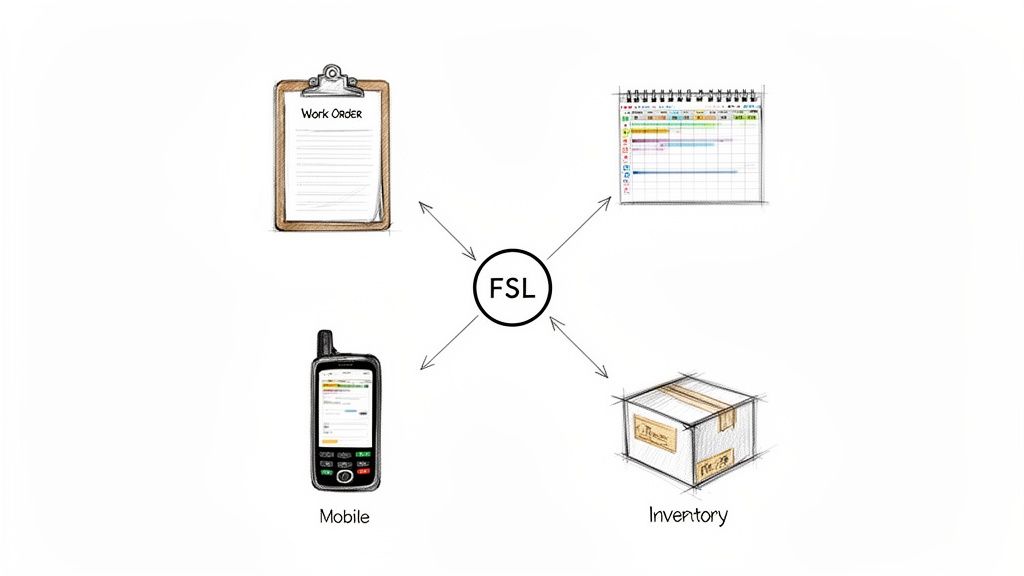
Work Order Management: Your Central Command Centre
At the core of Field Service is the Work Order. This is far more than a digital job ticket—it’s the single source of truth for every service task. It consolidates all critical details for an appointment into one unified record within your Salesforce CRM.
- The Business Challenge: An HVAC company in Melbourne gets a call about a faulty commercial air conditioner. In their old system, this meant disjointed notes, emails, and phone calls to relay information.
- The Salesforce Solution: A Work Order is created in FSL. It instantly becomes the single source of truth, containing:
- The customer's contact details and precise location.
- The specific asset requiring service, including its full maintenance history.
- The required skills for the job (e.g., commercial refrigeration certification).
- A list of parts likely needed for the repair.
- The Result: From the dispatcher in the office to the technician on the road, everyone is operating from the same information, eliminating guesswork and miscommunication.
Intelligent Scheduling: The Automated Dispatcher
With a work order created, the next challenge is dispatching the right technician to the right place at the right time. This is where Intelligent Scheduling acts as an automated air traffic controller for your mobile workforce.
- The Business Challenge: A dispatcher manually juggles spreadsheets, maps, and technician schedules, trying to optimise routes and assignments—a time-consuming and error-prone process.
- The Salesforce Solution: The system’s scheduling engine automatically analyzes multiple factors: technician skills, current location, travel time, and existing job priorities. It then suggests the most efficient schedule.
- The Result: Automation frees up the dispatch team to handle exceptions and emergencies instead of tedious manual scheduling. With 73% of customers expecting more personalised service, efficient scheduling is a key part of delivering a superior experience.
By automating scheduling based on skills, location, and priority, businesses can dramatically reduce travel time and fuel costs while increasing the number of jobs a technician can complete in a day. It’s a direct path to improved productivity and operational efficiency.
Mobile Workforce Empowerment: The Technician's Digital Toolkit
The Salesforce Field Service mobile app is where the digital transformation truly comes to life for the field team. It turns a technician's smartphone or tablet into a powerful toolkit, connected directly to your Salesforce CRM in real time.
- The Business Challenge: Technicians arrive at a job site with incomplete information, relying on memory or calling the office for details, leading to delays and potential errors.
- The Salesforce Solution: Our Melbourne HVAC technician uses the mobile app en route to the job to:
- Review the full work order: Access the job brief, safety checks, and the asset’s service history.
- Follow guided workflows: Use digital checklists and knowledge articles to ensure consistent, high-quality work.
- Capture data on-site: Take photos of the repair, get a digital customer signature, and generate a service report instantly.
- The Result: Technicians are empowered to solve problems faster and more effectively, which directly boosts first-time fix rates and customer satisfaction.
Asset and Inventory Management: The Virtual Warehouse
Nothing derails a service call faster than a technician arriving without the correct part. Asset and Inventory Management is the system's backbone, preventing this common and costly problem.
- The Business Challenge: Poor inventory tracking means technicians often make a second trip for parts, doubling travel time and frustrating the customer.
- The Salesforce Solution: The platform provides a real-time view of all inventory, from the main warehouse down to the stock in each technician's van. When the Melbourne tech identifies a faulty compressor, they can check their van's stock in the app. If it's not there, they can locate a nearby colleague who has one or order it directly from the warehouse.
- The Result: This level of visibility is critical for achieving high first-time fix rates and avoiding the cost and customer dissatisfaction of repeat visits.
How Australian Industries Leverage Salesforce Field Service
Salesforce Field Service isn't a one-size-fits-all product; it’s a flexible platform that can be configured to solve the specific challenges of different industries. Across Australia, we've helped companies use this adaptability to gain a significant competitive edge, turning operational pain points into opportunities for digital transformation and growth.
The real value emerges when the platform is tailored to specific workflows, compliance requirements, and service models. Here are some real-world examples drawn from our project experience.

Case Study: Construction and Asset Management
- The Business Challenge: In the high-stakes Australian construction industry, equipment downtime is a project killer. A single excavator failure can halt progress, causing costly delays. Project managers often struggle with manual scheduling of subcontractors and reactive maintenance.
- The Salesforce Solution: We implement Salesforce Field Service to automate preventative maintenance schedules based on equipment usage data, drastically reducing unexpected breakdowns. When a failure does occur, the system instantly identifies the nearest qualified subcontractor, checks their availability, and dispatches them with the asset's complete service history.
- The Results and Benefits: The client shifts from reactive firefighting to proactive asset management. This digital transformation keeps projects on schedule and within budget, turning operational reliability into a key competitive advantage.
Case Study: Healthcare and Medical Device Servicing
- The Business Challenge: For healthcare providers, servicing medical devices is about patient safety and strict regulatory compliance. When an MRI machine or patient monitor fails, the response must be rapid, precise, and fully documented for auditing purposes.
- The Salesforce Solution: FSL ensures the correctly certified technician is dispatched for urgent repairs. The technician arrives on-site with the device's full service history, calibration guides, and mandatory digital checklists on their mobile app. They capture electronic signatures to create a complete, compliant audit trail within Salesforce.
- The Results and Benefits: This single source of truth provides the control and documentation necessary to meet strict regulatory standards, ensuring patient safety and operational compliance.
A technician servicing a life-saving medical device can't afford to guess. They need immediate access to the asset’s entire service history, specific calibration guides, and a crystal-clear record of every action taken to meet strict regulatory standards. FSL provides that single source of truth.
Case Study: Franchising and Brand Consistency
- The Business Challenge: A national franchise network struggles to maintain consistent service quality across all locations. Different franchisees use local contractors, leading to inconsistent repair times, costs, and customer experiences that damage the brand's reputation.
- The Salesforce Solution: The entire network operates from a unified FSL platform. A franchisee logs a service request, and a work order is automatically created and assigned to an approved service partner. Head office gains visibility into KPIs like first-time fix rates and job duration across all locations.
- The Results and Benefits: The franchise gains the power to enforce brand standards, control costs, and deliver the reliable, high-quality experience customers expect, regardless of location. For more context on the market, see our overview of field service management software in Australia.
These case studies show how a strategic field service salesforce implementation delivers powerful, industry-specific results.
Integrating FSL for a True 360-Degree Customer View
Your field service team doesn’t operate in a silo, and neither should its software. While Salesforce Field Service is powerful on its own, its true value is unlocked when integrated with your other core business systems. This integration is the key to breaking down data silos and creating a genuine single source of truth across your entire organization.
The business challenge without integration is clear: disconnected islands of information. Your finance team works in Xero or MYOB, operations runs on an ERP like NetSuite, and your field team is in FSL. This separation leads to manual data entry, invoicing errors, and an incomplete view of your customer.
A Salesforce Partner's Perspective on Integration
From our project experience as a Salesforce partner, connecting these platforms is fundamental to achieving peak operational efficiency. The Salesforce solution isn't just FSL; it's a connected ecosystem. When FSL is seamlessly integrated with your ERP and accounting software, data flows automatically, creating a unified workflow from sales to service to finance.
For example, when a technician completes a job and uses a part, the FSL mobile app can instantly update inventory levels in your ERP. When they get a customer signature on a completed work order, it can automatically trigger an invoice in your accounting system. This automation eliminates redundant tasks and dramatically reduces human error, ensuring everyone from the field to the finance department is working from the same real-time data.
Common Salesforce Integration Scenarios
While system integration can present challenges, a well-planned strategy guided by an experienced Salesforce partner ensures a smooth connection. Here are common integration projects we manage for Australian businesses:
-
FSL and ERP (NetSuite, SAP): This integration aligns inventory, assets, and job costing. When parts are used, inventory levels in NetSuite or SAP are updated automatically, providing real-time stock visibility and preventing shortages.
-
FSL and Accounting (Xero, MYOB): This automates the invoice-to-payment cycle. Completed work orders in FSL can generate accurate invoices in Xero or MYOB without manual intervention, accelerating cash flow and improving billing accuracy.
By creating a seamless data flow, businesses eliminate the costly delays and errors that come from manual reconciliation. A technician completes a job, and the invoice is sent almost immediately—it’s that simple. This connection turns field service from a cost centre into a streamlined revenue generator.
Understanding how all your data can work together is crucial. For a deeper dive into creating a unified data strategy, you can explore how Salesforce's platform helps build a single customer view in our article on Salesforce Data Cloud services.
Ultimately, integrating field service Salesforce with your other systems isn't just a technical task; it's a powerful business strategy for digital transformation. It provides the 360-degree view of operations and customers needed to make smarter, data-driven decisions.
Your Roadmap to a Successful FSL Implementation
Implementing Salesforce Field Service is more than a software installation—it's a business transformation project. A successful rollout requires a clear, phased approach that ties the technology directly to your core business goals. A proven methodology is key to de-risking the project and ensuring a positive ROI.
Drawing from our experience across more than 110 Salesforce projects, we've refined a roadmap that ensures you see value from day one. It starts not with technology, but with a deep understanding of your business challenges and goals.
Phase 1: Discovery and Goal Setting
The Discovery phase is the most critical foundation. This is where we, as your Salesforce partner, collaborate to define the why behind your implementation. We move beyond vague objectives to establish specific, measurable outcomes.
Are you aiming to increase your first-time fix rate by 15%? Or is the goal to reduce technician travel time by 20%? These key performance indicators (KPIs) become the guiding principles for the entire project. We map your current processes, identify pain points, and pinpoint where FSL can deliver the greatest impact. Skipping this step is a common pitfall that leads to a system that works technically but doesn't solve real business problems.
Phase 2: Design and Configuration
With clear goals defined, we move to the Design and Configuration phase. Here, we translate your business needs into a functional FSL solution. This involves tailoring work order processes, defining intelligent scheduling policies, and customizing the mobile app to align with your technicians' workflows.
This stage is about smart configuration, not over-customization. An effective design makes the Salesforce platform intuitive for your team and directly supports the KPIs established during discovery. A key lesson learned from our projects is that simplicity drives adoption.
A truly effective FSL design empowers your team instead of overwhelming them. The aim is to get the right information into the right hands at the right time, turning the mobile app into a technician's most valuable tool on the job.
A critical part of this phase is mapping the data flow between your systems. This diagram illustrates a typical integration, connecting your core platforms to create a unified operational view.
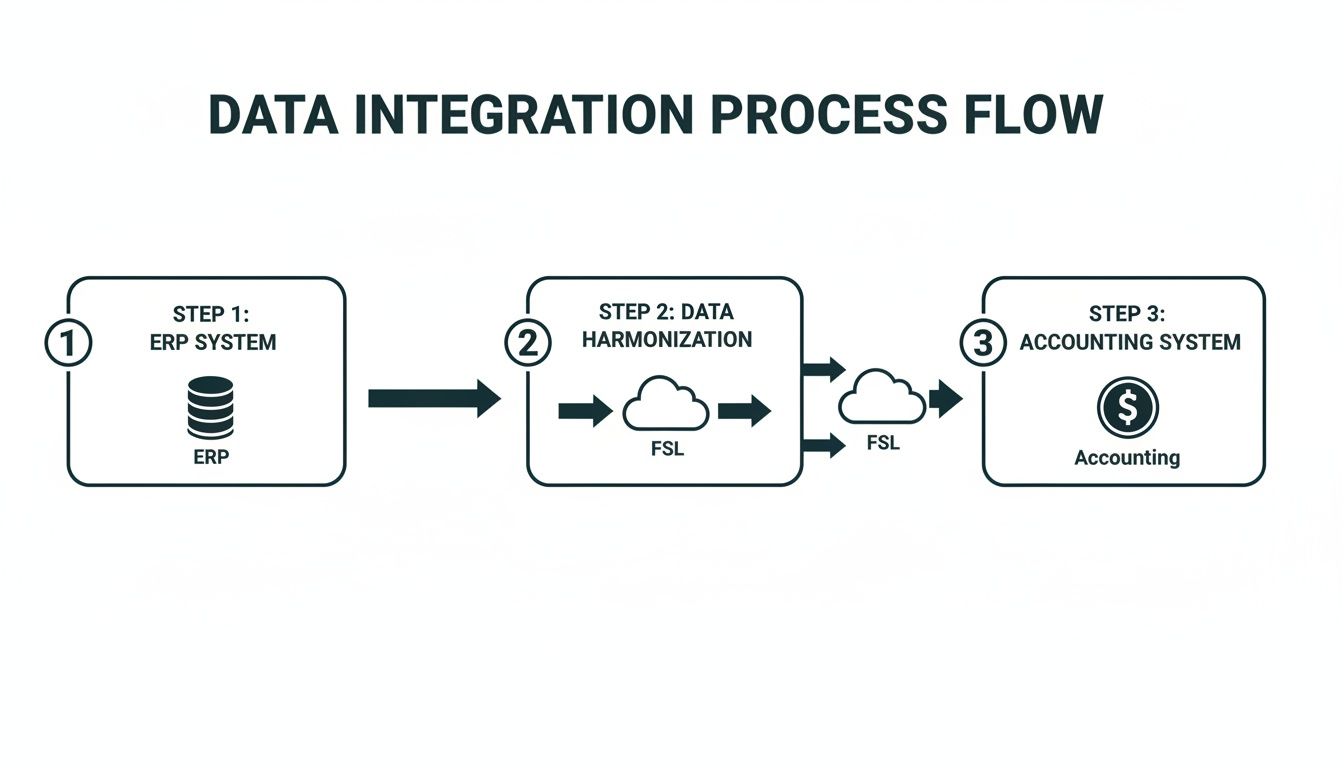
As shown, data from an ERP and accounting system flows into and out of FSL, creating a single source of truth that connects field operations with finance and inventory management.
Phase 3: Pilot and Training
Before a full-scale rollout, conducting a Pilot program is a best practice. We select a small group of users to test the system in real-world scenarios. Their feedback is invaluable for refining workflows and ensuring the solution is practical and efficient.
Simultaneously, we deliver comprehensive Training. User adoption is the ultimate measure of success. We ensure your dispatchers, technicians, and managers are confident and proficient with the new platform. This hands-on approach builds momentum and creates internal champions who will drive the change. Partnering with a dedicated Salesforce implementation consultant is crucial for managing this change effectively.
Phase 4: Go-Live and Continuous Improvement
Go-Live marks the launch of the platform across the organisation. However, our partnership doesn't end there. The final, ongoing phase is Continuous Improvement.
Your business will evolve, and your FSL configuration should evolve with it. We help you monitor the initial KPIs, gather ongoing user feedback, and make iterative enhancements to continuously optimise performance. This ensures your investment in the Salesforce CRM platform continues to deliver value long after launch. This is also where we can introduce advanced tools, like AI, to further refine operations. In fact, AI agent adoption in Australian field service has increased by 119% among early adopters, already reducing travel time by 28% and boosting customer satisfaction.
Why an Australian Salesforce Partner Makes the Difference
Choosing the right implementation partner is as important as selecting the right software. Salesforce Field Service is the high-performance engine, but you need a local expert who understands Australian business conditions, compliance requirements, and industry nuances. An offshore or generic provider simply cannot match the on-the-ground insight required for a successful digital transformation.
Working with a local Salesforce partner de-risks your project and accelerates your time-to-value. At Adaptal, our teams in Sydney, Melbourne, and Brisbane don't just configure software; we build Salesforce solutions that are tailored to the unique rhythm of your Australian business.
Local Expertise and Proven Integration Experience
One of our core strengths is connecting FSL with the platforms Australian businesses use every day. We have deep, real-world experience integrating Salesforce Field Service with essential systems like:
- NetSuite and SAP for a unified view of inventory and assets.
- Xero and MYOB for seamless, automated invoicing and financial reporting.
This hands-on experience ensures your data flows correctly from day one, helping you avoid the costly errors and operational disruptions that can derail a project.
Choosing a local partner means you're not just getting a technical team. You're gaining a strategic advisor who understands your commercial landscape and is genuinely invested in your long-term success.
Our commitment extends beyond the initial launch. Adaptal’s managed services are designed to ensure you continue to maximise your investment, providing ongoing support and optimization as your business grows and market conditions change.
If you're facing unique field service challenges, let's have a conversation. We can discuss your goals and explore how a properly implemented Salesforce Field Service solution, guided by an experienced Australian partner, can drive your business forward.
Salesforce Field Service FAQ
Here are answers to some of the most common questions we hear from Australian businesses considering Salesforce Field Service as part of their CRM strategy.
How Long Does a Typical Field Service Implementation Take?
This varies based on complexity. For a small business with straightforward requirements, a phased implementation can deliver initial value in a matter of weeks. However, for a larger organization requiring complex scheduling rules, data migration, and integration with an ERP like NetSuite, the project could span several months. Our best practice is to start with a thorough discovery process to create a realistic timeline and often recommend a pilot program to ensure a smooth transition and early wins.
Is Salesforce Field Service a Good Fit for Small Businesses?
Yes, absolutely. A common misconception is that FSL is only for large enterprises. The platform is highly scalable, making it an excellent fit for small and medium-sized businesses (SMEs). The key is a strategic implementation. As a Salesforce partner, we help SMEs focus on the core features that will deliver the biggest immediate impact, such as digitizing work orders and empowering technicians with the mobile app. Many Australian SMEs start with this foundation and expand the platform's capabilities as they grow, making it a smart, long-term investment.
What's the Difference Between Service Cloud and Field Service?
This is a great question. Think of them as two parts of a complete customer service solution:
- Salesforce Service Cloud is your contact centre hub. It manages customer issues coming in from channels like phone, email, and web chat. It’s designed to resolve problems remotely.
- Salesforce Field Service is the specialised tool for when an issue requires an on-site visit. It extends the capabilities of Service Cloud by managing the mobile workforce. It handles scheduling, dispatching, and all field activities.
They are designed to work together seamlessly. A case is created in Service Cloud, and if on-site work is needed, it's passed to Field Service to execute the hands-on solution, all within the same Salesforce platform.
Ready to see how a field service solution built for your specific needs could change your operations? The team at Adaptal has the local expertise and proven experience to guide your Salesforce Field Service implementation from start to finish. Let's talk about what's possible.