

Digital transformation services aren't just about plugging in new software. For growing businesses, they are specialist consulting and implementation services that help completely rethink operations using modern technology. Think of them as strategic Salesforce partners who guide you through the complex but necessary changes to work smarter, delight your customers, and ultimately, grow. A big part of this is breaking down walls between departments by connecting them with a powerful cloud platform like Salesforce.
Redefining Business Operations with Digital Transformation Services

Let's cut through the buzzwords. At its heart, digital transformation is about remodelling your business to thrive in today's world, using technology as the blueprint. Imagine it's like a major home renovation. You're not just slapping on a new coat of paint. You're rewiring the electrics, knocking down walls for a better flow, and building a more functional, valuable space.
In the same way, digital transformation services delivered by a Salesforce partner act as the expert architects and builders for your business. They help you:
- Rewire the Systems: This is all about replacing those clunky, outdated legacy systems that trap data in silos and slow everyone down, migrating you to a unified cloud platform.
- Improve the Layout: Here, the focus is on optimising and automating your core processes in Salesforce to get rid of bottlenecks and speed up everything from sales to service.
- Enhance the Experience: This is the payoff—creating smooth, personalised experiences for your customers and making your employees' lives easier with a single, intuitive interface.
The Power of a Centralised CRM Platform
A massive piece of this puzzle is getting your sales, marketing, and service teams to work as one cohesive unit. By bringing them together on a single, powerful CRM platform like Salesforce, these services transform disconnected data into your greatest asset.
The aim isn't just to get new tech; it's to achieve real business results. We're talking about boosting efficiency, fuelling growth, and building a competitive edge that lasts. This journey needs a solid plan, which is why the expertise of a Salesforce partner is so vital. To get started, it's worth understanding the specific contributions these consultants bring to the table, which we cover in our guide on the role of Salesforce development consultants in digital transformation.
Digital transformation services are really about using technology to change the way a business creates value. A perfect example is seeing how AI-powered analytics transforms business decision-making—it shows how modern tools can unlock fresh potential and build smarter, more agile organisations.
It’s More Than Just Technology—It's a Business Strategy
It's so important to remember that real transformation goes way beyond just installing new software. It’s a strategic pivot that involves your people, your processes, and your data, all centred around a platform like Salesforce. A successful project starts with a deep dive into your unique business challenges and goals. The right Salesforce partner will work with you to create a roadmap that lines up the technology with your vision for the future.
They help you find answers to the big questions:
- How can we use Salesforce Flow to automate tedious tasks and free up our team for more strategic work?
- What data do we need in our CRM to truly understand our customers' needs?
- How can Salesforce give us a single, clear view of the entire customer journey?
By tackling these core challenges, digital transformation services deliver a tangible return on your investment. They give your team the tools and insights needed to keep up with market changes and build stronger, more profitable relationships with your customers. This strategic approach ensures the changes you make today will keep paying dividends for years to come.
The Shift from Surface-Level Fixes to Core Process Automation
For a long time in Australia, "going digital" meant slapping on a fresh coat of paint – a slick new app or a modern e-commerce site. These are great, but businesses are waking up to the fact that a pretty storefront doesn't fix a chaotic stockroom out back. There's a major strategic pivot happening towards solving deep-seated operational problems.
Market pressures and the need for resilience are forcing everyone to look inward. The new focus is on tackling the core inefficiencies that burn cash, frustrate staff, and slam the brakes on growth.
The numbers back this up. Heading into 2025, a huge 65% of Australian organisations are set to increase their technology spending. Their number one goal, cited by 42% of businesses, is now reducing operational inefficiency. That's overtaken improving customer experience (31%), which held the top spot for years. Leaders now understand you can only build a fantastic customer journey on a rock-solid foundation of efficient internal processes powered by a platform like Salesforce. You can discover more about the state of Australia's digital transformation in 2025 in recent industry analysis.
Case Study: From Disconnected Operations to a Unified Powerhouse
This is where the real magic of digital transformation services comes into play. It's about connecting all the dots inside a business so that information and work can flow smoothly. When your systems don't talk to each other, you're left with data silos, duplicate manual work, and zero real visibility into what's going on.
Consider this real-world scenario from one of our projects with a mid-sized Australian manufacturing firm.
- The Challenge: The business was juggling a clunky inventory system, a separate accounting package, and sales data stuck in spreadsheets. The sales team had no idea what was in stock, leading them to promise delivery dates they couldn't hit. Management couldn't get an accurate forecast because their sales and production numbers were never in sync. This wasn't just an IT headache; it was a genuine barrier to growth.
How a Salesforce Partner Changes the Game
Knowing they needed a fundamental change, the firm brought in our Salesforce consulting team to overhaul their operations. This wasn't just about installing new software; it was a strategic mission to redesign their core business processes from the ground up on the Salesforce platform.
The solution had two key parts:
-
Implementing Salesforce Sales Cloud: This gave them a single source of truth for every customer interaction, sales pipeline, and forecast. The sales team finally had one unified platform to manage everything from leads to client relationships.
-
Integrating the ERP System: This was the crucial step. We connected their existing Enterprise Resource Planning (ERP) system directly with Salesforce. Suddenly, sales reps could see live inventory data right within the CRM before finalising a quote.
The real breakthrough happened when the wall between sales and operations came down. By connecting their CRM and ERP, the manufacturer turned a jumble of fragmented data into a powerful strategic asset, giving them a 360-degree view of their business for the very first time.
The Tangible Business Results
The impact wasn't abstract; it was immediate and measurable across the entire company.
Here’s what they achieved:
- A 25% drop in order processing errors by eliminating manual data entry.
- Sales forecasting accuracy shot up by over 40%, enabling better resource planning.
- On-time delivery rates improved, leading to happier customers and more repeat business.
- A massive boost in sales team productivity, as they spent less time chasing information and more time selling.
This project is a perfect example of the modern challenge for Australian businesses. True transformation isn't just about a nicer website. It's about building a smarter, more connected, and more resilient business from the inside out. By working with experts in digital transformation services, companies can turn operational chaos into a serious competitive advantage.
The Booming Digital Transformation Market in Australia
The shift to digital in Australia isn’t just a passing trend; it’s a fundamental economic movement. Investing in digital transformation services has moved from a ‘nice-to-have’ to a strategic necessity for staying competitive and ready for growth.
What’s driving this? A perfect storm of innovation, including the widespread adoption of AI and cloud computing, mixed with a relentless push for better operational efficiency. The government is also throwing its weight behind digital initiatives, creating ideal conditions for businesses to modernise.
This is fuelling incredible market expansion. The digital transformation services sector in Australia is projected to climb from USD 18.5 billion in 2024 to an astonishing USD 84.7 billion by 2033. That’s a compound annual growth rate (CAGR) of 18.4%. You can dive into the numbers yourself by reading the full research about Australia's digital transformation market.
The Rise of the Salesforce Partner
This massive market growth has created a surging demand for a very specific type of expert: the skilled Salesforce partner. As businesses scramble to adopt digital-first strategies, they’re quickly learning that the technology itself isn't the whole answer. What they really need are experts who can turn a powerful platform like Salesforce into practical, high-impact business solutions.
Think of a Salesforce partner as the bridge between technological potential and real-world results. They’re the specialists who:
- Map out the strategy: They help you define clear goals and lay down a realistic roadmap for your Salesforce journey.
- Handle the implementation: They configure platforms like Sales Cloud or Service Cloud to fit your unique processes.
- Drive user adoption: They ensure your team has the training and support to embrace the new systems and get the most out of them.
In short, they’re the architects and builders who make sure your Salesforce investment pays off.
The real magic of a Salesforce partner is their ability to connect the dots. They don’t just install software; they re-engineer processes, bring data together, and empower teams. They turn the promise of digital transformation into a measurable business reality.
Capitalising on a National Priority
With government frameworks actively encouraging digital innovation, the window of opportunity for Australian businesses has never been wider. Engaging with digital transformation services focused on platforms like Salesforce is how you unlock that potential. This is about more than just keeping up; it’s about setting a new pace for your entire industry.
That’s why choosing the right partner is one of the most critical decisions a leader can make. These experts guide you through the complexities of change, from connecting legacy systems with modern cloud platforms to building a culture that thrives on data-driven decisions. By linking up with a trusted Salesforce partner, Australian businesses can step confidently into this booming market, turning a national economic shift into their own powerful competitive advantage.
Your Salesforce Blueprint for a Winning Digital Strategy
Trying to kick off a digital transformation without a clear blueprint is like building a house with no architectural plans. A winning strategy isn’t just about the tech; it’s a balanced approach that takes every part of your business into account.
A successful Salesforce strategy comes down to four essential pillars. By getting a handle on each one, you can build a solid foundation for change that delivers real, measurable results and a solid return on your investment.
This hierarchy diagram shows the key drivers powering Australia's digital transformation market, including overall market growth, the big influence of AI and cloud technologies, and crucial government support.
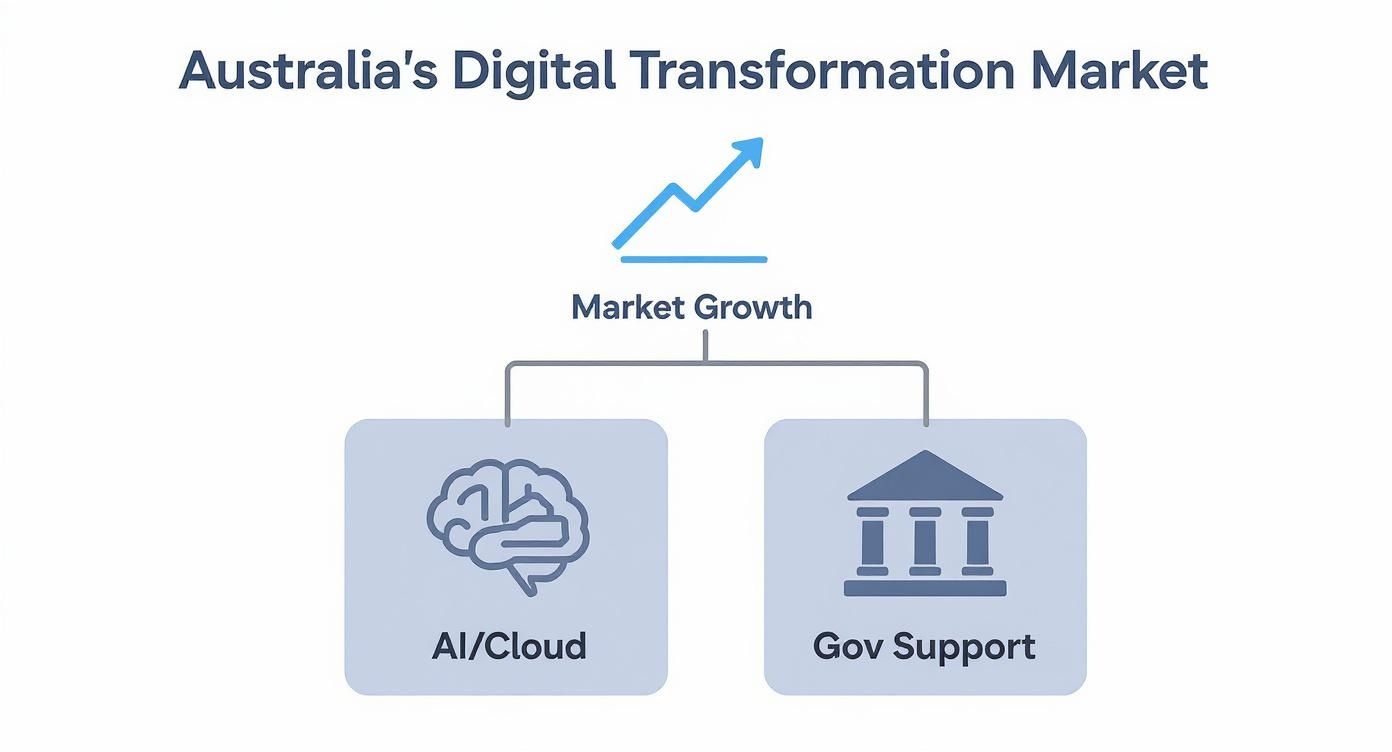
As you can see, the market's expansion is really propped up by both tech innovation and supportive government frameworks, which creates a pretty fertile ground for businesses looking to modernise.
People and Culture Driving Salesforce Adoption
The most sophisticated technology in the world is useless if your team doesn't use it. This is easily the most critical—and most often overlooked—pillar of any digital strategy. Success here is all about driving user adoption and building a culture that’s open to new ways of working.
- Change Management: This means clear communication from leadership about why the change is happening and how it’s going to make everyone’s job better.
- Skill Development: You have to invest in training that empowers your team, turning them from hesitant users into confident advocates for the new system.
When you implement Salesforce Service Cloud, the goal isn't just to swap out old ticketing software. It's about shifting the team's entire mindset towards a proactive, data-informed approach to customer support, where they can finally see the entire customer history in one place.
Process Optimisation for Real Efficiency
Digital transformation must solve real-world problems. This means going beyond simply digitising your current workflows and taking the opportunity to completely redesign them for maximum efficiency within Salesforce. Ask yourself: Where are the bottlenecks? Where is manual data entry slowing us down? Where does communication break down between teams?
A common mistake is to automate a broken process. The real value comes from first simplifying and improving the process, then applying technology to make it seamless. This ensures you're building on a solid foundation, not just paving over the cracks.
A practical example is redesigning a sales quoting process using Salesforce CPQ (Configure, Price, Quote). Instead of just moving spreadsheets to the cloud, you fundamentally change how quotes are built, approved, and sent. This slashes the time it takes to close a deal and gets rid of costly errors.
Technology Platforms Built to Scale
Your technology is the engine of your transformation, so it needs to be powerful, flexible, and ready to scale. Choosing a robust platform like Salesforce is a strategic decision that gives you a unified foundation for your entire business—from sales and marketing right through to customer service and operations.
A key consideration is choosing a platform that can grow with you. A scalable solution like Salesforce helps you avoid the costly problem of outgrowing your tech in a few years and having to start all over again. For a deeper dive into planning your platform rollout, check out our comprehensive Salesforce implementation guide for Australian businesses.
A Data Strategy for Competitive Advantage
In today's business world, data is your most valuable asset. But data is only useful if it's clean, accessible, and actionable. An effective data strategy ensures you are collecting the right information and, more importantly, using it to make smarter decisions.
This involves:
- Establishing a Single Source of Truth: Centralising data in a CRM like Salesforce gets rid of silos and gives everyone access to the same, up-to-date information.
- Leveraging Analytics: Using Salesforce dashboards and reports to track key metrics, spot trends, and uncover new opportunities for growth.
By focusing on these four pillars—People, Process, Technology, and Data—you can create a comprehensive blueprint that guides your digital transformation and ensures every dollar you invest drives you closer to your strategic goals.
Digital Transformation Readiness Checklist
Before you dive in, take a moment to assess where you stand. This quick checklist can help you gauge your organisation's preparedness across these four key pillars. It’s a simple way to spot strengths and identify areas that might need more attention before you start.
| Component | Key Question for Your Business | Signs of Readiness |
|---|---|---|
| People & Culture | Is our leadership team visibly championing this change, and is our company culture open to new ways of working? | Strong executive sponsorship. Employees are generally adaptable and have a history of embracing new tools. |
| Process | Have we mapped out our core business processes and identified the key bottlenecks and inefficiencies we want to solve? | Documented workflows exist. There's a clear understanding of current pain points and manual workarounds. |
| Technology | Do we have an existing tech stack that can be integrated with, or are we prepared for a full replacement? | Key systems have APIs. There is an IT team or partner ready to manage technical implementation and integration. |
| Data | Is our data currently organised and accessible, or is it spread across disconnected spreadsheets and legacy systems? | Some form of data governance is in place. There's a recognised need to centralise information for better insights. |
Taking stock with these questions gives you a much clearer picture of your starting point. It helps ensure that when you do move forward, you're building on solid ground and are truly ready for the journey ahead.
How to Choose the Right Salesforce Transformation Partner

Choosing a partner for your digital transformation is the most critical decision you'll make in this process. It will have a far bigger impact on your success than the specific tech you choose. The right Salesforce partner becomes your strategic guide, but the wrong one can turn an exciting project into a costly nightmare.
It’s easy to treat this like another procurement task, simply ticking boxes on a technical checklist. But that misses the point. You aren't just hiring developers; you're searching for a strategic ally who will challenge your assumptions, understand your business inside and out, and genuinely share your vision for the future.
Look Beyond the Technical Checklist
A partner's real value goes way beyond their ability to configure Salesforce. You need a team that brings a strategic mind, deep industry experience, and a company culture that gels with yours. This is the difference between a vendor who just follows orders and a partner who gets in the trenches with you to ensure your success.
Consider this cautionary tale: a mid-sized logistics company went with the cheapest vendor they could find. The vendor had technical chops but zero real-world understanding of the logistics industry. The result was a disaster. The project was bogged down by delays, the solutions didn't fit the company's workflows, and the final product needed an expensive overhaul just months after going live.
Now, contrast that with a business that chose a true strategic partner. This partner spent significant time upfront digging into the company's challenges and goals. They didn't just build a system; they co-created a solution that led to a successful Salesforce implementation and a massive return on investment.
The crucial difference is perspective. A vendor sells you hours and technical tasks. A true partner invests their expertise in your business outcomes, guiding you toward long-term value, not just short-term project completion.
Key Criteria for Evaluating Salesforce Partners
When you're sizing up potential partners for your digital transformation services, look for solid proof of their strategic abilities and track record.
- A Proven Salesforce Pedigree: Look for a certified Salesforce partner with a portfolio of successful projects similar to yours in scale and complexity.
- Deep Industry Knowledge: Do they speak your language? A partner with experience in your industry will already understand your unique challenges.
- A Focus on Long-Term Value: Their conversations should be about business outcomes like ROI, user adoption, and scalability—not just a list of technical features.
As you look at collaborators, it's also helpful to understand different working models. A good resource on choosing a staff augmentation company can offer insights into one popular approach. It's also smart to check out a firm's portfolio of Salesforce consulting services to get a real sense of their expertise.
Questions You Must Ask Any Potential Partner
To cut through the sales pitches, you have to ask sharp, direct questions. Keep this list handy during your evaluation process:
1. Strategic and Business Questions:
- "Can you share a case study where you helped a client in our industry solve a business challenge like ours with Salesforce?"
- "How will you measure the success of this project beyond just 'going live'?"
- "How do you handle change management to ensure our team actually adopts the new Salesforce system?"
2. Technical and Process Questions:
- "What's your project methodology, and how will you keep us in the loop on progress and potential risks?"
- "Walk me through your process for gathering business requirements to ensure the solution truly meets our needs."
- "What does your support and ongoing partnership model look like after the launch?"
Picking the right Salesforce partner sets the stage for your entire transformation. Take the time to find a team that aligns with your vision and has the proven experience to help you get there.
Why Australian SMEs Can No Longer Wait to Transform
When you hear "digital transformation," it's easy to picture a massive corporation. For Australian small and medium businesses (SMEs), it's a different game. It’s less about long-term strategy and more about immediate survival, growth, and punching above your weight against the big players.
The pressure is mounting. A huge 74% of brands are flagging it as a top priority for 2025. You can discover more insights about digital transformation trends and see why it's become such a critical focus.
SMEs navigate a unique set of challenges: tighter budgets, security worries, and the daily grind of keeping the lights on while trying to innovate. The way forward isn't chasing abstract buzzwords; it's making smart, targeted changes on a scalable platform that deliver a real punch.
Redefining Digital Maturity for SMEs with Salesforce
For a small or medium business, "digital maturity" doesn't mean having a sprawling IT department. It's about making savvy, strategic moves that pay off quickly. This approach is built on a few core pillars that any SME can start actioning today.
- Cloud Adoption: This is your foundation. Moving to scalable, cloud-based platforms like Salesforce gives you access to powerful tools without the crippling upfront costs of old-school systems.
- Improving Data Literacy: This is about empowering your team to turn customer details stored in your CRM into smart insights that fuel better sales and marketing.
- Building Customer-Centric Processes: SMEs are naturally closer to their customers. Digital tools like Salesforce simply help you formalise that advantage, making sure every interaction is tracked and used to build a stronger relationship.
By concentrating on these areas, SMEs can forge a powerful, modern operational core without breaking the bank.
Case Study: From Local Retailer to E-commerce Contender
Let's ground this in a real-world project. We worked with an Australian retailer with a few brick-and-mortar stores who was struggling to keep up with online giants. Their customer information was a mess, scattered across different systems, and they had zero real insight into what their customers were actually buying.
They decided to work with our Salesforce partner team, who rolled out a simple, two-part solution:
- Salesforce Commerce Cloud: This gave them a sleek, modern e-commerce site completely synced up with their in-store inventory and point-of-sale systems.
- Marketing Cloud Account Engagement: This platform brought all their customer data together into one place. Suddenly, they could send personalised marketing campaigns based on what people had actually bought or looked at online.
The change was profound. They went from guessing what their customers wanted to knowing with certainty. By bridging the gap between their online and offline worlds, they built a seamless customer experience that big-box retailers often struggle to nail.
The results speak for themselves. Online sales shot up by over 60% in the first year alone, and engagement with their marketing emails tripled. This SME didn't just get a new website; they built a fully connected engine for understanding and serving their customers. You can see from our other projects, detailed in these Salesforce case studies, how this kind of focused, practical approach delivers a fantastic return on investment.
For Australian SMEs, the message is clear: the time for sitting on the sidelines is over. Bringing in digital transformation services isn't just another expense; it's a direct investment in your ability to compete and grow.
Answering Your Salesforce Digital Transformation Questions
Stepping into a digital transformation can feel like learning a new language. You've got questions, and that's a good thing. Let's tackle some of the most common ones we hear from business leaders, breaking them down into clear, straightforward answers.
Where Should We Start Our Digital Transformation Journey?
The best place to start has nothing to do with technology. It begins with a hard look at your own business. You need to map out your current processes, pinpoint where your customers are feeling pain, and get crystal clear on what you’re trying to achieve.
A good Salesforce partner won’t start by pitching you a product. Their first move is always a discovery phase, where they work with you to define what success looks like for your business. Only after that deep dive should they begin to architect a solution on the Salesforce platform.
How Long Does a Salesforce Transformation Project Take?
The honest answer? It depends entirely on the scope. A focused project, like implementing Salesforce Sales Cloud for a single team, might only take a few months.
But a full-scale transformation across the entire company could realistically take a year or more. The most successful projects don't try to do everything at once. They take an agile, phased approach, delivering value in manageable chunks rather than attempting a risky "big bang" launch that can easily go off the rails.
How Do We Get Our Team to Actually Use the New System?
This is the million-dollar question, and the answer is simple: user adoption is everything. A shiny new system is worthless if nobody uses it. That's why a robust change management plan isn't an afterthought; it's a core part of any effective digital transformation service.
This means communicating clearly from day one. It involves hands-on Salesforce training and, crucially, bringing your employees into the design process to give them a sense of ownership. You have to show them, not just tell them, how these new tools will make their day-to-day work easier. A great partner will be an expert in guiding you through this critical cultural shift.
Is Digital Transformation Only for Large Companies?
Not at all. It's even more crucial for small to medium-sized enterprises (SMEs). Modern cloud platforms like Salesforce are incredibly scalable, with solutions specifically built for businesses of all sizes. For smaller businesses, transformation is a powerful way to punch above your weight. It's how you boost efficiency, sharpen your competitive edge, and go toe-to-toe with the big players in your industry.
Ready to start your own transformation journey? The team at Adaptal specialises in creating practical, high-impact Salesforce solutions for Australian businesses. Contact us for a consultation today.