

When you hear "digital transformation management consulting," it might sound like corporate jargon. But for businesses running on Salesforce, it’s about one thing: having an expert guide to modernise your operations and customer experiences using the platform you already trust. It's more than just a software update; it’s a strategic partnership focused on fundamentally changing how you operate by weaving Salesforce into the very fabric of your business.
As a Salesforce partner, we see this firsthand. True transformation happens when your people, processes, and technology come together on a single, powerful platform.
Understanding Digital Transformation in the Salesforce Ecosystem

Think of a digital transformation consultant as an experienced guide for your Salesforce journey. They don't just hand you a technical manual and wish you luck. Instead, they walk the path with you, helping you navigate the complexities of new Salesforce clouds, shifting customer expectations, and the internal changes that come with any CRM evolution. This strategic partnership ensures your Salesforce investments align directly with your biggest business goals.
The real aim is to move past just deploying new tools. True transformation means rethinking your business model to become more agile and customer-focused. While over 90% of organisations are attempting this shift, many fall short. Why? From our experience, it's because they get bogged down in technical details and forget the most important part: the people who use the system every day.
The Role of a Salesforce Partner
A Salesforce consulting partner brings a crucial outside perspective. Your internal teams are brilliant, but they're often stretched thin and too close to day-to-day problems to see the whole picture. A digital transformation management consulting firm offers objectivity, proven frameworks, and specialised Salesforce skills that most businesses don't have in-house.
Our partnership engagements typically kick off with a few key steps:
- Assessing Your Salesforce Maturity: First, we need to know where you stand. This means evaluating your current Salesforce org, business processes, and team skills to pinpoint what’s working well and where the gaps are.
- Building a Strategic Salesforce Roadmap: Next, we create a clear, actionable plan. This isn’t a vague wish list; it’s a roadmap that connects digital initiatives—like implementing Service Cloud or Account Engagement—to concrete business goals, such as boosting customer retention or improving sales productivity.
- Managing Organisational Change: This is where many projects fail. We guide your team through the transition, fostering buy-in, providing hands-on training, and ensuring everyone is on board and using the new Salesforce functionality successfully.
At its heart, digital transformation management consulting is about making technology work for your people, not the other way around. It’s about building a customer-focused business that is ready for whatever comes next, powered by Salesforce.
Integrating Salesforce as Your Central Hub
For nearly every modern business, a powerful CRM is the cornerstone of a successful transformation. Platforms like Salesforce act as the central nervous system, connecting all your customer data and streamlining operations. When we partner with businesses, our focus is almost always on using Salesforce as the engine to drive these changes.
A project might involve rolling out Sales Cloud to give your sales team a 360-degree view of every customer, or using Service Cloud to automate support workflows. By tying these powerful tools to a clear strategy, our Salesforce consulting services help turn abstract goals into tangible business results. The endgame is a seamless, integrated system where every department works from a single source of truth, delivering an exceptional experience for both employees and customers.
The Four Pillars of a Successful Salesforce Transformation
A successful transformation isn't just about shiny new tech. It’s built on a solid foundation of four critical pillars that have to work together: Strategy, Technology, People, and Process. For any Salesforce initiative to deliver real, lasting value, you have to get these elements perfectly aligned.
Ignoring even one pillar is like building a house on a shaky foundation. From our project experience, this is where digital transformation management consulting provides a clear framework, ensuring each component gets the expert attention it deserves.
A well-rounded approach is non-negotiable. The table below breaks down these four core pillars, highlighting typical business challenges and how a strategic consulting approach, powered by Salesforce, provides the solution.
The Four Pillars of Digital Transformation
| Pillar | Common Business Challenge | Consulting Solution & Salesforce Application |
|---|---|---|
| Strategy | Vague goals and a lack of clear direction lead to stalled Salesforce projects and wasted resources. | Define a concrete roadmap with measurable KPIs. Use Salesforce dashboards to track progress against core objectives, like increasing market share by 15%. |
| Technology | Selecting the wrong tools or struggling with poor integration creates data silos and inefficient workflows. | Implement Salesforce as the central, integrated platform. Ensure it supports the strategy, not dictates it, by choosing the right clouds (e.g., Sales, Service, Marketing). |
| People | Employee resistance to change and a lack of digital skills hinder Salesforce adoption and success. | Develop a robust change management plan with clear communication and hands-on training. Empower teams to embrace new Salesforce features and feel confident using them. |
| Process | Outdated, manual workflows persist even with new technology, limiting efficiency and customer focus. | Redesign and automate workflows using tools like Salesforce Flow or Marketing Cloud Account Engagement to streamline operations and free up your teams. |
By addressing each pillar, we help you build a holistic structure that supports genuine, sustainable change rather than just a surface-level tech upgrade.
The Strategic Pillar
Before a single line of code is written or a new license is purchased, you need a clear strategy. This pillar is all about answering the "why" behind your transformation. It involves setting sharp, measurable goals that connect directly to your core business ambitions, like boosting market share by 15% or slashing customer churn by 20%.
The biggest challenge here is creating a strategy that’s both ambitious and achievable. Without that clarity, projects drift, and teams lose sight of the purpose. A good consulting partner helps sharpen that vision, turning big ideas into a concrete roadmap with defined KPIs tracked in Salesforce.
The Technology Pillar
Technology is the engine of digital transformation, and Salesforce is often the central hub of this tech ecosystem. This pillar is about selecting and implementing scalable, integrated platforms that enable new ways of working.
Picking the right technology stack can feel overwhelming. It’s not just about flashy features; it’s about finding solutions that integrate with your existing systems and can grow with your business. For instance, implementing Salesforce Sales Cloud is about more than just a new CRM—it’s about building a single source of truth for all your customer data.
"A technology platform like Salesforce isn't just a tool to be installed. It's the infrastructure upon which you build entirely new, customer-centric processes and experiences. The real value comes from how you weave it into the fabric of your organisation."
This field is growing at a staggering pace. The global digital transformation consulting market was valued at USD 344.72 billion in 2024 and is projected to hit USD 383.33 billion in 2025. This growth is driven by the rapid adoption of AI and cloud computing, with Salesforce's Einstein leading the charge.
The People Pillar
Here’s the thing: technology doesn't transform a business. People do. This pillar is arguably the most critical and, sadly, often the most overlooked. It covers everything from executive buy-in and change management to employee training and nurturing a digital-first culture. A successful transformation leans heavily on getting the culture right, and using a comprehensive Culture Survey Guide to Measure and Transform Workplace Culture can offer priceless insights.
Resistance to change is natural. Your team might be comfortable with the old ways or worry that new tech will make their roles redundant. A smart consulting approach tackles these concerns head-on with open communication, solid training, and by empowering people to own the new Salesforce tools and workflows.
The Process Pillar
Finally, new technology is only as good as the business processes it supports. This pillar involves redesigning your workflows to be more efficient, automated, and customer-focused within Salesforce. It’s about taking a hard look at how work gets done and asking, "Is there a better, more automated way?"
For example, a business might use Salesforce Marketing Cloud Account Engagement to automate its lead nurturing. This isn't just plugging in a new tool; it's a fundamental process redesign. It frees up the marketing team from manual tasks and ensures every lead is handled consistently. Diving into Account Engagement best practice is a great first step to fine-tuning these marketing workflows.
By systematically addressing each of these four pillars, you can move beyond just implementing new tools and achieve a true, sustainable transformation.
Your Salesforce Transformation Journey with a Consulting Partner
Starting a digital transformation isn’t like flipping a switch. It’s a carefully planned expedition, where a digital transformation management consultant turns your abstract goals into a step-by-step journey with defined milestones and measurable results.
Think of it as a true partnership. Your deep industry knowledge combined with a consultant’s Salesforce expertise creates a powerful team. The process is methodical, moving from deep discovery through to strategy, implementation, and ongoing support. Each phase builds on the last, ensuring every decision is informed, strategic, and locked onto your core business objectives.
The Five Phases of a Consulting Engagement
A typical transformation project unfolds across five distinct phases. This structure provides clarity, manages risk, and builds momentum from the first conversation to the final rollout and beyond. It's a proven path from an idea on a whiteboard to tangible, lasting business value.
- Discovery and Assessment: The journey begins with a deep dive into your business. A consultant's first job is to understand your current processes, your tech stack, and—most importantly—your pain points. This involves stakeholder workshops to map out your operational reality.
- Strategy and Roadmap Development: With a clear picture of the present, the focus shifts to the future. This phase is about defining what success looks like, setting clear KPIs, and creating a detailed project roadmap with Salesforce at its heart.
- Technology Implementation and Integration: This is where the strategy becomes a reality. It involves configuring platforms like Salesforce Sales Cloud or Service Cloud, migrating your data, and integrating systems to create a single source of truth. The focus is always on building a solution that is powerful and easy for your team to use.
- Change Management and Training: A new system is only as good as the people who use it. This critical phase focuses on the people side of change. It involves providing comprehensive training, clear communication, and ongoing support to ensure your team feels confident and empowered by their new tools.
- Continuous Improvement and Optimisation: Transformation isn’t a one-time event; it’s an ongoing process. After launch, the work shifts to monitoring performance against your KPIs in Salesforce dashboards, gathering user feedback, and making iterative improvements to ensure the platform evolves with your business.
From Our Project Files: A Real-World Salesforce Transformation
Let’s make this concrete. A professional services firm was struggling with fragmented customer data. Their sales, service, and marketing teams were all using different systems. The result? Disconnected client experiences and leads falling through the cracks because no one had the full story.
Working with us as their Salesforce partner, their journey followed the five phases. The Discovery phase quickly confirmed data silos were the main bottleneck. The Strategy phase then outlined a plan to unify all client-facing operations on the Salesforce platform, with a clear goal to increase client retention by 15%.
During Implementation, we configured Sales Cloud and Service Cloud, migrating data from three legacy systems into one central hub. The Change Management phase was crucial; we ran targeted training sessions for each department, showing them how the unified platform made their jobs easier.
Finally, in the Continuous Improvement phase, we held monthly reviews to analyse Salesforce dashboards and spot areas for process optimisation. You can see how these projects come to life in our collection of Salesforce case studies.
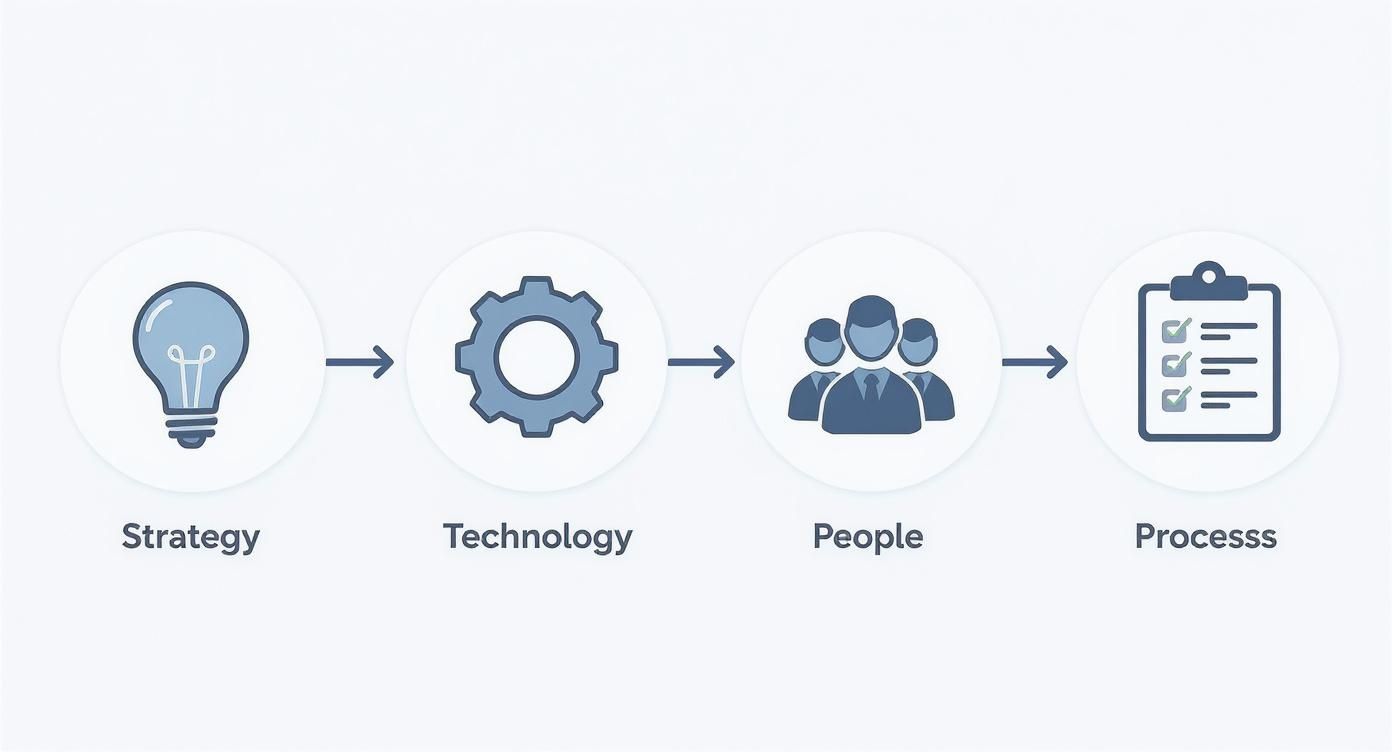
As the graphic shows, a successful project addresses each component in order. This structured approach, guided by an expert in digital transformation management consulting, turns a complex challenge into a manageable and successful project with a clear, positive impact on the business.
How Salesforce Drives Modern Digital Transformation
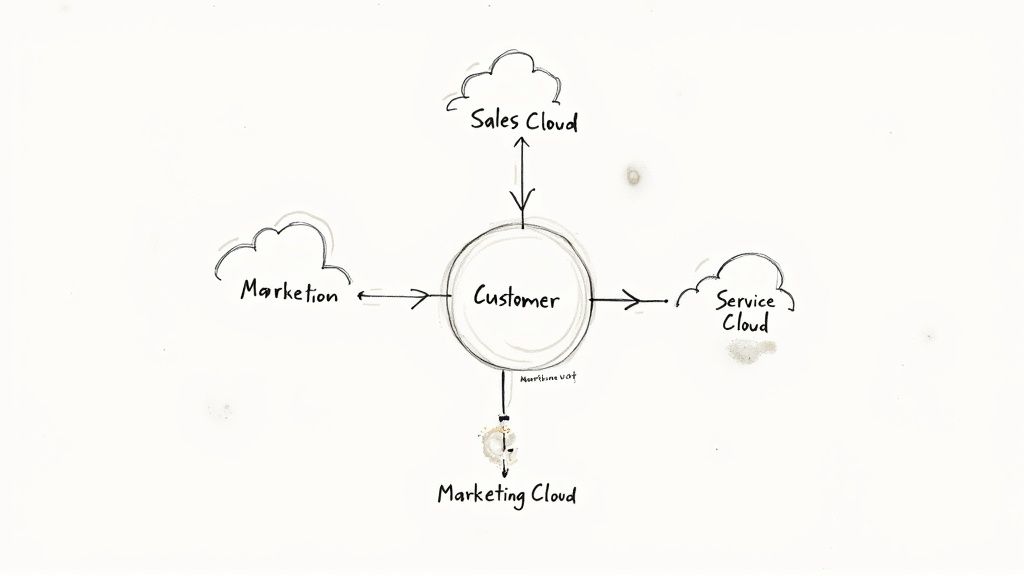
Modern digital transformation is about getting closer to your customers. That simple fact puts a powerful CRM platform right at the heart of any worthwhile initiative. Salesforce isn't just another piece of software; it's the ecosystem where your sales, service, and marketing teams can finally work as one cohesive unit.
Think of Salesforce as the central nervous system for your business. It’s where you break down frustrating data silos and create a single source of truth, giving every department a shared, 360-degree view of every customer. That unified perspective is the foundation for the smart, real-time decisions that define today’s leading organisations.
Unifying The Customer Journey With Salesforce Clouds
Salesforce achieves this through its specialised, interconnected cloud solutions. Each one masters a specific part of the customer lifecycle, but their true power is unleashed when they work together. This creates a seamless flow of information from the first marketing touchpoint through to long-term customer support.
Three core clouds paint a perfect picture of this synergy:
- Sales Cloud: This is your sales team’s command centre. It automates tasks, tracks every deal, and serves up rich insights into customer behaviour, freeing up your reps to build relationships and close deals.
- Service Cloud: This is where you transform customer service into a loyalty-building machine. It gives agents a complete customer history, empowering them to resolve issues quickly and efficiently.
- Marketing Cloud Account Engagement: Formerly Pardot, this B2B marketing automation engine aligns your marketing and sales teams. It nurtures leads with intelligent campaigns and hands off sales-ready prospects with a full history of their interactions.
When these are all clicking together, the customer journey becomes one smooth, continuous conversation.
The Power of Integration and Automation
A huge driver of digital transformation is operational efficiency. Salesforce shines here, offering powerful tools for automation and integration. A successful transformation often hinges on how well you connect your systems; mastering integration in Salesforce CRM is key to building a truly cohesive tech stack.
True transformation isn't just about adopting new software; it's about fundamentally redesigning workflows to be faster, smarter, and more automated. Salesforce provides the engine to make this happen at scale.
Australian businesses are catching on fast, with significant investment pouring into IT consulting. The average spend per employee in this sector is projected to hit AU$129.81 in 2025. This highlights how critical it is for local companies to integrate technologies like cloud computing and AI to sharpen their competitive edge.
A Scalable Foundation For Future Growth
Perhaps the most critical role Salesforce plays is providing a scalable foundation. Your business isn’t static, so why should your technology be? The Salesforce platform is built to grow with you. You can add new features, bring on more users, and integrate new business units without having to start over.
This built-in scalability ensures that the investment you make today continues to pay dividends tomorrow. A strategic partner can help you build this foundation correctly from day one, ensuring your digital transformation is set up for long-term success.
Choosing the Right Salesforce Consulting Partner
Picking the right partner is the single most important decision you'll make on your transformation journey. A good firm does more than just install software; they become a strategic part of your team, guiding you through tricky changes and making sure your investment delivers real, measurable value.
The market is crowded, so how do you find the one that truly fits? Look beyond a simple list of tech skills. You need a partner who blends Salesforce expertise with a genuine understanding of your business challenges and a focus on the results you want to achieve.
Criteria for Selecting Your Partner
To cut through the noise, concentrate on four critical factors that separate a vendor from a strategic partner.
You should look for:
- Proven Industry Experience: Do they understand the specific hurdles and customer expectations in your sector? A partner with experience in your industry brings relevant insights and proven solutions to the table.
- A Focus on Business Outcomes: A great partner is obsessed with your ROI. They should be more interested in talking about your business goals—like boosting client retention by 20%—than just rattling off software features.
- A Truly Collaborative Approach: Find a team that listens first and works with you, not just for you. A real partnership is built on open communication and solving problems together.
- Deep Change Management Expertise: Technology is just one piece of the puzzle. An elite partner understands the human side of change. They’ll have a structured way of training your team and ensuring high user adoption.
Key Questions to Ask Potential Salesforce Partners
When you’re vetting a digital transformation management consulting firm, asking the right questions is everything. You need to get past the sales pitch and dig into how they actually work.
A partner’s value isn't just in the solution they build, but in the capability and confidence they build within your team. They should empower you to own the transformation long after the project ends.
Keep this checklist handy during your evaluation:
- Can you share a Salesforce case study from a business like ours? This tests their industry experience and shows if they can deliver relevant results.
- How will you measure and report on the ROI of this Salesforce project? This uncovers their commitment to business outcomes. They should have a clear framework for defining and tracking success metrics.
- What does your change management and training process look like for a Salesforce implementation? This probes their understanding of the critical, people-focused parts of transformation.
- How will you collaborate with our internal team? This helps you get a feel for their working style. A transparent and collaborative process is essential—it’s something we pride ourselves on with our own Salesforce consulting team.
Finding the right partner is crucial in a field that's only getting bigger. In Australia, the management consulting industry is projected to include 94,910 businesses in 2025, marking a 2.9% annual growth rate since 2020. This growth highlights the demand for expert guidance, making it even more important to pick a partner who can truly deliver. You can learn more about the Australian management consulting industry trends to get a better sense of the market.
Common Questions About Digital Transformation Consulting
Kicking off a Salesforce transformation journey brings up a lot of questions. Business leaders often tell us they need clear, straightforward information to feel confident. Here are answers to some of the most common queries we hear about digital transformation management consulting.
What Is the Difference Between IT Consulting and Digital Transformation Management Consulting?
This is a great question. While related, their scope and focus are fundamentally different.
IT consulting is typically tactical. It’s called in to fix a specific technology problem, like implementing a piece of software or upgrading a network. An IT consultant might be brought in just to set up a new server, and that's where their job ends.
On the other hand, digital transformation management consulting takes a wider, strategic view. It’s not just about the tech; it’s about rethinking how your business operates, with technology as the engine for that change. A Salesforce project, for example, isn't just a software install—it's a chance to completely redesign your sales process to be more customer-focused and data-driven.
The core difference is the objective: IT consulting fixes a technical problem. Digital transformation consulting solves a business problem using technology like Salesforce.
How Long Does a Typical Digital Transformation Project Take?
There’s no magic number here, as the timeline depends on the complexity and scope.
A focused project, like rolling out Salesforce Sales Cloud for one sales team, might take a few months. This would cover discovery, setup, training, and go-live.
But for a full-scale, organisation-wide transformation—say, unifying sales, service, and marketing on the Salesforce platform while integrating it with your ERP system—you could be looking at 12-24 months. A good consulting partner will break this bigger journey into manageable phases with clear wins along the way, building momentum and ensuring you see results early.
How Do You Measure the ROI of Digital Transformation Consulting?
Measuring the return on investment (ROI) is non-negotiable and should be a priority from the first conversation. A credible consulting partner will work with you to define success metrics before the project begins.
Success metrics are tied directly to your business goals:
- Quantitative Metrics: These are the hard facts, like increased revenue, lower operational costs, shorter sales cycles, or better lead conversion rates.
- Qualitative Metrics: These track improvements in areas like customer satisfaction scores (CSAT or NPS) and employee engagement.
With a platform like Salesforce, these KPIs can be built right into dashboards, giving you clear, real-time visibility into how the transformation is performing.
Is Digital Transformation Relevant for a Non-Tech Company?
Absolutely. In fact, you could argue it’s more critical for them. Digital transformation is for any business that wants to compete in a world where customer expectations are set by digital-first experiences.
Whether you're in manufacturing, professional services, or retail, your customers expect seamless digital interactions. For your business, this could mean:
- Using Salesforce Service Cloud to create a seamless support experience across phone, email, and web.
- Automating manual back-office tasks to free up your team for more valuable work.
- Using data analytics to make smarter decisions about your operations.
The goal is to use digital tools to become better at your core mission. It’s about becoming a more efficient, agile, and customer-obsessed version of your current self.
Ready to turn these answers into a strategic action plan for your business? At Adaptal, we specialise in guiding Australian businesses through every stage of their Salesforce transformation journey. Our team of Salesforce experts is here to help you build a clear roadmap, implement the right technology, and achieve measurable results.
Contact us today for a consultation and let's discuss how we can make your transformation a success.