

Digital transformation consulting is about leveraging expert guidance to weave digital technology, particularly a powerful CRM like Salesforce, into the very fabric of your business. It’s not just about buying new software; it's a fundamental shift in how you operate and deliver value to your customers. The goal? To boost efficiency, delight customers, and build a more agile business on a platform designed for growth.
Demystifying Digital Transformation Consulting with Salesforce

Strip away the buzzwords, and what are we really talking about? Picture a classic Australian business—strong, with a great reputation, but held back by clunky, outdated systems. A digital transformation consultant steps in as both the architect and the builder for a complete operational renovation, using Salesforce as the blueprint. The aim isn't to bolt on new tech for the sake of it, but to fundamentally redesign how the business works for the modern world.
This means a strategic overhaul of your systems, processes, and how you connect with customers. Say goodbye to disconnected spreadsheets, manual data entry, and fragmented client info. The focus shifts to creating a unified, efficient, and intelligent core for your operations, all powered by the Salesforce platform.
The Role of Salesforce and Your Consulting Partner
Salesforce provides a single, integrated platform to manage your sales, service, and marketing from one source of truth. Think of it as the digital backbone that connects every part of your organisation, ensuring everyone is on the same page with the latest customer information. But simply subscribing to Salesforce won't unlock its full potential.
This is where digital transformation consulting is absolutely vital. A Salesforce partner doesn't just install software; they guide the entire project, ensuring it's laser-focused on your specific business goals. They bring deep expertise in Salesforce products and business process optimisation, turning your technology investment into a tangible competitive advantage.
A great Salesforce consultant doesn’t just implement software; they re-engineer your processes to unlock new levels of efficiency and customer insight, turning your technology investment into a true competitive advantage.
Key Focus Areas in a Salesforce Transformation Project
A consulting engagement is a partnership built to produce measurable results. The journey usually unfolds in key stages, with each one building on the last to ensure a successful outcome.
An experienced Salesforce consulting team will typically focus on:
- Strategy and Roadmap Development: Defining clear, achievable goals and creating a step-by-step plan to get you there on the Salesforce platform.
- Process Optimisation: Analysing your current workflows to spot bottlenecks and redesigning them to be as efficient as possible within the Salesforce ecosystem.
- Technology Implementation: This is the hands-on part—configuring platforms like Sales Cloud for your sales team or Service Cloud for your support crew to meet your unique business needs.
- Change Management and Training: Ensuring your team not only understands but embraces the new systems and processes, feeling confident and empowered from day one.
Ultimately, this is about so much more than technology. It’s a cultural and operational shift that readies your business for future growth by putting your customer at the centre of everything. A skilled consultant is the expert guide who makes sure that journey is strategic, successful, and built to last.
Why Australian Businesses Need Digital Transformation with Salesforce

For Australian businesses, the pressure to modernise isn't some far-off concept—it’s here and now. Customers expect seamless experiences, the market is fiercely competitive, and old, clunky processes are holding companies back. These operational bottlenecks aren't just frustrating; they represent real, missed opportunities and lead to unhappy customers. The way things have always been done just isn't cutting it anymore.
This isn’t just a passing trend; it's a massive economic shift. The market for digital transformation consulting in Australia is exploding, valued at roughly USD 18.5 billion. It's forecast to rocket at a compound annual growth rate of 18.4%, hitting USD 84.7 billion by 2033. This incredible growth highlights a huge demand for expert guidance with platforms like Salesforce, AI, and cloud computing.
The Business Challenge: Disconnected Customer Data
Let's look at a common scenario we solve for our clients. An Australian retailer has both a physical store and an online shop. A customer buys a product in their Melbourne store, but a week later, they try to return it online. The website has no record of the purchase. This kicks off a painful chain of phone calls and emails just to process a simple return.
The root cause? The in-store point-of-sale system and the e-commerce platform aren't speaking to each other. Customer data is trapped in separate silos, creating a broken and impersonal experience. This is precisely the kind of critical flaw that digital transformation consulting is built to fix. A Salesforce partner sees this not as a small glitch, but as a fundamental failure that erodes customer loyalty.
The Salesforce Solution: Building a Single Source of Truth
The solution is to create a single, unified view of every customer. This is where Salesforce CRM becomes the heart of the transformation. By implementing Salesforce, a consultant can integrate the retailer's fragmented systems.
Once integrated, every interaction a customer has with the business—no matter the channel—is recorded in one central profile. Suddenly, the business has a complete story for each customer:
- Purchase History: What they've bought, where they bought it, and how often.
- Service Interactions: A log of every call, email, or chat conversation in Service Cloud.
- Marketing Engagement: How they react to different campaigns sent via Marketing Cloud.
With this unified data, the retailer can finally deliver a seamless experience. An online return is processed in seconds because the system instantly sees the in-store purchase. A customer service agent can pull up the customer's entire history, providing faster, smarter, and more personal support. This is the real-world result of a well-executed Salesforce strategy.
The goal isn't just about plugging systems together. It's about connecting with your customers on a much deeper level by truly understanding their entire journey with your brand.
The Results: Gaining Resilience and a Competitive Edge
Fixing disjointed data does more than just improve customer service—it builds a stronger, more competitive business. This is especially true as new technologies emerge, a topic covered in this guide to understanding Large Language Models in Australia. By creating one central source of truth in Salesforce, organisations unlock powerful capabilities.
They can start to predict what customers need, craft highly personalised marketing, and spot sales opportunities before the competition. This strategic shift transforms a business from being reactive to proactive, making it ready to adapt to market changes and build customer relationships that actually last.
Your Digital Transformation Journey with a Salesforce Partner
Embarking on a digital transformation project can feel like a massive undertaking. The good news? With the right Salesforce partner, it’s not a giant leap into the unknown but a series of clear, manageable steps. Working with a Salesforce consultant provides a practical roadmap, guiding your business from where it is today to where it needs to be tomorrow.
This structured process turns the abstract idea of "consulting" into a concrete, results-driven plan. Each phase is designed with a specific purpose, from understanding your core business challenges to building the right Salesforce solution and ensuring it delivers long-term value.
Phase 1: The Discovery and Strategy Workshop
Everything starts here. This is where your consulting partner dives deep into your business, not just to understand what you do, but why you do it that way. Forget a simple Q&A session; think of this as a total immersion into your daily operations.
In this phase, the consultants map out your current processes and pinpoint the exact pain points holding you back. This could mean shadowing your sales team to see their lead management headaches firsthand or sitting with your customer service crew to understand their workflow for resolving cases. The goal is to get an unfiltered view of the challenges before designing a solution in Salesforce.
Phase 2: Implementation and Configuration
Once there's a solid grasp of your needs, the journey shifts into the implementation phase. Here, the focus moves to building your solution on the Salesforce platform. This isn’t about just installing some off-the-shelf software. It’s about expertly configuring tools like Salesforce Sales Cloud or Service Cloud to tackle the specific problems uncovered during discovery.
For example, if discovery revealed your sales team was wasting hours on manual lead assignments, the consultant would set up automation rules in Sales Cloud to handle it instantly. If the customer service team was struggling to find client information, they’d design a unified console in Service Cloud to put all that data at their fingertips. It’s this hands-on configuration that ensures the technology is moulded perfectly to your business.
A successful Salesforce implementation isn't just about turning on new features. It’s about meticulously translating your business challenges into a functional, efficient, and user-friendly system that your team will actually want to use.
The infographic below neatly lays out this structured, three-step journey from discovery right through to ongoing improvement.
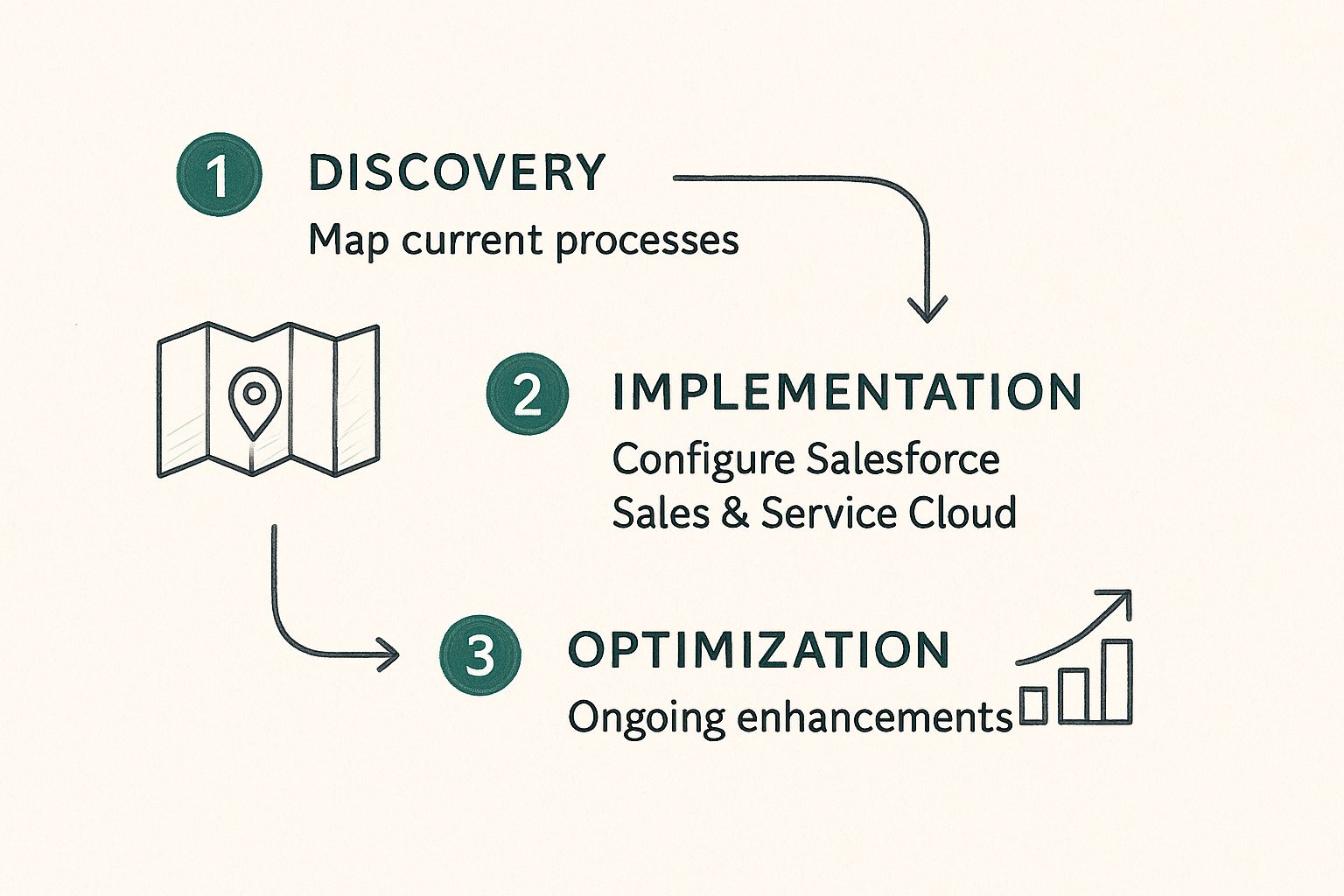
This visual roadmap shows how a great partnership moves from understanding your business, to building the right tools, and then making sure it all leads to long-term success.
Phase 3: Optimisation and Continuous Improvement
Launching your new Salesforce system is a huge milestone, but it’s definitely not the end of the road. The final phase is all about optimisation. Businesses never stand still, and your technology shouldn't either. A great consulting partner sticks around to help you adapt and grow.
This ongoing support can include:
- Performance Monitoring: Using Salesforce dashboards and reports to keep an eye on key metrics and spot opportunities for improvement.
- User Training: Running extra training sessions as your team expands or as new features are rolled out.
- System Enhancements: Adding new capabilities or integrating other tools as your business needs change down the track.
This cycle of continuous improvement ensures your investment in Salesforce delivers increasing value year after year. For a closer look at the expertise that makes this possible, you can explore the vital role of Salesforce development consultants in digital transformation, who are crucial during the build and optimisation stages. By treating transformation as a living process, you end up with a system that remains a true asset for your organisation.
Core Services from Salesforce Transformation Consultants
When you engage a Salesforce partner for your digital transformation, you're getting much more than just a software setup. You're accessing a suite of specialised services designed to solve specific, high-stakes business challenges. The true value of a consultant lies in their ability to diagnose your operational pain points and connect them to the right Salesforce solution, crafting a system that genuinely moves the needle.
This involves deep strategic thinking, rethinking your core processes, and understanding how to make technology serve your people—not the other way around. Understanding what a Salesforce partner offers is the first step on your transformation journey. For a wider lens on this, you can explore various consulting service offerings to see the full scope.
CRM Strategy and Sales Process Optimisation
A solid CRM strategy is the bedrock of most business transformations. Many companies are held back by inconsistent sales processes, a foggy view of their pipeline, and the constant struggle of accurate forecasting. A Salesforce consultant addresses this head-on by designing and building a system that brings clarity and control to your entire sales cycle.
Using Salesforce Sales Cloud, they’ll map out the ideal sales journey for your business, from lead generation to deal closure. This typically involves:
- Process Mapping: A deep dive into your current sales workflow to find bottlenecks and opportunities for smart automation.
- Pipeline Management: Building stages in Salesforce that accurately mirror how your team sells, giving you a live view of every opportunity.
- Performance Dashboards: Creating custom reports that track key metrics like conversion rates, sales cycle length, and team performance.
The goal is to get your team off spreadsheets and away from guesswork, shifting to a data-driven process that fuels productivity and drives more revenue.
Marketing Automation and Lead Nurturing
One of the most common challenges for B2B companies is the gap between marketing efforts and sales outcomes. Leads come in but get lost, aren't followed up correctly, or are passed to sales prematurely. A Salesforce consultant bridges this gap with marketing automation.
Imagine a professional services firm struggling to keep potential clients engaged. A consultant would implement Salesforce Account Engagement (formerly Pardot) to automate that nurturing process. They could build a journey that sends targeted emails based on prospect interactions, scoring each lead as they become more engaged.
The result is a finely tuned engine where sales reps only receive leads that are genuinely warm and interested. Aligning marketing and sales with Salesforce is a game-changer, creating a measurable jump in high-quality opportunities and making the entire sales team more efficient.
Customer Experience and Service Design
In today's market, how you support your customers is as important as the product you sell. Nothing erodes trust faster than a clunky service experience where customers have to repeat their story multiple times. Consultants use Salesforce Service Cloud to design a seamless, efficient support system.
This means bringing all your service channels—phone, email, web chat, social media—into a single, unified console for your agents. The moment a customer gets in touch, the agent sees their entire history: past purchases, previous support tickets, and more. This 360-degree view empowers them to solve problems faster and provide a much more personal, satisfying experience.
Unifying the Business on a Single Platform
When you zoom out, the true power of digital transformation consulting is in connecting all these moving parts on the single, cohesive Salesforce platform. This single source of truth allows your sales, service, and marketing teams to work in sync, all drawing from the same complete customer picture. Our full range of Salesforce consulting services is built to create this connected ecosystem for your business.
This unified approach is becoming more critical by the day. Australia's consulting services market, currently valued at AUD 14.45 billion, is set to grow at a CAGR of 7.5% through 2034, with IT leading the charge. This growth reflects a massive demand for integrated data capabilities and strategies that bring the whole organisation together. Working with a consultant ensures your investment in technology delivers real value right across the board.
How to Choose the Right Salesforce Consulting Partner
Choosing the right partner for your digital transformation consulting engagement is one of the most critical decisions you'll make. The right firm will accelerate your success, but the wrong one can lead to expensive delays and a system that doesn't meet your needs. You’re not just hiring a vendor; you're looking for a true collaborator for your journey.
This is about building a partnership. You need a team that will work closely with yours, understand your unique business challenges, and commit to delivering solutions that provide long-term value. The goal is to find a consultant who is as invested in your success as you are.
Look for Official Salesforce Credentials
Your first filter should always be official recognition from Salesforce. A certified Salesforce Partner has met rigorous standards for expertise, project success, and customer satisfaction. This isn't just a badge; it’s your guarantee that they have a proven track record and a direct relationship with Salesforce.
When vetting potential partners, look for their specific credentials and partnership tier. These are strong indicators of a deep commitment to the Salesforce ecosystem and a history of successful project delivery. It's a non-negotiable starting point that separates the real experts from the rest.
Prioritise Proven Industry Experience
Every industry has its own unique challenges, regulations, and operational processes. A consultant who already understands your sector—whether it's real estate, professional services, or construction—can deliver value much faster. They won't need to spend the first few weeks learning the basics of your business model.
Instead, they'll arrive with existing knowledge of common pain points and effective Salesforce solutions for your industry. Ask for case studies or references from businesses similar to yours. This is the evidence that shows they’ve solved comparable problems before and can bring those learnings to your project.
Finding a partner is as much about cultural fit as it is about technical capability. Choose a team that communicates clearly, shares your company values, and feels like a natural extension of your own organisation.
Evaluate Their Approach to Change Management
A successful Salesforce project is 20% technology and 80% people. You could have the most brilliantly configured system in the world, but it will fail if your team doesn't embrace it. That’s why a strong focus on change management is absolutely critical.
A great partner will have a well-defined strategy for managing the human side of the transition. This should include:
- Stakeholder Engagement: Actively involving key team members from day one to build genuine buy-in.
- Clear Communication: Keeping everyone in the loop on project milestones, changes, and—most importantly—the business benefits.
- Comprehensive User Training: Making sure every single user feels confident and capable with the new system from day one.
This focus on user adoption is what separates a good project from a great one. It ensures the transformation sticks, delivering lasting value long after the initial go-live. For a deeper dive into the steps involved, our Salesforce Implementation Guide for Australia offers a detailed roadmap.
Ultimately, choosing the right partner empowers your team and sets your business up for sustainable growth.
Measuring the Success of Your Digital Transformation
A transformation without measurement is just change for its own sake. To ensure your investment in digital transformation consulting delivers a strong return on investment (ROI), you need to define and track key performance indicators (KPIs) from the start. A successful project moves past vague goals and zeroes in on the metrics that truly matter to your bottom line.
A great Salesforce partner helps you establish these benchmarks from day one, building a framework to prove the project’s value. It’s all about creating a direct line between the work being done and the real improvements you see in the business.
From Vague Goals to Tangible Salesforce Metrics
The real power of a Salesforce-centric transformation is its measurability. Instead of just hoping for "better efficiency," you can track specific, quantifiable improvements directly on the platform. A skilled consultant will help you pinpoint these crucial metrics.
Here are a few practical examples from our projects:
- For Sales Teams (Sales Cloud): We look beyond just revenue. Success is measured by a reduced average sales cycle length, a higher lead-to-opportunity conversion rate, or a sharp increase in lead response times. These numbers show the process is becoming healthier and more efficient.
- For Service Teams (Service Cloud): The focus is on customer happiness and efficiency. Key metrics often include improved first-contact resolution rates, a reduction in average case handling time, and a higher Customer Satisfaction (CSAT) score.
- For Marketing Teams (Account Engagement): Success is about lead quality and sales alignment. We track a higher percentage of marketing-qualified leads (MQLs) that convert into sales opportunities, or a lower cost per acquired lead.
Creating Real-Time Visibility with Dashboards
Defining KPIs is step one; making them visible is step two. Your consulting partner should build custom dashboards in Salesforce or a business intelligence tool like Tableau to give you a live, at-a-glance view of performance.
This approach cultivates a culture of accountability and data-driven decisions. When your entire team can see how their daily work impacts key metrics in real time, they become more engaged and focused on the activities that genuinely drive results.
This transparent reporting allows you to see what’s working and what isn’t, enabling quick adjustments and continuous improvement. It’s no longer about waiting for a quarterly report; the data is right there, constantly updated, helping you steer the ship with confidence.
The Growing Demand for Measurable Outcomes in Australia
This focus on delivering measurable business outcomes is non-negotiable, especially in a competitive market like Australia. The local appetite for expert guidance is huge. In fact, within the Asia Pacific region, Australia’s slice of the digital transformation consulting services market is projected to be 5.16% in 2025.
The industry's value is tipped to grow from USD 7.4 billion in 2021 to an estimated USD 11.9 billion by 2025, driven by a strong push from both government and the private sector. You can explore more about the regional market growth for these services.
What this growth really shows is that Australian businesses aren't just buying technology; they're investing in partners who can prove the value of that technology. By focusing on clear, Salesforce-driven metrics from the get-go, you ensure your transformation project delivers the strategic edge you need to get ahead.
Frequently Asked Questions about Salesforce Consulting
Got a few questions? You're not alone. Here are some of the most common things Australian businesses ask when they're considering a digital transformation partnership centred on Salesforce.
What's the typical cost for Salesforce consulting?
The investment depends on the project's scope, complexity, and duration. A small project to optimise Sales Cloud for one team is very different from a complete, multi-department transformation that requires integration with systems like Xero or NetSuite. A reputable Salesforce partner will provide a detailed proposal that transparently outlines all costs before work begins, whether on a project basis or a retainer.
How long does a Salesforce transformation project usually take?
Timelines are tied directly to scope. A focused implementation of a single product like Salesforce Sales Cloud could take anywhere from 3 to 6 months, from initial discovery to team training and go-live. Larger, more complex projects involving significant customisation, data migration, and multiple integrations can extend to 12 months or more. The goal is always to deliver value in stages, so you see benefits early and often.
The most effective projects are structured to deliver incremental wins. Rather than a single "big bang" launch, a phased approach allows your team to adapt gradually and ensures the project maintains momentum by showing tangible results along the way.
How do we ensure our team actually uses the new Salesforce system?
This critical question comes down to one thing: change management. A great consulting partner knows the project is about people, not just technology. They focus on the human side from day one by identifying internal champions, providing role-specific training, and clearly communicating the "why" behind the changes. When your team understands how the new Salesforce system makes their jobs easier, not harder, you achieve genuine user adoption.
Ready to build a more connected, efficient, and customer-focused business on the Salesforce platform? The expert team at Adaptal is here to guide your digital transformation journey from strategy to success.