
Digital marketing consulting is more than just managing social media or running ads. For businesses using Salesforce, it’s the strategic blueprint connecting every marketing action directly to your CRM, ensuring every dollar spent on growth is measurable, effective, and tied to revenue. It’s about shifting from disconnected activities to building an integrated, data-driven engine for growth.
What Is Digital Marketing Consulting Really?
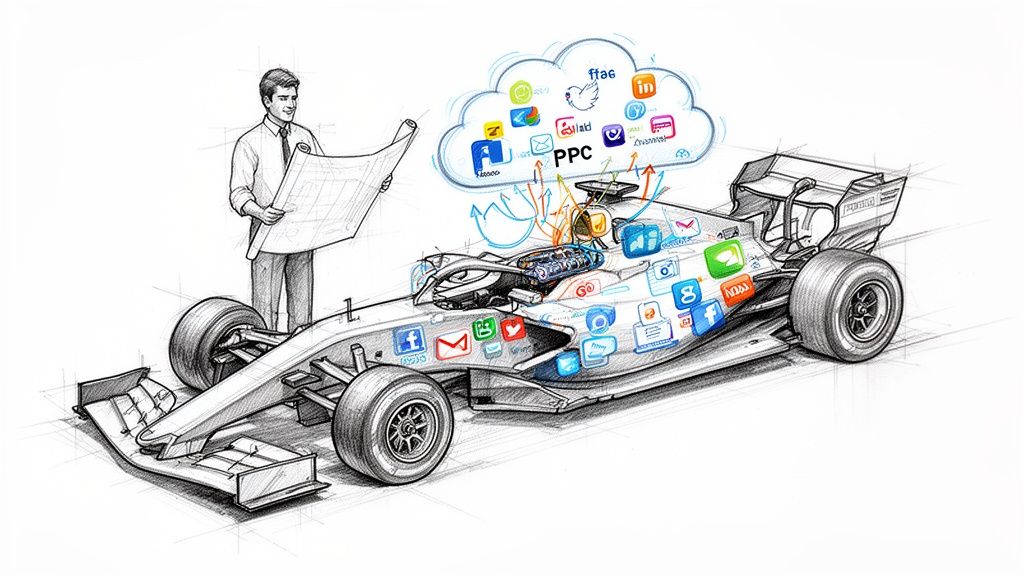
Think of your business as a high-performance race car. You’ve invested in powerful parts—a sleek website, active social media, and maybe some email campaigns. But without a chief engineer, those components might not work together. You’re left making a lot of noise but going nowhere fast.
A digital marketing consultant is that chief engineer.
Their job isn’t just to tune the engine; it’s to design the entire race strategy. They create the master plan that aligns every part of your marketing machine, ensuring each piece contributes to one primary objective: winning the race for customers and revenue.
This strategic approach becomes incredibly potent when you integrate it with a central nervous system like Salesforce. It’s the difference between collecting random data points and building a unified, 360-degree customer profile. Suddenly, every website click, email open, and social media engagement becomes a valuable piece of intelligence, fed directly into your Sales Cloud or Marketing Cloud.
A consultant transforms marketing from a cost centre into a predictable revenue generator. By connecting marketing efforts to Salesforce, you can finally see the complete journey from first contact to loyal customer and prove the value of your marketing spend.
Moving Beyond Simple Tactics
Many businesses fall into the trap of executing tactics without an overarching strategy. They might boost a post here or run a Google Ad campaign there, but these actions often exist in isolation, disconnected from real business outcomes.
Effective digital marketing consulting flips this on its head by focusing on outcomes, not just activities. The goal isn’t just to be busy; it’s to build a sustainable system that consistently delivers qualified leads and nurtures them all the way through the sales funnel, tracked seamlessly within Salesforce.
This strategic shift is crucial in a crowded market. Just look at the digital advertising agency sector in Australia. It’s been expanding at a compound annual rate of 7.4% between 2020 and 2025 and is projected to hit $3.7 billion in revenue. With over 97% of the Australian population online, simply having a presence isn’t enough. You need a rock-solid strategy to cut through the noise. You can dig into more Australian digital advertising trends to see the full picture.
Ultimately, a consultant ensures your marketing efforts are not just visible but also genuinely valuable. They connect the dots between a lead generated by a LinkedIn campaign and the final sale recorded in Salesforce, providing absolute clarity and proving your return on investment. This integration creates a seamless feedback loop, allowing for continuous optimisation and much smarter business decisions.
The Core Services That Drive Business Growth
An effective digital marketing consultant doesn’t just hand you a menu of services. They deliver a connected system of solutions, all designed to solve specific business problems. These core services are the engine of your growth strategy, with each one feeding valuable data and insights right back into your Salesforce platform.
Forget thinking of them as separate tasks. Picture them as interconnected gears. A sharp search engine optimisation (SEO) strategy fuels your content creation, which in turn gives you powerful assets for paid advertising campaigns. All these activities pull in leads that are then nurtured through marketing automation, creating a powerful, self-sustaining cycle.
This integrated approach means every part of your marketing contributes directly to things you can actually measure in Salesforce, like a healthier pipeline and more revenue.
Search Engine Optimisation And Content Strategy
SEO is the groundwork. It’s all about making sure your business shows up when potential customers are actively searching for the exact solutions you provide. It’s not about tricking algorithms; it’s about building your authority and creating a sustainable source of high-quality organic leads.
A strong content strategy goes hand-in-hand with SEO. This involves creating genuinely valuable articles, guides, and resources that answer your audience’s most urgent questions. This doesn’t just attract traffic—it builds trust and cements your brand as an industry leader. When tied together, these organic leads are captured automatically in Salesforce Sales Cloud, letting your sales team jump on conversations with warm prospects immediately.
Here in Australia, the focus on this is undeniable. Local businesses are projected to spend around AUD 1.5 billion on SEO services in 2025. The numbers back it up: analysis shows that for every $1 spent, the return can be over $22. This really cements its position as a top-tier investment for any business serious about growth.
Paid Advertising And Performance Marketing
While SEO builds your long-term authority, paid advertising (PPC) gives you immediate visibility and highly targeted traffic. A consultant designs and runs campaigns on platforms like Google Ads and LinkedIn to get in front of specific customer segments with real precision.
The real magic here is in the data-driven optimisation. By tracking every single click and conversion directly into Salesforce, a consultant can constantly refine the targeting, messaging, and ad spend to get the absolute best return on your investment. This isn’t just about getting clicks; it’s about acquiring customers in a way that’s both profitable and predictable. These campaigns also often involve weaving in effective digital loyalty solutions for business transformation to make sure the customers you win, stick around.
Marketing Automation And Nurturing Journeys
So, you’ve captured a lead. What happens next? This is where marketing automation, especially inside Salesforce, changes the game completely. It’s all about delivering the right message to the right person at exactly the right time, all on autopilot.
Using Salesforce Marketing Cloud or Account Engagement (formerly Pardot), consultants build intelligent customer journeys. These automated workflows nurture leads with personalised content, score how engaged they are, and only flag them to the sales team when they’re genuinely qualified and ready for a chat.
This process ensures no lead ever falls through the cracks, and it keeps your sales team focused on what they do best: closing deals with the most promising opportunities. Our specialists at our email marketing agency help businesses design these exact types of high-impact nurturing sequences. This is where marketing and sales finally click together—and it’s where real growth happens.
Connecting Your Marketing Directly to Salesforce
Let’s be honest. The real power of modern digital marketing isn’t just about getting clicks on a social media post or a Google Ad. It’s about what happens after the click. It’s realised when all your marketing efforts connect directly back to your customer relationship management (CRM) system.
Without that connection, you’re essentially flying blind.
Consider the challenge many businesses face: marketing data is scattered everywhere. Website stats are in Google Analytics, campaign results are siloed in Facebook Ads, and lead information lives in disconnected spreadsheets. It’s nearly impossible to see the full story of how a customer found you. You hope your marketing is working, but you can’t actually prove it.
A digital marketing consultant with Salesforce expertise is there to fix this exact problem. Their main job is to tear down those data walls and build a single, unified source of truth right inside Salesforce.
Creating a Unified Customer View
Once your systems are integrated, every single interaction becomes a valuable piece of the puzzle. A new lead fills out a form on your website? It flows into Salesforce. Someone clicks a link in your latest email campaign? That’s tracked. They engage with a social media post? That data point is added to their profile.
Suddenly, you have that sought-after 360-degree view of your customer.
This is how modern marketing works best: you attract people through channels like SEO and PPC, and then you use smart, automated systems to nurture them along their journey.
As you can see, foundational activities like SEO and PPC aren’t just standalone tactics; they feed directly into an automation engine, creating a cohesive system rather than a set of disconnected efforts.
This is where platforms like Salesforce Marketing Cloud and Account Engagement (what used to be called Pardot) really shine. They take all that rich, unified data and use it to send incredibly personalised communications, even at a massive scale.
Instead of sending generic email blasts to everyone on your list, you can build intelligent journeys that adapt to what a customer does in real-time. This is what turns disconnected marketing activities into a cohesive, measurable system that actually generates revenue.
From Guesswork to Measurable ROI
This integration is the difference between guessing about your marketing’s impact and knowing its exact contribution to your bottom line. You can finally answer the big business questions with total confidence:
- Which campaigns are actually bringing in the best leads? By tracking leads from their source all the way to a closed deal in Salesforce, you know precisely where your budget is best spent.
- What is the real cost to acquire a new customer? You can calculate your customer acquisition cost (CAC) with pinpoint accuracy by tying your campaign spending directly to sales revenue.
- How is marketing influencing the sales pipeline? Salesforce dashboards can show you, clear as day, how marketing-generated leads are moving through each stage of the sales cycle.
This shift provides complete clarity. It turns your marketing department from a cost centre into a predictable engine for growth, where every dollar spent is tied to a measurable business outcome.
If you want to dig deeper into how these tools work together, our guide on Salesforce for marketers provides a more detailed breakdown. Ultimately, this connected approach is how you stop spending money on marketing and start investing it.
Tailored Strategies for Your Industry
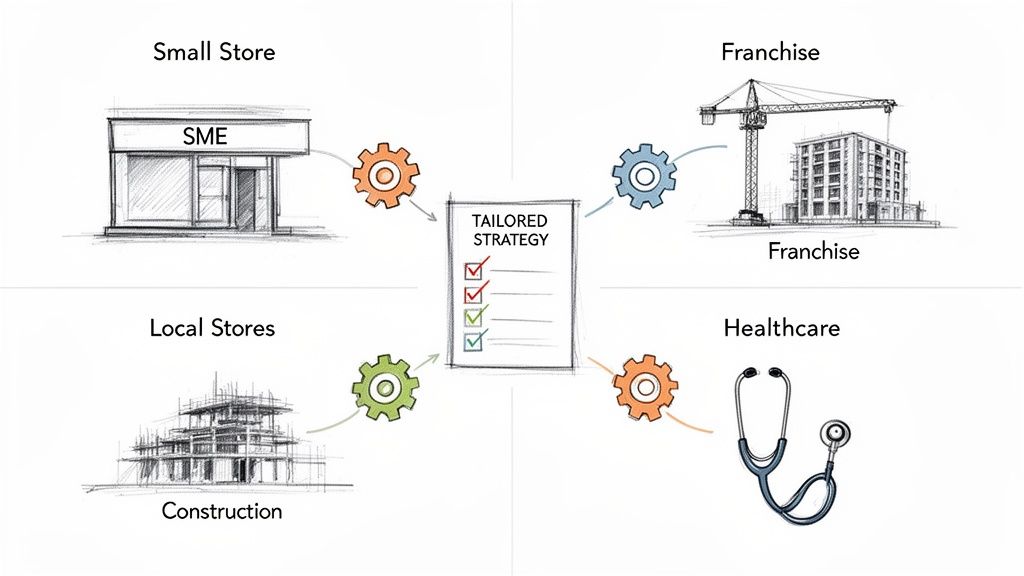
Let’s be honest, a generic marketing plan is a recipe for wasted budget. The hurdles a national franchise faces look nothing like those of a local construction firm. A truly effective digital marketing consulting partner gets this. They dig into the specific challenges of your sector and build a strategy that actually solves them.
It’s about more than just applying general advice. The real value comes from using the right tools—like Salesforce—to fix specific, real-world business problems. Think of it as building a custom growth engine for your business, not just following a standard playbook.
Let’s break down how this works for different Australian businesses.
The following table provides a snapshot of the distinct challenges and tailored consulting solutions for a few key sectors.
Industry-Specific Digital Marketing Focus
| Industry | Primary Challenge | Recommended Consulting Focus |
|---|---|---|
| Franchise Networks | Balancing national brand consistency with local franchisee marketing needs. | Implementing Salesforce Distributed Marketing for brand-approved, customisable local campaigns. |
| Construction & Real Estate | Managing long sales cycles and keeping leads engaged over months or years. | Designing automated lead nurturing journeys with Salesforce Account Engagement (Pardot). |
| Healthcare | Building patient trust and communicating sensitive information securely. | Using Salesforce Health Cloud to create personalised, compliant patient communication pathways. |
| Professional Services | Establishing thought leadership and generating high-value B2B leads. | Leveraging LinkedIn campaigns integrated with Salesforce for targeted lead capture and tracking. |
| SMEs/Retail | Competing with larger players and driving repeat business. | Creating loyalty programs and targeted promotions using Salesforce Marketing Cloud. |
As you can see, the strategy isn’t just different; it’s designed to solve a very specific problem that holds that industry back.
For Australian Franchise Networks
The classic franchise dilemma: how do you maintain a strong, consistent national brand while empowering local franchisees to market effectively in their own communities? It’s a constant tug-of-war between control and localisation.
Case Study: The Salesforce Solution
This is where a consultant can bring in Salesforce Marketing Cloud’s distributed marketing features to create harmony. They can set up a system that gives franchisees access to pre-approved, brand-safe templates for their emails, social media, and local ads.
- Centralised Brand Control: Head office creates and signs off on all the core creative and messaging.
- Localised Execution: Franchisees can then tweak these templates with their local deals, store details, or community events.
- Unified Data: The best part? All the performance data from every location flows back into one central Salesforce dashboard, giving HQ a bird’s-eye view of what’s working across the network.
This approach gives local operators the tools they need to succeed while ensuring the brand identity remains strong and consistent. It’s a complex balance, and it’s something our team at our social media marketing agency helps brands manage every day.
For Construction and Real Estate
If you’re in construction or real estate, you know the sales cycle isn’t a sprint; it’s a marathon. A potential buyer might express interest today but not be ready to sign for months, or even years. The biggest challenge is simply staying top-of-mind without being pushy.
Case Study: The Salesforce Solution
Here, a consultant’s game plan changes entirely. The focus shifts to building sophisticated, long-term lead nurturing journeys using Salesforce Account Engagement (what used to be called Pardot). It’s not about forcing a quick sale; it’s about methodically building trust over time.
By automating the delivery of valuable, relevant content—like project case studies, market reports, or financing guides—you can guide prospects through their decision-making process without your sales team having to manually chase every lead.
This automated process does the heavy lifting, keeping your brand visible and credible. When the prospect is finally ready to make a move, your company is the one they remember. Suddenly, that long sales cycle becomes a competitive edge, not a weakness, because you’ve spent all that time building a rock-solid relationship.
How to Choose the Right Consulting Partner
Picking the right digital marketing consulting partner is a big deal. It’s a decision that can genuinely shape the future of your business. The right choice unlocks new revenue and gives you a clear return on your investment. The wrong one? Well, that leads to wasted budget and missed opportunities.
Think of the process less like a sales pitch and more like a high-stakes interview. You’re not just hiring a contractor to tick off tasks; you’re looking for a true partner who understands your business inside and out, especially how you leverage Salesforce.
Vetting Potential Partners
A strategy-first mindset is absolutely non-negotiable. Any consultant worth their salt should start by asking you probing questions about your business goals, target customers, and current challenges.
If they dive straight into talking about tactics—like running ads or posting on social media—without first understanding why, that’s a massive red flag.
A good consultant is obsessed with delivering real business outcomes, not just fluffy metrics that look good on paper. They should be talking your language: pipeline growth, cost per acquisition, and customer lifetime value. These are the numbers that matter, the ones that live inside your Salesforce CRM.
The most important quality to look for is a demonstrated ability to connect marketing activities directly to business results. A partner who can’t clearly explain how their work will generate revenue is not the right partner.
And the stakes for getting this right have never been higher. As we moved into 2025, social and content marketing became a major investment for Aussie businesses. For example, LinkedIn’s potential ad reach in Australia shot up by 2.0 million users (+13.3%) between early 2024 and early 2025 alone. Imagine mismanaging that kind of spend—it can easily waste hundreds of thousands. You can dig into the full details in the Digital 2025 Australia report. This makes your choice of partner absolutely critical.
To help with this, it’s wise to review resources that offer expert tips on choosing a digital marketing agency. It’s also vital to understand the different types of partners out there, which is why we put together a guide to help you compare the best Salesforce consulting firms available.
Key Questions to Ask
To cut through the noise, you need to arm yourself with questions that force potential partners to prove their expertise. Here’s a practical checklist to get your conversations started:
- Salesforce Expertise: “Can you show us exactly how you integrate marketing campaigns with Salesforce Sales Cloud and Marketing Cloud to track ROI all the way from lead to close?”
- Industry Experience: “Show us case studies where you’ve solved similar problems for a business in our industry. What were the specific, measurable results?”
- Strategic Approach: “Walk us through your process for building a digital marketing strategy. How do you make sure your plan is aligned with our core business objectives?”
- Reporting and Transparency: “What does your reporting actually look like? Can we see a sample dashboard that tracks progress towards our key performance indicators (KPIs)?”
Frequently Asked Questions About Digital Marketing Consulting
Dipping your toes into the world of digital marketing consulting naturally brings up a few questions. Before you jump into a partnership, you need clarity. Let’s walk through some of the most common queries we hear from business leaders, breaking them down with straightforward answers to help you move forward with confidence.
What Is the Difference Between a Marketing Agency and a Consultant?
It’s a classic question, and the best way to think about it is with an analogy. A consultant is the architect who draws up the blueprint for your house. They figure out the high-level strategy, make sure every room serves a purpose, and align the whole project with your ultimate vision.
An agency, on the other hand, is the crew of skilled builders who bring that blueprint to life. They’re the ones on the ground, running the ad campaigns, managing social media, and creating the content. They’re masters of execution.
A truly great partner, however, doesn’t make you choose. They blend the strategic foresight of a consultant with the hands-on expertise of an agency. This way, the plan isn’t just brilliant on paper—it’s implemented flawlessly.
How Is the ROI of Consulting Measured?
We measure the return on your investment (ROI) with cold, hard business metrics, tracked right inside your Salesforce platform. We skip the fluffy stuff like ‘impressions’ or ‘likes’ and zero in on the numbers that actually impact your bottom line.
This means we’re watching things like:
- The raw increase in marketing-qualified leads (MQLs).
- A real, measurable drop in your cost per acquisition (CPA).
- Tangible growth in the value of your sales pipeline.
- Direct revenue that can be traced back to specific marketing campaigns.
A consultant’s worth is proven by their ability to move these numbers in the right direction. It’s about creating a clear, undeniable link between our work and your financial growth.
The single most important measure of success is tying marketing spend directly to closed-won deals in Salesforce. It’s the ultimate proof that your investment is generating real, profitable returns for the business.
How Long Does It Take to See Results?
You’ll start seeing results in waves. Some wins come quickly. We can often get targeted paid ad campaigns up and running that drive immediate traffic and leads within the first few weeks.
But the real, sustainable growth—the kind that comes from strategies like SEO and content marketing—takes a bit more time to build momentum. You can typically expect to see that foundation solidify over three to six months.
A good consultant builds a roadmap that balances these quick hits with compounding, long-term value. From day one, you’ll have full visibility into our progress through detailed Salesforce dashboards, so you’re never left guessing.
How does consulting integrate with my Salesforce setup?
A consultant should not only understand digital marketing but also be an expert in the Salesforce ecosystem. The process begins with an audit of your current Salesforce instance (Sales Cloud, Marketing Cloud, etc.) to understand your data structure and processes. From there, we ensure all marketing channels—from your website forms to paid ad platforms—are properly connected to Salesforce. This creates a closed-loop system where leads are captured, nurtured, and tracked seamlessly, providing a single source of truth for your entire customer journey.
Ready to build a marketing strategy that delivers measurable results directly in Salesforce? The team at Adaptal specialises in creating and implementing data-driven digital marketing plans that connect every activity back to your business goals. Contact us today for a consultation.