

Digital business transformation consulting is a strategic service that guides companies in modernising their technology, processes, and culture to thrive in a connected world. It’s not about just plugging in new software; it's a fundamental rewiring of your business to be more agile, efficient, and customer-focused, with a powerful platform like Salesforce at its centre. For businesses using or considering Salesforce, this transformation is key to unlocking the platform's full potential and achieving significant growth.
Understanding Digital Business Transformation Consulting

Think of your business as a well-loved, classic car. It’s been reliable for years, but its parts are getting old. The engine is inefficient, the navigation is a paper map, and the radio only picks up AM stations. It still gets you from A to B, but it can’t keep up with modern cars that offer GPS, fuel efficiency, and seamless connectivity.
Digital business transformation consulting is like bringing in a team of expert mechanics and Salesforce architects to overhaul that car. They don’t just give it a new coat of paint; they rebuild the engine with modern automation, install a state-of-the-art digital dashboard powered by Salesforce, and integrate a modern GPS to guide your customer journeys. The goal is to keep the car's classic soul while giving it the power and intelligence to outperform on today's business highways.
Moving Beyond Simple Upgrades with Salesforce
This analogy highlights a critical point: transformation isn’t the same as a simple technology upgrade. It’s a holistic shift that connects previously siloed parts of your business—sales, service, marketing, and operations—into a single, cohesive unit. This is where a platform like Salesforce becomes the central nervous system of your newly modernised organisation.
Instead of different departments using separate, incompatible tools, Salesforce provides one unified CRM platform where all customer data and interactions live. This creates a single source of truth, giving every team a complete 360-degree view of the customer.
By breaking down internal silos with a unified CRM, you replace fragmented customer interactions with a seamless, consistent journey. This shift is the essence of becoming a truly customer-centric organisation.
Why This Matters for Australian Businesses
The push for modernisation is more than a global trend; it’s a local necessity. The Australian digital transformation market is expanding quickly as organisations realise they need to adapt. As of 2024, over 45% of Australian companies had already launched digital programs. The market, valued at $18.5 billion in 2024, is projected to soar to $84.7 billion by 2033, proving that digital readiness is now a core competitive strategy, not just an option.
A Salesforce consulting partner's job is to guide you through this complex journey. They help you:
- Identify Inefficiencies: Pinpoint the outdated processes and data silos in your sales, service, and marketing operations that are holding your business back.
- Develop a Strategic Roadmap: Create a clear, actionable plan for change that aligns with your specific business goals and leverages the Salesforce platform.
- Implement the Right Technology: Use Salesforce products like Sales Cloud, Service Cloud, and Marketing Cloud to build a scalable and integrated technology stack.
- Manage Change: Guide your team through the cultural and operational shifts needed for successful Salesforce adoption.
To really get your head around the multifaceted nature of digital business transformation, it's insightful to see how it applies in specific sectors, like the strategic approaches to digital transformation in healthcare. This shows how core principles can be adapted to meet unique industry challenges, from patient care to operational logistics.
The Core Pillars of a Successful Salesforce Transformation
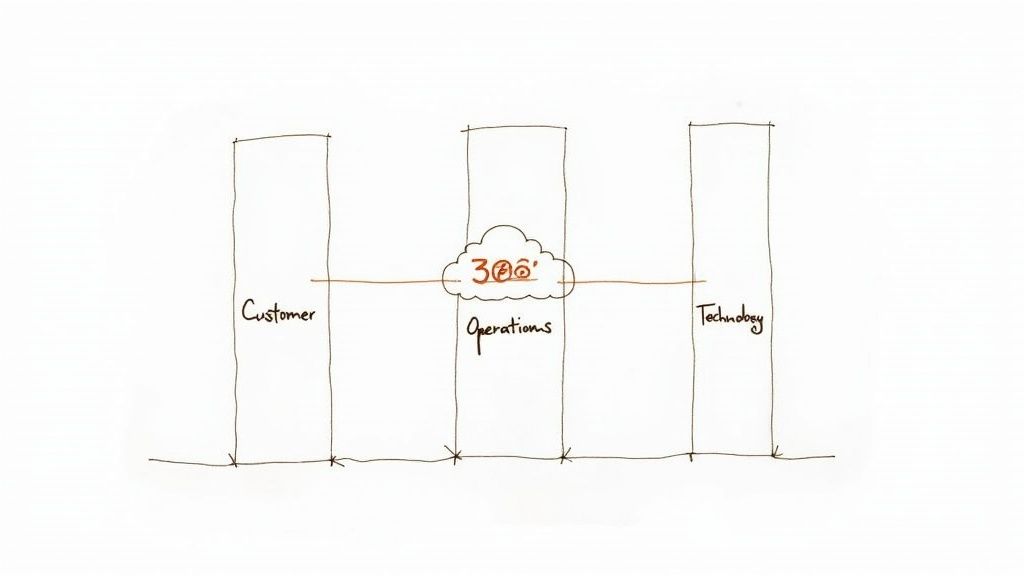
Any genuine transformation goes way beyond just installing new software. It’s about rethinking your entire business from the ground up, focusing on how you deliver real value to your customers.
Lasting change is built on three pillars that have to work together: radical customer-centricity, streamlined operational excellence, and intelligent technology enablement.
When these are balanced, your business can adapt and thrive. But if one is weak, the whole structure feels shaky. A digital business transformation consultant’s job is to strengthen each of these areas, using a platform like Salesforce to tie them all together into a single, cohesive strategy.
Pillar 1: Radical Customer-Centricity
This isn't just about good customer service. It’s about designing your entire business around your customer’s needs and journey. It means that every single department—from sales and marketing to service and logistics—shares a complete picture of who the customer is and what they need.
This is where so many businesses get stuck, with crucial customer data siloed away in different, disconnected systems.
A tool like Salesforce Service Cloud is a perfect example of how technology supports this pillar. It pulls every customer interaction—every call, email, chat, and purchase history—into one unified view. This 360-degree customer view gives your teams the power to offer proactive, personalised service that genuinely builds loyalty.
Pillar 2: Streamlined Operational Excellence
Operational excellence is all about getting the friction out of your internal processes. Think of it as automating repetitive tasks, killing off manual data entry, and building smart workflows so your team can focus on what they do best, not on admin.
Inefficient processes don’t just drain time and money; they create a poor customer experience through delays, mistakes, and frustration.
This is where automation becomes non-negotiable. Salesforce Flow, for instance, lets you build automated processes that can handle everything from assigning new leads in Sales Cloud to escalating support cases in Service Cloud or managing approvals. By automating these routine jobs, you slash the risk of human error, speed up your response times, and free up your people to solve real problems.
A business with streamlined operations doesn't just work harder; it works smarter. This efficiency translates directly into a more consistent and reliable experience for your customers, building trust with every interaction.
Pillar 3: Intelligent Technology Enablement
The final pillar is the technology that connects the first two. This isn’t about chasing the latest tech fad. It's about strategically choosing a platform that is flexible enough to grow with you, scalable enough to handle your needs, and integrated enough to talk to all your other systems.
Your technology should act like the central nervous system for your business—collecting data, enabling communication, and serving up the insights you need to make smart decisions.
For many, Salesforce becomes this foundational layer, creating a single platform where customer data and business processes finally meet. Its real power isn't just in one product, but in how the entire ecosystem works together to create a single source of truth.
To see how this comes to life, it’s worth understanding the role of Salesforce development consultants, as they are the experts who architect this connected system.
To pull off a successful transformation, you need a balanced strategy. Focusing too much on one pillar at the expense of the others just leads to failure—great tech that no one uses, or brilliant customer ideas that your clunky operations can’t deliver. A holistic approach, guided by experienced digital business transformation consulting, makes sure all three pillars are built together, creating a solid foundation for growth.
The Three Pillars of Digital Transformation
A successful transformation relies on these three core components working in harmony. Here’s a quick breakdown of each pillar and how a platform like Salesforce helps bring it to life.
| Pillar | Core Focus | Example Salesforce Solution |
|---|---|---|
| Customer-Centricity | Understanding and organising the business around the customer journey. | Service Cloud: Creates a 360-degree view of every customer interaction. |
| Operational Excellence | Automating internal processes to remove friction and increase efficiency. | Salesforce Flow: Builds automated workflows for tasks like lead assignment and case approvals. |
| Technology Enablement | Implementing a flexible, scalable, and integrated tech foundation. | Salesforce Platform: Acts as a central hub connecting data and processes across the entire business. |
Ultimately, a robust digital platform like Salesforce acts as the glue, ensuring that your customer focus, operational efficiency, and technology stack are all perfectly aligned to drive your business forward.
Why a Salesforce Partner Is Your Transformation Guide
Trying to navigate a digital transformation on your own is a bit like setting sail across the ocean with just a map and compass. You know where you want to go, but you're completely unprepared for the sudden storms, strong currents, and hidden reefs that will inevitably appear. Choosing the right guide for this journey—specifically, an experienced Salesforce partner—is often the single most important decision you'll make.
Many businesses fall into the trap of seeing a consultant as just an installer, someone who comes in to set up the software. This perspective misses the real value entirely. A true partner is your strategic navigator, charting a course that sidesteps common pitfalls and steers you directly toward your business goals.
Beyond Implementation to Strategic Navigation
The value of a good Salesforce partner goes well beyond just technical skill. They bring an objective, outside-in view that’s almost impossible to get from inside the company. Your own team is often too close to the current processes and internal politics to see the bigger picture or challenge the "way things have always been done."
A Salesforce partner, on the other hand, arrives with a fresh set of eyes. They're trained to diagnose the root causes of problems, not just patch up the symptoms. That objectivity is crucial for making the tough—but necessary—decisions that lead to real, lasting change.
A Salesforce partner's job is to translate your high-level business vision into a concrete, technical reality on the platform. They bridge the gap between what you want to achieve and what your technology can actually deliver, ensuring your Salesforce investment generates measurable returns.
Case Study: Connecting Silos for a Services Firm
Let me give you a classic example we see all the time: a mid-sized professional services firm where the sales and marketing teams were basically operating on separate islands. Sales was using a simple CRM that didn’t talk to their marketing automation tool, which in turn was completely disconnected from the client service platform.
The Challenge: The marketing team was generating leads with no idea of their quality or if sales was following up. Sales reps were frustrated, trying to engage prospects with zero context, making their outreach feel generic. Worst of all, nobody had a single, clear view of the customer's journey from lead to loyal client.
From Disconnected Data to Unlocked Growth with Salesforce
The Solution: Instead of just ripping and replacing one tool, our first move as their Salesforce partner was to build a strategic roadmap. We sat down with people from every department to map out their current processes and, more importantly, figure out exactly where the pain was coming from.
The core issue wasn't the tools themselves, but the total lack of a central hub for data. To fix this, we designed a solution built on Salesforce Sales Cloud and Account Engagement (formerly Pardot) to unify their marketing and sales efforts. We then brought in MuleSoft to build solid integrations with their existing finance and project management systems, creating a single source of truth.
The Results: The impact was immediate and powerful:
- A Unified Customer View: For the first time, both sales and marketing could see the entire customer lifecycle in Salesforce. This led to smarter lead nurturing and much more personalised sales conversations.
- Improved Efficiency: With automated workflows in Salesforce Flow, qualified leads were instantly routed to the right reps with all necessary context, cutting response times by over 40%.
- Actionable Insights: With all data in one place, leadership could finally run Salesforce reports and dashboards that showed which marketing campaigns were actually driving the most valuable business.
This project is a perfect illustration of why expert guidance is so vital. By providing strategic oversight, we helped them fix not just a technology problem, but a fundamental business problem. For a deeper look into this approach, explore our dedicated Salesforce consulting services. The Management Consulting industry in Australia, while seeing shifts due to government reforms, remains a vital sector for driving such business improvements. You can learn more about the industry's current landscape from IBISWorld.
Your Step-by-Step Salesforce Transformation Roadmap
Jumping into a digital transformation project without a clear map can feel a bit like setting off on a cross-country trip with no GPS. You might have a destination in mind, but the path is anything but clear. That’s why a structured, proven methodology is so important to get you from an ambitious idea to real, tangible results.
Our approach to digital business transformation consulting breaks the entire journey down into three distinct, manageable phases. It's designed to bring clarity, keep everyone aligned, and build momentum at every stage. This roadmap demystifies the whole process, giving you a predictable and reliable path forward. Each phase builds on the one before it, making sure the final Salesforce solution isn't just technically sound but is also perfectly in tune with your core business goals.
Phase 1: Discovery And Strategy
This first phase is all about listening. Before we even whisper the word 'technology', we dive deep into your business to properly understand your unique challenges, day-to-day operational pain points, and bigger strategic goals. This isn't just a quick chat; it's a thorough diagnostic process.
Here’s what we typically get up to in this phase:
- Stakeholder Workshops: We get your key people in a room—from the C-suite right through to the front-line staff using the system daily. This gives us a 360-degree view of the current challenges and what everyone needs for the future state in Salesforce.
- Process Mapping: Our consultants visually map out your existing workflows. This exercise is brilliant for spotting bottlenecks, duplicated effort, and clear opportunities for automation within Salesforce. You’d be surprised what these maps can uncover.
- Defining Critical KPIs: We work with you to lock in clear, measurable Key Performance Indicators (KPIs). These become the metrics that define success for the project, ensuring we're all pulling in the same direction.
Getting this initial work right is absolutely crucial. By the end of this phase, you get a comprehensive strategic roadmap that lays out the project's scope, objectives, and a high-level plan for getting it all done. Think of it as our shared compass for the entire journey.
The infographic below shows how we translate business challenges into a clear strategy for measurable growth.
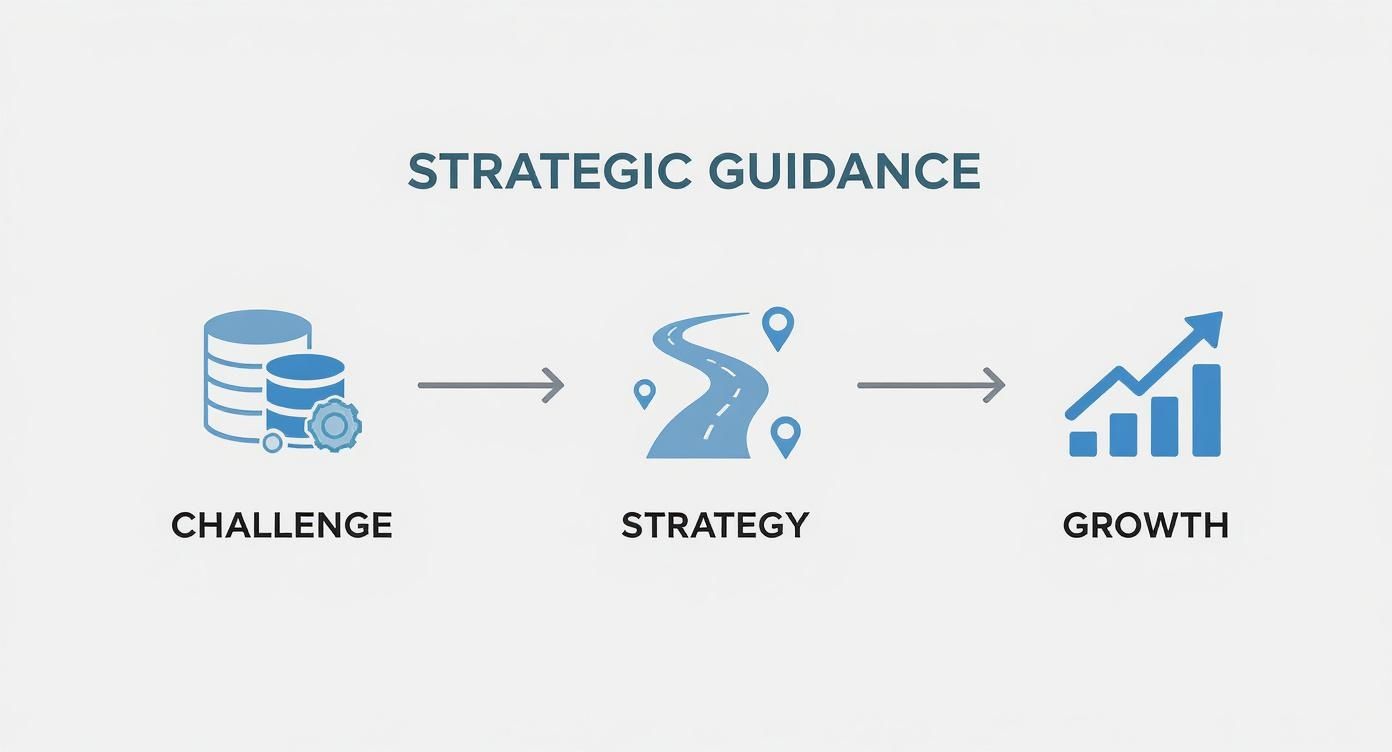
This visual shows the journey from pinpointing initial problems like data silos all the way to developing a strategic roadmap that drives real business growth.
Phase 2: Salesforce Solution Design And Implementation
With a solid strategy in our hands, we shift gears into the technical design and build. This is where the vision starts taking shape within the Salesforce ecosystem. Our focus is squarely on configuring a solution that’s both powerful and practical, tailored specifically to the workflows we mapped out in the discovery phase.
The best technology solutions aren't just powerful; they're intuitive and slide seamlessly into your team's daily work. The goal is to build a Salesforce system that empowers people, not one that creates new frustrations.
During this hands-on phase, we're busy with:
- Customising Salesforce Objects: We configure Salesforce to mirror your unique business processes. That might mean tailoring Sales Cloud to fit your sales cycle like a glove or customising Service Cloud for your specific support structure.
- Building Robust Integration Pathways: A CRM rarely works alone. We design and build secure integrations with your other critical systems—think accounting software like Xero or MYOB, or your ERP—to create a single, connected operational hub.
- Agile Development Sprints: We don't disappear for months and come back with a finished product. We build, test, and refine the solution in short, iterative cycles, giving your team regular demos to gather feedback and make sure the final result is exactly what you expect.
For a deeper dive into the technical side of this phase, have a look at our complete Salesforce Implementation Guide for Australian businesses.
Phase 3: Adoption And Optimisation
A successful launch isn't the finish line; it’s just the beginning. The final, and arguably most important, phase of our roadmap is all about making sure your team actually embraces the new system and that the solution keeps delivering value long after go-live. After all, technology is only as good as the people using it.
This phase is dedicated to creating sustainable success through:
- Comprehensive User Training: We develop and deliver training programs designed for different user groups, ensuring everyone feels confident and capable from day one with the new Salesforce instance.
- Establishing Feedback Loops: We set up channels for users to give ongoing feedback, flag issues, and suggest improvements. This user-first approach is what drives continuous enhancement.
- Continuous Improvement: Business needs change, and your Salesforce platform should change with them. We'll work with you to monitor performance against those KPIs we set earlier and make ongoing tweaks to ensure your investment keeps paying off.
This three-phase approach provides a structured and transparent journey, turning the huge challenge of digital transformation into a manageable—and ultimately successful—project.
Using Emerging Tech in Salesforce for a Competitive Edge
Successfully navigating a digital transformation is a huge achievement, but true market leadership comes from what you build next. Once your core processes are modernised in Salesforce, the next step is using new technologies like artificial intelligence (AI) and advanced data analytics to carve out a real competitive advantage.
This is the point where your business stops playing catch-up and starts pulling ahead.
A forward-thinking digital business transformation consulting partner helps you look past today’s problems to seize tomorrow's opportunities. The goal shifts from simply fixing operational headaches to proactively creating new value. Within the Salesforce ecosystem, that means tapping into powerful tools that turn your data into predictive insights and automated actions.
From Reactive to Predictive with Salesforce Einstein
Imagine your sales team knowing which leads are most likely to convert before they even pick up the phone. That’s the real-world power of Salesforce Einstein, the AI layer baked directly into the platform. It crunches historical data, customer engagement, and countless other signals to deliver predictive lead scoring.
Suddenly, your sales reps can stop guessing and start focusing their energy where it counts. Instead of treating every lead the same, they can prioritise the opportunities with the highest chance of closing, boosting both their efficiency and their success rates in Sales Cloud.
By weaving AI directly into daily workflows, you empower your teams to make smarter, data-driven decisions—no data science degree required. It’s all about turning complex information into simple, actionable advice.
Hyper-Personalisation with Advanced Analytics
In a crowded market, generic customer experiences just don’t cut it anymore. To stand out, you need to deliver hyper-personalised journeys that show you truly get each customer. And that level of insight is only possible with sophisticated data analytics.
This is where platforms like Tableau and Marketing Cloud Intelligence (formerly Datorama) shine. They connect and visualise data from across your entire business—and beyond—to uncover deep insights into customer behaviour.
- Marketing Cloud Intelligence: This tool gives you a single source of truth on marketing performance across all channels, helping you optimise your spend and strategy.
- Tableau: With its powerful visualisation tools, Tableau helps you spot trends and patterns you’d otherwise miss, leading to smarter segmentation and more effective campaigns.
This data-driven approach is becoming non-negotiable. By 2030, the Australian digital transformation market is projected to grow at a compound annual growth rate of 31.8%. That’s a clear signal of the intense focus on data-driven strategies.
These technologies allow you to move beyond basic automation and create proactive service models. For instance, by integrating IoT data with Service Cloud, you can predict when a piece of equipment might fail and schedule maintenance before it breaks down. You could even use a Visual Remote Assistant (VRA) Flow to guide field technicians, creating an even more efficient and proactive customer support model.
FAQ: Your Salesforce Transformation Questions Answered
Jumping into a Salesforce-led digital transformation project always brings up a few practical questions. It's natural for business leaders to want clarity on timelines, what resources they need to commit, and what success actually looks like on the other side. Here are some of the most frequent questions we tackle right at the start of a digital business transformation consulting partnership.
How do we measure the ROI of our Salesforce investment?
Measuring Return on Investment (ROI) isn't just about the numbers on a spreadsheet. Of course, we track hard metrics like revenue growth and cost savings from new automations, but the real value often shows up in strategic KPIs that point to long-term health and growth.
- Improved Customer Satisfaction: We keep a close eye on metrics like your Net Promoter Score (NPS) and customer retention rates. A well-executed Salesforce implementation almost always leads to happier, more loyal customers who stick around.
- Increased Operational Efficiency: This is where you see the direct impact on your day-to-day. We look for tangible improvements like shorter sales cycles in Sales Cloud, quicker case resolution in Service Cloud, and a sharp drop in time spent on manual data entry.
- Enhanced Employee Productivity: Salesforce adoption rates tell a big story. When your team genuinely embraces the new tools and uses them consistently, it's a clear sign their work has become easier and more effective.
How long does a typical Salesforce transformation take?
There's really no "one-size-fits-all" answer here, as the timeline depends entirely on the scope and complexity of what you're trying to achieve. That said, we always phase our projects to deliver value quickly, rather than making you wait for one massive "big bang" launch.
A foundational Salesforce implementation, maybe focusing on core sales functions in Sales Cloud for one department, might take around three to six months. More complex projects that bring in multiple clouds (like Sales, Service, and Marketing Cloud) and require intricate integrations can stretch to a year or more. Our approach is always agile, delivering tangible wins in stages to build momentum and show progress early.
What internal involvement is required from our team?
Your team's involvement is absolutely critical for a successful Salesforce project. This isn't something you can just hand off and forget about. For a transformation to stick, we need active participation from key stakeholders and the subject matter experts within your organisation—the people who know your business inside and out.
A successful transformation is a partnership. Your internal expertise on your business combined with our external expertise on Salesforce and strategy is the formula for achieving the best outcomes.
You should expect key team members to set aside time for workshops, user testing, and training sessions. One of the best things you can do is appoint an internal project champion. This person becomes the driving force for Salesforce adoption and ensures the project stays perfectly aligned with your business goals. As you get started, understanding and preparing for the common digital transformation challenges is a key step for a smoother journey.
Ready to turn these questions into a clear action plan for your Salesforce journey? The team at Adaptal specialises in guiding Australian businesses through every stage of their digital transformation. We provide the strategic insight and technical expertise to ensure your Salesforce investment delivers real, measurable results. Contact us today for a consultation.