
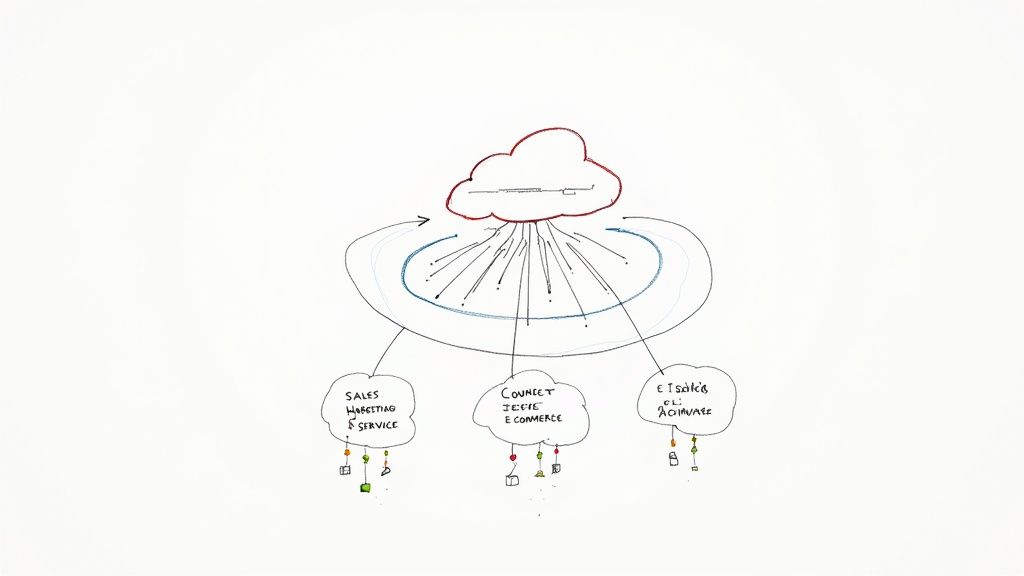
Picture this: your customer data is scattered everywhere. It's in your sales CRM, your marketing platform, your service desk, your e-commerce store—each holding a tiny piece of a much larger story. The business challenge is clear: without a single view, you can't deliver the seamless experiences customers expect. Salesforce Data Cloud is the solution designed to solve this, acting as the master storyteller that pieces all these fragments together into a single, unified narrative.
In simple terms, it’s Salesforce’s real-time customer data platform (CDP). Its entire job is to bring all your customer information into one place, no matter where it's hiding, and make it actionable for your teams.
The Business Problem That Data Cloud Solves
For most organisations, customer data is trapped in silos. The marketing team has the engagement history, the CRM holds sales conversations, the e-commerce platform tracks every purchase, and the service desk logs all the support tickets. This fractured view means you never really see the whole customer, which leads directly to disjointed and frustrating experiences.
It's a classic scenario we see in projects all the time: a sales rep, trying to be proactive, calls a high-value client. What they don't know is that same client has an unresolved, infuriating support ticket that’s been open for a week. That's the kind of friction that damages relationships and stalls growth. Without a central hub for this information, every department is flying blind, and genuine personalisation remains a distant dream.
A Central Nervous System for Your Customer Data
Think of Salesforce Data Cloud as the central nervous system for your entire business. It connects every single customer touchpoint—every click, every call, every purchase—and feeds it all into a single source of truth. This isn't just another database; it’s an intelligent layer that listens to signals from all your systems in real time.
The platform pulls in, cleans up, and merges data from any source to build a rich, detailed profile for every customer. Suddenly, your teams aren't working with disconnected snippets of information anymore. They have a complete, 360-degree view that gets smarter with every new interaction. To see how Data Cloud fits into the bigger picture, it's worth looking at other leading analytic data solutions that are reshaping how businesses operate.
Salesforce Data Cloud is designed to make every interaction smarter. It ensures that your customer-facing teams have the full context they need to deliver exceptional experiences, turning fragmented data into your most valuable business asset.
Why This Matters for Your Business
Having all your data in one place has a huge impact. It’s the bedrock for creating the seamless, context-aware experiences that customers now demand. Once your data is organised and accessible, you can finally move beyond generic email blasts and reactive support calls.
Instead, you can:
- Personalise at Scale: Send out tailored messages and offers based on a customer's entire history and what they’re doing right now.
- Anticipate Customer Needs: Use unified data to spot patterns and predict what a customer might need next, allowing you to be proactive with service and sales.
- Fuel Your AI Strategy: Feed your AI tools, like Einstein, with clean, reliable, and harmonised data. This ensures its predictions and recommendations are actually accurate and useful.
This unified approach changes the game. A recent study found that 73% of customers now expect companies to understand their unique needs and expectations—something that’s nearly impossible to do when your data is all over the place. Data Cloud is built to solve exactly that problem.
Paving the Way for Intelligent Engagement
Ultimately, Salesforce Data Cloud is about closing the gap between your business and your customers. It tears down the internal walls that stop you from seeing the complete picture. By creating a single, actionable view of every customer, it makes every sales call more relevant, every marketing email more timely, and every service interaction more effective.
As a Salesforce partner, we've seen firsthand how a unified data strategy can completely transform a business. The organisations that successfully connect their data are the ones best equipped to build lasting customer loyalty and drive real, sustainable growth. It’s the critical infrastructure needed to power the next wave of personalised, AI-driven engagement, making sure every part of your business is working together from a single, intelligent understanding of your customer.
Understanding The Core Architecture of Data Cloud Salesforce
To really understand how Salesforce Data Cloud creates that elusive single source of truth, you need to look at its architecture. It isn't just a jumble of tech; it's a logical, three-part framework designed to ingest, harmonise, and activate customer information from anywhere and everywhere. For business leaders and IT managers alike, understanding this structure is the key to seeing its massive real-world value.
The whole process boils down to three functional pillars: Connect, Harmonise, and Activate. Each stage plays a vital role in turning raw, scattered data points into the kind of intelligent, actionable insights that can genuinely push your business forward. It's a methodical approach that makes sure the data you're using is not just complete, but also clean, consistent, and ready to go in real time.
This diagram shows how these core functions work together to build a complete customer profile.
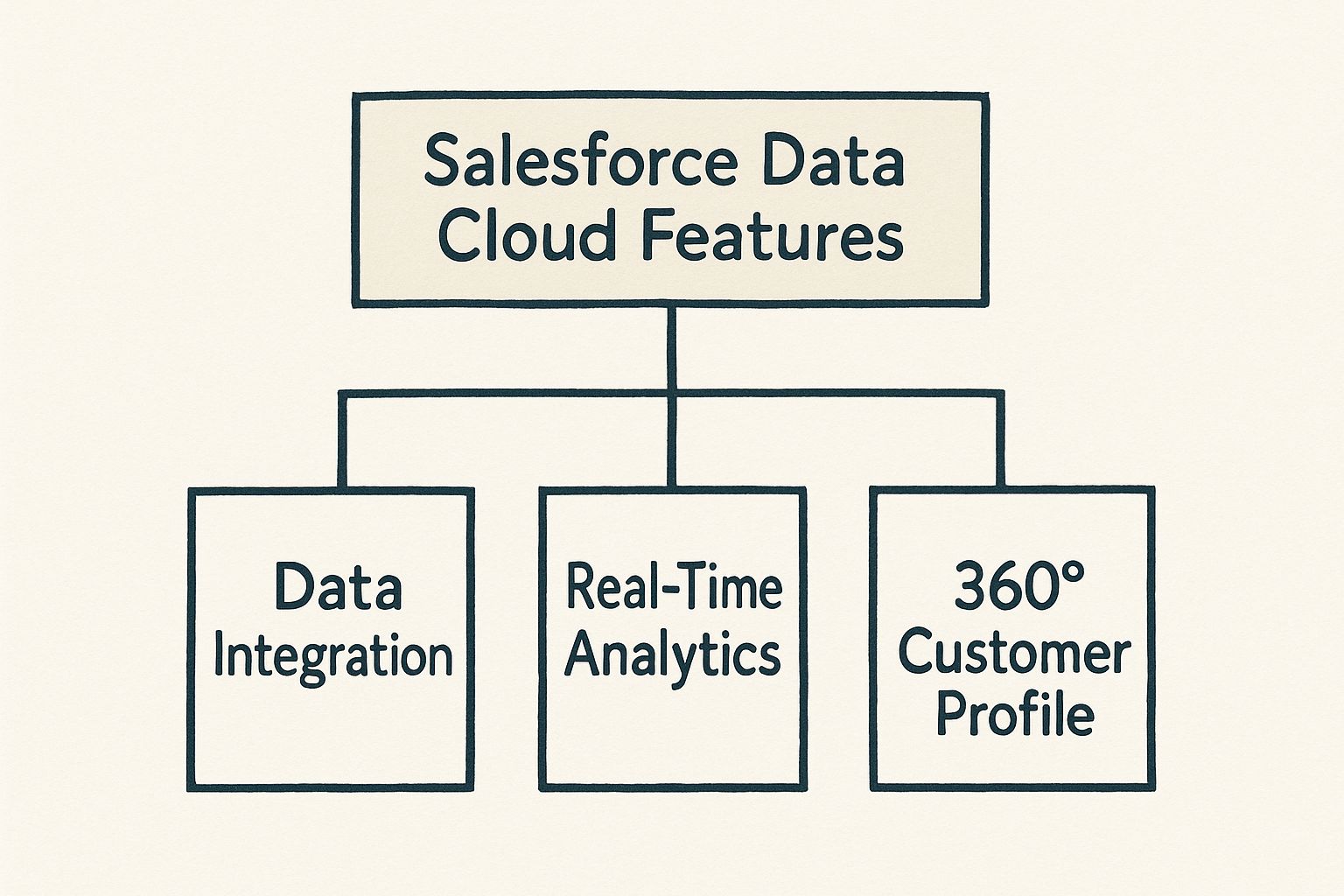
As you can see, it’s all about bringing data together and applying real-time intelligence to create that foundational 360-degree customer view.
To better understand how this works in practice, here's a breakdown of the core functions within Data Cloud, showing how they turn raw data into intelligent action.
Salesforce Data Cloud Functional Pillars
| Core Pillar | What It Does | Business Outcome |
|---|---|---|
| Connect | Ingests data in real-time or batches from any source—Salesforce clouds, external databases, APIs, websites, and apps. | Breaks down data silos, creating a single location for all customer information. |
| Harmonise | Maps and transforms inconsistent data into a single, standardised Canonical Data Model, resolving identities and removing duplicates. | Creates a rich, trustworthy, and unified customer profile that everyone in the business can rely on. |
| Activate | Pushes the unified profiles and insights back into the tools your teams use daily (like Sales Cloud and Marketing Cloud). | Empowers teams to take immediate, data-driven actions, from personalising campaigns to providing contextual support. |
This table shows the logical flow from connection to activation, which is the secret sauce behind Data Cloud's power.
Connect Your Disparate Data Sources
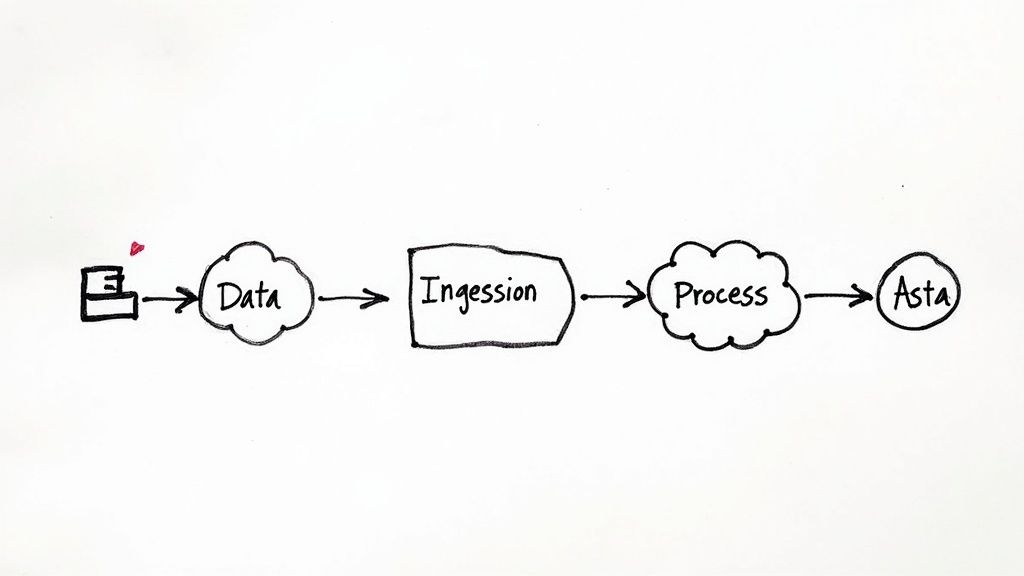
The first step, Connect, is all about data ingestion. Data Cloud is built to pull information from pretty much any source you can think of, breaking down the walls that typically keep valuable customer insights locked away. This isn't just about the Salesforce ecosystem; it’s about creating a truly unified view of everything.
Data can be brought in either in real-time or in batches from all over the place:
- Salesforce Clouds: Seamlessly pulls data from Sales Cloud, Service Cloud, and Marketing Cloud Engagement.
- External Databases: Connects to data warehouses like Snowflake, Redshift, and BigQuery.
- APIs and SDKs: Ingests data from your mobile apps, websites, and other third-party systems.
This flexibility means a customer's recent website activity, their latest online purchase, and their most recent service ticket can all flow into one central hub.
Harmonise Data into a Single Profile
Once all that data is flowing in, the Harmonise phase kicks off. This is where the magic really happens, turning messy, inconsistent information into a standardised and reliable asset. Data Cloud uses a Canonical Data Model that acts like a universal translator for all your different systems.
For example, your marketing system might call someone a "Lead," while your sales CRM calls them a "Prospect." The Canonical Data Model maps both of these labels to a single, unified object, like "Individual." This mapping and merging process creates one coherent profile for each customer, resolving different identities and removing duplicates.
By standardising every piece of information, Data Cloud builds a rich, dependable customer profile. This harmonised data becomes the fuel for every personalised interaction, ensuring your teams are always working from the complete and correct story.
Activate Insights Across Every Channel
The final pillar, Activate, is where all that beautifully unified data is put to work. A perfect customer profile is useless if it just sits in a database. The goal here is to push these rich insights back into the systems your teams use every day, powering smarter actions in your Salesforce CRM and other tools.
This means a sales rep can see a customer's recent marketing engagement directly within Sales Cloud before making a call. A service agent can view a customer's entire purchase history in Service Cloud to provide faster, more contextual support. And marketers can build hyper-specific audience segments based on real-time behaviours and send them straight to Marketing Cloud (Account Engagement) for incredibly personalised campaigns.
The Modern Lakehouse Foundation
Underpinning this entire structure is a modern data lakehouse architecture. This hybrid model gives you the best of both worlds: the sheer scalability of a data lake combined with the smart data management features of a data warehouse. For your business, this means Data Cloud can handle massive volumes of information without breaking a sweat. It’s built to scale right alongside your organisation, effectively future-proofing your business intelligence and digital transformation efforts.
Of course, when you're building on such a powerful platform, security is paramount. It's essential to implement strong Cloud Security Fundamentals for safeguarding data and applications to protect your valuable assets, ensuring your architecture is both powerful and secure.
Driving Business Growth with Salesforce Data Cloud
While the tech behind Salesforce Data Cloud is impressive, the real question for any decision-maker is simple: what’s in it for my business? Let's move past the features and talk about tangible results. It’s all about turning scattered information into a strategic advantage that actually impacts your bottom line.
When you create that single, unified view of your customer, you finally stop guessing what people want and start knowing what they need. That shift from reactive to proactive is where real growth kicks in.
Enable True Hyper-Personalisation
For years, "personalisation" often meant little more than putting a customer's first name in an email subject line. Data Cloud changes that game completely. Armed with a complete, real-time view of every interaction, you can deliver experiences that are genuinely unique to each individual.
Consider the business challenge for a retailer: a customer has been browsing running shoes on their website, viewed a specific pair on social media, and has a history of buying a particular brand. The Salesforce solution? Data Cloud connects these dots instantly. The next time that customer visits the site, they’re greeted with a personalised offer for those exact shoes. That’s a seamless and highly relevant journey that boosts conversion and builds real brand loyalty.
Boost Marketing ROI with Laser-Focused Audiences
Great marketing is all about reaching the right people with the right message. But when your data is siloed across different systems, your audience segmentation is often based on old or incomplete information. The result? Wasted ad spend and campaigns that fall flat.
Data Cloud lets marketers build incredibly precise audience segments based on what people are doing right now. You could create a segment of customers who have spent over a certain amount, abandoned their cart in the last 24 hours, and recently clicked on a specific marketing email.
By connecting every customer data point, Data Cloud allows you to move beyond broad demographic targeting. You can now segment based on actual intent, making sure every dollar of your marketing budget is spent engaging the most promising prospects.
This capability is especially important as the Salesforce economy in Australia continues to expand. Projections show it could generate approximately AUD 48.6 billion in new business revenues by 2026, with cloud solutions being a major driver of this growth.
Improve Sales and Service Efficiency
Your sales and service teams are on the front lines, and the quality of their data directly impacts how well they can do their jobs. Data Cloud gives them the full story they need to succeed in every single interaction.
- For Sales Teams: Reps can see high-intent signals as they happen. If a key contact from a major account suddenly starts downloading whitepapers and checking your pricing page, your sales team gets an instant alert within Sales Cloud. This allows them to reach out at the perfect moment with a highly relevant conversation.
- For Service Teams: Agents in Service Cloud can see a customer's entire history in a single view—every purchase, every past support ticket, and every marketing message they’ve ever received. This means faster resolutions, less frustration for the customer, and no more asking, "Can you please repeat your account number?"
The practical benefits are clear, and many businesses are already seeing significant improvements. You can explore how we've applied these principles by checking out our collection of successful Salesforce project case studies.
Fuel a Smarter AI Strategy
Finally, one of the most critical benefits of Data Cloud is its role as the foundation for effective artificial intelligence. AI tools like Salesforce Einstein are incredibly powerful, but they’re only as good as the data you feed them. Without clean, harmonised data, AI is just making educated guesses.
Data Cloud provides the trustworthy, unified data that AI needs to deliver accurate predictions, intelligent recommendations, and reliable automation. By ensuring your AI has a complete and accurate picture of your customers, you unlock its true potential to drive efficiency and uncover new growth opportunities across your entire organisation.
How Different Industries Use Data Cloud Salesforce
The real magic of Salesforce Data Cloud isn't just in the technology itself; it's what happens when you apply it to real-world business challenges. Seeing how different sectors are putting unified data to work is where the penny really drops. It’s all about turning scattered information into a genuine strategic asset.
Let's look at a few case study examples of how this plays out on the ground.
Retail and E-commerce Personalisation
Every retailer knows the frustration of the online-offline divide. A customer might spend days researching a new pair of hiking boots online, adding them to their cart, and then deciding to pop into a store to try them on. But when they walk in, the store staff are completely blind to that entire journey. It's a clunky experience and a massive missed opportunity.
Data Cloud is designed to stitch that journey back together.
- The Challenge: A shopper abandons their online cart but visits a physical store a few days later. The in-store team has no clue what they were looking at, so they can't offer any targeted help.
- The Salesforce Solution: By connecting the e-commerce platform with the in-store point-of-sale (POS) system, Data Cloud creates a single customer view. When the customer identifies themselves in-store, perhaps through a loyalty app, the sales assistant gets a real-time notification on their tablet showing the abandoned cart items.
- The Results: The conversation changes completely. The assistant can now say, "I see you were looking at these specific running shoes online. We have them in your size if you'd like to try them on." It’s a seamless, genuinely helpful experience that dramatically increases the chance of a sale and makes the customer feel understood.
Proactive Financial Services
Trust and personalised advice are the bedrock of financial services. The problem is, customer data is often locked away in different silos—their mortgage is handled by one team, their investments by another, and their daily banking by a third. It’s nearly impossible for an advisor to get a holistic view of a client's financial world.
Data Cloud breaks down those walls and creates that single source of truth.
By combining transaction data, investment information, and service interaction history, financial institutions can move from a reactive service model to one that anticipates client needs and offers timely, valuable advice.
Imagine a client's savings account balance suddenly drops. Around the same time, they've been browsing the bank's website for information on personal loans. Data Cloud spots this pattern, connects the dots, and can trigger an automated but personalised message from their advisor. It’s a simple check-in to offer support before a small issue becomes a big problem, and it's this kind of proactive care that builds relationships that last.
Predictive Maintenance in Manufacturing
For manufacturers, the sale is just the beginning of the relationship. The real value is in ongoing service and maintenance. Today's industrial equipment is packed with IoT sensors, constantly streaming performance data. The challenge has always been connecting that firehose of operational data with the customer's actual sales and service history sitting in the CRM.
This is where Data Cloud delivers a huge advantage. By integrating IoT data streams with information from Sales Cloud and Service Cloud, manufacturers can finally shift from a reactive "break-fix" model to genuinely predictive maintenance.
The system can analyse sensor data to spot the early warning signs of potential equipment failure. This can automatically create a service case in Service Cloud, allowing the team to schedule maintenance before anything breaks down. This foresight prevents costly downtime for the customer and also opens up new revenue streams through proactive service agreements. This sort of innovation is becoming key in Australia’s enterprise software market, which is seeing incredible growth. Forecasts project the market to hit AUD 5.31 billion by 2025, as major corporations adopt AI to boost efficiency. You can find out more about how Salesforce is driving AI adoption in Australia on eWeek.
Even in sectors like property, having the right technology stack is a game-changer. You can learn more about our perspective on this by reading our guide on Salesforce as the backbone for modern real estate agencies.
Our Proven Salesforce Data Cloud Implementation Approach
Getting a Salesforce Data Cloud implementation right isn't just a technical job; it’s a strategic move that needs a solid plan from the get-go. A clear, structured approach ensures the platform is set up not just to work, but to start delivering real business value from day one. As an experienced Salesforce partner, we see every implementation as a true partnership, keeping your business goals at the centre of everything we do.
Our method is built on years of hands-on project experience. It’s a roadmap designed to position your organisation for success. We’ve learned that the best way to start is by focusing on a single, high-impact use case. This builds momentum and shows value quickly, which is far more effective than trying to boil the ocean with a massive, all-at-once deployment.

Step 1: Discovery And Strategy
First things first, we need to understand your unique business landscape. We kick things off with a deep-dive discovery workshop to get everyone aligned on key objectives and agree on what a successful outcome actually looks like for your organisation.
During this stage, we’ll work closely with your key stakeholders to:
- Identify Critical Data Sources: We map out exactly where your most valuable customer data lives. Is it in other Salesforce clouds, hiding in external databases, or locked away in third-party applications?
- Define a High-Impact Use Case: We help you pinpoint one specific business challenge that Data Cloud can solve for a quick win. Think improving marketing segmentation or personalising the e-commerce journey.
- Establish Success Metrics: We'll define the key performance indicators (KPIs) we’ll use to measure the project's impact, so everyone knows if we're hitting the mark.
Step 2: Data Modelling And Harmonisation
With a clear strategy in place, we roll up our sleeves and get to the core of the implementation—data modelling and harmonisation. This is where the magic really happens, turning messy, scattered data into a clean, single source of truth.
This stage is the absolute linchpin of any Data Cloud project. A well-designed data model is what ensures your unified profiles are accurate, trustworthy, and ready to power intelligent actions across your entire business.
Our team focuses on mapping your various data streams to the Salesforce Canonical Data Model. It’s a meticulous process of resolving identity conflicts, weeding out duplicate records, and making sure every piece of information is structured consistently. This foundational work is what allows us to create those rich, reliable customer profiles you need. For a deeper look into the planning required for a successful rollout, check out our comprehensive Salesforce Implementation Guide for Australian businesses.
Step 3: Integration And Activation
Once your data is harmonised, the next step is connecting everything. We integrate your identified systems with Data Cloud, setting up the data pipelines that will feed information in real-time. This is crucial for keeping your customer profiles constantly updated with the very latest interactions.
The growing demand for cloud solutions in our region really underscores the need for expert implementation. In its 2025 fiscal year, Salesforce Australia Pty Ltd generated approximately AUD 1.92 billion in revenue, a 15.4% jump from the previous year. That’s a massive 152% increase since 2021, showing just how much businesses are relying on platforms like Data Cloud. You can read more about Salesforce's financial performance in Australia on IBISWorld.
Finally, we get your team ready to go with activation and training. This final step is all about ensuring your people understand how to use the unified data in their day-to-day work, turning powerful insights into meaningful customer engagement. As your Salesforce partner, we're here to provide the support needed to unlock real, sustainable value from your data.
FAQ: Salesforce Data Cloud Questions Answered
When organisations start looking into Salesforce Data Cloud, a few questions always seem to pop up. Business leaders and IT managers want to get straight to the point: How does this thing actually work? What’s it going to cost? And how will it integrate with the systems we already have?
To help you get the answers you need, we’ve put together a no-nonsense breakdown of the most common questions we hear from our clients.
How is Salesforce Data Cloud different from Marketing Cloud Personalisation?
This one comes up all the time, and for good reason. Both tools are geared towards creating personalised customer experiences, but they have very different—though complementary—jobs in your Salesforce tech stack.
Here’s a simple way to think about it: Salesforce Data Cloud is the central brain, while Marketing Cloud Personalisation is the specialised arm that takes immediate marketing action.
-
Salesforce Data Cloud has the bigger job. It pulls in, cleans up, and unifies customer data from every single source across your business—sales, service, e-commerce, and more. Its goal is to build one reliable, golden-record customer profile that anyone in the company can use.
-
Marketing Cloud Personalisation (formerly Interaction Studio) is all about the here and now. It captures what a user is doing in real-time on your website or mobile app. It then uses that immediate behaviour to deliver in-the-moment personalisations, like swapping out a banner on your homepage or suggesting the perfect product.
So, Data Cloud gives you the deep, historical, and cross-channel context on a customer. Marketing Cloud Personalisation acts on the immediate digital breadcrumbs they’re leaving right now. They’re powerful on their own, but when Data Cloud feeds its rich, unified profiles into Personalisation, the results are a game-changer for marketing automation.
What does the Data Cloud Salesforce pricing model look like?
Understanding the investment is obviously a big piece of the puzzle. Salesforce Data Cloud runs on a consumption-based pricing model. This is a shift from the typical per-user, per-month licences you see with products like Sales Cloud or Service Cloud. Your cost is tied directly to how much you use the platform’s resources.
A few key factors will shape your overall cost:
- Data Ingestion and Storage: How much data are you bringing in and keeping over time?
- Data Processing: How much heavy lifting is the platform doing to transform, harmonise, and segment your data?
- Query and Activation Volume: How often are you tapping into that unified data or pushing segments out to other platforms?
This model gives you a lot of flexibility. You can start small with a single use case and then scale up your investment as you find more ways to get value from it. The flip side is that you need solid data governance and a clear strategy to keep costs predictable. As a Salesforce partner, a big part of our job is helping clients build a cost model that aligns with their specific business goals from day one.
Do I need other Salesforce products to use Data Cloud?
The short answer is no. While Salesforce Data Cloud is built to fit perfectly into the wider Salesforce ecosystem, you are not required to have other Salesforce products to get value from it. It’s designed to be source-agnostic. That means it can connect to and pull data from just about any system, whether it’s a rival CRM, an external data warehouse, or a custom-built application.
The real power of Data Cloud is unlocked when it acts as the central hub for all customer data, regardless of where it lives. Its core purpose is to tear down silos, wherever they are.
That said, it’s true that the platform delivers its biggest punch when it’s integrated with other Salesforce clouds. The native connectors to Sales, Service, and Marketing Clouds make the "activation" part—getting the data into the hands of your teams—incredibly smooth. Pushing unified profiles and smart segments directly into the tools your teams use every day is where the data really comes to life.
For businesses already on the Salesforce platform, Data Cloud is the ultimate unifier. For those new to the ecosystem, it can be the foundational data layer you build a more connected, customer-first architecture on over time.
Ready to stop guessing and start knowing your customers? As a trusted Salesforce partner, we have the expertise to guide your Salesforce Data Cloud implementation from strategy to activation. Contact us today for a consultation and let's build your single source of truth.