
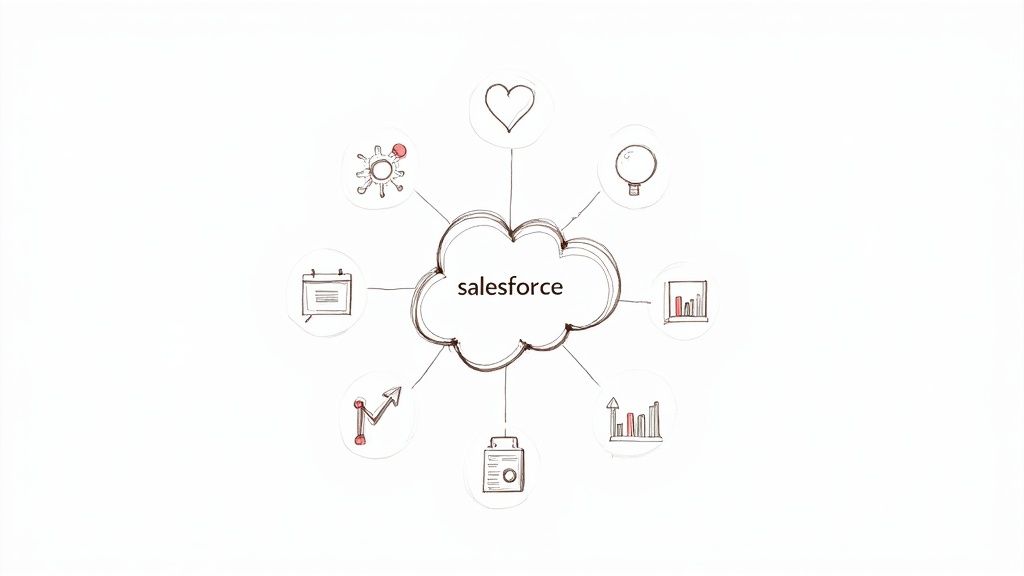
Acquiring a new customer can cost five times more than retaining an existing one. Yet, many organisations pour the majority of their resources into the top of the funnel, neglecting the immense profit potential sitting within their current customer base. In a competitive market defined by rising acquisition costs, a focus on customer retention isn't just a defensive move; it's the most powerful engine for sustainable growth. For businesses using Salesforce, mastering customer retention strategies is the key to building a resilient and profitable enterprise.
This isn't just about reducing churn. It's about transforming satisfied customers into loyal advocates who drive repeat business and referrals. The challenge lies in moving from reactive problem-solving to proactive, personalised engagement. This is where a powerful CRM like Salesforce becomes indispensable, acting as the central nervous system for your retention efforts. It provides the data, automation, and a 360-degree customer view necessary to execute sophisticated strategies at scale. To truly understand the health of your customer base and the impact of these strategies, it's crucial to track the right indicators. Learn about essential user retention metrics to measure what matters most.
Drawing from our experience as a Salesforce partner across more than 110 successful projects, this guide cuts through the noise. We’ll explore 10 actionable customer retention strategies that deliver measurable results. Forget generic advice; we'll provide specific, practical implementation steps within the Salesforce ecosystem, showing you precisely how to leverage its powerful tools to cultivate lasting customer relationships and secure your long-term success.
1. Loyalty Programs
Loyalty programs are structured initiatives designed to reward repeat business and foster deeper customer engagement. More than just a simple discount system, these programs are a cornerstone of modern customer retention strategies, creating a value exchange where customers receive tangible benefits for their continued patronage. By tracking purchases and interactions, businesses can offer personalised incentives like points, exclusive access, or tiered benefits, turning transactional buyers into loyal advocates.

From Sephora's celebrated VIB tiered system to the convenience-driven ecosystem of Amazon Prime, successful loyalty programs make customers feel recognised and valued. This sense of belonging is crucial for long-term retention.
Implementing Loyalty Programs with Salesforce
For organisations using Salesforce, implementing a sophisticated loyalty program is highly achievable. Salesforce Loyalty Management provides a dedicated platform to build, manage, and scale these initiatives directly within your CRM.
- Unified Customer View: Centralise loyalty data with existing customer profiles in Sales Cloud and Service Cloud. This allows for a complete 360-degree view, enabling highly personalised reward offerings based on purchase history, service interactions, and marketing engagement.
- Tiered & Points-Based Systems: Easily configure tiered levels (e.g., Bronze, Silver, Gold) or points-based accrual systems. Use Salesforce Flow to automate tier progression and reward issuance when a customer reaches a specific milestone, ensuring timely recognition.
- Personalised Experiences: Leverage Marketing Cloud Account Engagement (formerly Pardot) to send automated, personalised communications about loyalty status, points balance, and exclusive offers, keeping the program top-of-mind.
Project Insight: We helped a retail client integrate Loyalty Management with their e-commerce platform. By using Salesforce Flow to automatically assign customers to tiers based on their spending, we created a seamless system that rewarded high-value customers instantly, leading to a 15% increase in repeat purchase frequency within six months.
A well-designed program creates a compelling reason for customers to choose your brand over a competitor. To dive deeper into the mechanics of effective loyalty initiatives, consider exploring a guide on Mastering Loyalty Programs for Customer Retention. By integrating these programs into your CRM, you transform them from a simple marketing tactic into a powerful, data-driven engine for sustainable growth.
2. Personalization and Customer Segmentation
Personalization and customer segmentation are powerful customer retention strategies that move beyond a one-size-fits-all approach. By tailoring products, communications, and experiences to individual customers based on their preferences and behaviours, businesses can create a deeply relevant and engaging journey. This involves dividing the customer base into distinct segments and delivering highly contextual interactions to each group, making customers feel understood and valued.

Think of Netflix’s content recommendations or Spotify’s Discover Weekly playlists; these services retain users by proving they understand their tastes. This level of tailored experience builds a strong emotional connection, making customers less likely to switch to a competitor.
Implementing Personalization with Salesforce
Salesforce provides a robust toolkit for organisations to implement sophisticated personalization and segmentation at scale. By leveraging its integrated clouds, you can transform customer data into meaningful, one-to-one experiences.
- Advanced Segmentation: Use Salesforce Data Cloud to unify customer data from all touchpoints into a single, real-time profile. Create dynamic segments based on purchase history, website behaviour, demographics, or service interactions, allowing for precision targeting.
- AI-Powered Recommendations: Leverage Salesforce Einstein to analyse customer data and predict future behaviour. Use Einstein's recommendation engine to suggest relevant products on your e-commerce site (via Commerce Cloud) or deliver the next best content in a marketing campaign.
- Tailored Communications: Utilise Marketing Cloud Account Engagement (formerly Pardot) and Marketing Cloud Engagement to build dynamic journeys. Create email campaigns or mobile notifications that change based on a customer’s real-time actions, ensuring every message is relevant and timely.
Project Insight: For a B2B SaaS client, we used Marketing Cloud Account Engagement's dynamic content feature to personalize onboarding emails. By segmenting users by industry, we delivered tailored use cases and tips relevant to their specific business, resulting in a 25% lift in user engagement during their first 30 days.
By segmenting your audience and personalizing their journey, you demonstrate a genuine understanding of their individual needs. Integrating these strategies within your Salesforce environment empowers you to automate and scale these efforts, turning data-driven insights into one of the most effective customer retention strategies available.
3. Exceptional Customer Service and Support
Exceptional customer service is the art of consistently exceeding customer expectations, transforming a standard support interaction into a memorable, positive experience. It goes beyond merely resolving issues; it's about providing responsive, empathetic, and proactive assistance that makes customers feel heard and valued. This proactive approach to care is a powerful driver of customer loyalty and one of the most effective customer retention strategies available.
From Zappos' legendary dedication to customer happiness to the Ritz-Carlton's policy of empowering every employee to resolve guest issues, a culture of superior service creates deep emotional connections. When customers know they can rely on you for help, they have a compelling reason to stay.
Delivering Exceptional Service with Salesforce
Organisations leveraging Salesforce can use its powerful ecosystem to build and scale a world-class customer support operation. Salesforce Service Cloud is the central hub for orchestrating every aspect of the customer service journey, ensuring no query falls through the cracks.
- Omni-Channel Support: Integrate all your support channels (email, phone, web chat, social media) into a single agent console with Service Cloud. This gives your team a complete, contextual view of every customer interaction, regardless of the channel they use to reach out.
- Empowerment through Automation: Use Salesforce Flow and macros to automate repetitive tasks and guide agents through complex support processes. This frees them up to focus on high-value, empathetic problem-solving rather than administrative work, improving both agent and customer satisfaction.
- Proactive Issue Resolution: Leverage Service Cloud's case management and escalation rules to identify and address potential issues before they become major problems. By tracking case trends and customer feedback, you can proactively improve products, services, and support documentation.
Project Insight: We implemented Service Cloud for a financial services firm, creating automated case escalation rules. This ensured high-priority client issues were routed to senior agents immediately, reducing average resolution time by 40% and significantly boosting their Net Promoter Score (NPS).
By investing in the tools and training to deliver outstanding support, you build a resilient competitive advantage. To learn more about how to optimise your support operations, consider exploring a guide on Enhancing Customer Service with Salesforce. When customers trust that you'll be there for them, their loyalty is yours to keep.
4. Customer Success Management (CSM)
Customer Success Management (CSM) is a proactive business methodology where dedicated teams ensure customers consistently achieve their desired outcomes while using your product or service. Going far beyond traditional support, CSMs act as strategic partners, guiding customers from onboarding and adoption through to renewal and growth. This approach transforms the customer relationship from a reactive, transactional one into a long-term, value-driven partnership, making it one of the most powerful customer retention strategies available.
Companies like HubSpot and Adobe have built their enterprise-level success on this model, understanding that a customer's success is intrinsically linked to their own. By ensuring clients maximise value, they create deep-seated loyalty that is difficult for competitors to disrupt.
Implementing Customer Success Management with Salesforce
Salesforce provides a robust ecosystem for building and scaling a CSM function. By centralising customer data, you empower your CSMs to be proactive, data-driven, and highly effective.
- Holistic Customer Health Scoring: Use Salesforce Service Cloud and Sales Cloud data to create a comprehensive customer health score. Track metrics like product usage, support ticket volume, and engagement levels to identify at-risk accounts before they churn.
- Automated Onboarding Playbooks: Leverage Salesforce Flow to create automated, repeatable onboarding journeys. Trigger tasks for CSMs, send welcome emails, and schedule check-ins at key milestones to ensure every new customer starts on the right path.
- Centralised Engagement Tracking: Log all customer interactions, including Quarterly Business Reviews (QBRs) and strategic calls, directly on the account record. This provides a single source of truth for the entire organisation, from sales to support.
Project Insight: For a tech company, we built a custom "Customer Health" dashboard in Salesforce that aggregated data from Sales Cloud and their own product usage analytics. This gave their CSM team a real-time, color-coded view of at-risk accounts, allowing them to intervene proactively and reduce churn by 18% in the first year.
A well-organised CSM function turns customer relationships into strategic assets. To understand how to align your team and technology around this philosophy, explore the benefits of dedicated Salesforce consulting services. By integrating CSM principles directly into your CRM, you build a powerful engine for reducing churn and driving sustainable growth.
5. Community Building and Engagement
Community building is the practice of creating dedicated spaces where customers can connect, share experiences, and engage with your brand beyond transactions. This powerful customer retention strategy transforms your customer base into a network of advocates, fostering a deep sense of belonging and peer-to-peer support. By facilitating these connections, you create a valuable ecosystem that strengthens loyalty and builds a moat around your brand that competitors cannot easily replicate.
From the legendary Harley Owners Group (HOG) to Peloton's highly engaged digital member groups, successful communities make customers feel like part of something bigger. This emotional investment is a significant driver of long-term retention and advocacy.
Implementing Community Building with Salesforce
For organisations looking to build, manage, and scale a branded community, Salesforce Experience Cloud is the ideal platform. It integrates seamlessly with your CRM, turning your community into a dynamic extension of your business operations.
- Integrated Customer Experience: Build a branded portal or forum directly connected to your Salesforce CRM. This allows members to access their own data, create support cases, interact with other customers, and engage with your team, all from one central hub.
- Peer-to-Peer Support: Empower customers to help each other by creating knowledge bases and forums. This not only reduces the burden on your service team but also fosters a collaborative environment where experienced users become valuable brand advocates.
- Feedback and Ideation: Use your community as a direct line to your customers for feedback and new ideas. With Salesforce, you can capture this input and link it directly to product development or service improvement initiatives within your CRM, closing the feedback loop effectively.
Project Insight: We launched an Experience Cloud community for an education provider, enabling students to collaborate and support each other. By integrating it with Service Cloud, we deflected over 30% of common support queries to the community's peer-answered forums, reducing support costs while increasing student engagement.
A vibrant community gives customers a compelling reason to stay connected to your brand, far beyond the initial purchase. To learn more about how to leverage this powerful tool, consider exploring strategies for Building Brand Communities with Salesforce. By integrating a community with your CRM, you create a self-sustaining ecosystem that fuels both retention and innovation.
6. Regular Communication and Content Marketing
Regular communication and content marketing are powerful customer retention strategies focused on building relationships through value, not just transactions. By consistently providing useful, relevant, and engaging content, businesses can stay top-of-mind and position themselves as trusted industry authorities. This approach shifts the dynamic from a simple vendor-customer relationship to one of a valued partner, fostering loyalty that transcends price points.
Effective content marketing demonstrates that you understand your customers' challenges and are invested in their success. From HubSpot’s extensive educational blog to Moz’s industry-leading SEO resources, this strategy is about giving first. This consistent delivery of value builds trust and keeps your audience engaged long after the initial purchase.
Implementing Content Marketing with Salesforce
Salesforce provides a robust toolkit for orchestrating and personalising your communication strategy, ensuring your content reaches the right audience at the right time.
- Targeted Segmentation: Use Salesforce CRM data to create highly specific audience segments. Filter customers based on purchase history, industry, or past engagement to deliver content that resonates with their unique needs and interests.
- Automated Nurture Campaigns: Leverage Marketing Cloud Account Engagement (formerly Pardot) to build automated email nurture journeys. A new customer could receive a welcome series with educational content, while a long-term client might get advanced tips or invitations to exclusive webinars.
- Track Engagement: Monitor how customers interact with your content directly within Salesforce. Track email opens, link clicks, and content downloads to gain a clear picture of what resonates, allowing you to refine your strategy continuously.
Project Insight: For a manufacturing client, we used Marketing Cloud Account Engagement to create a "post-sale" content journey. Based on the specific product purchased, customers automatically received a series of emails with maintenance tips, usage guides, and information on compatible accessories, which led to a 10% increase in repeat business for related products.
A well-executed content strategy keeps the conversation going, providing ongoing value that strengthens the customer relationship. To get the most out of your Salesforce-powered communications, it is crucial to understand Marketing Cloud Account Engagement best practice. By integrating your content efforts with your CRM, you create a seamless, data-informed system for nurturing long-term loyalty.
7. Proactive Issue Resolution and Feedback Loops
Proactive issue resolution shifts customer service from a reactive function to a preventative strategy. Instead of waiting for a customer to report a problem, this approach involves using data and monitoring to anticipate and address potential issues before they impact the user. It is one of the most powerful customer retention strategies because it demonstrates a deep commitment to the customer experience, building trust and mitigating frustration before it can even begin.
This is complemented by creating robust feedback loops, which are systematic processes for collecting, analysing, and acting on customer input. By actively seeking feedback and, more importantly, visibly implementing changes based on that feedback, businesses show customers that their voice matters.
From Tesla’s over-the-air software updates that fix bugs before most users notice them, to Slack’s rapid iterations based on community feedback, proactive support turns potential negatives into brand-strengthening positives. This approach is essential for long-term loyalty.
Implementing Proactive Support with Salesforce
Salesforce provides a powerful suite of tools to move from a reactive to a proactive support model and establish effective feedback loops directly within your CRM.
- Anticipate Issues with Service Cloud: Use Salesforce IoT to monitor connected products and create cases automatically when a device shows signs of malfunctioning. Service Cloud’s AI-powered Einstein Bots can also analyse incoming cases to identify emerging trends, allowing your team to address a widespread issue before it escalates.
- Systematise Feedback Collection: Deploy Salesforce Surveys to automatically send feedback requests after a case is closed or a purchase is completed. The responses are logged directly against the customer’s record, providing valuable context for all future interactions and tracking metrics like Net Promoter Score (NPS).
- Close the Loop with Marketing Cloud: Use Marketing Cloud Account Engagement (formerly Pardot) or Journey Builder to create automated communication workflows. When a customer-suggested feature is launched or a reported issue is resolved system-wide, you can send targeted emails to the customers who provided that initial feedback, demonstrating that their input led to tangible improvements.
Project Insight: We configured Salesforce Surveys for a software company to trigger after every support case resolution. The feedback was piped into a dashboard for the product team, creating a direct line between customer issues and the development roadmap. This process helped them prioritise bug fixes that directly improved customer satisfaction.
By integrating these processes into Salesforce, you create a virtuous cycle where customer feedback directly fuels product and service enhancements. This builds a loyal customer base that feels heard and valued, making them significantly less likely to churn.
8. Win-Back and Re-engagement Campaigns
Win-back and re-engagement campaigns are strategic marketing efforts designed to reconnect with inactive or lapsed customers. Instead of focusing on new acquisitions, these campaigns identify customers who have stopped interacting with your brand and deliver targeted communications aimed at reigniting their interest. The goal is to remind them of the value you offer and provide a compelling reason to return, turning a past customer into a current one.
From Spotify's targeted emails offering a discount to come back, to a local gym's "We Miss You" reactivation offer, these campaigns work because they leverage existing customer data. They acknowledge the past relationship and make a personalised appeal, which is often more effective and cost-efficient than acquiring a brand-new customer.
Implementing Re-engagement Campaigns with Salesforce
Salesforce provides a powerful suite of tools to automate and personalise win-back campaigns, ensuring you reach the right customers with the right message at the right time.
- Identify Lapsed Customers: Use reports and dashboards in Sales Cloud or Service Cloud to create dynamic lists of customers who haven't made a purchase or logged an interaction within a specific timeframe (e.g., 90 days). This segmentation is the first critical step.
- Automate Outreach: Leverage Marketing Cloud Account Engagement (formerly Pardot) to build an automated Engagement Studio program. This program can trigger a series of emails when a customer enters the "lapsed" segment, starting with a gentle nudge and escalating to a special offer.
- Personalise the Offer: Use Salesforce data to make the re-engagement feel personal. Reference past purchases, mention new features relevant to their previous interests, or create a unique discount code. The more tailored the offer, the higher the chance of success.
Project Insight: We built a win-back journey in Marketing Cloud Account Engagement for an e-commerce client. The system automatically identified customers who hadn't purchased in 120 days and sent a personalised "We've missed you" email featuring products related to their last purchase. This single automated campaign successfully reactivated 8% of their lapsed customer base.
Executing these campaigns effectively requires a deep understanding of your customer journey and the ability to capture and act on intent. To learn more about how to set up the technical infrastructure for these initiatives, explore a guide on using an Account Engagement form handler to manage returning customer data seamlessly. By systematically re-engaging past customers, you tap into a valuable revenue stream and strengthen your overall customer retention strategies.
9. Exclusive Perks and VIP Experiences
Exclusive perks and VIP experiences are premium customer retention strategies that move beyond transactional rewards to create an emotional connection. This approach involves offering top-tier or highly loyal customers special benefits and unique experiences that are not available to the general public. By creating a differentiated, premium level of service, businesses can make their most valuable customers feel recognised, appreciated, and truly special, fostering an elite sense of belonging.
From the personalised shopping events offered by luxury brands like Hermès to the coveted concierge services of the American Express Centurion Card, successful VIP programs are built on exclusivity and exceptional value. These initiatives incentivise increased spending and engagement by providing a clear, aspirational goal for customers to strive for.
Implementing VIP Experiences with Salesforce
Salesforce provides the ideal platform to identify, manage, and deliver these high-touch experiences with precision. By leveraging customer data, you can create a truly personalised and automated VIP program.
- Identify VIPs with Data: Use Sales Cloud and Service Cloud data to create dynamic segments of your most valuable customers. Define criteria based on lifetime value, purchase frequency, or engagement score to automatically identify who qualifies for VIP status.
- Automate Tier Progression: Leverage Salesforce Flow to automatically assign customers to different tiers (e.g., Gold, Platinum) when they meet specific thresholds. This automation ensures that recognition is instant, delighting the customer the moment they qualify.
- Personalise Exclusive Offers: Use Marketing Cloud Account Engagement to orchestrate exclusive communication journeys for your VIP segments. Send personalised invitations to private events, early access notifications for new products, or special offers based on their known preferences and purchase history.
Project Insight: For a hospitality group, we used Salesforce to create a tiered VIP program. We built a Salesforce Flow that automatically upgraded a guest's status based on nights stayed, triggering a personalised welcome email from their dedicated concierge. This high-touch automation contributed to a 20% increase in bookings from their top customer segment.
A well-executed VIP strategy strengthens relationships with your most profitable customer segment, creating a powerful barrier to switching. For a deeper understanding of how to use data for personalisation, explore how to build a 360-degree customer view. By integrating these exclusive perks into your CRM, you transform a simple rewards system into a sophisticated engine for high-value customer retention.
10. Product and Service Innovation Based on Customer Feedback
Continuously evolving your products and services based on direct customer feedback is one of the most powerful customer retention strategies. This approach transforms the customer relationship from a simple transaction into a collaborative partnership. By actively listening to user needs, pain points, and ideas, you demonstrate that your organisation values their input, fostering a deep sense of loyalty and co-ownership.
Tech innovators like Slack and Notion have built their empires on this principle, using community-driven roadmaps and transparent feedback channels. When customers see their suggestions come to life, they become invested in your success and are far less likely to churn, as they have a tangible stake in the product's evolution.
Implementing Feedback-Driven Innovation with Salesforce
Salesforce provides a powerful ecosystem to systematically collect, analyse, and act on customer feedback, embedding it directly into your product development lifecycle.
- Centralised Feedback Hub: Use Service Cloud to capture feedback from various channels like support cases, emails, and social media. Create a specific record type for "Product Feedback" to categorise and route these insights directly to product teams for review.
- Customer Communities: Leverage Experience Cloud to create dedicated customer portals or advisory boards. Here, you can implement feature voting systems, host discussion forums, and share product roadmaps, creating a transparent and collaborative environment.
- Close the Loop: Utilise Marketing Cloud Account Engagement (formerly Pardot) or Sales Cloud email alerts to automate "feedback loop" communications. When a feature suggested by a customer is released, trigger a personalised email to notify them, reinforcing that their voice was heard and acted upon.
Project Insight: We implemented an 'Ideation' feature in an Experience Cloud community for a B2B client. Customers could submit and vote on new product features. The data was synced to Salesforce reports, allowing the product team to prioritise their roadmap based on popular demand. Closing the loop with automated emails to contributors significantly increased community engagement.
By turning customer feedback into a core component of your innovation engine, you create products and services that are not only relevant but also deeply resonant with your user base. To see how organisations are leveraging their CRM to drive such initiatives, explore some real-world Salesforce project case studies. This strategy ensures your offerings never become stagnant, making your brand an indispensable partner in your customers' success.
Top 10 Customer Retention Strategies: Comparison Matrix
| Strategy | Implementation complexity | Resource requirements | Expected outcomes | Ideal use cases | Key advantages |
|---|---|---|---|---|---|
| Loyalty Programs | High — CRM, points systems & integrations | Moderate–High — tech, rewards budget, marketing | More repeat purchases; higher customer LTV | Retail, hospitality, subscriptions | Encourages repeat business; captures behavior data |
| Personalization & Customer Segmentation | High — data pipelines, ML & integration | High — analytics, data engineers, privacy compliance | Higher engagement and conversion rates | E‑commerce, streaming, complex catalogs | Delivers relevant experiences; reduces marketing waste |
| Exceptional Customer Service & Support | Medium — omnichannel ops & training | High — staffing, training, support tools | Reduced churn; stronger brand loyalty | Service-heavy industries, premium brands | Builds emotional loyalty; differentiates brand |
| Customer Success Management (CSM) | High — strategic processes & onboarding | High — skilled CSMs, analytics, training | Lower churn; more upsell and expansion | SaaS, B2B, high‑value accounts | Proactive value delivery; long‑term partnerships |
| Community Building & Engagement | Medium — platform setup & moderation | Medium — community managers, events, content | Increased advocacy; peer support; UGC | Lifestyle brands, platforms, niche products | Generates advocates; lowers support costs |
| Regular Communication & Content Marketing | Low–Medium — editorial workflows | Low–Moderate — writers, tools, scheduling | Greater brand awareness; steady engagement | Brands seeking thought leadership & retention | Cost‑effective brand building; improves SEO |
| Proactive Issue Resolution & Feedback Loops | High — monitoring, analytics & processes | High — engineering, ops, rapid response teams | Fewer incidents; continuous product improvement | Software, platforms, large‑scale operations | Prevents churn; demonstrates responsiveness |
| Win‑Back & Re‑engagement Campaigns | Low–Medium — segmentation & campaigns | Low — marketing, targeted incentives | Recover lapsed customers; incremental revenue | SaaS trials, retail lapsed customers | Cheaper than acquisition; reveals churn causes |
| Exclusive Perks & VIP Experiences | Medium — tier management & CX design | High — premium services, events, concierge | Increased spend from top customers; loyalty | Luxury brands, airlines, hospitality | Drives high LTV; creates aspirational loyalty |
| Product & Service Innovation from Feedback | Medium–High — research, testing & roadmaps | Moderate–High — R&D, feedback systems, beta programs | Better product‑market fit; higher retention | Product‑led companies, SaaS, fast‑iterating firms | Aligns roadmap with customers; builds ownership |
Turn Your Salesforce Platform into a Retention Powerhouse
We've explored a comprehensive suite of powerful customer retention strategies, moving from loyalty programs and deep personalisation to proactive support and community building. Each strategy, from re-engaging lapsed customers with targeted campaigns to innovating based on direct feedback, represents a crucial lever for transforming your business from a transactional entity into a relational partner. The common thread weaving through all these approaches is the shift from a reactive, problem-solving mindset to a proactive, value-creation framework.
The true power of these strategies is realised when they are not treated as isolated initiatives but as interconnected components of a unified customer experience. Your loyalty program, for instance, should be informed by the data gathered through your customer feedback loops. The insights from your Customer Success Management team should directly influence the content marketing you produce. This holistic approach ensures every customer touchpoint is consistent, valuable, and reinforces their decision to stay with your brand.
From Strategy to Execution: The Salesforce Advantage
Throughout this article, we've highlighted how the Salesforce ecosystem acts as the central nervous system for these retention efforts. It is the platform where data transforms into insight and insight sparks action.
- Unifying the Customer View: With tools like Service Cloud, Sales Cloud, and Experience Cloud working in concert, you can break down internal silos. This creates a single, 360-degree view of the customer, enabling every team member to deliver a highly contextual and personalised experience.
- Automating for Impact: The real magic happens when you use Salesforce Flow and Marketing Cloud Account Engagement (formerly Pardot) to automate key processes. Imagine automatically enrolling a high-value customer into a VIP tier or triggering a personalised check-in from a customer success manager after a support case is closed. This is how you scale exceptional service.
- Measuring What Matters: Salesforce's robust reporting and analytics dashboards are essential. They allow you to move beyond gut feelings and track the real-world impact of your customer retention strategies. You can directly correlate your efforts-like a new loyalty program or a win-back campaign-to metrics like Customer Lifetime Value (CLV), churn rate, and Net Promoter Score (NPS).
Your Next Steps with a Trusted Salesforce Partner
Ultimately, technology is an enabler, not the entire solution. The most successful organisations embed a customer-centric philosophy into their company culture. As a Salesforce partner, we help you align your technology with that philosophy, ensuring every team member can contribute to retaining customers. The strategies we've discussed are the building blocks of a sustainable, growth-oriented business model.
By harnessing the full potential of your Salesforce platform, you are not just implementing tactics; you are building an operational framework designed for long-term customer loyalty. The goal is to make your customers feel seen, heard, and valued at every stage of their journey. When you achieve this, retention ceases to be a strategy and becomes the natural outcome of a business that genuinely cares.
Ready to transform your Salesforce instance into a powerful customer retention engine? At Adaptal, we specialise in customising Salesforce solutions to help businesses like yours implement the strategies discussed in this article, driving measurable growth and fostering lasting customer loyalty. Visit our website at Adaptal to learn how our expert guidance can help you unlock the full potential of your CRM investment.