
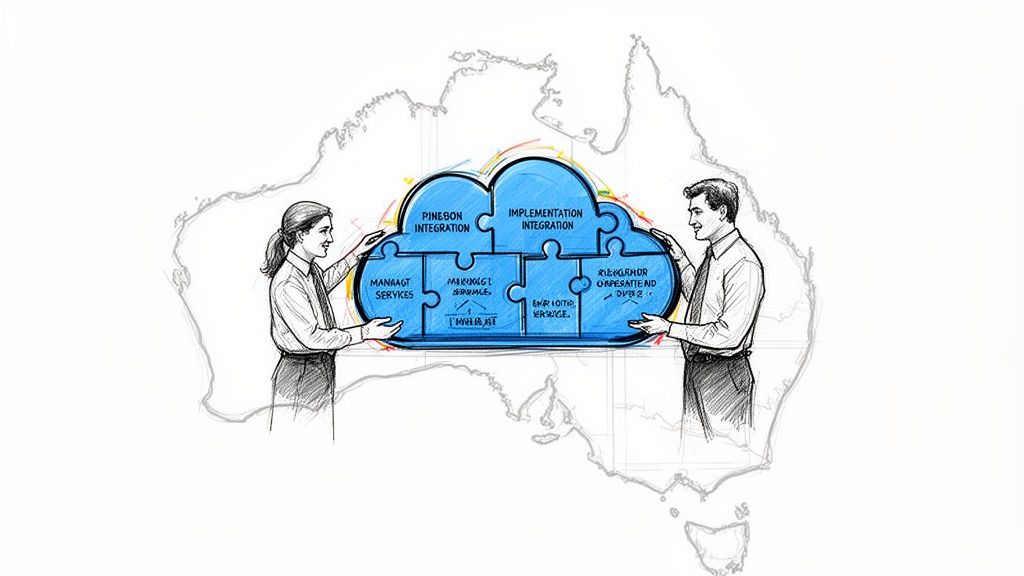
Think of Salesforce consulting as bringing in an expert team to help you plan, implement, customise, and get the most out of the platform. It’s a strategic partnership designed to ensure Salesforce’s powerful features are perfectly aligned with your specific business goals. The aim is to deliver a significant return on your investment by building a system that genuinely drives growth, efficiency, and customer satisfaction. This is about more than just tech support; it’s about transforming how your business operates.
What Is Salesforce Consulting and Why It Matters
Imagine Salesforce as a high-performance engine. You can buy it straight off the shelf, but to truly win the race, you need an expert mechanic. That’s the heart of consulting for Salesforce. You’re not just getting someone to install the engine; you’re bringing in a specialist who can custom-tune every single component to solve the unique challenges of your business.
This partnership is far more than technical assistance. It’s a strategic collaboration that bridges the gap between what Salesforce can do and what your business needs it to do to achieve its long-term objectives.
The Architect Analogy for Your Business
A great way to think about it is to compare a Salesforce partner to an architect designing your dream office. You bring the vision—how your sales team should manage its pipeline, how customer service should resolve cases, and how marketing should nurture leads. The consultant then takes that vision and turns it into a functional, efficient blueprint within Salesforce.
Without that architectural guidance, many businesses end up with a poorly built system. It might look okay on the surface, but underneath it’s clunky, hard to use, and doesn’t support how your team actually works. This leads to expensive rework, low user adoption, and a failure to see any real return on investment.
A Salesforce consultant’s primary role is to prevent these costly mistakes. They ensure the platform is built not just for today’s needs but is scalable enough to support future growth and digital transformation.
Why Expert Guidance Is Critical for Australian Businesses
For specialised industries across Australia—like construction, healthcare, and professional services—a generic, out-of-the-box CRM solution just won’t cut it. These sectors have unique compliance rules, complex workflows, and specific customer engagement models that demand a customised approach.
Expert consulting helps these businesses:
- Align Technology with Business Goals: This ensures every feature and automation directly contributes to your objectives, whether that’s higher sales conversions, better operational efficiency, or improved customer loyalty.
- Maximise ROI: It turns a significant software expense into a genuine competitive advantage by unlocking its full potential and helping you sidestep common implementation pitfalls.
- Drive User Adoption: A consultant designs an intuitive system that your team will actually want to use, which is absolutely critical for the success of any CRM project.
At the heart of any consulting engagement is a formal agreement. It’s vital for both sides to understand what a service contract entails to set clear expectations from the start. By partnering with a consultant, you’re investing in a strategic asset that will power your business forward, making it a key part of any successful approach to consulting and digital transformation.
What Does a Salesforce Partner Actually Do?
When you engage a Salesforce consulting partner, you’re not just buying software off the shelf. You’re getting access to a team of specialists who architect a solution that fits the unique DNA of your business. It’s less about installation and more about building a system that solves real-world problems and delivers measurable results.
These services generally fall into four key areas, each designed to provide tangible value at different stages of your Salesforce journey. Think of it as moving from the initial blueprint and construction right through to ongoing maintenance and future-proofing your investment.
Let’s break down what each of these service areas looks like in practice.
Strategic Implementation and Customisation
This is where the foundation is laid. A good partner doesn’t just switch on Salesforce and hand you the keys. They meticulously configure it to mirror how your business actually operates. For a sales team, that means setting up Sales Cloud to reflect your precise sales cycle, from lead qualification to closing the deal and managing the account.
It’s about creating custom objects, fields, and automation rules that make sense for your business. The end goal is a system that feels completely intuitive to your team because it was literally designed around their workflows, not the other way around. This bespoke approach is what drives high user adoption and delivers the quick efficiency gains that stakeholders want to see.
Seamless System Integration
No business today runs on a single piece of software. Data gets trapped in different systems, creating silos that are a major roadblock to growth. A critical part of a consultant’s job is to connect Salesforce with your other essential tools, creating a single source of truth for all your business data.
This could mean linking Salesforce to your accounting software like Xero or MYOB, your ERP system like NetSuite, or your marketing platforms. For instance, a professional services firm could sync project milestones from Salesforce directly into their finance system. This eliminates double-entry and gives management a real-time, accurate view of project profitability. If you want to dig deeper into this, our guide on what is system integration is a great starting point.
A crucial piece of this puzzle often involves implementing smart workflow automation strategies, which are absolutely vital for making your business processes flow smoothly within the platform.
Proactive Managed Services and Support
Your business is always evolving, and your Salesforce platform needs to keep up. Managed services provide the ongoing support, maintenance, and optimisation required to ensure your system continues to perform at its best, long after the initial project is finished.
Think of it as having an expert Salesforce admin on call, but without the full-time overhead. This typically includes:
- User Support: Answering questions and resolving issues for your team so they can stay productive.
- System Health Checks: Proactively identifying and fixing potential problems before they impact the business.
- Continuous Improvement: Recommending and implementing new features as your business grows and your needs change.
This proactive support protects your investment and ensures your CRM can adapt to new challenges and seize new opportunities.
A strong managed services agreement moves your Salesforce instance from a static tool to a living, breathing part of your business that grows with you. It’s about maximising long-term value, not just completing a one-off project.
High-Level Strategic Advisory
Beyond the technical work, the most valuable service a true partner offers is strategic guidance. They act as an advisor, helping you map out a long-term technology roadmap that directly supports your overarching business goals.
This is about seeing the bigger picture. A consultant will help you identify opportunities for digital transformation, plan for future growth, and ensure your tech stack is ready to handle your ambitions. They’re constantly asking, “What’s next?” and ensuring your Salesforce platform is ready for the answer. This strategic counsel is what turns your CRM from a simple database into a powerful engine for genuine business growth.
The Tangible Business Impact of Expert Consulting
Investing in consulting for Salesforce isn’t just about implementing new software. It’s about achieving real, measurable results that impact your bottom line. When an expert partner connects the capabilities of Salesforce to the specific problems your business is facing, the outcomes are clear, quantifiable, and strategically significant.
It’s easy to talk theory, but the real value is in the ‘before-and-after’ stories. These aren’t just feel-good tales; they’re concrete examples of what happens when a CRM is fine-tuned to solve business challenges.
Case Study: From Lagging Leads to Accelerated Sales Growth
The Challenge: A professional services firm we worked with was struggling with a chaotic lead management process. Leads were coming in from multiple channels, but too many were lost in overflowing inboxes or forgotten on spreadsheets. Follow-up was inconsistent, and they had zero visibility into which marketing campaigns were actually generating revenue. This lack of process was costing them valuable opportunities.
The Solution: We implemented a tailored Sales Cloud solution focused on automation and visibility.
- Automated Lead Routing: New leads were instantly assigned to the right salesperson based on territory and expertise. No more manual handling, no more delays.
- Structured Follow-Up Cadences: We set up automated tasks and email templates to ensure every lead received timely and consistent communication.
- Clear Dashboard Visibility: Custom dashboards gave management a live view of lead conversion rates, pipeline health, and campaign ROI.
The Results: The firm achieved a 25% increase in their lead conversion rate within six months. This wasn’t a minor tweak; it was a direct improvement to their revenue engine, all because their Salesforce system was finally built to help their sales team succeed.
The real proof of a successful Salesforce project isn’t a smooth ‘go-live’ day—it’s the strategic wins that follow. It’s gaining the clarity to make smarter decisions, building a platform that scales with you, and future-proofing your operations.
Case Study: Enhancing Customer Service and Operational Efficiency
The Challenge: A healthcare provider was drowning in patient queries. Their support team was managing everything manually, leading to slow response times and frustrated patients. Tracking the history of a query was nearly impossible, forcing patients to repeat their story every time they made contact.
The Solution: By implementing Service Cloud, we automated their operations from the ground up. Case management workflows were configured to automatically categorise and prioritise incoming queries. We also integrated a knowledge base, giving agents instant access to accurate answers.
The Results: The provider reduced patient query resolution times by 40%. This not only led to higher patient satisfaction but also freed up their staff to handle more complex issues, delivering a powerful and measurable return on their investment.
A Thriving Market for Strategic Salesforce Expertise
This sharp focus on delivering real business value is exactly why the local market is so robust. In fact, Australia and New Zealand are global leaders in the Salesforce services market, holding a 40% share in the planning and consulting space as of 2025. This strength comes from our advanced cloud infrastructure and a culture of innovation, where businesses are quick to adopt Salesforce to improve customer experiences and fuel growth. It’s a perfect fit for Adaptal’s track record of over 110 projects integrating Sales Cloud with ERP systems. You can dig deeper by exploring the latest Salesforce services market research.
Ultimately, expert consulting for Salesforce turns your technology spend into a powerful engine for growth. It connects every feature and workflow to a real business outcome, transforming your CRM from a simple tool into a core strategic asset. To see how this approach could work for your business, learn more about our business transformation consultancy services.
How to Choose the Right Salesforce Partner in Australia
Selecting a partner for your Salesforce journey is one of the most critical decisions you’ll make. This isn’t just about hiring a technical expert; it’s about finding a strategic ally who understands your vision and is invested in your success. The right partner becomes an extension of your own team, transforming your CRM from a piece of software into a true engine for growth.
Get this choice wrong, and you could end up with a system that doesn’t fit, a blown budget, and a frustrating lack of return on investment. But a great partnership paves the way for a smooth rollout, high user adoption, and genuine business value from day one. Let’s walk through what really matters when making this decision.
Look for Proven Industry Experience
Salesforce is an incredibly flexible platform, but its true power is unlocked when it’s configured to solve the specific challenges of your industry. A partner with generic experience might know the technology, but one with deep industry knowledge knows your business. They speak your language, understand your common pain points, and have already solved similar problems for businesses just like yours.
For example:
- Construction: A partner who knows construction understands how to connect Salesforce with project management and accounting tools like Xero or MYOB, giving you a live look at project profitability.
- Healthcare: A healthcare-focused consultant knows the critical importance of patient data security and compliance. They build solutions that meet strict regulatory standards while actually improving the patient journey.
When you’re interviewing a potential partner, don’t just ask if they’ve worked in your industry. Ask them to share a specific case study of a business with challenges similar to yours. Their answer will tell you everything you need to know about the depth of their expertise.
Verify Official Salesforce Certifications
Certifications aren’t just fancy badges for a website. They are a clear indicator of a partner’s commitment to quality and their proven expertise within the Salesforce ecosystem. Salesforce offers a wide range of credentials, each one demonstrating mastery over a specific product or discipline.
You want to see a team that holds a variety of certifications. This proves they have a well-rounded grasp of the platform, from the technical architecture to specific clouds like Sales Cloud, Service Cloud, or Marketing Cloud Account Engagement (formerly Pardot). It provides peace of mind that they adhere to best practices and are up-to-date with the latest features.
Your Salesforce Consulting Partner Evaluation Checklist
Use this checklist to score and compare potential Salesforce partners based on the criteria most critical for a successful project.
| Evaluation Criteria | Partner A | Partner B | Partner C |
|---|---|---|---|
| Industry Experience | |||
| Proven success in your industry? | |||
| Relevant case studies provided? | |||
| Understands your specific pain points? | |||
| Salesforce Certifications | |||
| Relevant cloud certifications? | |||
| Technical Architect/Developer certs? | |||
| Consulting/Strategy certs? | |||
| Project Methodology | |||
| Clear, documented process? | |||
| Transparent communication plan? | |||
| Handles scope changes well? | |||
| Local Presence & Culture | |||
| Local Australian team? | |||
| Similar time zone for support? | |||
| Good cultural fit with your team? | |||
| Overall Score |
This simple scoring system can bring clarity to your decision-making process, helping you move from a gut feeling to a data-backed choice.
Evaluate Their Project Methodology
A successful project requires a clear, transparent, and structured process. Ask potential partners to walk you through how they run a project, from the initial discovery workshop to the final handover. A reputable consultant will have a well-defined methodology that covers discovery, design, configuration, data migration, testing, and training.
Just as importantly, you need to understand how they handle communication and inevitable project changes. Ask them directly:
- How do you manage scope changes once a project is underway?
- What’s your process for communicating budget impacts?
- How often will we have project meetings and receive progress updates?
A transparent methodology means no surprises. It sets clear expectations, provides a roadmap for everyone, and builds the trust required for a true partnership. To get a better feel for the landscape, you can learn more about the different types of Salesforce partners in Australia and how they operate.
Prioritise a Local Australian Presence
While remote work is the norm, there’s still a significant advantage in partnering with a team that has a presence in Australia. A local partner understands the nuances of the Australian market, from business regulations to specific compliance requirements.
On a practical level, being in a similar time zone simplifies collaboration. It means your partner is available during your business hours for meetings, workshops, and urgent support. This local connection fosters a stronger, more responsive working relationship, keeping your project moving forward without frustrating delays.
Navigating Your Salesforce Implementation Journey
A successful Salesforce implementation isn’t a single event. It’s a well-planned journey that breaks a large, complex project into a series of manageable, clear steps. Understanding this roadmap demystifies the process, sets realistic expectations, and shows you exactly how a strategic idea becomes a living system that drives business growth.
Think of it like building a house. You wouldn’t just start laying bricks. First, you need detailed architectural plans. Then you lay the foundations, build the structure, connect the utilities, and finally, conduct a thorough inspection before moving in. Each phase is crucial for the final result.
Phase 1: Discovery and Strategy
This is the most critical phase of the entire project. Before any technical work begins, your consulting partner will work closely with you to define your ‘why’. This involves deep-dive workshops with your key stakeholders to thoroughly understand your business processes, your biggest challenges, and your strategic goals.
What to expect:
- Business Process Mapping: Your partner will document how your teams operate today and identify opportunities for improvement.
- Requirements Gathering: You’ll define exactly what you need the system to do, from specific automation rules to the reports your leadership team needs to see.
- Defining Success: Together, you’ll establish clear, measurable Key Performance Indicators (KPIs) to evaluate the project’s success.
Your role is to provide open access to your team and be transparent about your challenges. Your partner’s role is to listen, ask insightful questions, and translate your business needs into a technical blueprint.
Phase 2: Design and Configuration
With a clear strategy in place, the solution starts to take shape. In this phase, the consultant acts as the architect, designing your Salesforce environment and configuring the platform to meet the requirements from the discovery phase. This is where a standard Salesforce platform is transformed into your platform.
This involves setting up user profiles, creating custom objects and fields for your specific data, building automation with tools like Flow, and designing user-friendly page layouts. You’ll review the build regularly to provide feedback, ensuring it stays perfectly aligned with your vision.
The diagram below shows a simple process for a key decision in your journey: picking the right partner to guide you through these stages.
This visual breaks down the core pillars of partner selection—Industry expertise, Certifications, and Methodology. These are the crucial filters for finding a partner who can successfully navigate this journey with you.
Phase 3: Data Migration and Integration
A CRM is only as good as the data within it. This phase involves the critical task of moving your customer data from legacy systems—whether they’re spreadsheets or outdated software—into your new Salesforce instance. It demands careful planning to ensure the data is clean, accurate, and mapped correctly to the new fields.
At the same time, your partner will build the integrations that connect Salesforce to your other essential business systems, like Xero, MYOB, or NetSuite. This creates a seamless flow of information across your business, finally eliminating frustrating data silos.
Phase 4: Testing and Training
Before go-live, the system must be thoroughly tested. This is where User Acceptance Testing (UAT) is essential. Your key users get hands-on with the system and run through real-world scenarios to confirm everything works as expected and to identify any bugs before launch.
While testing is underway, training begins. Your partner will develop and deliver training sessions tailored to different teams, ensuring everyone feels confident and ready from day one. High user adoption is the ultimate measure of an implementation’s success, so this phase cannot be overlooked.
Phase 5: Go-Live and Ongoing Support
Go-live is the day your new Salesforce system is launched and becomes your official source of truth. But the journey doesn’t end there. A good partner provides “hypercare” support immediately after launch to quickly resolve any initial issues.
From there, the focus shifts to continuous improvement. This is where the long-term value of consulting for Salesforce shines. Your partner helps you refine processes, add new features, and ensure the platform evolves with your business. The Australian market is poised for significant growth in this area. In fact, Salesforce’s $2.5 billion investment in Australia, announced for early 2025, signals a booming era for expert implementation and support services. This plan focuses heavily on AI, meaning businesses will need partners to help them innovate. You can discover more about Salesforce’s investment in Australia and its projected impact.
Common Questions About Salesforce Consulting
Embarking on a Salesforce project for the first time? It’s natural to have questions. Business leaders need straightforward answers to make informed decisions, clear up confusion, and move forward with confidence.
Here, we tackle the most common questions we hear from Australian businesses, providing honest insights to help you get started.
How much does Salesforce consulting cost?
This is often the first question, and the honest answer is: it depends on the scope. The cost of a Salesforce project is directly tied to your business objectives. A simple Sales Cloud setup for a small business might be a few thousand dollars, whereas a complex, multi-cloud digital transformation for a larger enterprise can be a six-figure investment.
Most reputable Australian partners work on a time-and-materials basis or offer a fixed price for projects with a clearly defined scope. The key is to shift focus from upfront cost to long-term value and return on investment.
A good proposal will not only break down the costs but will also connect them directly to the business outcomes you’re targeting—whether that’s increased sales, improved efficiency, or higher customer retention. That clarity is what turns an expense into a strategic investment.
The best way to view cost is through the lens of value. A cheap quote that leads to a failed implementation will cost you far more in the long run. A well-planned project should make the return on investment clear from the start.
Is Salesforce consulting only for large companies?
Not at all. In fact, some of the most significant and rapid improvements we see come from small and medium-sized businesses (SMEs). For an ambitious Australian SME, a well-implemented Salesforce CRM is the engine for growth, automating manual processes that hinder scalability.
For a smaller business, the right Salesforce setup can:
- Eliminate time-wasting tasks: It frees up your team from administrative work so they can focus on customers and revenue generation.
- Provide critical insights: You gain a clear view of your sales pipeline and customer data, enabling data-driven decisions instead of guesswork.
- Build a scalable foundation: It creates a system that grows with you, so you aren’t forced to start over in a few years.
A good consultant will design a solution that fits your budget now while solving your most pressing problems, with a clear roadmap for the future.
What is our role as the client during an implementation?
Your involvement is the single biggest predictor of project success. We bring the Salesforce expertise, but you and your team bring the deep business knowledge. You know how your business runs, what your customers need, and your strategic goals. The best projects are true partnerships.
As the client, your key responsibilities include:
- Appointing a project lead: Designate one person from your team as the main point of contact who can make decisions.
- Making your experts available: We need to speak with the people who perform the daily tasks. Their input during workshops is invaluable.
- Providing timely feedback: When we present a design or feature, let us know your thoughts promptly. Quick feedback keeps the project on track.
- Championing the new system: Get your team excited about the changes and communicate how it will make their jobs easier.
What happens after the project goes live?
Go-live is a major milestone, but it’s the starting line, not the finish. Your Salesforce journey is just beginning. Any partner worth their salt understands this and plans for the next phase.
Immediately after launch, expect a period of ‘hypercare’ support, where your partner is on high alert to fix any minor issues and answer your team’s initial questions. Following this, many businesses transition to a managed services plan.
This provides ongoing access to expert help, proactive system enhancements, and strategic advice on how to get even more value from the platform. It ensures your Salesforce investment continues to deliver returns and evolves with your business for years to come.
Ready to turn your Salesforce investment into a powerful engine for growth? The team at Adaptal has successfully guided over 110 Australian businesses through their implementation journeys. Contact us today for a consultation and let’s discuss how we can build a solution that delivers real results for you.