

At its core, consulting for digital transformation is a strategic partnership. It’s not just about installing the latest software; it’s about fundamentally rethinking how your business operates, serves customers, and creates value in a digital-first world. A successful consulting engagement ensures that every technology investment serves your core business goals, delivering a clear and measurable return.
Moving Beyond Technology for Technology's Sake
Many business leaders fall into the trap of viewing digital transformation as a purely technical project—a simple swap of old systems for new ones. But that perspective misses the bigger picture.
True transformation uses technology as a catalyst to unlock new opportunities, drive efficiencies, and build a more resilient, agile organisation.
Think of it like renovating a house. You could just replace old carpet with new flooring (a technical upgrade). Or, you could work with an architect to redesign the entire layout, improving flow, functionality, and long-term value. Digital transformation consulting is the architectural approach. It focuses on how technology can solve fundamental business problems and create sustainable growth.
The Real Drivers Behind Transformation
Organisations don't seek out digital transformation consultants just because their IT infrastructure is getting old. The real motivators are almost always tied to significant business challenges or strategic goals.
These initiatives are usually driven by a pressing need to:
- Meet Evolving Customer Expectations: Today's customers demand seamless, personalised, and instant experiences. Transformation helps align your entire operation to deliver just that.
- Improve Operational Agility: Manual processes and disconnected systems create painful bottlenecks. Modernisation automates workflows, freeing up your team to focus on high-value work.
- Respond to Market Disruptions: New competitors and shifting industry dynamics mean businesses have to adapt, and fast. A flexible digital foundation isn't a nice-to-have; it's essential for survival and growth.
- Make Data-Driven Decisions: Without integrated systems, valuable business data stays trapped in silos. Transformation unlocks this data, turning it into actionable insights. A key part of this involves building a clear roadmap for growth through services like data strategy consulting for SMBs.
The sheer scale of this shift is reflected in market growth. The digital transformation market in Australia hit an estimated USD 18.5 billion in 2024 and is projected to soar to USD 84.7 billion by 2033, growing at a remarkable 18.4% annually. This explosion shows just how critical these initiatives have become for Australian businesses fighting to stay competitive.
Core Pillars of Digital Transformation Consulting
A great consulting partner provides value across several interconnected pillars. Here’s how we break it down to ensure a holistic approach:
| Pillar | Focus Area | Business Outcome |
|---|---|---|
| Strategy & Vision | Aligning technology with business goals, creating a clear transformation roadmap, and identifying key opportunities for growth. | A unified vision, prioritised initiatives, and a clear path to achieving measurable ROI. |
| Technology Implementation | Selecting, customising, and integrating the right technology stack (like Salesforce) to solve specific business problems. | A seamless, scalable, and secure technology ecosystem that supports business operations. |
| Process Optimisation | Redesigning and automating workflows to eliminate inefficiencies, reduce manual effort, and improve operational speed. | Increased productivity, lower operational costs, and faster delivery of products and services. |
| Data & Analytics | Unlocking data from silos, establishing data governance, and implementing analytics tools to generate actionable insights. | Improved decision-making, a deeper understanding of customer behaviour, and predictive capabilities. |
| Change Management | Preparing the organisation for change through training, communication, and support to ensure high user adoption and engagement. | A smooth transition, minimised disruption, and an empowered team that embraces new tools and processes. |
Each pillar is essential, forming a complete strategy that ensures technology isn't just implemented, but fully adopted and integrated into the DNA of the business.
Digital transformation consulting is the bridge between your current business reality and your future vision. It’s the strategic and operational expertise that ensures your technology investments directly contribute to business outcomes, rather than just becoming another line item on the IT budget.
Ultimately, partnering with a consultant is about gaining a clear, strategic path forward. For instance, understanding the specific role of Salesforce development consultants in digital transformation shows how a specialised expert translates broad goals into tangible system improvements. It's this blend of high-level strategy and hands-on execution that makes consulting an indispensable part of modernising any business.
Your Step-by-Step Transformation Journey
Kicking off a digital transformation can feel overwhelming. But when broken down, it becomes a series of manageable, logical steps. Think of it like building a custom home—you wouldn't pour the foundation without a detailed blueprint, and you shouldn't start transforming your business without a clear plan.
A successful consulting digital transformation engagement follows a proven, four-stage journey. Each phase builds on the last, ensuring your vision becomes a valuable reality. Let's walk through this path, from the initial idea to lasting impact.
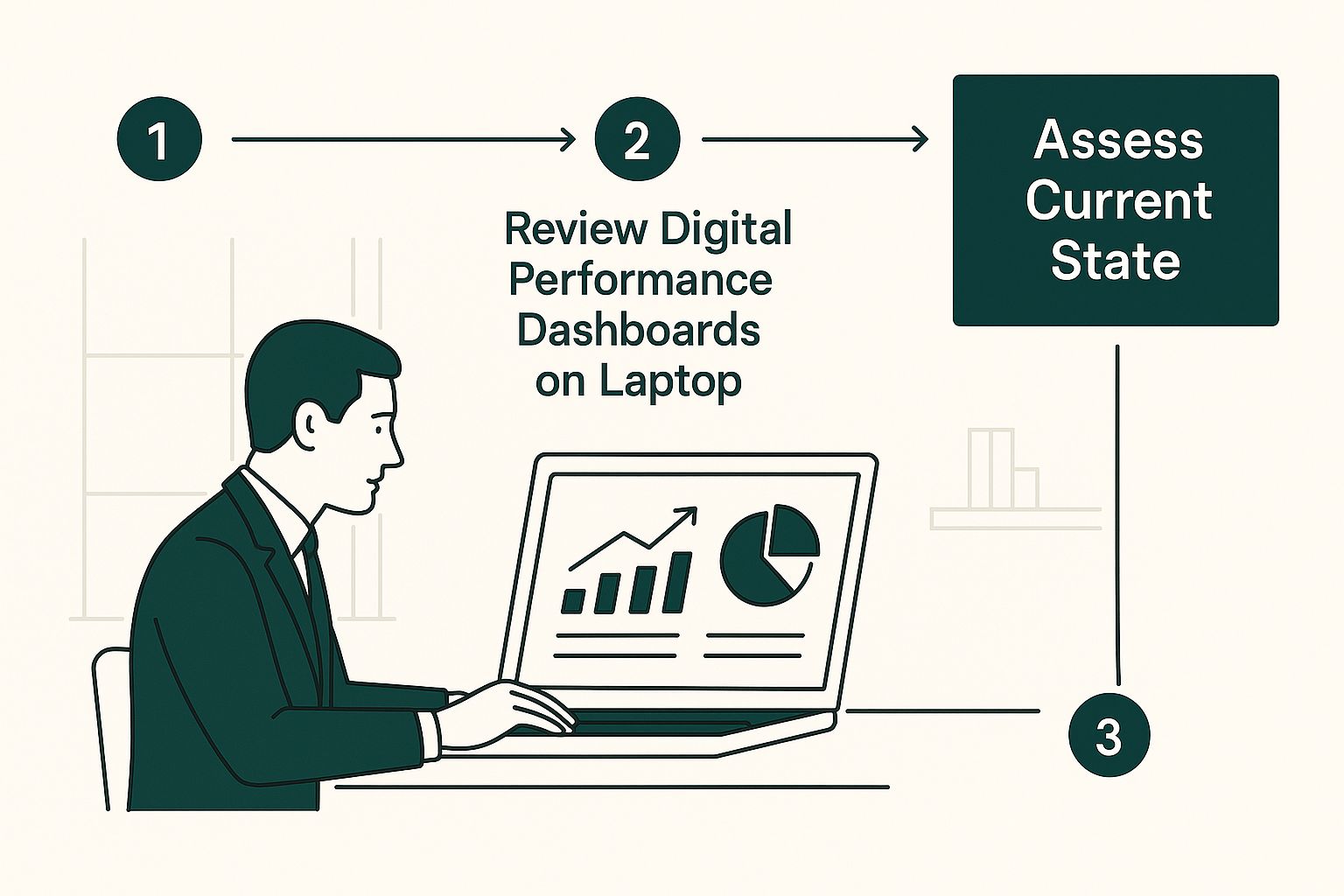
As you can see, the journey starts with a thorough look at where you are now. This sets the stage for a data-backed strategy that perfectly aligns technology with your business objectives.
Phase 1: Discovery and Strategy
This is the blueprint phase. Before we touch any technology, we need to understand exactly where you are and where you want to go. It's all about asking the right questions to define the "why" behind the project.
Key activities in this stage include:
- Stakeholder Workshops: We bring leaders from across your business together to understand their pain points, goals, and vision for the future.
- Process Audits: We map out your current workflows to spot bottlenecks, inefficiencies, and hidden opportunities for improvement.
- Technology Assessment: We take a hard look at your existing systems. What can we leverage? What needs replacing? How will new tools integrate?
- Competitive Analysis: We also need to understand how your competitors are using technology to gain an advantage.
The main result of this phase is a clear, unified vision and a strategic document that outlines the business case for transformation. This gets everyone on the same page, aligned on the goals and what success looks like.
Phase 2: Roadmap and Planning
With a solid strategy in hand, the next step is to map out how we'll get there. This is like getting building permits and drawing up the construction schedule for your new home. Outlining your digital transformation roadmap is a crucial step in any modernisation effort.
This phase turns high-level strategy into an actionable plan with clear timelines, budgets, and responsibilities.
A roadmap without clear milestones is just a wish list. The planning phase turns your strategic vision into a concrete, time-bound project plan that holds everyone accountable.
Here’s what we focus on:
- Prioritising Initiatives: You can't do everything at once. We work with you to pinpoint the quick wins and foundational projects that will deliver the most value, fast.
- Selecting Technology: Based on the strategy, we help you choose the right technology stack that fits your specific business needs, budget, and future growth.
- Defining Scope and Timeline: We break the project into smaller, manageable phases, each with clear deliverables and deadlines. No ambiguity.
- Resource Planning: We figure out who needs to be involved—from your internal team to our specialists—and define everyone’s roles and responsibilities.
Phase 3: Implementation and Change Management
This is the construction phase, where the plan comes to life. It involves all the technical work of building, configuring, and integrating your new systems. But a successful implementation is about much more than just technology; it’s about your people.
Change management is a critical piece of this stage. Introducing new tools and processes requires careful communication, training, and support to ensure your team embraces the changes. A project is only successful if people use the new system.
We guide you through a structured rollout every step of the way. To get a feel for what this looks like in practice, check out our detailed Salesforce implementation guide for Australian businesses, which breaks down the key steps from setup to launch.
Phase 4: Optimisation and Scaling
The journey doesn't end when the new system goes live. Just like a new home needs ongoing maintenance, your digital ecosystem needs continuous improvement to deliver long-term value.
This final phase is about monitoring performance, gathering feedback, and making iterative improvements. It's also where we look for opportunities to scale the solution to other parts of your business, maximising your return on investment. The real goal is to build a culture of continuous improvement, where your organisation is always looking for ways to get better.
Key Technologies Driving Business Modernisation
Successful digital transformation has little to do with chasing every new gadget or buzzword. It's about strategically picking the right tools for the job—technologies that solve real business problems, create efficiencies, and deliver experiences that keep customers coming back.
In any modern business, technology is the engine that drives growth. Understanding the core components of that engine is the first step to making smart investment decisions. Let's cut through the hype and look at the technologies that form the backbone of business modernisation.
Artificial Intelligence and Machine Learning
Artificial Intelligence (AI) and Machine Learning (ML) have moved from science fiction into the everyday business toolkit. Think of AI as your team's most powerful analyst, able to sift through mountains of information to spot patterns and predict outcomes a human could never see on their own.
For instance, AI-powered analytics can dive into a customer's purchase history to predict what they'll buy next, enabling marketing campaigns that feel genuinely personal. On the operations side, ML algorithms can forecast demand with high accuracy, helping you optimise inventory and avoid costly stockouts.
The goal is to turn your data from a passive resource into a strategic asset. By using AI to understand customer behaviour, streamline operations, and make smarter forecasts, you can shift from reactive decision-making to proactive, data-driven strategies.
Cloud Infrastructure
If AI is the engine, then cloud infrastructure is the chassis. Cloud platforms like Amazon Web Services (AWS) or Microsoft Azure provide the flexible, scalable, and secure foundation that modern business operations demand. Moving away from on-premise servers isn't a trend; it's a fundamental requirement for staying agile.
Cloud infrastructure brings massive advantages:
- Scalability: Instantly ramp computing resources up or down to meet demand, paying only for what you use. This eliminates the need for huge upfront hardware investments.
- Accessibility: Your team can access critical data and applications from anywhere, which is essential for supporting remote work and global operations.
- Security and Reliability: Major cloud providers invest billions in security, offering a level of protection most individual businesses could never afford on their own.
Ultimately, the cloud gives you the operational freedom to innovate quickly and adapt to market shifts without being chained to rigid, outdated IT infrastructure.
The real power of the cloud isn't just about saving money on servers. It's about creating a business that is inherently more flexible, resilient, and ready to seize new opportunities.
Intelligent Automation and RPA
Many businesses are bogged down by repetitive, manual tasks that consume valuable time and are prone to human error. Intelligent Automation, including Robotic Process Automation (RPA), tackles this problem head-on. RPA uses software "bots" to mimic human actions and automate rule-based jobs like data entry, invoice processing, or report generation.
This isn't about replacing people; it's about freeing them up. When routine tasks are handled automatically, your team can redirect their focus to more strategic, creative, and customer-facing work—the activities that actually drive the business forward. The result is a more productive, engaged, and innovative workforce.
The growing commitment to these technologies is clear when you look at how Australian businesses are spending. IT consulting and implementation services are seeing major growth, with the average spend per employee expected to hit around AUD 129.81 in 2025. This investment shows a clear focus on using technology to streamline operations and get a leg up on the competition. You can dive deeper into these IT consulting trends transforming Australian businesses to get a better sense of where the market is headed.
Case Study: A Retail Operations Overhaul
Talking strategy is one thing, but seeing the real-world results of a digital transformation partnership is where the value becomes clear. Let's step away from theory and look at the story of a mid-sized Australian retailer who came to us at a critical crossroads.
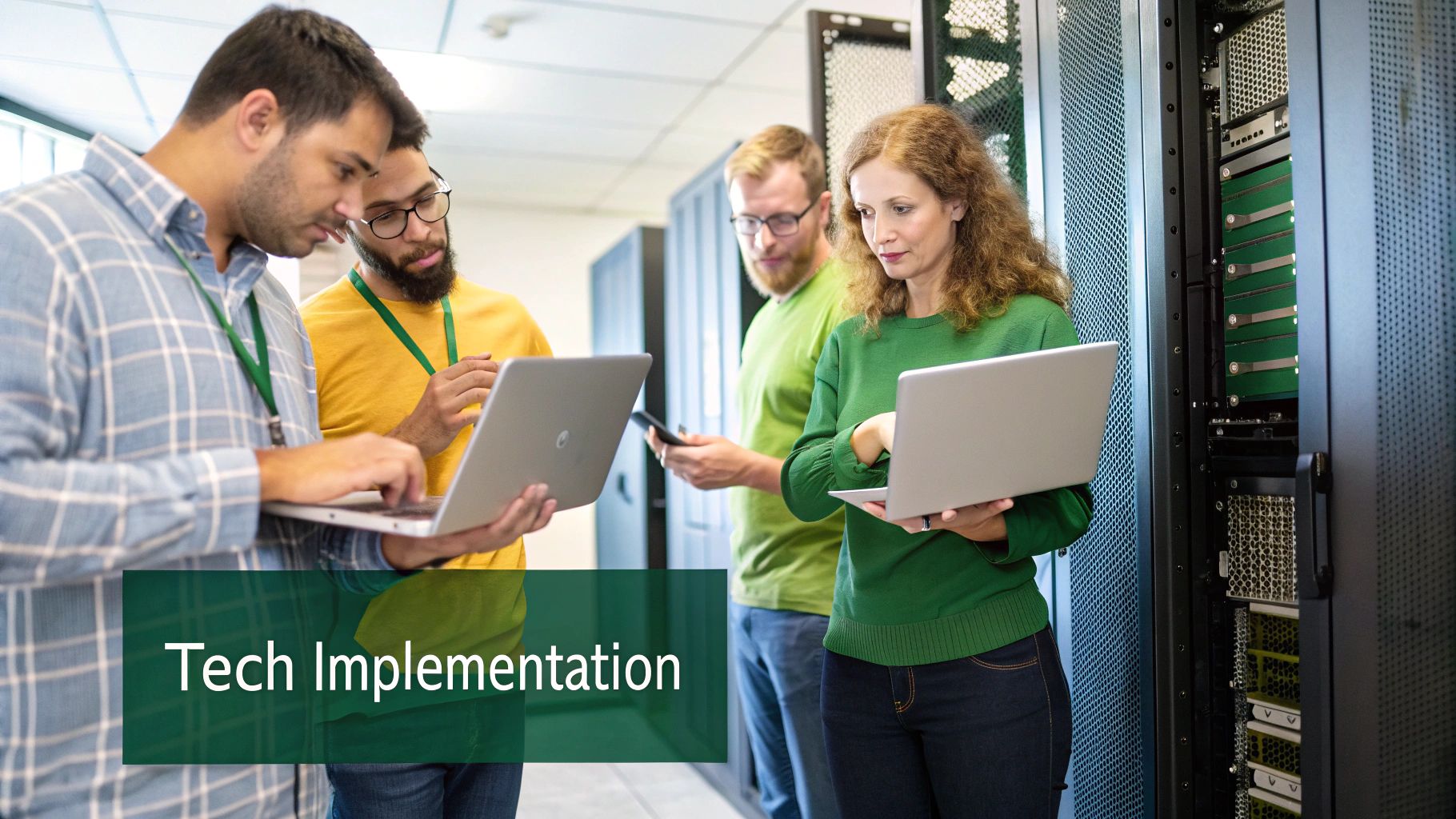
The Challenge: Disconnected Systems and Frustrated Customers
Our client, a growing fashion retailer with several brick-and-mortar stores and a busy e-commerce site, was hitting a wall. Their operations were hamstrung by a patchwork of disconnected systems that couldn’t talk to each other.
Their inventory system was an island. So was their online store. And neither was connected to their customer relationship management (CRM) platform. This created a host of problems:
- Frequent Stockouts: An item sold in-store wouldn't update online in real-time, leading to customers buying products that were already gone.
- Wasted Hours: Staff were spending countless hours manually reconciling inventory levels between physical shops and the website.
- Poor Customer Experience: With no single view of the customer, someone who bought in-store was treated like a stranger online, making personalisation impossible.
The leadership team knew this fragmented foundation couldn't support their growth ambitions. They needed to unify their operations to deliver the seamless experience customers expected.
Our Approach: A Unified Commerce Solution
We began with a deep dive into their existing workflows to pinpoint the exact friction points. It was clear a band-aid fix wasn't enough; they needed a fundamental overhaul. We proposed building a unified commerce platform, using Salesforce as the single source of truth for all customer, sales, and inventory data.
Our solution was built on three core pillars:
- System Integration: We connected their inventory management, point-of-sale (POS), and e-commerce systems directly into their Salesforce CRM.
- Workflow Automation: We automated repetitive tasks like updating stock levels and syncing customer data, freeing up their team to focus on serving customers.
- A 360-Degree Customer View: By funnelling all interaction data into one place, we empowered the marketing team to create personalised campaigns based on a customer's complete purchase history.
The goal was never just about installing new software. It was about re-architecting their entire operation around the customer, ensuring every single touchpoint—from browsing online to walking into a store—was consistent and connected.
The Outcome: Measurable Improvements Across the Board
The results spoke for themselves. Within six months of going live, the retailer saw significant, measurable improvements that impacted their bottom line and streamlined daily operations. This project delivered tangible business value, much like you'll see in our other successful Salesforce case studies.
Here are the key results:
- A 25% reduction in stockouts, which dramatically improved customer satisfaction and prevented lost sales.
- A 15% lift in online conversion rates, driven by a smoother user experience and accurate inventory data.
- Hundreds of staff hours saved each month on manual data entry, allowing teams to focus on activities that grow the business.
This project is a perfect example of how a strategic approach to digital transformation is about so much more than just technology. By aligning the right tools with specific business challenges, we helped this retailer build a rock-solid, scalable foundation for their future.
Measuring the True ROI of Your Transformation
How do you know if a digital transformation was worth the time, effort, and money? Success isn’t just about flicking a switch on a new system. The real value is measured in tangible business outcomes, and the work to define those outcomes must happen long before a single dollar is spent.
A solid digital transformation engagement starts by setting clear Key Performance Indicators (KPIs) from the very beginning. This gives you a baseline to measure against and ensures every decision is tied back to a specific, valuable goal. It’s all about building a business case your stakeholders can get behind.
Building a Balanced Scorecard
To get the full picture of success, you have to look beyond just the financials. A balanced scorecard approach provides a holistic view of your transformation’s value by tracking metrics across several key areas of the business.
Here are the essential categories to build into your scorecard:
- Financial Gains: These are the direct, bottom-line numbers. We're talking revenue growth from new digital channels, cost reductions from smarter processes, and healthier profit margins.
- Operational Improvements: This is all about how efficiently the business is running. You should be tracking shorter process cycle times, boosts in team productivity, and fewer errors in core workflows.
- Customer-Centric Wins: This bucket focuses on your most important asset—your customers. Keep a close eye on metrics like customer satisfaction scores (CSAT), Net Promoter Score (NPS), and customer retention rates.
This multi-faceted approach ensures you capture both the hard financial returns and the softer, but equally crucial, improvements in efficiency and customer loyalty that fuel sustainable growth.
Key Metrics for Measuring Transformation Success
Use this table as a starting point to build a comprehensive ROI model for your own digital initiatives.
| Category | Example KPI | How to Measure It |
|---|---|---|
| Sales Performance | Sales Cycle Length | Track the average time from initial contact to a closed-won deal. A shorter cycle means faster revenue. |
| Marketing Effectiveness | Customer Acquisition Cost (CAC) | Calculate the total marketing and sales spend divided by the number of new customers acquired in a period. |
| Marketing Effectiveness | Lead Conversion Rate | Measure the percentage of leads that convert into paying customers. |
| Operational Efficiency | Employee Productivity | Monitor metrics like tasks completed per employee or time spent on manual data entry versus strategic work. |
| Customer Experience | Customer Satisfaction (CSAT) | Use post-interaction surveys to ask customers to rate their satisfaction on a numerical scale. |
| Customer Experience | Net Promoter Score (NPS) | Ask customers, "How likely are you to recommend our company to a friend or colleague?" on a scale of 0-10. |
| Financial Impact | Revenue Growth | Compare revenue from specific digital channels or product lines before and after the transformation. |
| Financial Impact | Cost Savings | Quantify savings from process automation, reduced IT maintenance, or lower overheads. |
| User Adoption | System Usage Rate | Track the percentage of employees actively using the new platform daily or weekly through system analytics. |
This isn't an exhaustive list, but it demonstrates how to connect your transformation efforts to concrete, measurable results that everyone in the business can understand.
Beyond the Numbers: The People Factor
One of the most overlooked—yet critical—metrics is user adoption. You can have the most powerful system in the world, but it's worthless if your team doesn't actually use it. Measuring adoption isn't just a technical checkbox; it’s a direct reflection of how well you’ve managed the change.
The ultimate measure of a transformation's ROI isn't the technology itself, but the degree to which it empowers your people to work smarter, serve customers better, and drive the business forward.
High adoption rates prove the new tools are genuinely making your team's jobs easier and more effective. This, in turn, is what fuels the operational and financial gains you set out to achieve.
The demand for this kind of strategic guidance is only growing. The Australian consulting services market, which includes this expertise, was valued at around USD 9.1 billion in 2024 and is expected to rocket to USD 18.8 billion by 2034. This growth is driven by businesses looking for partners who can not only deliver but also prove measurable results. You can find more details in the Australian consulting services market forecast.
Ultimately, measuring ROI isn’t a one-off report. It’s about building a culture of data-driven decision-making, where every initiative is tracked, analysed, and fine-tuned to deliver maximum value back to the business.
How to Choose the Right Transformation Partner
Choosing a partner for your digital transformation is one of the most important decisions you'll make. This choice has a massive impact on the project's success, influencing everything from team adoption to the long-term return on your investment.
Think of it like hiring a guide for a mountain trek. You wouldn't just hire someone with a map; you’d want a seasoned expert who knows the terrain, can spot trouble before it hits, and is genuinely committed to getting you to the summit safely. The same logic applies to finding the right partner for your consulting digital transformation.
Beyond the Technical Checklist
While technical skill is non-negotiable, it’s only one piece of the puzzle. A great partner brings a powerful mix of industry know-how, strategic insight, and a feel for your unique business culture. Their ability to manage change and get your team excited is just as vital as their coding prowess.
Look for a firm that is invested in your long-term success, not just ticking off tasks to close out a project.
Key Questions to Ask Potential Partners
To get past the sales pitch and find a partner that's a genuine fit, you have to ask the right questions. This checklist will help you dig into their capabilities and approach.
-
How do you define and measure success for a project like ours?
- A great partner talks about business outcomes—revenue growth, operational efficiency, customer satisfaction. They should be eager to set clear KPIs with you from day one.
-
Can you share examples of similar projects in our industry?
- Industry-specific experience is invaluable. A partner who understands the unique challenges in your sector can deliver more relevant solutions and help you avoid common pitfalls.
-
What is your approach to change management and user adoption?
- This is critical. The best technology is worthless if your team won't use it. A strong partner will have a clear, structured plan for training, communication, and ongoing support to ensure a smooth transition.
Your transformation partner's value is measured not by the technology they deliver, but by the business capabilities they help you build. Their role is to empower your team and create a foundation for continuous improvement.
Ultimately, the goal is to find a team that feels like an extension of your own. When you're assessing our Salesforce consulting services, we encourage you to look at our track record of building lasting partnerships that drive real, measurable results. As you evaluate potential partners, also consider their expertise in specialised areas, such as providing Kubernetes consulting services to enhance your cloud-native capabilities.
Frequently Asked Questions (FAQ)
Here are answers to some of the most common questions business leaders ask when considering a digital transformation project.
What is the first step in a digital transformation?
The most important first step is strategy, not technology. A successful project always kicks off with a discovery phase where we get crystal clear on the business problem you're trying to solve. We identify pain points, set measurable goals (KPIs), and map out a strategic plan. This ensures your investment is tied directly to a real business outcome.
How long does a typical transformation take?
There's no single answer, as it depends on the project's complexity. A smaller project might take a few months, while a complete overhaul of core systems could take a year or more. However, modern consulting for digital transformation focuses on delivering value in phases. This agile approach means you see a return on investment sooner and can adjust the plan as your business needs change.
How do we ensure our team adopts the new technology?
User adoption is critical, and the secret lies in comprehensive change management from day one. A solid plan includes clear communication about why the change is happening, practical and role-specific training, and ongoing support to help your team succeed. When your team understands the value and feels supported, they become advocates for the new way of working.
Ready to build a future-proof foundation for your business? At Adaptal, we partner with Australian organisations to deliver strategic, results-driven digital transformations powered by Salesforce. Start your transformation journey with us today.
Article created using Outrank
Pingback: A Guide To Consulting For Salesforce In Australia