

Salesforce is not just a single product; it’s a powerhouse suite of specialised cloud services designed to manage every facet of your customer relationships. Think of it as the central hub for your business—a platform where your sales, customer service, and marketing teams collaborate from a single source of truth to drive tangible growth.
Understanding the Salesforce Cloud Ecosystem
At its core, the Salesforce ecosystem is engineered to solve one critical business challenge: breaking down data silos. Instead of sales figures living in one spreadsheet, support tickets in another, and marketing campaign results buried in a third system, Salesforce unifies this information. This integration provides a complete, 360-degree view of your customer, which is the foundation for making smarter decisions and coordinating efforts across your entire organisation.
This unified approach is precisely why Salesforce has become the undisputed world leader in Customer Relationship Management (CRM). For 13 consecutive years, they’ve been ranked number one in Sales CRM applications, and for 12 consecutive years in Customer Service CRM. According to the latest IDC data, Salesforce holds a commanding 20.7% market share in CRM applications globally, putting it far ahead of the competition. This leadership isn’t just a global trend; it’s a reality for businesses across the Asia-Pacific region and right here in Australia. If you’re curious, you can explore the full IDC market share report for a detailed breakdown.
Why a Cloud-Based Platform is a Game-Changer
Adopting a cloud-based platform like Salesforce offers significant advantages over traditional, on-premise software. For Australian businesses, the key benefits are transformative:
- Scalability: The platform grows with your business. Whether you’re a startup in Melbourne or a national enterprise, you can begin with the features you need today and seamlessly add more capability as you expand.
- Accessibility: Your team can securely access critical customer data from anywhere, at any time. This is essential for organisations with remote teams or field staff, such as those in construction or professional services.
- Automatic Updates: Forget the headaches of manual software updates and maintenance. Salesforce manages all platform upgrades, ensuring you always have the latest features and security enhancements without needing a dedicated IT team for complex deployments.
In essence, Salesforce provides the digital foundation your business needs to become more connected and customer-centric. It’s not just about storing data; it’s about making that data actionable for everyone in your company.
When you centralise your data, you empower genuine team collaboration. A sales representative can instantly see if a client has an open support ticket before making a call. Your marketing team can design campaigns targeting specific customers based on their purchase history. This level of insight is what separates successful businesses from the rest. As a certified Salesforce partner, helping companies unlock this potential is what we do every day.
A Breakdown of the Core Salesforce Clouds
Think of Salesforce not as a single application, but as a connected suite of specialised tools. It organises its cloud services around specific business functions, with each cloud designed to solve distinct challenges. The real power, however, is unleashed when these clouds share data and work together to create that single, unified view of your customer.
To better understand how this works, let’s explore the core offerings. The diagram below illustrates how the main clouds align with key business functions like sales, service, and marketing.
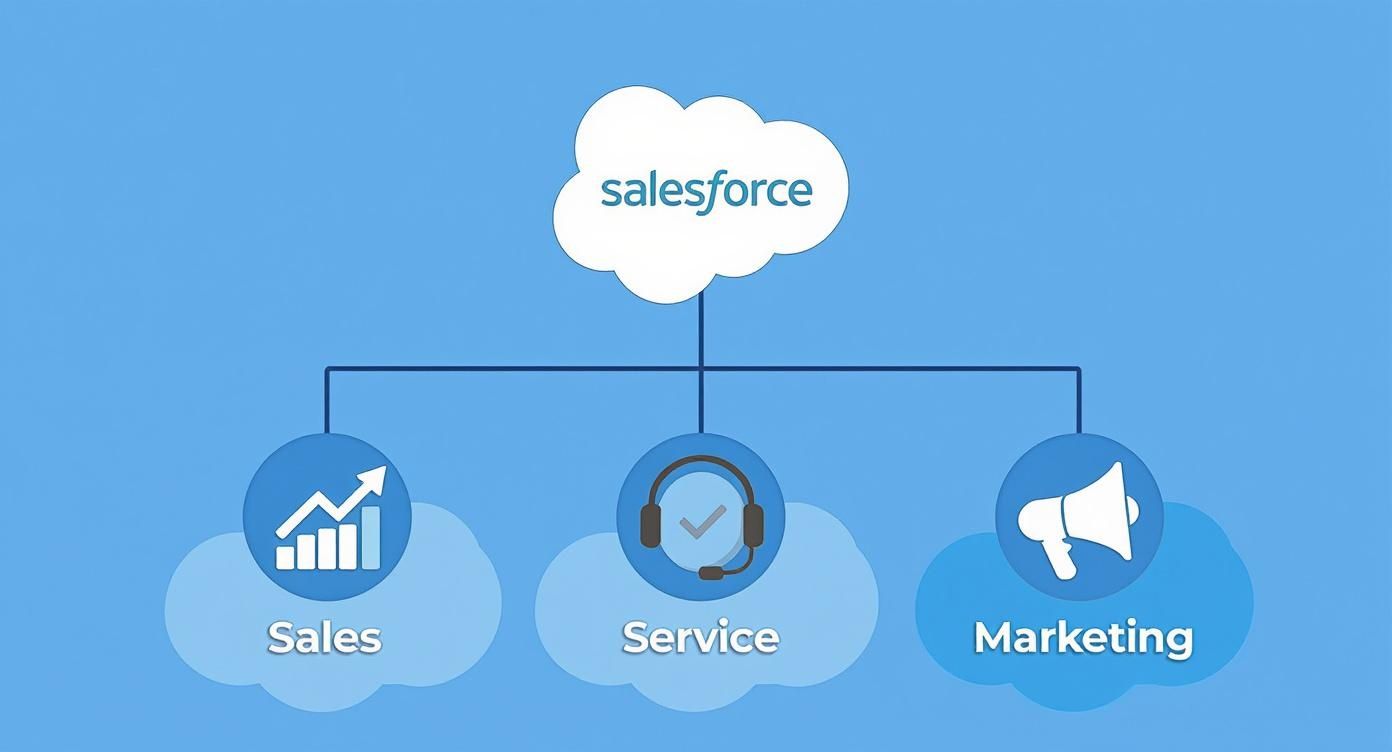
While each cloud has a primary purpose, they all connect back to the central Salesforce platform. This ensures data flows seamlessly between departments, breaking down the operational silos that so often hinder business growth.
Sales Cloud: The Engine of Your Revenue Growth
For most businesses beginning their Salesforce journey, Sales Cloud is the logical starting point. It’s purpose-built to manage and accelerate your entire sales process, from lead generation to closing the deal. You can think of it as the central nervous system for your revenue team.
It provides a single source of truth for lead management, opportunity tracking, sales forecasting, and performance analytics. With crucial information no longer lost in spreadsheets or buried in individual inboxes, sales leaders gain a crystal-clear view of the pipeline. The market reflects its importance: widespread enterprise adoption is driving rapid growth, with the Australia and New Zealand region forecasted to lead global growth at a CAGR of 19.1% through 2035. Sales Cloud services represent a significant portion of this market, highlighting how vital sales automation and pipeline visibility are for modern businesses.
Service Cloud: The Heart of Customer Loyalty
Once a deal is won, the customer relationship is only just beginning. This is where Service Cloud excels. It’s designed to manage every aspect of customer support and engagement, transforming your service centre from a cost centre into a loyalty-building machine.
It unifies all your support channels—phone, email, social media, and live chat—into a single console. This gives your agents a complete customer history at their fingertips, empowering them to resolve issues faster and deliver more personalised support. The objective is to shift from reactive problem-solving to proactive customer care.
By connecting your service data with your sales data, you create a powerful feedback loop. Service agents can identify upsell opportunities, and sales reps can see a customer’s full support history before making a call. This leads to much smarter, more contextual conversations.
For any business serious about elevating its support operations, it’s worth taking a deep dive into Salesforce Service Cloud to understand how it can help build lasting customer relationships.
Marketing Cloud and Account Engagement: Driving Targeted Growth
Delivering the right message to the right person at the right time is the core of modern marketing. Salesforce offers two powerhouse solutions to achieve this: Marketing Cloud and Account Engagement (formerly known as Pardot).
These platforms act as the megaphone for your brand, but with incredible precision. They enable you to map out personalised customer journeys that nurture leads from their first moment of awareness all the way through to purchase and beyond.
- Marketing Cloud is ideal for B2C companies focused on engaging large customer bases across multiple channels like email, SMS, social media, and digital advertising.
- Account Engagement (Pardot) is tailored for B2B organisations with longer, more complex sales cycles. It helps identify the most engaged leads, so the sales team knows precisely who to follow up with.
By tying marketing activities directly to sales outcomes within your CRM, you can finally measure the true return on investment of your campaigns. Understanding Account Engagement best practices is a great starting point for any B2B marketer looking to leverage these powerful tools.
Experience Cloud: Building Collaborative Digital Spaces
Finally, Experience Cloud allows you to securely extend your Salesforce data to customers, partners, and employees. You can use it to build self-service portals, partner relationship management (PRM) sites, and thriving online communities.
Imagine a secure portal where your clients can log in to check project updates, download invoices, or create support tickets 24/7. This not only elevates the customer experience but also frees up your team from handling routine administrative tasks. It’s about empowering your entire ecosystem with the data they need to collaborate effectively.
Which Salesforce Cloud Solves Your Business Need?
With several powerful options, knowing where to start can be challenging. This table breaks down the core Salesforce clouds, their primary functions, and the business problems they are perfectly suited to solve.
| Salesforce Cloud | Primary Business Function | Ideal for Solving These Challenges |
|---|---|---|
| Sales Cloud | Sales Process Automation & CRM | Disorganised lead tracking, inaccurate sales forecasts, lack of pipeline visibility, inefficient sales team collaboration. |
| Service Cloud | Customer Support & Service Management | Disjointed customer service channels, slow issue resolution times, low customer satisfaction scores, lack of a 360-degree customer view. |
| Marketing Cloud | B2C Marketing Automation & Customer Journeys | Impersonal mass-email campaigns, inability to track marketing ROI, difficulty engaging customers across multiple channels (email, SMS, social). |
| Account Engagement | B2B Marketing Automation & Lead Nurturing | Poor alignment between marketing and sales teams, low-quality leads, long and complex sales cycles needing consistent nurturing. |
| Experience Cloud | Community & Portal Building | High volume of repetitive customer queries, need for a secure partner collaboration space, desire for a customer self-service help centre. |
The right cloud—or combination of clouds—depends entirely on your specific goals. Each is a powerful tool on its own, but they deliver maximum value when used together to create a seamless experience for both your team and your customers.
How Australian Industries Leverage Salesforce Cloud Services
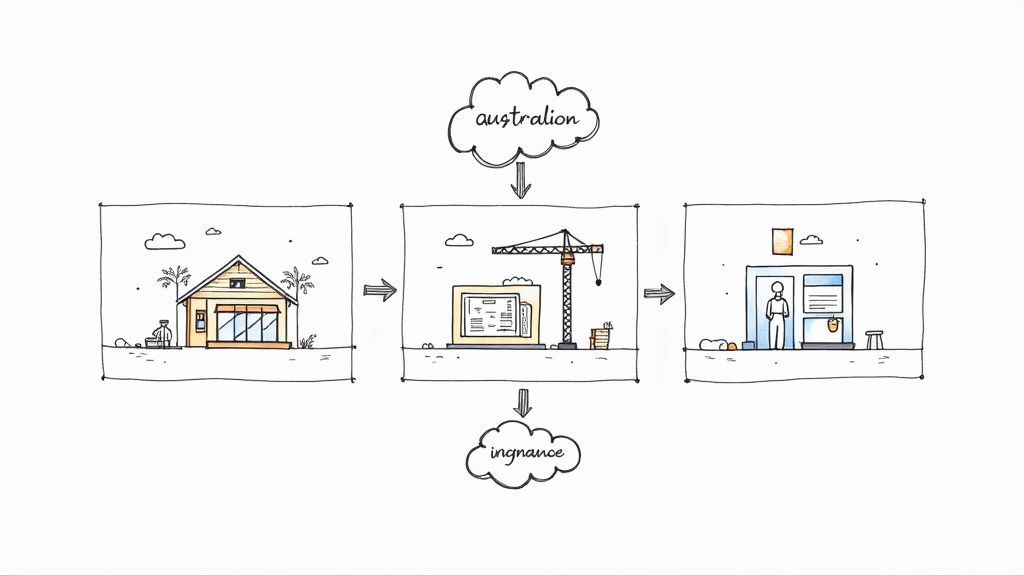
Understanding what each Salesforce cloud does is one thing; seeing how it solves real-world business problems is another. Let’s explore how specific Australian industries are using these cloud services to overcome their unique operational challenges.
The true strength of Salesforce lies in its flexibility. It’s not a rigid, one-size-fits-all product but a versatile platform that can be tailored to address the distinct needs of different sectors. Whether it’s unifying a national franchise network or managing a complex construction project, the right combination of clouds can deliver measurable results.
Below are a few case study style examples. Each follows a simple narrative: the business challenge, the Salesforce solution we helped implement, and the positive outcomes achieved.
Case Study: Unifying a Franchise Network with Sales Cloud
- The Challenge: A national retail franchise with stores across Australia faced a major blind spot. Each franchisee managed their sales pipeline independently using spreadsheets or basic contact managers. This fragmented approach gave head office zero visibility into the overall sales pipeline, making forecasting pure guesswork and leading to an inconsistent customer experience.
- The Salesforce Solution: The franchise implemented Salesforce Sales Cloud across its entire network. This created a single, standardised sales process for every location. Leads were captured and distributed centrally, opportunities were tracked in a consistent format, and dashboards provided both franchisees and corporate leadership with a real-time view of all sales activity.
- The Results: The outcome was a dramatic improvement in operational clarity. Head office could finally forecast revenue with confidence and identify which locations were excelling. For franchisees, it meant less time on manual administration and more time focused on selling.
Case Study: Precision Project Management for a Construction Firm
- The Challenge: A mid-sized construction company struggled with disconnected operations. Project managers coordinated jobs on-site, the sales team managed bids in a separate system, and the service team handled post-completion maintenance reactively. These information silos caused project delays, budget overruns, and a disjointed client experience.
- The Salesforce Solution: The company implemented Salesforce Field Service alongside its existing Sales Cloud instance. This powerful combination connected the entire project lifecycle, from the initial bid to final sign-off and ongoing maintenance. Sales Cloud handled quoting and contracts, while Field Service managed scheduling, dispatch, and real-time job tracking.
- The Results: This integrated system provided a single source of truth for everyone, from the sales rep to the on-site project manager. The company significantly reduced costly errors caused by miscommunication and improved its ability to deliver projects on time and on budget.
Case Study: Personalised Patient Care for a Healthcare Provider
- The Challenge: A growing allied health clinic needed a secure way to manage patient relationships while complying with Australia’s strict privacy laws. Disparate systems made it impossible to track a patient’s journey across different practitioners, hindering coordinated care.
- The Salesforce Solution: By implementing Salesforce Health Cloud, the clinic created a secure and compliant platform designed for patient data management. Health Cloud provided a 360-degree view of each patient, consolidating their medical history, appointments, and treatment plans. This enabled better collaboration among practitioners and automated administrative tasks like appointment reminders.
- The Results: The patient experience improved dramatically. Patients felt better supported throughout their treatment, and the clinic operated more efficiently with a reduced administrative burden.
These stories are just a snapshot of what’s possible. You can explore a wide range of real-world success stories in our detailed Salesforce case studies. Each one demonstrates how a tailored approach to the cloud services Salesforce provides can solve the unique pain points of any industry.
Integrating Salesforce with Your Existing Technology
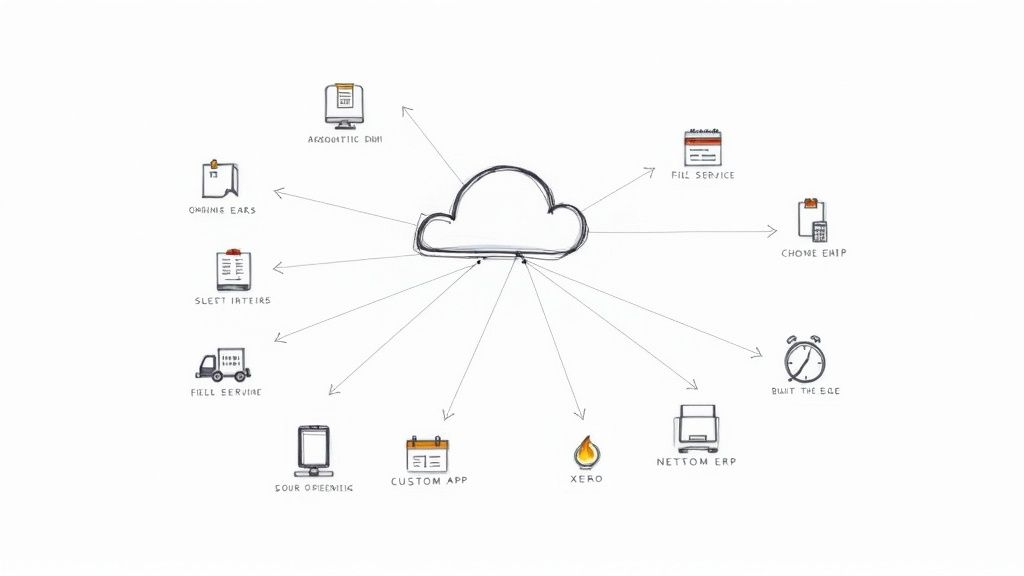
Implementing one of the cloud services Salesforce offers is a powerful first step. However, the real transformation occurs when Salesforce communicates seamlessly with the other software you rely on every day. A new platform is only as effective as its ability to connect with your existing tools. The goal is to establish Salesforce as your single source of truth for all customer-related data, eliminating the silos that cause confusion and inefficiency.
Without proper integration, teams are often stuck in a loop of manual data entry—a slow, tedious process prone to costly errors. Imagine your sales team closing a deal in Salesforce, only for your accounts department to re-enter every detail into Xero or MYOB to generate an invoice. This disconnect creates double-handling and increases the risk of mistakes.
A well-designed integration strategy ensures data flows automatically and accurately across your entire organisation, streamlining everything from invoicing and financial reporting to project management and customer support.
Common Salesforce Integrations for Australian Businesses
For most Australian businesses, a few key integrations are non-negotiable. They build essential bridges between your customer-facing activities and back-office operations. Based on our project experience, these are the most common systems we connect to Salesforce:
- Accounting Software: This is typically the top priority. Linking Salesforce to platforms like Xero, MYOB, or QuickBooks allows for invoices to be generated automatically when a deal is marked ‘Closed Won’, providing a real-time view of revenue.
- Enterprise Resource Planning (ERP) Systems: For larger organisations, integrating with an ERP like NetSuite or SAP is critical for a complete view of business operations—from supply chain and inventory to financials—all tied back to the customer record in Salesforce.
- Marketing Automation Tools: While Salesforce offers its own marketing platforms, many businesses use other specialised tools. Integration ensures that lead data from campaigns flows directly into Salesforce for sales follow-up.
- Email and Calendar Platforms: A simple yet highly effective integration. Connecting tools like Outlook or Gmail ensures every customer email and appointment is automatically logged against the correct contact record in Salesforce.
The core principle is simple: data should only be entered once. A robust integration strategy makes this a reality, saving hundreds of hours and dramatically improving data accuracy across your entire business.
Why Expert Guidance is Key to Integration Success
Connecting disparate software systems can become complex quickly. You’re often dealing with custom fields, unique business rules, and large volumes of data. A poorly planned integration can create more problems than it solves, leading to data conflicts, system downtime, and frustrated teams.
This is where an experienced Salesforce partner makes a critical difference. A specialist can design and build a reliable and scalable integration, ensuring your systems work together from day one. For particularly complex projects, engaging the right data integration consultants can be a game-changer. An expert partner helps navigate technical hurdles and ensures the integration supports your business processes. Understanding the role of Salesforce development consultants in digital transformation provides deeper insight into how this expertise drives project success.
Your Salesforce Implementation Roadmap: A Phased Approach
Implementing Salesforce is not a one-off IT project; it’s a strategic business journey. Think of it less like flipping a switch and more like building a house. A clear roadmap is your blueprint, breaking down a large undertaking into manageable, value-driven phases. It’s about getting the foundations right from the start.
After delivering over 110 Salesforce implementations, we have honed a process that prioritises business outcomes. It always begins with a deep dive into your operations to define exactly what you need the platform to achieve.
Phase 1: Discovery and Strategic Planning
This initial phase is the most critical. Before any technology is configured, we collaborate with your key stakeholders to map current processes, identify pain points, and define what success looks like for your business. We document everything from your ideal customer journey to the specific reports your leadership team needs. This creates a detailed project blueprint, ensuring the technology is perfectly aligned with your strategic goals.
A well-defined plan is your insurance policy against scope creep and budget blowouts. It ensures every feature and customisation serves a clear business purpose.
Phase 2: Configuration and Data Migration
With a solid plan in place, our team begins building your tailored Salesforce solution. This involves configuring the cloud services Salesforce offers, setting up user profiles, and developing any custom objects or automation rules your workflows require. Next, we handle the delicate process of data migration, carefully cleaning, mapping, and importing your existing customer data from legacy systems into your new Salesforce environment.
Phase 3: User Training and Change Management
A powerful CRM is only effective if your team uses it. That’s why we treat user training and change management as core project pillars. We develop training programs tailored to different roles within your organisation, ensuring everyone feels confident and capable. We focus on the “why” behind the change, demonstrating how Salesforce will make their jobs easier and more effective. Strong user adoption is the ultimate measure of a successful implementation.
Salesforce is deeply committed to local growth, pledging a $2.5 billion investment in Australia over five years to fuel AI innovation and workforce development. You can learn more about Salesforce’s investment in Australia’s future on their official site.
Phase 4: Go-Live and Ongoing Optimisation
Go-live day is an exciting milestone, but our partnership doesn’t end there. We provide dedicated support to address any immediate questions as your team begins using the system. After launch, our focus shifts to ongoing optimisation. As your business evolves, so should your Salesforce instance. We remain your partner to refine processes, add new features, and ensure the platform continues to deliver maximum return on your investment.
How a Salesforce Partner Maximises Your Investment
You’ve seen what Salesforce’s cloud services can do. But extracting maximum value from the platform requires more than just technology. Real success comes from smart customisation, expert guidance, and a commitment to continuous improvement. This is where a trusted Salesforce partner becomes your most valuable asset.
Think of a partner as your strategic guide, translating your business challenges into a practical, working solution. They ensure your platform is not just configured, but optimised for your unique daily operations, from your sales process to your customer support workflows. This tailored approach helps you avoid costly missteps and ensures the technology directly supports your business goals.
The Fastest Path to Achieving Your Business Goals
Partnering with an experienced implementation team is the fastest way to achieve a return on your investment. With deep project experience, they know how to navigate complex areas like data migration, system integration, and user adoption. They bring best practices learned from dozens of successful projects, helping you sidestep common pitfalls and get it right the first time.
A partner’s value extends far beyond the initial go-live. They become an extension of your team, providing ongoing support and identifying new opportunities to refine your processes as your business grows.
Ultimately, this strategic partnership is the fastest way to turn your Salesforce investment into a powerful engine for measurable growth. If you’re ready to see how a solution built for your business can drive you forward, the next step is a simple conversation.
Our team of experts specialises in shaping the Salesforce platform to meet the unique demands of Australian businesses. To see how our Salesforce consulting services can help you achieve your goals, we invite you to schedule a consultation with us today.
Frequently Asked Questions about Salesforce Cloud Services
Here are answers to some of the most common questions we hear from Australian businesses considering Salesforce.
What sets Salesforce apart from other CRMs?
It’s a fair question, as many CRMs appear similar at first glance. Salesforce stands out for three key reasons. First is its deeply connected ecosystem. It’s not a single tool but a comprehensive suite of specialised platforms for sales, service, marketing, and more, all designed to work together seamlessly. Second is the Salesforce AppExchange, a business app store with thousands of third-party applications that extend the platform’s functionality to solve nearly any niche business problem. Finally, its proven scalability allows you to start small and grow your business on the platform without ever hitting a ceiling.
What is the typical investment for a small or medium business in Australia?
There is no single price tag for Salesforce, as the cost is tailored to your specific needs. Your final investment depends on several factors:
- Which Salesforce clouds you choose (e.g., Sales Cloud, Service Cloud, or both).
- The number of user licences required for your team.
- The edition you select for each cloud, as different tiers offer more advanced features.
- The level of customisation and integration needed to align with your business processes.
The best way to get an accurate figure is through a consultation. A discussion with an experienced partner will provide a precise quote based on your operational needs and business goals.
Can we start with one Salesforce Cloud and add more later?
Yes, absolutely. In fact, we recommend this phased approach for most businesses. A key strength of the Salesforce platform is its modularity. You don’t have to implement everything at once. Many businesses start with a core solution like Sales Cloud to establish a single source of truth for their customer data and streamline their sales process. This creates a solid foundation for future growth. As your business matures, you can seamlessly add other clouds, such as Service Cloud to enhance customer support or Account Engagement to scale your B2B marketing. This approach allows you to manage change effectively and demonstrate value at each stage.
Ready to see how a Salesforce solution built around your unique business challenges can unlock real growth? The team at Adaptal is here to help. Schedule a no-obligation consultation today to talk through your goals with our Australian-based experts.
Pingback: 9 Salesforce-Powered Client Relationship Management Strategies