
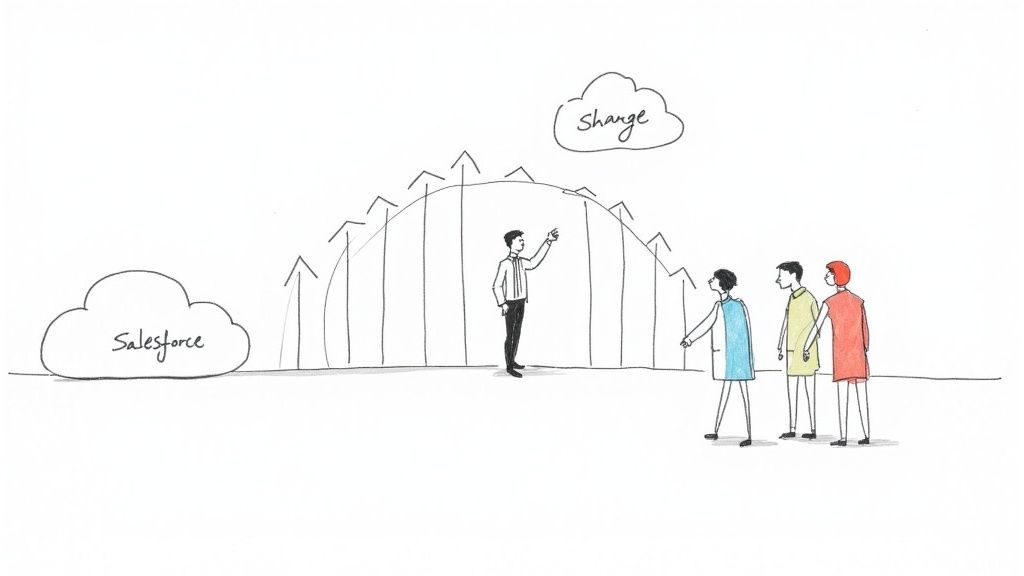
You’ve decided to invest in Salesforce—a powerful platform that promises transformative results. But technology alone is never a silver bullet. The success of any major CRM implementation hinges on one critical factor: whether your people actually adopt and use it effectively. This is where the strategic value of change management consultants becomes undeniable.
Why Your Salesforce Success Depends on People, Not Just the Platform
Picture a scenario we’ve seen firsthand. A growing B2B services firm invests in a state-of-the-art Salesforce Sales Cloud implementation. It has everything: automated workflows, insightful dashboards, and a perfectly designed sales process. Six months later, what’s the reality? User adoption is critically low. The sales team clings to their familiar spreadsheets, the new CRM is a wasteland of incomplete data, and management’s promised ROI remains a distant dream.
The problem wasn’t the technology. Salesforce was perfectly capable of delivering. The failure was in underestimating the human side of the equation. This is the precise gap that expert change management consultants are hired to fill, ensuring your technology investment translates into tangible business growth.
Bridging the Gap Between Your Salesforce Solution and Your Team
Effective change management is more than just a few announcement emails and a one-off training session. It’s a structured, human-centric strategy designed to guide an organisation from its current state to its desired future state. Think of it as the essential bridge between implementing a powerful tool like Salesforce and achieving full team buy-in.
Without a solid plan to manage this transition, even the most impressive tech stack will fall flat. Your employees will naturally have concerns bubbling under the surface:
- “Why are we changing?” Without a clear vision, the new Salesforce system feels like an unnecessary disruption.
- “How will this impact my daily work?” Fear of the unknown is a powerful driver of resistance.
- “What if I can’t learn the new system?” A lack of confidence will send users retreating to old, inefficient habits.
- “Did anyone ask for my input?” Feeling ignored is the quickest way to disengage your team and foster resentment.
Securing Your Salesforce Investment
This is where skilled change management consultants make their mark. They don’t just manage a technical go-live; they architect the entire human journey of adoption. Their role is to build genuine understanding, generate excitement, and empower your team with the skills and confidence needed to excel. Whether you’re rolling out an enterprise-level solution or just exploring options like the best free CRM platforms, achieving a true return on your investment always comes down to getting the people part right.
A Salesforce project isn’t just a technology upgrade—it’s a fundamental shift in how your business operates. Change management consultants ensure this shift is a success by placing your people at the very centre of the strategy, turning potential resistance into enthusiastic adoption and securing the long-term value of your investment.
What a Salesforce Change Management Consultant Actually Does
Many business leaders mistakenly believe change management consultants simply deliver training and send a few company-wide emails. This is a common misconception. In reality, their role is far more strategic and foundational to the success of any Salesforce project.
Think of them as the ‘adoption architects’ for your new CRM. While your technical implementation partner is building the Salesforce platform, change consultants are building buy-in and preparing your organisation for a new way of working. They are the critical bridge ensuring the technical goals of a Salesforce rollout align with the day-to-day realities of your sales, service, and marketing teams.

This proactive approach is gaining significant traction. In Australia, the change management consulting market was valued at approximately USD 1.93 billion in 2024 and is projected to reach USD 3.89 billion by 2032. This growth reflects a clear understanding that structured, people-focused change is essential for any major business transformation to succeed.
Core Functions of a Salesforce Change Consultant
So, what does this look like in a real Salesforce project? A skilled consultant acts as a ‘business translator,’ decoding technical project milestones into tangible, real-world benefits for every user. Their primary function is to anticipate challenges and build positive momentum from the very beginning.
Key functions include:
- Conducting Readiness Assessments: Before the project kicks off, a consultant assesses your organisation’s readiness for change. They identify potential resistance, evaluate current skill levels, and pinpoint cultural hurdles that could quietly derail your Salesforce implementation.
- Crafting Strategic Communication Plans: This goes beyond simple project updates. They develop a clear and consistent communication strategy that articulates the ‘why’ behind the new Salesforce system, building a compelling narrative about the future benefits for both the business and its employees.
- Designing Targeted Salesforce Training: One-size-fits-all training is ineffective. Consultants design role-specific training focused on daily workflows, not just system features. This ensures your sales team learns precisely how Sales Cloud makes their job easier, while your support team sees how Service Cloud helps them resolve customer issues faster.
- Establishing Feedback Channels: They create structured channels for employees to voice concerns, ask questions, and share ideas. This fosters a sense of ownership and turns employees from passive recipients of change into active participants.
By focusing on the human element, change management consultants ensure that your Salesforce platform doesn’t just get implemented—it gets embraced. They transform a technology rollout into a genuine business evolution.
From Technical Implementation to Organisational Buy-In
Ultimately, a change consultant’s job is to ensure the human side of the project keeps pace with the technical implementation. Long before go-live, they might conduct a modern training needs assessment to understand existing knowledge gaps.
This deep analysis allows them to proactively address user concerns. For example, a veteran salesperson might worry that automation in Sales Cloud will devalue their relationship-building skills. A consultant can address this head-on, demonstrating how the platform automates administrative tasks to free up more time for building those crucial client relationships.
This empathetic, strategic approach is what separates a successful Salesforce project from one that fails to deliver ROI. It ensures that on go-live day, your team is not just looking at a new login screen—they are equipped, confident, and ready to leverage their powerful new CRM to drive business growth.
A Proven Framework for Salesforce Change Management
Successful organisational change is not accidental; it requires a deliberate and structured plan. Experienced change management consultants don’t use guesswork. They follow a proven methodology to guide businesses through the complexities of a Salesforce implementation, ensuring momentum is built steadily from day one.
This journey is broken into distinct phases, each with a clear purpose. While every Salesforce project has unique requirements, the core principles of preparing your people, implementing the change, and sustaining adoption remain constant. This process is what transforms a technical project into a human-centric success story.
The infographic below provides a high-level overview of a consultant-led change initiative, simplifying the journey into three key stages.
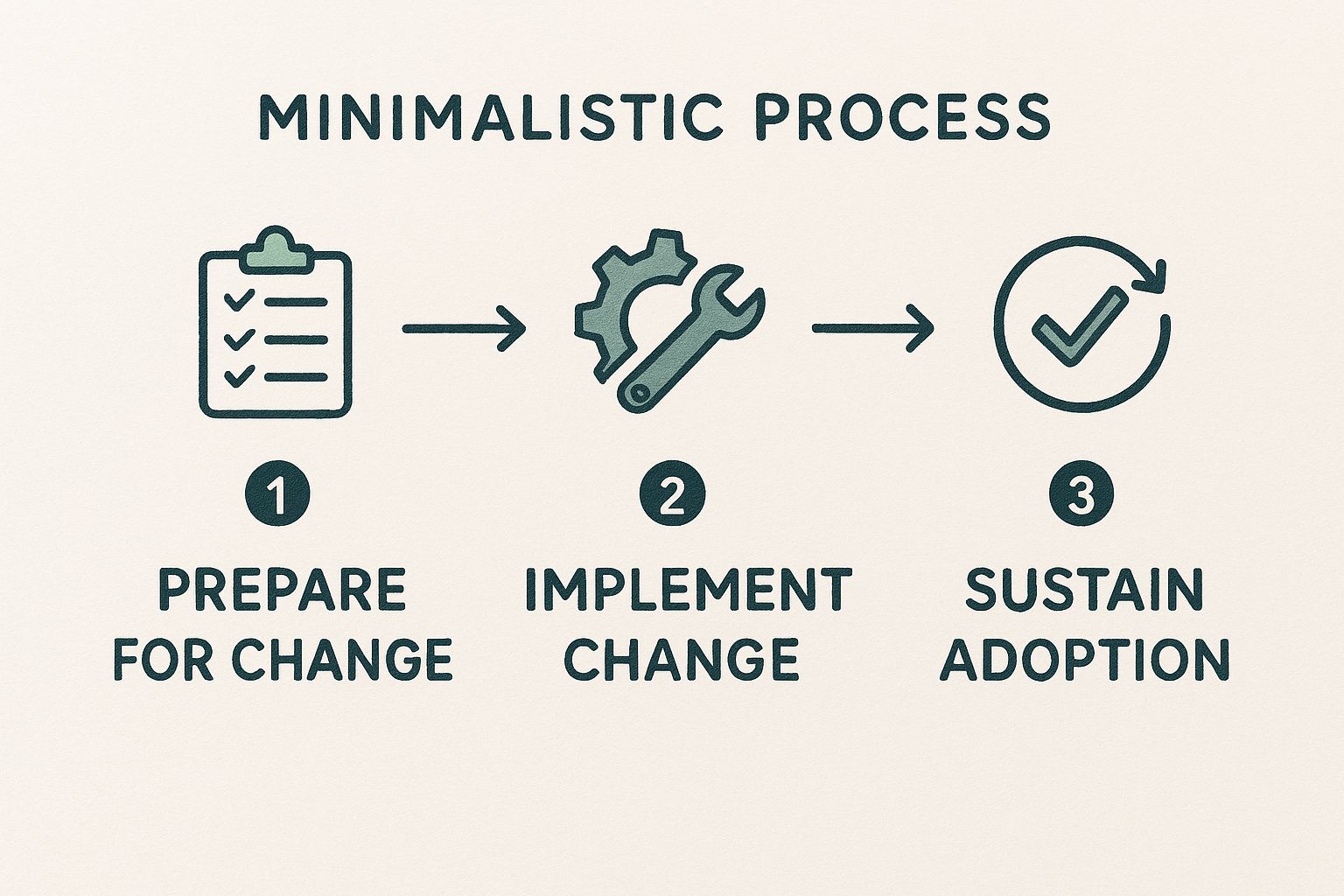
As this illustrates, a successful transition begins long before the go-live date and continues well after, reinforcing that preparation and ongoing support are just as critical as the implementation itself.
To provide a clearer picture, we can break down the process into four key phases, each with specific activities and a primary objective.
| Phase | Key Activities | Primary Objective |
|---|---|---|
| Phase 1: Readiness & Impact Analysis | Stakeholder interviews, user surveys, process mapping, risk assessment. | To understand the current environment, identify who will be affected, and pinpoint potential resistance. |
| Phase 2: Strategy & Engagement Design | Developing communication plans, building a ‘Change Champions’ network, designing engagement activities. | To create a clear roadmap for the change and get key people on board early. |
| Phase 3: Training & Go-Live Support | Creating role-based training materials, delivering practical workshops, providing ‘hypercare’ support. | To empower users with the skills and confidence they need to use the new system effectively. |
| Phase 4: Reinforcement & Optimisation | Measuring user adoption, gathering feedback, celebrating wins, providing follow-up coaching. | To embed new habits, ensure long-term success, and maximise the return on investment. |
Let’s unpack what happens in each of these stages.
Phase 1: Readiness and Impact Analysis
This initial phase is about discovery and diagnosis. Before drafting a single communication or building a training module, a consultant must understand the environment your team operates in. This means observing current workflows, identifying pain points, and understanding exactly how the new Salesforce system will alter daily routines.
Key activities include stakeholder interviews, user surveys, and process mapping. For instance, a consultant might sit down with top-performing sales reps to understand their existing processes and address any concerns about moving to Sales Cloud. These insights are invaluable for anticipating where resistance is likely to emerge.
The main goal is to answer critical questions: Who will be most impacted by this change? What are the primary risks to user adoption? What cultural hurdles might we encounter? The result is a detailed impact analysis that forms the foundation of the entire change strategy.
Phase 2: Strategy and Engagement Design
With a clear understanding of the landscape, the consultant designs the roadmap to guide employees through the transition. This phase is about creating genuine engagement, not just planning.
A cornerstone is crafting a strategic communication plan that does more than announce project updates. It builds a compelling narrative around the “why,” linking the Salesforce implementation to tangible benefits for both the company and individual employees.
Another powerful tactic is creating a ‘Change Champions’ network. By identifying influential employees from different departments, a consultant builds an internal advocacy group. These champions act as a vital bridge between the project team and end-users, helping to build trust, share positive messages, and provide valuable frontline feedback. For more details on this process, see our complete Salesforce implementation guide for Australian businesses.
Phase 3: Training and Go-Live Support
As the technical launch approaches, the focus shifts to empowerment. Generic, one-size-fits-all training is a recipe for failure. An effective consultant designs targeted, role-based training that focuses on real-world workflows, not just a long list of Salesforce features.
For example, a customer service team using Service Cloud doesn’t need in-depth training on lead management. Their sessions should be laser-focused on how the new system helps them manage cases, track resolutions, and improve customer satisfaction. This practical approach builds user confidence and demonstrates immediate value.
Support extends beyond the training room. During go-live and the subsequent weeks, consultants provide ‘hypercare’ support—on-the-spot assistance, quick-reference guides, and drop-in clinics to help users navigate any initial challenges and build momentum.
A successful go-live isn’t just about the system working; it’s about people feeling confident and capable from their first login. This hands-on support is critical for building early adoption.
Phase 4: Reinforcement and Optimisation
This final phase is arguably the most critical for long-term success. A common mistake is assuming the job is done once Salesforce is live. In reality, this is where the work of embedding new habits begins.
This stage is about gathering feedback, measuring adoption metrics, and identifying areas for improvement. Consultants will analyse Salesforce usage data to see which users are excelling and who may need additional support. This data-driven approach allows for targeted follow-up training and coaching where it’s needed most.
Celebrating early wins is also a key part of reinforcement. Highlighting teams that are achieving great results with the new platform and sharing their success stories creates positive momentum and inspires others. This ongoing cycle of support, measurement, and optimisation ensures your Salesforce investment delivers increasing value over time.
Navigating Modern Business Shifts in Australia
Australian businesses are currently navigating an unprecedented pace of change. We’re no longer talking about simple software updates; companies are juggling complex, overlapping transformations, from AI integration and new ESG regulations to the permanent reality of hybrid work. These are fundamental shifts in how organisations operate.
Attempting to manage these changes with a purely technical approach is insufficient. This is where skilled change management consultants become indispensable. They guide the human side of these massive business model shifts, especially when a powerful platform like Salesforce is at the core.

Market data validates this need. The demand for change management is being driven by rapid technology adoption and new sustainability pressures. The broader Australian management consulting market reached USD 5.25 billion in 2025 and is projected to hit USD 7.37 billion by 2030. Much of this growth stems from the human challenges created by digital transformation, which require specialist expertise.
The Human Side of Salesforce AI Integration
Artificial intelligence is no longer a futuristic concept; it’s a practical tool embedded within Salesforce Sales Cloud and Service Cloud. Features like Einstein AI offer incredible potential, from predictive lead scoring to automated customer service. However, simply activating these features is a recipe for failure.
Employees often react with a mix of excitement and fear, worrying about job displacement or feeling overwhelmed. A change management consultant addresses these concerns head-on. They build strategies to increase AI literacy, frame AI as a supportive co-pilot rather than a replacement, and design training that helps teams use these tools to enhance their roles. For insights on the latest advancements, check out our summary of the Salesforce Winter ’25 Release highlights.
Adapting to New ESG Mandates with Salesforce
Another significant shift is the introduction of mandatory sustainability disclosure in Australia. From 2025, many organisations must report on their environmental, social, and governance (ESG) performance. Salesforce provides an excellent platform for managing the required datasets.
However, this is far more than a technical challenge; it’s a profound cultural shift toward transparency and accountability. A change consultant helps navigate this transition by:
- Communicating the ‘Why’: Ensuring every employee understands the importance of ESG reporting.
- Redefining Roles: Working with teams to clarify who is responsible for gathering and verifying ESG data within the Salesforce ecosystem.
- Building Data-Driven Habits: Fostering a culture where data accuracy and transparency are priorities for everyone.
Without a deliberate change strategy, ESG reporting can feel like a burdensome compliance task. With expert guidance, it becomes an opportunity to build a more responsible and transparent business culture powered by your CRM.
Ultimately, these modern challenges confirm that technology and people must evolve together. A change management consultant acts as the essential bridge, ensuring that as your systems become smarter, your teams become more capable and confident.
How to Choose the Right Salesforce Change Management Partner
Selecting the right change management consultants for your Salesforce project is a critical decision. You are not just hiring a vendor; you are securing a strategic partner who understands both the technology and the human dynamics of your business.
A great partner becomes an extension of your team, deeply invested in ensuring your project delivers lasting user adoption and measurable ROI. Making the right choice means looking beyond polished presentations and focusing on criteria specific to a successful Salesforce implementation.
Evaluate Their Salesforce-Specific Experience
Not all change management consultants are created equal, especially when dealing with a platform as multifaceted as Salesforce. A generalist may understand change theory, but they won’t grasp the specific challenges your sales team will face when transitioning to Sales Cloud or the unique daily workflows of your agents in Service Cloud.
Look for a proven track record within the Salesforce ecosystem. A strong partner will have a portfolio of case studies demonstrating measurable results from projects similar to yours. They should be able to speak fluently about common Salesforce adoption hurdles and provide concrete examples of how they’ve helped other clients overcome them.
Ask potential consultants: “Can you describe a Salesforce implementation that faced significant user resistance and detail the specific steps you took to turn it around?” Their answer will reveal the depth of their practical, hands-on experience.
Assess Their Methodology and Flexibility
A structured methodology is essential, but it must not be rigid. Business realities are complex, and a one-size-fits-all approach is a major red flag. The right partner will have a clear framework but also the agility to tailor it to your company’s culture, industry, and the specific goals of your Salesforce project.
They must also be able to define success with clarity. Vague promises of “improved engagement” are not enough. Look for partners who establish clear key performance indicators (KPIs) from the start, such as:
- User Adoption Rates: Tracking active logins and the creation of new records (e.g., leads, cases, opportunities).
- Data Quality Metrics: Measuring the completeness and accuracy of information within Salesforce.
- User Proficiency Milestones: Assessing how quickly users can complete key tasks without assistance.
- Reduction in Support Tickets: Monitoring a decrease in “how-to” questions post-launch.
Key Questions to Ask Your Potential Salesforce Partner
To determine if a consultant is the right fit, you need to ask questions that cut to the heart of their capabilities. Here is a checklist to guide your conversations:
- How will you connect your change management strategy directly to our desired business outcomes for this Salesforce project?
- What specific tools and techniques do you use to assess our team’s readiness and identify potential sources of resistance?
- Can you provide an example of a communication plan you developed for a Salesforce go-live?
- How do you tailor training for different roles, such as our sales team in Sales Cloud versus our support agents in Service Cloud?
- What level of support do you provide during the critical “hypercare” period immediately following the launch?
Finding the right fit is about more than a list of credentials. It’s about finding a team that aligns with your values and can build genuine trust with your people. To see how we approach this, learn more about our dedicated Salesforce consulting team.
The Tangible ROI of Expert Change Management
Investing in change management consultants can sometimes feel like an abstract cost, but the return on that investment is concrete, measurable, and impactful. Effective change management translates directly into the KPIs that leadership teams care about, transforming a technology project into a true business asset. It’s less an expense and more a crucial investment that multiplies the value of your Salesforce platform.
A structured, human-centric approach delivers clear, bottom-line results. One of the first benefits you’ll see is faster user proficiency. Instead of a long, painful learning curve, your team gets up to speed quickly. This means your business starts realising value from its Salesforce investment sooner and minimises the productivity dip often associated with major system changes.

This directly leads to another significant win: higher data quality. When users understand the ‘why’ behind the new system and feel confident using it, they input clean, accurate, and complete information. This data integrity is the bedrock of reliable reporting, accurate forecasting, and effective automation within Salesforce.
Case Study: From Low Adoption to High Performance with Service Cloud
Let us share a common challenge we helped resolve. A national logistics company implemented Service Cloud, but user adoption was dismal. Support agents found the system complex and reverted to their old spreadsheet-based methods. Consequently, data quality plummeted, and the expensive new platform delivered almost no value.
This is when they engaged change management experts. The focus immediately shifted from system features to the people using them. Through tailored training, the creation of an internal ‘Change Champions’ network, and establishing clear communication channels, we successfully turned the project around.
Within six months, active user login rates increased by 85%, and the accuracy of case resolution data improved by over 90%. This is a powerful demonstration that focusing on the human side of technology is the fastest path to unlocking ROI. Explore more real-world examples in our collection of Salesforce case studies.
Navigating the Australian Consulting Landscape
In the current Australian economic climate, wise investments are more critical than ever. The management consulting industry, which includes change management, is a significant part of the economy. However, with the Australian Federal Government reducing its external consultancy spending, there is a sharper focus on delivering demonstrable value. This is where expert change management consultants prove their worth, ensuring projects are not just completed but deliver tangible results that justify the investment. You can find more insights on the Australian management consulting industry on IBISWorld.
This focus on outcomes ensures that every dollar spent on change management directly contributes to the long-term success of your Salesforce implementation, protecting your investment and driving sustainable growth.
Frequently Asked Questions About Salesforce Change Management
Embarking on a major Salesforce implementation naturally brings up questions, especially regarding the role of a change management consultant. Here are clear answers to the questions we hear most often from our clients.
When is the best time to engage a change management consultant?
The ideal time is at the very beginning of your Salesforce journey, even before the technical scope is finalised. Bringing a consultant in early allows them to conduct thorough readiness assessments, identify potential resistance before it takes hold, and integrate the change strategy with your core business objectives from day one. A common mistake is waiting until problems arise or just before training begins. An early partnership ensures the people-focused aspects of the project develop in parallel with the technical build, leading to a much smoother and more successful implementation.
What is the difference between change management and project management?
This is a critical distinction. While both are essential for a successful Salesforce rollout, they have different focuses:
- Project Management concentrates on the technical solution. A project manager is responsible for budgets, timelines, resources, and ensuring the Salesforce platform is built and delivered according to specifications.
- Change Management focuses exclusively on the people side of the solution. A change consultant prepares, equips, and supports your employees to ensure they can successfully adopt and use the new system to its full potential.
In short: a project manager ensures the Salesforce system is delivered on time and on budget. A change management consultant ensures that once delivered, it is embraced and used effectively by your team. The two roles are complementary partners.
How do you measure the ROI of change management?
The ROI of change management is measured through specific, data-driven metrics tied directly to your Salesforce project goals. Key performance indicators (KPIs) often include:
- Increased User Adoption Rates: Tracking login frequency and the volume of key records (e.g., opportunities, cases) being created.
- Improved Data Quality: Measuring the completeness and accuracy of CRM data.
- Faster Time to Proficiency: Assessing how quickly new users can perform core tasks without support.
- Reduced Support Costs: Seeing a decline in help desk tickets related to “how-to” questions.
By tying these people-centric metrics to business outcomes like increased sales productivity or improved customer satisfaction, the ROI becomes clear and quantifiable.
Ready to ensure your Salesforce investment delivers the transformative results you expect? The team at Adaptal is a Salesforce partner specialising in guiding Australian businesses through successful, people-focused technology transformations. Contact us today for a consultation.