
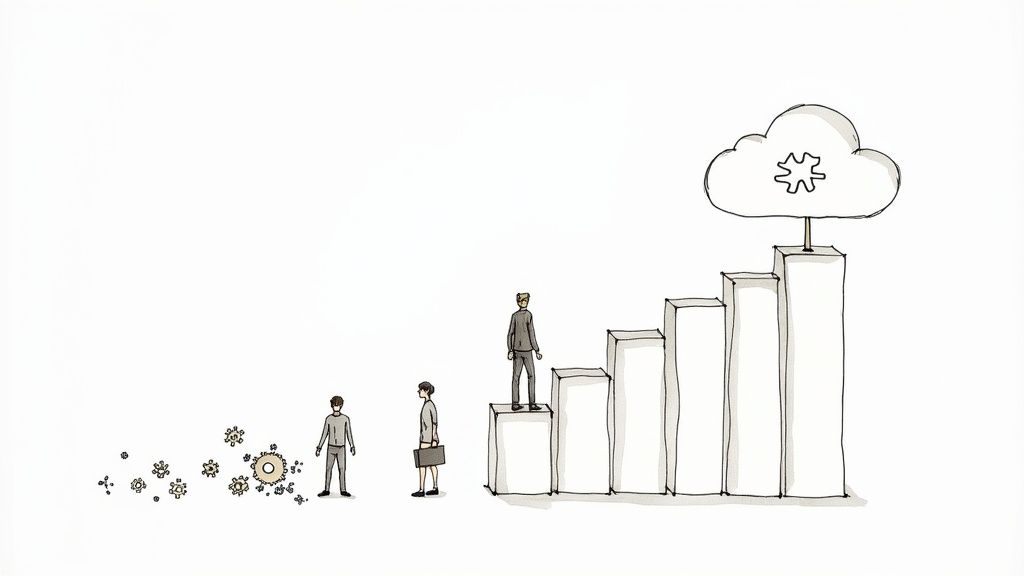
A change management consultant is your strategic partner for navigating the people side of a major technology shift, like implementing a new Salesforce system. Their entire focus is on guiding your team through the transition. They build strategies to get everyone on board, reduce friction, and ensure your business sees a real return on its Salesforce investment.
What a Change-Management-Consultant-Does-for-a-Salesforce-Project

Let’s cut through the jargon. For any major business overhaul, especially a Salesforce implementation, a change management consultant is your secret weapon. Think of them as the 'people architect' of the project.
While your technical team is busy configuring Sales Cloud or Service Cloud, the change consultant is building enthusiasm and readiness within your organisation. They are the essential bridge between implementing powerful technology and getting your team to actually use it—which is the only way your CRM investment will ever pay off.
Bridging the Gap Between Salesforce Technology and People
Here’s the hard truth: even the most sophisticated CRM is useless if your team doesn't use it properly—or at all. A consultant’s core job is to ensure new Salesforce processes aren't just installed, but are genuinely embraced by the people who rely on them every day.
This means turning resistance into engagement. They work to align the new ways of working with your company's bigger goals, making sure your team doesn't just tolerate Salesforce, but thrives with it. This human element is the one thing technology alone can never solve.
A common mistake is thinking change management is just about training sessions. In reality, training is just one small piece of a much larger puzzle. True change management is about strategically shaping mindsets and behaviours to achieve specific business goals with Salesforce.
The need for these skills is climbing. The management consulting market in Australia, for instance, is valued at around USD 5.25 billion as of 2025 and is expected to hit USD 7.37 billion by 2030.
Core Responsibilities in a Salesforce Context
So, what does this look like day-to-day on a Salesforce project? A change consultant handles several crucial functions that directly influence whether your implementation is a success or a failure. They're not just brought in at the end; they're involved right from the beginning.
Their work is a mix of psychology, communications, project management, and strategic thinking. They spot roadblocks before they happen, build positive momentum, and create an environment where change can actually take root. As an experienced provider of Salesforce consulting services, we’ve seen firsthand how this expertise is the difference between a successful CRM implementation and a costly failure.
To give you a clearer picture, we've broken down their core responsibilities and how each one helps ensure your Salesforce project delivers real value.
Core Responsibilities of a Salesforce Change Management Consultant
| Responsibility Area | Key Activities | Impact on Salesforce Success |
|---|---|---|
| Stakeholder Analysis | Identifying key influencers, potential resistors, and project champions across the organisation. | Ensures communication is targeted and addresses the unique concerns of different groups, from the C-suite to frontline staff. |
| Impact Assessment | Analysing how new Salesforce processes will affect daily roles, responsibilities, and workflows. | Helps proactively manage disruption and prepare employees for what’s coming, reducing anxiety and resistance. |
| Communication Planning | Developing and rolling out a clear, consistent communication plan that explains the 'why' behind the change. | Builds trust and keeps everyone informed and aligned with the project's vision, turning confusion into clarity. |
| Training & Enablement | Designing custom, role-based Salesforce training that goes beyond clicks to focus on new, more effective ways of working. | Gives employees the skills and confidence they need to use Salesforce effectively and see its value in their own roles. |
| Adoption Measurement | Creating dashboards and metrics in Salesforce to track user adoption, data quality, and overall engagement with the new system. | Provides solid data to pinpoint where extra support is needed and to prove the ROI of the initiative to leadership. |
Ultimately, their job is to make sure the technology sticks. By managing the human dynamics of the project, they safeguard your Salesforce investment and help you achieve the outcomes you were promised.
Why Salesforce Projects Fail Without Change Management
Investing in a platform like Salesforce Sales Cloud or Service Cloud is a massive strategic move, but it's no magic bullet for growth. Too many organisations learn this the hard way. Months after a costly rollout, they stare at plummeting user adoption rates, wondering where the promised return on investment went. It’s a frustratingly common story we've helped businesses overcome.
The Business Challenge: A sales team has run on familiar spreadsheets for years. The company invests heavily into Salesforce Sales Cloud, expecting a leap in efficiency and data visibility. But without a plan to manage the human side of this shift, launch day is met with confusion and resistance.
Salespeople, comfortable in their old routines, see the new CRM as an administrative burden that slows them down. What happens next? They stick to their trusty spreadsheets, and the expensive new platform gathers digital dust. Its potential is completely squandered.
The Real Cost of Low User Adoption
This isn't a hypothetical. The project is technically signed off as "complete," but the business outcomes are a total failure. Reports are a mess because no one is entering data, sales forecasts are pure guesswork, and collaboration between teams is as disjointed as ever.
The financial investment is gone, but the damage runs deeper. Morale takes a nosedive, trust in leadership erodes, and the entire digital transformation initiative is suddenly on shaky ground. This is what happens when you focus only on the technology and ignore the very people you need to use it.
An alarming 70% of change initiatives fail to meet their objectives. Most of the time, this isn't a tech problem. It's a people problem—a direct result of employee resistance and a lack of effective change management.
The Salesforce Solution: A Change Management Consultant
Now, let's replay that scenario with a change management consultant involved from the start. They are the insurance policy for your Salesforce investment.
Before a single line of code is written, the consultant gets to work understanding the team’s culture and workflows. They identify the "spreadsheet champions" not as roadblocks, but as key influencers who need to be brought into the fold. They sit down and listen to the team's concerns about the new system.
Armed with these insights, the consultant works with leadership to craft a compelling story—the "why" behind it all. They clearly show how Salesforce will make each salesperson's life easier, help them close more deals, and ultimately earn more commission. The narrative shifts from "you must do this" to "this tool will help you win."
Turning Sceptics into Champions: The Results
Instead of a single, overwhelming launch day, the change management consultant rolls out a structured plan that includes practical steps:
- Building a Champion Network: They identify influential team members, train them first, and empower them to become internal advocates for Salesforce.
- Targeted Communication: They create clear, consistent messages that tackle specific concerns and highlight personal wins for each team member.
- Role-Specific Training: Training is tailored to real-world sales scenarios, demonstrating how Sales Cloud makes their daily tasks easier.
- Feedback Loops: The consultant opens channels for everyone to ask questions and give feedback, making them feel heard and valued.
This proactive approach completely flips the dynamic. The team feels supported and prepared. They start to see the genuine value of the new cloud solution, which sparks genuine adoption. By putting people first, the consultant ensures the technology actually delivers on its promise, turning a high-risk project into a massive success. The many successful projects in our Salesforce case studies show how this approach consistently drives real business results.
How the Change Management Process Works for Salesforce
Change management isn't an abstract concept; it's a structured process designed to guide people through significant transitions. A good change management consultant follows a battle-tested roadmap that turns a company's ability to adapt from a weakness into a strength, especially during a complex Salesforce implementation.
This structured approach is critical in a major digital transformation. Think of it like building a house: you wouldn't start without a solid foundation and a blueprint. Change management provides that essential blueprint for the human side of your Salesforce project.
The Assessment Phase: Uncovering the Real Challenges
The first step any expert change management consultant takes is to listen and learn. This Assessment phase is about understanding the landscape before taking action. If you're rolling out Service Cloud, for instance, this goes far beyond a simple technical audit.
Consultants conduct candid interviews with key stakeholders—from executives who need high-level dashboards to the frontline support agents who will live in the new system daily. They work to identify risks, uncover anxieties, and pinpoint natural leaders and sceptics within each team. This early discovery work is crucial for preventing problems down the line.
The value of these structured methodologies is widely recognised. The organisation and change management consulting market in Australia was valued at an estimated USD 1.63 billion in 2025 and is projected to hit USD 2.18 billion by 2029, reflecting a serious corporate focus on getting change right.
The visual below shows what often happens when a project is launched without a structured change plan. It’s a common sequence of pitfalls that leads straight to user resistance and project failure.
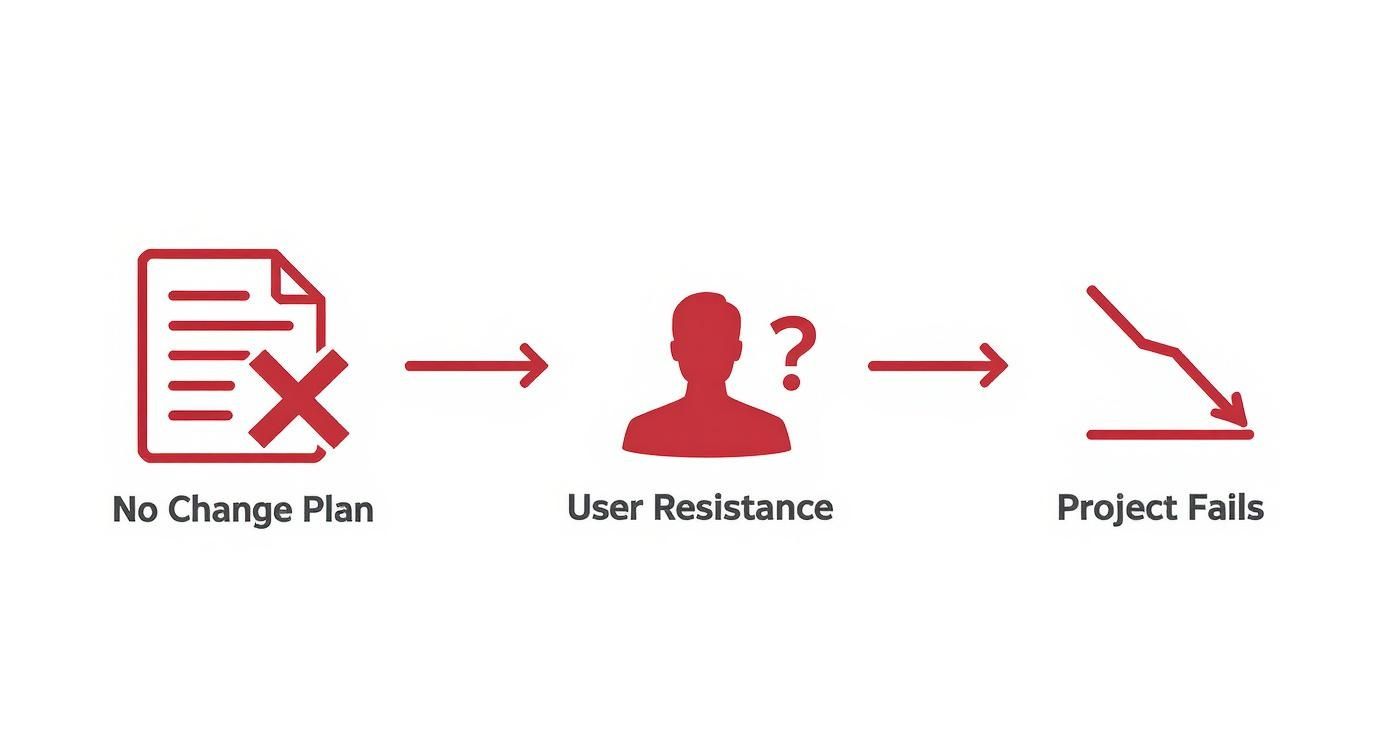
This simple flow drives home how easily a lack of planning can derail a project. It highlights why a methodical approach isn't just a "nice-to-have" – it's absolutely necessary for Salesforce success.
The Planning Phase: A Roadmap for Your People
Once the consultant has a clear picture, the Planning phase kicks off. This is where strategy comes to life. A comprehensive communication plan is developed to answer the all-important "what's in it for me?" question for every employee.
A key activity is building a network of internal "change champions." These are respected individuals from various departments who are brought into the project early. They get extra training, empowering them to become advocates for the new Salesforce system among their peers.
This phase also involves creating a detailed training strategy. We're not talking about generic, one-size-fits-all sessions. This is about role-specific training that shows users exactly how the new CRM will make their jobs easier and more effective. For more on this critical stage, check out our comprehensive Salesforce implementation guide for Australian businesses.
Unpacking the ADKAR Model in a Salesforce Context
Many consultants use proven frameworks to structure their work. One of the most popular is Prosci's ADKAR model, an acronym that outlines the five milestones an individual must achieve for change to stick.
- Awareness: Understanding the business reasons for the change. "Why are we moving to Salesforce Marketing Cloud?"
- Desire: The personal motivation to support the change. "How will this help me hit my targets?"
- Knowledge: Knowing how to use the new tools and workflows. "Where do I click to build a new customer journey?"
- Ability: Demonstrating the skill to implement the change in their daily work. "I can now build and launch a campaign without help."
- Reinforcement: Systems and support that make the change permanent. "Our team bonuses are now tied to the data we capture in Salesforce."
By applying a framework like ADKAR, a change management consultant can methodically address each human barrier to adoption. It moves the process from "I hope they use it" to "We have a concrete plan to ensure they do."
The Implementation and Reinforcement Phases
Finally, the process moves into Implementation and Reinforcement. During the go-live, the consultant is on the ground, providing support, answering questions, and gathering real-time feedback.
The Reinforcement phase is about making new habits stick. This involves celebrating early wins, sharing success stories, and using adoption metrics from Salesforce to identify teams or individuals who might need extra coaching. By ensuring ongoing support is available long after launch day, a consultant turns a technology rollout into a lasting business-wide win.
Selecting the Right Change Management Partner for Salesforce
Choosing a change management consultant is one of the most important decisions you’ll make for your Salesforce project. You're not just filling a temporary role; you're finding a true partner to navigate your team through a massive shift. Get this right, and you’re on the path to success. Get it wrong, and you’re looking at an expensive failure.
A slick proposal is nice, but the real value is much deeper. The right partner will embed themselves in your team, understand your unique company culture, and be completely focused on delivering measurable results.
Here’s a game plan for finding a consultant who can help you achieve genuine, lasting change.
Look for Proven Salesforce Experience
First, your consultant must speak fluent Salesforce. This isn't the time for generic change theory. They need real, hands-on experience with the specific challenges of a Salesforce implementation, whether it's Sales Cloud, Service Cloud, Experience Cloud, or another product.
Ask them for specific case studies. Can they tell you a story about how they helped a sales team ditch spreadsheets for Sales Cloud? Or how they got a customer service department genuinely excited about a new Service Cloud rollout? Concrete, relevant examples are the clearest sign they know what they’re doing.
A consultant with deep Salesforce experience won't just manage resistance; they'll anticipate it. They know the common sticking points and can build a proactive strategy to solve them before they become problems.
It’s also worth noting how the wider market is shifting. Recent management consulting trends in Australia show a huge demand for digital transformation expertise. This highlights why you need a consultant who isn’t just available, but is a genuine specialist in your field.
Evaluate Their Methodology and Approach
How a consultant plans to work with your team is just as critical as what they know. A one-size-fits-all plan is a massive red flag. Your business is unique, and your change strategy should be too. A great consultant starts by listening—they want to understand your goals, your culture, and your people first.
Their approach should engage stakeholders at every level, from the C-suite to the people on the front lines. They should have a clear process for finding and empowering internal champions who will become the project's biggest advocates.
And be wary of anyone who only talks about training after go-live. Training is important, but it’s just one piece of the puzzle. A proper strategy addresses the "why" long before the "how," building awareness and desire well before anyone sits down for a training session.
Define and Measure Success Together
Finally, any consultant worth hiring is obsessed with results. From day one, they should be working with you to define what success looks like and setting up clear, measurable key performance indicators (KPIs) to track it within Salesforce.
These metrics need to go way beyond simple login numbers.
Effective success metrics for a Salesforce project should include:
- User Adoption Rates: Not just who’s logging in, but who is actively using key features to do their job better.
- Data Quality Scores: Are people entering accurate and complete information into your new CRM?
- Process Efficiency Gains: Can you quantify how much time you’re saving on manual tasks?
- Employee Feedback: Using surveys and one-on-one chats to see how the team is really feeling about the new system.
When you lock these benchmarks in early, everyone is on the same page. It ensures your consultant is completely aligned with your business goals and holds them accountable for delivering real, tangible value.
To help you through this process, we've put together a checklist to evaluate potential partners on the things that truly matter.
Evaluation Checklist for a Change Management Consultant
Use this practical checklist to assess and select the best change management consulting partner for your Salesforce project.
| Evaluation Criteria | What to Look For | Red Flags to Avoid |
|---|---|---|
| Salesforce Expertise | Shares specific, relevant project examples and success stories with Salesforce platforms (Sales Cloud, Service Cloud, etc.). | Speaks in generic change management theory without Salesforce-specific context. |
| Customised Approach | Starts by asking questions about your unique culture, goals, and people. Proposes a tailored plan. | Presents a "one-size-fits-all" methodology or a templated project plan. |
| Stakeholder Engagement | Has a clear strategy for engaging everyone from leadership to front-line staff and for identifying internal champions. | Focuses only on C-suite buy-in and overlooks the needs of end-users. |
| Focus on 'Why' | Emphasises building awareness and desire for the change before focusing on technical training. | Their plan is almost entirely focused on post-launch training activities. |
| Results-Oriented | Wants to define measurable KPIs with you from the start (e.g., adoption rates, data quality). | Is vague about what success looks like or can't define how it will be measured. |
| Cultural Fit | Their communication style and working process feel like a natural extension of your own team. | Their approach feels rigid, overly corporate, or misaligned with your company's values. |
| Long-Term Partnership | Discusses ongoing support and continuous improvement beyond the initial launch. | Sees the project as "done" the day you go live, with no follow-up plan. |
Choosing your partner carefully is the first, and most important, step towards ensuring your investment in Salesforce pays off. A consultant isn't just a resource; they are your guide, your strategist, and your co-pilot on this journey.
Measuring the ROI of Your Salesforce Change Initiative
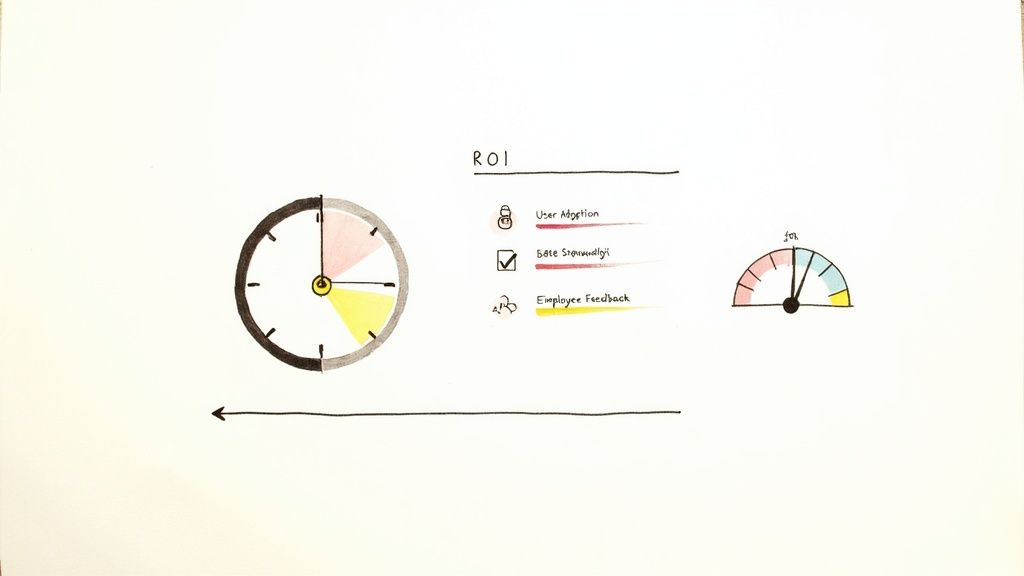
How do you prove that bringing in a change management consultant was worth it? It all boils down to clear, measurable results that go way beyond just "it feels better." This is the critical step that shifts the conversation from change management being a project 'cost' to a strategic investment with a provable return.
To make that happen, you have to establish a baseline. Before any work begins, a consultant will capture a snapshot of your current state. Think of it as the "before" photo in a renovation—it provides the hard data needed to show clear, undeniable improvement after the project is complete.
Defining Your Quantitative Metrics in Salesforce
The most powerful way to show ROI is through numbers. A good change management consultant will work with you to pinpoint key performance indicators (KPIs) that are directly tied to your business goals and can be tracked within your Salesforce ecosystem.
These quantitative measures give you objective proof that the new system and workflows are delivering. They take the guesswork out of the equation and show the direct business impact of better user adoption.
Some common quantitative metrics we track include:
- User Adoption Rates: Tracking the active use of key features in Sales Cloud or Service Cloud, like the percentage of salespeople actively creating and updating opportunities.
- Data Quality Scores: Measuring the completeness and accuracy of crucial data points like contact records and lead sources. High-quality data is the bedrock of reliable reporting.
- Reduced Case Resolution Times: For teams on Service Cloud, tracking the average time it takes to close a customer support ticket. Faster resolution times are directly linked to customer satisfaction.
- Increased Sales Pipeline Velocity: Measuring how quickly opportunities move through the sales stages in Salesforce, giving a clear indication of a more efficient sales process.
Understanding the Qualitative Measures
While numbers tell a huge part of the story, you can't ignore the human side. Qualitative measures are about capturing the shifts in attitude, sentiment, and behaviour across your team. These insights are usually gathered through structured feedback channels organised by the change management consultant.
These metrics provide crucial context behind the hard data. For instance, a spike in user adoption is fantastic, but knowing why it happened—because the team feels more confident and supported—is even more powerful. To fully grasp the financial benefits, it is beneficial to analyse a CRM automation ROI comparison, particularly against manual data entry.
The real win is when you see both sides of the coin—hard data improving on dashboards and positive conversations happening in the hallways. That’s when you know the change is truly embedding itself in your company culture.
Key qualitative measures to watch:
- Employee Feedback Surveys: Using anonymous surveys to gauge sentiment, identify ongoing pain points, and measure the effectiveness of training and support.
- Managerial Feedback: Regular check-ins with team leads give a direct line of sight into how their teams are adapting to new ways of working.
- Sentiment Analysis: Reviewing comments from training sessions or team meetings helps identify common themes and address concerns proactively.
By combining quantitative and qualitative data, a change management consultant can paint a complete picture of the project's success. This comprehensive approach proves the value of their work and reinforces the positive impact of your Salesforce investment, as demonstrated in our work to improve processes for organisations like Carer Solutions.
Ready to Start Your Salesforce Transformation?
A successful Salesforce project is never just about the technology. It's a business transformation powered by your people. This guide has shown why a strategic change management consultant is the secret ingredient to unlocking your CRM's full potential, turning a complex rollout into a clear success story.
As an experienced Salesforce partner, we pair deep technical expertise with proven change management strategies. We don't just build a platform; we build the confidence and competence your team needs to truly embrace and excel with new cloud solutions. Our focus is on making sure your project delivers lasting, measurable results.
Your Partner in People-Led Success
Whether you're planning a new implementation or trying to improve low user adoption, the right support can make all the difference. To empower your team, it's vital to build comprehensive support systems, like AI-powered knowledge bases.
We can help you build a strategy that puts your people at the centre of your digital transformation, helping you sidestep common pitfalls and fast-track your path to a solid ROI.
A great Salesforce platform paired with a disengaged team is a recipe for failure. A great platform embraced by an empowered team is the engine for unstoppable growth.
Ready to start your Salesforce journey with a team that gets it? Contact us for a consultation to talk through your unique business challenges and goals. Let's build a strategy that delivers real, lasting results.
Frequently Asked Questions About Salesforce Change Management
Stepping into a Salesforce transformation can feel like exploring new territory, and it's natural to have questions. Here are some of the most common ones we hear from business leaders about bringing a change management consultant on board.
What is the difference between a Change Management Consultant and a Project Manager?
It’s easy to mix these two up, but they play very different, equally vital roles in a Salesforce project.
Your Project Manager is the architect of the technical side. They’re focused on the what and the when – the budget, timeline, and scope. Their job is to make sure your Salesforce system is built correctly, on time, and within budget.
A change management consultant, on the other hand, is the champion for your people. They focus on ensuring your team is ready, willing, and able to embrace the new system. They tackle resistance, build enthusiasm, and drive user adoption so you actually see a return on your investment. While they work side-by-side, the consultant handles the human element that technology alone can't solve.
How early should we involve a consultant in our Salesforce project?
The sooner, the better.
Ideally, you’ll bring a change management expert in during the discovery and planning phase, long before any technical work begins. This gives them crucial time to conduct an impact assessment, pinpoint potential resistance, and understand your company culture.
When a consultant is there from the start, they can help build a people-first strategy right into the project's DNA. This means creating a proactive communication plan and building excitement from day one, rather than being called in later to firefight adoption problems that were entirely preventable.
Waiting until after your Salesforce go-live to think about change is a classic, costly mistake. Getting ahead of the curve is the secret to a smooth transition and seeing a real return from the get-go.
Is change management necessary for a small business implementing Salesforce?
Absolutely. The scale might be smaller, but the human side of change is just as real.
In a small business, every person’s contribution is massive. That makes getting everyone on board with a new CRM even more critical. One team member resisting the change can have a huge ripple effect on the project's success.
A good change management consultant knows how to scale their approach for a smaller, tight-knit team, keeping the process lean and focused. They help make sure your investment pays off by getting your team to fully use new Salesforce tools to fuel your growth. The core principles are the same, no matter your size – the goal is always getting your people on board to drive business results.
At Adaptal, we don’t just build great Salesforce solutions; we make sure your people love using them. By blending deep technical expertise with proven change management strategies, we cover all the bases for a successful project.
If you’re ready to see your team truly embrace your new CRM, let’s have a chat.