

When you hear "change management," what comes to mind? For many Australian businesses, it’s the crucial process of steering teams through significant technological shifts, like a new Salesforce implementation. It’s about more than just managing disruption; it’s about making sure your investment in a world-class CRM platform actually delivers tangible results.
Think of it as the bridge between implementing a powerful platform like Sales Cloud or Service Cloud and achieving real business growth. This is especially vital when you consider that a staggering 70% of change initiatives fail, often due to poor user adoption—a challenge we've helped countless Australian organisations overcome.
Why Strategic Change Is Non-Negotiable For Salesforce Success in Australia

Rolling out Salesforce isn’t just an IT update; it’s a fundamental change to how your business operates. From sales and customer service to marketing automation, the platform reshapes daily workflows and demands new skills. Here in Australia, where organisations in Sydney, Melbourne, and Brisbane are constantly adapting to market pressures, treating a Salesforce project as a simple tech task is a recipe for a low ROI.
Technology alone doesn’t solve business problems. The real value is unlocked only when your people are engaged, adopt new processes, and leverage Salesforce's features to drive growth. As a Salesforce partner, we've seen firsthand that effective change management turns a CRM project from a costly expense into a strategic asset.
The Driving Forces Behind Salesforce Adoption in Australia
Several powerful trends are reshaping the local business environment, making a structured approach to CRM change more important than ever. Ignoring these drivers can lead to low user adoption, wasted budget, and a Salesforce project that never reaches its full potential.
These key drivers include:
- Widespread Digital Transformation: Australian businesses are moving away from siloed legacy systems towards integrated cloud platforms like Salesforce to create a single source of truth for customer data.
- The Rise of AI and Automation: AI-powered tools like Einstein are now deeply embedded in Salesforce, requiring new skills and process adjustments to leverage predictive insights and automate tasks.
- Shift to Agile Business Models: To remain competitive, organisations need agility. Your CRM must support rapid pivots, which means your teams need to be ready and able to adapt their ways of working.
The current economic climate only makes this more urgent. With a high demand for skilled professionals, especially in IT, Australian organisations are focusing on projects that deliver clear growth and efficiency—a core promise of a well-adopted Salesforce platform.
Bridging the Gap Between Salesforce Investment and Business Outcome
Ultimately, the success of your Salesforce implementation rests on your people. Are they equipped, enabled, and motivated to use the new platform? Without a dedicated change management plan, even the most expertly configured Salesforce org will struggle to gain traction.
A thoughtful change management plan ensures your teams don't just understand how to use Salesforce, but—more importantly—why it benefits them and the wider business. Communicating this "why" is the cornerstone of successful CRM adoption.
To truly master CRM adoption, it's worth exploring purpose-built tools. A comprehensive guide to digital adoption software can show you how these platforms provide on-screen guidance to help users navigate new systems like Salesforce with confidence.
For real-world examples of how Australian businesses have successfully managed their Salesforce rollouts, explore our Salesforce implementation case studies.
Aligning Salesforce with the Unique Australian Business Culture
Implementing a platform like Salesforce in an Australian organisation is about much more than technology. To succeed, you must navigate the local business culture. Getting this wrong is one of the fastest ways to encounter resistance and see your project stall before it even gets started.
The typical Aussie workplace is egalitarian, direct, and consultative. A top-down, "thou shalt now use Salesforce" approach is almost guaranteed to fail. Announcing that everyone must adopt a rigid new process in Sales Cloud without consultation will be met with pushback and, ultimately, a system that gathers digital dust. The key is to stop dictating change and start co-creating it with your team.
Fostering Collaboration Over Mandates in Your Salesforce Project
In most Australian businesses, employees at all levels expect their professional opinions to be valued. They want to understand the reasoning behind a decision, not just be told what to do. This cultural trait is a massive advantage for any Salesforce project if you leverage it correctly.
Don't treat your team as passive recipients of a new system. Involve them as active participants in the design and rollout. They are the ones on the front lines, talking to customers and managing daily tasks. Their insights are invaluable for configuring Salesforce in a way that genuinely makes their jobs easier, not harder.
When you involve your team in the design process, you transform them from potential resistors into your biggest Salesforce champions. This creates a sense of ownership and deepens their investment in the project's success.
This isn't just about fostering goodwill; it's a smart project management strategy. Engaging users early helps identify potential process bottlenecks and usability issues, leading to a more robust and practical Salesforce solution. For a deeper dive, our Salesforce implementation guide for Australia provides a detailed roadmap for this collaborative approach.
Articulating the 'Why' Before the 'How' of Salesforce
Before you demonstrate a single Salesforce feature, your team must understand why the business is making this significant investment. Australian teams are pragmatic; they will disengage if they perceive the project as just another corporate initiative without clear benefits.
You must communicate the business case clearly and connect it to their daily work. Show them how the new CRM will solve the specific pain points they face every day.
- For your Sales Reps: Frame Sales Cloud as a tool to eliminate manual data entry, provide a clear pipeline view, and ultimately help them close deals faster and earn more commission.
- For your Service Agents: Position Service Cloud as a solution that gives them a 360-degree view of the customer, empowering them to resolve issues on the first contact and improve satisfaction scores.
- For your Marketers: Showcase Marketing Cloud Account Engagement as a platform that automates lead nurturing and provides deep campaign insights, freeing them to focus on high-impact strategy.
When the benefits are tangible and directly relevant to their roles, your team is far more likely to embrace the change with a positive, engaged mindset.
A Real-World Australian Salesforce Adoption Story
The Challenge: An Australian retail company planned to roll out Sales Cloud to its nationwide store network. The initial plan, developed at head office, was met with strong resistance from experienced store managers who felt the proposed workflows were disconnected from the reality of the shop floor.
The Salesforce Solution: Recognising the risk, the leadership team paused the rollout. They organised collaborative workshops, inviting store managers to map out their actual daily sales processes. They asked them to identify exactly where the proposed Salesforce workflows would help and where they would create friction.
The Result: Based on this direct feedback, crucial adjustments were made to the Sales Cloud configuration. The revised solution was then championed by the very managers who had initially resisted it. They could articulate the benefits to their teams in authentic, relatable terms. The result was a highly successful launch with excellent user adoption, turning a potential failure into a major business win through cultural awareness and genuine collaboration.
A Practical Framework for Salesforce Change Management
Successfully guiding an Australian organisation through a Salesforce implementation requires a structured, repeatable plan. Without a clear framework, key steps are often missed, leading to confusion, low user adoption, and a failure to achieve the desired business outcomes.
As a Salesforce partner, we use a proven, four-phase framework honed across numerous projects. This approach breaks the journey into manageable stages, ensuring the "people side" of the change is addressed from project kickoff to long-term success.
Here's how we structure our change management plans to ensure a smooth transition to Salesforce.
| Phase | Objective | Key Activities for Salesforce Projects |
|---|---|---|
| 1. Vision and Strategy | Establish a clear business case and roadmap for the Salesforce implementation. | Define measurable goals (e.g., increase sales productivity by 15%), identify key stakeholders across departments, and map out how daily workflows in Sales, Service, and Marketing will change. |
| 2. Engagement and Communication | Build buy-in and prepare the organisation for the upcoming changes. | Launch a two-way communication plan, identify and empower internal 'Salesforce Champions', and actively gather user feedback to refine the approach and configuration. |
| 3. Training and Enablement | Equip users with the skills and confidence to use Salesforce effectively. | Deliver role-based training (e.g., Sales Cloud for sales, Service Cloud for support), create hands-on learning scenarios, and build a library of support resources like videos and quick-reference guides. |
| 4. Reinforcement and Optimisation | Embed the new ways of working and continuously improve the Salesforce platform. | Gather user feedback post-launch, celebrate early wins and success stories, monitor adoption dashboards in Salesforce, and make iterative improvements to the configuration. |
This table provides a high-level view. Let's break down what happens in each phase.
Phase 1: Vision and Strategy
This initial phase is about laying a solid foundation. Before anyone logs into Salesforce, you must be crystal clear on what success looks like and how you'll measure it. This involves building a robust business case that directly links the Salesforce investment to tangible company goals.
Key activities include:
- Defining Clear Objectives: What specific business problems will Salesforce solve? Are you aiming to increase sales team productivity by 15% with Sales Cloud or reduce customer service response times by 30% with Service Cloud? Be specific.
- Identifying Stakeholders: Map out everyone who will be impacted by the change, from the executive team to frontline users in sales, service, and marketing.
- Assessing Impact: Understand exactly how roles, processes, and daily routines will change. A crucial part of this is managing changing requirements effectively as the project evolves.
Phase 2: Engagement and Communication
With your strategy set, the focus shifts to bringing your people on the journey. In the Australian workplace, communication is a dialogue, not a monologue. This phase is about generating genuine buy-in by listening, involving your team, and consistently explaining the "why" behind the Salesforce implementation.
A collaborative and consultative approach is essential for aligning with Australian business culture. This simple flow illustrates a model that consistently delivers results.
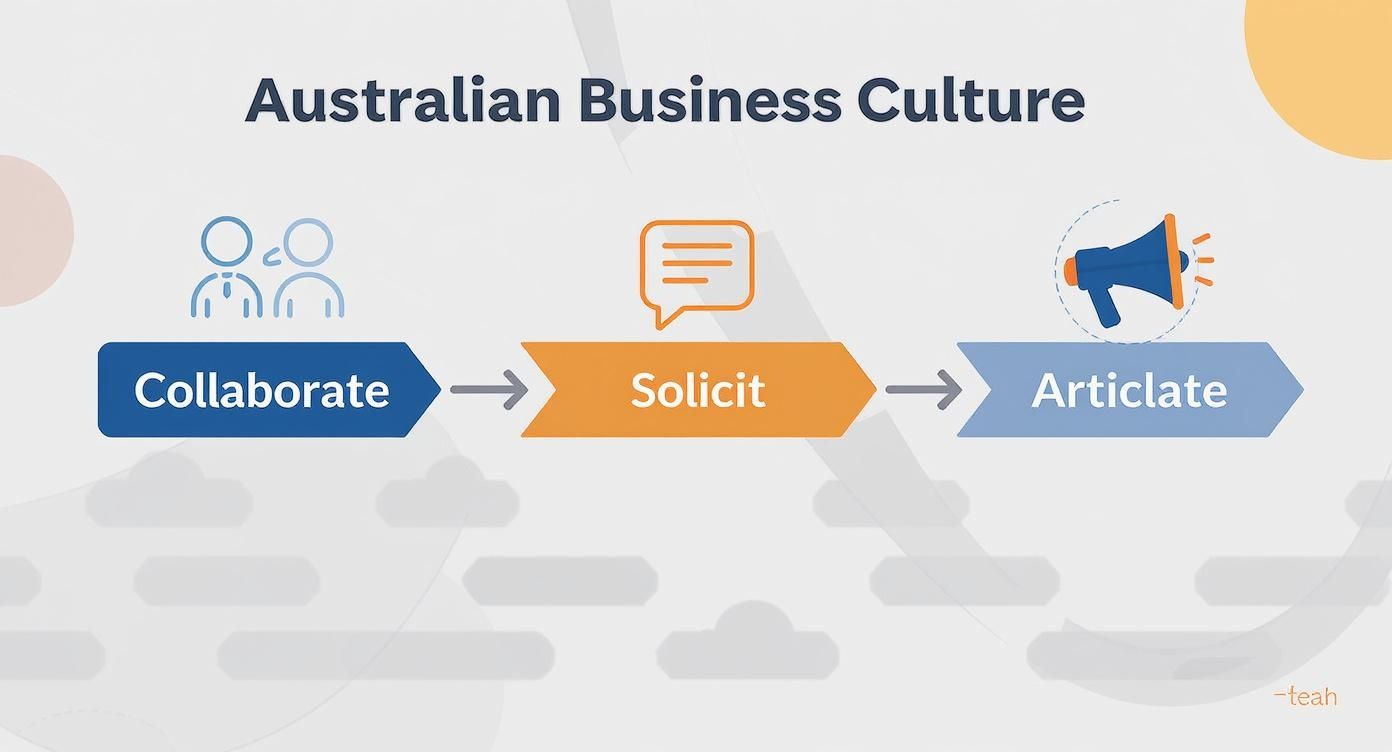
As shown, successful change starts with collaboration, moves to genuinely seeking feedback, and only then shifts to communicating the final decision.
One of the most powerful strategies in this phase is to identify and empower 'Salesforce Champions'. These are enthusiastic and respected individuals within your teams who can advocate for the new system, answer peer questions, and provide crucial on-the-ground feedback to the project team.
A communication plan is not just a series of emails. It's about creating a consistent drumbeat of information across multiple channels—town halls, team meetings, newsletters—to keep everyone informed, engaged, and prepared.
Phase 3: Training and Enablement
This is where strategy becomes reality. Effective training is far more than distributing generic user guides. For a powerful and flexible platform like Salesforce, enablement must be tailored to the specific roles and daily realities of your team.
The goal is to build both competence and confidence.
- Role-Based Workshops: Don't overwhelm users with irrelevant features. A sales rep needs to master lead and opportunity management in Sales Cloud, while a marketer needs to become an expert in Account Engagement. Focus training on what each team will actually use.
- Hands-On, Problem-Solving Scenarios: Base training around real-world business challenges. Have users practice converting a lead, closing a customer case in Service Cloud, or building a marketing automation journey.
- Provide Ongoing Resources: A single training session is never sufficient. Develop a library of resources like quick-reference guides, short video tutorials, and a dedicated support channel for questions that arise after launch.
Phase 4: Reinforcement and Optimisation
Launching Salesforce isn't the finish line—it's the starting line. The weeks and months following go-live are critical for ensuring new habits stick and the system delivers on its promise. Change must be actively reinforced until it becomes the new standard operating procedure.
This final phase is about continuous improvement.
- Gather Feedback: Proactively ask users what's working and what's causing friction. Use surveys, focus groups, and regular check-ins to identify pain points.
- Celebrate Wins: Publicly recognise teams and individuals who are using Salesforce to achieve great results. Highlighting success stories builds momentum and demonstrates what's possible.
- Monitor Adoption Metrics: Use Salesforce dashboards to track key metrics like login rates, data quality, and feature usage. This data tells you where additional support or training is needed.
- Iterate and Optimise: Use feedback and data to make ongoing improvements to your Salesforce configuration and business processes. A great CRM system is never static; it evolves with your business.
Leading Salesforce Change in Large Australian Organisations
Driving a Salesforce transformation in a large Australian company or public sector agency presents unique challenges. The scale, complexity, and number of stakeholders are far greater than in smaller businesses.
You're often dealing with rigid hierarchies, siloed departments, and entrenched legacy systems, all of which can foster significant resistance to change. Success in these environments requires visible, committed, and active leadership from the top. Without executive sponsors who genuinely champion the new platform, even the best-laid plans can fail.
Securing Executive Sponsorship That Drives Real Change
In a large organisation, a Salesforce implementation must be positioned as a strategic business initiative, not just an IT project. The C-suite must see it as a critical tool for achieving core business objectives, such as increasing market share or enhancing customer loyalty.
However, an executive sponsor's role extends far beyond budget approval. They must be actively involved.
- Champion the vision: They are the chief storyteller, consistently communicating the 'why' behind the change and linking it directly to business strategy.
- Remove organisational roadblocks: When departmental politics or resource conflicts threaten to derail the project, the sponsor must step in to clear the path.
- Hold leaders accountable: They ensure that all department heads are actively promoting adoption and supporting their teams through the transition.
Without this level of visible, hands-on support, the project can lose momentum and be perceived as optional by middle management and their staff.
Building Coalitions Across Departmental Silos
Large Australian organisations can often operate as a collection of separate fiefdoms, each with its own priorities and processes. A platform like Salesforce, designed to create a single source of truth about the customer, can feel threatening to this established order. This requires a proactive strategy to manage resistance and build consensus.
The key is to build cross-functional coalitions from the outset. This involves bringing together influential leaders and users from sales, marketing, service, and operations to form a unified project steering committee. This group becomes collectively responsible for the project's success, breaking down the "us vs. them" mentality that can poison large-scale transformations.
A Salesforce project can be a powerful catalyst for breaking down internal silos. When different departments collaborate on a shared platform, they begin to understand how their work impacts one another, fostering a more unified, customer-centric approach.
Lessons from Public Sector Transformations
These challenges are often amplified within large government bodies. The Australian Public Service (APS) offers a compelling case study on the complexities of change management in a large, bureaucratic environment. A census of over 87,000 employees revealed mixed perceptions of change leadership, highlighting ongoing difficulties in engaging staff during major transitions.
This data underscores the challenge of driving change where deep-seated hierarchies and processes create significant institutional inertia. You can read more about the findings on public service change leadership for a deeper analysis.
The lesson is consistent across the public and private sectors: strong, persistent leadership is non-negotiable for navigating a major digital transformation. This is where expert guidance from a Salesforce partner becomes invaluable. Our Salesforce consulting services are designed to help large organisations navigate these exact challenges, ensuring leadership alignment and departmental buy-in from day one.
Overcoming Change Fatigue and Building Team Resilience for Your Salesforce Journey

Constant change, even when positive, can exhaust your team. We see it frequently. The relentless pace of digital projects can lead to change fatigue—a state of cynicism, disengagement, and burnout that can quietly sabotage even the most well-planned Salesforce implementation.
When your people feel overwhelmed, their capacity to embrace a new CRM like Salesforce diminishes significantly. This isn't just a morale issue; it impacts your bottom line through reduced productivity, poor user adoption, and a lower return on your investment in platforms like Sales Cloud or Service Cloud.
This is a particularly relevant challenge for change management in Australian organisations today. A recent HR sector survey identified change fatigue as a major barrier to successful transformation, as employees feel the strain of rapid change, slowing the adoption of new systems. You can discover more about how leadership visibility can mitigate these impacts in the full survey findings.
Acknowledging the Human Element of CRM Change
The first step in combating change fatigue is acknowledging its existence. Your team is composed of people, not robots. They are navigating new processes, learning new tools, and balancing their daily responsibilities. Ignoring this human side of change is a critical error.
Leaders must be empathetic, visible, and approachable. Instead of issuing top-down directives, they need to be actively listening to concerns and demonstrating an understanding of the pressures the team is facing.
Building resilience isn’t about pushing people harder; it's about creating a supportive environment where they feel heard and equipped to adapt. This transforms the Salesforce rollout from a stressful mandate into a shared journey toward improvement.
This approach fosters the psychological safety necessary for your team to ask questions, admit when they are struggling, and ultimately, commit to the new way of working in Salesforce.
Strategies to Build Momentum and Resilience During Your Salesforce Rollout
While you can't eliminate the stress of change entirely, you can manage it with practical, human-centric strategies. These tactics are designed to build positive momentum and provide the support your team needs to thrive through the transition.
Here are a few proven methods we’ve used with clients to maintain high energy levels during a Salesforce project:
- Celebrate Small Wins: Don't wait for the final go-live. When a sales team masters a new dashboard in Sales Cloud or the service team reduces case resolution times using Service Cloud, celebrate it publicly. These small victories build confidence and demonstrate tangible progress.
- Establish 'Salesforce Office Hours': Create regular, informal drop-in sessions where anyone can ask questions. This provides a safe space for users to get help without feeling like they are falling behind, making the new system less intimidating.
- Pace the Change: Where possible, avoid a "big bang" rollout. Introduce new Salesforce features or processes in manageable phases. This gives teams time to absorb one change before the next, preventing them from feeling overwhelmed.
- Clearly Connect to 'What's In It For Me': Continually link the change back to how Salesforce makes their specific job easier. For a marketing team, show how Marketing Cloud Account Engagement automates tedious lead follow-ups. For a field technician, demonstrate how Field Service streamlines their daily schedule.
By focusing on these supportive measures, you build genuine organisational resilience. Your team learns to adapt not out of fear, but with the confidence that they have the backing and resources to succeed.
Salesforce Change Management FAQ
When steering a Salesforce implementation, many questions arise, particularly around the people side of the project. Here are our answers to the most common queries we hear from Australian leaders about making CRM change stick.
What’s the biggest mistake companies make with Salesforce change management?
The most common and costly mistake is focusing exclusively on the technology while neglecting the people and processes. Many organisations invest heavily in customizing the "perfect" Salesforce instance but fail to develop a robust change management strategy to bring their teams along on the journey. This tech-first approach often results in a technically sound but practically unused system. A successful Salesforce implementation requires a balanced plan that includes clear communication, stakeholder buy-in, and comprehensive, role-specific training from day one.
How do you measure the success of a Salesforce change management program?
Success should be measured using a combination of quantitative data and qualitative feedback. This dual approach provides a complete picture of how well the change is being adopted.
- Quantitative Metrics (The Hard Numbers): These are measurable data points from within Salesforce, such as user adoption rates (daily logins), data quality scores, the number of new opportunities created in Sales Cloud, or reductions in case resolution times in Service Cloud.
- Qualitative Metrics (The Human Element): This involves understanding your team's experience. Use employee surveys to gauge sentiment and confidence, conduct focus groups to uncover pain points, and gather direct feedback from your "Salesforce Champions."
When you combine high login rates with positive user feedback, you know your change management strategy is working.
How long does the Salesforce change management process take?
Change management is not a one-off task that ends at go-live. It is an ongoing process that should be integrated into the project from the very beginning and continue long after launch.
Think of it in three key phases:
- Before Go-Live: This phase begins at project kickoff and involves building the vision, securing stakeholder alignment, and communicating the upcoming changes.
- During Go-Live: This is an intensive period of hands-on support, training, and rapid issue resolution.
- After Go-Live: This is arguably the most critical phase. You must continue to reinforce new behaviours, gather feedback, and optimise the system for at least three to six months post-launch to ensure new habits stick and you achieve the full value of your Salesforce investment.
Treating change management as a short-term event invites users to revert to old habits. Lasting success comes from sustained effort that embeds the new processes into your company culture.
Ready to ensure your Salesforce project delivers the results you expect? As a dedicated Salesforce partner, Adaptal has successfully guided over 110 Australian businesses through complex digital transformations. Our tailored change management strategies are designed to build enthusiasm, drive user adoption, and maximise your return on investment.
Contact us today for a consultation and let's build a plan for your success.