

A centre for digital transformation of health is the strategic hub for a healthcare organisation's technology-driven initiatives. It's the central command responsible for guiding how technology, particularly a powerful CRM like Salesforce, is used to improve both patient care and operational efficiency. Its mission is to ensure every digital initiative is directly tied to clinical goals and delivers a measurable return on investment, moving beyond simple IT upgrades.
Unlocking Healthcare Innovation with Salesforce

Too often, healthcare organisations treat digital transformation as a series of disconnected technology projects. This approach often results in fragmented systems, frustrated clinicians, and a poor return on investment.
A dedicated centre for digital transformation flips this script. It's not just an IT department keeping servers online; it’s the strategic nerve centre for genuine healthcare innovation, acting as the 'air traffic control tower' for every digital initiative. From patient-facing mobile apps to internal process automation, the centre ensures each project safely and effectively supports the organisation's core mission: delivering exceptional patient care.
The Business Challenge and the Salesforce Solution
The primary role of this hub is to connect technology investments to tangible health outcomes. As a trusted Salesforce partner, we see organisations consistently face the same challenges: siloed data, inefficient workflows, and a lack of a unified patient view. The centre tackles these by focusing on key objectives:
- Breaking Down Data Silos: It connects disparate systems—like Electronic Health Records (EHRs) and patient portals—to create a single, unified view of the patient, often powered by a central CRM.
- Aligning Technology with Clinical Needs: It ensures new digital tools are practical, improve clinical workflows, and don't add administrative burden.
- Driving Patient-Centric Care: It leads projects that empower patients, such as self-scheduling tools or personalised health journeys powered by platforms like Salesforce Health Cloud.
- Measuring and Proving Value: It establishes clear metrics to track the success of digital projects, demonstrating their impact on both patient outcomes and operational efficiency.
This strategic approach is gaining momentum in Australia, supported by government initiatives like the adoption of Fast Healthcare Interoperability Resources (FHIR) standards for secure data exchange. The goal is to enable quicker clinical decisions and improve hospital efficiencies, making healthcare more connected and personalised. You can learn more about what digital health means for Australians on csiro.au.
Ultimately, a centre for digital transformation of health is the engine that drives meaningful change. It turns the promise of technology into reality, creating a healthcare system that is more responsive, efficient, and truly focused on the people it serves.
Exploring Core Functions and Salesforce-Aligned Operating Models
A centre for digital transformation of health is where the theory of better healthcare meets the reality of daily practice. It's not just about managing technology; it's about weaving platforms like Salesforce into the fabric of patient care and clinical operations to ensure every digital initiative delivers measurable value.
The centre’s core function is to craft a digital strategy aligned with the organisation's mission. This involves evaluating new technologies, managing change with clinical teams, and establishing robust data governance. Without strong governance, patient data becomes a liability, not an asset. Our guide on secure data storage and file deletion offers insights into handling this sensitive information responsibly.
This is precisely where a platform like Salesforce Health Cloud provides the technological backbone. It enables the centre's vision, turning ambitious plans into practical, automated workflows that improve experiences for both patients and staff.
Aligning Your Structure with a Salesforce Strategy
Healthcare organisations aren't one-size-fits-all, and neither are the operating models for a transformation centre. The structure must fit your organisation's culture, size, and strategic goals. We typically see three common models, each with implications for a Salesforce implementation.
- Centralised Model: A single, top-down team makes all strategic digital decisions. This ensures consistency and standardisation, but can be slow to react to unique departmental needs.
- Decentralised Model: Each clinical unit has its own team driving digital projects. This sparks rapid innovation but risks creating new data silos and a disjointed patient experience.
- Federated Model: This hybrid combines a central team for setting standards and strategy with decentralised teams executing projects. It balances enterprise-wide consistency with departmental agility, making it a popular choice for large health systems.
A federated model often provides the ideal balance for a Salesforce-powered organisation. It allows a central team to manage the core Salesforce platform and data strategy, while empowering individual service lines to build their own patient journeys and applications on that shared foundation.
Choosing the right model is a critical decision. It directly impacts how effectively your organisation can implement and scale digital health initiatives on platforms like Salesforce.
Comparing Operating Models for a Health Transformation Centre
To help you determine the best fit, let's break down how these models compare, particularly when integrating a platform like Salesforce.
| Operating Model | Structure | Best For | Salesforce Integration Approach |
|---|---|---|---|
| Centralised | A single, authoritative team governs all digital initiatives and technology decisions. | Organisations needing strong standardisation, compliance control, and consistent user experiences across all departments. | A single, centrally managed Salesforce org with uniform processes and a strict governance framework applied universally. |
| Decentralised | Individual departments or service lines have autonomy to select and manage their own digital tools. | Highly specialised departments that require unique, fast-to-deploy solutions without enterprise-wide dependencies. | Multiple, independent Salesforce orgs tailored to specific departmental needs, which can lead to data integration challenges. |
| Federated | A central team sets standards and provides a core platform, while business units innovate within that framework. | Large, diverse health systems that need both enterprise-wide data visibility and localised clinical workflow flexibility. | A single, primary Salesforce org with a common data model, but with delegated administration and development for business units. |
Ultimately, the best model depends on your organisation's unique context. The federated approach, however, often provides the flexibility needed for modern healthcare—maintaining control over core data and security while giving clinical teams the freedom to innovate where it matters most: at the point of care.
The Salesforce-Centric Tech Stack That Powers Modern Healthcare
A modern centre for digital transformation of health is powered by a sophisticated technology stack where every component is interconnected. Think of it as the digital nervous system enabling coordinated, data-driven, and patient-centric care, with a CRM platform at its core.
The foundation is the Electronic Health Record (EHR)—the clinical workhorse holding patient histories, diagnoses, and treatments. However, EHRs were built for clinical documentation, not proactive patient engagement. This is where the rest of the tech stack, particularly Salesforce, comes in.
To bridge these systems, secure cloud infrastructure is essential, providing the scalable backbone for sensitive health information. Layered on top are data interoperability standards, which are critical for getting different systems to communicate. You can't build a digital health strategy without understanding what is interoperability in healthcare.
Salesforce as the Central Hub for Patient Engagement
While the EHR is the system of record for clinical data, a CRM platform like Salesforce Health Cloud becomes the system of engagement. It acts as the central hub, pulling information from disparate sources to build a complete, 360-degree view of the patient's entire journey. This unified view allows a healthcare organisation to shift from reactive treatment to proactive wellness management.
The principles are similar across industries. We’ve seen how a Salesforce-centric tech stack transforms operations in real estate by connecting sales, marketing, and client management. In healthcare, Salesforce plays the same centralising role.
This drive for connected systems is a major focus for Australian healthcare providers. A recent report found that 42% of organisations are prioritising the reduction of operational inefficiencies, while 36% are focused on upgrading outdated IT systems—challenges directly addressed by a unified CRM platform.
The infographic below shows the different operating models organisations can use to manage these digital health initiatives.
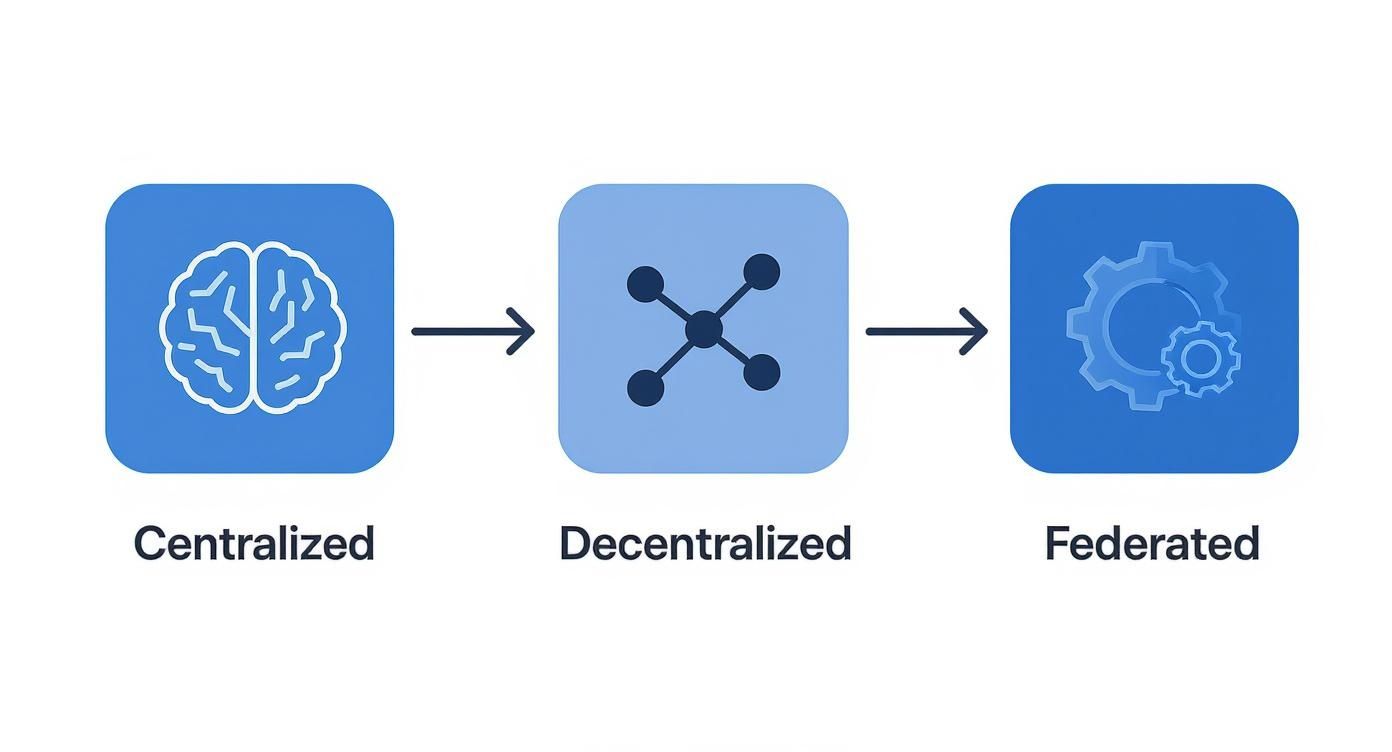
Your choice of a centralised, decentralised, or federated model will significantly impact how effectively you can manage and scale your technology stack.
Case Study: A Patient Journey Powered by Salesforce
Let's walk through a common scenario to see how this works in practice.
The Business Challenge: A patient discharged after a cardiac procedure needs ongoing support to manage recovery at home and avoid readmission. In a disconnected system, their care plan information is locked in different places, leading to disjointed communication and reactive care.
A truly connected system doesn't just store data; it makes that data actionable. It transforms information into insights that empower clinicians to intervene at the right moment, with the right message, through the right channel.
The Salesforce Solution:
- EHR Integration: The moment the patient is discharged, their summary—including medications and follow-up notes—is automatically synced from the EHR to their profile in Salesforce Health Cloud. This eliminates manual data entry and delays.
- Personalised Patient Portal: The patient logs into a secure portal built on Salesforce Experience Cloud. They see a personalised care plan, educational resources, and a secure messaging feature to communicate with their care team.
- Automated Outreach: Based on their care plan, Marketing Cloud triggers automated emails and SMS messages. These helpful nudges include medication reminders, prompts to record daily vitals, and links to schedule virtual follow-ups.
The Results: In this model, Salesforce is the connective tissue linking clinical data from the EHR with the engagement tools needed for effective patient communication. It breaks down data silos, delivering the seamless experience that improves patient outcomes and provider efficiency.
Measuring the Impact of Your Digital Transformation with Salesforce
https://www.youtube.com/embed/7FC6DXDxvls
Investing in a centre for digital transformation of health is about delivering clear, measurable results. The real value isn't in the technology itself, but in the tangible improvements in patient care, workflows, and data-driven decision-making.
By focusing on three core areas, organisations can translate their digital transformation goals into concrete outcomes that leadership can track and act upon, often using Salesforce's powerful reporting and analytics capabilities.
Better Patient Outcomes
This is the ultimate goal. Digital transformation improves the quality and personalisation of care by making it more proactive and accessible. Instead of reacting to illness, a connected system helps anticipate patient needs and engage them in their own health journey.
Key performance indicators (KPIs) here are focused on patient health and engagement:
- Reduced hospital readmission rates for specific chronic conditions.
- Increased patient portal adoption and active engagement.
- Improved patient satisfaction scores (e.g., Net Promoter Score or NPS).
- Higher adherence rates for medication and care plans.
Improved Operational Efficiency
Healthcare professionals are often burdened with administrative tasks that take them away from patients. A key benefit of a transformation centre is automating workflows, reducing manual data entry, and streamlining processes from patient intake to billing. This gives clinicians back valuable time and reduces operational costs.
KPIs for efficiency focus on optimising internal processes:
- Shorter average time to schedule a first appointment.
- Lower administrative costs per patient visit.
- Decreased staff turnover rates due to reduced burnout.
- Faster claims processing and reimbursement cycles.
The true power of a platform like Salesforce is its ability to turn data into a clear story of progress. Custom dashboards can track these diverse KPIs in real-time, giving leadership a single source of truth to measure ROI and steer the transformation strategy effectively.
Strategic and Financial Growth
A successful transformation provides the data-driven insights needed for smart, strategic growth. With unified data, you can identify trends, optimise service lines, and develop new care models that meet patient and market demands.
This is particularly relevant in Australia, where the digital health market is booming, with expected revenues of around USD 2.29 billion. This growth is largely driven by demand for telehealth and remote monitoring, highlighting the need for robust digital platforms. You can discover more insights about the Australian digital health market on Statista.
Strategic KPIs focus on long-term sustainability and innovation:
- Increased patient acquisition and retention rates.
- Growth in revenue from new digital health services (like telehealth).
- Improved accuracy in demand forecasting for staffing and resources.
Tracking these metrics is essential. They turn a digital transformation initiative from a cost centre into a clear value-driver.
KPIs for Measuring Digital Health Transformation Success
| Benefit Category | Example KPI | Salesforce Tool for Measurement |
|---|---|---|
| Patient Outcomes | Reduced hospital readmission rates by 15% for CHF patients within 12 months. | Health Cloud patient timelines and Tableau dashboards |
| Patient Outcomes | Increase patient portal engagement by 30% year-over-year. | Experience Cloud analytics and Marketing Cloud engagement scores |
| Operational Efficiency | Decrease average patient check-in time from 15 minutes to 5 minutes. | Custom Flow Automation reports and Service Cloud case resolution times |
| Operational Efficiency | Reduce staff time spent on manual scheduling by 40%. | Salesforce Scheduler utilisation reports |
| Strategic Growth | Increase telehealth appointment volume by 50% in the next fiscal year. | Sales Cloud opportunity reports and Tableau revenue dashboards |
| Strategic Growth | Improve patient retention by 20% for high-value service lines. | CRM Analytics (formerly Tableau CRM) for predictive insights |
By tracking these metrics directly within Salesforce, a healthcare organisation can draw a straight line from its transformation initiatives to the outcomes that define success for patients, staff, and the bottom line.
Your First 90 Days: Launching a Salesforce Transformation Initiative
Launching a digital transformation can feel overwhelming. However, a structured 90-day plan can turn ambitious goals into tangible progress. The key is to break the initial phase into three 30-day sprints, allowing your centre for digital transformation of health to build momentum, demonstrate value quickly, and set the stage for long-term success.

This roadmap focuses on a high-impact pilot project that solves a real business problem, proving the power of a platform-based approach from the start.
Days 1-30: Discovery and Alignment
The first month is about listening, learning, and laying the groundwork. Success here is measured by organisational alignment around a clear, solvable problem.
The primary goal is to move from broad ideas to a specific challenge. This requires engaging with people on the front lines.
- Conduct Stakeholder Interviews: Meet with clinicians, administrators, IT staff, and patient advocates to understand their daily frustrations and workflow bottlenecks.
- Define a Core Business Problem: Based on this feedback, pinpoint one high-value, achievable goal. Common challenges include high patient no-show rates, inefficient referral management, or inconsistent post-discharge follow-up.
- Secure Executive Buy-In: With a well-defined problem, build a compelling business case for leadership. This is a strategic proposal that connects your proposed Salesforce solution to better patient outcomes or operational efficiency.
The entire point of this first phase is to build consensus. A transformation project driven by a unified vision is far more likely to get off the ground than one being pushed by a single department.
Days 31-60: Foundation and Planning
With a clear goal and leadership support, the next 30 days are about assembling resources and building a solid plan. You'll shift from the "what" to the "how," defining the pilot's scope and the metrics for success.
This phase is crucial for building the human and technical infrastructure for your pilot project.
Key activities include:
- Forming a Cross-Functional Team: Assemble a small, agile team with representatives from clinical, administrative, and IT departments to ensure shared ownership and diverse perspectives.
- Selecting a High-Impact Pilot Project: Choose a small-scale but highly visible project. A great starting point could be using Salesforce Service Cloud to create a unified patient communication hub or automating a manual intake process. The aim is a quick win that showcases the platform's value.
- Defining Success Metrics (KPIs): Establish clear, measurable KPIs. If tackling patient scheduling, metrics might include "a 20% reduction in average appointment booking time" or "a 15% decrease in administrative follow-up calls."
Days 61-90: Pilot Execution and Communication
The final 30 days are about action. Your pilot project goes live, you start collecting real-world data, and you begin sharing early wins with the broader organisation.
The focus is on execution, learning from feedback, and building momentum.
- Launch the Pilot: Roll out the Salesforce solution to a small, controlled group of users, such as implementing a new patient intake process using Salesforce Forms for a single clinic.
- Gather Continuous Feedback: Use surveys and check-ins to collect feedback from staff and patients. This input is invaluable for refining your approach.
- Share Early Wins: Don't wait until day 90 to share progress. Celebrate small victories and positive stories. You could demonstrate how a Visual Remote Assistant built on Salesforce is already reducing the need for in-person support. Learn more in our guide on the Visual Remote Assistant (VRA) Flow. This generates excitement and builds support for future phases.
Finding the Right Salesforce Partner for Your Digital Health Journey
Embarking on a digital transformation is more than a technology project—it's a fundamental shift in how your healthcare organisation operates and delivers care. Establishing a successful centre for digital transformation of health requires a Salesforce partner who understands this distinction and brings deep industry knowledge, not just technical skills.
The journey is filled with challenges unique to healthcare, from navigating strict compliance regulations to managing change among clinical staff. The right Salesforce partner acts as your guide, helping you avoid common pitfalls and ensuring your technology investment supports your core mission of improving patient outcomes.
Why Your Implementation Partner Matters
Choosing a Salesforce implementation partner is one of the most critical decisions you'll make. A partner with a proven track record in healthcare can accelerate your progress and mitigate risks.
Here’s what you should look for in a Salesforce partner:
- Navigating Healthcare Complexity: They must understand the nuances of the Australian healthcare system, from data privacy laws to interoperability standards.
- Driving User Adoption: Your partner needs a clear plan for training clinical and administrative staff to ensure they embrace new workflows and technologies.
- Integrating Disparate Systems: Expertise in connecting platforms like Salesforce Health Cloud with your existing EHRs and other legacy systems is non-negotiable for creating a single view of the patient.
The right partner doesn’t just install software; they build a sustainable strategy with you. They make sure your Salesforce platform is configured not only for today's needs but is also ready to scale for future innovations in care delivery.
At Adaptal, our deep expertise in both Salesforce and the healthcare sector positions us as that strategic partner. We know that a successful transformation is built on real-world experience and close collaboration. The role of Salesforce development consultants in digital transformation is to translate your clinical goals into a powerful, functional CRM solution that works for everyone.
Ready to build a digital health strategy that delivers real, measurable results? Contact us today for a consultation. Let’s discuss how we can help you unlock the full power of Salesforce and accelerate your digital health journey.
Frequently Asked Questions About Salesforce in Digital Health Transformation
Setting up a Centre for Digital Transformation of Health brings up many questions. Here, we tackle some of the most common ones we hear from decision-makers, connecting the answers back to the strategic role of a CRM platform like Salesforce.
How Is a Transformation Centre Different From an IT Department?
A traditional IT department focuses on maintaining existing systems and ensuring operational stability—keeping the lights on. It's a crucial but often reactive role.
A Centre for Digital Transformation, on the other hand, is a strategic unit focused on innovation and redesigning how care is delivered. They proactively seek ways technology can fundamentally improve clinical workflows and the patient experience. For example, while IT manages the EHR's stability, the transformation centre would lead a project using Salesforce Health Cloud to connect EHR data with patient outreach programs, aiming to reduce hospital readmissions. One maintains the status quo; the other drives change.
What Role Does Salesforce Health Cloud Play in This?
Salesforce Health Cloud typically serves as the central hub for patient engagement. While your EHR is the system of record for clinical data, Health Cloud acts as the system of engagement. It creates a complete, actionable, 360-degree view of the patient by connecting data from various sources like EHRs, medical devices, and patient apps.
This unified perspective is the secret sauce. It’s what allows a transformation centre to launch initiatives that actually move the needle. You're no longer just storing data; you're enabling personalised care plans, automating patient communication, and streamlining referrals, all from one cohesive platform.
What Is the First Step to Start a Transformation Initiative?
The most critical first step isn't about technology; it's about securing executive sponsorship and defining a clear business problem to solve. Lasting change requires top-level support and a sharp focus on a real-world issue.
Start by identifying a high-impact area, such as reducing patient wait times or improving care plan adherence. A well-defined goal makes it easier to gain leadership buy-in. Once you have a clear objective, assemble a small, cross-functional team to pilot a solution. A focused pilot using a platform like Salesforce can demonstrate value quickly, building the momentum needed for broader, organisation-wide change.
At Adaptal, we know that a successful digital transformation is built on deep industry knowledge and a smart, strategic approach. We specialise in helping healthcare organisations use Salesforce to make meaningful improvements in patient care and operational efficiency.
Ready to start your digital health journey? Contact us for a consultation today.