

Business transformation consulting isn't just about making small tweaks. It’s a strategic partnership designed to help organisations fundamentally change how they operate using powerful platforms like Salesforce. From overhauling core systems and daily processes to shifting company culture, the goal is to achieve significant, measurable improvements. Think of it less as a tune-up and more as a complete operational overhaul to unlock growth, boost efficiency, and gain a real competitive edge with Salesforce at the core.
What Does Salesforce-Centric Business Transformation Consulting Actually Do?

Imagine your business is a well-built house that, over the years, just doesn't fit your needs anymore. A business transformation consultant is like an architect who doesn't just suggest a new coat of paint. Instead, they redesign the entire layout for better flow, function, and future growth, using a powerful foundation like Salesforce to connect every room.
That’s the essence of business transformation consulting. It’s a holistic approach that realigns your people, processes, and technology with a clear, forward-thinking strategy. It’s about moving beyond small, incremental improvements to focus on foundational, lasting change driven by a unified CRM platform.
Diagnosing the Core Business Challenges
The first step is always diagnosis. As experienced Salesforce partners, we act like organisational detectives, digging deep to uncover the real reasons behind inefficiency, customer friction, or stalled growth. We aren't interested in surface-level symptoms; we want to understand the entire business ecosystem and how data flows (or doesn't flow) between teams.
This discovery process usually involves a few key activities:
- Stakeholder Interviews: Talking to everyone, from C-suite decision-makers to frontline sales and service staff, to get a 360-degree view of the CRM pain points and hidden opportunities.
- Process Mapping: Creating visual blueprints of current workflows to clearly see where the bottlenecks, data silos, and redundant manual steps are holding you back.
- Data Analysis: Diving into the numbers—from sales reports and service tickets to marketing engagement—to find hard evidence of the problems that a platform like Salesforce can solve.
A core part of business transformation consulting is applying key business process improvement methods to ensure every change is systematic and backed by data, not guesswork.
Designing the Future-State Blueprint on Salesforce
Once the root problems are clear, we architect a blueprint for the future. This isn't a theoretical document; it's a practical, actionable roadmap detailing exactly how the business will operate differently, with Salesforce as the new operational backbone.
For forward-thinking organisations, Salesforce provides the single, unified system needed to manage customer relationships, automate sales cycles, and streamline service delivery. As your consulting partner, we design a solution that directly ties Salesforce technology to your specific business goals, ensuring the platform works for you, not the other way around.
Guiding the Salesforce Implementation and Change
This is perhaps the most crucial role a transformation consultant plays: guiding the implementation and managing the human side of change. A brilliant blueprint is useless if it’s not executed correctly. Many internal CRM projects fail not because the strategy was flawed, but because of poor execution and a failure to get user buy-in.
A Salesforce consulting partner manages the entire project, keeps it on track, and ensures milestones are met. More importantly, we help your people adapt to new, more efficient ways of working within the Salesforce environment. This hands-on guidance turns an ambitious vision into a tangible reality. For businesses ready to take this leap, our expert Salesforce consulting services provide the strategic oversight and technical know-how needed for a successful transformation.
The Four Pillars of a Successful Business Transformation
A successful business transformation isn't a single project. It's like building a sturdy structure; you need four critical, interconnected pillars. If one is neglected, the whole initiative becomes wobbly. To achieve real, lasting change, you must give equal attention to Strategy, People, Process, and Technology.
This balanced approach ensures every part of the business moves forward together, creating a powerful synergy that fuels growth and keeps you ahead of the competition.
Pillar 1: Strategy – The Why and the Where
Before taking any action, you need a crystal-clear strategy. This is the 'why' behind the entire effort. Think of it as your North Star, guiding every decision, from technology investments in platforms like Salesforce to small process tweaks in your sales cycle.
A solid transformation strategy answers a few fundamental questions:
- Where are we going? It paints a vivid picture of what success looks like for the business—for example, "a 360-degree view of every customer."
- Why do we need this change now? It clearly states the urgent business drivers, whether it’s fixing a leaky sales funnel, improving customer retention, or scaling operations.
- How will we measure success? It establishes clear, measurable metrics (KPIs) within Salesforce to track progress and define what success looks like in black and white.
Without this strategic clarity, transformation efforts become disconnected projects that lack purpose and fail to deliver real business value.
Pillar 2: People – The Heart of Change
You can have the best strategy and the most sophisticated Salesforce implementation, but if your people don't get on board, the initiative is doomed. The 'People' pillar is the most complex and critical part of any transformation. It’s all about managing the human side of change.
This means fostering a culture that welcomes new, more efficient ways of working. It means investing in Salesforce training to give your team the skills they need to thrive. Most importantly, it requires transparent communication and strong leadership to guide everyone through the uncertainty that comes with change.
The image below highlights the benefits you see when you put your people and processes first.
As you can see, focusing on your people and processes leads directly to major business wins like better efficiency, more agility, and happier customers.
Pillar 3: Process – Redesigning How Work Gets Done
The 'Process' pillar is where your strategy becomes reality. It's about fundamentally redesigning core workflows to eliminate friction, automate repetitive tasks using Salesforce Flow, and focus everything on delivering a superior customer experience.
Think of your business processes as the circulatory system of your organisation. If they're clogged with inefficient, manual steps, the whole business slows down. Transformation consultants meticulously map out your current processes, pinpoint the bottlenecks, and design new, streamlined workflows built for speed and effectiveness within the Salesforce platform.
The goal isn't just doing the same things faster. It's about finding entirely new and better ways of working that create more value for both your customers and your company.
Pillar 4: Technology – The Salesforce Engine of Enablement
Technology is the powerhouse that makes modern business transformation possible. It's the engine that drives your redesigned processes and gives your people the tools to work in new, more collaborative ways. In this context, platforms like Salesforce aren't just software—they become the central nervous system of the transformed business.
A well-implemented CRM like Salesforce provides a single source of truth for all your customer data. This unified view is the bedrock for creating seamless experiences across sales, service, and marketing.
- Salesforce Sales Cloud automates the entire lead-to-cash cycle, giving your sales teams more time to actually sell.
- Service Cloud gives support agents a 360-degree customer view to resolve issues faster and more effectively.
- Marketing Cloud Account Engagement (formerly Pardot) lets you create personalised, automated marketing journeys at scale.
To get the most out of this powerful platform, it’s vital to understand the role of Salesforce development consultants in digital transformation. A skilled partner ensures the technology is perfectly aligned with your strategic goals, creating a cohesive system where every pillar supports the others.
How Transformation Consulting Delivers Real Results with Salesforce
Let's move past the theory. The real worth of business transformation consulting is measured in tangible, data-driven outcomes within your CRM. Vague promises of ‘improved efficiency’ mean very little without proof.
Real results look like slashing a sales cycle from weeks to days using Sales Cloud. Or boosting customer retention by 25% in six months with Service Cloud. It’s all about creating measurable business value that you can see on your Salesforce dashboards.
This is where a strategic Salesforce partner connects ambitious goals to concrete actions. By focusing on specific, measurable outcomes, businesses see a clear return on their investment and build momentum for lasting change. Let’s break down the key benefits you can expect from a well-executed transformation.
Radical Operational Improvements
One of the most powerful impacts of a business transformation is the overhaul of clunky, manual processes. Think about the daily friction points that drain your resources and frustrate your teams. A key goal is to find and embed effective strategies for increasing operational efficiency into your organisation’s DNA.
We saw this firsthand with a construction firm struggling with a chaotic quote-to-cash process involving messy spreadsheets and manual approvals, leading to project delays.
- The Challenge: Inaccurate quotes and a slow, error-prone approval cycle that was killing momentum and impacting cash flow.
- The Salesforce Solution: We implemented Salesforce CPQ (Configure, Price, Quote) to automate the entire workflow. Complex pricing rules were built directly into the system, ensuring every quote was accurate and consistent.
- The Result: The firm slashed its average quote generation time by a massive 70%. Costly errors were eliminated, and they could get projects off the ground faster, directly improving cash flow and client satisfaction.
Creating Superior Customer Experiences
Today, customers expect a seamless, personalised experience. A disconnected journey, where your marketing, sales, and service teams don't share information, is a fast track to customer churn. A transformation project powered by Salesforce is designed to break down these internal silos for good.
The core idea is simple but powerful: build a single, unified view of the customer. When every team member is looking at the same information in Salesforce, they can deliver a consistent and context-aware experience that builds genuine loyalty.
Take a retail franchise we worked with that couldn't track customer interactions across different locations and their online shop, creating a frustrating loop for customers and staff.
By implementing Salesforce Service Cloud and connecting it to their e-commerce platform, we helped them create a single customer profile. Now, any service agent can see a customer's full history and provide the fast, effective support that builds loyalty.
Enabling Data-Driven Decisions with CRM Analytics
Gut feelings don't cut it anymore. A true transformation gives leaders the data they need to make informed, strategic decisions. When a CRM like Salesforce sits at the heart of your business, every interaction can be captured, analysed, and turned into actionable insight via reports and dashboards.
The Australian business transformation consulting market is booming because local companies are investing heavily in these data capabilities to stay competitive. Market analysis predicts the Australian consulting services sector will grow at a compound annual rate of 6.27% between 2025 and 2033, driven by the intense demand for expert guidance in technology like Salesforce.
These results aren't just hypotheticals. To see how we’ve helped other Australian businesses achieve them, explore our detailed Salesforce case studies.
Navigating Your Transformation Journey Step By Step
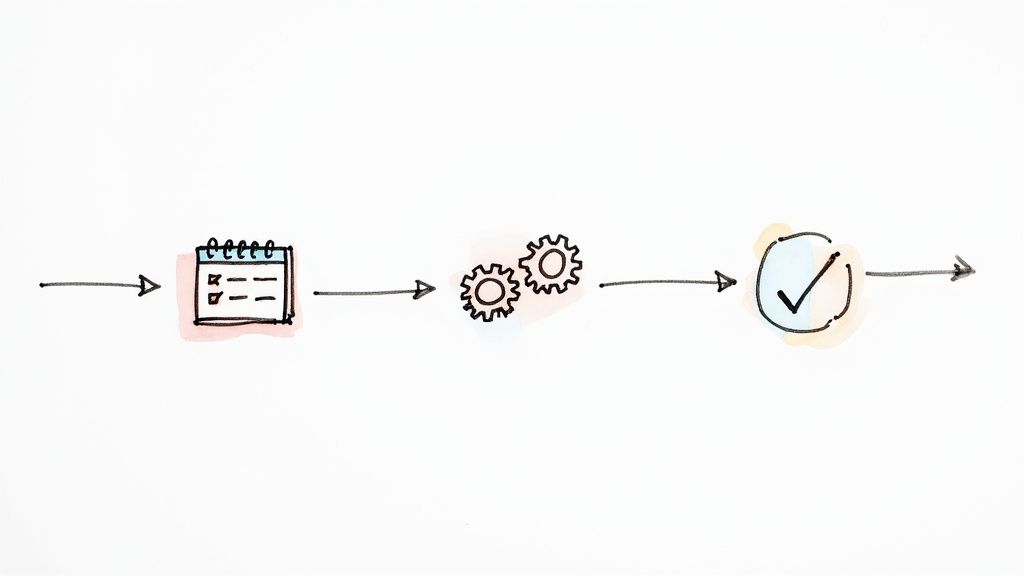
Kicking off a business transformation consulting engagement can feel like planning a major expedition. The destination—a more efficient, profitable business powered by Salesforce—looks incredible, but the path seems foggy. This is where a great consulting partner acts as your guide, providing a clear, structured roadmap that breaks the journey into four manageable stages.
This phased approach demystifies the process. It ensures every action has a purpose, every dollar is accounted for, and everyone on your team knows their role, from the first workshop to the final success report.
Let's walk through what that journey typically looks like.
Phase 1: Discovering Your 'Why' and Defining Success
This first phase is the most important. Before we even talk about Salesforce features, we need a crystal-clear picture of where you are now and where you want to go. This is the bedrock of your strategy.
The real goal is to find the root causes of your business challenges, not just the symptoms. A good Salesforce partner will run workshops and interviews with key people across the organisation to uncover the core pain points.
Key activities in this phase include:
- Deep-Dive Workshops: Hands-on sessions to map out your current processes, pinpointing the exact spots where things get stuck or become inefficient.
- Stakeholder Alignment: Getting your leadership and key teams on the same page, agreeing on the main problems we're solving and the vision for the future.
- Success Metrics Definition: Working together to set up clear, measurable Key Performance Indicators (KPIs) that can be tracked in Salesforce dashboards. These are the concrete numbers that will tell us we've won.
This stage is about building an undeniable business case for change. By the end, you'll have a rock-solid definition of what success looks like in real terms.
Phase 2: Designing Your Future-State Blueprint on Salesforce
Once the vision is clear, it's time to design the solution. We translate the strategic goals from Phase 1 into a detailed technical and operational blueprint built on the Salesforce platform.
Think of your consulting partner as an architect. They'll design how platforms like Salesforce Sales Cloud or Service Cloud will be configured to bring your new, improved workflows to life. This is about designing a fundamentally better way of working.
A classic mistake is to copy-paste old, clunky processes onto a shiny new platform. The whole point is to challenge how things have always been done and design processes that are smarter from the ground up, leveraging Salesforce's automation and data capabilities.
This blueprint becomes the master plan for the build phase, detailing everything from data migration to the specific automations that will make your team's life easier.
Phase 3: Building and Launching Your New Capabilities
Now we bring the blueprint to life. The consultant's technical team gets to work configuring Salesforce, building any custom code, and connecting it with your other critical business systems.
This process is highly collaborative and usually managed with an agile approach. We break the project into smaller "sprints," so your team sees progress in real-time, offers feedback, and helps make adjustments along the way. This avoids surprises and ensures the final product is exactly what you need.
Before launch, we put the system through rigorous testing. We also get your team fully trained, ensuring they feel confident and ready to hit the ground running with their new tools from day one.
Phase 4: Driving Adoption and Measuring Impact
The work doesn't stop when the system goes live. This final, ongoing phase is all about ensuring people use the new system and that it delivers the planned value. Change management is the name of the game.
Your partner will help you encourage user adoption with ongoing support, training, and clear communication. At the same time, they'll help you monitor those KPIs defined in Phase 1. By tracking dashboards and reports inside Salesforce, you can see the real-world impact of the transformation—whether it's shorter sales cycles, higher customer satisfaction scores, or lower operating costs.
This data-driven feedback loop proves the return on your investment and builds momentum for continuous improvement.
Choosing the Right Salesforce Transformation Partner
The success of your business transformation hinges on one critical decision: choosing the right partner. This isn't just about hiring a supplier; it's about finding a Salesforce expert who will guide you through a complex journey.
A great partner brings more than just technical chops. They offer strategic foresight, a collaborative spirit, and a genuine commitment to your success. Choose wisely, and your project is built on a foundation of expertise and trust. A poor choice can lead to budget blowouts, missed deadlines, and a final result that doesn't hit the mark.
Look Beyond the Tech Specs
While a deep understanding of the Salesforce platform is non-negotiable, it’s just the starting point. True business transformation consulting demands a partner who understands the nuances of your industry and your specific challenges.
They need to speak your language and have a portfolio of successful Salesforce projects with businesses like yours. A partner who has already navigated your industry's specific compliance hurdles and customer expectations will be far more effective than a generic IT provider.
Here are the must-haves:
- Deep Industry Experience: They should have a proven track record of solving real problems in your sector.
- Proven Salesforce Mastery: Look for a certified Salesforce partner with clear success across projects involving Sales Cloud, Service Cloud, and other products you need.
- A Partnership Mentality: They should feel like an extension of your team, prioritising open collaboration and transparent communication.
Questions That Cut Through the Noise
When vetting potential partners, you need to ask questions that get past the glossy sales pitch and reveal how they actually operate. Their answers will tell you everything about their approach and commitment.
The Australian management consulting market, which includes business transformation services, is valued at around AUD 45.9 billion in 2025. Following recent Senate inquiries, the industry faces tighter regulatory scrutiny, making partner transparency and ethical practices more important than ever. You can explore more about the Australian consulting market to understand these trends.
This heightened focus on transparency means asking tough questions is essential for your due diligence.
How Do They Handle the Human Side of Change?
A successful transformation is less about the technology and more about the people. Your partner’s approach to change management is arguably the most critical factor.
Ask them directly:
- How do you manage change and get users on board with Salesforce? A good answer will focus on clear communication, practical training, and creating champions for the new system inside your organisation.
- How will you define and measure success for our Salesforce project? They should talk about co-creating specific, measurable KPIs that tie directly to your core business goals.
- Can you walk us through a difficult Salesforce project you handled? Ask what went wrong and how they fixed it. This reveals their real-world problem-solving skills and honesty far better than a polished case study.
Ultimately, you're looking for a partner who is genuinely invested in your outcomes, not just in ticking off deliverables. Their ability to manage the human side of change is what will turn a good technology rollout into a great business transformation.
The Strategic Role of Technology in Transformation
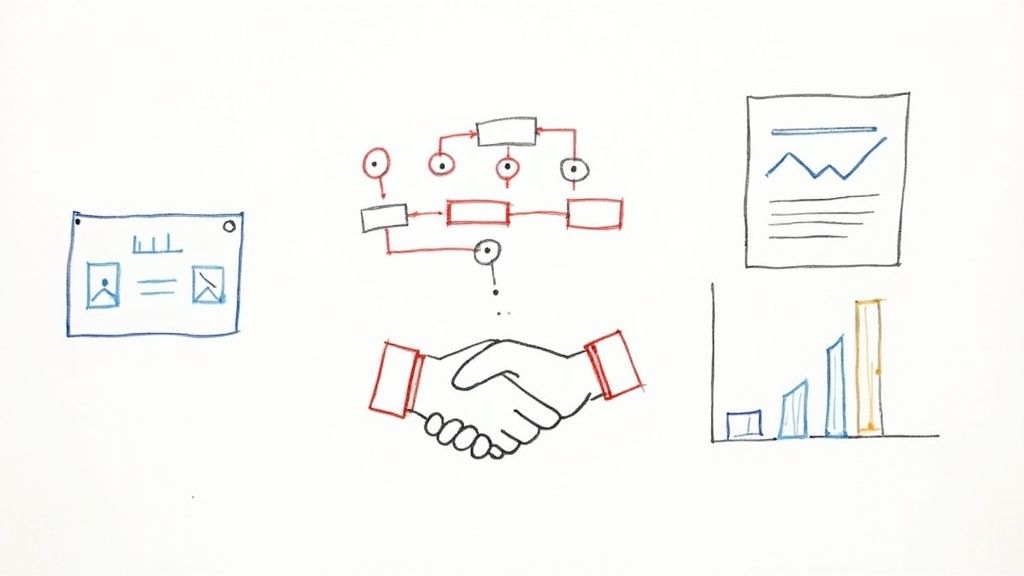
It’s easy to get swept up in the latest tech buzz, but successful projects remember one truth: technology is the engine, not the destination. It’s the tool that brings new processes to life and gives your team smarter ways to work.
A sharp business transformation consulting partner helps you look past the shiny software. Their job is to draw a straight line from every technical project directly to a business outcome, ensuring every dollar invested in technology has a clear purpose.
The Salesforce ecosystem is a classic example of technology acting as a catalyst for change. It’s a single platform where sales, service, and marketing teams can finally stop working in silos and start operating from a single source of truth. This alone can dissolve the friction that frustrates both your staff and your customers.
Building the Right Foundation
Before you can create a truly customer-focused operation on Salesforce, you need to get the technical groundwork right. These foundational projects are the essential building blocks for hitting your bigger business goals.
Think of it like this:
- Cloud Migration: Moving from old, on-premise systems to a flexible cloud platform like Salesforce gives you the agility to adapt when you need to.
- Data Integration: By connecting separate systems to Salesforce, you create that single, unified view of the customer you need to make great decisions.
- Enhanced Cybersecurity: Any transformation introduces new systems and data flows. Beefing up your security is what protects your business and your customers' trust.
Nailing these technical steps creates the secure, modern, and connected environment where your crucial people and process changes can finally take hold.
Salesforce as a Business Enabler
The real magic happens when Salesforce directly enables new and better ways of working. This is where a smart investment gives you a genuine competitive edge, a trend we’re seeing across Australian businesses.
In fact, 2024 data shows significant growth in Australia’s IT consulting and implementation market. Companies are putting serious money into digital solutions that streamline how they operate. You can explore detailed 2024 market insights on Statista to see the numbers for yourself.
A secure and connected technology platform gives your team the tools they need to execute the new strategy. It automates manual tasks, provides instant access to customer insights, and fosters collaboration across departments.
Take a real estate agency, for example. They can use Salesforce to manage a client’s entire journey, from their first online enquiry right through to settlement. This doesn't just make the agency more efficient; it creates a far smoother and more professional experience for the home buyer. Having the right tech stack allows them to deliver a superior service.
Learn more about why Salesforce is the backbone of modern real estate agencies in our detailed guide. This direct link between technology and a better business outcome is the hallmark of a successful transformation.
Got Questions About Business Transformation? We've Got Answers.
When you're thinking about a major shake-up of your operations, it's natural to have questions. Getting clear on the details is non-negotiable before diving into a business transformation. Here are straightforward answers to the questions we hear most often from business leaders considering Salesforce.
How long does a Salesforce transformation take?
The honest answer? It depends entirely on the project's complexity. A tightly focused project, like implementing Salesforce Sales Cloud to tune up a sales process, might wrap up in six to nine months. On the other hand, a full-scale, enterprise-wide transformation touching every department could stretch over several years. A good consulting partner will break the project into clear phases, so you start seeing value early and keep the momentum going.
What's the single biggest risk I should worry about?
Forgetting about your people. Poor user adoption is the most common reason CRM projects fail. Too many organisations get laser-focused on the shiny new technology but underestimate the human side of change. Without solid leadership, clear communication, and getting your employees genuinely on board with Salesforce, the project's value will never be realised.
How do you measure the ROI of a Salesforce transformation?
The Return on Investment (ROI) for business transformation consulting isn't about fuzzy feelings. It's about tracking hard numbers against the specific, measurable goals we set right at the beginning, often within Salesforce itself.
We're typically looking at metrics like:
- Increased Revenue: Are sales figures climbing? Is customer lifetime value improving?
- Improved Operational Efficiency: Pinpointing cost savings from smarter workflows and automation.
- Higher Customer Satisfaction: Keeping a close eye on scores like Net Promoter Score (NPS) or Customer Satisfaction (CSAT).
- Better Employee Engagement: Seeing a real impact on staff retention and productivity rates.
Ready to get clear answers for your specific business challenges? The team at Adaptal specialises in guiding Australian businesses through successful, Salesforce-powered transformations. Contact us today for a strategic consultation.