

A business transformation consultant is the strategic architect behind your company's growth, especially when you're using Salesforce. They don't just plug in software; their job is to rethink how your people, processes, and technology work together to hit your most ambitious targets. In a Salesforce context, their core function is to ensure the platform serves your business strategy, not the other way around.
Think of them as the bridge between your high-level vision—like improving customer retention or streamlining sales—and the practical, on-the-ground Salesforce solution needed to make it real.
What a Salesforce Business Transformation Consultant Actually Does
While a developer is focused on the technical build of a platform like Salesforce, a business transformation consultant answers the crucial "why" and "how." They ensure your CRM becomes a catalyst for genuine improvement, rather than just another software subscription that gathers dust.
This role goes way beyond a standard tech implementation. It involves a deep dive into your operations to find hidden inefficiencies and untapped opportunities. By mapping out your current challenges in sales, service, or marketing, they design a future where your processes are sharp, your teams are aligned, and your Salesforce platform is actively driving results. The process starts with understanding the core concepts of digital transformation.
The Core Mandate: Connecting Salesforce to Business Outcomes
A Salesforce business transformation consultant’s primary goal is to make your business more effective, profitable, and customer-focused using the Salesforce platform. Here’s how they get it done:
- Aligning Strategy with Technology: They ensure your Salesforce setup directly supports your most critical business goals, whether that’s increasing lead conversion with Sales Cloud or boosting customer loyalty with Service Cloud.
- Redesigning Business Processes: This involves mapping your existing workflows, finding the bottlenecks, and redesigning them for peak efficiency using Salesforce’s automation, data analytics, and other powerful features.
- Driving Change and Adoption: They manage the human side of digital transformation. This means training your teams, clearly communicating the benefits of the new Salesforce solution, and making sure everyone is on board with the new way of working.
Case in Point: A common mistake is treating a Salesforce project like a simple IT upgrade. A business transformation consultant reframes it as a fundamental business initiative. Instead of just ticking off features, they focus on outcomes like achieving a 25% reduction in the sales cycle with Sales Cloud automation or a 30% lift in customer satisfaction using Service Cloud case management.
This strategic approach is clearly gaining traction. In Australia, the management consulting market—which includes these transformation services—was valued at around USD 5.6 billion in 2024. It’s projected to hit a staggering USD 10.4 billion by 2033. This boom highlights just how much businesses need experts who can deliver measurable improvements through strategic change with platforms like Salesforce.
Ultimately, their work is holistic, touching every corner of your organisation. For a closer look at the specifics of platform customisation, you might find our article on the role of Salesforce development consultants in digital transformation insightful.
The Six Phases of a Successful Salesforce Transformation Journey
A successful business transformation doesn't just happen; it's a carefully planned journey. A skilled business transformation consultant leads you through a proven, multi-phase process designed to minimise risks, get your team on board, and deliver a solid return on your Salesforce investment. Each stage builds on the last, creating a clear path from your initial idea to results you can measure.
This structured approach is what keeps Salesforce projects from going off the rails due to vague goals or scope creep. It ensures every technical decision is tied directly to a strategic business outcome, turning your CRM platform into a real engine for growth.
The diagram below shows how a big-picture vision is refined into a concrete strategy and, ultimately, real business growth.
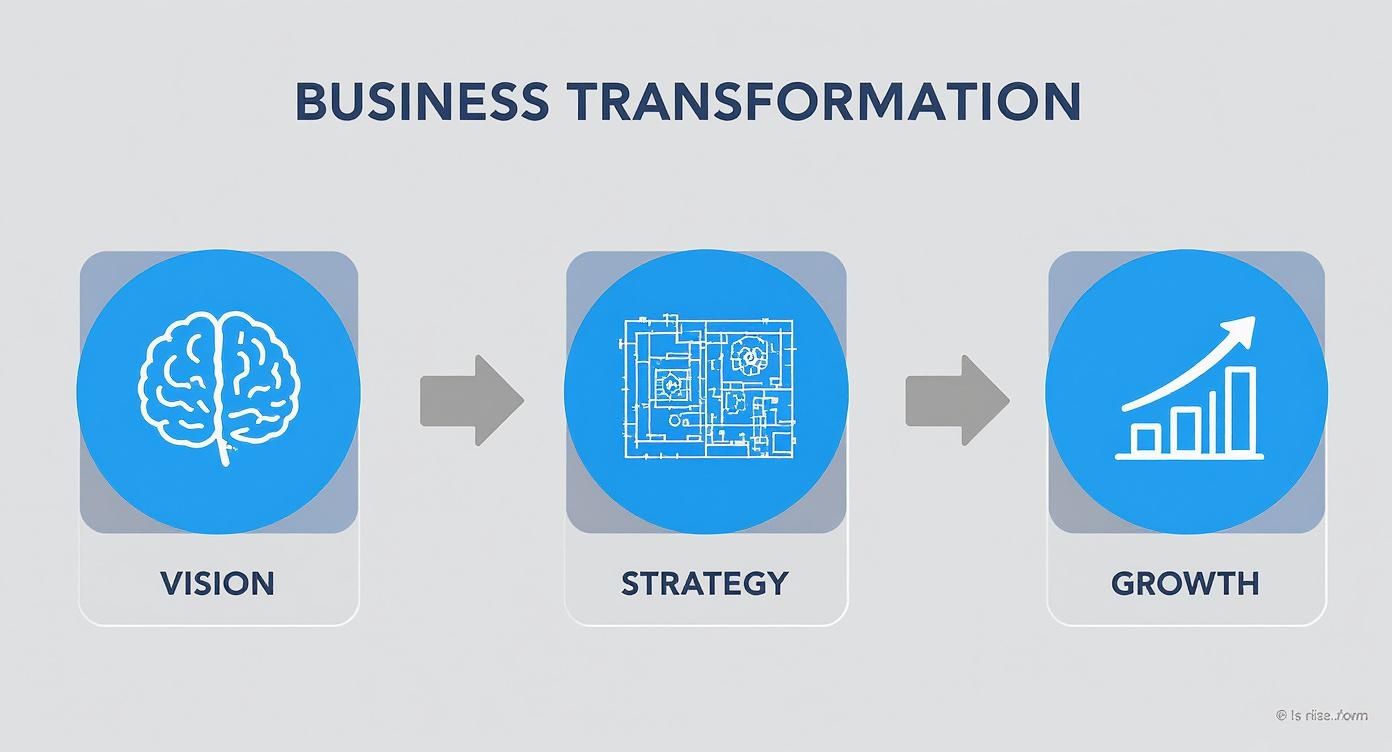
As you can see, a successful transformation always starts with a clear "why" before anyone touches the "what" and "how." This ensures the technology serves a distinct purpose. Let's break down the six key phases of this journey.
1. Discovery and Strategic Assessment
The journey kicks off with a deep dive into your business. A good consultant doesn't start by talking about Salesforce features; they start by listening to understand your pain points, goals, and operational realities. This means conducting stakeholder interviews, mapping existing processes, and assessing your current tech stack.
This phase is all about asking the tough questions. Where are the bottlenecks in your sales cycle? Why are customer service response times lagging? What data do you wish you had to make better decisions? The goal here is to paint a complete picture of your current state to pinpoint the most powerful opportunities for improvement with Salesforce.
2. Roadmap and Salesforce Solution Design
With a solid grasp of your needs, the consultant moves into the design phase. This is where your business goals get translated into a technical blueprint. They'll map out precisely how Salesforce products—like Sales Cloud, Service Cloud, or Pardot/Account Engagement—can be configured to solve the problems uncovered during discovery.
This isn't just a technical spec sheet. A key deliverable from a business transformation consultant is a clear plan for change, much like one would approach building a comprehensive digital transformation roadmap. It lays out timelines, milestones, required resources, and a solid business case to justify the Salesforce investment.
This strategic roadmap ensures everyone, from the executive team to project managers, is on the same page about the project's direction and what success looks like.
3. Agile Implementation and Technical Build
Now, the vision starts to become a reality. Following the solution design, the technical team gets to work configuring and customising your Salesforce environment. This phase is usually managed using an agile methodology, which means the project is broken down into smaller, manageable "sprints."
This approach allows for constant feedback and adjustments, ensuring the final product perfectly aligns with your real-world business needs. Instead of waiting months for a "big bang" launch, you see progress incrementally and can steer the project along the way, a best practice for successful digital transformation.
4. Change Management and User Adoption
Technology is only as good as the people who use it. This is a critical phase that focuses squarely on the human side of the transformation. A consultant will develop a comprehensive change management plan that typically includes:
- Communication Strategy: Clearly explaining the "why" behind the change and what's in it for each user group.
- Training Programs: Providing hands-on, role-specific training so every team member feels confident using the new Salesforce system from day one.
- Feedback Channels: Setting up ways for users to ask questions and share feedback, making them feel heard and part of the process.
Without a strong focus on adoption, even the most powerful CRM implementation will fail to deliver its promised value. It's a key lesson learned from countless projects.
5. Go-Live and Dedicated Support
The "go-live" is the moment your new Salesforce solution is rolled out to the team. A well-planned launch includes final data migration, system checks, and a clear cutover plan to keep any business disruption to an absolute minimum.
But the consultant's job isn't over. They provide dedicated "hypercare" support right after the launch to quickly squash any bugs, answer user questions, and ensure a smooth transition. This hands-on support is vital for building user confidence in those first few critical weeks.
6. Performance Measurement and Continuous Improvement
The final phase is all about making sure the transformation delivers lasting value. The consultant helps you track the key performance indicators (KPIs) that were defined back in the roadmap phase. This could be anything from lead conversion rates in Sales Cloud and average deal size to customer satisfaction scores in Service Cloud.
By analysing this data, they help you spot opportunities for further optimisation. This continuous improvement cycle ensures your Salesforce platform evolves with your business, helping you stay competitive long after the initial project is finished.
How Transformation Consultants Solve Industry-Specific Challenges with Salesforce
The real value of a business transformation consultant comes from solving the practical, day-to-day problems your industry faces. They apply a deep understanding of your sector’s unique pressures to shape Salesforce into a genuine competitive edge. This isn't about shoehorning your business into a pre-built template; it’s about creating a purpose-built solution.
A consultant translates your industry's language and challenges into a Salesforce solution, turning a powerful platform into a purpose-built engine for your business's growth.

Let's look at a few case study examples to see how this works in key Australian industries.
Case Study: Standardising Success for Franchise Networks
Franchises live and die by consistency. The core challenge is ensuring every location delivers the same high-quality sales experience and adheres to brand standards, especially when operating semi-independently.
- The Business Challenge: A national fitness franchise with 80+ locations was losing leads due to inconsistent processes. Some gyms used spreadsheets, others relied on sticky notes, resulting in a fragmented view of the national sales pipeline.
- The Salesforce Solution: A business transformation consultant designed and rolled out a standardised Salesforce Sales Cloud environment. They built a unified lead management process, automated follow-up tasks for staff at every gym, and created dashboards so franchisees could track their performance against benchmarks.
- The Results and Benefits: For the first time, head office had a crystal-clear view of the entire national sales pipeline. Franchisees reported a 15% lift in lead conversion within six months thanks to consistent follow-ups. Onboarding new franchisees also became simpler with a ready-to-go CRM system.
Case Study: Managing Complexity in Construction and Real Estate
The construction and real estate sectors are defined by long, complex project lifecycles. Managing everything from client bids to project milestones without a central system is a recipe for costly mistakes.
- The Business Challenge: A property development firm struggled with disconnected data silos across sales, project management, and client service. Critical information was often lost in email chains or buried in spreadsheets, leading to project delays and poor customer experience.
- The Salesforce Solution: A consultant implemented Salesforce as a central hub for managing the entire quote-to-completion lifecycle. They used the platform to create a single source of truth, connecting sales activities in Sales Cloud with project milestones and client communications.
- The Results and Benefits: The unified view of projects and clients reduced administrative overhead by 20%. Communication between teams improved dramatically, ensuring everyone had access to real-time project information, which led to fewer errors and faster project delivery.
Case Study: Enhancing Patient Engagement in Healthcare
Healthcare providers operate in a highly regulated space where patient trust and clear communication are paramount. The challenge is delivering personalised engagement while maintaining strict data privacy and managing complex schedules.
- The Business Challenge: A growing allied health clinic struggled with high patient no-show rates. Their manual system of phone call reminders was consuming valuable admin time and was not effective.
- The Salesforce Solution: The consultant implemented Salesforce Health Cloud. They set up automated appointment reminders via SMS and email, created secure patient communication channels via an Experience Cloud portal, and developed automated care pathways to prompt staff for timely follow-ups.
- The Results and Benefits: The clinic saw a 30% drop in missed appointments in the first quarter. Patients reported higher satisfaction due to proactive communication, and the admin team reclaimed an estimated 10 hours per week, which they could then dedicate to higher-value patient support tasks.
In every case, the consultant's value came from their ability to diagnose the core industry problem and apply the right Salesforce technology to fix it. To see how we can apply this industry-focused approach to your business, explore our Salesforce consulting services.
Integrating Salesforce with Your Core Business Systems
Your Salesforce platform delivers its greatest value when it’s not an island. Real business transformation happens when Salesforce becomes the central nervous system of your operations, seamlessly connected to your other core systems. This is where integration stops being a "nice-to-have" and becomes a non-negotiable part of the strategy.
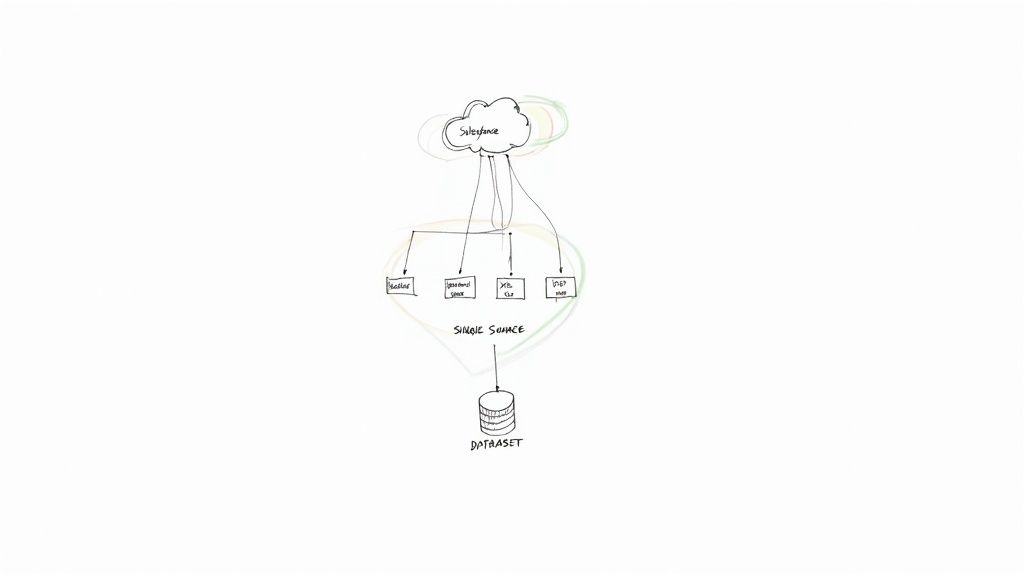
A business transformation consultant acts as the architect for this connected ecosystem. Their job isn’t just to link software; it’s to map the flow of information across your business, creating a single, reliable source of truth. This is how you finally eliminate the data silos that lead to duplicated work and untrustworthy reports.
Why a Unified System Matters in Digital Transformation
Connecting Salesforce to your finance, operations, and marketing platforms is a strategic move that directly impacts your bottom line. It allows you to automate entire cross-departmental workflows that used to be manual and error-prone.
For example, when Salesforce is linked to an accounting system like Xero or MYOB, a sales rep can close a deal in Sales Cloud, and an invoice is automatically generated in the accounting system. This streamlines your entire quote-to-cash cycle, a key goal of digital transformation.
This level of integration is a huge focus for Australian businesses. The local consulting market hit a valuation of around USD 9.1 billion in 2024, with a massive chunk driven by demand for digital and IT consulting. As businesses adopt more sophisticated cloud solutions, they need expert Salesforce partners to make them all work together. You can see more on this in a detailed Australian consulting market forecast.
Orchestrating Key Salesforce Integrations
A consultant’s role is to pinpoint which connections will deliver the biggest business impact. They analyse your unique processes to determine the best way to link your systems, whether through off-the-shelf connectors or custom-built APIs.
Some of the most high-value integrations we implement include:
- ERP Systems (NetSuite, SAP): Tying Salesforce to your ERP delivers a true 360-degree view of the customer. Sales teams can see inventory levels and order history, while finance gets a live look at sales data.
- Accounting Software (Xero, MYOB): This connection automates invoicing and gives sales teams visibility into a customer’s payment status, helping them manage accounts more effectively.
- Marketing Automation (Pardot/Account Engagement): A tight integration here ensures rich marketing engagement data flows directly into Sales Cloud. Sales reps get immediate insight into a lead's interests, leading to more informed and effective conversations.
By orchestrating these integrations, a business transformation consultant eliminates the "swivel-chair" effect—where employees constantly jump between apps to piece together a customer story. This boosts efficiency, improves data accuracy, and enhances the overall employee experience.
Ultimately, integration unlocks better, faster decision-making. When data from sales, service, marketing, and finance all flows into Salesforce, you can generate reports and dashboards that were previously impossible, providing the business intelligence needed for true transformation.
For a deeper dive into the technical and strategic steps involved, check out our complete Salesforce implementation guide for Australian businesses.
How to Choose the Right Salesforce Transformation Partner
Choosing the right business transformation consultant is the single most important decision you'll make on your Salesforce journey. You aren't just hiring a vendor; you're bringing on a strategic partner to help reshape your business from the inside out.
The best Salesforce partners bring more than just certifications—they bring deep business acumen and a genuine investment in your long-term success.
The goal is to find a team that thinks about your operational goals first and the technology second. Their ability to understand your unique challenges, manage the human side of change, and tie the project directly to your commercial objectives is what separates a successful transformation from a costly IT project.
Vetting Your Potential Salesforce Partner
To properly vet potential consultants, you need to dig deeper than their technical skills. Your evaluation should be a deep dive into their experience, their process, and their cultural fit with your company.
A strong Salesforce partner will have confident, evidence-backed answers that show real-world project experience, not just textbook theory. They should be able to clearly articulate how they'll guide your team through the entire process.
To help you get started, we've put together a table of key questions you should be asking.
Key Questions to Ask a Potential Business Transformation Consultant
| Category | Question to Ask | What a Good Answer Looks Like |
|---|---|---|
| Industry & Business Acumen | "Can you share specific examples of how you've solved challenges for businesses like ours in the construction or professional services space?" | They'll provide concrete case studies, not generalisations. They'll talk about the specific business problem, the Salesforce solution they designed, and the measurable results. |
| Change Management | "What's your approach to user adoption? How do you handle resistance to change within a team?" | A great answer will focus on communication, role-specific training, and involving end-users early. They should mention strategies like identifying 'champions' and creating feedback loops. |
| Strategic Alignment | "How will you ensure this Salesforce implementation directly moves the needle on our core KPIs, like improving our quote-to-cash cycle?" | They should talk about starting with your business goals and working backwards. They'll ask clarifying questions about your KPIs and explain how they map Salesforce features to those outcomes. |
| Team & Experience | "Who exactly will be on our project team, and what is their direct experience with transformations of our scale and complexity?" | You should hear names, roles, and specific project histories. A vague answer about "our team of experts" is a red flag. They should be transparent about who you'll be working with. |
Asking the right questions upfront sets the foundation for a successful partnership.
Understanding Different Engagement Models
A business transformation consultant will usually offer a few different pricing structures. Figuring out which one works for you is key to aligning the partnership with your budget and project scope.
The three most common models are:
- Fixed Price: A set cost for a clearly defined scope of work. Best for projects where requirements are locked in.
- Time and Materials: You pay an hourly or daily rate. This model offers maximum flexibility for complex transformations where the scope may evolve.
- Retainer: A monthly fee for a set amount of ongoing support, continuous improvement, and strategic guidance post-implementation.
The demand for consultants who can deliver these kinds of projects is strong. The Australian consulting market, which covers these services, hit AUD 6.2 billion in 2024. With growth pegged at around 5% for 2025, it’s clear that companies are actively looking for Salesforce partners who can deliver strategic change.
Interestingly, approximately 50% of clients need consulting support to implement their plans, which underscores the critical role these partners play in turning strategy into reality. You can dig into more detail in recent research on the Australian consulting market.
Choosing the right partner and engagement model is fundamental. For a detailed discussion on how we structure our partnerships, explore our Salesforce consulting services.
Finding Your Partner in Salesforce-Led Transformation
A successful Salesforce implementation is a strategic business journey, not just a tech project. A skilled business transformation consultant is your guide, ensuring every decision pushes you toward your long-term growth goals. They translate your big-picture vision into a practical, technology-driven reality.
This partnership is about much more than technical expertise; it’s built on a deep understanding of your operational challenges and commercial targets. Their job is to ensure the platform serves your strategy, preventing it from becoming another expensive, underused software subscription.
A great Salesforce partner doesn’t just implement a CRM; they build a foundation for continuous improvement. Their role is to empower your team, refine your processes, and ensure the technology evolves with your business.
Taking the Next Step
Choosing the right partner is the most critical decision you'll make. You need a team that blends sharp business sense with proven Salesforce expertise and a genuine commitment to your success. They should feel like an extension of your own team—someone as invested in delivering measurable results as you are.
Ready to see how a strategic approach can unlock the full power of your Salesforce investment? The experts on our Salesforce consulting team are here to help you map out your journey. Let's start a conversation about your unique challenges and explore how an expertly executed transformation can drive sustainable growth for your business.
Frequently Asked Questions
Here are answers to some of the common questions we hear from organisations considering a Salesforce-led business transformation.
What is the difference between a business transformation consultant and a Salesforce developer?
A Salesforce developer is your technical expert. They write code, build custom features, and ensure the platform is technically sound. They focus on the ‘how’ of the build.
A business transformation consultant is your strategist, focused on the ‘why’. We work with your leadership to understand your biggest business challenges and design a Salesforce solution to solve them. We don't just implement software; we redesign processes, manage change, and drive user adoption to ensure the technology delivers measurable business value. A developer builds the car, but the consultant maps the journey and ensures you reach your destination.
How do you measure the ROI of a Salesforce transformation project?
Measuring return on investment (ROI) starts with defining clear success metrics before the project begins. It’s a mix of quantitative and qualitative measures:
- Quantitative Metrics: These are hard numbers like increased sales revenue, reduced operational costs, improved lead conversion rates (a 15-20% lift is a common goal), or faster customer service response times in Service Cloud.
- Qualitative Metrics: These are improvements to culture and customer experience, such as higher customer satisfaction scores (CSAT), better employee engagement with the new system, and improved data quality for decision-making.
How long does a typical Salesforce transformation engagement last?
The timeline depends on the complexity and scope of the project.
A small to medium-sized business implementing a single solution like Sales Cloud with some process automation might see a three to six-month project.
A larger enterprise overhaul involving multiple Salesforce clouds (e.g., Sales, Service, and Marketing Cloud), deep process redesign, and complex integrations could be a 12 to 18-month journey, often broken into phases to deliver value incrementally. This agile approach is a best practice that allows us to adapt and refine as we go.
Ready to transform your business with a strategic Salesforce partner? The team at Adaptal has the expertise to guide you through every phase of your journey, ensuring your technology investment delivers measurable results. Contact us today for a consultation.