

What exactly is a business transformation consultancy? Think of them as a strategic partner dedicated to fundamentally re-engineering your organisation's core—its people, processes, and technology—to unlock significant, lasting improvements. This isn't about applying simple fixes. It's about implementing deep, structural change with a powerful platform like Salesforce at the centre, getting every part of your business aligned with a single, customer-focused vision.
Understanding a Business Transformation Consultancy
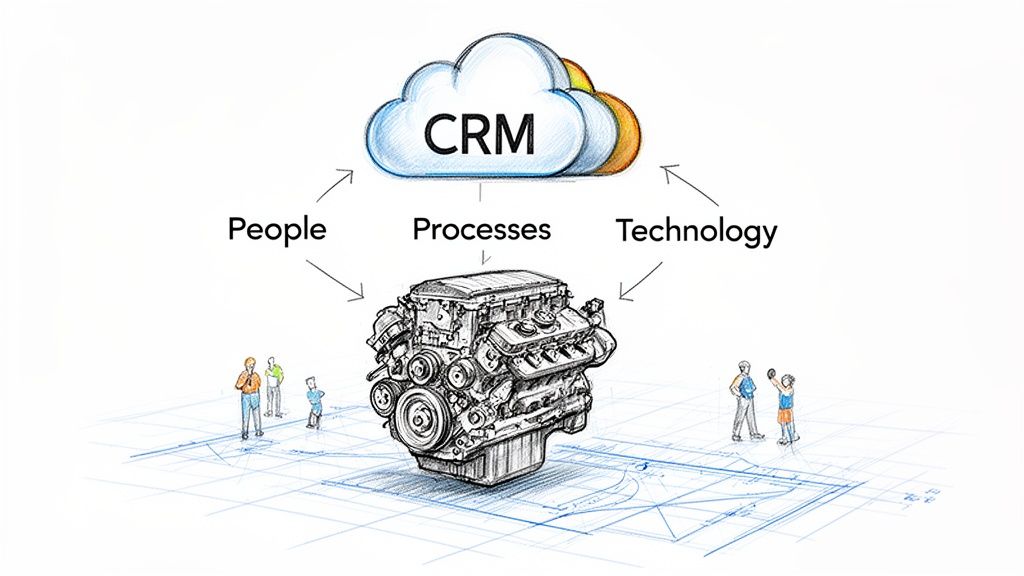
Picture your business as a high-performance engine. Even the best engines eventually become inefficient or outdated. A business transformation consultancy doesn’t just perform a routine tune-up; they act as architects, redesigning the entire system to meet modern demands. The goal isn't just to make things run faster, but to build a more powerful, resilient, and customer-obsessed organisation from the ground up.
This process starts with a deep dive into your current operations to find friction points, bottlenecks, and disconnected systems. We ask the tough questions. Are your sales and service teams working from the same playbook? Are clunky manual processes slowing your growth? Is your tech holding you back instead of propelling you forward?
The Role of Salesforce as a Transformation Toolkit
At the heart of most modern business transformations is a powerful Customer Relationship Management (CRM) platform. We don't see Salesforce as just another piece of software; it's a comprehensive toolkit for completely rebuilding how a company operates. It lays the foundation for a single source of truth about your customers, which changes everything.
For instance, a business transformation consultancy might put these Salesforce tools to work:
- Salesforce Sales Cloud to automate the entire lead-to-cash cycle, giving your sales team more time to sell and less time bogged down in admin.
- Service Cloud to create a unified view of every customer interaction, empowering support agents to resolve issues faster and deliver superior experiences.
- Marketing Cloud Account Engagement to get marketing and sales on the same page, ensuring a seamless journey for every prospect.
The real magic happens when you connect these components. By bringing disparate departments onto one unified platform, a business transformation consultancy demolishes data silos and fosters genuine collaboration. This creates a cohesive system where every employee has the insights they need to better serve the customer. To really get a feel for this, it helps to understand what sets a strategic business advisor apart from traditional consultants.
Moving Beyond Surface-Level Fixes
It’s tempting to solve problems with isolated, surface-level fixes—a new app here, a tweaked process there. While these might offer temporary relief, they rarely address the deep-seated issues. A true transformation partner looks beyond the symptoms to build a robust framework for sustained, long-term success.
A business-led approach is crucial. Transformation isn't about chasing the latest technology trend; it's about defining the future your organisation wants to create and then selecting the right tools, people, and processes to get there.
This kind of strategic alignment is what separates a genuine transformation from a simple tech upgrade. It ensures that every dollar invested in platforms like Salesforce delivers tangible returns, like shorter sales cycles, higher customer retention, and dramatically increased operational efficiency. Our work as a Salesforce partner is all about architecting these deep, structural changes that drive real-world business outcomes.
The Core Pillars of a Successful Salesforce Transformation
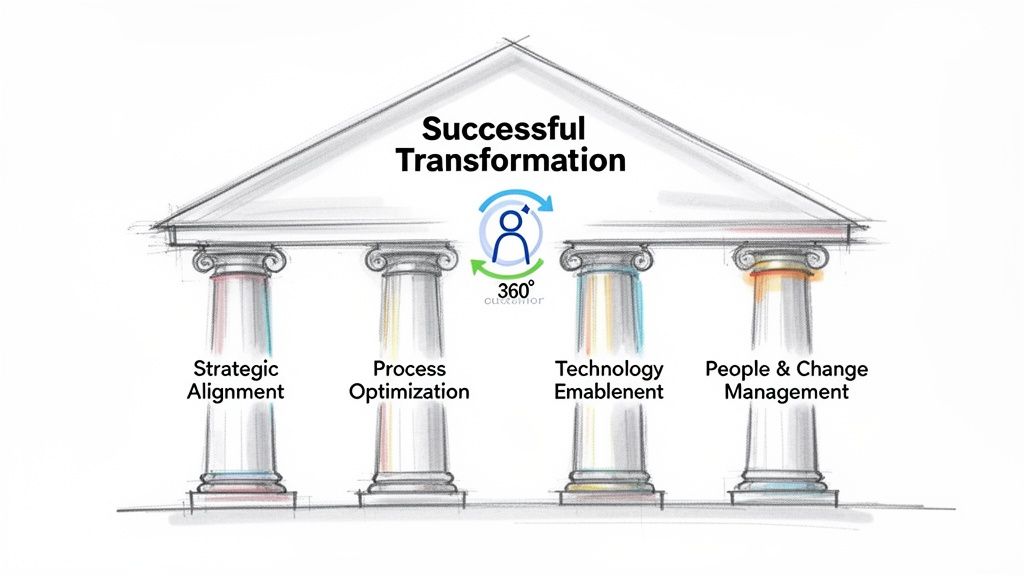
A genuine business transformation isn't a single, magic-bullet solution. It's a carefully constructed journey built on several interconnected pillars. As a business transformation consultancy, we've found that focusing on four key pillars is the only way to ensure a Salesforce project delivers real, measurable value. This approach goes beyond simply installing new software; it guarantees every decision is directly tied to your biggest goals.
Pillar 1: Strategic Alignment
Everything starts with the "why." Before we even think about technology or new processes, we nail down the most critical question: "What are we actually trying to achieve?" This pillar is all about making sure your Salesforce roadmap is a direct reflection of your company's vision.
Case Study Example: A professional services firm aimed to lift client retention by 20%. Our strategy aligned every action with that number. The conversation immediately shifted from "we need a CRM" to "we need to build a system in Salesforce that inspires fierce client loyalty by tracking every client interaction and service deliverable." This is where we map your big-picture goals to specific Salesforce features for a clear, actionable plan.
Pillar 2: Process Optimisation
Once the strategy is clear, we analyse how your teams get work done today. A business transformation consultancy digs deep into current workflows to uncover bottlenecks, manual workarounds, and hidden inefficiencies. The goal isn't just to tweak things, but to completely redesign them for a better future within Salesforce. We don't just copy and paste old processes into a new system. That’s a recipe for disaster.
A common failure point in transformation projects is automating a broken process. True optimisation involves fundamentally re-imagining how work gets done to create simpler, faster, and more effective workflows.
Case Study Example: A construction company was stuck with a clunky, paper-based quoting system. We redesigned their entire workflow using Salesforce CPQ to automate quote generation. This not only ensured accuracy but dramatically slashed the time it took to get winning proposals into clients' hands, directly impacting their sales velocity.
Pillar 3: Technology Enablement with Salesforce
This is where the strategy and optimised processes come to life. Technology enablement is the hands-on work of implementing Salesforce tools to solve the specific business pains we identified earlier. It’s all about configuring platforms like Sales Cloud or Service Cloud to give your teams the exact tools they need to excel.
This pillar is incredibly practical and focused on results. It might involve:
- Building a 360-degree customer view by connecting Salesforce with your accounting software, like Xero or MYOB.
- Creating automated lead nurturing journeys in Marketing Cloud Account Engagement so no opportunity ever slips through the cracks.
- Developing custom dashboards and reports that give leadership a real-time pulse on business performance.
Every configuration is a direct answer to a strategic need, ensuring the technology is actively driving the outcomes you care about.
Before we dive into the final pillar, let's break down how these components work together in a Salesforce-led transformation. The table below illustrates how each pillar connects a specific focus area to a Salesforce application and a tangible business outcome.
Four Pillars of Salesforce-Led Business Transformation
| Pillar | Focus Area | Example Salesforce Application | Business Outcome |
|---|---|---|---|
| Strategic Alignment | Defining clear business objectives and KPIs | Salesforce Reports & Dashboards | Aligning sales targets with executive-level visibility into revenue forecasting. |
| Process Optimisation | Redesigning workflows to eliminate inefficiencies | Salesforce Flow & Process Builder | Automating the lead-to-cash cycle, reducing manual data entry by 40%. |
| Technology Enablement | Configuring the platform to support new processes | Sales Cloud & Service Cloud | Providing sales and support teams with a unified customer view for faster issue resolution. |
| People & Change | Driving user adoption through training & support | Trailhead & In-App Guidance | Increasing user adoption rates by 30% through targeted, role-based training. |
This structured approach ensures that technology isn't just implemented, but is deeply integrated into the fabric of the business to produce meaningful results.
Pillar 4: People and Change Management
We've saved the most important pillar for last: the human element. A brilliant new Salesforce system is useless if your team doesn't understand it, trust it, or use it properly. This pillar is about making sure your employees not only adopt the new system but become its biggest advocates.
This involves more than just a quick training session. It’s about comprehensive education, clear communication on the "why" behind the changes, and providing ongoing support long after launch day. The aim is to build confidence and show people exactly how this new platform will make their jobs easier. For organisations navigating this crucial human side of change, working with expert change management consultants can make all the difference.
Why Australian Businesses Are Investing in Salesforce-Led Transformation
Across Australia, the conversation in boardrooms has fundamentally changed. Business transformation isn't a forward-thinking luxury anymore; it’s a core strategic imperative for survival and growth. We're seeing companies move beyond theoretical plans and actively pour resources into operational overhauls, driven by intense market pressures and the undeniable advantages of modern cloud platforms like Salesforce.
This isn't just a gut feeling—the numbers tell a clear story. The Australian management consulting industry is a massive AUD 45.9 billion market, and a growing slice of that is being channelled directly into technology-led transformation. Businesses realise that standing still is the riskiest move in this economic climate.
The Rise of Technology-Led Transformation with Salesforce
While transformation can touch many parts of a business, the real engine of change is technology. Specifically, it’s about harnessing powerful, integrated cloud platforms like Salesforce to completely redefine how work gets done. Australian businesses are waking up to the fact that their disconnected spreadsheets, clunky legacy software, and manual processes aren't just inefficient—they're creating serious risks and putting a hard ceiling on their potential.
A few key pressures are driving this shift:
- Customer Expectations: Today's customers expect seamless, personalised experiences. A unified CRM platform like Salesforce is no longer optional to deliver that.
- Operational Efficiency: Automation has moved from a buzzword to a bottom-line necessity. Salesforce helps cut costs, wipe out human error, and free up your team for high-value work.
- Data-Driven Decisions: Leaders need real-time visibility. Salesforce provides the dashboards and analytics to make smart decisions, fast.
Putting money into a platform like Salesforce, especially with the guidance of experienced Salesforce implementation partners, is now seen for what it is: a direct investment in future-proofing the business.
Connecting Market Demand to Salesforce Solutions
This groundswell of demand for transformation lines up perfectly with the Salesforce solutions we deliver. When a business decides to modernise, they’re almost always trying to solve specific, painful problems that platforms like Salesforce were built to fix.
The ultimate goal is always to create a single, reliable source of truth for every customer interaction. This is the bedrock upon which everything else is built—from faster sales cycles to incredible customer service.
Case Study Example: Many of our clients come to us with a chaotic sales process. We implement Salesforce Sales Cloud to automate lead management and give them a crystal-clear view of their sales pipeline. Others are wrestling with disjointed customer support, a problem we solve with Service Cloud to create a single, unified service desk where nothing falls through the cracks. Even better, integrating Salesforce with essential accounting systems like NetSuite, Xero, or MYOB demolishes the walls between finance and operations.
The Key Drivers Fuelling Salesforce Transformation Demand
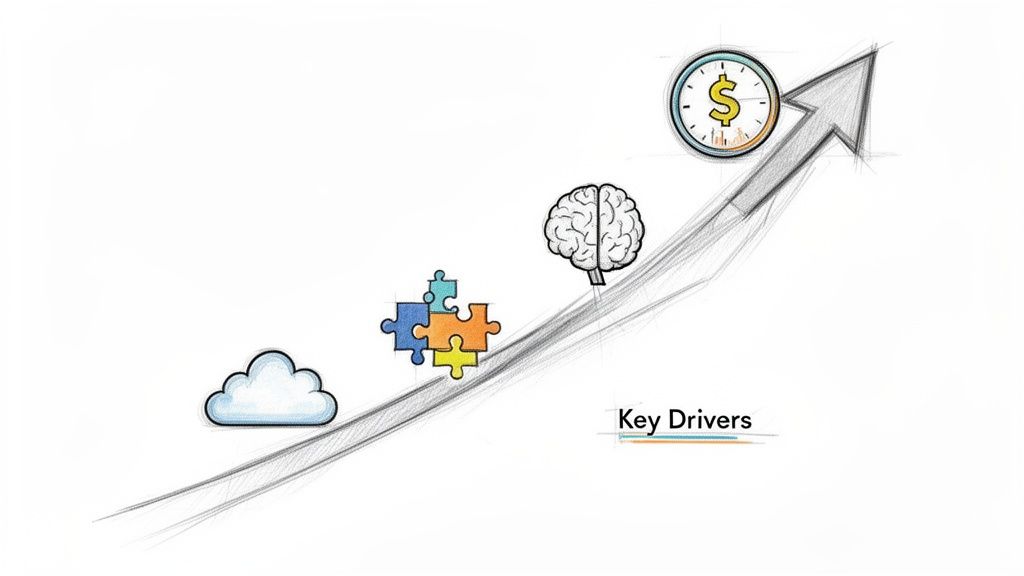
The massive investment we’re seeing in business transformation isn't happening by chance. It’s a direct answer to a few powerful market forces that are completely changing the rules of the game. These aren't just buzzwords; they are real pressures forcing companies to either evolve or get left behind. Understanding these drivers is the first step to seeing why a strategic overhaul, guided by a business transformation consultancy, has shot to the top of the priority list.
The Push for Complete Digitalisation with Salesforce
Digitalisation has moved far beyond just having a website. Today, it’s about weaving technology into the very DNA of your operations. Businesses are feeling the heat to get rid of clunky manual processes that slow everything down, invite errors, and frustrate both staff and customers.
Case Study Example: A sales team was still building quotes manually in spreadsheets, creating a huge bottleneck. By implementing Salesforce CPQ (Configure, Price, Quote), we digitised their entire workflow. This automated quote generation, locked in pricing accuracy, and massively sped up their sales cycle, flowing straight to the bottom line.
The Practical Application of AI with Salesforce Einstein
Artificial intelligence is no longer a sci-fi concept; it's a practical business tool delivering real-world results. Smart companies are using AI to automate routine decisions and predict customer behaviour. This is a massive driver for transformation because old, legacy systems just can’t keep up.
In the Salesforce world, this often means putting Salesforce Einstein to work. Picture your service team predicting which customer cases are about to escalate. Or your sales reps getting AI-powered tips on which leads are most likely to convert. This is the tangible result of building AI into your CRM.
The real power of AI isn't in its complexity, but in its ability to amplify what your people can do. It handles the predictable, so your team can focus on the exceptional.
This kind of intelligent automation is a core reason businesses seek transformation. They need a platform that doesn't just hold data, but actively uses it to make smart, real-time recommendations.
The Rise of Multi-Cloud and Integrated Salesforce Strategies
The days of siloed software are over. Modern businesses rely on a mix of specialised cloud apps. The real challenge—and a huge driver for change—is getting all these different systems to talk to each other. A multi-cloud strategy is a necessity for getting a single, clear view of the entire business.
This is where expert system integration becomes critical. We often see businesses running Salesforce for sales and MYOB or Xero for accounting. Without proper integration, customer and financial data are trapped in separate worlds. To get a better sense of how this works, you can read our detailed guide on what is system integration. A business transformation consultancy architects the pathways between these platforms, creating a seamless flow of information that establishes a single source of truth.
It's no surprise that the demand for consultants who can manage these complex digital projects is skyrocketing. Research shows the Australian consulting market, valued at around AUD 13–14 billion, is set to grow as businesses ramp up their adoption of cloud and AI.
Our Engagement Process: Your Salesforce Transformation Journey
A successful business transformation isn’t a one-off event; it’s a journey we take together. As your Salesforce partner, we follow a proven, transparent process designed to make you a co-creator in your own success. This phased approach breaks down a complex project into a logical, manageable progression, guiding you from initial strategy to long-term success on the Salesforce platform.
Phase 1: Discovery and Strategy
Before we touch any technology, we immerse ourselves in your world. This phase is a deep dive into your unique challenges, workflows, and strategic vision. We meet with your key people—from the C-suite to the frontline team—to understand their pain points and what they hope to achieve. The goal is to get a crystal-clear picture of your current state and define what a "win" looks like. This phase wraps up with a strategic roadmap that ties our proposed Salesforce solution directly to your most critical business goals.
Phase 2: Solution Design and Architecture
With a solid strategy in hand, we shift to the blueprinting stage. Our Salesforce architects design the future state of your operations on the platform. We create a detailed solution design that outlines exactly how Salesforce will be configured to meet the needs we uncovered during discovery.
This involves sorting out key details like:
- Data Modelling: Structuring how your customer data will flow within Salesforce for maximum insight.
- Process Automation: Designing smart workflows using tools like Salesforce Flow to eliminate repetitive manual tasks.
- User Experience (UX) Design: Crafting intuitive layouts that make the system easy for your team to use.
We’ll walk you through this blueprint for your review, ensuring the proposed architecture is the perfect fit before a single component is built.
Phase 3: Implementation and Integration
This is where the magic happens. Our certified Salesforce developers and consultants bring the solution design to life. We configure your Salesforce environment, build out custom components, and migrate your existing data with precision. A massive part of this stage is system integration. We connect Salesforce to your other essential business tools, like accounting systems such as NetSuite or SAP, to create a single, unified view of your operations. We use an agile approach, holding regular check-ins to show you our progress.
Transparency is everything during the build. We provide constant updates and walkthroughs, so there are never any surprises—just the solution you envisioned coming to life.
Phase 4: Training and Adoption
A powerful new system is only as good as the team using it. This phase is entirely focused on empowering your people to become confident and proficient with Salesforce. We develop and deliver training programs tailored to specific roles, ensuring each department understands exactly how the new platform will make their job easier. Our approach goes beyond just showing people which buttons to click; we focus on driving real user adoption, which is the ultimate measure of success.
Phase 5: Ongoing Support and Optimisation
Our partnership doesn’t stop on go-live day. We provide ongoing support and managed services to ensure your Salesforce platform keeps running at peak performance and evolves as your business grows. This final phase is our commitment to your long-term success, helping you continuously fine-tune your processes and get the best return on your investment.
How to Choose the Right Salesforce Transformation Partner
Picking the right partner is the most important decision you'll make on your transformation journey. A good business transformation consultancy becomes an extension of your team, steering you through challenges and ensuring the solution works in the real world. The wrong choice can lead to expensive delays, a system that doesn't fit, and a team that refuses to use it. You need to get past the glossy sales pitches and look for real proof that they are a trusted Salesforce partner.
Key Evaluation Criteria for a Salesforce Partner
When you're sizing up a potential Salesforce partner, zero in on four key areas.
- Industry-Specific Experience: Have they delivered Salesforce projects in your industry, whether it's construction, healthcare, or professional services? Industry knowledge is crucial because it means they already understand your unique challenges.
- Technical Proficiency: How deep is their knowledge of the specific Salesforce products you'll be using, like Sales Cloud, CPQ, or complex integrations? A true expert understands the ins and outs of features like Salesforce Field History Tracking.
- Measurable Results: Can they show you case studies with concrete ROI? Ask for hard numbers—like a 30% reduction in admin tasks or a 25% increase in lead conversion rates. You need to see that their work leads to real business outcomes.
- Partnership Model: What happens after go-live? A true partner offers ongoing managed services and support. They stick around to help you fine-tune and adapt the platform as your business grows.
The diagram below maps out the typical five-phase journey a consultancy will guide you through, from the initial discovery all the way to continuous improvement.
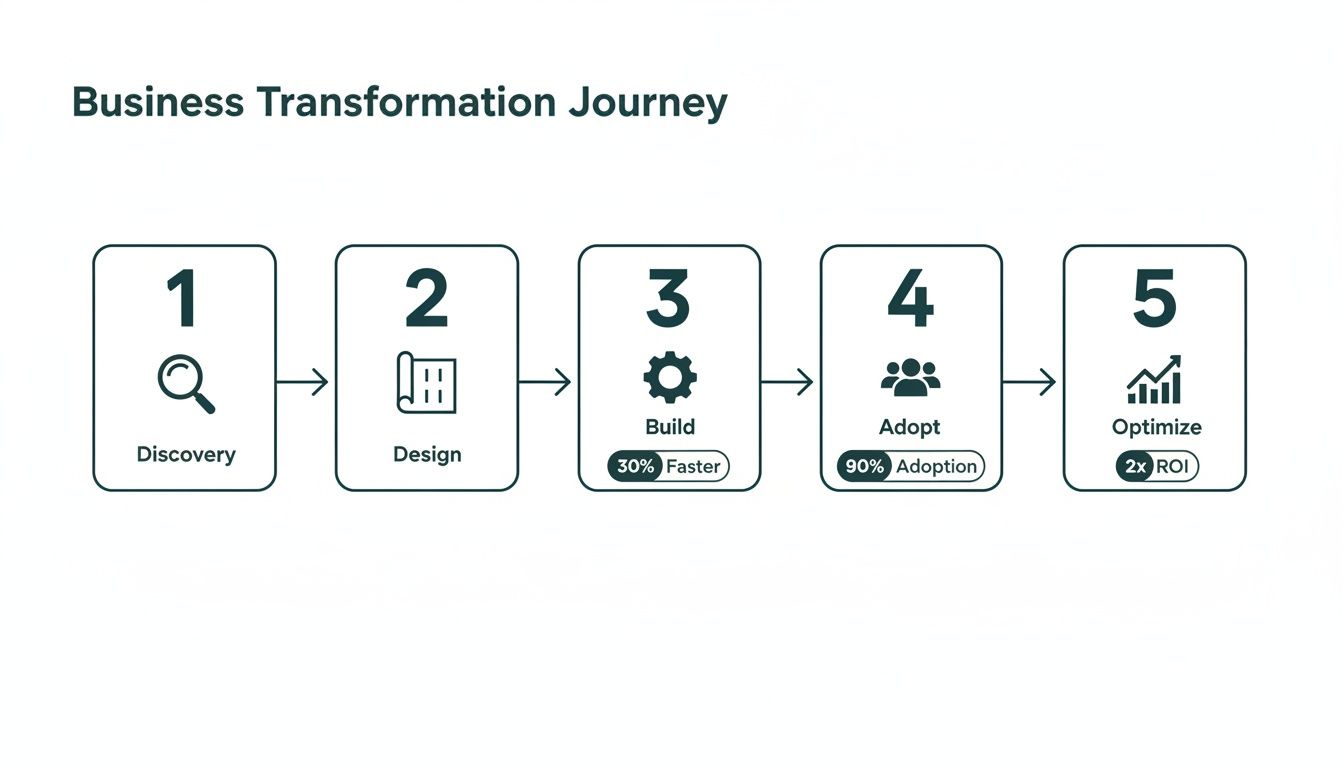
This process shows that a successful transformation isn't a one-and-done project. It's a structured, ongoing cycle.
Questions to Ask a Potential Salesforce Partner
To put this all into practice, use this checklist when you're talking to potential partners. The quality of their answers will tell you everything you need to know.
The best partners are more than just technical experts; they are trusted advisors who challenge your assumptions and bring a calm, steady hand during times of change and complexity.
Make sure you get clear answers to these critical questions:
- Can you walk us through a similar Salesforce project you completed for a company in our industry?
- How will you ensure our team is properly trained and ready to adopt the new system?
- What is your process for integrating Salesforce with our existing systems, like Xero or SAP?
- How do you measure the success of a project, and what KPIs do you track?
Choosing a consultancy is a big commitment. By taking a structured, evidence-based approach, you can be confident you’re finding a partner who can turn your vision into a successful reality.
Frequently Asked Questions About Business Transformation
Even with a solid plan, diving into a business transformation can feel like a huge leap. It’s normal to have questions about how long it will take, what it might cost, and what it really takes to get it right. We've put together some of the most common questions we hear from business leaders to give you clear, straight-up answers.
How long does a typical business transformation project with Salesforce take?
There’s no single answer. The timeline for any business transformation depends entirely on its scope and complexity.
For a focused project, like getting a small team up and running on Salesforce Sales Cloud, you might be looking at 8 to 12 weeks. That timeframe usually covers the core setup, initial data migration, and the first round of user training.
However, a full-blown transformation involving multiple Salesforce clouds (like Sales and Service Cloud), complex data migration, and integration with an ERP like NetSuite or SAP, can easily take 6 to 12 months, or even longer. That’s why we always start with a detailed discovery phase to build a realistic roadmap with clear milestones.
Is business transformation only for large enterprises?
Not at all. While you often hear about large corporations undergoing massive transformations, small to medium-sized businesses (SMBs) often see the most dramatic and immediate results from Salesforce. Transformation is about sharpening your competitive edge, which is crucial for businesses of any size.
For an SMB, a transformation could be as simple as automating a manual sales process with Salesforce. That one change can give them a 360-degree view of their customers for the first time. Or it could be integrating Salesforce with Xero to streamline invoicing, saving the team dozens of hours every month.
The key isn't the size of your company, but the scale of the solution. A great business transformation consultancy specialises in tailoring Salesforce solutions to deliver maximum ROI, whether you have a team of 10 or 10,000.
What is the most critical factor for a successful transformation?
While the right technology and technical skill are important, the single most critical factor for success is executive sponsorship and effective change management. A successful transformation isn’t just a tech project; it's a fundamental shift in your company's culture.
When your leadership team actively communicates the "why" behind the change, it gives the entire organisation a clear sense of purpose. If executives champion the project, employees are far more likely to get on board with new ways of working. Without that support from the top, even the most brilliantly designed Salesforce system can hit a wall of resistance. It's why our approach as a business transformation consultancy always puts a huge emphasis on user training and adoption.
Ready to modernise your operations and build a more resilient, customer-focused business? Adaptal is your trusted Australian Salesforce partner, dedicated to designing and implementing solutions that deliver real results. We translate complex business challenges into powerful, practical Salesforce solutions.
Explore our Salesforce consulting services to start your transformation journey.
Pingback: A Guide To Consulting For Salesforce In Australia