

What exactly are content marketing services? Think of them less as hiring a writer and more as engaging a strategic partner to build a valuable, long-term asset for your business. This isn't just about publishing blog posts. It's a calculated approach, grounded in your business challenges, to create and share genuinely useful content that attracts your ideal audience, builds trust, and drives profitable action within your Salesforce ecosystem.
Moving Beyond Buzzwords: How Content Fuels Your CRM
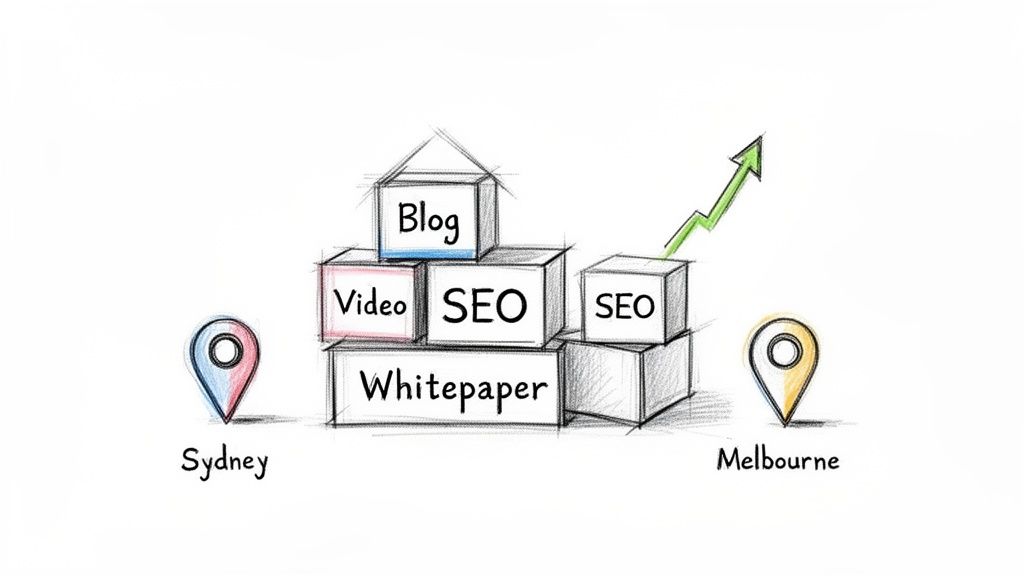
Let's cut through the noise. Content marketing is about building a business asset that appreciates over time. Picture it like a well-built commercial property—it consistently generates returns, unlike a paid ad that vanishes the moment you stop paying for it.
A dedicated Salesforce partner uses content to solve real-world business problems and achieve three core goals:
- Establish Authority: When you consistently publish expert content that addresses customer pain points, you become the go-to resource in your industry. Trust is built long before a sales call ever happens.
- Connect with Audiences: Content is your direct line to the challenges your customers face, whether they're in construction, healthcare, or professional services. It allows you to speak their language and demonstrate you understand their world.
- Drive Profitable Action: The end game is to guide potential customers through their buying journey, turning curious readers into qualified leads managed seamlessly within Salesforce.
The Strategic Business Impact
For businesses investing in Salesforce, content is no longer a "nice-to-have." It's the fuel for your entire customer relationship engine. When your content strategy is aligned with your CRM, every interaction becomes a valuable data point that drives smarter business decisions and accelerates your sales cycle.
A strategic approach is all about helping your customers solve a problem. When your content delivers real value, it builds a foundation of trust that paid advertising simply can't buy, feeding your Salesforce pipeline with high-quality, educated leads.
Imagine a potential client in the construction industry downloads a technical guide from your website. This single action can initiate a powerful, automated workflow in Salesforce. Marketing Cloud can nurture them with relevant follow-up content, and once they're sales-ready, Sales Cloud can alert your team that a qualified lead is ready for a conversation. This seamless integration of your digital marketing technology turns your content into a measurable revenue-driving machine.
Why It Is an Investment, Not an Expense
For businesses in specialised industries, content marketing is a core investment in sustainable growth. It's about creating a library of assets that works for you 24/7, constantly attracting and educating prospects. A paid ad is gone in a flash, but a high-performing blog post or case study can keep generating leads for years.
The real power of content marketing services lies in their ability to turn your hard-won expertise into a magnet for new business. To get past the basic definitions and truly grasp the strategic implications, it's worth exploring what CEOs need to know about content marketing and how it shapes long-term success. This isn't just marketing—it's how you build a lasting competitive advantage.
What To Expect From Your Salesforce Content Partner
Investing in a professional content marketing service isn't just about getting more words on a page. It's about turning your business challenges into measurable outcomes within your Salesforce environment. A true Salesforce partner doesn't just deliver articles; they build a structured framework for success based on solid strategy, clean execution, and clear communication.
It all starts with a deep dive into your business. Before a single word is written, we ensure every piece of content has a purpose and is perfectly aligned with your objectives. This means collaborative workshops to define your ideal customer personas, map their buying journey, and analyze the competitive landscape. The result is a clear roadmap that outlines content pillars, key themes, and a distribution plan designed to engage your audience and drive them into your CRM.
Core Deliverables That Drive Salesforce Results
Once the strategy is locked in, your partner gets to work producing the assets that will power your sales and marketing engine. These are the tangible deliverables you’ll see, each with a specific job to do in attracting, engaging, and converting your audience within Salesforce.
A solid content marketing service will usually deliver a mix of the following:
- SEO-Driven Blog Posts: These are the backbone of your strategy, designed to answer your audience’s questions and capture valuable organic search traffic. Each article is carefully crafted around targeted keywords to boost your visibility and attract top-of-funnel leads.
- Authoritative White Papers or E-books: For businesses with longer, more complex sales cycles, these in-depth resources are invaluable. They position your company as a thought leader and are incredibly powerful for generating high-quality leads that can be tracked and nurtured in Salesforce.
- Compelling Case Studies: Nothing builds trust faster than demonstrating you’ve solved similar problems before. Case studies offer concrete proof of your expertise, making them essential for prospects in the final stages of their decision-making process.
- Engaging Video Scripts: From quick social media clips to detailed product demos, video is a fantastic way to grab and hold attention. A good partner can write scripts that are optimised for maximum engagement and clarity, driving viewers toward a call-to-action.
On top of these core assets, many partnerships also include creating and managing email newsletters. This is a crucial part of lead nurturing, and our expertise as an effective email marketing agency helps turn content engagement into direct, meaningful conversations managed through your CRM.
Understanding Common Pricing Models
In the Australian market, content marketing services generally fall under a few common pricing structures. Understanding these models helps you align your budget with your business goals. A transparent partner will work with you to find the best fit for your needs and the outcomes you're aiming for.
The right pricing model isn't just about cost—it's about value and ensuring a shared commitment to achieving measurable business growth, not just delivering a set number of articles. It should reflect the strategic integration with your Salesforce platform and the expected ROI.
To give you a clear picture, here’s a breakdown of what’s typically offered and how it’s priced.
Typical Content Marketing Service Inclusions and Pricing Models
| Service Type | Common Deliverables | Typical Pricing Model |
|---|---|---|
| Ongoing Content Strategy & Creation | SEO Blog Posts, Social Media Content, Email Newsletters, Performance Reporting | Monthly Retainer |
| Lead Generation Campaigns | E-books, White Papers, Webinars, Landing Pages, Nurture Sequences | Project-Based or Retainer |
| Website Content Overhaul | Core Web Pages (Home, About, Services), SEO Optimisation, Case Studies | Project-Based Fee |
| Specialised Asset Creation | Video Scripts, Pillar Pages, Infographics, In-depth Guides | Project-Based Fee |
These models provide a framework, but the best partnerships are flexible. The goal is always to find a structure that supports a long-term, results-focused relationship centered on maximizing your Salesforce investment.
Integrating Content Marketing With Your Salesforce CRM
Great content is one thing, but its real magic happens when you plug it directly into your sales engine. By integrating your content marketing services with your Salesforce CRM, you stop guessing and start measuring. This is how you turn clicks and downloads into closed deals, creating a seamless journey for your customers and proving the value of your marketing spend.
When your content strategy talks to platforms like Salesforce Marketing Cloud or Account Engagement (Pardot), you’re no longer just publishing articles. You’re building an intelligent, automated system that nurtures leads, scores their interest, and hands them over to the sales team at the exact right moment.
Turning a piece of content into a sales-qualified lead isn’t just a single action; it’s a well-oiled process. This flow shows how it all connects—from the initial strategy and asset creation right through to the commercial models that make it all work.
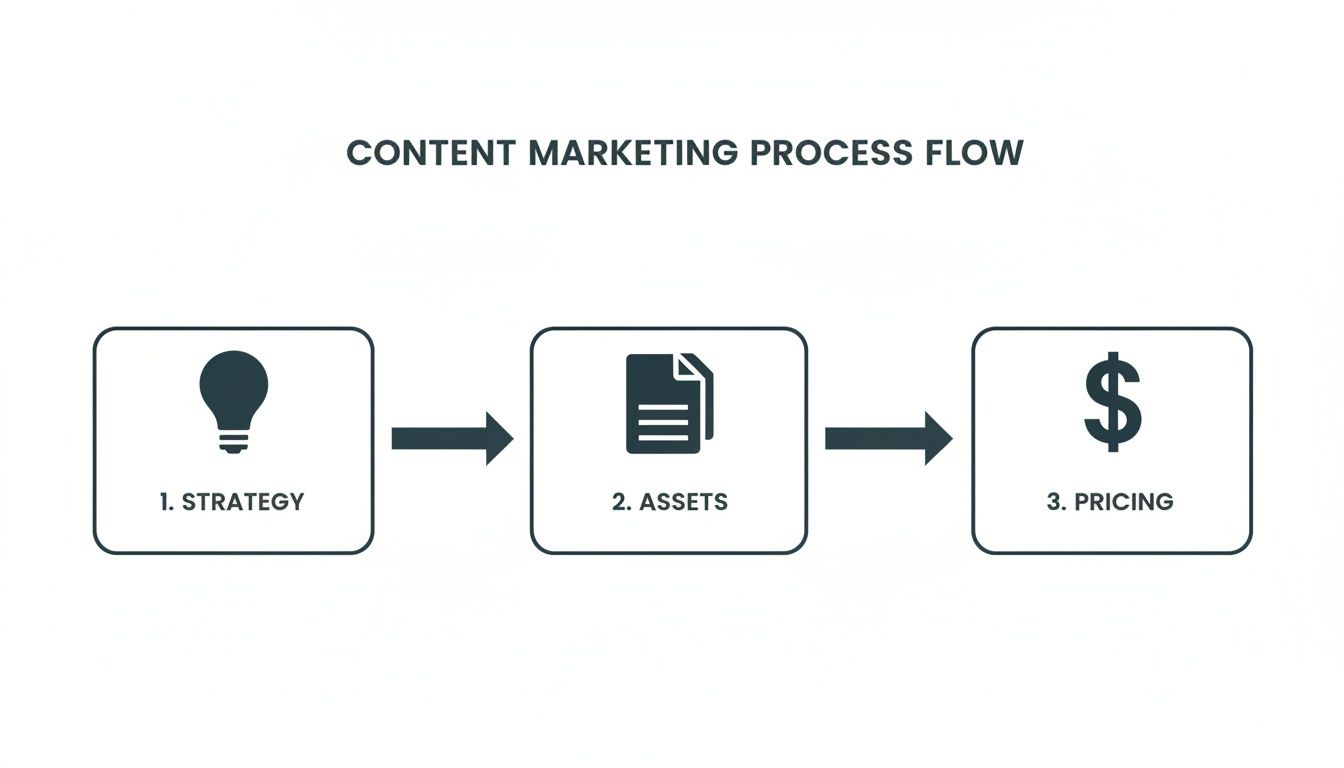
As you can see, it's a connected loop. Smart strategy dictates the assets you create, and both of these elements inform the pricing and partnership that make sense for your business.
From Content Download To Sales Cloud Alert: A Case Study
Let's walk through a real-world example. Imagine a project manager at a construction firm is facing challenges with supply chain logistics. They find your in-depth white paper on optimizing material procurement and download it.
That single download is the trigger. Here’s how Salesforce turns that simple action into a genuine sales opportunity:
- Lead Capture and Tracking: The form they fill out instantly creates a new lead record in Salesforce. From this point on, every interaction they have with your brand is tracked against their profile, providing a 360-degree view of their interests.
- Automated Nurture Journey: Account Engagement automatically enrols them into a pre-built journey designed for prospects in the construction industry. Over the next few weeks, they’ll receive curated emails with related content, like a case study from a similar project or an invite to a relevant webinar.
- Intelligent Lead Scoring: With every email opened, link clicked, or page visited, their lead score increases. This score is a live measure of their engagement and sales-readiness. You can dive deeper into these workflows in our guide to Salesforce for marketers.
- Sales Team Notification: The moment their score hits a pre-defined threshold, an automated workflow assigns the lead to a sales rep in Sales Cloud and creates a task for them to follow up immediately.
Now, when the sales rep makes that call, they aren't going in blind. They have a complete history of the prospect's journey and know exactly what content they’ve engaged with. This context makes for a much warmer, more relevant conversation and dramatically boosts the chance of closing the deal.
Proving Content ROI With Salesforce Dashboards
One of the biggest challenges for marketers is proving the return on investment. Connecting your content efforts to Salesforce solves this by linking marketing activities directly to sales outcomes. You can build powerful dashboards that visualize the entire funnel, from first touch to final sale.
When you track content performance inside Salesforce, you’re no longer guessing about ROI. You can point to the exact blog posts, white papers, or case studies generating the most qualified leads and contributing the most revenue to your pipeline.
Your dashboards can answer the tough questions from management, moving beyond vanity metrics and focusing on what really matters to the business.
- Which content assets are sourcing the most opportunities? Pinpoint the exact e-books or webinars that are attached to leads converting into real pipeline value.
- What is the lead-to-close conversion rate for content-generated leads? See how the quality of leads from your content stacks up against other channels.
- How does content influence the sales cycle length? Find out if leads who engage with specific case studies close deals faster.
This insight is non-negotiable for any business serious about growth. It gives you the data needed to double down on what’s working, fine-tune your content strategy, and confidently show stakeholders the tangible value your content marketing services deliver. Your content stops being a cost centre and becomes a predictable, scalable source of revenue.
Finding a Content Partner Who Understands Salesforce and Your Industry
Not all content marketing agencies are created equal. Choosing the right partner is about more than finding good writers; it's about finding a team that understands your world—your industry's unique challenges, its specific buying cycles, and how to leverage Salesforce to drive results. A generic approach simply won't cut it.
An agency that excels for a B2C e-commerce brand likely won't grasp the nuances of generating leads for a major construction project. To make a smart choice, you need to ask questions that go deeper than a portfolio and get to the heart of their real-world industry and Salesforce experience. This is critical when your end goal is to pipe high-quality, industry-specific leads straight into your Salesforce CRM.
Checklist for Construction and Real Estate Firms
In construction and real estate, content must build credibility by showcasing tangible results. Your audience wants proof of expertise, rock-solid reliability, and a deep understanding of complex projects.
Here are a few key questions to vet a potential content partner:
- B2B Lead Generation: Can you show us a case study of how you've used content, like project showcases or technical guides, to generate qualified leads for other clients in the building sector?
- Project Storytelling: Let's see examples of case studies you've built. How do you communicate the business challenge, the implemented solution, and the successful outcomes of a complex construction or property development project?
- Salesforce Integration: Talk to us about your experience creating content for long sales cycles. How would you map out a content journey in Account Engagement (Pardot) to keep a high-value prospect engaged for months on end?
Checklist for Healthcare Providers
In healthcare, content is all about earning patient trust. It must educate clearly, show empathy, and navigate strict regulatory guidelines. Your partner must be able to create content that is both human and authoritative.
Use this checklist to find a team who understands the healthcare space:
- Patient Education: How do you address complex medical topics, making them easy for patients to understand without sacrificing accuracy or authority?
- Compliance and Trust: What is your process for ensuring every piece of content is factually accurate, medically sound, and compliant with Australian healthcare advertising standards?
- Building Community: Can you share examples of how you've used content to build a community and support network around a specific health service or clinic, and how that engagement is tracked?
Checklist for Franchise Networks
Franchise marketing is a balancing act. You need content that maintains a consistent national brand message while empowering local franchisees to connect with their communities. A one-size-fits-all strategy is doomed to fail.
Ask potential partners these franchise-focused questions:
- Brand Consistency: What strategies do you use to ensure a consistent brand voice across dozens, or even hundreds, of different franchise locations?
- Local SEO: How would you build a content plan that boosts local search visibility for individual franchisees while strengthening the national brand’s domain authority?
- Franchisee Enablement: How can your content marketing services arm our franchisees with assets and templates they can easily customize for local campaigns, ensuring all leads are tracked back to our central Salesforce system?
A true industry partner won't just create content for you; they'll create content with you. They’ll tap into your team's internal expertise to build assets that solve real-world problems for your target audience and drive measurable business results within Salesforce.
How To Measure The Real ROI Of Your Content in Salesforce
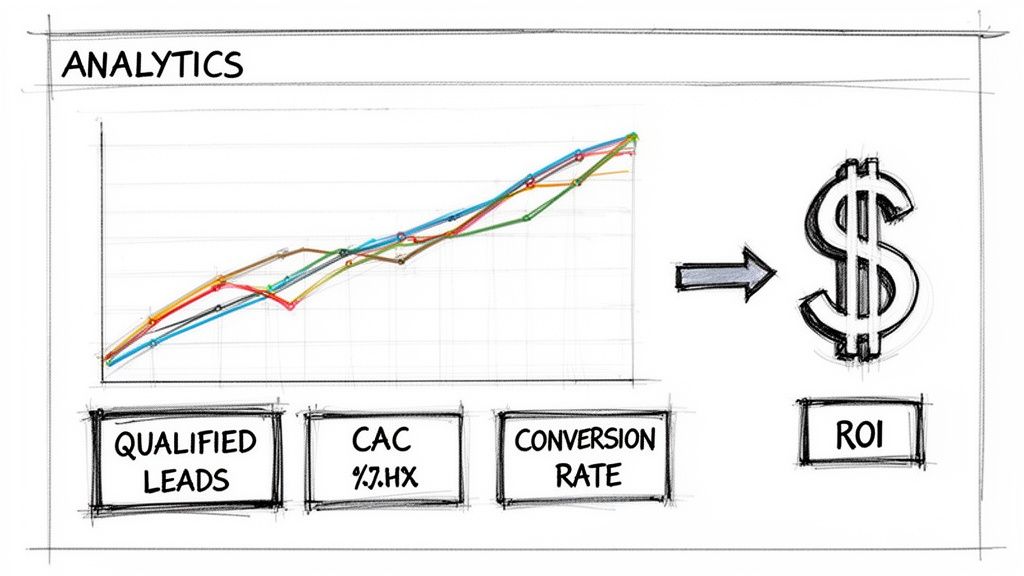
Effective content marketing services do more than generate traffic and likes; they deliver tangible business results. To see the true return on your investment, you must look past surface-level vanity metrics and focus on the numbers that impact your bottom line.
It’s about drawing a clear line from every blog post, case study, and white paper to actual sales figures. The ultimate goal is to connect content engagement directly to revenue. By tracking the right metrics inside your Salesforce CRM, you can build a powerful business case for your content strategy. This isn't just about justifying spend; it's about making smarter decisions that fuel sustainable growth.
Key Performance Indicators That Actually Matter
Forget about chasing page views. Instead, concentrate on the metrics that tell a story about customer acquisition and pipeline growth. These are the numbers that your executives and sales leaders care about because they translate directly into commercial success.
Your primary focus should be on tracking:
- Qualified Lead Generation: How many leads generated from content are genuinely sales-ready? Salesforce is brilliant at helping you distinguish a casual reader from a high-intent prospect by tracking their engagement over time.
- Customer Acquisition Cost (CAC): What does it cost to win a new customer through your content efforts? A well-oiled content machine should consistently lower your CAC by attracting high-quality, organic leads that require less sales effort to convert.
- Sales Conversion Rates: Of all the leads that originated from your content, what percentage ultimately became paying customers? This is the ultimate test of your content's effectiveness in driving real business.
Building Your ROI Dashboard in Salesforce
This is where your investment in content marketing services truly comes to life. By integrating your content efforts with your CRM, you can build dashboards that show the entire customer journey—from the first article they read to the final closed-won deal. For a deeper dive, this A Guide to Measuring Content Marketing ROI is a fantastic resource with some extra perspectives.
A well-configured Salesforce dashboard doesn't just show you data; it provides actionable insights. It empowers you to prove that your content is not a cost centre but a reliable, revenue-generating engine for the business.
Your dashboard should be built to answer critical business questions at a glance. What is the total pipeline value influenced by your blog? Which case studies are most effective at accelerating deals in the construction or healthcare sectors? Having this data at your fingertips is a game-changer. For advanced reporting, unifying your various data points is key; discover how to achieve this with our overview of Salesforce Data Cloud.
The Compelling Business Case for Content
The shift towards data-driven content is undeniable. By 2025, Australian businesses are projected to spend a staggering $1.5 billion on SEO services—a core component of any serious content marketing plan.
This investment is backed by an impressive return, with SEO delivering an average of $22 for every $1 invested, making it a powerhouse for growth. This move towards measurable strategies means you can finally demonstrate the direct financial contribution of your content, transforming marketing discussions from expenses to essential investments in your digital transformation.
Frequently Asked Questions about Content Marketing and Salesforce
Taking the leap into strategic content marketing is a big decision, and it's smart to have questions. We've gathered the most common queries we hear from business leaders, pulled directly from our client projects and consultations. Our goal is to give you clear, straightforward answers so you can feel confident in your strategy and understand the powerful connection between content, search, and your Salesforce platform.
How long does it take to see results from content marketing?
This is the most common question, and the answer involves shifting from a short-term campaign mindset to a long-term asset-building one. While you can see early indicators like increased website traffic and engagement within the first 3 months, the truly significant business outcomes—such as a predictable flow of qualified leads and top-tier search rankings—typically take 6 to 12 months to materialize.
Think of it as an investment. Each article, guide, or case study strengthens your digital presence and authority over time. By tracking lead sources and engagement within your Salesforce CRM, you can watch this value build from day one, seeing initial interest grow into tangible sales opportunities.
What is the difference between content marketing and SEO?
It’s a common point of confusion, but content marketing and Search Engine Optimisation (SEO) are not separate activities. They are two sides of the same coin and are completely intertwined for success. One simply cannot work without the other.
Think of it this way:
- Content Marketing is the "what": It's the creation of valuable, relevant information—like blog posts, case studies, or how-to guides—that solves a problem for your target audience.
- SEO is the "how": This is the strategic and technical framework that ensures your valuable content gets found by search engines and placed in front of the right people at the right moment.
An effective content marketing service doesn't just "do SEO" at the end. It weaves optimization into every step, from initial keyword research to on-page optimization, ensuring the assets you invest in are engineered to attract your ideal audience.
How does content marketing integrate with Salesforce?
Connecting your content strategy with Salesforce is where the magic really happens. This integration transforms content from a marketing tool into a measurable, automated sales machine. Using platforms like Salesforce Marketing Cloud or Account Engagement (formerly Pardot), you create a closed-loop system that proves its own ROI.
Here’s a practical example: a prospect downloads a technical guide from your website. This action can automatically create a new lead in Salesforce and trigger a personalized nurture journey. As they engage with more content, their lead score increases. Once it hits a certain threshold, a notification is sent directly to a sales rep in Sales Cloud.
The real power here is that your sales team receives a warm, educated lead, complete with a full history of their interests. This context leads to a more relevant conversation, shortening the sales cycle and dramatically increasing the likelihood of closing the deal.
This entire journey, from the first click to a signed contract, is completely trackable, allowing you to build dashboards that show the direct financial impact of every piece of content.
Will content marketing work for my specialised industry?
Yes, absolutely. In fact, for specialised industries—like construction, manufacturing, or complex professional services—content marketing is often even more powerful. Your audience isn't looking for light entertainment; they are actively searching for expert answers to complex, high-stakes business problems. Your content becomes the solution they need.
When you produce detailed case studies, technical guides, or authoritative white papers that speak directly to their pain points, you build enormous trust. You transition from being just another vendor to becoming an essential resource and a trusted authority. In these fields, problem-solving content is never "boring" to the person who needs it to do their job better. It’s the key to establishing credibility and winning high-value clients.
Ready to see how a strategic content marketing service can fuel your Salesforce CRM and drive measurable growth? Adaptal is an Australian Salesforce Consulting Partner with proven experience helping businesses in construction, healthcare, and professional services turn their expertise into a lead-generation engine. Contact us today for a consultation to discuss your business goals.