
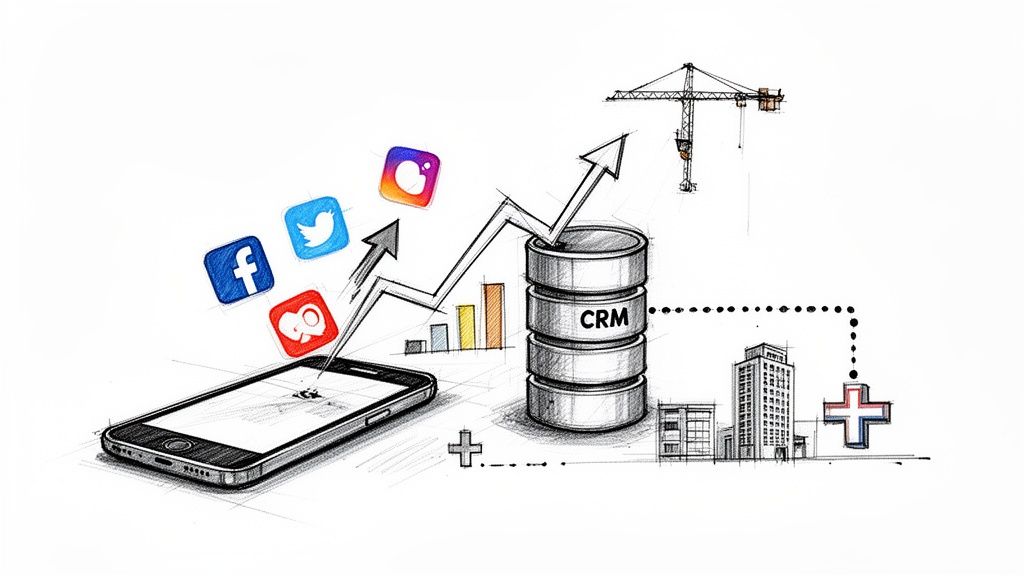
A modern social media marketing agency is much more than a content scheduler; they are a strategic partner dedicated to your growth, integrating seamlessly with your CRM. As a trusted Salesforce partner, we see them as data-savvy teams focused on building brand authority, creating genuine customer relationships, and driving a steady stream of qualified leads directly into your Salesforce pipeline.
Beyond Posts and Likes: What a Salesforce-Integrated Agency Delivers
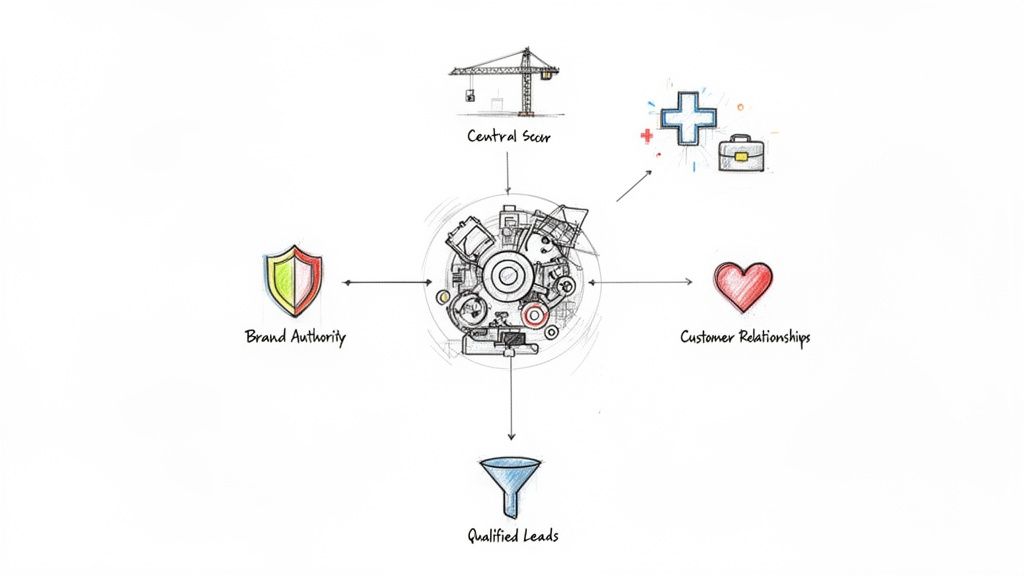
Many business owners, especially those in demanding sectors, often see social media as a chore—something you have to do, but that eats up precious time. The reality is that a well-executed strategy, integrated with your CRM, becomes an indispensable part of your sales and marketing machine.
Bringing in an expert agency lets your internal team get back to what they do best. While you’re managing projects or serving clients, your agency navigates the ever-changing world of social media algorithms and ad platforms. This isn't just about efficiency; it's about handing a critical business function to specialists who live and breathe digital engagement and understand how to make it work for your sales team in Salesforce.
The Strategic Shift in Social Media
The role of a social media agency has fundamentally shifted from task execution to strategic partnership. Their job is to translate high-level business goals into measurable digital campaigns that feed directly into your sales process.
A true agency partner doesn’t just ask, “What should we post?” They ask, “What business problem are we trying to solve with Salesforce?” This focus on outcomes is what drives real results, like boosting qualified leads in Sales Cloud or improving customer retention through Service Cloud insights.
This strategic mindset is critical in a competitive digital landscape. With a vast majority of businesses active on social media, a generic presence isn't enough. You need a plan that connects every action to a tangible business outcome within your CRM.
To deliver these comprehensive results, modern agencies rely on sophisticated platforms. You can explore some of the top social media tools for agencies to see the technology driving their success. Ultimately, their goal is to guide potential customers along a carefully planned path, turning initial awareness into lasting loyalty tracked within Salesforce. A great starting point for understanding this is customer journey mapping, the foundation for connecting social media efforts to real business value.
The Core Services That Drive Real Business Growth
A top-notch social media marketing agency does much more than schedule posts. They build a sophisticated communications system where every message is strategic, targeted, and designed for maximum impact within your sales funnel. This structured approach clarifies your investment and shows how each component contributes to your bottom line.
The process begins with a data-informed strategy that ties social media activity directly to business goals. They analyse your target audience, assess competitors, and set clear Key Performance Indicators (KPIs) that matter—moving beyond vanity metrics to focus on lead generation and conversion rates tracked in Salesforce.
From Strategy to Execution
Once the roadmap is set, the focus shifts to creating content that genuinely connects with your audience. A modern agency is a multimedia powerhouse, producing assets that capture attention and tell your brand's story.
- Compelling Content Creation: This includes professionally shot videos, insightful blog articles, and high-quality graphics. For instance, a professional services firm might publish in-depth articles on LinkedIn to establish thought leadership and drive traffic to a lead-capture form integrated with Salesforce.
- Paid Advertising Campaigns: Relying solely on organic reach is challenging. Agencies run targeted ad campaigns on platforms like Facebook, LinkedIn, and Instagram to zero in on specific demographics, capture leads, and drive traffic. With most marketers generating leads through social media, this is critical for growth.
- Community Management: They actively engage with your audience, responding to comments, answering questions, and building a positive community. This builds trust and loyalty, turning casual followers into brand advocates whose interactions can be tracked for a complete customer view in Service Cloud.
The real magic is how an agency weaves these services together. A case study video can be shared organically, boosted through paid ads, and used to spark community conversations—with all engagement data funneling back to inform your CRM strategy.
Analysis and Optimisation
Finally, a great agency never "sets and forgets." They constantly analyse performance data to see what’s working and what isn’t, tracking metrics like click-through rates, conversion rates, and cost per lead.
These insights are fed back into the strategy to optimise campaigns and improve results over time. This data-driven loop is where the connection to your CRM becomes critical. Understanding how social media efforts translate into actual leads and customers is paramount. We explore the specific tools and techniques in our guide to Salesforce for marketers to make this connection. By linking campaign data directly to your CRM, you get a transparent view of your return on investment.
Connecting Agency Success to Your Salesforce CRM
Hiring a social media marketing agency is one thing; proving its value is another. This is where your investment transforms from an expense into a measurable driver of revenue, moving beyond likes and shares to tangible business outcomes. The key is creating a seamless connection between your agency’s campaigns and your Salesforce ecosystem.
Imagine a potential client sees a targeted LinkedIn ad for your B2B services. They click, fill out a form, and that lead—instead of getting lost in a spreadsheet—instantly appears as a new record in Sales Cloud. Your sales team gets an immediate notification and can act while the lead is still warm. That’s the power of digital transformation through integration.
This is the clear, repeatable system a good agency follows to deliver results.
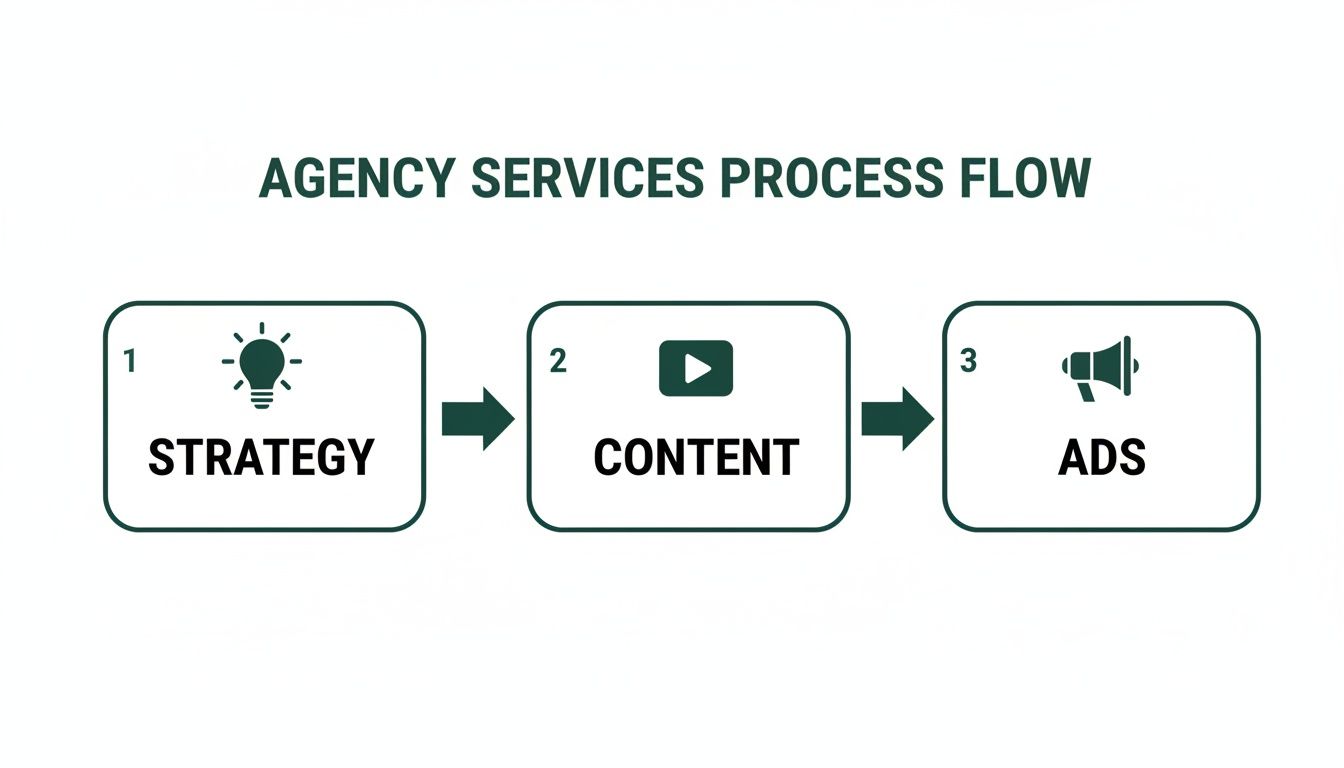
It’s a straightforward process, moving from strategy to content creation and finally to targeted advertising, all designed to deliver results you can measure in Salesforce.
Creating a Closed-Loop Reporting System with Salesforce
When marketing and sales systems are disconnected, you create data silos, making it nearly impossible to prove the return on investment (ROI) from your agency partnership. The goal is to build a closed-loop system where you can track a customer’s entire journey, from their first social media interaction to a closed deal in Salesforce. For agencies working with platforms like Salesforce, understanding CRM Integration is essential for delivering this value.
Social engagement data can also trigger powerful automation within Salesforce. For example, data from social campaigns can flow into Marketing Cloud Account Engagement (Pardot) to score prospects based on their activity. Someone who clicks an ad, downloads a guide, and watches a video is clearly engaged—their lead score should reflect that, automatically triggering a personalised email nurture series to guide them through the sales funnel.
A Real-World Salesforce Integration Story
Let's ground this in a practical example we've delivered for our clients.
The Business Challenge: A professional services firm was investing heavily in social media ads but couldn't connect that spend to new client wins. Their marketing and sales data lived in separate worlds, making it impossible to prove social media ROI.
The Salesforce Solution Implemented: As their Salesforce partner, we configured a direct integration between their social ad platforms (LinkedIn and Facebook) and Salesforce Sales Cloud. Every lead generated from a campaign was automatically created as a new Lead record in Salesforce, tagged with the specific campaign source.
The Results and Benefits Delivered: Within one quarter, the firm gained a crystal-clear view of their marketing pipeline. They could see exactly which campaigns were generating the most qualified leads and which were converting into real business. They were able to trace a 30% increase in their sales pipeline directly back to their social media efforts, proving the value of their agency partnership through Salesforce data.
This kind of connection is more critical than ever, with significant ad spend on social platforms. When you connect platforms like LinkedIn or Facebook directly to your CRM, you turn that massive audience into a genuine pipeline of opportunities. This approach transforms your agency from a content creator into a vital growth partner, with their success directly measurable within the Salesforce platform you rely on. To make this happen, it's crucial to align your agency’s work with your wider digital marketing technology stack.
How to Choose the Right Agency Partner for Your Business

Choosing the right social media marketing agency is one of the most important decisions for your brand's growth. The best partner isn't just a vendor; they're an extension of your team, a strategic guide who understands your business goals and knows how to achieve them online.
Get it wrong, and you’ll burn through your budget on campaigns that generate noise but no value. To avoid this, you need a structured way to vet potential partners to ensure they align with your specific needs and can integrate with your core systems like Salesforce.
Vetting Potential Agency Partners
Before signing a contract, conduct serious due diligence. Start with their industry experience. An agency that understands your sector's nuances will create content that truly connects with your target audience.
Dive into their case studies. Do they showcase results for businesses similar to yours? Look for concrete evidence and measurable outcomes. Beyond their track record, assess their process and communication style. A transparent agency will gladly walk you through their approach to strategy, content approvals, and reporting, ensuring you have a clear picture of how they'll collaborate with your team.
The most important question isn't "What will you do for us?" but "How will you measure the success of what you do in our CRM?" An agency focused on vanity metrics like likes is a red flag. A true partner will talk about leads, pipeline contribution, and cost per acquisition.
To assist you, we've developed a checklist to compare agencies and ensure you cover all critical details.
Agency Selection Checklist
| Evaluation Criteria | What to Look For | Red Flags to Avoid |
|---|---|---|
| Industry Experience | Demonstrable success in your sector. They should understand your audience's pain points and business challenges. | A generic portfolio with no relevant examples. They claim "we can do it all" without proof. |
| Case Studies & Results | Clear evidence of achieving business goals like lead generation, not just vanity metrics. Ask for specific numbers. | Vague success stories focused on "increased engagement" without tying it to revenue or CRM data. |
| Strategic Approach | A customised strategy based on a deep dive into your business, not a one-size-fits-all plan. | A pre-packaged plan that hasn't been tailored to your unique challenges and Salesforce setup. |
| Technical Skills | Proven expertise in integrating with CRMs like Salesforce. They should discuss tracking ROI from end to end. | Confusion or hesitation when asked about CRM integration or closed-loop reporting. |
| Communication & Reporting | A defined process for regular updates, clear reporting dashboards, and a dedicated point of contact. | Infrequent communication. Reports that are data dumps with no strategic insights or recommendations. |
| Team & Culture | A team that feels like a genuine partner. They should be curious, ask smart questions, and challenge your thinking. | A purely transactional relationship where they just take orders without offering strategic input. |
This checklist provides a solid foundation, but the real insights come from the questions you ask directly.
Key Questions to Ask a Potential Agency
Arming yourself with the right questions transforms a sales pitch into a strategic discussion, forcing an agency to demonstrate their true capabilities.
Here are a few essential questions to get you started:
- How do you measure success beyond vanity metrics? This cuts right to the chase. You want to hear about lead quality, sales pipeline contribution, and customer lifetime value.
- Describe your process for integrating campaign data with a CRM like Salesforce. This is a deal-breaker. A top-tier agency must be able to explain, step-by-step, how they track ROI from the first click to a closed deal in Sales Cloud.
- Can you show us a sample performance report? This provides a window into their approach. Is the report clear and insightful? Does it focus on the metrics that matter to your bottom line, or is it filled with fluff?
Asking these tough questions will help you confidently choose a social media marketing agency that doesn't just manage your accounts but becomes a key engine for your business's growth.
Deciding Between an In-House Team and an Agency
You're at a crossroads: build an in-house social media team or partner with a specialist agency? This is a significant strategic decision that goes beyond who will manage your posts. It’s the classic "build or buy" debate that defines your approach to achieving measurable growth from social media.
Each path has compelling advantages and unique challenges. You must weigh them carefully against your business objectives, available resources, and long-term vision.
An in-house team offers undeniable perks. No one knows your brand and culture like your own people, ensuring a consistent voice. You also have direct control over strategy and execution. However, this control comes at a high cost, including salaries, benefits, training, and expensive software for analytics and content creation. Keeping up with relentless algorithm changes and platform trends is a full-time job in itself.
Evaluating the True Cost and Expertise Gap
The skill set for effective social media marketing is incredibly broad. It's nearly impossible to find one person who masters content strategy, copywriting, graphic design, video production, paid advertising, and data analysis. Building a team that covers all these specialisations is a massive financial and operational undertaking.
This is where a social media marketing agency becomes a compelling alternative. When you partner with an agency, you're not just hiring a person; you're accessing an entire team of seasoned experts.
- Access to Specialists: You gain a strategist, a copywriter, an ad buyer, and a data analyst all working on your account.
- Cutting-Edge Technology: Agencies have already invested in enterprise-level tools and software, spreading the cost across their clients.
- Proven Scalability: They have established processes to scale your campaigns up or down based on your business needs and growth.
An agency's expertise is particularly valuable for running targeted, high-performance campaigns that an in-house team might lack the niche knowledge to execute effectively. For the latest insights on platform usage, see stats on the Australian social media landscape on reachmarketinggroup.com.au.
The decision boils down to calculating the true return on investment. For many businesses, an agency offers a more cost-effective path to acquiring the diverse expertise needed to see real business results in Salesforce.
Analyse the numbers carefully. Compare the total cost of an in-house team—salaries, software, training—with an agency retainer. This data-backed approach will help you make the right decision, aligning with your budget and strategic goals for building strong customer connections, a core principle detailed in our guide on what is customer relationship management.
FAQ: Your Salesforce and Social Media Agency Questions Answered
Even with a solid plan, bringing a social media marketing agency into the fold can feel like a big step. It’s natural to have questions, especially concerning ROI and Salesforce integration. We’ve rounded up the most common ones we hear from decision-makers.
How long until we see results in Salesforce?
While you may see an increase in engagement metrics like likes and comments within the first month, tangible business results—like a consistent flow of qualified leads into Salesforce—typically take three to six months to build. This initial period is crucial for testing, data collection, and optimising campaigns to ensure sustainable, long-term growth that is measurable within your CRM.
What’s the difference between social media management and marketing?
It’s easy to confuse these two, but the difference is critical for a business using Salesforce.
- Social media management is the daily execution: scheduling posts, responding to comments, and growing follower counts. It’s essential maintenance.
- Social media marketing is the comprehensive strategy. It includes management but is driven by larger business objectives, involving paid advertising, lead generation funnels, deep data analysis, and tying every social activity back to your business goals—like populating new leads directly into your Salesforce CRM.
A true agency partner doesn't just manage your accounts; they build a marketing engine designed for growth within your sales ecosystem.
How will an agency connect social media to our Salesforce CRM?
This connection is non-negotiable for proving ROI. A proficient agency partner will use APIs and integration tools to create a seamless bridge between social platforms like LinkedIn or Facebook and your Salesforce instance. This creates a powerful, closed-loop reporting system.
For example, a common implementation involves configuring social lead generation forms to automatically create a new Lead record in Sales Cloud the moment a prospect submits their information. The lead is instantly available to your sales team, tagged with the specific campaign source, eliminating manual data entry and follow-up delays.
This direct data flow transforms social media into a measurable sales channel, empowering your team to act on hot leads immediately.
What is the typical cost of a social media marketing agency?
The cost can vary significantly based on the scope of your strategy. For a professional agency, monthly retainers generally range from a few thousand dollars to over $10,000 for complex, multi-channel campaigns. This investment gives you access to an entire team of specialists—strategists, copywriters, designers, and ad buyers—plus their subscriptions to advanced analytics and management software. It's best to view it not as a monthly expense, but as an investment in a dedicated growth team for your business.
Ready to see how a strategic social media partnership can directly fuel your Salesforce pipeline? At Adaptal, we are a Salesforce partner specialising in creating data-driven social campaigns that integrate seamlessly with your CRM, turning social engagement into measurable business growth. Contact us today for a consultation.