

Salesforce CPQ, short for Configure, Price, Quote, is a powerful sales tool built natively on the Salesforce platform. As a Salesforce partner, we've seen firsthand how it transforms the often complex and error-prone process of creating sales quotes. It intelligently guides your sales reps through configuring complex products, applies the correct pricing every time, and generates a professional proposal. The result? Manual errors vanish, your sales cycle accelerates, and your team can focus on what they do best: selling.
What Exactly is CPQ for Salesforce? A Real-World Business Challenge
Imagine your sales team is trying to assemble a custom solution for a client—perhaps a complex piece of equipment with various optional components and multi-year service packages. Without a robust system, they are likely digging through disparate spreadsheets, guessing which components are compatible, and chasing a manager for a discount approval. From our project experience, this scenario is all too common. It's slow, fraught with potential mistakes, and a frustrating experience for everyone, especially the customer awaiting a quote.
Salesforce CPQ is the expert solution in this scenario. It isn't just another application; it's a strategic system designed to eliminate friction in your quoting process. Because it lives inside your Salesforce environment, it connects your CRM data with your sales operations, turning the chaotic art of quoting into a streamlined, intelligent science.
The Business Challenge: When You've Outgrown Spreadsheets
Many growing organisations hit a wall with their manual quoting methods. The very spreadsheets and Word documents that once supported their growth become major roadblocks. If any of the following challenges sound familiar, it's a clear sign your business needs a more robust solution, like CPQ for Salesforce.
Here are the classic pain points we see in our projects:
- Glacially Slow Quotes: Your reps spend more time building quotes than engaging with prospects. These delays in delivering a proposal often mean losing the deal to a faster, more agile competitor.
- "Wild West" Pricing: Different reps quote different prices for the same products, often applying unapproved discounts that erode profit margins. This undermines your entire pricing strategy.
- Costly Configuration Errors: With a complex product catalogue, it's easy for reps to quote incompatible items or forget essential components. These mistakes lead to expensive order corrections and damage customer trust.
- Profit Leaks: Without proper controls, maverick discounting and missed upsell or cross-sell opportunities accumulate. You end up leaving significant revenue on the table without even realizing it.
Lesson Learned: A well-implemented CPQ solution acts as a set of guardrails for your sales team. It empowers them to build complex, accurate quotes quickly, ensuring every proposal is not only fast but also profitable and professional.
The Salesforce Solution: Moving from Manual Quoting to an Automated Engine
Making the leap from manual processes to an automated CPQ system is a game-changer for any business aiming to scale. Manual quoting is reactive and administrative; it forces your talented sales reps to act like data entry clerks. In contrast, Salesforce CPQ transforms quoting into a proactive, strategic part of the sales cycle. For more on modernising sales operations, our article on sales in the cloud offers valuable context on building an efficient sales engine.
Let's compare the two worlds based on a typical project:
Manual Quoting vs Salesforce CPQ
| Process Step | The Business Challenge (Manual Quoting) | The Salesforce Solution (With CPQ) |
|---|---|---|
| Product Selection | Reps search through spreadsheets, risking errors. | Guided selling rules present only valid and relevant options. |
| Pricing & Discounts | Manually calculated, often inconsistent. Approvals are slow. | Pricing is automated based on pre-set rules. Discounts are controlled. |
| Proposal Creation | Copy-pasting into a Word template. Time-consuming and prone to errors. | Professional, branded proposals are generated automatically. |
| Approval Process | Endless email chains and follow-ups. Delays are common. | Automated approval workflows accelerate the entire process. |
By embedding your pricing rules, product dependencies, and approval workflows directly into your Salesforce CRM, you create a single source of truth. This shift ensures consistency, slashes errors, and gives leadership a clear, real-time view of the sales pipeline.
Breaking Down the Three Pillars of CPQ for Salesforce
At its core, Salesforce CPQ works through three interconnected pillars that transform a complex sales process into a simple, guided journey. To understand what makes this CPQ for Salesforce solution so powerful, you need to see how Configure, Price, and Quote work together as a unified system, built to create accurate, profitable deals every time.
Each step flows logically into the next, eliminating the guesswork and manual data entry that slows down so many sales teams. The system is engineered to prevent the common errors that erode revenue and drag out sales cycles. It’s like having an expert co-pilot for your reps, ensuring every detail is correct from product selection to the final proposal.
C is for Configure: Guided Selling in Action
The 'Configure' pillar is your digital playbook for guided selling. It solves the classic problem of sales reps trying to memorize complex product catalogues, dependencies, and bundling rules. Instead of relying on memory or clunky spreadsheets, reps are walked through a logical series of questions and options within Salesforce.
This guided process ensures they select only compatible products and services. For instance, if a rep selects a primary software license, the system can automatically prompt them to add the mandatory implementation service or suggest an optional premium support package.
- Rule-Based Logic: The system uses predefined rules to prevent reps from selecting invalid combinations, ensuring every configuration is technically viable.
- Upsell and Cross-sell Prompts: It intelligently suggests relevant add-ons and upgrades, helping to increase the average deal size.
- Error Prevention: By controlling the available options, it becomes impossible for a rep to quote a product bundle that can't be delivered.
The map below illustrates how these three pillars—Configure, Price, and Quote—form a seamless, interconnected system within the Salesforce platform.
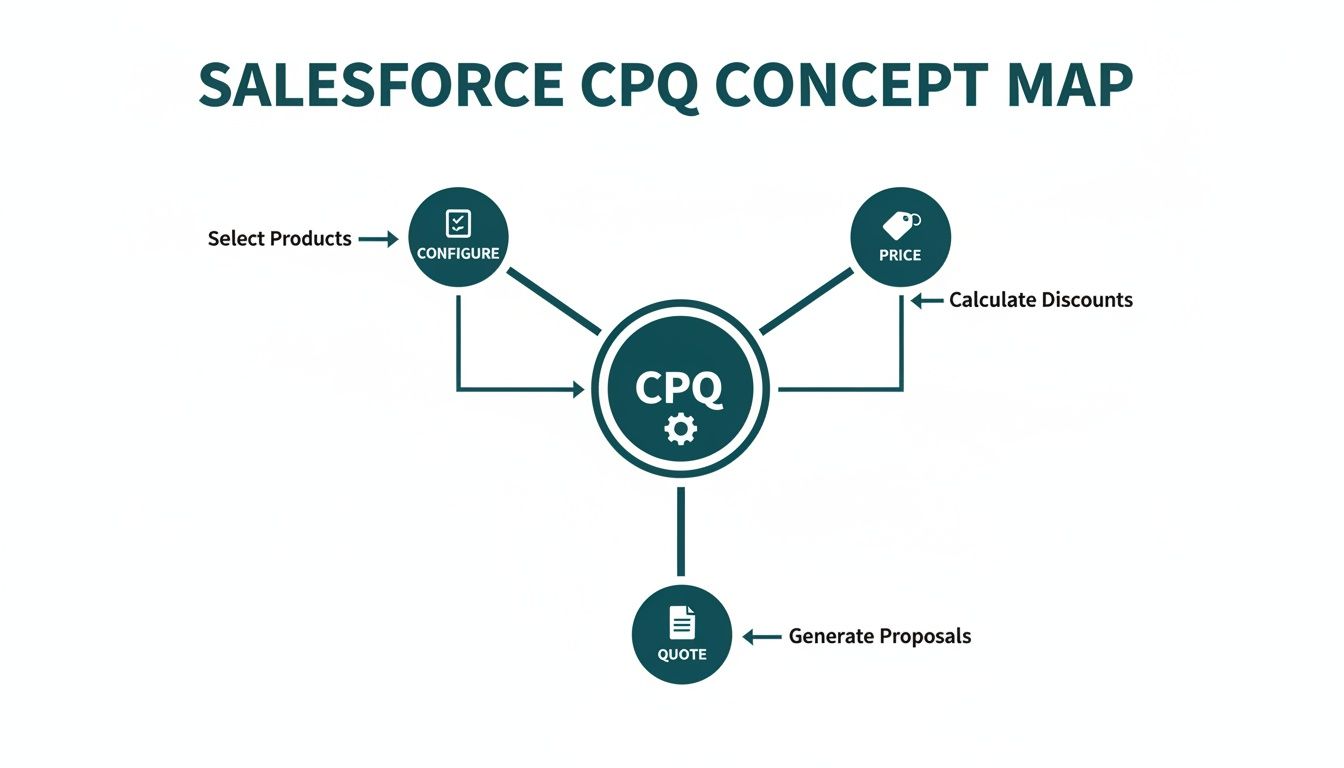
As you can see, each pillar is a distinct but essential stage in a smooth workflow, all driving towards faster, more accurate sales outcomes.
P is for Price: The Automated Pricing Engine
Once the products are correctly configured, the 'Price' pillar kicks in. This is the automated pricing engine that flawlessly executes your company's entire pricing strategy. It handles everything from standard list prices to the most complex, multi-layered discount scenarios, all without requiring manual calculations.
Case Study Snippet: A manufacturing client we partnered with went from a chaotic, multi-day discount approval process to a standardized system where pricing was applied instantly and correctly. This change alone protected their margins and cut their quote generation time by 70%.
The engine can manage numerous pricing models simultaneously, including partner-specific pricing, volume-based discounts, subscription fees, and regional price adjustments. Automating this within Salesforce ensures consistency and protects your profitability on every deal.
Q is for Quote: Generating Professional Proposals
The final pillar, 'Quote', takes the configured and priced deal and turns it into a professional, customer-facing document. Instead of reps wasting hours copying and pasting information into a Word template, Salesforce CPQ generates a polished proposal in minutes.
These documents are not just fast; they are accurate and consistent. They pull all necessary data directly from the Opportunity in Salesforce—product descriptions, quantities, pricing, customer details, and more.
Here’s what that means for your team:
- Branding Consistency: Every quote adheres to your company’s branding guidelines, presenting a unified and professional image.
- Dynamic Content: Templates can automatically include specific terms, marketing materials, or case studies relevant to the customer.
- Speed and Efficiency: What used to be hours of administrative work is reduced to a few clicks, freeing up reps to spend more time selling.
Together, these three pillars create powerful workflow automation right inside your sales process. By connecting Configure, Price, and Quote within your Salesforce CRM, you empower your team to focus on building customer relationships instead of being bogged down in paperwork.
The Real Business Impact of Implementing CPQ for Salesforce
Let's move beyond features and functions. The true measure of a CPQ for Salesforce solution is its tangible impact on your business—the results you can see on your bottom line. Implementing this technology is not just an IT project; it's a strategic business transformation that directly boosts revenue, efficiency, and customer satisfaction. It fundamentally changes how your sales team operates, shifting their focus from low-value admin to high-value selling.
The most immediate result you'll notice is a dramatic acceleration of your sales cycle. Quotes that once took hours or even days to assemble can be generated in minutes. This speed not only creates a better customer experience but also provides a significant competitive advantage over rivals still using manual processes.
Driving Revenue and Increasing Deal Size with CPQ
Think of Salesforce CPQ as a built-in revenue engine for your CRM. By embedding guided selling and smart recommendations into the quoting process, it systematically uncovers opportunities to add value to every deal.
Here are the key ways it delivers results:
- Automated Upselling: The system can be configured to prompt reps to offer premium versions or higher-tier service packages based on the customer's selections.
- Intelligent Cross-selling: CPQ suggests relevant add-ons and complementary products, ensuring no opportunity is missed.
- Protected Margins: With centralized control over pricing and discounts, you can eliminate rogue discounts that erode profitability. Every quote aligns with your business strategy.
This structured, intelligent approach consistently increases the average deal size, turning every quote into a revenue-maximization opportunity.
Case Study: A Professional Services Firm's Transformation
We worked with a professional services firm that was struggling with complex, multi-layered service agreements. Their sales team was spending nearly half its time wrestling with spreadsheets, manually calculating project costs, resource allocation, and service terms. The process was slow and error-prone, leading to customer dissatisfaction and delayed projects.
The Results: After implementing Salesforce CPQ, the firm recovered an average of 15 hours per salesperson per week. This was a fundamental shift that allowed them to reallocate 40% of their sales capacity from administrative work to client engagement and relationship building.
That newfound efficiency translated directly into a shorter sales cycle and higher win rates. Just as importantly, it boosted team morale and allowed them to focus on what they do best: strategic selling, not manual calculations.
The Australian Advantage in Numbers
This isn't just a hypothetical scenario; businesses across Australia are achieving these results. Local data shows that companies adopting Salesforce CPQ are making significant, measurable gains. Reports from Australian case studies typically show improvements of 15–30% in sales efficiency and a 40–60% reduction in quote generation time within the first year. For a 25-person sales team, that time saving is equivalent to adding three to six full-time employees, without the associated overheads.
This automation also streamlines your financial operations. To understand how CPQ fits into the broader financial picture, it's worth understanding the complete Order-to-Cash process. By ensuring every quote is 100% accurate from the start, CPQ for Salesforce eliminates the downstream chaos of order corrections and billing disputes. This builds greater trust and strengthens long-term customer relationships.
How to Prepare for a Successful CPQ Implementation
A successful rollout of CPQ for Salesforce begins long before any technical work starts. Think of it like laying the foundation for a building; the strength of the final structure depends entirely on the quality of your groundwork. One of the most common mistakes we see as a Salesforce partner is businesses rushing into implementation without a clear plan, which often leads to budget overruns, poor user adoption, and a system that fails to deliver.
This preparation phase is all about strategy. It involves taking a hard, honest look at your current sales processes, your product data, and your ultimate business goals. Dedicating proper time to this discovery stage sets the project up for a smooth, effective, and impactful transformation.
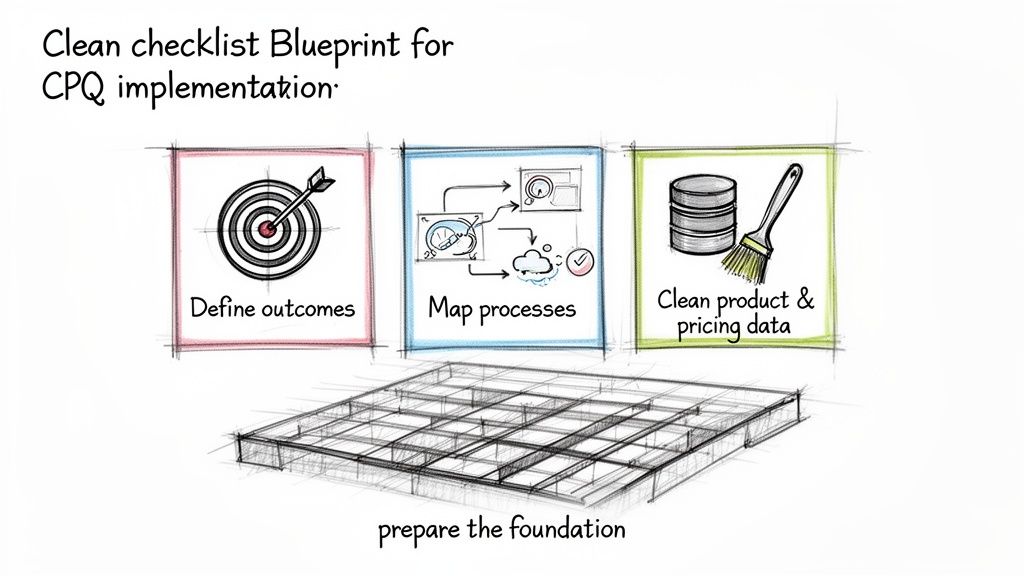
Define Your Business Outcomes First
Before you dive into features and functions, you must start with the "why." What specific business problems are you trying to solve with CPQ? Vague goals like "improving efficiency" are not enough. You need clear, measurable outcomes to guide every decision.
Gather your key stakeholders—sales leaders, finance, operations, IT—and ask pointed questions. This collaborative approach ensures everyone is aligned from day one.
- Which approval workflows are causing the biggest bottlenecks in our sales cycle?
- Where are we leaking the most revenue from unapproved discounts or configuration errors?
- How do we currently handle complex scenarios like multi-year contracts, subscriptions, or product bundles?
- What is our target for reducing quote generation time? From hours to minutes?
Having these answers provides a clear benchmark for success and helps prioritize which CPQ features to implement first.
Map Your Processes and Clean Your Data
Once your goals are defined, the next step is to map your current sales process from end to end. This exercise often reveals hidden roadblocks and complexities. You need to understand every step a quote takes, from initial creation to the final customer signature.
Lesson Learned: The single biggest hurdle in any CPQ implementation is almost always data quality. A powerful CPQ engine is useless if it's running on inaccurate or inconsistent product and pricing data.
This brings us to the most critical pre-implementation task: cleansing your product and pricing data. This is non-negotiable. You must establish a single source of truth for all your SKUs, product descriptions, pricing tiers, and discount rules. Attempting to build a CPQ system on a foundation of messy spreadsheets is a recipe for failure.
Engage a Salesforce Partner Early
A CPQ implementation is a complex project. It demands more than just technical skill; it requires deep expertise in sales process re-engineering and change management. This is where a certified Salesforce partner becomes your most valuable asset. An experienced partner brings a wealth of knowledge from countless projects, helping you sidestep common pitfalls and avoid costly mistakes.
A key part of preparation is understanding how different tools will connect. For example, knowing how Mindstamp's integration with Salesforce works provides insight into the wider ecosystem you're building. A partner helps you plan for these integrations, ensuring your CPQ solution communicates seamlessly with other critical business systems like your ERP or billing platform. Getting this system integration right is a cornerstone of a successful digital transformation.
By bringing an expert on board early, you elevate a software installation into a strategic business initiative—one that's truly tailored to your unique needs and set up for long-term success.
The Future of Quoting: CPQ with AI and Automation
The future of quoting is already here, driven by the powerful combination of Artificial Intelligence (AI) and CPQ for Salesforce. While traditional CPQ excels at following predefined rules, the next generation injects intelligence into every step of the process. This evolution transforms your quoting tool from a simple calculator into a strategic advisor, actively helping your sales team make smarter, faster, and more profitable decisions.
AI is fundamentally rewriting what’s possible within the quoting process. It goes beyond simple automation, offering predictive insights and proactive guidance that gives your reps the confidence to close complex deals with precision. This shift is part of a broader trend towards digital transformation in sales.
AI-Driven Price Optimisation
One of the biggest game-changers AI brings to CPQ is price optimisation. Forget static price lists and rigid discount tiers. An AI-powered CPQ can analyze vast amounts of historical data—past deals, win/loss rates, customer segments, and market trends—to recommend the optimal price for every quote.
This intelligent engine helps find the sweet spot: a price that maximizes your chance of winning the deal without sacrificing profit margins. It can flag when a slightly larger discount might be needed to secure a strategic account or, conversely, when a customer is likely to pay a premium.
Intelligent Product Recommendations
AI also delivers intelligent product recommendations. By analyzing the buying patterns of similar customers and identifying successful product combinations from past deals, the system can suggest relevant upsells and cross-sells directly within the quoting interface.
Best Practice Tip: This turns quoting from a reactive task into a proactive sales opportunity. The system essentially acts as a digital sales coach, suggesting, "Customers who bought Product A also frequently bought Product B and achieved great results."
This guided selling approach ensures your reps never miss an opportunity to add value and increase the overall deal size, making every quote more robust and profitable.
Automated Contract Analysis and Risk Flagging
Beyond products and pricing, AI is making an impact in the final proposal and contract stages. New capabilities are emerging for automated contract analysis, where the system scans documents for non-standard terms, potential risks, or clauses that deviate from company policy.
This instantly flags potential issues for legal or management review, dramatically reducing the approval cycle and minimizing your organization's exposure to risk.
This trend is accelerating in Australia. As reported in these insights from Salesforce Australia, the adoption of AI-driven tools that integrate with quoting workflows is surging. Salesforce’s Agentic Enterprise Index reveals that agent creation among early-adopter companies rocketed up by 119% in the first half of 2025. Furthermore, Australian consumers who regularly use AI agents report 64% higher satisfaction. These AI investments are highly relevant to CPQ, as they can auto-suggest product bundles and fine-tune pricing, slashing errors and shortening sales cycles.
By embracing these smart cloud solutions, Australian businesses are not just making their quoting faster; they are embedding intelligence deep into their sales DNA, setting themselves up for a more agile and competitive future.
Why a Salesforce Partner Is Key to CPQ Success
Implementing a CPQ for Salesforce solution is a significant undertaking. It's not a simple software installation; it's a fundamental business transformation. It involves redesigning core sales processes, managing complex data, and guiding your team through substantial change. Attempting this alone is risky and can often lead to budget overruns and a solution that fails to meet business objectives.
This is precisely where a certified Salesforce partner becomes your most valuable asset. A seasoned partner brings much more than technical product knowledge. They offer deep industry experience, a playbook of proven best practices from dozens of similar projects, and the strategic foresight to steer you clear of common and costly mistakes.
Beyond Technical Skill: Business Process Expertise
A great Salesforce partner acts as a translator, bridging the gap between your business goals and CPQ's technical capabilities. They don't start with the technology; they start by deeply understanding your unique commercial challenges. Are you dealing with complex rebate structures in manufacturing or tricky subscription bundles in professional services?
Their role is to challenge your assumptions and help you re-engineer workflows for maximum efficiency before any technical work begins. This strategic guidance ensures your CPQ solution isn’t just a new version of an old, broken process but a streamlined engine built for real growth.
Lesson Learned: A partner’s true value lies in their ability to see the bigger picture. They ensure your CPQ project aligns with your long-term business goals, delivering a clear return on investment, not just another piece of technology.
Navigating the Australian Salesforce Ecosystem
Working with a local Salesforce partner is particularly critical in Australia. The regional ecosystem is booming, with Salesforce-related activity driving significant tech revenue and innovation. Salesforce has backed over 100 certified partners in Australia and established AUD-denominated funds to support the local tech scene, creating huge demand for specialist skills like CPQ implementation. You can read more about the Salesforce ecosystem in Australia and New Zealand to understand this dynamic environment.
An Australian-based partner understands these local market nuances and has established relationships within this network. They are experts at guiding you through critical project phases, such as:
- Data Migration: Ensuring your product and pricing data is clean, structured, and ready for a seamless transition.
- System Integration: Connecting CPQ with your existing ERP, finance, and billing systems to create a unified flow of information.
- Change Management: Preparing your sales team for the new system with targeted training and support to drive high user adoption.
Choosing the right partner means gaining an ally invested in your success. A skilled Salesforce implementation consultant transforms a complex project into a manageable and successful initiative, guaranteeing your investment in CPQ for Salesforce delivers lasting value.
FAQ: Common Questions About CPQ for Salesforce
When business leaders and sales managers explore ways to improve their sales process, a few common questions about Salesforce CPQ always arise. Getting clear answers is key to making an informed decision and setting your team up for success.
We’ve gathered the most frequent queries we hear from our clients to provide a straightforward overview.
How long does a typical CPQ for Salesforce implementation take?
A typical CPQ for Salesforce implementation usually takes between 8 to 16 weeks. The final timeline depends on the complexity of your product catalogue, pricing rules, and the number of approval workflows required.
From our project experience, a phased approach works best. We recommend starting with core features to secure quick wins and then building on that foundation over time. This makes the process more manageable and helps your team adapt without feeling overwhelmed.
What is the difference between Salesforce CPQ and standard quoting in Sales Cloud?
The standard quoting tool in Sales Cloud is suitable for businesses with simple product lists and straightforward pricing. However, when complexity increases, Salesforce CPQ becomes essential.
CPQ is built to handle advanced scenarios that standard quoting cannot, including:
- Configurable Products and Bundles: It guides reps through building valid product combinations.
- Subscription and Usage-Based Pricing: It automates recurring revenue models, from subscriptions to pay-as-you-go.
- Automated Discounting Tiers: It enforces your pricing strategy automatically, protecting margins.
- Guided Selling: It acts as a digital coach, suggesting upsells and cross-sells to maximize every deal.
In short, if your sales process involves customization, layered pricing, or subscriptions, CPQ isn't just an upgrade—it's a necessity.
How does Salesforce CPQ handle subscriptions and renewals?
Salesforce CPQ is expertly designed to manage the entire subscription lifecycle. It accurately prices recurring services and simplifies co-terming, effortlessly aligning end dates when a customer adds new products mid-contract.
The key benefit is its automation of the renewal process. The system proactively generates renewal opportunities and quotes well before a contract expires. This single feature dramatically reduces manual work, prevents revenue leakage from missed renewals, and improves the accuracy of your sales forecast.
Navigating the complexities of a CPQ implementation requires an experienced partner. At Adaptal, we are a trusted Salesforce partner dedicated to translating your unique business challenges into a powerful CRM solution that drives real results.
Ready to transform your quoting process? Contact our Salesforce experts today.