
Walk down any aisle in an Australian supermarket, and you're in the heart of the Fast-Moving Consumer Goods (FMCG) industry. It's the world of everyday essentials—food, drinks, toiletries, cleaning supplies—that fly off the shelves. This is a game of volume and velocity, where thin profit margins and fierce competition are the norm. To win, you need to be fast, efficient, and build a brand that people trust and come back to.
Understanding The Modern Australian FMCG Landscape
The Australian FMCG sector isn't for the faint-hearted. It's a high-stakes environment where the slightest edge in your operations can translate into huge gains in market share. For the small and mid-sized brands trying to get a foothold, the biggest challenge is clear: competing against the retail giants who own the shelf space and the customer's attention. This is where being nimble and truly understanding your customer becomes your superpower.
Success here is about much more than just having a fantastic product. It demands a smart, cohesive strategy for managing every single step of the journey, from the factory floor to the customer's shopping trolley. For those in the food sector, for instance, things like effective film packaging for food safety and freshness are non-negotiable for building consumer trust.
The Pillars of Success in Australian FMCG
To really get a feel for the competitive pressures, you just have to look at the numbers. In 2023, Australia’s FMCG food retail sector pulled in roughly AUD 168 billion in revenue. A massive slice of that pie—about AUD 139 billion—came from supermarkets alone. This tells you everything you need to know about the dominance of the major chains and just how volume-driven this business is.
If you want to thrive in this market, you have to master a few key areas:
- Speed to Market: Getting your products from the warehouse to the shelf has to be a well-oiled machine. Any delay in the supply chain is a lost sale and an open door for your competitors.
- Retailer Relationships: You need strong partnerships with distributors and the big retailers. It’s the only way to secure decent shelf space and run in-store promotions that actually work.
- Customer Loyalty: With a dizzying amount of choice on offer, building a real connection with your customers is everything. Loyalty programs and personalised marketing aren't just nice-to-haves; they're essential for driving repeat business.
The Role of Salesforce in Gaining an Edge
This is exactly where a powerful CRM platform like Salesforce becomes a game-changer for growing businesses. It provides the digital backbone you need to manage the complexity of your operations while building those all-important customer relationships. As a trusted Salesforce partner, we've seen firsthand how the right technology implementation can level the playing field.
For an FMCG business, data is as valuable as inventory. A unified CRM platform transforms raw data from sales, service, and marketing into actionable intelligence, allowing brands to anticipate consumer needs and outperform competitors.
By pulling all your disparate systems together and giving you a single, clear view of your customer, Salesforce helps you leapfrog common industry hurdles. It can automate sales processes, simplify intricate supply chain communications, and help you deliver the kind of personalised experiences that today’s shoppers have come to expect. This isn’t just a tech upgrade; it’s fundamental to your survival and growth.
Getting To Grips With Key Segments And Major Players
The Australian FMCG industry can feel like a sprawling ecosystem, but it really boils down to three core categories: food and beverages, personal care, and household care. While everything moves fast in this sector, the day-to-day pressures look very different depending on where you sit.
Food and beverage brands are in a constant battle with cold chain logistics and razor-thin margins. Personal care companies live and die by brand loyalty and the latest consumer trends. Meanwhile, household care operators are locked in a fierce fight over price and perceived effectiveness. For any business trying to make its mark, getting your head around these nuances is the first, most crucial step.
Australian FMCG Market Segmentation At A Glance
To put this into perspective, let's break down the landscape. The following table gives a clear snapshot of the main segments, the kinds of products you'll find in each, and the unique challenges businesses face.
| FMCG Segment | Key Product Categories | Primary Business Challenges |
|---|---|---|
| Food & Beverages | Fresh produce, packaged foods, dairy, snacks, alcoholic and non-alcoholic drinks. | Managing complex supply chains, ensuring food safety and compliance, handling price sensitivity, and dealing with short shelf-life logistics. |
| Personal Care | Skincare, haircare, cosmetics, oral care, and grooming products. | Building strong brand loyalty, keeping up with fast-changing consumer trends (e.g., sustainability, clean beauty), and managing high marketing costs. |
| Household Care | Cleaning supplies, laundry detergents, paper products, and air fresheners. | Competing heavily on price, demonstrating product effectiveness, and navigating strict chemical and environmental regulations. |
Understanding which box you fit into is fundamental. It shapes everything from your distribution strategy to your marketing message and the Salesforce solution you need to tie it all together.
The Retail Duopoly And The Rise Of The Challenger
It’s no secret that the competitive landscape is dominated by a powerful retail duopoly. For many brands, getting prime shelf space in one of the major supermarkets feels like the ultimate prize. But that’s only half the picture. While the big players have immense scale, the industry itself is made up of a huge number of operators.
As of mid-2024, there were over 155,000 retail trade businesses ticking along in Australia. More specifically, industry research pegs the number of Consumer Goods Retailing businesses at around 85,272, generating a massive AUD 252.7 billion. These numbers tell a fascinating story: massive revenue is concentrated at the top, but there's a vibrant, fragmented "long tail" of smaller retailers.
This creates a dynamic where independent grocers, specialty stores, and discount chains can thrive by carving out their own niches and serving specific communities.
Case Study: How a Challenger Brand Manages Growth
Let’s imagine a small, ambitious Aussie brand called "Outback Organics," producing premium, locally sourced condiments. Their biggest challenge isn't just making a fantastic product; it's weaving through the complex web of relationships needed to get that product from their kitchen into a customer's shopping trolley.
- The Challenge: They struggle with disconnected processes. Distributor conversations are lost in emails, retailer orders are tracked on spreadsheets, and customer feedback from social media is completely siloed from their sales data.
- The Salesforce Solution: They implement Salesforce CRM as their central hub. Now, every interaction—from a distributor call to a retailer order or a customer Instagram DM—is captured in one place.
- The Results: Outback Organics can now track their sales pipeline with distributors, manage retailer promotions effectively, and use customer feedback to inform product development. They have a single source of truth, allowing their small team to operate with the efficiency of a much larger company.
Every single one of these relationships is a critical data point. This is exactly why a well-implemented CRM isn’t a luxury—it’s essential for survival and growth.
A CRM acts as the central nervous system for an FMCG brand. It tracks every conversation with a distributor, every order from a retailer, and every interaction with a customer, turning isolated activities into a cohesive growth strategy.
For the thousands of smaller businesses that make up the backbone of the FMCG industry in Australia, this level of organisation is the key to competing. A robust platform like Salesforce gives challenger brands the operational control they need to punch well above their weight.
If you're curious about the major players these smaller brands are up against, you can explore our detailed guide on the leading FMCG companies in Australia.
Solving Complex Supply Chain And Distribution Hurdles
Australia's sheer scale creates some serious logistical headaches for the FMCG industry. Trying to manage the vast distances, unpredictable weather, and the razor-thin, just-in-time inventory demands from major retailers can feel like you're constantly fighting fires. For many mid-sized companies, the day-to-day reality is a messy patchwork of spreadsheets and manual processes that give them zero real-time visibility into their own supply chain.
This lack of a single, unified view causes a domino effect of expensive problems. Inconsistent stock levels lead to those frustrating out-of-stock signs on retail shelves, which chips away at your brand's reputation and practically invites competitors to swoop in. When your order management systems are disjointed, errors and delays become the norm, and poor coordination with logistics partners means missed delivery windows and seriously strained relationships.
Case Study: A Beverage Brand's Bottleneck
Let's look at a common project scenario. A mid-sized beverage company is struggling to keep up with surging demand.
- The Challenge: Their sales team, working in one system, just landed a massive promotional deal with a national supermarket chain. At the exact same time, their warehouse team, operating on a completely separate platform, gets word of an unexpected delay in a critical shipment of raw materials.
- The Breakdown: Because these systems don't talk to each other, the company confidently commits to an order it simply cannot fulfil on time. The result? A costly stockout, a very unhappy retail partner, and a team left scrambling to pick up the pieces. This scenario gets right to the heart of a core pain point for so many in the FMCG industry Australia: disconnected data is a direct path to operational failure.
This infographic gives you a bird's-eye view of the journey products take within the Australian FMCG ecosystem, from the factory floor to the customer's pantry.
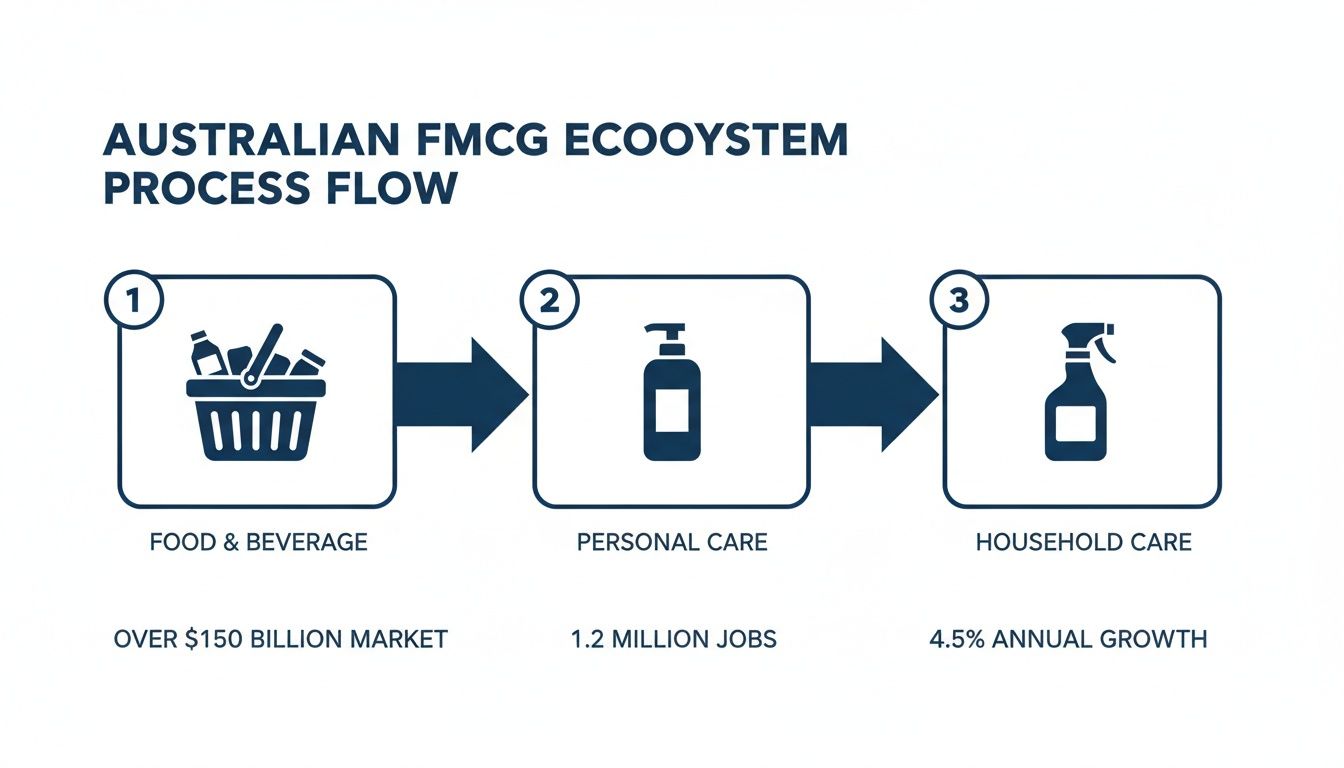
As you can see, whether it's food, personal care, or household goods, every product follows a similar path through a complex network to finally reach the end consumer.
The Salesforce Solution: Creating A Single Source Of Truth
The only way to break this cycle of chaos is to establish a single, reliable source of truth across the entire operation. This is achieved by integrating a powerful CRM like Salesforce with the company's Enterprise Resource Planning (ERP) system. The CRM is your command centre for all customer and partner interactions, while the ERP handles the nuts and bolts of inventory, financials, and core logistics.
When you connect these two platforms, the siloed data that crippled the beverage company is replaced by a shared, real-time view of the entire business. Suddenly, everyone—from the sales reps out in the field to the managers on the warehouse floor—is working from the same playbook.
Integrating Salesforce with an ERP system is like giving your business a central nervous system. It connects the 'brain' (customer data and sales strategy) to the 'body' (inventory and logistics), ensuring every part works in perfect concert.
Using Salesforce to Unify the Supply Chain
Specific Salesforce tools are built to solve these exact challenges, turning supply chain visibility from a lofty goal into a daily reality.
- Sales Cloud for Demand Forecasting: Your sales teams log orders and track promotional pipelines directly in Salesforce. This data feeds into an accurate, real-time picture of upcoming demand, allowing for much sharper and more proactive inventory planning.
- Experience Cloud for Partner Collaboration: Instead of drowning in endless email chains and phone calls, your distributors and logistics partners can log into a secure, dedicated portal. Here, they can see inventory levels, track order statuses, and pull any necessary documentation, all in one spot.
This level of transparency doesn't just improve efficiency; it strengthens relationships across your entire value chain. Furthermore, when tackling the nitty-gritty of sourcing and logistics, having clear insights into details like reliable sea freight from China to Australia can make a huge difference to your bottom line. By connecting every partner on a single platform, an Australian FMCG business can finally shift from being reactive to proactive, anticipating problems before they happen and making sure products are always exactly where they need to be.
Boosting Sales And Retail Execution With Sales Cloud
In the fast-paced FMCG industry Australia, the real battle is won or lost on the shop floor. For any brand with a distributed field sales team, trying to manage hundreds of retail accounts across vast territories is a monumental task. Without the right tools, it’s an exercise in inefficiency, plagued by vague visit schedules, clunky paper-based order forms, and absolutely zero real-time insight into what’s happening on the shelves.
This operational gap quickly turns into a major headache. Sales reps end up spending more time on admin than actually building relationships with store managers. Back at HQ, management has little visibility into team performance, making it impossible to know which promotions are hitting the mark or which retail channels are falling behind. It’s a classic business challenge that directly eats into the bottom line, stifles growth, and weakens those all-important retailer partnerships.
Case Study: Transforming a Field Sales Team
Let's look at a common project we encounter with mid-sized Aussie snack food companies.
- The Challenge: They have a sales team of 20 reps covering three states, trying to crack the independent grocery store market. Their process is chaotic. Reps use personal calendars for rough route planning, scribble orders on notpads, and take photos of displays that get lost in messy email chains.
- The Salesforce Solution: We step in as their CRM partner to implement Salesforce Sales Cloud. The objective is to swap manual chaos for intelligent automation and give the entire team a single, powerful platform to manage retail execution.
- The Results: Reps now use Salesforce Maps for optimised route planning, cutting down travel time. On their mobiles, they access each store's order history, capture new orders digitally, and use in-app checklists to verify promotional displays. Management gets real-time dashboards showing sales performance, rep activity, and promotion effectiveness.
How Salesforce Sales Cloud Solves FMCG Sales Challenges
The table below really breaks down the practical shift from old frustrations to new, efficient solutions based on real project outcomes.
| FMCG Sales Challenge | Salesforce Sales Cloud Solution | Business Benefit |
|---|---|---|
| Inefficient route planning and wasted travel time. | Salesforce Maps creates optimised daily routes based on location, priority, and appointment times. | Increased number of store visits per day, reduced fuel costs, and more time for relationship building. |
| Manual, error-prone order taking on paper. | Mobile-first digital order forms allow reps to capture orders directly in the app, with real-time product catalogues and pricing. | Faster order processing, elimination of data entry errors, and immediate sync with the inventory system. |
| Lack of visibility into in-store promotion execution. | In-app checklists and photo capture for verifying planogram compliance and promotional display setup. | Real-time proof of execution for trade marketing spend and quick identification of non-compliant stores. |
| Disconnected performance tracking and reporting. | Customisable dashboards and reports give managers a live view of sales targets, rep activity, and top-performing products. | Data-driven decision-making, effective performance management, and the ability to pinpoint successful strategies. |
This isn't just about tweaking a few processes; it’s a complete operational upgrade that delivers clear, tangible results from the field to the boardroom.
Driving Tangible ROI Through Efficiency
With these tools in their hands, the snack company’s field reps are no longer just order-takers. They become strategic partners to their retail accounts. They can have informed conversations about sales trends, suggest new product placements based on solid data, and resolve issues on the spot. This improved level of service strengthens relationships and builds the trust needed to secure better shelf space and more prominent promotional displays.
For a field sales team, Salesforce isn't just a CRM—it's a mobile command centre. It empowers them with the data and tools needed to make every store visit count, turning routine check-ins into revenue-generating opportunities.
For management, the benefits are just as profound. Dashboards provide a clean, real-time picture of performance against targets. They can see which reps are knocking it out of the park, which products are flying off the shelves, and which promotional strategies are delivering the highest ROI. This data-driven oversight allows them to make smarter decisions, allocate resources more effectively, and provide targeted coaching to the team.
To understand how this core platform can be adapted for your business, you can explore the powerful features of Salesforce Sales Cloud and see how it fits different business models. The end result is a more efficient, accountable, and ultimately more successful sales operation.
Forging Lasting Customer Loyalty on a Unified Platform
In the hyper-competitive Australian FMCG industry, where a shopper can switch brands in a heartbeat, customer loyalty is the ultimate currency. A one-off purchase is nice, but it's the consistent, repeat business that actually builds a sustainable brand.
The problem is, creating this loyalty has become incredibly complex. Customer interactions are now fragmented across a dozen different channels, from social media DMs to in-store promotions.
This creates a huge challenge for many growing Australian FMCG companies. Imagine a brand running a popular Instagram page, an e-commerce website, and in-store promotions with its retail partners. The data from each of these touchpoints exists in its own isolated silo, offering a fractured, incomplete picture of who their customers truly are.
With this disconnected approach, meaningful engagement is almost impossible. A customer who abandons their online cart might be the same person who just signed up for a loyalty program in-store. Without a unified system, the brand is flying blind. Marketing efforts feel generic, and customer service calls lack the personal context needed to build real rapport.
The Salesforce Solution: Creating a Single View of the Customer
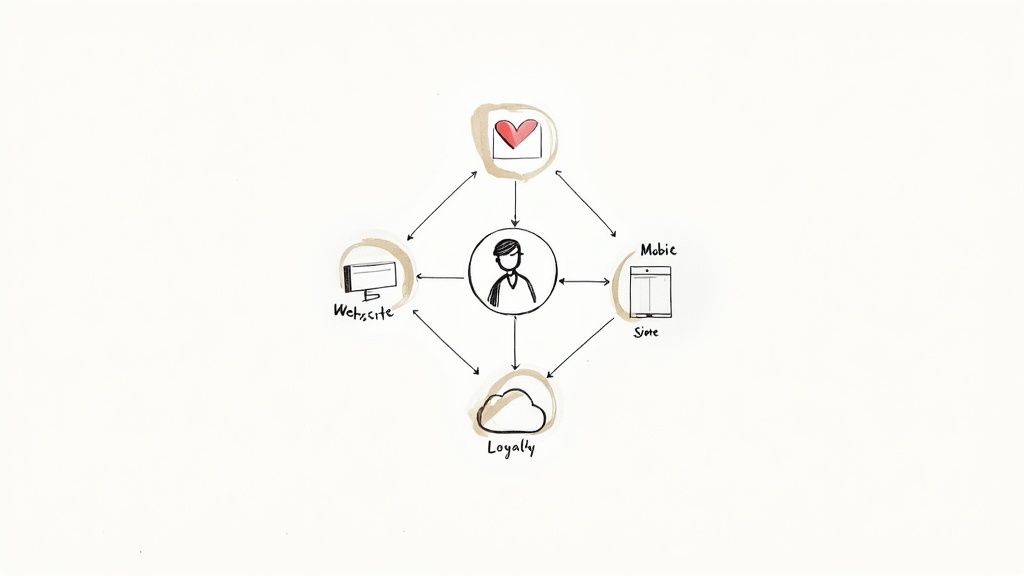
The only way to fix this fragmentation is by bringing all your customer data together onto a single, unified platform. This is where Salesforce comes in, acting as the central hub for every single customer interaction. It builds a rich, 360-degree view that completely changes how you connect with your audience.
A 360-degree customer view isn't just another marketing buzzword; it’s a strategic imperative. It allows FMCG brands to move beyond simple transactions and build genuine, lasting loyalty by understanding and anticipating the needs of every customer.
By integrating every touchpoint—from social media likes to purchase histories and service tickets—a brand can finally see the complete customer journey. This comprehensive insight is the foundation for delivering the kind of personalised experiences that turn casual buyers into passionate advocates. It’s also where different customer retention strategies become far more effective, simply because you have data-driven clarity.
Powering Personalised Journeys and Exceptional Service
With a unified customer profile in place, specific Salesforce tools can then be used to build and nurture loyalty with incredible precision.
- Salesforce Marketing Cloud: This platform allows you to design and automate highly personalised customer journeys. For example, if a customer buys a particular product, Marketing Cloud can automatically trigger a follow-up email with usage tips, related recommendations, or a special offer. It also powers sophisticated loyalty programs that reward customers for repeat business across all channels.
- Salesforce Service Cloud: When a customer has a query, Service Cloud gives your support team instant access to their entire history. They can see past purchases, previous interactions, and loyalty status, allowing them to provide fast, contextual support on any channel—phone, email, or social media. This turns a potential complaint into a positive, brand-affirming experience.
The Tangible Results of a Unified Approach
For an FMCG business, implementing a unified platform has a direct impact on the bottom line. Personalised marketing leads to higher engagement and conversion rates, while exceptional service reduces churn and builds a reputation for reliability.
Research shows that within the Consumer Goods & Retail sector, brands that are active and engaging on platforms like LinkedIn can see engagement rates as high as 3.9%, significantly above average. This just goes to show the power of consistent, relevant communication.
By pulling everything together on a unified Salesforce platform, brands in the Australian FMCG market can finally connect the dots between marketing, sales, and service. This cohesive approach not only improves operational efficiency but, more importantly, fosters the deep-seated customer loyalty required to thrive in a crowded marketplace.
Unifying Your Partner Ecosystem With Experience Cloud
Let's be honest, success in the Australian FMCG game is impossible without a rock-solid network of distributors, retailers, and suppliers. But for so many brands, managing this ecosystem is a constant headache. Communication gets messy—bogged down in endless email chains, frantic phone calls, and outdated manual order forms. It all creates friction and costly delays.
This isn't just a minor annoyance; it directly hurts your ability to get products on shelves quickly and reliably. When a distributor can't get a simple answer on stock levels, or a retailer struggles to find the latest marketing assets for a big promotion, opportunities are missed. It's a common challenge that slowly chips away at the very partnerships you need to grow.
Creating A Digital Front Door For Your Partners
This is where Salesforce Experience Cloud completely changes the dynamic. It allows you to create secure, branded, self-service portals for your partners. Think of it as a digital front door for your entire ecosystem. Instead of chasing your team for information, partners can log in to a single, centralised hub built just for them.
It's a simple concept that creates a seamless, professional experience, empowering your partners while freeing up your team's time.
Let's walk through a real-world scenario. A key distributor for a growing Australian food brand needs to place a large order for an upcoming holiday promotion. Here's how Experience Cloud transforms that process:
- Real-Time Inventory and Ordering: The distributor logs into the portal and sees live inventory levels for every single product. They place their order right there in the system, which means no more data entry errors or back-and-forth delays.
- Access to Marketing Assets: They can instantly download pre-approved marketing materials, product images, and campaign guidelines, ensuring your brand looks consistent across every single retail location.
- Shipment and Order Tracking: As soon as the order is confirmed, they can track its status in real-time—from the moment it's picked in the warehouse to its final delivery. Total visibility, zero phone calls.
This self-service model shifts the relationship from a reactive, manual chore into a proactive, efficient partnership.
Integrating For A Seamless Value Chain
Now, the true power of a partner portal is unlocked when it’s wired into your core business systems. Integrating Salesforce Experience Cloud with your ERP is non-negotiable. This is what ensures that the inventory data your distributor sees in the portal is the exact same data your warehouse team is looking at.
A partner portal is more than a communication tool; it’s an extension of your business. When integrated correctly with your ERP, it ensures that every partner, from supplier to retailer, is operating from a single source of truth.
This seamless flow of data across the entire value chain is fundamental. It prevents stockouts caused by mismatched information and ensures orders placed in the portal are processed instantly. For any business looking to scale, this kind of operational cohesion isn't a luxury—it's essential for keeping your partners happy and staying competitive.
By giving your partners the tools they need to succeed, you build a more resilient and collaborative ecosystem. Contact us to chat about how a Salesforce Experience Cloud portal can strengthen your channel partnerships.
FAQ: Answering Your Questions About Salesforce for FMCG
When you're deep in the trenches of Australia's FMCG sector, questions about the right tools to get ahead are always bubbling up. We often hear from decision-makers trying to figure out how a platform like Salesforce can genuinely solve the specific, day-to-day challenges they face.
So, let's tackle some of the most common questions we get from Australian FMCG leaders, drawing from our hands-on experience with real-world projects.
How Can Salesforce Help a Small FMCG Brand Compete with the Giants?
For a smaller or emerging brand, Salesforce isn't just another tool; it's the great equaliser. It helps you punch above your weight, not by matching the big guys' budgets, but by making you smarter and faster.
Think about it. It lets your small team manage complex distributor relationships, see exactly what your field reps are doing, and use real data to spot those niche opportunities the major players are too slow to notice. Plus, with a tool like Marketing Cloud, you can run incredibly targeted digital campaigns that build a loyal following with an agility your competitors can only dream of. It's all about getting the absolute most out of every person and every dollar.
Salesforce gives challenger brands an edge by swapping out manual grunt work for intelligent automation. This frees up your team to do what they do best: build relationships, innovate products, and outmanoeuver the competition.
Is Salesforce Actually Any Good for Managing Trade Promotions?
Absolutely. This is one of the areas where it truly shines. Salesforce Sales Cloud is practically built for the complexities of trade promotion management. It gives you one central place to plan your campaigns, coordinate execution in the field, and, most importantly, measure the real return on investment (ROI) for every dollar you spend.
Your field reps can use the Salesforce mobile app right from the supermarket aisle. They can instantly verify that displays match the planogram, snap photos of the promotion in action, and report back in real time. For management, this means no more guessing games. You get an immediate, clear picture of which promotions are actually driving sales, ensuring your marketing spend isn't just being thrown into a black hole.
What's the Single Biggest Hurdle with a Salesforce Integration?
When you're connecting Salesforce to your ERP system, the biggest challenge, without a doubt, is getting the data synchronisation right. Your entire operation—from stock levels to pricing to order fulfilment—hinges on clean, accurate data flowing between these two systems without a hitch.
A successful integration is all about meticulous data mapping. You have to ensure the customer and sales information in Salesforce speaks the same language as the financial and inventory data in your ERP. The ultimate goal is to create one undisputed source of truth. Get this wrong, and you're looking at data conflicts that lead to stockouts, pricing errors, and major disruptions to your supply chain. This is one area where partnering with an experienced Salesforce integration specialist is non-negotiable—it saves you from incredibly costly mistakes down the line.
Ready to see how Salesforce can be tailored to the unique rhythm of your FMCG business? The team at Adaptal has deep experience helping Australian brands bring their sales, service, and marketing operations under one roof. Contact us today for a personalised consultation.