
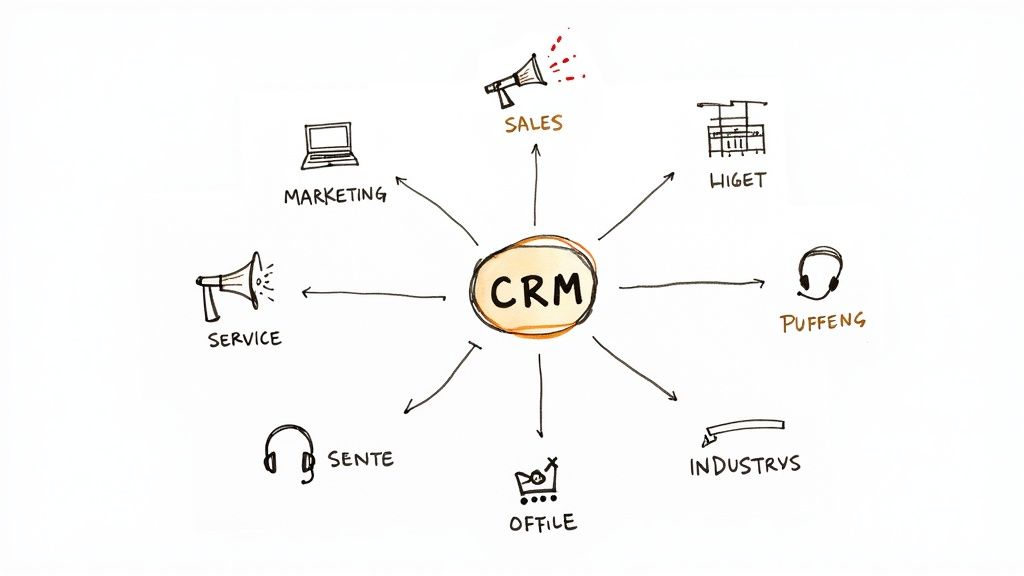
If you've heard the term CRM, you might think it's just another piece of business jargon or complex software only large corporations need. But at its core, Customer Relationship Management (CRM) is a straightforward, powerful strategy: it’s about managing every relationship and interaction your company has with current and potential customers.
The real goal? Improve those relationships to grow your business. A well-implemented CRM strategy, powered by a platform like Salesforce, helps you stay connected, streamline internal processes, and ultimately, drive revenue.
Beyond the Acronym: What Is Customer Relationship Management?
Let's cut through the buzzwords. Think of a CRM as the central nervous system for every client interaction. It’s a strategic shift away from messy spreadsheets, scattered notes, and siloed conversations toward a unified system that helps you understand your customers on a much deeper level.
A powerful CRM platform like Salesforce centralises this vital information, transforming it from disorganised data into one of your most valuable assets. This allows your sales, service, and marketing teams to build stronger, more profitable, and lasting relationships from a single source of truth.
The investment in this approach is serious and growing fast. In Australia, the CRM market was valued at USD 1.97 billion in 2024. That figure is projected to skyrocket to USD 5.01 billion by 2033, demonstrating how essential this technology has become for Australian businesses aiming for digital transformation.
How Salesforce CRM Solves Business Challenges
A CRM system gives everyone in your organisation—from sales and marketing to customer service—a single, shared view of every customer. This unified perspective is the key to delivering a consistent and high-quality customer experience, every single time.
A modern CRM is the backbone for several key business functions. Here’s how Salesforce empowers businesses to master their customer relationships.
Core Functions of a Modern CRM Platform
| Function | What It Achieves for Your Business |
|---|---|
| Contact Management | Securely stores customer contact info, communication history, and key details in one organised place. No more hunting for notes. |
| Sales Management | Tracks leads from first contact to closed deal, manages sales pipelines, and automates tasks so your team can focus on selling. |
| Customer Service | Manages support tickets and service requests efficiently, ensuring customer issues are resolved quickly and effectively. |
| Marketing Automation | Helps you create, manage, and measure targeted marketing campaigns to nurture leads and engage your audience. |
Ultimately, this puts the customer right where they should be: at the very centre of your operations.
"A CRM system is the single source of truth for your business. It allows your sales, service, and marketing teams to work together seamlessly, ensuring every customer feels understood and valued."
Strong relationships are built on effective communication, and a CRM system is designed to foster exactly that. For more on this, it's worth exploring some client communication best practices.
By having a clear, data-driven view of your customer's entire journey, you can start making smarter decisions, anticipating their needs, and building the kind of loyalty that drives real, sustainable growth.
The Three Pillars of a Powerful CRM System
A truly effective CRM system isn't just a single piece of software; it's a connected ecosystem built on three core pillars: Sales, Marketing, and Service. When these functions work together within a platform like Salesforce, they create a seamless journey that turns prospects into loyal customers.
Think of it as a three-legged stool—if one leg is weak, the entire structure becomes unstable.
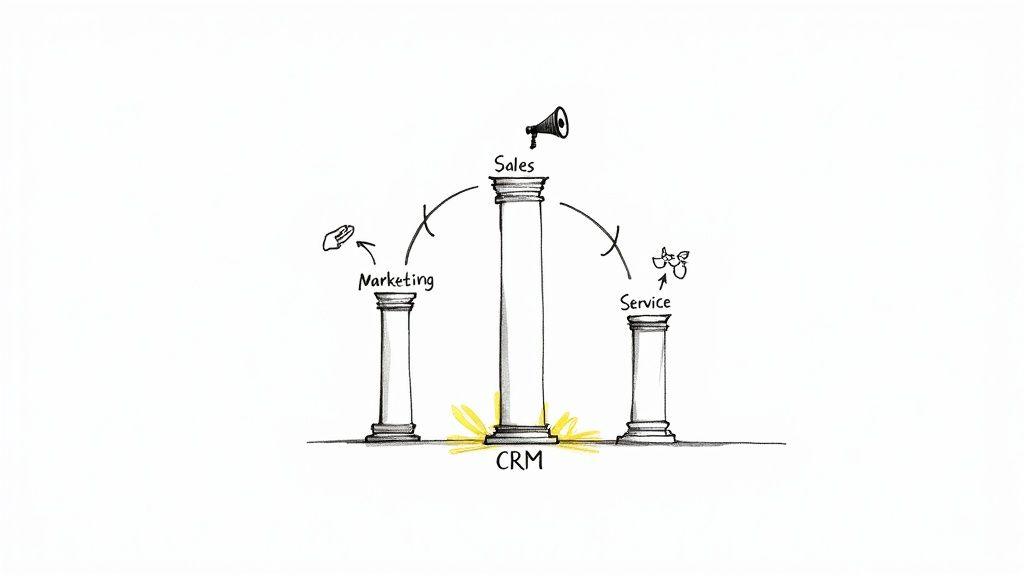
This unified approach ensures that no matter where a customer is in their journey, your team has the full context needed to provide a valuable and consistent experience. Let's break down how each pillar functions, using Salesforce as the central platform that wires them all together.
The Sales Pillar: Driving Growth and Efficiency
The sales pillar is where relationships translate directly into revenue. Its entire focus is on managing leads, tracking opportunities, and closing deals efficiently. Without a strong sales function powered by the right tech, even the most brilliant marketing efforts can fall flat.
The Business Challenge: A growing business struggles with manual lead tracking. Sales reps use individual spreadsheets, leading to lost opportunities and zero visibility for management.
The Salesforce Solution: With Salesforce Sales Cloud, a new lead from a website form automatically creates a record assigned to the right rep. This record becomes the single source of truth, logging every email, call, and meeting. Automation handles follow-up reminders and data entry, freeing reps to focus on what they do best: building relationships and selling.
The Result: Sales reps no longer waste time digging through emails. They have an at-a-glance view of the entire interaction history, leading to more informed conversations and a shorter sales cycle.
The Marketing Pillar: Nurturing Leads with Precision
The marketing pillar is all about attracting prospects and nurturing them until they're ready for a sales conversation. It’s the engine that feeds the sales pipeline with qualified, engaged leads. Modern marketing isn’t about shouting into the void; it's about delivering the right message to the right person at exactly the right time.
The Business Challenge: Marketing sends out generic email blasts with low engagement and has no way to identify which leads are sales-ready.
The Salesforce Solution: Using Salesforce Account Engagement (formerly Pardot), marketing teams connect website activity, email engagement, and form submissions to a prospect's record. A prospect who downloads a whitepaper is automatically enrolled in a personalised email nurture campaign with related content, building trust and educating them over time.
For those looking to master the platform, exploring Account Engagement best practice is a crucial next step. Effective automation is a cornerstone of this process; you can learn more about marketing automation for ecommerce that truly converts to see how it drives engagement.
By the time a lead is passed to sales, it's not just a name on a list. It's a warm, informed prospect who has shown genuine interest, dramatically increasing the likelihood of conversion.
The Service Pillar: Building Loyalty and Retention
The final pillar, service, is arguably the most critical for long-term success. It’s all about supporting customers after the sale, resolving their issues, and ensuring they have a positive experience. Excellent service turns one-time buyers into lifelong brand advocates.
The Business Challenge: A support team uses a chaotic shared inbox. Customers have to repeat their issues to different agents, and there's no history of past interactions, leading to frustration and churn.
The Salesforce Solution: When a customer contacts support, a case is created in Salesforce Service Cloud. The agent instantly sees the customer's complete history—what they've purchased, past interactions, and previous support tickets. Armed with this 360-degree view, the agent can resolve the issue faster and more effectively.
The Result: This efficient, empathetic support doesn't just solve a problem; it strengthens the customer relationship and builds lasting loyalty. These three pillars, powered by a unified platform like Salesforce, work in concert to create an organisation that is truly customer-centric.
Why Australian Businesses Are Investing Heavily in CRM
Investing in technology for its own sake is a quick way to burn cash. The real question any decision-maker asks isn’t, "What does this software do?" but rather, "What business problem does it solve and what results will it deliver?" This is exactly why CRM systems have shifted from a 'nice-to-have' to the operational backbone for Australian businesses serious about scaling.
The focus is on tangible return on investment (ROI). Businesses are moving away from scattered data, clunky manual processes, and lost opportunities. They’re investing in platforms like Salesforce to achieve measurable wins in three key areas: enhancing customer experience, enabling data-driven decisions, and boosting team productivity.
From Manual Chaos to a Streamlined Powerhouse
Let me paint a picture we see all the time as a Salesforce partner. An Australian professional services firm is growing, but its old processes are breaking. The sales team tracks leads in separate spreadsheets, the service team manages client requests from a chaotic shared inbox, and marketing sends generic newsletters with no insight into their effectiveness.
The Business Challenge: Nothing is connected. A salesperson has no idea their top client has an urgent support ticket open. The marketing team can't tell which campaigns are generating the best leads. This disconnect causes embarrassing mistakes, frustrates staff, and creates a poor customer experience.
The Salesforce Solution:
- A Single Source of Truth: Every lead, contact, and customer interaction is logged in one shared system. Before a call, a sales rep sees a client's full history, including service issues and marketing engagement.
- Intelligent Automation: When a new lead fills out a web form, it’s automatically routed to the right salesperson with a follow-up task created. Tedious data entry is eliminated, freeing up the team to focus on high-value activities.
- Data-Driven Insights: Leadership can now access real-time dashboards showing the health of the sales pipeline, customer satisfaction scores, and marketing campaign performance, enabling strategic decisions based on data, not guesswork.
This isn't a small tweak; it’s a complete digital transformation that turns a reactive, disjointed operation into a proactive, data-driven machine.
The Numbers Behind the CRM Boom
This is a strategic shift happening nationwide. As of June 2024, Australia was home to about 2.66 million trading businesses, with mid-market firms leading the charge in CRM adoption. These companies are opting for cloud-based systems like Salesforce because the subscription model avoids massive upfront costs and allows them to scale. This trend is sparking impressive growth, with regions like the Australian Capital Territory helping to drive a forecasted market CAGR of 13.1% in the coming years. You can dig deeper into the Australian CRM market projections on OpenPR.com.
For the modern Australian business, a CRM isn't just a fancy contact list. It's the engine that drives efficient processes, delivers exceptional customer experiences, and unlocks real, sustainable growth.
The proof is in the results. Investing in a solid CRM strategy is no longer optional. By centralising data and automating workflows, companies aren't just becoming more efficient—they're fundamentally changing how they connect with their customers for the better.
How a CRM Tackles Challenges in Key Australian Industries
The real value of a CRM system lies in its adaptability. A generic, out-of-the-box solution rarely works because every industry has unique pressures, customer demands, and operational challenges. A well-configured CRM, however, becomes a specialised tool moulded to solve the specific problems of your sector.
As a Salesforce partner, we see this play out every day. From construction sites in Perth to healthcare clinics in Sydney, businesses are using platforms like Salesforce not just as a database, but as a core strategic asset to solve real-world problems.
Let’s look at a few practical examples of how a tailored Salesforce CRM delivers tangible results.
Construction: Managing Projects from Bid to Build
The Business Challenge: A mid-sized commercial construction firm is drowning in disconnected spreadsheets and emails. Project managers burn hours manually chasing updates, and the sales team has zero visibility into the project pipeline, leading to missed deadlines and budget blowouts.
The Salesforce Solution: We implement a customised Salesforce solution where:
- A central dashboard tracks every project from the initial bid to final handover.
- Automated workflows notify subcontractors about schedule changes and send clients timely reminders.
- A mobile app lets site managers upload progress photos and notes directly to the project record in real-time.
The Result: A single source of truth connects the office to the job site. This visibility cuts down on costly errors, improves client communication, and gives leadership an accurate forecast of future work.
Healthcare: Delivering a Better Patient Experience
The Business Challenge: A multi-location allied health clinic is swamped with calls for appointment changes. Practitioners have no quick way to see a patient’s complete communication history, creating administrative friction and a frustrating patient experience.
The Salesforce Solution: We implement Salesforce Health Cloud, a secure platform built for this environment, to:
- Manage patient records with a 360-degree view of appointments, communication preferences, and care history.
- Automate appointment reminders via SMS or email, dramatically reducing no-shows.
- Provide a secure patient portal for appointment requests and communication, freeing up phone lines.
This shift isn't just about back-office efficiency; it empowers patients by giving them more control and builds trust through secure, reliable communication.
Professional Services: Tracking Every Billable Hour
The Business Challenge: A consulting firm struggles with disconnected project and financial data. Time tracking is manual, leading to inaccurate billing and revenue leakage.
The Salesforce Solution: Salesforce is configured to create a unified workflow. When a new client signs on, a project is created. Consultants log hours and expenses against that project directly in the CRM. The system is integrated with their accounting software, generating accurate invoices automatically.
The Result: This solves a major industry pain point by eliminating manual data entry, ensuring every billable hour is captured, and providing a real-time snapshot of project profitability. Many of our clients have transformed their operations this way, as seen in our detailed Salesforce case studies.
Integrating Your CRM for a True 360-Degree Customer View
A powerful CRM system should be the operational heart of your entire business. But its true potential is only realised when it’s connected to your other essential business systems.
A CRM operating in isolation becomes just another data silo. This is where Salesforce truly shines—as the central hub connecting your entire technology ecosystem. For any decision-maker, integration isn’t just a feature; it's non-negotiable for achieving a genuine 360-degree view of your customer. This complete picture, from the first marketing touchpoint to the final invoice, is what enables a business to operate with real intelligence.
The Common Challenge: Disconnected Sales and Finance Data
One of the most frequent problems we solve as a Salesforce partner is the disconnect between sales and finance departments. Sales teams work in Salesforce to close deals, while the finance team lives in an accounting system like Xero or MYOB.
When these worlds aren't connected, chaos ensues:
- Manual double-handling: Staff waste hours manually re-keying closed-deal data from Salesforce into the accounting system to create invoices.
- Lack of visibility: The sales team has no idea if a client has paid, leading to awkward follow-up calls.
- Inaccurate forecasting: Leadership struggles to get a clear, real-time picture of cash flow because the data is fragmented.
Building a Single Source of Truth
The Salesforce Solution: We build a rock-solid integration that allows data to flow automatically between Salesforce and the accounting platform. When a salesperson marks an opportunity as 'Closed Won' in Salesforce, an invoice is automatically created in Xero, pulling all relevant customer and deal data. When that invoice is paid, the payment status is pushed back to update the account record in Salesforce. This simple change ensures everyone works from the same up-to-the-minute information. For those curious about the technical side, it's even possible to expose a file via Salesforce Flow to make data sharing even more direct.
The result is a single source of truth that spans the entire customer lifecycle. It transforms siloed departments into a cohesive, data-driven organisation where every team member has the complete context they need to serve the customer effectively.
The following infographic shows how a central CRM strategy connects and empowers diverse Australian industries.
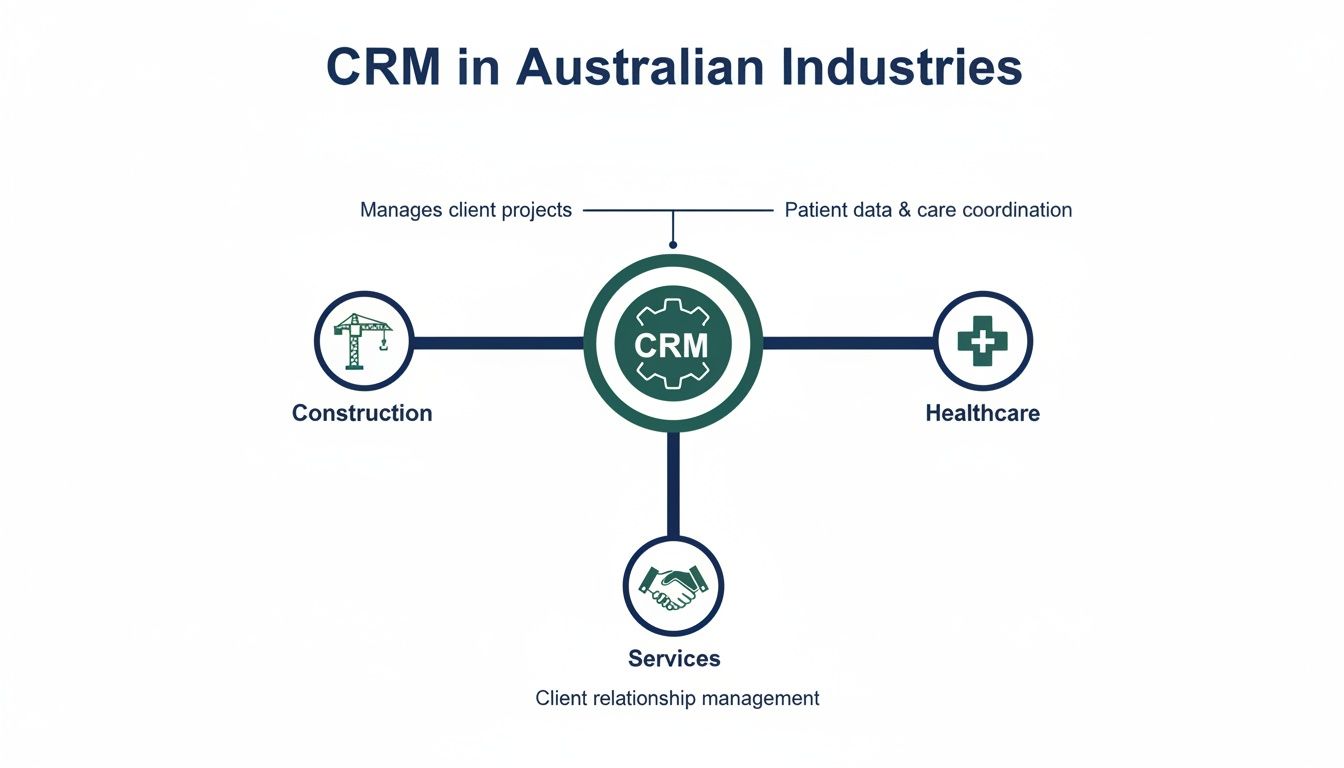
This visualises how a CRM acts as the core engine for sectors like construction, healthcare, and professional services, unifying their distinct operational needs. This connected approach is driving major investment right across the country.
In fact, Australian CRM software revenue is projected to surpass USD 1.67 billion in 2025, highlighting the nation’s rapid move towards integrated business environments. These systems are proven to deliver an average return of $8.71 for every dollar spent, proving their immense value. You can discover more insights about these CRM market findings on MarketResearch.com.
Successfully integrating your CRM isn't just a technical task; it's a strategic move that positions your business for smarter, more efficient growth.
Your Roadmap to a Successful CRM Implementation
Knowing what a CRM is and understanding its benefits is one thing. Actually unlocking that value through a thoughtful, well-executed implementation is another beast entirely. Bringing a powerful platform like Salesforce into your business isn't just a technical task; it's a strategic project that needs a clear plan to deliver the results you're banking on.
Partnering with an experienced Salesforce consultant is the best way to navigate this journey. A proper implementation roadmap turns a complex undertaking into a manageable, step-by-step process, making sure your investment delivers a real impact from day one.
The Discovery and Strategy Phase
A successful project begins with deep listening. The discovery phase is all about understanding your business—your goals, your pain points, and how your teams actually work. It’s where we sit down and map out what success will look like for you.
A common mistake is treating a CRM as a plug-and-play solution. This stage is about getting specific. Do you need to shorten your sales cycle? Improve customer service response times? Or finally get a clear picture of your marketing ROI?
Lesson Learned: A detailed strategy is your project’s blueprint. We once worked with a client who just wanted to "improve sales." Through discovery, we found the real problem: a lack of follow-up on high-value leads. The final solution focused on lead scoring and automated task creation, directly hitting the core issue and delivering a 25% increase in lead conversion within three months.
Data Migration and System Setup
With a solid strategy locked in, the next stage is the technical heavy lifting: configuration and data migration. This is a critical step where all your existing customer information—often scattered across spreadsheets and old systems—is cleaned, organised, and moved into your new Salesforce environment.
This isn't just a copy-paste job. It requires careful planning to ensure every piece of data is mapped correctly and stays accurate. During this phase, we also build out the custom fields, objects, and automated workflows defined in the strategy, tailoring the platform to your specific operational needs.
User Training and Adoption
A perfectly configured CRM is useless if your team doesn’t know how to use it. User training and adoption are arguably the most important parts of the whole process. The goal is to empower your team, showing them not just how to use the new system, but why it will make their jobs easier and more effective.
Effective training should be role-specific, hands-on, and provide ongoing resources to help everyone build confidence.
- Sales Team Training: Focuses on pipeline management, logging activities, and using dashboards to track performance.
- Service Team Training: Centres on case management, knowledge bases, and tools for quick issue resolution.
- Marketing Team Training: Covers campaign management, lead nurturing, and analysing marketing performance.
Lesson Learned: Make champions, not hostages. For a recent project, we identified key 'power users' within each department and got them involved early. They became internal advocates, helping their colleagues see the benefits firsthand and driving adoption from the ground up. This peer-to-peer support was instrumental in achieving a 95% user adoption rate within the first month. For a more detailed breakdown, our complete Salesforce implementation guide for Australia offers deeper insights into this process.
Got Questions About CRM? We've Got Answers.
As you explore what a CRM can do for your organisation, a few common questions always arise. Here are straight answers to what business leaders and decision-makers frequently ask.
How Long Does It Take to Implement a CRM System?
There's no one-size-fits-all answer, as the timeline is shaped by the complexity of your business. A simple setup for a small team focusing on core Sales Cloud functions might be running in a few weeks. In contrast, a full-scale enterprise rollout with deep integrations and complex data migration could take several months.
The most important factor is a clear, realistic roadmap. As a Salesforce partner, we map out a practical timeline based on your specific needs, ensuring an efficient and successful launch.
Is a CRM Only for Sales Teams?
Absolutely not. While sales teams are often the primary users, a modern platform like Salesforce is designed to be the central hub for your entire customer-facing operation. It’s the ultimate silo-buster.
- Marketing teams use it to run sophisticated campaigns and analyse performance.
- Service teams use it to manage customer cases and provide seamless support.
- Leadership gets a powerful reporting engine for making strategic, data-backed decisions.
A properly implemented CRM creates a single, shared view of every customer interaction, giving every department the context needed to excel.
What Is the Difference Between CRM and Salesforce?
This is a great question. The simplest way to think about it is through an analogy: CRM is the strategy, and Salesforce is the tool you use to execute that strategy.
Think of it like this: "Smartphone" is the category of device, while "iPhone" is a specific, market-leading product within that category. Similarly, CRM (Customer Relationship Management) is the overall approach and the type of software, while Salesforce is the world's leading brand and platform in that space.
Salesforce provides the powerful, flexible, and scalable technology you need to bring your customer relationship strategy to life.
How Do We Measure the ROI of a CRM Investment?
You measure the return on your CRM investment by tracking specific, concrete metrics tied directly to your business goals. The key is to focus on tangible key performance indicators (KPIs) that prove the system is delivering real impact.
Common KPIs to track include:
- Growth in sales revenue and average deal size.
- Higher customer retention rates and satisfaction scores (like NPS).
- A shorter average sales cycle.
- Noticeable improvements in team productivity and efficiency.
A good Salesforce partner will help you define these critical metrics before the project begins. More importantly, they’ll build the dashboards and reports right inside Salesforce so you can track your progress in real-time and clearly demonstrate the value of the investment.
Ready to see what a smart CRM strategy could do for your business? At Adaptal, we’re more than just technicians; we are a strategic Salesforce partner invested in your success. Contact us today for a consultation and let's start building your roadmap to growth together.