

Think of a digital transformation consultant as the architect behind your company's evolution, especially when it comes to leveraging powerful platforms like Salesforce. They don't just hand you a list of software; they design a detailed blueprint that aligns your business goals with the right Salesforce solution—like Sales Cloud, Service Cloud, or Account Engagement—to kickstart real, sustainable growth.
The Salesforce Architect Behind Your Business's Future
Many business leaders mistake digital transformation for simply buying new tech. But it’s much deeper than that—it's a fundamental rethink of how your business operates and delivers value. A digital transformation consultant specializing in Salesforce is your expert guide through this often-tricky journey.
Their main job is to connect your big-picture vision with the practical reality of making technology work for you. It all starts with a deep dive into your current workflows, customer journey, and how things really get done in your business.
This diagnostic phase is absolutely critical. A Salesforce consultant's goal is to sniff out the specific bottlenecks, data silos, and manual tasks that are quietly draining your time and money. It’s about getting to the root cause of the friction, not just slapping a band-aid on the symptoms.
From Diagnosis to a Strategic Salesforce Roadmap
Once the real challenges are on the table, the consultant switches hats from diagnostician to strategist. They don't just throw software recommendations at you; they build a cohesive roadmap connecting your problems to targeted Salesforce solutions.
- Business Challenge: Disconnected sales processes and messy spreadsheets are causing leads to fall through the cracks.
- Salesforce Solution: They design a streamlined process using Salesforce Sales Cloud to automate lead management, giving your sales team one clear, reliable source of truth.
- The Result: A shorter sales cycle, higher conversion rates, and a sales team focused on selling instead of admin.
Here's another common scenario we encounter:
- Business Challenge: Poor customer support due to siloed communication channels and a lack of customer history.
- Salesforce Solution: The roadmap centers on Service Cloud to bring all communication channels into a single console and give agents a 360-degree view of every customer.
- The Result: Faster case resolution times, improved customer satisfaction (CSAT) scores, and more efficient support agents.
Table: Core Functions of a Salesforce-Focused Digital Transformation Consultant
| Area of Focus | Consultant's Role & Key Activities |
|---|---|
| Business Process Analysis | Conducts deep-dive workshops to map existing workflows, identify pain points, and uncover hidden inefficiencies across sales, service, and marketing. |
| Strategy & Roadmap Development | Aligns Salesforce solutions with long-term business goals, creating a phased implementation plan that delivers value at each stage. |
| Technology Selection | Recommends specific Salesforce clouds (e.g., Sales, Service, Marketing Cloud) and AppExchange apps best suited to solve identified business problems. |
| Solution Design & Architecture | Designs the technical blueprint for the Salesforce implementation, ensuring it's scalable, secure, and meets all business requirements. |
| Change Management & User Adoption | Develops training programs and communication plans to help employees embrace new tools and processes, ensuring a smooth transition to Salesforce. |
| ROI & Performance Measurement | Establishes Key Performance Indicators (KPIs) to track success, measure the financial impact of the transformation, and prove return on investment. |
As you can see, their role is far more than just technical. It's about steering the entire project towards a successful business outcome.
The consultant’s real value is in their ability to translate your business needs into a functional, technical blueprint. They make sure the technology serves the strategy, not the other way around.
Beyond Just "Flicking the Switch"
A top-tier digital transformation consultant is obsessed with outcomes, not just outputs. The end goal isn't just to install new Salesforce software; it's to deliver real, measurable results for your business. To truly tap into what's possible, it helps to understand how specialised firms provide intelligent automation consulting services, essentially acting as the builders who bring these digital plans to life.
This means their work doesn't stop once the tech is set up. They lead the change management process, making sure your team is trained, confident, and ready to use the new systems. To learn more about this crucial function, explore the pivotal role of Salesforce development consultants in your company's transformation. They also set up KPIs to measure what success actually looks like, turning your investment into a clear, demonstrable ROI.
Ultimately, they’re your strategic partner, guiding your evolution into a more agile, data-driven, and customer-focused organisation powered by Salesforce.
Warning Signs You Need a Salesforce Transformation Consultant
For many growing businesses, the signs that old processes are failing start as quiet whispers before they become deafening shouts that disrupt your entire operation. If you ignore them, you risk stagnation, frustrated teams, and watching your competitors fly past you.
If any of the following pain points feel a little too familiar, it's a clear signal that you need a Salesforce partner.
Disconnected Data and Departmental Silos
This is the classic red flag: data chaos. Your sales team has customer information in spreadsheets, the service team has it in their inbox, and marketing is working from a third list entirely. The result is a choppy, frustrating experience for everyone involved—especially your customers.
- The Business Challenge: When a customer calls support, your agent can't see their entire purchase history or recent marketing interactions. This leads to a poor customer experience.
- The Salesforce Solution: A digital transformation consultant implements a unified CRM platform like Salesforce. This creates a single source of truth, giving every department a 360-degree view of the customer.
- The Result: Every team member is on the same page, leading to seamless handoffs between departments and a superior customer journey.
Manual Processes Are Draining Your Resources
Are your best people stuck doing repetitive tasks like manual data entry, pulling together reports, or sending the same follow-up emails over and over? This kind of work isn't just boring; it's expensive. It pulls your team away from strategic work and leads to burnout and costly mistakes.
- The Business Challenge: Your top salesperson spends hours each week updating their pipeline in a spreadsheet instead of calling prospects.
- The Salesforce Solution: A consultant spots these bottlenecks and stamps them out with automation. By setting up smart workflows in Salesforce, routine tasks get handled automatically.
- The Result: Your team is freed up to focus on what humans do best: building relationships and solving complex problems. If you're wondering whether you've hit this point, check out these 5 signs your business needs workflow automation.
Poor Visibility and Ineffective Reporting
Here's another big one: you can't get quick, clear answers from your own data. When you ask, "Which marketing campaign brought in our best leads last quarter?" you shouldn't have to wait days for someone to cobble together a report from five different spreadsheets.
If you can't measure it, you can't improve it. Vague or outdated reports force you to make critical business decisions based on guesswork rather than facts.
- The Business Challenge: You're flying blind, making strategic decisions based on gut feel because accurate data is too hard to get.
- The Salesforce Solution: A consultant fixes this by building powerful dashboards and reporting tools right inside Salesforce. Suddenly, you have real-time visibility into your most important KPIs.
- The Result: You can track progress, spot trends, and make data-driven decisions with confidence, uncovering actionable insights that steer the future of your company.
Your Salesforce Transformation Journey from Start to Finish
Embarking on a digital transformation project can feel like a massive undertaking, but a good consultant breaks it down into a clear, manageable path. A successful Salesforce project isn't one big event; it's a series of well-defined phases designed to build momentum, manage change, and deliver real results.
This journey ensures that the Salesforce platform is thoughtfully aligned with your business goals right from the start.
Phase 1: Discovery and Audit
First, we need to understand where you are right now. In this initial phase, a digital transformation consultant acts like a diagnostician, auditing your current processes, technology, and data infrastructure. They'll run workshops with your key teams—from sales and service to marketing and operations—to map out daily workflows and pinpoint the exact sources of friction and inefficiency. The goal is to define what success looks like in concrete terms.
The infographic below shows the kind of common issues we often uncover, illustrating how messy data leads to clunky manual tasks and, ultimately, poor reporting.
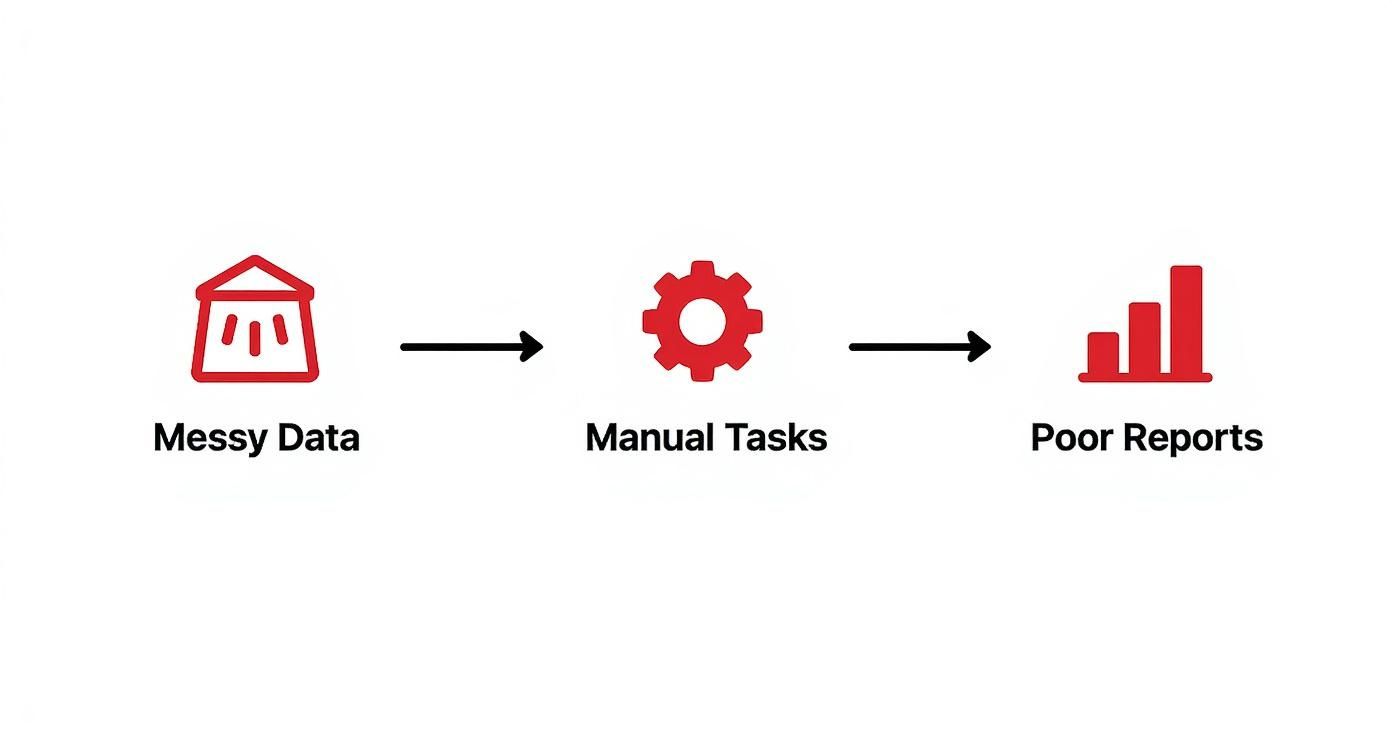
It’s a classic domino effect where foundational problems with data integrity create significant operational headaches down the line.
Phase 2: Strategic Design and Salesforce Roadmap
Once we have a clear picture of the challenges, it's time to design the solution. This is where your consultant architects the future state of your operations. They create a strategic roadmap detailing which Salesforce products—like Sales Cloud, Service Cloud, or Account Engagement—will be used to solve specific problems. This isn't just a technical blueprint; it’s a business plan that outlines project phases, key milestones, and a realistic timeline.
Phase 3: Salesforce Implementation and Integration
This is the hands-on building phase. Here, the consultant and their team configure your Salesforce platform according to the strategic design. This involves setting up custom objects, building automation workflows, and designing user-friendly dashboards. A critical part of this stage is data migration, where customer information from old spreadsheets and legacy systems is cleaned and moved into your new, centralised CRM. It also includes integrating Salesforce with your other essential business tools to create a single, seamless ecosystem. For a deeper dive, check out our comprehensive Salesforce implementation guide for Australia.
Phase 4: User Adoption and Training
Even the most powerful technology is useless if your team doesn't use it. This phase is all about change management and ensuring high user adoption.
A successful transformation isn't measured by the technology installed, but by the team's ability to use it effectively. Empowering your people is the single most important factor for achieving a positive return on investment.
A good consultant develops training sessions tailored for different roles. They create easy-to-understand documentation and provide hands-on support to help everyone feel confident with the new system. The goal is to turn potential resistance into enthusiastic advocacy by showing each person how Salesforce makes their job easier and more effective.
Phase 5: Ongoing Optimisation and Support
Real digital transformation isn’t a one-and-done project; it’s a continuous process of improvement. After the initial launch, the consultant's role shifts to monitoring performance, gathering user feedback, and identifying new opportunities for optimisation. This final, ongoing phase ensures your Salesforce platform evolves with your business, helping you truly maximise the value of your investment.
How Salesforce Drives Success in Your Industry
The theory of digital change clicks into place when you see it in action. A skilled digital transformation consultant doesn’t just roll out generic software; they mould powerful platforms like Salesforce to solve the unique, industry-specific headaches your business deals with every day. Let's look at how targeted Salesforce solutions deliver real, measurable results across different sectors.
Construction and Real Estate
In construction or real estate, you're constantly juggling on-site projects, client communications, and long sales cycles. Disconnected teams and a lack of real-time data can quickly spiral into costly delays and missed opportunities.
- Business Challenge: Poor communication between the main office and field teams, causing scheduling mix-ups and project hold-ups.
- Salesforce Solution: A consultant implements Salesforce Field Service, connecting office staff with crews on the job site for real-time scheduling, work order updates, and inventory management. For property sales, Sales Cloud manages the entire pipeline from inquiry to contract.
- The Result: A significant reduction in project delays and a huge jump in client satisfaction because everyone is finally on the same page. You can get a deeper look by exploring the real estate tech stack and Salesforce's role.
Professional Services and Consulting
For firms in professional services—legal, accounting, or marketing agencies—the biggest bottleneck is often managing the client lifecycle. Manual onboarding, clunky project tracking, and disconnected billing systems can chew up billable hours.
The name of the game for any service-based business is to spend less time on admin and more time delivering real value. Salesforce automation is exactly how you make that happen.
- Business Challenge: Inefficient client onboarding and project management are eating into profitability.
- Salesforce Solution: A consultant sets up Sales Cloud to automate the client intake process, then links it to Experience Cloud to create a secure client portal for sharing documents and project updates.
- The Result: A seamless client journey from new lead to happy, long-term partner, with far less administrative overhead.
Healthcare and Allied Health
Healthcare organisations need to deliver personalised patient care while navigating strict data security and compliance rules. Outdated, siloed systems often make it impossible to get a complete view of a patient’s journey.
- Business Challenge: Patient data is scattered across multiple, disconnected systems, making it a nightmare for care teams to coordinate effectively.
- Salesforce Solution: A consultant implements Salesforce Health Cloud, an industry-specific platform built to provide a 360-degree view of each patient. It helps care coordinators manage treatment plans and track interactions securely.
- The Result: A noticeable improvement in patient engagement scores and a sharp reduction in admin time, freeing up staff to focus on direct patient care.
Industry-Specific Salesforce Solutions
| Industry | Common Business Challenge | Primary Salesforce Solution |
|---|---|---|
| Small-to-Medium Enterprises (SMEs) | Juggling sales, service, and marketing with a small team and limited resources. | Salesforce Essentials or Sales Cloud to provide a unified CRM that grows with the business. |
| Franchises | Maintaining brand consistency and operational standards across multiple locations. | Experience Cloud to create a central portal for franchisees to access resources, training, and support. |
| Professional Services | Inefficiently tracking billable hours and managing complex client projects from start to finish. | Salesforce CPQ & Billing integrated with project management tools to automate quoting and invoicing. |
Ultimately, a Salesforce-focused consultant acts as your translator. They take your industry's specific operational pains and turn them into a clear, actionable technology strategy that fuels real, tangible business growth.
Proving the ROI of Your Salesforce Investment
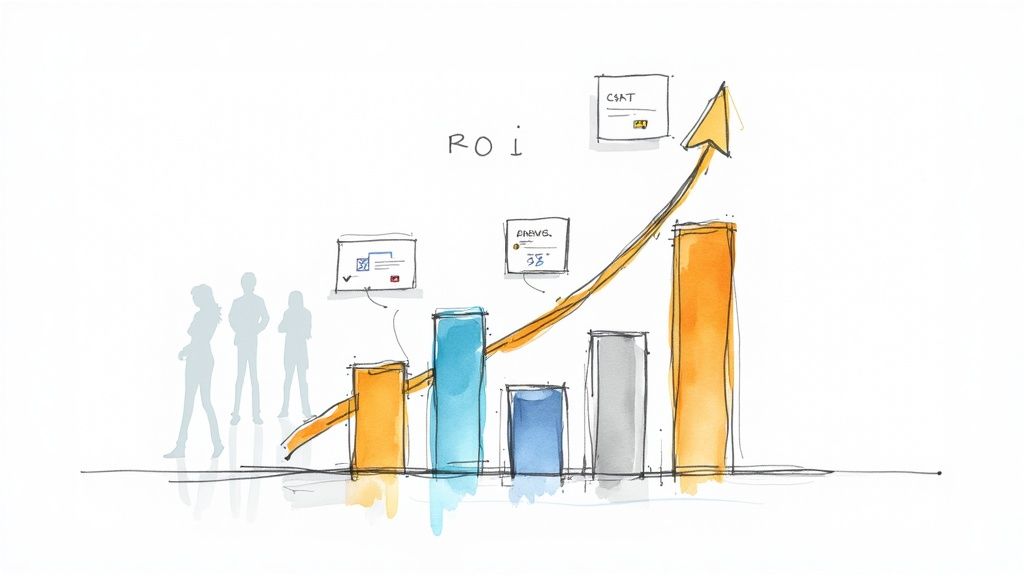
When you’re asking stakeholders to back a significant technology investment, the conversation must focus on financial impact. A core part of a digital transformation consultant’s role is helping you define, track, and prove the return on your Salesforce investment. We build a rock-solid business case that speaks in dollars and sense.
Success isn't just about switching on a new system; it's about hitting measurable business outcomes by identifying the right Key Performance Indicators (KPIs) that tie directly to your strategic goals.
Quantifying Success With Hard Metrics
The most powerful business cases are built on hard numbers. A good consultant helps you set up Salesforce dashboards and reports to track these critical metrics from day one, providing undeniable proof of the project's value. From our experience on Salesforce projects, this is what success looks like:
- Reduced Sales Cycle Times: By automating lead nurturing in Sales Cloud or Account Engagement, businesses can slash the time from first contact to a closed deal, often by 15-20%.
- Higher Lead Conversion Rates: A unified view of every lead's journey allows marketing and sales teams to deliver more timely, relevant messages that boost conversion rates.
- Faster Service Resolutions: Service Cloud gives your support team a complete customer history at their fingertips, leading to much quicker case resolution times and lower operational costs.
- Increased Sales Productivity: Getting rid of manual data entry frees up your sales team to do what they do best: sell.
These aren't just abstract goals; they are the direct results of targeted improvements. You can see how these outcomes materialise in our Salesforce case studies, which break down the specific challenges and results for businesses just like yours.
The Power of Qualitative Benefits
Beyond the balance sheet, a successful transformation brings powerful qualitative benefits that fuel long-term growth. While harder to put a dollar figure on, these improvements are just as crucial.
A more engaged and empowered team isn't just a "nice-to-have." It's a direct driver of better customer experiences and lower employee turnover, both of which have a real financial impact.
These benefits often include:
- Improved Team Morale: Replacing frustrating, clunky processes with streamlined Salesforce workflows reduces daily friction and boosts job satisfaction.
- Enhanced Data-Driven Insights: With centralised, real-time data, leaders can make faster, more confident strategic decisions based on facts, not guesswork.
- Better Cross-Departmental Collaboration: When sales, service, and marketing all work from the same unified Salesforce platform, data silos crumble, and collaboration becomes second nature.
Ultimately, a digital transformation consultant ensures your Salesforce project is treated not as a technology expense, but as a strategic investment with a clear and demonstrable return across every part of your organisation.
Choosing the Right Salesforce Partner
Picking a digital transformation consultant is one of the most important decisions you'll make. The right Salesforce partner becomes a true extension of your team, a strategic guide invested in your success. The wrong one can lead to expensive delays, frustration, and a system that doesn't fit your needs.
To make the right call, you have to ask questions that dig deeper than the standard sales pitch.
Industry Experience and Proven Case Studies
First, find a consultant who speaks your language. Generic expertise won’t cut it. You need a partner who understands the unique challenges and opportunities in your specific industry, whether you're in construction, healthcare, or professional services.
Ask them directly:
- Can you show me case studies of successful Salesforce projects you've delivered in our industry?
- What specific results have you delivered for clients facing challenges similar to ours?
- How do you tailor your approach to the operational needs of a business like ours?
Deep Technical Expertise and Salesforce Certifications
A top-tier partner must have deep technical chops. Their team’s Salesforce certifications are a clear sign of expertise and a commitment to keeping up with the platform's constant evolution.
A consultant’s value lies not just in knowing how to configure software, but in understanding how to architect a scalable and secure Salesforce solution that grows with your business. Don't be afraid to dig into the technical details.
Here are some key questions:
- What Salesforce certifications does your implementation team hold?
- How do you ensure your technical solutions are built for long-term scalability?
- Can you walk me through your experience integrating Salesforce with other key business systems we use, like Xero, MYOB, or NetSuite?
A Clear Approach to Project and Change Management
A successful transformation is as much about people as it is about technology. The partner you choose must have a rock-solid project management process and a clear plan for managing the human side of change.
Ask them about their process:
- What is your project management methodology, and how do you keep clients updated on progress?
- How do you handle user training and adoption to ensure our team embraces the new system?
- What does your support model look like after we go live?
Choosing the right digital transformation consultant isn't about hiring a vendor. It's about finding a strategic Salesforce partner who will guide you through every stage of the journey.
FAQs About Salesforce Digital Transformation
Kicking off a major technology project always brings up a few questions. Business leaders want to understand the timeline, the impact on their team, and the real-world value a Salesforce partner brings. Let's tackle some of the most common questions we hear.
How Long Does a Salesforce Transformation Project Take?
There's no single answer, as the timeline depends on your project's scope. For a small-to-medium business needing a foundational Salesforce setup—for core sales or service processes—we typically see a timeline of 8 to 12 weeks. This first phase focuses on getting quick wins.
More involved projects can take six months or longer, especially if they involve multiple Salesforce Clouds (e.g., Sales Cloud, Service Cloud, and Account Engagement), complex integrations with systems like NetSuite, or heavy data migration. A good digital transformation consultant maps out a realistic, phased roadmap, delivering value at each stage.
How Do You Ensure Our Team Adopts the New System?
User adoption is the critical factor for success. Our strategy is built around your people. We involve key users from the very beginning to ensure the solution is designed for their day-to-day reality.
The goal is to make sophisticated technology feel intuitive. When we can clearly show how the new tools make each person’s job easier and more effective, that initial resistance turns into genuine enthusiasm.
We deliver training tailored to different roles, create simple user guides, and provide dedicated post-launch support to help new habits take root.
Why Hire a Consultant if We Have an Internal IT Team?
Your internal IT team is essential for managing current systems, but a digital transformation consultant brings a different, strategic skill set. Our specialty is connecting technology directly to your overarching business goals—a world away from day-to-day IT management.
The value we bring comes from:
- Deep Industry Know-How: We understand the specific pains and opportunities in sectors like construction, healthcare, or professional services.
- Salesforce Best Practices: We’ve learned lessons from hundreds of CRM projects, so you can avoid common pitfalls.
- Dedicated Change Management: We focus on the human side of the shift to drive lasting adoption.
Think of us as the bridge between your business strategy and the technology. We ensure the final solution delivers a measurable return on your investment.
Ready to start your own transformation journey with a trusted Salesforce partner? The team at Adaptal has guided over 110 businesses across Australia through successful implementations. We build solutions that deliver real results.
Contact us today for a complimentary consultation to discuss your business goals.